

Among the many festivals celebrated in India, Guru Purnima occupies a unique place because it is not dedicated to a deity, a harvest or a seasonal change, but to the person who guides humanity from ignorance to enlightenment-the guru. Observed on the full moon day (Purnima) of the Hindu month of Ashadha, usually falling in June or July, Guru Purnima is a day of reverence, gratitude and introspection. It honours the timeless relationship between the guru and the disciple, a tradition that has shaped Indian philosophy, spirituality and education for thousands of years.
The word guru is derived from two Sanskrit syllables-Gu, meaning darkness, and Ru, meaning remover. Thus, a guru is one who dispels the darkness of ignorance and leads the seeker towards the light of knowledge and self-realisation. In Indian culture, the guru is regarded as more than a teacher; he or she is considered a guide, philosopher and spiritual mentor who transforms lives through wisdom and compassion. Ancient scriptures even place the guru on par with the divine, declaring that the guru embodies the creative, sustaining and transformative powers of the universe.
The Origin of Guru Purnima
Guru Purnima traces its origins to the Vedic period and is closely associated with the great sage Maharishi Ved Vyasa, one of India’s most revered scholars. The festival is therefore also known as Vyasa Purnima. According to tradition, Ved Vyasa was born on this auspicious full moon day and dedicated his life to preserving and organising the vast body of Vedic knowledge for future generations.
Before Vyasa’s work, the Vedas were transmitted orally from one generation to another. Recognising the need to preserve this sacred wisdom, he divided the Vedas into four collections-Rigveda, Yajurveda, Samaveda and Atharvaveda-making them easier to study and teach. Besides compiling the Vedas, he authored the Mahabharata, one of the world’s greatest epics, composed the Brahma Sutras and is traditionally credited with writing the eighteen Puranas. His extraordinary contribution to Indian philosophy earned him the title of the eternal guru, and Guru Purnima became the day on which disciples pay homage not only to their personal teachers but also to the entire lineage of spiritual masters descending from Ved Vyasa.
The Legend of Ved Vyasa
and the Mahabharata
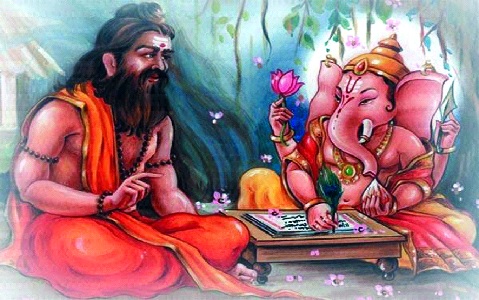
One of the most celebrated legends associated with Guru Purnima concerns the writing of the Mahabharata. It is believed that Ved Vyasa sought the help of Lord Ganesha to write down the epic as he dictated it. Ganesha agreed, but only on the condition that Vyasa would recite continuously without pause. Vyasa accepted but placed his own condition-that Ganesha must fully understand every verse before writing it.
As the composition progressed, Vyasa occasionally recited deeply philosophical verses requiring careful interpretation. These complex passages gave him enough time to compose the next sections of the epic. This remarkable partnership resulted in the Mahabharata, a monumental work of literature that continues to guide humanity on questions of duty, righteousness, morality and the pursuit of truth.
The Story of the First Guru
Another ancient tradition associates Guru Purnima with Lord Shiva, who is revered in yogic philosophy as the Adi Guru, or the first guru. According to legend, after attaining supreme enlightenment, Shiva remained immersed in deep meditation in the Himalayas. Seven earnest seekers patiently waited for years, hoping to receive his teachings. Their unwavering dedication eventually moved Shiva, who accepted them as his disciples on the full moon day of Ashadha. These seven disciples later became the Saptarishis, the seven great sages who spread yogic knowledge and spiritual wisdom across different regions of the world. Guru Purnima is therefore celebrated in many yogic traditions as the day when the guru-disciple tradition first began and the science of yoga was shared with humanity.
Guru Purnima in Buddhism and Jainism
Guru Purnima is also observed with deep reverence in Buddhism. According to Buddhist tradition, it marks the day when Gautama Buddha delivered his first sermon after attaining enlightenment under the Bodhi tree. At the Deer Park in Sarnath near Varanasi, he explained the Four Noble Truths and the Noble Eightfold Path to his first five disciples. This event, known as the Dhammacakkappavattana Sutta or “Setting the Wheel of Dharma in Motion,” marked the beginning of the Buddhist Sangha and the spread of Buddhist teachings.
In Jainism, Guru Purnima commemorates the day when Lord Mahavira accepted Gautam Swami as his first chief disciple. This event established the sacred tradition of spiritual mentorship within Jain philosophy, making the day equally significant for Jain devotees who offer prayers and express gratitude to monks and spiritual teachers.
The Guru-Shishya Tradition
The significance of Guru Purnima lies in the ancient Guru-Shishya Parampara, one of the oldest educational systems in the world. In the traditional Gurukul system, students lived with their guru in forest hermitages where education extended far beyond academic learning. They studied philosophy, grammar, mathematics, astronomy, medicine, music, warfare, ethics and meditation while also learning discipline, humility, compassion and self-control.
The guru’s responsibility was not limited to imparting knowledge but also included shaping the student’s character and guiding every aspect of life. The disciple, in turn, served the guru with sincerity, respect and dedication. Guru Purnima celebrates this sacred relationship that has remained central to Indian civilisation for millennia.
Rituals and Observances
Guru Purnima is observed with simplicity, devotion and gratitude across India. Devotees begin the day with an early morning bath and wear clean or traditional clothes before visiting temples, ashrams or the residence of their guru. Many spiritual organisations conduct Guru Puja, during which disciples offer flowers, sandalwood paste, fruits, sweets and garlands to their guru. In some traditions, Paduka Puja, the ceremonial worship of the guru’s sandals, symbolises reverence for the spiritual path shown by the teacher.
Special Vyasa Puja is performed in temples and monasteries to honour Maharishi Ved Vyasa. Devotees recite passages from the Bhagavad Gita, Mahabharata, Upanishads, Guru Gita and other sacred scriptures, reflecting on the teachings of great masters. Meditation, chanting and satsangs are organised throughout the day, encouraging seekers to deepen their spiritual practice and renew their commitment to self-improvement.
Many devotees observe a fast on Guru Purnima, consuming only fruits and milk or fasting until evening. Charity also forms an important part of the celebrations, with people donating food, clothes, books and educational materials to those in need. Students visit their teachers to seek blessings, while many express gratitude to parents, mentors and guides who have shaped their lives.

Be the first to comment