
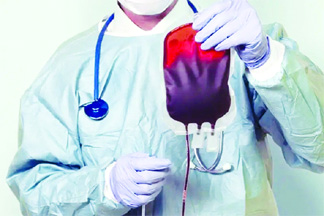

Japanese scientists have developed artificial blood, which serves as a substitute for real blood. It is a new type of universal artificial blood that could be used for any blood type, stored without refrigeration.
This breakthrough could eliminate one of the biggest challenges in emergency medicine: finding the right blood type in time. The World Health Organisation (WHO) has highlighted a global shortage of blood supply. This innovation could play a crucial role in treating trauma and could be used in surgeries and emergencies.
Japan’s Nara Medical University is set to begin a clinical trial this year to test whether expired donated blood, normally thrown away, can be reused by turning it into artificial red blood cells. If the trials are successful, Japan could become the first country to deploy artificial blood in real-world medical systems by 2030. Because this artificial blood lacks the specific markers that typically determine compatibility (like A, B, AB, or O types), it can be safely transfused into any patient without cross-matching. The artificial blood is also virus-free and has a much longer shelf life than donated human blood.
While traditional blood must be used within a few weeks and kept under refrigeration, this synthetic alternative can be stored for several years at room temperature, making it especially useful in remote areas, disaster zones, and for military use.
Professor Hiromi Sakai at Nara Medical University in Japan has pioneered the project. The researchers developed the product by extracting haemoglobin, the oxygen-carrying component of red blood cells, from expired donor blood.
They then encapsulate it in tiny fat-based bubbles that mimic natural red blood cells, allowing the haemoglobin to circulate safely through the body without triggering an immune response. “When a blood transfusion is urgently needed, it takes some time before starting the transfusion because the patient’s blood type needs to be examined,” said Hiromi Sakai told The Japan Times.



Be the first to comment