
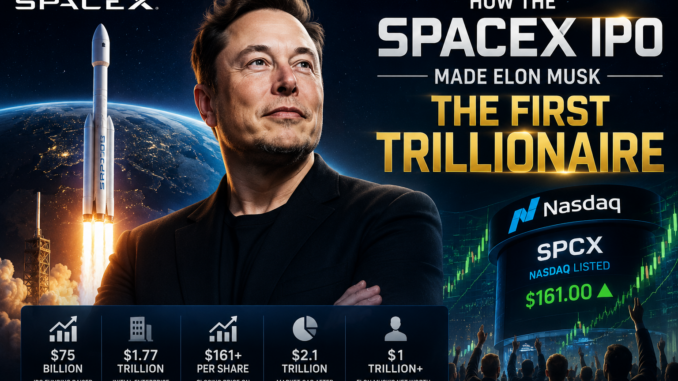

The absolute limits of private capital accumulation were completely redrawn on June 12, 2026, when SpaceX completed its highly anticipated initial public offering on the Nasdaq exchange. Operating under the ticker symbol SPCX, the massive listing raised an astonishing 75 billion dollars for the company’s long-term ambitions. The firm entered the public market at an unprecedented baseline enterprise valuation of 1.77 trillion dollars, instantly positioning itself as a corporate titan. By the conclusion of its very first trading day, an aggressive wave of global institutional buying pushed the final stock price past 161 dollars per share, driving the total market capitalization of the firm to an incredible 2.1 trillion dollars.
SpaceX (SPCX) Historic Public Listing Matrix
| Listing Parameter | Metric Value / Financial Specification | Context & Market Impact |
| Listing Venue & Ticker | Nasdaq Global Select: SPCX | Flagship tech board debut |
| Subscription Stock Price | $135.00 per share | Initial institutional offer baseline |
| Opening-Day Close Price | $161.00 per share | Recorded an immediate +19.2% surge |
| Total Cash Capital Raised | $75.00 Billion | Record-breaking haul in global IPO history |
| Market Capitalization Peak | $2.10 Trillion | Secured the 6th spot among top US corporations |
| Musk Individual Ownership | 42.0% Equity / 82.0% Voting | Retains absolute operational and board control |
This historic market surge had an immediate and profound impact on global personal wealth tracking metrics. Because he retains a tightly held 42% equity stake in the newly public aerospace giant, Elon Musk’s personal net worth officially breached the 1 trillion-dollar milestone on the Bloomberg Billionaires Index. This milestone makes him the very first authenticated US dollar trillionaire in human history.
For international market watchsters analyzing these massive capital transformations via The Indian Panorama, the financial liftoff represents a profound shift from speculative deep-space technology into a high-yielding industrial infrastructure empire.
Why did a rocket manufacturer secure a software-style valuation multiplier?
To understand why a capital-intensive aerospace manufacturer secured a valuation multiplier usually reserved for asset-light cloud software corporations, institutional investors must look directly at the company’s pre-IPO financial filings. The detailed S-1 prospectus disclosed that SpaceX has quietly transformed from a simple launch provider into the world’s most dominant cloud-compute and artificial intelligence infrastructure network.
The major turning point occurred when SpaceX completed a strategic internal acquisition of Musk’s artificial intelligence enterprise, xAI, in a parity deal that valued the combined entities at over 1.1 trillion dollars. This clever merger allowed SpaceX to leverage its low-Earth-orbit Starlink satellite constellation to build decentralized, space-based data centers. This unique engineering setup offers near-zero cooling costs and total physical protection from terrestrial infrastructure failures or climate disruptions.
The underlying revenue model is anchored by massive, multi-year corporate commitments that ensure consistent cash generation. In May 2026, artificial intelligence pioneer Anthropic signed a definitive contract worth 1.25 billion dollars per month to acquire the entire processing capacity of the space-based Colossus 1 data center network. This was followed closely in early June by a secondary cloud computing agreement with Google, which committed to a monthly spend of 920 million dollars over three years to power its next-generation Gemini language models. By anchoring its balance sheet with over 25 billion dollars in guaranteed annual recurring revenue from elite technology firms, SpaceX proved its cash flow generation is entirely independent of volatile government defense allocations or speculative Mars exploration goals.
For a comprehensive review of our institutional finance columns, corporate governance deep dives, and global market tracking briefs, check out our specialized services and products directory.
How does Musk maintain absolute control with a minority equity stake?
The corporate governance structure of SpaceX post-IPO offers a masterclass in aggressive equity engineering and corporate control. While more than twenty rounds of private venture funding diluted Musk’s actual equity ownership down to 42% at the time of the official listing, the company’s corporate charter utilizes a highly protective multi-class stock structure designed to completely prevent institutional shareholder activism.
The Class B shares retained exclusively by Musk carry super-voting privileges, granting him ten votes per share compared to the single vote allowed for Class A public shares. This framework ensures that even as a minority equity holder, Musk commands an absolute 82% of the total voting power over the board of directors. This structural setup effectively insulates executive decision-making from short-term Wall Street pressure, allowing the company to channel billions into non-commercial development projects like the Mars Starship program without risking shareholder litigation over capital allocation.
If your enterprise wants to submit market insights, contribute corporate analyses, or engage with our financial journalism desk, utilize our official contact page.
Is a personal net worth of one trillion dollars economically healthy?
The sheer scale of Musk’s personal wealth has triggered intense debate among macroeconomic analysts and tax policy experts worldwide. When John D. Rockefeller became the world’s first billionaire in 1916, his 900 million-dollar holdings represented roughly 2.3% of the total United States gross domestic product. Musk’s 1.01 trillion-dollar valuation now accounts for slightly more than 3% of the modern US GDP, making him nearly four times as wealthy as the second-richest person on earth, Larry Page.
Defenders of the valuation point out that unlike historic industrial monopolies built on resource extraction, this wealth is entirely driven by public market equity valuations. The appreciation reflects the massive efficiency gains SpaceX delivered to the global communications sector, compressing the cost of payload delivery to orbit from 10,000 dollars per kilogram to under 900 dollars per kilogram. However, critics argue that allowing a single private individual to command a personal balance sheet larger than the sovereign wealth funds of most mid-sized nations creates an unhealthy concentration of power over critical aerospace and communication infrastructure.
For an unyielding, daily stream of vetted news regarding global finance, technological innovations, and diaspora economic trends, return to our home page for real-time reporting.
Chasing the Infinity Multiplier in the Space Age
Ultimately, the SpaceX IPO proves that the next generation of wealth generation belongs to infrastructure networks that merge physical dominance with digital processing scale. The traditional barriers between aerospace engineering, telecommunications, and artificial intelligence have completely evaporated, replaced by a single, vertically integrated commercial ecosystem that orbits the earth. As institutional capital continues to flood into SPCX tracker funds over the coming quarters, the financial world must get used to a reality where a single corporation holds the master key to both global communication rails and off-world industrial expansion.
Be the first to comment