

-
By TIP Team
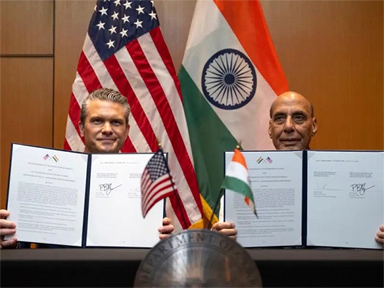
Few bilateral relationships have undergone as dramatic a transformation as that between India and the United States. Once separated by Cold War politics and mutual suspicion, the world’s largest and oldest democracies have today built one of the most consequential strategic partnerships of the 21st century. Defense and security cooperation, once the weakest pillar of the relationship, has become its strongest.
For Indian Americans—many of whom have contributed significantly to both nations’ technological, academic, military, and political life—the growing India-U.S. strategic partnership represents more than diplomacy. It reflects shared democratic values, common security interests, and a vision for a stable Indo-Pacific.
A Partnership Built on Shared Interests
The strategic logic behind India-U.S. defense cooperation has never been stronger. Both countries seek a free, open, inclusive, and rules-based Indo-Pacific where international law, freedom of navigation, and peaceful resolution of disputes are respected.
China’s rapid military modernization, increasing assertiveness along the India-China border, growing naval presence in the Indian Ocean, and expansive activities in the South China Sea have fundamentally altered Asia’s security landscape. While India and the United States approach China from different perspectives, both recognize the importance of maintaining regional stability and preventing any single power from dominating the Indo-Pacific.
The partnership is not directed against any one country. Rather, it seeks to strengthen deterrence, enhance regional resilience, and promote cooperation among like-minded democracies.
From Buyer-Seller to Co-Developers
The defense relationship has evolved far beyond simple arms sales.
The United States has emerged as one of India’s leading defense suppliers, providing platforms such as C-17 Globemaster strategic airlifters, C-130J transport aircraft, P-8I maritime surveillance aircraft, Apache attack helicopters, Chinook heavy-lift helicopters, MH-60R naval helicopters, and advanced artillery systems.
Yet the emphasis is increasingly shifting toward co-development, technology transfer, and joint manufacturing.
India’s “Make in India” initiative aligns well with Washington’s growing willingness to collaborate on advanced defense technologies. Recent initiatives include cooperation on jet engine technology, unmanned systems, artificial intelligence, semiconductors, cyber security, space technologies, and critical minerals.
This transition reflects growing trust. India seeks technological self-reliance while diversifying defense partnerships, and the United States views India as a long-term strategic partner capable of strengthening regional security.
The Importance of Military Exercises
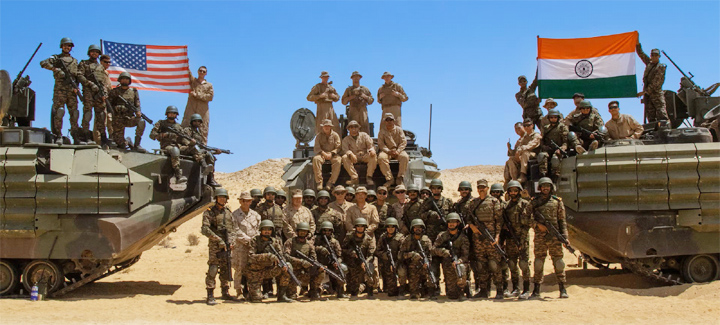
Perhaps no indicator better illustrates the depth of military cooperation than the expanding scope of joint exercises.
The annual Yudh Abhyas army exercise, Cope India air force drills, Tiger Triumph tri-service exercise, and the increasingly sophisticated Malabar naval exercise have enhanced interoperability between the two militaries.
Malabar, originally a bilateral India-U.S. naval exercise, now includes Japan and Australia, highlighting the growing strategic cooperation among Quad nations.
These exercises improve disaster response, anti-submarine warfare, maritime surveillance, humanitarian assistance, and high-end combat readiness.
They also build personal relationships among military officers—an often overlooked but critical ingredient in long-term strategic cooperation.
The Quad: Security Without Becoming an Alliance
India’s participation in the Quadrilateral Security Dialogue—or Quad—with the United States, Japan, and Australia marks another important evolution.
Unlike NATO, the Quad is not a military alliance. Instead, it focuses on practical cooperation across maritime security, emerging technologies, supply chains, disaster relief, cyber security, critical infrastructure, and resilient economies.
For India, the Quad allows strategic cooperation without sacrificing its long-standing commitment to strategic autonomy.
For Washington, India’s participation significantly strengthens efforts to maintain balance and stability across the Indo-Pacific.
Technology Takes Center Stage
Defense cooperation today extends well beyond traditional military hardware.
Artificial intelligence, quantum computing, cybersecurity, semiconductor manufacturing, satellite technologies, secure communications, and undersea infrastructure are becoming central to national security.
The India-U.S. Initiative on Critical and Emerging Technology (iCET) has elevated cooperation in these sectors, encouraging collaboration between governments, private industry, universities, and startups.
Indian engineers working in Silicon Valley, American companies investing in India, and joint research projects have created an innovation ecosystem that increasingly supports both economic competitiveness and national security.
In many respects, technology cooperation may prove even more significant than conventional arms sales over the coming decades.
The Indian American Connection
No discussion of India-U.S. strategic cooperation is complete without recognizing the contribution of the Indian American community.
More than five million Americans of Indian origin have emerged as an influential bridge between the two democracies. Indian Americans serve in Congress, state governments, academia, research laboratories, Fortune 500 companies, Silicon Valley, healthcare, and increasingly within America’s national security establishment.
This community has helped deepen political understanding while promoting educational exchanges, scientific collaboration, and business partnerships.
Equally important, Indian Americans have become effective advocates for stronger bilateral ties across party lines in Washington.
The relationship today enjoys rare bipartisan support in both countries—a significant strength in an increasingly polarized global environment.
Challenges Remain
Despite remarkable progress, differences continue to exist.
India values strategic autonomy and remains reluctant to enter formal military alliances. It also continues to maintain longstanding defense relationships with Russia, although diversification has accelerated in recent years.
Trade disputes occasionally complicate the broader relationship, while differing approaches toward sanctions, regional conflicts, and global governance sometimes create friction.
Human rights and democratic values also periodically enter bilateral discussions, reflecting the openness characteristic of democratic societies.
Yet these differences have not derailed the larger strategic trajectory.
Instead, both governments have demonstrated increasing maturity in managing disagreements while expanding cooperation where interests converge.
Looking Ahead
The future of India-U.S. defense cooperation will likely be defined less by weapons purchases and more by joint innovation.
Collaboration in autonomous systems, drone technologies, space security, cyber defense, missile defense, quantum technologies, and resilient supply chains will shape the next phase of the partnership.
Maritime security across the Indian Ocean, protection of critical sea lanes, humanitarian assistance during natural disasters, and cooperation against terrorism will remain central priorities.
As global power shifts toward Asia, India and the United States are likely to become even more important strategic partners.
A Partnership with Global Significance
For Indian Americans, this partnership carries a unique meaning.
It demonstrates that two vibrant democracies—with different histories, political traditions, and economic trajectories—can build trust through shared interests and mutual respect.
The India-U.S. strategic partnership is no longer defined by transactional diplomacy or short-term geopolitical calculations. It is increasingly anchored in democratic values, economic interdependence, technological collaboration, people-to-people ties, and a shared commitment to maintaining peace and stability across the Indo-Pacific.
In an era marked by geopolitical uncertainty, the strengthening defense relationship between India and the United States is emerging as one of the defining partnerships of the 21st century—one that benefits not only the two nations but also contributes to a more secure, stable, and prosperous global order.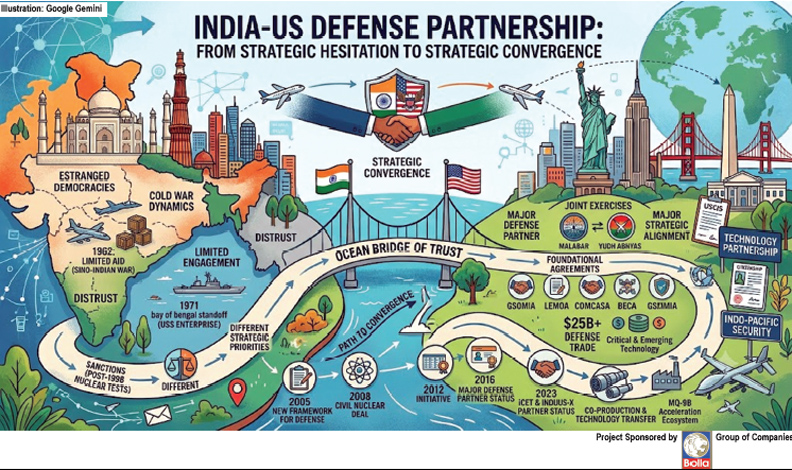


Be the first to comment