Tag: India- US relations

  • India-New Jersey: A New Chapter Begins with Governor Phil Murphy’s Visit

    India-New Jersey: A New Chapter Begins with Governor Phil Murphy’s Visit

    Bidisha Roy

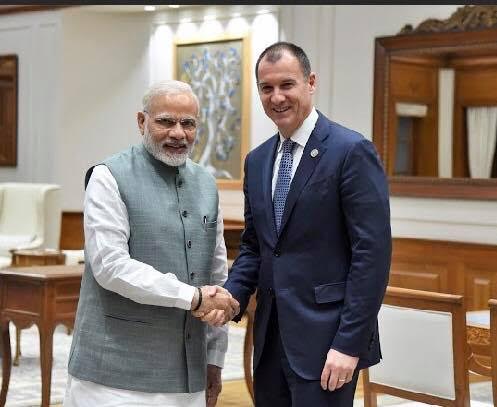
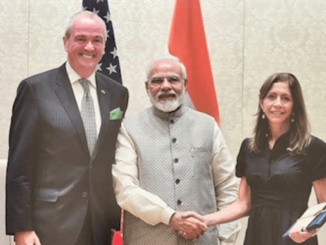
    NEW JERSEY / NEW DELHI(TIP): New Jersey Governor Phil Murphy and the New Jersey delegation had action-packed days on their economic development mission to India. Governor Murphy, First Lady Tammy Murphy, Deputy Chief of Mission Edgard Kagan and NJEDA’s Wesley Mathews met with Prime Minister Narendra Modi. They discussed Indian-New Jersey relations and their economic vision for the future. Working together, they can build a stronger and fairer future for both the people of New Jersey and India.

    On Sept 17, Murphy met with External Affairs Minister Dr. S. Jaishankar

    On Sept 17, he met with External Affairs Minister Dr. S. Jaishankar. “Proud to meet External Affairs Minister Dr. S. Jaishankar today to talk about the India-New Jersey relationship, based on our shared values of inclusivity, progress, and growth for all”, Governor Murphy tweeted.

    The opening of the New Jersey India Center in Gurugram kicked off Governor Murphy’s seven-day, six-city economic mission trip to India. Governor Murphy is the first Governor in New Jersey history to visit India on official business. “Today’s historic announcement charts a new course and effort to increase economic opportunities and build relationships between New Jersey and India,” said Governor Murphy. “Expanding operations into India will further Choose New Jersey’s goal to attract global businesses to New Jersey. With this new office, we will be able to bring our state’s message of economic prosperity directly to India.”

    During his visit to the Southern State of Telangana, Governor Murphy signed first-ever sister state partnership

    Governor Murphy, along with Edgard D. Kagan, Deputy Chief of Mission of the U.S. Embassy in New Delhi and Jose Lozano of Choose New Jersey, announced the opening of the Choose New Jersey India Centre with T&A Consulting. “My number one priority has been to foster an unrivalled economic ecosystem where innovative and game-changing companies – including Indian companies – can find a home and succeed,” said Governor Murphy. “India can be one of our leading partners in New Jersey’s re-emerging dominance in the global innovation economy, and New Jersey can be a leading partner in India’s continued economic rise.”

    Choose New Jersey and VentureLink at NJIT signed an MOU with the National Association of Software and Services Companies (NASSCOM) to promote cross-border trade through innovation, investments and technology partnerships between New Jersey and India. Through this partnership, NASSCOM member companies considering expansion into New Jersey will be provided 90 days of complimentary space at VentureLink@NJIT’s International Business Center while they explore opportunities to do business in New Jersey.

    Governor Murphy and First Lady Tammy Murphy witnessed the signing of two MOUs with Princeton University to help promote the development of renewable energy, bringing us closer to a sustainable future. “Sustainability and fostering the transition away from fossil fuel-based energy and toward renewable sources is a future which all of us are committed to, and a future the actions taken today will help create,” said Governor Murphy. One MOU will induct two Princeton University post-graduate/doctoral students to work on-site on clean energy research with ReNew Power – India’s largest independent producer of renewable energy. The second MOU, between Princeton University’s Andlinger Center for Energy and the IIT Delhi Centre of Excellence, will establish a collaboration on renewable energy and sustainability-related research.

    Governor Murphy addressed the U.S.-India Business Council and the Federation of Indian Chambers of Commerce & Industry and made the case that India can be one of New Jersey’s leading partners in the re-emergence of the state’s dominance in the global innovation economy. New Jersey Economic Development Authority’s Tim Sullivan highlighted opportunities for growth and partnership, including New Jersey’s pharma, tech, and advanced manufacturing sectors – along with India’s growing clean energy and film and media sectors.

    First Lady Tammy Murphy met with the deputy head of UNICEF India and had a thought-provoking conversation on women and children’s health issues and discussion of best practices. The First Lady learned about UNICEF India programs, which cover areas such as child protection, child marriage, adolescents, education, empowerment, and maternal health services. UNICEF India plays a critical role in supporting children and families, especially mothers. “I hope that our growing partnership between New Jersey and India helps us both learn how to better protect our children,” said First Lady Tammy Murphy.

    Governor Murphy and the First Lady paid homage to Mahatma Gandhi

    Governor Murphy and the New Jersey delegation toured historic and holy sites, including the Taj Mahal in Agra. Governor Murphy and the First Lady paid homage to Mahatma Gandhi, India’s foremost freedom fighter. During a visit to Gandhi Smriti, they also penned a message in the visitor book. They were given a tour of the Jama Masjid. Located in central Delhi. Governor Murphy toured the Swaminarayan Akshardham Temple and expressed his deepest gratitude to His Holiness Mahant Swami Maharaj for his gracious welcome.

    Governor Murphy toured the Swaminarayan Akshardham Temple

    During his visit to the Southern State of Telangana, Governor Murphy signed first-ever sister state partnership.

    Governor Murphy and wife Tammy Murphy were given a tour of the Jama Masjid in central Delhi

    “Great to be with @KTRofficethis morning as we signed our first-ever sister state partnership in India with the State of Telangana, creating and expanding partnerships in our IT, pharma, clean energy, education, and film sectors” he tweeted.

    “By furthering clean energy cooperation between New Jersey and Telangana, we can build economies fit for the 21st century while protecting the best interests of our people and our environment. Grateful to@indianchamber15for convening this important discussion. #NJIndiaMission.”

    “Thrilled to announce an MOU between @THubHydand @NJITand to hear pitches from startups increasing their presence in NJ. We all win when we forge new partnerships and take a chance on new and world-changing ideas”, Governor Murphy further tweeted.

    In return, India’s Consul General in New York Ambassador Sandeep Chakravorty thanked him. “Thanks @GovMurphyfor your personal commitment to strong relations with India. I am confident that the New Delhi office of @ChooseNJwill be its best”, Amb Chakravorty tweeted.

  • India-US ties and the Soviet baggage

    India-US ties and the Soviet baggage

    By KP Nayar

    Till about a decade ago, India and the US were talking to each other on 38 platforms. Now they are talking at one another. Such difficulties have been compounded by a tendency in India to run down Trump and view him as a bull in the global diplomatic China shop. But there is hope as the new External Affairs Minister, S Jaishankar, does not believe in demonizing Trump.

    At the root of most of the gripe in recent weeks about the state of relations between New Delhi and Washington is a long-standing popular expectation since the demise of the Soviet Union that as India and the US got closer, the latter would become a substitute for Russia.

    It is an expectation that is shared in India not merely at the popular level, but in the media, sections of which plug this line as their wishful thinking. Because of the heavy American influence on the think tank community and non-governmental organisations (NGOs), the public discourse on Indo-US relations has also fostered such an expectation.

    Policymakers within successive Indian governments since then Prime Minister PV Narasimha Rao — during whose tenure the Soviet Union collapsed — have mostly had serious reservations about such a perception. Unfortunately, their American counterparts have both publicly and privately encouraged the policy line that with the fall of the Berlin Wall and with the East bloc gone, all that was needed was for India and America to consummate their marriage that was made in heaven and ordained by their horoscopes matched by the constellations of democracy, English language, the rule of law and so on.

    Additionally, after the George W Bush-Manmohan Singh nuclear deal, which ended India’s long nuclear winter, Americans at every level of strategic thought, both within their administrations and outside, nursed a sense of entitlement about India. When Sanjaya Baru, then PM’s Media Adviser, handed over the first consignment of Alphonso mangoes to then US Secretary of State Condoleezza Rice in June 2007 at the annual meeting of the US-India Business Council, a senior State Department official standing next to this writer loudly exclaimed: “We give India the nuclear bomb and all we get in return is a basket of mangoes.”

    This official’s reaction was patently an exaggeration, but it reflected the strong feelings within the Washington establishment then — as also now. His reference was to the historic nuclear deal which ended a three decade-old ban on India’s trade in nuclear material and technology, initially with the US and eventually with the rest of the world. Till 2007, mangoes — like many other Indian agricultural products — could not be exported to the US despite New Delhi’s strenuous efforts because of stringent US regulations.

    In May 2006, Boeing invited Indian journalists based in Washington to visit the company’s highly secure and heavily restricted Integrated Defense Systems headquarters in St Louis, Missouri, where its modern military aircraft were being designed and developed. Word had been out then that India was about to order 126 medium multi-role combat aircraft (MMRCA), the biggest military aviation deal in history. The invitation was meant to familiarize the Indian public with US defense capabilities. Indo-US defense trade had not picked up in 2006 to anywhere near what it is today.

    Pin-stripe-suited Boeing senior executives, who flew down to St Louis to smoke exquisite cigars and sip premium cognac with the journalists at the Ritz Carlton’s Cigar Club, were smug in their belief that the MMRCA deal would go to US companies which were preparing to bid as soon as the tendering process was set in motion by the Congress-led government. When this writer told an executive that a deal as big as the one for 126 planes would take at least five years to be negotiated, he dismissed that view with contempt. “We have been told that in six months everything would be completed once the process begins,” he said confidently.

    In the end, it took a decade to sign an agreement for partial purchase of the original 126 planes and the deal did not go to American companies. This anecdote is worth narrating because it is just one of the many examples of how companies in the US have little idea of how to do business in India and are ill-equipped to cope with the peculiarities of decision-making in the Indian government.

    Just as US administrations want to send Indian-Americans as Ambassadors to India in the belief that they can swing things for them in New Delhi, US companies and lobbying groups hire retired bureaucrats from Lutyens’ Delhi whose contacts are from a bygone era. Sadly for economic and trade relations between the two countries, there are many instances where these men and women have given wrong advice to their principals back in America. But when things go wrong, the blame is on India, as many Americans in the Donald Trump administration and outside are doing now.

    After the thick ice between Washington and New Delhi caused by the 1998 nuclear tests melted through the most comprehensive dialogue in their history between then PM Atal Bihari Vajpayee’s confidant Jaswant Singh and then President Bill Clinton’s troubleshooter Strobe Talbott and bilateral relations eventually took off, 38 working groups came into being to catalyze Indo-US relations across the board.

    But six months after Hillary Clinton became Secretary of State, she found these 38 groups to be mere talking shops. During a visit to New Delhi in July 2009, she persuaded her Indian counterpart SM Krishna to scrap these working groups. In their place, Clinton and Krishna created the lofty sounding ‘five principal pillars’ of their relationship: strategic cooperation; energy and climate change; education and development; economics, trade and agriculture; science, technology, health and innovation.

    In retrospect, this was a mistake. When there were 38 working groups, there was constant toing and froing between the two sides and they were in constant and unbroken dialogue offering numerous windows to understand differences and disputes. India and the US were talking to each other then on 38 platforms. Now they are talking at one another.

    Such difficulties have been compounded by a tendency in India to run down Trump and view him as a bull in the global diplomatic China shop. But there is hope because the new External Affairs Minister, S Jaishankar, does not believe in demonizing Trump. When he was Foreign Secretary, within a month of Trump’s inauguration as President, Jaishankar began advising those in India who practice diplomacy and engage in strategic thought. “Do not demonize Trump, analyses Trump. He represents a thought process. It is not a momentary expression” what Trump is saying, has been Jaishankar’s approach. If Trump is re-elected President next year, India will have to follow this advice in letter and spirit or give up on India’s most important foreign policy priority.

    (The author is a Strategic Analyst)

  • US regards India as the “Closest Ally” & will be ready to support its war on terrorism

    US regards India as the “Closest Ally” & will be ready to support its war on terrorism

    It is for India to take advantage of a sea of  US goodwill

    By Ven Parmeswaran

    The US has recommended that India must get rid of Jaish-e-Mohammed and Lashkar-e-Taiba thru surgical strikes.  It is implied that once India decides, both the U.S. and India would jointly formulate military strategy and execute it.

    Pakistan sponsored Jaish-e-Mohammed, a terrorist organization,  killed 41 Indian para  military personnel  on February 13th.  Immediately upon hearing the news, a  chain of successive events took place in Washington D.C.  The Secretary of State and the National Security Adviser issued statements of strongest support to India.  This was followed by discussion on the situation  in the U.S. Senate and the U.S. House of Representatives.  All important and leading senators and congressmen/women condemned Pakistan and extended political support to India.  The Chief of the US Central Command, General Joseph Votel  gave his assessment to  the Congress and offered support to India.

    The US has recommended that India must get rid of Jaish-e-Mohammed and Lashkar-e-Taiba thru surgical strikes.  It is implied that once India decides, both the U.S. and India would jointly formulate military strategy and execute it. Indian Ambassador Shringla said: “The designation of India as a Major Defense Partner was also codified into law by the US Congress in the National Defense Authorization Act of 2017, thanks to the unstinted  support of the members of the India Caucus.”

    President Trump has been demanding  that Pakistan dismantle all terror cells and organizations inside Pakistan.  He is the first US President  to cancel military aid to Pakistan. Prime Minister Imran Khan of Pakistan  has been wanting to meet President Trump to seek support for loans from the I.M.F. President Trump has told him that unless he gets rid of all terror outfits and terrorists from Pakistan, he would not support Pakistan’s request.

    Pakistan was defeated by India in three conventional wars.  India defeated Pakistan in its third war and Pakistan lost East Pakistan. Since then, Pakistan has been using the homegrown terrorist organizations, such as Jaish-e-Mohammed; Lashkar-e-Taiba; and others as proxy to fight India.  This resulted in attacks on the Indian Parliament, , New Delhi shopping mall, and the City of Mumbai that killed 165 Indians and foreigners.

    Pakistan is controlled by its military and the I.S.I.,  its intelligence agency.  The military has selected its Prime Minister and therefore the Parliament is a joke.  Because India so far has not retaliated, Pakistan has taken advantage and continues to use the terrorists to attack India.

    India’s new Ambassador to the U.S.A., Harsh Vardhan Shringla  after presenting his credentials to President Trump was given the most enthusiastic reception at the Capitol Hill.   This was attended by more senators and congressmen/women than ever before.   The grand reception given to Ambassador Shringla is a reflection of India-US relations, with India now  branded as “CLOSEST  ALLY”. The chain of events in Washington after Pakistan’s attack in Kashmir reinforces President Trump’s new policy towards South Asia.  India should be pleased because the “CLOSEST ALLY” status has bipartisan support. It is time for India to take full advantage of the US support and  draw up a plan to end the scourge of terrorism from inside Pakistan.

    (The author,  in  the U.S. for 65 years, lives in Scarsdale, N.Y. He  is a Senior Adviser to Imagindia Institute, New Delhi, a think tank. He can be reached at vpwaren@gmail.com)

  • High-end defense tech pact with US: Delhi firm on military ties with Russia

    High-end defense tech pact with US: Delhi firm on military ties with Russia

    NEW DELHI(TIP): India and the US on Thursday, September 6, inked a vital agreement on seamless exchange of military information — Communications, Compatibility and Security Agreement (COMCASA) — even as New Delhi is clear that it will “stay the course” in its military relations with Moscow.

    The purchase of state-of-the-art S-400 Russian air-defense missile system is at the heart of the threat of US sanctions against countries dealing with Moscow.

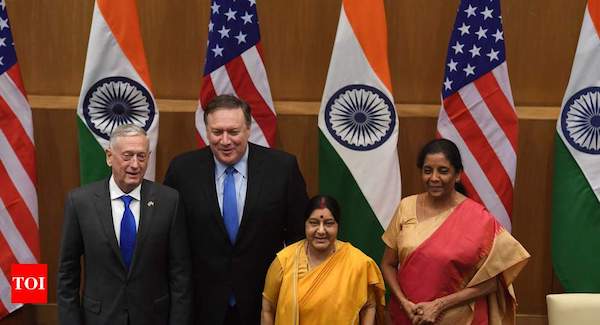
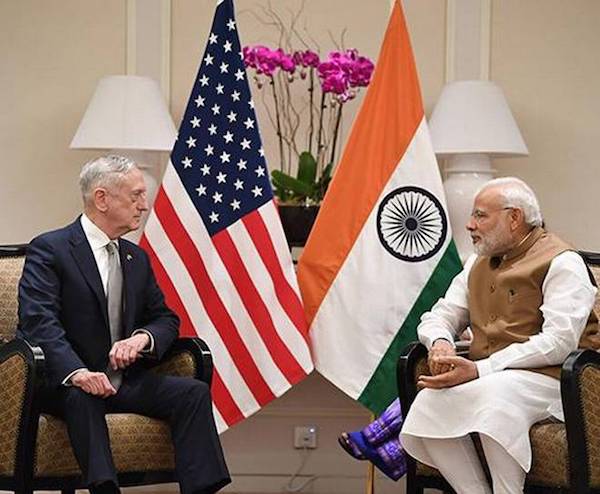
    Russia was literally the “elephant in the room” when Indian and US delegations sat down for their first-ever 2+2 dialogue, sources confirmed, as External Affairs Minister Sushma Swaraj and Defense Minister Nirmala Sitharaman met their US counterparts Mike Pompeo and Jim Mattis.

    Sources said the US told India that it understood the need for New Delhi to maintain its Russian-origin military equipment, but in case big-ticket items (like the S-400) are purchased, cooperation with the US could be “affected”. India is buying the system for Rs 39,000 crore to have a protective air-defense umbrella.

    India, in turn, has assured the US that its purchases from Russia do not harm the US’ interests in any manner. A US legislation Countering America’s Adversaries

    Though Sanctions Act (CAATSA) provides for a waiver against sanctions to India, it’s not a blanket waiver. Pompeo’s remarks released to the press say, “Our effort here, too, is not to penalize great strategic partners like India, a major defense partner. The sanctions aren’t intended to adversely impact countries like India. They are intended to have an impact on the sanctioned country, which is Russia. And so, we’ll work our way through the waiver decision as the days and weeks proceed, and we’ll do that alongside our partner, India, as well.”

    In another important development the two countries committed to start exchanges between the US Naval Forces Central Command (NAVCENT) and the Indian Navy. India will post an attaché at Bahrain to coordinate with US forces. India and the US will begin negotiations on an Industrial Security Annex (ISA) that would support closer defense industry cooperation and collaboration.

    About COMCASA

    Communications, Compatibility and Security Agreement will allow Indian defense forces to receive military-grade communications equipment from the US and ensure access to real-time encrypted information

    It will help India gain access to critical communication network of the US armed forces

    The pact, valid for 10 years, will ensure interoperability among the US and the Indian armed forces.

  • 2+2 talks take Indo-US ties to new high

    2+2 talks take Indo-US ties to new high

    Defense, trade, terror top agenda; Concerns on Russia, Iran sanctions highlighted

    NEW DELHI(TIP): India and the United States on Thursday, September 6, sought greater political convergence with a long-term view of relations and enhanced synergy between respective foreign and defense ministries through the inaugural 2+2 dialogue.

    Defense Ministers Nirmala Sitharaman and James Mattis and Foreign Ministers Sushma Swaraj and Michael Pompeo sat down for separate discussions before the 2+2 dialogue.

    Three sessions on energy and people-to-people ties, defense and regional security were part of the dialogue that included all four principals and their delegations.

    Followed by lunch and joint press statements, the leaders collectively called on PM Modi. According to sources, there was no laundry list of irritants to be resolved overnight, rather shared understanding of mutual concerns as regards trade ties, reducing the deficit, visas, US sanctions against Iran and Russia as well as counter-terrorism cooperation and Indo-Pacific strategy.

    Pompeo shared notes following his meetings with Pakistan PM Imran Khan and Army Chief Bajwa in Islamabad en route Delhi and the missives shared to act on terror and towards reconciliation efforts in Afghanistan.

    “On the 10th anniversary of the 26/11 attacks, we recognized the importance of justice and retribution for the masterminds behind this terrorist attack,” said Swaraj.

    “India supports President Trump’s South Asia Policy. His call for Pakistan to stop its policy of supporting cross-border terrorism finds resonance with us,” she added.

    Pompeo reportedly mentioned that “it is too early to judge the new Imran Khan government, but Pakistan has been asked to step up counter-terrorism efforts and encouraged to take right decisions and actions”.

    “Pompeo assured the ministers that ‘we have a long ask of the new Pakistan government’, while sharing concerns about Hafiz Saeed roaming freely,” said an official privy to discussions.

    India has asked the US to sustain pressure on Islamabad to crack down on terror entities, sources say.

    The sentiments are reflected in the joint statement issued after talks in a significant tweak.

    India impressed upon the US to use “under Pakistan control, instead of territory” referring to terror groups operating out of PoK and driving home territorial integrity issue, pointed out officials. “The ministers denounced any use of terrorist proxies in the region, and in this context, they called on Pakistan to ensure that the territory under its control is not used to launch terrorist attacks on other countries,” underlines the statement that was work in progress till late into the night.

    Ties with Iran and Russia came up for discussion from the Indian side during the dialogue, but without any specific mention of the S400 missiles purchase, sources said.

    Americans reportedly shared India’s position that its defense security systems or energy suppliers could not be switched overnight to US platforms. But India assured it was working to reduce high bilateral trade deficit that Donald Trump has disapproved of openly.

    Indian officials sounded hopeful of a carve out on Chabahar port, given its strategic importance to Afghanistan, to avoid heat of US sanctions against Iran.


  • H-1B issue to figure in ‘2+2’ talks, says India’s External Affairs Minister Sushma Swaraj

    H-1B issue to figure in ‘2+2’ talks, says India’s External Affairs Minister Sushma Swaraj

    NEW DELHI(TIP):  Replying to queries in the Rajya Sabha, on July 26, External Affairs Minister Sushma Swaraj said: “I would like to state that so far there is no significant change with regard to H-1B Visas. Changes have taken place, but no significant changes are there so far”.

    However, the “danger” (of change in rules) persisted and there are concerns over the tightening of the visa regime in the US following President Donald Trump’s “Buy American, Hire American” policy which India will effectively raise at the ‘2 plus 2’ dialogue on September 6.

    In fact, the number of H-1B visas had gone up from over 1.08 lakh in 2014 to 1.29 lakh visas now. As many as 1,08,817 H-1B visas were issued in 2014 and 1,19,952 in the following year, she said.

    Though as per Congress’ Anand Sharma there was “42 per cent increase in the proportion of H-1B petitions denied for Indian professionals from the third to the fourth quarter of the financial year 2017”.

    “Yesterday, the National Foundation for American Policy (NFAP) has released the report. I will share it with the minister,” he added. However, as per Swaraj, it was not a government report and that her figures came from the government records.

    India, she said, had already taken up the issue with the US on relevant platforms and would further discuss it at the inaugural ‘2 plus 2’ dialogue between the two countries in New Delhi on September 6.

    “I assure you that in the ‘2 plus 2’ dialogue, we will certainly and forcefully raise this issue also,” she said.

    (Source: PTI)

  • Crucial ‘2+2’ Dialogue Postponed: Strain in India-US Ties?

    Crucial ‘2+2’ Dialogue Postponed: Strain in India-US Ties?

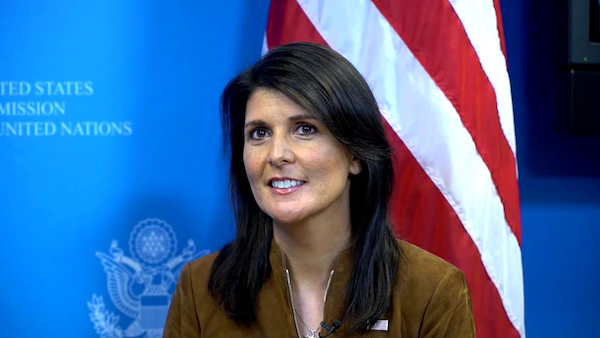
    PM Narendra Modi knows why US deferred talks with India: Nikki Haley

    WASHINGTON(TIP): US abruptly postponed the crucial ‘2+2’ dialogue with India scheduled on July 6, for the second time in a row. US Ambassador to UN Nikki Haley, in Delhi, however said there’s a good reason to delay talks and PM Modi knows about it. But questions are being asked if India-US ties are facing a rough weather and are cracks emerging in India-US relationship?

    US Ambassador to United Nations, Nikki Haley, has said that Prime Minister Narendra Modi knows the reason for the Donald Trump administration cancelling 2+2 dialogue which was scheduled to be held in Washington on July 6 and 7.

    Speaking to NDTV, Haley said that the talks were cancelled for reasons that had nothing to do with India, adding that the world would soon be informed about the same. She added that Prime Minister Modi is aware of the “exact reason”, which is a “very good” one.

    Dismissing reports of differences between the two countries of rescheduling of the talks, Haley said that the relationship between India and US has “never been stronger”. Her remarks come a day after the US conveyed to India that it had postponed the 2+2 dialogue scheduled to be held in Washington next week, due to “unavoidable reasons”.

    Earlier, Haley had said that the US wants to take bilateral ties with India to the next level, adding that US President Donald Trump shares Prime Minister Narendra Modi’s vision of nations pursuing growth “free and fearless in their choices” in the Indo-Pacific region.

    Responding to a question, she also talked about the contentious issue of immigration amid an uproar over detention of scores of people in the US, including Indians, for illegally entering the country. America is a country of immigrants, but it cannot allow illegal immigration in the wake of the challenge of terrorism, Haley said.

    India and the US enjoy a natural friendship that is based on their shared values and interests, the 46-year-old Indian American said. “The Trump Administration seeks to take the US-India relationship to the next level; to build a strategic partnership rooted in our common values and directed toward our common interests,” she said.

    Haley said India was a state with advanced nuclear technologies widely accepted around the world because it is a democracy and continues to be a responsible leader. Noting that in the last couple of years, India has joined three major nonproliferation groupings, she said the US also fully supports India’s membership bid for the Nuclear Suppliers Group. “India continues to demonstrate it is a responsible steward of its nuclear technology,” she said.

    (With inputs from PTI)

  • Taking the UNHCR report in stride

    Taking the UNHCR report in stride

    The killings of Bukhari and Aurangzeb were meant to provoke New Delhi, which decided to be seen as tough

    By KC Singh
    If India and the US let domestic politics color their approach to the protection of human rights in the 70th year of the Universal Declaration of Human Rights, it would prove that terrorism and illegal immigration have succeeded in making the two major democracies less liberal, says the author.

    The 47-member Geneva-based UN Human Right Council and the UN High Commissioner for Refugees (UNHCR) have been in focus the past week. First came an unprecedented report by the UNHCR Zeid al-Hussein on Jammu and Kashmir (J&K), Pakistan Occupied Kashmir and Gilgit Baltistan. While Pakistani knuckles were rapped mildly, the report, as conceded in its executive summary, is really about “widespread and serious human rights violations’’ in J&K from the death of militant Burhan Wani in July 2016 to April 2018.

    Under separate headings it holds India guilty on account of lack of access to justice and impunity; military courts and tribunals blocking this access, excessive use of force and pellet-guns, arbitrary arrests, including of minors, torture and enforced disappearances, and sexual violence, etc. All through, even UN-listed terror outfits are referred to as “armed groups”. A former Indian diplomat writing elsewhere calls it more akin to a report by Organisation of Islamic Conference than a UN high official. India strongly rebutted it and could have probably ignored it, except that Zeid is on record saying he would recommend to the UN Human Rights Council (UNHRC), which convened on June 18 for one of its three annual sessions, an investigation.

    Two events impinge on this development. One, Jammu and Kashmir has been placed under Governor’s rule with the BJP withdrawing from the coalition government. Two, US Ambassador to UN Nikki Haley announced, at the State Department, US withdrawal from the UNHRC, alleging lack of reform and it having become a “protector of human rights abusers and cesspool of political bias”. Both need closer examination.

    The Trump administration has been threatening to withdraw from the UNHRC for some time, but the decision came a day after Zeid slammed the US for separating children from parents on border with Mexico when apprehending illegal immigrants. The media is also reporting illegal immigrants from India, many from Punjab, held in detention centers under sub-human conditions.

    Republican Senator John McCain, terminally ill with brain cancer but combative as always, tweeted that the “administration’s current family separation policy is an affront to the decency of the American people, and contrary to the principles and values upon which our nation was founded’’. He later went on to oppose Trump’s nomination of Ronald Mortensen to lead the US refugee and migration policy, alleging he lacked empathy for people fleeing oppression. Thus, while the US is right that election to the UNHCR of nations like Venezuela and Congo (though the US omitted mentioning China) hardly makes it the custodian of global conscience on human rights, but neither does the US by its xenophobic immigration control creating gulags for apprehended illegal immigrants qualify it to lecture the council.

    The J&K imbroglio raises many similar questions about India’s trajectory in dealing with terrorism at home. The PDP-BJP alliance raised hope that their Agenda of Alliance would provide a template for resolution of the Kashmir issue. The death of Mufti Sayeed at the beginning of 2016 and a long hiatus before his daughter Mehbooba effectively took charge probably doomed the experiment, if at all had any chance to succeed.

    At the root of the problem was the Modi government’s Pakistan policy of “no dialogue” unless terror ends. On the contrary, the PDP had got elected promising dialogue with Pakistan, more political space even for separatists and improved trade and people-to-people links with Kashmiris across the Line of Control (LoC). The Pakistan army exacerbated these fault lines by keeping up support to militancy, provocatively killing Indian soldiers and turning the LoC into free-fire zone. The Governor’s rule now denies India the argument that J&K has a popularly elected government which is a guardian of people’s rights scrutinizing, if not overseeing, counter-terror operations of security forces. Pakistan, currently a member of the UNHRC, shall use the High Commissioner’s tendentious report and collapse of the alliance to pillory India in coming weeks.

    The Modi government must surely have assessed the profit-loss outcome of its decision. The domestic implications would dominate New Delhi’s thinking as the government heads into literally the last six months of effective rule before the Lok Sabha election process kicks-in. It needs to ensure that no major breakdown of security order in Kashmir occurs till election, particularly during the Amarnath pilgrimage.

    There may be information that leading to parliamentary election in Pakistan in July its army, having a freer hand than normal with a caretaker government in position, is planning to fling every last terror asset across the LoC in a make-or-break gambit. The targeted killing of moderate journalist Shujaat Bukhari and the taped torture and execution of soldier Aurangzeb were intended to provoke New Delhi. A big attack on pilgrims, as has happened in the past, could make the Union Government look extremely ineffective. Governor’s rule is the counter-move to ensure that despite the debate in Geneva on India’s human rights record the Modi government is seen as strong at home.

    If India and the US let domestic politics color their approach to the protection of human rights in the 70th year of the Universal Declaration of Human Rights, it would prove that terrorism and illegal immigration have succeeded in making the two major democracies less liberal. The latest survey by Freedom House, a US think-tank, is called “Democracy in Crisis”. Last year was the 12th consecutive year when nations suffering democratic setbacks outnumbered those gaining. According to Democracy Index of The Economist Intelligence Unit, 89 countries regressed in 2017 and only 27 improved. Globalization and technology in the West and Pakistan-sponsored terror in South Asia are derailing the quest for liberal, law-based democratic rule. If a four-year political alliance between the PDP and BJP, representing disparate views on Kashmir, cannot develop a consensus for bridging the divide, the future is indeed bleak. A fresh attempt at reconciliation seems unlikely until after parliamentary elections in Pakistan and India. Till then, geopolitical haze in South Asia will be thick as the dust that enveloped northern India a week ago.

    (The author is a former Secretary, Ministry of External Affairs, India)

  • No longer seeing eye to eye?

    No longer seeing eye to eye?

    With India recalibrating its relations with other powers, the India-U.S. equation is not quite balancing out

    By Suhasini Haidar

    At his speech at the Shangri-La Dialogue in Singapore last week, billed as a major foreign policy statement, Prime Minister Narendra Modi spoke of India and the U.S.’s “shared vision” of an open and secure Indo-Pacific region. Yet his words differed so much from those of U.S. Defense Secretary James Mattis, who spoke at the same event, that it seemed clear that New Delhi and Washington no longer see eye-to-eye on this issue, and several others as well.

    Oceanic gulf

    To begin with, Mr. Modi referred to the Indo-Pacific, a term coined by the U.S. for the Indian and Pacific Oceans region, as a natural geographical region, not a strategic one, while Mr. Mattis called the Indo-Pacific a “priority theatre” and a “subset of [America’s] broader security strategy” for his military command, now renamed the Indo-Pacific Command. While Mr. Modi referred to India’s good relations with the U.S., Russia and China in equal measure, Mr. Mattis vowed to counter China’s moves in the Indo-Pacific and referred to the U.S. National Defense Strategy released this January, which puts both China and Russia in its crosshairs as the world’s two “revisionist powers”.

    The divergence in their positions, admittedly, are due more to a shift in New Delhi’s position over the past year than in the U.S.’s, when Mr. Modi and President Donald Trump met at the White House. A year ago, the Modi government seemed clear in its intention to counter China’s growing clout in its neighborhood, especially post-Doklam, challenge the Belt and Road Initiative (BRI), and back a Quadrilateral grouping of India, the U.S., Japan and Australia to maintain an open Indo-Pacific. Today, the Doklam issue has been buried, the BRI isn’t as much a concern as before, and the government’s non-confrontational attitude to the Maldives and Nepal indicates a softened policy on China in the neighborhood. Meanwhile, Mr. Modi now essays a closer engagement with Chinese President Xi Jinping and a relationship reset with China after the Wuhan meeting.

    The Quad formation, which is holding its second official meeting today in Singapore, has also been given short shrift. India rejected an Australian request to join maritime exercises along with the U.S. and Japan this June, and Navy Chief Admiral Sunil Lanba said quite plainly last month that there was no plan to “militarize” the Quad. Contrast this with India’s acceptance of military exercises with countries of the Shanghai Cooperation Organisation (SCO), the Russia-China led grouping it will join this week in Qingdao, and one can understand some of the confusion in Washington. Pentagon officials, who had come to accept India’s diffidence on signing outstanding India-U.S. foundational agreements, are now left scratching their heads as India publicly enters the international arena in the corner with Russia and China, while proclaiming its intention to continue energy deals with Iran and Venezuela in defiance of American sanctions.

    Era of summits

    In a world where summits between leaders have replaced grand strategy, the optics are even clearer. Mr. Modi will have met Mr. Xi and Russian President Vladimir Putin four-five times each by the end of the year, if one counts informal and formal summits, as well as meetings at the SCO, BRICS and G-20. In contrast, nearly half the year has gone in just scheduling the upcoming 2+2 meet of Indian and U.S. Ministers of Defense and Foreign Affairs.

    Trade protectionism is clearly the other big point of divergence between India and the U.S., which have in recent months taken each other to the World Trade Organisation on several issues. There has been a surge in disputes between the two countries: on the new American steel and aluminum tariffs, the proposed cuts in H1B professional visas and cancellation of H4 spouse visas, on India’s tariffs and resistance to U.S. exports of dairy and pork products, on Indian price reductions on medical devices, and Reserve Bank of India rules on data localization on Indian servers for U.S. companies.

    The row over Harley-Davidson motorcycles is a case in point, where what should have been a small chink in the relationship has ended up denting the discourse quite seriously. When Mr. Trump announced to Harley executives and union representatives in February last year that he would stop countries “taking advantage” of them, no one in New Delhi paid much attention. Over the year, Mr. Trump grew more vocal in this demand, including twice during meetings with Mr. Modi in Washington and Manila, calling for India to scrap its 75-100% tariffs, given that the U.S. imposes zero tariffs on the import of Indian Royal Enfield motorcycles. Mr. Modi tried to accommodate U.S. concerns, and even called Mr. Trump on February 8 this year to tell him that tariffs were about to be cut to 50%. But after Mr. Trump divulged the contents of their conversation publicly, trade talks were driven into a rut. Officials in Washington still say that if India were to slash its rates, it would see major benefits in other areas of commerce, while officials in New Delhi say that with Mr. Trump having gone public with Mr. Modi’s offer, it would be impossible to back down any further. In fact, a new cess has taken tariffs back up to 70%.

    The biggest challenges to a common India-U.S. vision are now emerging from the new U.S. law called Countering America’s Adversaries Through Sanctions Act and the U.S.’s withdrawal from the Iran nuclear deal with the threat of more secondary sanctions. Both actions have a direct impact on India, given its high dependence on defense hardware from Russia and its considerable energy interests in Iran. In particular, India’s plans to acquire the Russian S-400 missile system will become the litmus test of whether India and the U.S. can resolve their differences. Clearly the differences over a big-ticket deal like this should have been sorted out long before the decisions were made; yet there is no indication that the Trump administration and the Modi government took each other into confidence before doing so.

    In the face of sanctions

    Defense Minister Nirmala Sitharaman’s avowal of the S-400 agreement, and Foreign Minister Sushma Swaraj’s open defiance of U.S. sanctions on Russia, Iran and Venezuela at separate press conferences this month couldn’t have helped. It also didn’t help that owing to Mr. Trump’s sudden decision to sack Rex Tillerson as Secretary of State in March, the 2+2 meeting in April, which may have clarified matters, was put off. The truth is, building a relationship with the Trump administration in the past year has been tricky for both South Block and the Indian Embassy in Washington, as more than 30 key administration officials have quit or have been sacked — they have had to deal with three National Security Advisers, two Chiefs of Staff, as well as two Secretaries of State as interlocutors.

    It is equally clear that the India-U.S. equation isn’t balancing out quite the way it did last year, when Mr. Modi and Mr. Trump first announced the idea of the “2+2” dialogue. Ms. Swaraj, Ms. Seetharaman and their American counterparts have their work cut out for them during their upcoming meeting in Washington on July 6. If a week is a long time in politics, in geopolitics today a year is an eternity.

    (The author is Deputy Resident Editor & Diplomatic Affairs Editor, The Hindu. She can be reached at suhasini.h@thehindu.co.in)


  • India, US need a full-scale relationship: former US Ambassador to India Richard Verma

    India, US need a full-scale relationship: former US Ambassador to India Richard Verma

    NEW YORK CITY, NY(TIP):  India and the US need a “full scale relationship” that encompasses defense, strategic and economic ties, former US Ambassador to India Richard Verma said stressing that the two countries cannot be “fighting every day on trade” while cooperating on defense. They need to fire on all cylinders to achieve their ambitious relationship.

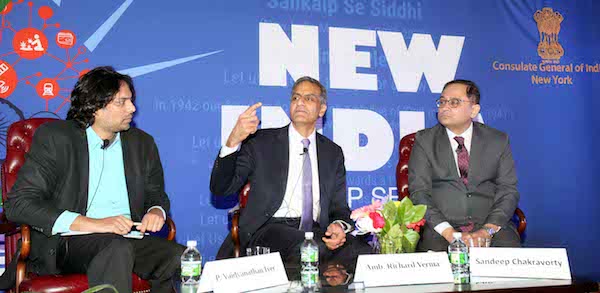
    “We need a full-scale relationship, not just the defense relationship, not just the strategic relationship. We need to focus on the economic side too. We somehow need to navigate America First with Make in India,” Verma said, speaking at the third New India Lecture at Indian Consulate, April 23.

    Verma said Washington and New Delhi want an “ambitious relationship” and to become natural allies for that they need to be “firing on all cylinders”, including economic and military.

    “We can’t be fighting every day on trade, cooperating on defense and think we are just going to have a great relationship. We need to be firing on all cylinders, that means economic, that means military,” he said. He further stressed that the US needs to take its defense relationship with India to the next level. “That means we ought to be providing India with the most advanced technology, we ought to make sure that if India is in trouble they have the means to win, if they are challenged,” he said.

    Verma spoke at length on a wide range of topics pertaining to India-US relations, including H1B work visas, immigration as well as geo-political issues relating to China and Pakistan.

    Verma, Vice Chairman and Partner at the Asia Group and a board member of the US-India Strategic Partnership Forum (USISPF), said the India-US relationship has been a “slightly underperforming” one for decades. “We have got some history that weighs us down. We still have some trust issues and neither side wants to be in an alliance,” he said in his address on ‘US-India: Natural Allies — Absent the Alliance.’

    Responding to a question on concerns among Indian workers over H1B visas, Verma said last year about 1.1 million visas were issued to Indian nationals to come to the US in every category and out of these, about 50,000-60,000 were H1B visas. “A very small percentage of the visa pool is for H1 B visas,” he said.

    Verma, who had served as the US Ambassador to India from 2014 to 2017, said he had conveyed to Indian CEOs and software companies that they have to be aware of the “political realities” in the US. While they should pay their employees in the US competitive wages, they also need to be “sensitive” towards people’s fear of losing jobs in an era of globalization.

    “If your consultants are coming here and advising about downsizing or scaling back and then that operation or function ends up in India, people are not going to be necessarily happy,” he said.

    “You have to understand the political realities that people are facing here, fear about globalization. I think we are getting to a better understanding. I hope we don’t run into a huge fight on H1B,” he said.

    Verma, who has previously served as the Assistant Secretary of State for Legislative Affairs, noted that “some reforms are probably necessary”, adding that the H1B visas are an important but “small part” of the overall people-to-people relationship between India and the US.

    “I think US-India trade relationship is one relationship where you can get distinct wins on both sides,” he said.

    Highlighting the critical role of the diaspora in strengthening relations between India and the US, Verma said “we have to increase our people-to-people connections and we should be celebrating and standing up for the immigrants who come into this country and not looking at ways to shrink the pool of people coming here.”

    On the trajectory of India-US relations under the Trump administration, Verma said looking at Washington’s all other bilateral relations, the one with India is “still on a pretty good trajectory.”

    While things have been moving along on the strategic side, on the economic side there are some growing pains. However, he said he is “more concerned about how we treat people who may not necessarily look like and sound like the rest of middle America and that’s the part I keep the most eye out for in this environment.”

    Recalling the journey of his parents from India to the US, Verma said that immigrants and immigration have played a hugely important role in America. “It is not just one group of immigrants or immigrants who look a certain way but immigrants from all over the world and it’s really important that we stand up for that group of people.”

    On ties with Pakistan, Verma said the US has made the message quite clear to Pakistani leaders that “this continuing support and facilitation” of terrorist groups along the border to create a “perpetual state of conflict” with India is “not sustainable.

    “It’s not in their interest, and it’s not the way to have that goal of a functioning normal state in the international system,” he said.

    He stressed that the US can’t lose the connections to all the people and moderate voices in Pakistan that want peace with India and a better future for their children.

    “It’s a very difficult situation but we have to get there with a variety of economic and political tools,” he said.

    Responding to a question on relations with China, Verma said India and the US have remarkably similar situations with regard to China, including economic inter-dependencies, trade and commercial activities.

    “But we also have security concerns. We have concerns about what China is doing in the international systems, we have concerns about their failure to adhere to rules and norms, we have concerns about the Belt and Road Initiative and what they are doing in the South China Seas,” he said.

    Verma stressed on the need to be able to balance some of these concerns.

    “No one wants to see a conflict with China. But we also have to be able to stand up for our basic values,” he added.

    He further noted that in India-China and US-China relations, there is a lot of dialogue at all levels.

    However, “it is a very difficult, complicated and contentious relationship but I don’t think anyone wants to see the spark that leads to an actual conflict,” he said.

    Verma emphasized that there is need for an international system that reflects India’s role in the world today. He lamented that India is not on the UN Security Council, is not a member of the Asia-Pacific Economic Cooperation and doesn’t play the kind of role that it probably should on the G-20 bloc of nations or in other international Institutions.

    “The US needs to pave the way forward for India so that it actually has the seat at the table in this century, a seat that is appropriate for a country of the size and stature of India. We have to be working very hard for that,” he said.

    Ambassador Verma, Consul General Sandeep Chakravorty, Vaidyanathan Aiyer, and Air India Regional Manager Vandana Sharma pose for a photograph with the young students from Bangalore Engineering College
    Photos- Jay Mandal/On Assignment

    A group of students from a Bangalore Engineering College, who were on way to Boston to take part in an auto engineering fair also attended the lecture.

    Ambassador Verma, Consul General Sandeep Chakravorty, Vaidyanathan Aiyer, and Air India Regional Manager Vandana Sharma posed for a photograph with the young students.

    (With inputs from PTI)

  • Suozzi Meets with Prime Minister Narendra Modi and discusses U.S.-India relationship

    Suozzi Meets with Prime Minister Narendra Modi and discusses U.S.-India relationship

    HUNTINGTON, NY (TIP): Last week Congressman Tom Suozzi (D – Long Island, Queens) traveled to India and met with Prime Minister Narendra Modi in New Delhi to discuss the U.S. – India relationship, Betsy Davidson stated in a press release April 12.

    The formal talks were conducted as part of a high-level delegation of Congressional leaders that met with their Indian counterparts to discuss trade, strategic partnerships, immigration and security coordination.

    “Our relationship with India is based upon shared values, including the rule of law and respect for diversity, and has never been stronger. It is driven, in part, by our vibrant Indian-American community, one of the most industrious and successful diaspora populations in the world. As the world’s oldest and largest democracies, we have a shared interest in promoting global security and economic prosperity through trade, investment and communications,” said Congressman Suozzi.

    Other members of the bipartisan delegation included Representatives Raja Krishnamoorthi (D-IL), Pete Olson (R-TX), Terry Sewell (D-AL), Dina Titus (D-NV), Brenda Lawrence (D-MI), and Drew Ferguson (R-GA).

    Along with Modi, the delegation also met with Minister of Commerce and Industry Suresh Prahbu, Minister of Communications and Information Technology Ravi Shankar Prasad, and Minister of State for External Affairs M.J. Akbar. The delegation also attended the India-U.S. Trade Policy Forum where they discussed trade tariffs. immigration issues, and the India-U.S. strategic partnership, identifying ways to strengthen it further.


  • Hafiz Saeed should be prosecuted to fullest extent of law: US

    Hafiz Saeed should be prosecuted to fullest extent of law: US

    WASHINGTON (TIP): The United States has called for Hafiz Saeed’s prosecution “to the fullest extent of the law,” following Pakistan’s Prime Minister Shahid Khaqan Abbasi’s remark that no action could be taken against the United Nations-designated terrorist.

    Abbasi, during an interview to Geo TV on Tuesday, referred to Saeed as ‘sahib’ or ‘sir’ “There is no case against Hafiz Saeed sahib in Pakistan. Only when there is a case, can there be action,” he said when asked why there was no action against Saeed.

    US fumes at non-action Reacting strongly to the comments, State Department spokesperson Heather Nauert said the US believed that Saeed should be prosecuted and they have told Pakistan as much.

    “We believe that he should be prosecuted to the fullest extent of the law. He is listed by the UNSC 1267, the Al- Qaeda Sanctions Committee for targeted sanctions due to his affiliation with Lashkar-e-Taiba, which is a designated foreign terror organisation,”Ms. Nauert told reporters at her daily news conference on Thursday.

    “We have made our points and concerns to the Pakistani government very clear. We believe that this individual should be prosecuted,” she said.

    Responding to a question, Nauert said the US has “certainly seen” the reports about Abbasi’s comment on Saeed. “We regard him as a terrorist, a part of a foreign terrorist organisation. He was the mastermind, we believe, of the 2008 Mumbai attacks which killed many people, including Americans as well,” she said. Saeed, the chief of the Jamaatud- Dawah (JuD), was released from house arrest in Pakistan in November.

    The US has labelled JuD the “terrorist front” for the Lashkar-e-Taiba (LeT), a group Saeed founded in 1987. LeT was responsible for carrying the 2008 Mumbai attack that killed 166 people.

    Pak need to do more Acknowledging that the US has had some challenging times with the government of Pakistan recently, Ms. Nauert has said the Trump Administration expects Pakistan to do a lot more to address terrorism issues. “That’s something that we’ve been very clear about all along. You know the news that we had that came out a couple weeks ago about our decision to withhold some of the security funding for Pakistan,” she said.

    Nauert said the entire administration was on the same page on the issue of USPakistan relationship.

    Early this month, the US suspended about $2 billion worth of security assistance to Pakistan accusing it of not doing enough in the fight against terrorism.

    In retaliation, Pakistan suspended military and intelligence co-operation with the US.

    The State Department on Thursday said it has not received any formal information in this regard from Pakistan.

    Source: PTI

  • Do not Lose Hope in Trump, America’s Expectations Can Still Come True

    Do not Lose Hope in Trump, America’s Expectations Can Still Come True

    By A.D. Amar

    Since in office, Trump has given a very favorable treatment to many Indian Americans by appointing them in key Federal positions in his administration. He has also given India whatever it asked for. Additionally, Trump started to band with India in Asia-Pacific and other parts of the world against India’s archenemies. Indian Americans definitely appreciate that, says the author.

    In 2008, when I was contesting for the US Congress from the New Jersey’s District 7, I met with many seasoned and intelligent politicians from both parties. They all agreed on one thing that America’s problems were too big. They also agreed that they knew of no politician who had the capabilities to solve them.

    When I focused on these problems, I found out that there were just two big sources of most of America’s problems. They both had to do with the poor boarder control. One due to the lack of control of human inflow into the country and the second due to the lack of control of goods flowing in from all over the world. In other words, it is due to the illegal immigration and unchecked importation of goods. This is how America from being the world’s biggest and best-quality producer became the biggest importer and became a laughing stock of those countries that imported to America and even of those living in America, for its poor quality.

    In the process, from being the richest country in the world, it needed to borrow money from almost all countries around the world, with our biggest creditors being those who sold their goods to us, such as China, Japan, Germany, Mexico, Canada, Korea, etc. Because of the large inflow of the low skill workers from poor countries, American wages fell. Americans lost their jobs and riches to those who had forced themselves in through the borders, mostly along the South. The unemployment costs increased on the states and, because most of the illegal immigrant businesses run underground, the tax base decreased. Furthermore, the increased school, healthcare and other costs made the states and the Federal government operating in deficit.

    I believed that if we fixed these two problems, we could revive our economy and, with that, our financial problems will disappear. Furthermore, as money comes back in the system, slowly but surely everything will come back. America’s problems will disappear.

    In 2015, when I decided to support Donald J. Trump for the US President and, on December 25, 2015, with a friend, decided to form a committee to promote Trump, I knew that Trump would be able to deliver what America needed to fix its problems. Therefore, with my friend and another colleague, in January 2016, I registered a PAC called Indian Americans for Trump 2016. I did so because I had faith in Trump’s ability and temperament to be able to take on America’s problems. I expected Trump’s temperament as his big strength since the approaches of all other so called “normal” presidents had not succeeded in solving our problems, economic as well as foreign policy.

    During the primary campaign period, according to the records of the Trump for President, I was one of the three academics to had endorsed Trump for President. The political action committee we formed and I led was the first Indian American group formed specifically to openly favor Trump for President. The PAC worked very hard, reached out to Indian Americans and others in many states to campaign for Trump. President Trump, after his victory, agreed that Indian Americans played a critical role in his victory.

    Since in office, Trump has given a very favorable treatment to many Indian Americans by appointing them in key Federal positions in his administration. He has also given India whatever it asked for. Additionally, Trump started to band with India in Asia-Pacific and other parts of the world against India’s archenemies. Indian Americans definitely appreciate that.

    Another issue is that the countries who are “our friends” believe in keep taking money from us whether we have it or not. The story is the same whether these were countries who would keep selling to us their products without buying anything form us, or these were the countries who were living on aid from America; they all disdained America if America tried to cut their stream of cash coming from the USA. Both these groups of countries believed that they had a right to those streams, whether it was Japan, Germany, South Korea, Canada, France, and many others in this class. On the other hand, these are the countries that had been living on the aid coming from the USA. They include Pakistan, Egypt, Iraq, Israel, Palestine, Jordan, etc. They also believed that it was their right to receive these monies without any obligation. Trump already had bitter arguments on this with the leaders of these countries such as Angela Markel of Germany and Khwaja Asif of Pakistan.

    Another big problem that muddies up things in the USA is the political lobbies. They engage in pay-to-play. Politicians get contributions, and, in return, they do what the lobbyists want them to do. Many question why when Presidents were candidates, contesting for election, talked about these problems, but accepted them on their election. Others said that these have been happening for so long that they have become the “American Way”, America’s tradition. Among other American Presidents, Obama criticized the practice and promised never to do that and promised to change them, but did not dare go against the lobbyists. In fact, he let them run the White House, such as David Axelrod and Rahm Immanuel. The presidents, who changed, as Obama did, did not want to take the “risk”. They wanted to have their 8 years and retire, shifting the responsibility on the next President.

    Trump has been in office less than a year. All voters are watching. So far, he has been doing all right. If election were held today, he will win. However, if illegal immigrants continue to stay in the country and others, somehow, are allowed to sneak in, and the unchecked importation of foreign goods is allowed to continue, America’s problems will not go away. The stock market rise will be temporary and will make some rich, nevertheless, the problems will continue.

    However, Trump’s performance for the 2020 reelection will depend on his ability to handle the sources of America’s biggest problems listed above. If he cannot handle the trade imbalances, the illegal immigrant problems, and the power of the lobbyists, it will be difficult for him to get votes of those who made him win in 2016, Indian Americans or not.

    (The author is Professor of Management, Stillman School of Business, Seton Hall University. He can be reached at  Ad.amar@shu.edu / Tel: (973) 761 9684.)


  • Guest Comment : India in US global strategy: Limits to friendship with Uncle Sam

    Guest Comment : India in US global strategy: Limits to friendship with Uncle Sam

    A new US national security strategy under Donald Trump was bound to induce great interest, especially about India’s place in how the global system should be ordered. The 68-page document is confined to a macro view of the world’s complex and interconnected problems. However, India clearly emerges as a useful cog in US attempts to prevent a shift in the balance of power in the Asian heartland. More than West Asia, the US has chalked out a more prominent role for India in the maritime domain in line with its strategy to prevent a free hand to hobble China’s bid to expand its regional influence.

    What are the payouts? Trump explicitly asks India to loosen its purse strings in Central and South Asia, perhaps as compensation for declining to put Indian boots on Afghan soil.  The price for partnering the US in the Indo-Pacific is both tangible — more orders for US military companies at a time when the US budget is facing constraints — and intangible — greater Indian visibility in the near neighborhood. Just as the US is single-mindedly devoted to advancing American influence, India will have to cut its cloth according to its own national interests. It cannot view Russia and China from the American lens of unremitting hostility: its only two make-in-India defense projects are of Russian origin and there is already word that a Sino-India trade-off on NSG and One-Belt One-Road may be in the offing. India can ill afford to shrink the room for dialogue with both Russia and China.

    A reality check is also in order: the US mentions India as only one of the eight potential allies in the Asia Pacific. If India is described as a “leading world power”, there is approbation for the others: Japan is a “critical ally”, Australia “a key partner”, and friendship with South Korea “forged by trials of history”. In West Asia too, India has a marginal role as the US has several irons in the fire. Whether it was Obama earlier or Trump now, proximity with the US has its limits as well as advantages.

    (Tribune, India)

  • Bluster as foreign policy – Hostility has left neighbors unmoved

    Bluster as foreign policy – Hostility has left neighbors unmoved

    By Sandeep Dikshit

    Clearly, the comforting words of the American naval officer and the temporary presence of a number of warships in the Bay of Bengal can have no impact on the border standoff on the India-China-Bhutan tri-junction or dampen the Sino-Pakistani tango where Beijing has promised to do the heavy lifting for a massive infrastructure buildup that straddles Indian Kashmir, says the author.  

    An unnamed US navy top brass sought to enlighten us about the end game behind the recent week-long excitement in the waters of the Bay of Bengal involving navies of the US, India and Japan. “They [China] will know that we are standing together and that it is better to stand together,” he said at the end of the war-like maneuvers involving, as breathless defense correspondents put it, three aircraft carriers for the first time.

    Like all naval exercises this comes with a name, this one is called the Malabar. It began in 1992 as India began reaching out to the other side of the Cold War divide and has now assumed proportions that are the interest of every sea-faring nation in the world because it involves Japan, India and the US with a very interested onlooker in Australia, all of whom disagree with Beijing’s modus operandi of reworking the power equations in the region.

    Astute as they are, the Chinese would have noticed that the famed US aircraft carrier Nimitz came for the exercises with a leaner complement of accompanying warships. The Japanese contributed two warships. More than war-fighting machines, they remain symbols of Shinzo Abe’s overturning of Japan’s post World War law forbidding its participation in international conflicts. Australia, which was kept out of the Malabar exercises, is still reorienting its navy for a blue water role.

    Clearly, the comforting words of the American naval officer and the temporary presence of a number of warships in the Bay of Bengal can have no impact on the border standoff on the India-China-Bhutan tri-junction or dampen the Sino-Pakistani tango where Beijing has promised to do the heavy lifting for a massive infrastructure buildup that straddles Indian Kashmir.

    Prime Minister Narendra Modi has recently jet-setted to the US, Russia, Spain, France and Germany, all with a thriving military-industrial complex. Very few have responded to his call to manufacture military hardware on Indian soil, partly because most would not wish to rework their equations with China.

    The belligerent realists who have come to dominate the Indian foreign policy may draw comfort from the Donald Trump’s maiden defense budget that has a few lines about India. So far India has largely bought surveillance and detection equipment from the US while going slow on offensive platforms like fighters, tanks and submarines.

    Both sides have their reasons. The US had abruptly suspended the Malabar exercises after India conducted the nuclear tests in 1998. As part of US sanctions at that time, Pentagon even ordered the British to seize Indian Navy’s helicopters that had come for repairs because they had American parts. India’s strategic planner learnt their lessons. Just like they were left stranded after the US withdrew military assistance in 1965 (and unwittingly left a vacuum filled by the Soviet Union) after India had clashed with Pakistan, they realized military trade with the US can be halted anytime if it conflicts with American foreign objectives.

    The proximity brought about by the foreign policies of successive Indian administrations has caused those apprehensions to recede. There is even talk of the US transferring its F-16 manufacturing facility to India.  But the US will not easily offer any of the top-end offensive military platforms without a demonstrative expression of strategic closeness.

    This could be tactical such as positioning Indian armed forces in Afghanistan. But to get into the real meat of the US arms industry, this is inadequate. Even countries in a client-patronage relationship with the US like Pakistan have been let down on crucial occasions (Kargil War) or rewarded for their occasional usefulness with a few military toys that are grossly inadequate for a full-fledged war.

    The US would ideally like to sink a long strategic hook into India that makes the alliance irreversible. One element — signing of three military agreements — has been on the table since the Manmohan Singh-AK Antony era. The duo withstood immense American pressure to sign these agreements because that would have meant an irreversible entry into critical defense systems that countries with independent foreign policies try to prevent.

    The Modi government has succumbed to the easiest of the three military agreements. But even its complexities have meant that the two sides could not operationalize the pact for the Malabar exercises. The signing of the other two pacts will certainly cause the Russians to turn lukewarm in supplying top-end military hardware to India.

    With neither a credible sea denial strategy in hand or adequate military platforms to deter China, it was inevitable that the bluster in foreign policy would have a short shelf life. The Army Chief made a show of muscularity by dashing to Sikkim when the faceoff with the Chinese began. Three weeks later, he has reverted to expiating on Kashmir.

    This approach has brought negative returns with Pakistan as well. High on Chinese backing, utility for the Arabs and Russian mending of fences, Islamabad has little appetite for dialogue on New Delhi’s terms. The attempt to square Pakistan’s meddling in Kashmir with reciprocal interference in Balochistan has suffered a massive blowback with the arrest of the former Indian Naval officer. Nepal too is not looking too good and India has been left with too few diplomatic tools to turn the situation around. The antipathy with China could have been best avoided when Nepal was looking to balance India’s testiness with approaches to Beijing.

    This cul de sac may have persuaded Foreign Secretary S Jaishankar to complain that the Dokalam military standoff between India and China has blown out of proportion due to “supra-nationalism” — beyond the authority of one national government. Apart from the usual suspects and slogans — boycott of Chinese manufactured goods, annexure of Kailash Mansarovar — the Foreign Secretary may also be hinting at the wind being provided to the sails of hyper-nationalists by foreign strategic experts with the single point agenda of showing up China poorly.

    India has been hedging against Chinese dominance for nearly two decades. But its policy makers eschewed bluster towards China in favor of painstaking incremental diplomatic dexterity. The three years of belligerence may have turned the clock back.


  • Trump sticks to Obama line on India

    Trump sticks to Obama line on India

    By Sandeep Dikshit

    Narendra Modi has realized that India will not get a free pass from the dealmaker in the White House. India must make its markets and commercial laws US-friendly to upgrade bilateral ties. Till then, the existing approach suits both sides fine, says the author.

    Prime Minister Narendra Modi’s three top-level interactions in Washington would have provided a fair understanding of India’s position in Donald Trump’s scheme of rearranging international relations in Asia.

    Trump is forthright, some would say non-statesmanlike, in conducting state business, making it easier for the side at the other end of the negotiating table to understand the underlying motives and expectations. His chief consiglieres, the ministers for Defense and Foreign Affairs, have a similarly unvarnished approach of laying out their cards.

    These three policy-marker meetings have made it clear that the White House retains the Obama era policy of encouraging India to concentrate on its eastern approach. This means American help for building trade bridges with the four US allies — ASEAN, Australia, South Korea and Japan — as well as in positioning India as a neutralizer of China’s increasing maritime presence. The Trump era disinterest in the US “Pivot to Asia” does not yet translate into India losing its usefulness as a major naval force in the Indo-Pacific. With Japan and Australia also stepping up their maritime presence, the US Deep State believes this quadrilateral should be kept in readiness as a formidable armada off China’s southern and eastern coasts.

    The Indo-Pacific Economic Corridor that would cut a road link across Bangladesh/Myanmar, Thailand and Vietnam not just reopens a route for India that has remained closed ever since the Europeans initiated hostilities with the Japanese, it also fits in with the American plan to checkmate transport corridors descending from China into these countries. This battle of corridors – west-east (India to Vietnam) pitted against China’s north-south (Myanmar, Bangladesh and Thailand) – and the contest of the seas will ensure India remains embedded in American economic-military strategy despite waxing and waning of this concept’s importance among successive White House Administrations. This realization explains India’s alignment with the US position on the North Korean missile tests. It also pleases South Korea, emerging as a prominent supplier of defense equipment.

    But on the west, especially in Pakistan and Afghanistan, India has to strike alliances on its own. The MEA spokesperson’s choice of phraseology after the PM met US Secretary of Defense John Mattis indicated that the CIA/Pentagon would prefer to do business in Afghanistan without the India-Pakistan zero-sum contest. Another reason for US opposition to a dust-up is it plans to push a gas pipeline from Turkmenistan to permanently kill any prospects of Iranian gas finding a market in the region. This US disinclination to hostilities brought about a softened Modi. He did touch upon the surgical strikes during a town hall with the Indian diaspora, but unlike at the previous G-20 and SCO summits, there was no laundering of neighborhood animosities from the pulpit. Instead, the PM spoke of a peaceful neighborhood and the sharing of India’s growth spoils with the world.

    India earned two endorsements of its position on regional security. The Trump-Modi joint statement threw Pakistan down the stairs for fostering violent militant groups. It was burnished with the US naming a Pakistan based Kashmiri militant leader as a global terrorist. But too much is being read into the joint statement’s suspicions about the OBOR. The businessman in Trump would have to balance the multi-billion dollar contracts being won by American companies with the US military-intelligence establishment’s suspicions of the strategic game plan wrapped in China’s OBOR trade-only claims. Clearly opportunities from the $ 1 trillion OBOR infrastructure development pie do not put US opposition on the same footing as that of India, which is also suffering the anxiety of encirclement.

    Trump has suggested in no uncertain terms that the US needs more Indian business to get it more interested in Indian strategic priorities. With a $ 500 billion trade deficit, Trump is looking at Indian efforts to reduce its trade surplus with America. These mean creating the right tariff environment for its capital goods and opening up the Indian market for American IT and agricultural products. It also means killing all Indian expectations of a liberal visa regime and if possible handing Westinghouse with a $ 50 billion contract for six nuclear reactors. Trump also explained that India was not getting access to sensitive and closely held technology because its intellectual property regime does not measure up to Pentagon’s expectations.

    Without this to-do list, India’s aspiration to ride on American technology to sharpen its military edge and backing to enter NSG may have to remain on hold. The US has given that indication by slowing down work on an ambitious military co-production project of building an aircraft carrier. The official explanation could not be weaker: the US Navy team earmarked for the project is busy de-commissioning USS Enterprise. The implication is India’s attempt to reach aircraft carrier parity with China gets delayed.

    On the eve of his departure to the US, PM Modi had signaled India’s willingness to qualitatively improve its surveillance of the Indian Ocean – which primarily means keeping an eye on Chinese vessels – with products bought from American companies. His $ 2 billion order pales in comparison to Qatar’s $ 13 billion and Saudi Arabia’s $ 110 contracts for US military equipment. Clearly, Indian foreign policy will have to keep its multi-vector approach alive. It will be too expensive to have Trump as the sole ally.

    (The author can be reached at sandeep4731@gmail.com)


  • Vice President Mike Pence Speaks on Growing U.S.-India Partnership at USIBC Summit

    Vice President Mike Pence Speaks on Growing U.S.-India Partnership at USIBC Summit

    WASHINGTON (TIP): Celebrating its 42nd year, the U.S. Chamber of Commerce U.S.-India Business Council’s (USIBC) Annual Leadership Summit on June 27 featured Vice President of the United States Mike Pence and other high-ranking government and private sector leaders to address USIBC members and guests.

    The Leadership Summit focused on the important role of the private sector in advancing the ties between the two countries, the future of the U.S.-India economic relationship, as well as strengthening and deepening the U.S.-India defense partnership.

    “The partnership between the U.S. and India has never been more important,” said John Chambers, USIBC chairman and executive chairman of Cisco. “Both governments are deeply committed to creating greater economic opportunity for their citizens. The USIBC does just that by advancing bilateral cooperation between the two nations. I’m incredibly proud of the impact we’ve had so far in driving economic growth, job creation, innovation and entrepreneurship in both nations, and we look forward to shaping the future of both countries by doubling down on our efforts in the years to come.”

    The summit welcomed addresses from the Ambassador of India to the United States Navtej Sarna and Congressman Pete Sessions, chairman of the House Committee on Rules. USIBC presented its prestigious annual “Global Leadership Awards” to Andrew Liveris, chairman and CEO of The Dow Chemical Company, and Adi Godrej, chairman of the Godrej Group. Both were honored for creating inclusive business environments, integrating India in the global supply chain and advancing core values such as manufacturing, innovation and scale in tough market conditions.

    “I would like to thank the U.S.-India Business Council for honoring me with the Global Leadership Award. The United States and India enjoy a strong economic relationship, both in terms of trade and investment. With India’s strong expected growth over the next few years, this relationship will grow multifold and will be helped by the excellent work by the U.S.-India Business Council,” said Godrej on receiving the award.

    “It is our pleasure honoring these two industry leaders that have made tremendous strides in their businesses. They are indicative of the power of private enterprise in building strong ties between India and the U.S. As both governments prioritize their domestic and foreign trade policies, we encourage fostering environments that grow businesses and advance economic opportunity in both India and the United States. We also congratulate President Trump and Prime Minister Modi on having completed a successful first round of talks and look forward to future engagements,” stated USIBC President Mukesh Aghi.


  • Fillip to Trade and Investment to be focus of Modi’s visit to US: MEA

    Fillip to Trade and Investment to be focus of Modi’s visit to US: MEA

    NEW YORK (TIP):  Deepening bilateral trade and economic ties will be one of the key focus areas of Prime Minister Narendra Modi during his visit to the US where he will hold talks with President Donald Trump on June 26 in their first meeting.

    A number of key issues, including ways to step up cooperation for effectively combating terrorism and further strengthening defense ties, are also likely to figure during the talks between the two leaders.

    Modi will visit the US on June 25 and 26 as part of a three-nation tour beginning on Saturday.

    “One of the agendas of the visit is how to further push and develop economic and commercial cooperation between the two countries for mutual benefit,” External Affairs Ministry Spokesperson Gopal Baglay said.

    Refusing to give further details, he said that all matters of bilateral interests will be on the table, adding, “The leaders will have an entire gamut of relationship in front of them when they talk.”

    Asked whether incidents of alleged racial attacks will be raised by the Prime Minister with the US president, Baglay said that not all attacks were racial. “Whenever there have been attacks on Indians, it is because of some reason or the other, we have seen that they have been condemned very strongly by the US government,” he said.

    He added that the Indo-US relationship has been very robust and strong and thrust would be to take it further.

    Asked whether Modi will raise the issue of cross-border terrorism emanating from Pakistan, Baglay said that India’s concerns regarding it are very well known and that it was logical to assume that matters relating to regional and global security will be discussed.

    “Terrorism that emanates from there (Pakistan) affects not only India, but other countries in South Asia and the world over,” he said.

    On whether India will apprise the US about its concerns over the US military aid to Pakistan being diverted for anti- India activities, Baglay did not give a direct reply, but said such concerns have been conveyed whenever there has been an occasion.

    To a query on how preparations for the Modi-Trump meeting were going on considering the US leader’s “maverick nature”, Baglay said, “I don’t agree with your description of the president.”

    The MEA spokesperson said Modi will meet CEOs of top US companies and senior representatives from the business community on June 25. On Modi’s meeting with the CEOs, he said discussions are expected on giving further fillip to trade and investment.

    There will be an Indian community event in the afternoon of that day as well.

    Modi would visit Portugal on June 24 and the Netherlands on June 27.