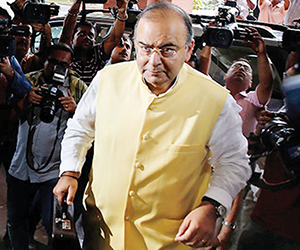
NEW DELHI (TIP): The Narendra Modi government on July 10 unveiled its intent to revive growth by shoring up infrastructure and manufacturing, besides increasing investments by boosting savings through Income Tax sops and raising tax breaks on housing loans in its first Union Budget. Finance Minister Arun Jaitley, presenting his maiden Budget for 2014-15, said the Budget followed the theme of “Sabka Saath, Sabka Vikas”. Jaitley balanced the fiscal deficit by accepting the target of 4.1 per cent this year set by the previous UPA government. The fiscal deficit target will go down to 3.6 per cent and 3 per cent in the next two years, although, Jaitley added, it would be a challenge.
Laying the groundwork of the direction of the Budget proposals, Jaitley said these steps were only the beginning of a journey towards a sustained growth of 7-8 per cent or above within the next 3-4 years along with macroeconomic stabilization. “Therefore, it would not be wise to expect everything that can be done or must be done to be in the first Budget presented within 45 days of the formation of this government,” he added, probably to tone down the burden of expectations from the new government. Bearing Modi’s stamp, the Budget proposals are geared more towards investment and asset creation as opposed to the entitlement driven social sector focus of the UPA regime. Following a strategy of boosting savings and putting more money into the hands of the people, Jaitley has raised the threshold Income Tax exemption limit from Rs 2 lakh to Rs 2.5 lakh and investments under 80C by Rs 50,000 to Rs 1.5 lakh.
In addition, the deduction limit on interest on housing loan for self-occupied property has been increased from Rs 1.5 lakh to Rs 2 lakh. Balwant Jain, CFO, Apnapaisa said the Finance Minister has given the benefit of Rs 1.5 lakh in aggregate spread over three components of Rs 50,000 each. Jain said savings would range from a minimum of Rs 5,150 for a person who is in the 10 per cent slab and does not avail 80 C benefit and does not have home loan, to a maximum of Rs 46,350 for a person who is in the 30 per cent tax slab, avails 80 C benefits and pays minimum of Rs 2 lakh as interest on home loan during the year. For senior citizens, the IT exemption limit is higher at Rs 3 lakh and the pension scheme has been re-introduced for a limited period.
Free baggage allowance for inbound passengers has been increased from Rs 35,000 to Rs 45,000. For consumers, the Budget makes cigarettes and colas costlier, while cathode ray tube TVs, LCD panels of less than 19 inch, computers, soaps and footwear are cheaper. The direct tax proposals involve a net outgo of Rs 22,200 crore mainly because of income tax exemptions, while indirect tax proposal will yield a revenue of Rs 7,725 crore. Non-plan expenditure for the current year has been estimated at Rs 12.19 lakh crore, while the total expenditure estimates stand at Rs 17.94 lakh crore.
The Plan Expenditure will grow by 20 per cent year on year. The Budget makes a big statement on attracting foreign investment. The Foreign Direct Investment cap on insurance and defense has been raised from 26 to 49 per cent. Further, FDI in e-commerce has been allowed, while rules for FDI in real estate have been relaxed. The controversial retrospective taxation clause and all transfer pricing cases arising out of it have been referred to a high-level committee to assure foreign investors. Jaitley, who took an unusual five-minute break during the speech following backache, said the Budget followed the theme of “Sabka Saath, Sabka Vikas”. The big push in the Budget is around housing, smart cities, warehousing capacity, urban areas rejuvenation, highways and agriculture.
Tag: Indian Politics
POLITICS & POLICY
-

Modi government’s maiden budget sets tone for higher growth trajectory, job creation
-

Obama invites Modi to the US
NEW DELHI (TIP): Prime Minister Narendra Modi was on July 10 invited by US President Barack Obama to visit Washington in September, saying he wants to “work closely with Prime Minister to makeIndia-US relations a defining partnership for the 21st century”. This should be music to the ears of a man who was told, after the Gujarat riots of 2002, that he would be unwelcome in the US, if he were to visit to address Gujaratis in that country on a tourist visa. Subsequently the US cancelled his tourist visa.But things have changed.
US Deputy Secretary of StateWilliam Burns called on Modi and delivered Obama’s invite. “The prime minister thanked President Obama for the invitation and looked forward to a result-oriented visit with concrete outcomes that imparts new momentum and energy to the India-US strategic partnership,” stated the Press Information Bureau. “The relationship between the world’s oldest and largest democracies should not only be for the benefit of the two countries but should emerge as a powerful force of good for peace, stability and prosperity in the world,” Modi was quoted as saying, in the press release.
Modi is to go to the US to attend the UN General Assembly, sometime in September. Soon after the Lok Sabha election results, chatter had started in the Bharatiya Janata Party (BJP) that Modi should not go to the US unless that country apologised for denying him a visa. However, that was put down firmly by the party’s senior leadership. The bilateral aspect of Modi’s visit will be an important milestone for Indo-US relations. It was quite clear from the statement by the government that this would be a focussed results-oriented visit, not just a networking exercise or a pleasure trip.
The is whether Modi will meet Pakistan Prime Minister Nawaz Sharif in the US. In 2013, a meeting between the two PMs turned into a media disaster with Nawaz Sharif supposedly likening the Indian PM to a “dehaati aurat” (village woman) who would bring in third parties to settle disputes with her husband.With hardly any formal forward movement in relations with Pakistan after Sharif’s visit to attend Modi’s oath-taking ceremony, exactly what if anything such a meeting will achieve will have to be assessed. The Sangh family will also give its inputs on such a meeting. -

BUDGET IS ‘SANJEEVANI’ FOR MORIBUND ECONOMY, SAYS MODI
NEW DELHI (TIP): Describing the general Budget as a ‘sanjeevani’ (new life) to the “moribund economy”, Prime Minister Narendra Modi on July 10 said it converts hopes and aspirations of the people into trust and is in line with his government’s endeavour to bring India out of crisis. “This Budget is a new ray of hope for the poor and downtrodden sections of society,” he said commenting on the maiden budget of his government presented in Parliament on July 10.
The Prime Minister stated that despite the “testing times”, his government is committed to extend every possible help to the poor, the neo-middle class and the middle class, inspired by the mantra of ‘Sabka Saath, Sabka Vikas’. Assuring the people that the government is leaving no stone unturned in developing India and rid the nation from the challenges it faces, he said for the “moribund economy”, this budget has come as “a sanjeevani and an arunoday (sunrise) for the last man in the line”. He said his government is committed to and confident of bringing India out of crisis, which is due to the capabilities and strength of 125 crore Indians. “This strength would be channelled towards taking the country to new heights.”
He said the Budget is in line with making India skilled and digital, guided by the usage of the latest technology. Congratulating Union Finance Minister Arun Jaitley, he said, “The Budget will give an impetus to Jan Bhagidari (people’s participation) and Jan Shakti (people’s power).” Modi said development should be all-encompassing (“samaveshak, sarvadeshak, sarvasparshi”) and should also reach those parts of the country which have so far remained underdeveloped.
The Prime Minister said the Budget will give a ray of hope to the housewife who is being burdened by rising prices and place utmost importance to women empowerment and girl’s education. Recalling that the entire world had immense expectations from India, he said, however, that the way the entire economic system crubled in the last decade, not only India but the entire world lost hope and there was an atmosphere of pessimism. “Since we formed the government, there were discussions about whether this government can free the nation from crisis but the Railway Budget and Thursday’s General Budget show that we are moving in the right direction,” Modi said.
He referred to the innovative provisions in the Budget for the development of tribal communities and schemes for giving an impetus to skill development for youth. “The Budget is in line with the government’s vision to create a skilled and digital India,” he said. He talked about the measures proposed for the farmers such as ‘Krishi Sinchai Yojana’ that would benefit farmers and achieve the guiding principle of ‘per drop, more crop’ He also mentioned the provisions in the Budget for the cleaning of the Ganga. He reaffirmed the government’s commitment to make India self-reliant in the defence sector. -

Modi and McCain talk of desire to ‘revitalise’ India-US ties
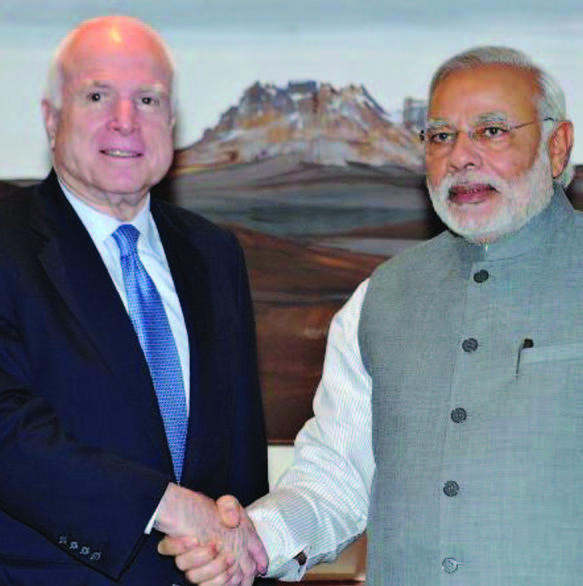
NEW DELHI (TIP): Prime Minister Narendra Modi pushed for improving U.S. ties during a meeting with Senator John McCain in New Delhi on Thursday, as the two countries seek to patch up their differences and boost their economic relationship.
The treatment of an Indian diplomat arrested in New York in December triggered a serious spat between the two countries and was widely blamed for the resignation of the U.S. ambassador to India. The Obama administration has been seeking to revive ties since Modi’s election in May, seeing India as a key strategic counter-balance in Asia to an increasingly assertive China.
Modi “conveyed his desire to further deepen and expand the strategic partnership,” a statement from the Indian government said. It said that he hoped for a “forward looking, result-oriented visit” to the United States in September when he is due to attend the United Nations General Assembly in New York. McCain, who told the Senate last week that Washington should seek to help India’s economic and military development, spoke of high expectations about a new momentum in India’s economic growth under the new government. There was no mention in the statement of defence deals.
Both governments have signalled they are keen to ramp up bilateral trade, which stands at about $100 billion annually and is considered to be below potential due to disputes over protectionism and intellectual property rights. McCain’s visit comes at an awkward time – just days after reports that the U.S. National Security Agency was authorised to spy on Modi’s Bharatiya Janata Party in 2010, when the party was in the opposition.
On July 2, foreign ministry summoned a senior U.S. envoy in Delhi and said it had sought an assurance that the surveillance would not happen in the future. The government statement of their remarks released after the McCain-Modi meeting did not mention the snooping row. Modi was denied a visa in 2005 for travel to the United States following religious riots in 2002 while he was a state chief minister. Even so, he has responded positively to the U.S. advances and shown no resentment publicly.
In addition to discussing the situation in Iraq and Afghanistan, Modi emphasised that the fight against terror should be a global priority, the statement said.
-

AHEAD OF MODI’S VISIT TO J&K, PAK CALLS KASHMIR ‘DISPUTED TERRITORY’
NEW DELHI/ISLAMABAD (TIP): Needling India ahead of Narendra Modi’s first visit to Jammu & Kashmir as Prime Minister, Pakistan on Thursday harped on Kashmir being a “disputed territory”. “We do not accept the so-called accession of the State of Jammu & Kashmir to India. Kashmir is not an integral part of India.
Our position is that Jammu & Kashmir is a disputed territory,” foreign office spokesperson Tasnim Aslam said during a briefing. Her remarks came on the eve of Modi’s one-day visit to Jammu and Srinagar. “People of the State of Jammu & Kashmir have yet to exercise their right to self determination which has been assured to them by almost 20 resolutions of the United Nations Security Council,” Aslam said in response to a question on Modi’s visit to the state. Pakistan’s contention has been outrightly rejected by India which has asserted that J&K is its integral part.
-

Modi flags off Katra-Delhi train for Pilgrims
NEW DELHI (TIP): Prime Minister Narendra Modi launched a train that will give easier access to one of India’s most popular pilgrimages. Modi landed in Jammu and flew by chopper to Katra, where he flagged off a new train from Katra to Delhi via Udhampur, providing a direct link to the base town for the Mata Vaishno Devi pilgrimage.
Chief Minister Omar Abdullah was also with him. An estimated 50 lakh people visit the shrine every year and a Railways official said they expected “good demand” on the new line. The train connectivity to Katra is part of the ambitious Rs. 1,150-crore Kashmir rail link project which links the region with the rest of the country.
-

No honeymoon period for my government, says Modi
NEW DELHI (TIP):
Every decision that his government took has been “guided solely by national interest,” Prime Minister Narendra Modi said on Thursday, June 26, as he completed one month in office, but rued that a “series of allegations began” immediately after he took that friends in the media like to call a ‘honeymoon period.’ …. Not unexpectedly I don’t have any such luxury,” he wrote.In a post titled “a few thoughts as we complete a month in office” on his website, Mr. Modi expressed satisfaction at the functioning of the government.“A big challenge I am facing in Delhi is to convey to a select group of people about our intentions and sincerity …. These are people who are both within and outside the government system,” Prime Minister Narendra Modi said on Thursday, adding “we need to strengthen systems whereby the right things are communicated to the right people at the right time.” In a post titled “a few thoughts as we complete a month in office” on his website, Mr. Modi said he was no longer gripped by the thought that he was new to Delhi.
“Fortunately, a month later that thought does not exist any longer in my mind. My confidence and determination has increased tremendously,” he said recalling that many people thought it would be a while before he learnt the intricacies of the Central government. He credited his success to the “wisdom of ministerial colleagues” and his own experiences as a four-time Chief Minister.
Mr. Modi said his meetings with ministers and officials enabled exchange of thoughts and ideas and the government has “come up with excellent road maps for the various ministries.” He hoped to work closely with Chief Ministers of States, and allegations do not matter when “one is working with the sole aim of serving the nation determinately.” Noting that it was on June 26, 1975 that the Emergency was imposed in the country, the Prime Minister said it was a “grim reminder of the dangers associated with subverting freedom of speech, press, expression and silencing opposition.” Mr. Modi said he was committed to creating strong institutions through good governance so that “we never ever see those dark days again.”
-

People’s Expectations from Modi are enormous, says Chaurasia
HICKSVILLE, NY (TIP): A nascent organization that came in to being a few months before the elections, has been able to propel itself into limelight, much to the chagrin of the traditional BJP organizations which include factions of Overseas Friends of BJP (OFBJP). The organization, a political action committee, to begin with, chose a more appropriate name, to be in sync with the brewing political climate – Overseas Friends of Narendra Modi.
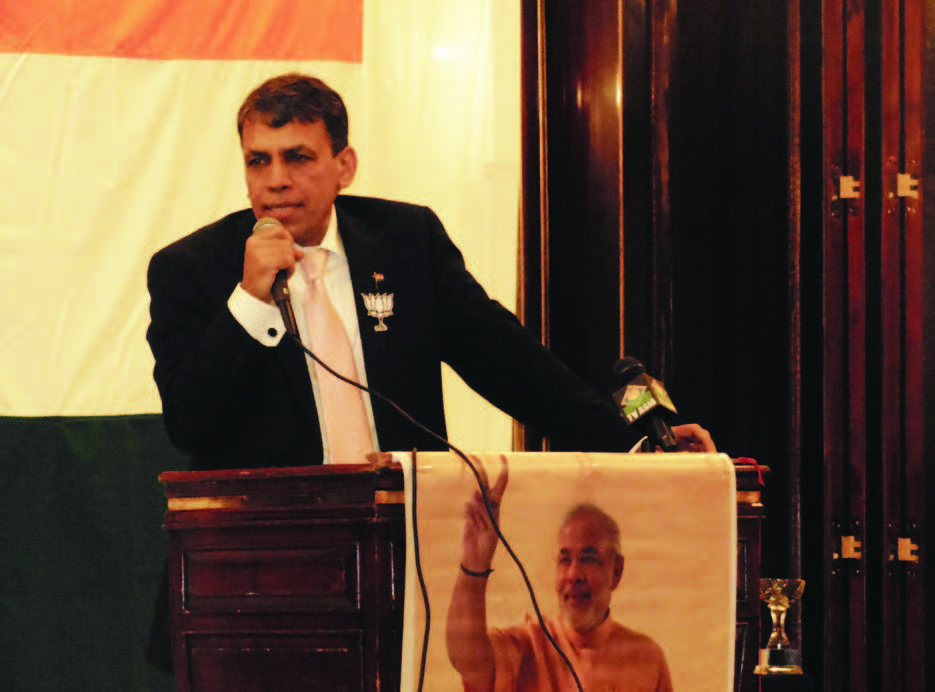
The organization organized a Modi-BJP victory celebration on June 18 in Hicksville which was attended by a diverse section of the Indian American community. , Jagdish Sewhaney, the man behind the organization, recalled his long association with Narendra Modi and described him as a man with strong convictions and a great will power. BJP National Secretary Rameshwar Prasad Chaurasia was the guest speaker.

BJP National Secretary Rameshwar Prasad Chaurasia who was the guest speaker, claimed that Modi would bring about development and India would soon be a leading nation in the world.
When asked how NRIs can be of help in nation building in India, Chaurasia first of all thanked overseas Indians whose voice – over Twitter and other social media even from afar– and support for BJP and Modi in the run up to the general election mattered a lot. “Now, your support is still needed because people’s expectations from Modi government are enormous,” said Chaurasia. He gave the example of poor peasants in Bihar who wanted to make Modi PM hoping that Modi will develop Bihar too like Gujarat so that their sons don’t have to go to Gujarat to find work.” Similarly, he said, India should be so developed that instead of Indians going abroad, NRIs would want to return to their home land.

Darshan Singh Bagga whose organization GOPIO was one of the sponsors hoped India will do well under Modi
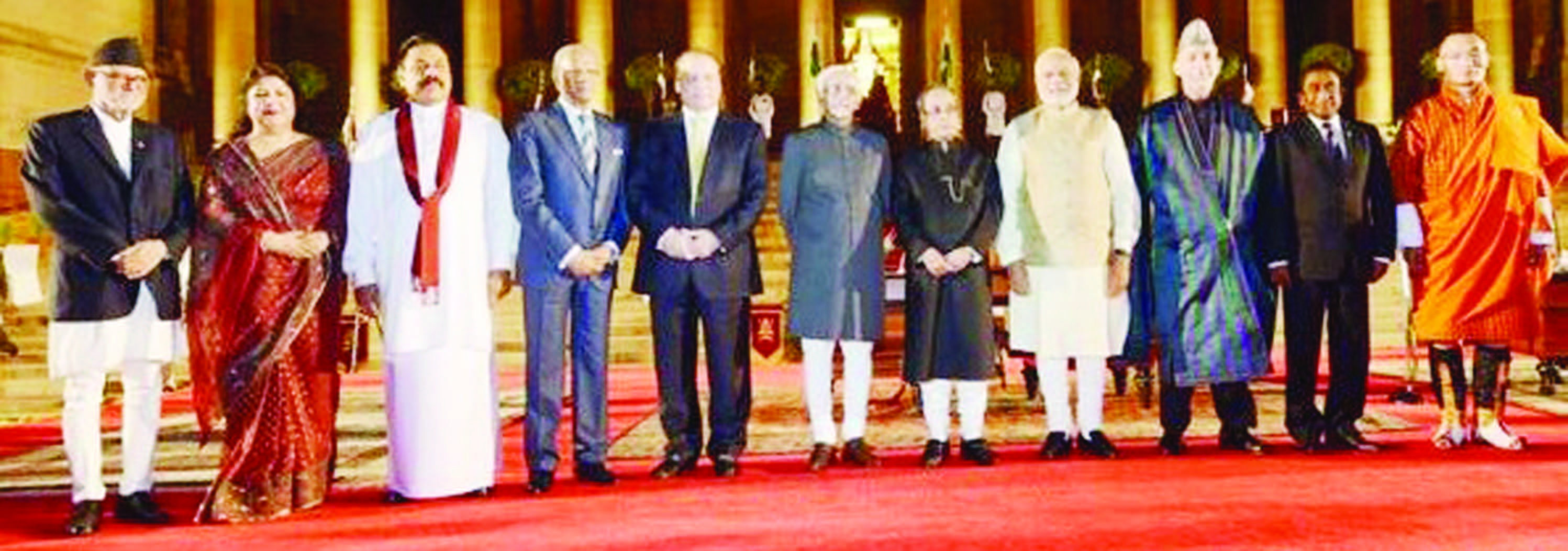
Chaurasia said Modi showed how a strong leader projects strength of a nation when he invited all SAARC heads to his swearing in and they fell over each other to attend. Modi’s slogans have been: ‘Sabaka saath, sabka vikas’, and ‘Ek Bharat, shreshtha Bharat.’ So he is going to see to it that northeast too develops, Bihar and UP too are not lagging behind Gujarat. Chaurasia complimented Modi for breaking the walls of caste and creed, and cited that over 20% Muslims voted for Modi in Varanasi.

He praised Modi’s step to allow 100% FDI in defense production, which will bring in capital and knowhow direly needed in a country “whose ordnance factories cannot even manufacture AK-47s, which even a village in Munghyr has bootlegged.” Chaurasia ascribed falling of rupee value to black money from India hoarded in foreign banks in dollars. And for corruption he blamed bureaucrats more than politicians. Weak ministers depend on bureaucrats who don’t fear losing their jobs and get into shady deals.

View of the gathering
Modi’s incorruptibility is well-known despite ruling Gujarat for 15 years – note that his real brother still runs a ration shop. Chaurasia said that Modi wants to make a beginning by first cleaning up Parliament. “He has asked Supreme Court to decide the pending cases against MPs within one year, so we can be rid of the bad eggs.” Others who spoke welcoming the speaker and eulogizing Modi included Dr Shashi Shah, Sunil Modi, Darshan Singh Bagga, Dr Yash Pal Arya, Mohinder Verma, Dr Narinder Kukar and Dr Azad Anand.
-

Modi’s Japan Visit Postponed
NEW DELHI (TIP): Prime Minister Narendra Modi’s expected visit to Japan next month has been deferred till after the Budget session of Parliament ends in early August. The decision has been taken in view of the Budget Session which is expected to be a pathbreaking one, putting into action many ideas which PM Modi has been talking about since several months.The Cabinet meeting, chaired by PM Modi in New Delhi this evening, decided to recommend the convening of the Budget session in the first week of July, sources said.
The Prime Minister was expected to visit Japan during early July, given the strong strategic, economic and cultural foundations of the bilateral relationship. “However, in view of the ensuing Budget session, it seems unlikely that he will be able to visit Japan before the same,” the sources said. Reports had suggested that PM Modi would be visiting Japan on July 3-4.
The sources said the Prime Minister, however, remains keen to make Japan his first major bilateral visit and it is learnt that the visit to that country will take place any time after the Parliament session. This session of Parliament is very important for the Prime Minister as this will see the presentation of the first budget of the newly-formed government. The Budget is expected to be a pathbreaking one, putting into action many ideas of the Prime Minister, which he has been talking about since several months, the sources said.
-

Modi gives Gujarat its lifeline
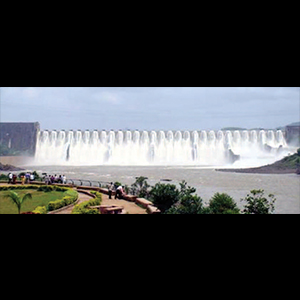
Narmada Dam height to be raised by 17 metres; lakhs will lose their homes, activists say
NEW DELHI/AHMEDABAD (TIP): The government has decided to raise the height of the Narmada Dam by 17 metres — a longstanding demand of Gujarat — within 20 days of Narendra Modi becoming the Prime Minister, raising protests from activist Medha Patkar who drew attention to the resultant displacement of thousands of people. On June 10, the Narmada Control Authority (NCA) approved the proposal to raise the dam’s height from 121.9 metres to 138.7 metres, making it the second highest dam in the world after Grand Coulee in the US. The approval came two days after the Gujarat chief minister Anandiben Patel met Modi and water resources minister Uma Bharti and reiterated the state’s demand.
A higher dam will optimize hydropower generation and water supply capacity of this project, and is expected to benefit not just Gujarat but also neighbouring Rajashthan, Maharashtra and Madhya Pradesh. Gujarat has been demanding this for the last eight years, and Modi would place this demand before the Centre on every official visit to Delhi as chief minister. Medha Patkar, who heads the Narmada Bachao Andolan, held a press conference in Mumbai to say the decision was taken in an undemocratic manner.
“The government has neither given us any hearing nor has it taken any time nor made any attempt to know the ground reality before deciding on the dam’s height,” she said. Patkar said at its present height, the dam has 2 lakh people in its affected region. If the height is raised by 17 metres, the densely populated villages in Nimad area of Madhya Pradesh with houses, farms, shops, temples, mosques and standing crops would be drowned, she said. Asked about the sudden change of stand by NCA which is headed by central water secretary, the Union water resources minister Uma Bharti said the decision was taken on the basis of a report of the ministry of social justice and empowerment on the rehabilitation of displaced people.
“Social justice ministry has given its report and the officials are 100% satisfied (of the measures being taken by the affected states)… All the responsibilities they have to commit they have done. They have full satisfactory report in this meeting today. That is why the decision was taken,” Bharti said. Though the Supreme Court had earlier given the approval for the project to raise the height of the dam, it got embroiled in controversy over displacement of project-affected people.
The main problem had come from Maharashtra as the state had fallen behind the rehabilitation schedule. Some 400 families were left to be resettled, leaving the height issue unresolved. Officials said that the rehabilitation work was now on track, making it possible for the NCA to give its final approval. The NCA has representatives of the four states of Madhya Pradesh, Gujarat, Maharashtra, Rajasthan and representatives of various central ministries. The project, considered a lifeline for parched Gujarat, was inaugurated by Jawaharlal Nehru on April 5, 1961.
-

Churlish Not to Acknowledge Narendra Modi: Shashi Tharoor
NEW DELHI (TIP): Congress MP and spokesman Shashi Tharoor says he should not be called a “Modi fan” after his recent praise for India’s new Prime Minister, but also that it would be churlish not to acknowledge the latter’s efforts to reach out to all.
The former minister’s article in the Huffington Post, titled How Narendra Modi May Have Evolved into ‘Modi 2.0’ has made headlines. Though the Congress has distanced itself from Tharoor’s comments. In an interview to a TV channel Tharoor said, “We have been extremely concerned about what Mr Modi represents and his aspirations and ambitions on coming to Delhi.
What has been a pleasant surprise for the likes of me is the way in which he has actually conducted himself and spoken after his election. From the moment of his victory, he has been amazingly gracious and accommodating particularly in the language he has said and the tone he has used, I think it would be churlish not to acknowledge for example when he says that he would be PM for everyone, including those who have not voted for him, that he would like to serve all Indians.” But the Congressman also added, “We will certainly robustly oppose him.
The duty of an opposition seems to me to stand up for national interest, not to oppose for the sake of opposing everything the government says or does.” He pointed out that he has already voiced concern “about the tendency not of Modi but of some of his supporters to raise sensitive issues – Article 370, the illegal immigrants in Bangladesh, the Common Civil Code – issues that have been raised for reasons that we believe have to serve their sectarian interests and not the interests of India and we have flagged them and we will oppose them strongly.”
When asked if his party was ok with high praise for the PM, Tharoor pointed out that he had not been fired yet and was still the spokesman, adding that his party understood what he was trying to say. But the Congress said the Mr Tharoor’s views are his personal views. “As a party, it is too early to comment on the functioning of the government,” the party’s Shobha Oza said.
Senior Congress leader Mani Shankar Aiyar slammed Mr Tharoor, calling him “immature.” Aiyar said he was deeply offended and disappointed by Tharoor’s praise for Modi. “Can’t believe an intelligent man like Shashi would say this,” he said.
-

Narendra Modi’s First Foreign Visit as PM to be Bhutan
NEW DELHI (TIP): Prime Minister Narendra Modi will travel to neighbouring Bhutan later this month in his first foreign visit after assuming power. PM Modi will be travelling to Bhutan and will hold talks on key bilateral and regional issues with the leadership of the Himalayan nation, top government sources said.
The visit reflects the importance India attaches to its ties with Bhutan whose Prime Minister Tshering Tobgay was among the leaders from the neighbouring countries to attend PM Modi’s swearing-in on May 26. After the swearing-in, PM Modi had held a short duration bilateral meeting with the Bhutanese leader. The PM is also likely to travel to Brazil to participate in the BRICS (Brazil, Russia, India, China and South Africa) summit in mid-July.
-

Modi coming buzz sends top babus on clean-up drive
NEW DELHI (TIP): Central government offices across the capital were on high alert on June 5, with secretaries and other top officials scanning corridors and parking lots. The heightened activity was not part of a security drill but was triggered by an advisory suggesting that Prime Minister Narendra Modi may visit the offices to inspect hygiene and cleanliness. Suddenly, senior officers noticed that toilets were stinking, lights at receptions were on the blink, stretches around water coolers were dirty, paint had peeled off from several parts of the buildings and most corridors were stashed with waste paper and furniture, no longer in use.
With the buzz “Modiji aane wale hain (Modi is about to come)” ringing loud and clear, the administration wing of several departments swung into action by 11am. Secretaries personally asked the cleaning staff to get rid of all unwanted stuff. After lunch, several secretaries in Krishi Bhawan, Udyog Bhawan and Transport Bhawan were out in the corridors, inspecting every corner that till a few hours ago had paan stains.
Painters were hurriedly summoned to ensure that the patchwork did not show. Even tiles were replaced on war footing to ensure that a stubborn stain didn’t spoil the look of an otherwise white corridor. One of the secretaries asked his juniors to ensure that air-conditioners installed in all rooms were in working condition. Urban development secretary Sudhir Krishna reportedly had issued a circular on Wednesday, asking officials to ensure their rooms were decked up and office complexes well maintained.
What triggered the sudden flurry of activity was Modi’s meeting with secretaries on Wednesday during which he instructed all department heads to pep up their workforce and ensure that the working environment was conducive for better delivery. In some ministries, secretaries issued circulars mentioning the priority areas and that rooms and corridors clean had to be kept clean.
In the urban development ministry, for instance, officials have been instructed to take up representations of MPs on priority basis and also ensure that the parliamentary committees’ recommendations are complied with. Secretaries have also issued instructions to set up more IT-based public interface to resolve the problems of citizens expeditiously.
-

US looking forward to welcome MODI TO WASHINGTON
WASHINGTON (TIP): The United States is looking forward to welcoming the new Indian Prime Minister Narendra Modi to Washington, but refrained from making any announcement on the possible trip in September. “We look forward to welcoming the Prime Minister to Washington, nothing to announce on timing at this point,” the state department deputy spokesperson, Marie Harf, told reporters at her daily press conference.
“I don’t have any more details. We said we look forward to welcoming him,” Harf reiterated when pressed further. Earlier last month US secretary of state John Kerry had welcomed Narendra Modi to US during his meeting with the Indian ambassador to the United States S Jaishankar. The assistant secretary of state for South and Central Asia, Nisha Desai Biswal is scheduled to hold meetings in New Delhi over the next several days establishing the first high level contact between the Obama administration and the Modi government after the latter came back to power on May 26.
“Some very productive consultations w (with) my Chinese counterparts on regional connectivity,” Biswal tweeted. In a statement, the North American Punjabi Association welcomed the purposed meeting between Modi and Obama in Washington in September. “This meeting is a step in national interest,” said Satnam Singh Chahal, its executive director. NAPA, he said, will write to Modi to raise the issue of Security and Safety of Sikhs residing in the United States.
-

Pakistan PM Nawaz Sharif Gifts Sari to Narendra Modi’s Mother
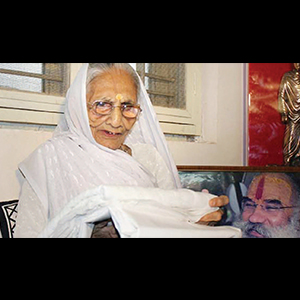
GANDHI NAGAR (TIP): Pakistan Prime Minister Nawaz Sharif has sent a white sari for the mother of his Indian counterpart Narendra Modi. Obviously, it is a return gift from Pakistan Prime Minister whom Modi had gifted a shawl for his mother when he was in New Delhi to attend his swearing-in as Prime Minister of India.
Modi thanked Sharif in a tweet, June 5: “Nawaz Sharif ji has sent a wonderful white Sari for my Mother. I am really grateful to him & will send it to my Mother very soon.” Immediately after being sworn-in on May 26, Modi took to Twitter to share his informal conversation with his Pakistani counterpart. He said Sharif had talked about pictures of Modi’s mother offering him sweets. “The visuals touched both Nawaz Sharifji and his mother.
He (Sharif) told me after seeing the visuals, his mother got very emotional,” Modi had tweeted. He also tweeted, “Nawaz Sharif ji told me that he stays in Islamabad but goes to meet his Mother once in a week.” Modi had sent the shawl for Sharif’s mother with the Pakistani leader, whose daughter Maryam Nawaz Sharif had tweeted, “Thank u v much PM @narendramodi for the beautiful shawl for my grandmother. My father personally delivered it to her.” A good beginning on human level.
-

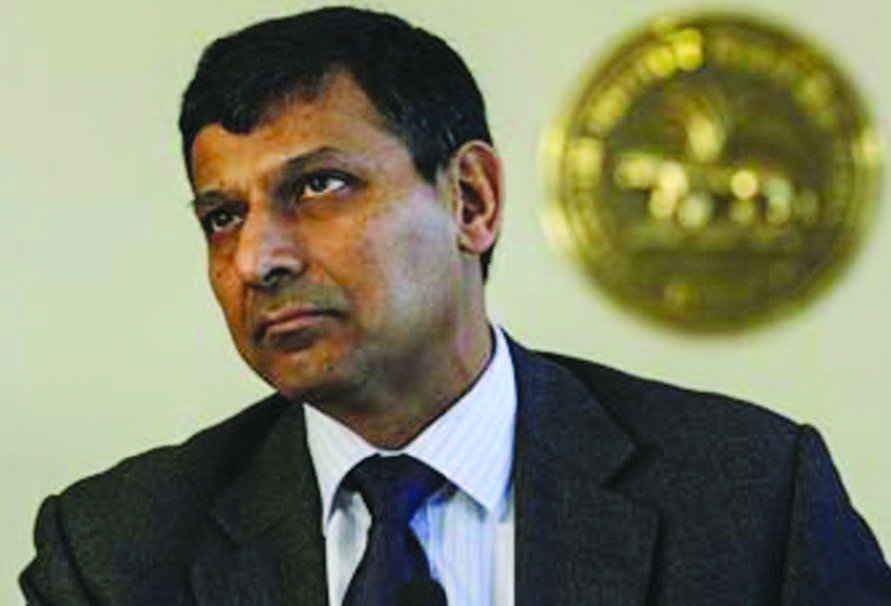
RBI’S “007” RAJAN FACES PRO-GROWTH BOSS IN MODI
MUMBAI (TIP): Hailed as a troubleshooting “James Bond” of central bankers amid India’s currency crisis last year, Raghuram Rajan was given a licence to kill inflation with higher interest rates and drive a programme of monetary policy reforms. Now, the governor of the Reserve Bank of India (RBI) may need all the suave charm of the fictional British spy to sell that same hard-nosed agenda to a powerful new prime minister who is determined to revive economic growth and create jobs. Rajan, who calls high inflation a “dangerous disease”, won plaudits after he took office in September for arresting a rupee freefall and helping restore investor confidence that had all but evaporated under a lame-duck government led by the Congress party.
This month’s decisive election win by the pro-growth Bharatiya Janata Party (BJP) shifts the power dynamics. Now, investors and voters are looking to Prime Minister Narendra Modi to stir India’s economy from its prolonged torpor, putting Rajan and Modi on a collision course if inflation stays high. In his first months on the job, Rajan overcame push-back from within the central bank as well as the finance ministry to shift the benchmark inflation measure from wholesale to consumer prices.
The consumer price index (CPI) is the global standard, but in India the higher level of CPI meant Rajan was likely to keep rates tighter for longer. High interest rates make credit more expensive and create a difficult environment to re-ignite growth. But if, as many expect under Modi, the investment climate improves and government expenses are managed better, Rajan might get some relief on the inflation front. Investors expect Modi to bring down inflation by cutting subsidies, improving food distribution and promoting investment in infrastructure.
“The Modi-Rajan equation reminds us of that between Volcker and Reagan, where it was a combination of the central banker’s inflation-fighting cred and the latter’s charismatic image,” said Philippe Jauer, chief investment officer at fund manager Amundi Singapore. Paul Volcker was head of the U.S. Federal Reserve when Ronald Reagan was president in the 1980s. For now, the RBI is expected to leave interest rates on hold at its policy review on Tuesday, but investors will be scouring Rajan’s accompanying statement for clues to whether the new government’s strong electoral mandate has changed his rate outlook. Investors expect the next policy move will be a rate cut, but perhaps not before early next year
TIES AT THE TOP
A professor at the University of Chicago and former chief economist at the International Monetary Fund, Rajan was brought back to India in 2012 to be chief adviser to then-finance minister P. Chidambaram of the Congress party, which meant the two already had a working relationship when Rajan took over at the RBI. After stunning the markets with a series of bold measures on his first day, he was dubbed variously by the Indian media as “The Guv” and “a rock star banker”.The “Name’s Rajan, game’s Bond,” the Economic Times daily gushed on its front page, with a photo-edited picture of Rajan in an action pose and brandishing James Bond’s trademark Beretta pistol, albeit one made of rupee notes. Rajan, 51, has proven to be a pragmatic – if not swashbuckling – operator at the RBI, pushing to streamline a staid institution, deepen markets, and reform policymaking to control the country’s grinding inflation. Rajan and the new finance minister, Arun Jaitley, 62, a prominent corporate lawyer, held a meeting in New Delhi on Tuesday, but have not previously worked together.
Jaitley is not seen to be as hawkish as Rajan on inflation – a dynamic that is typical between central bankers and governments around the world and often leads to tension. One senior finance ministry official who worked with Rajan and was part of the team that made a presentation this week to Jaitley said Rajan’s initiative to set an inflation target based on CPI could create conflict if, as many expect, CPI rises in coming months. “Rajan is … making things difficult for the government by publicly speaking about RBI’s stance on the CPI inflation.
He would not find it easy to backtrack even if he wants to adjust with the new government,” the official said. The shift would give the central bank a clear price-stability mandate and make fighting inflation its chief objective. Previously, the RBI was charged with promoting growth and financial stability as well as controlling inflation.
FAR FROM DONE
Getting the new government’s support for inflation targeting is far from a done deal. Rajan has done what he can to set an informal target by establishing a “glide path” to get CPI inflation down to an annual 6 percent by January 2016 and 4 percent, plus or minus 2 percentage points, a year later. CPI inflation was at 8.59 percent in April year-on-year after running near or above 10 percent for almost two years through the end of 2013. “Inflation targeting will require trying to convince the government, and I think it won’t necessarily be a bed of roses.But I think it is a right step,” said Rajeev Malik, senior economist at CLSA in Singapore. Inflation targeting and setting up a monetary policy committee – as Rajan proposes – both require legislative changes. Agreeing on the make-up of a committee, including whether the government would appoint members and who they might be, could prove contentious. Rajan recently softened his tone, noting that inflation targets are for the medium term and are flexible, and that the proposal does not aim to turn the RBI into “inflation nutters”.
However, he was uncharacteristically blunt on the subject of RBI independence in other recent remarks. “I am happy to talk to the government, I am happy to listen to the government, but ultimately the interest rate that is set is set by me,” he said at an event in St. Gallen, Switzerland. “The government can fire me, but the government does not set monetary policy.” On Tuesday, after his first meeting with Jaitley as finance minister, he said fighting inflation would continue to be a priority, although the RBI will also aim to strike a balance between spurring economic growth and containing prices. “RBI has always maintained the balance between growth and inflation,” he told reporters.
-

WILL MEET YOU, YOUR SECRETARIES ONE-ON-ONE: MODI TO MINISTERS
NEW DELHI (TIP): Stressing on “sushasan” or good governance as the cornerstone of his government, Prime Minister Narendra Modi on May 29 gave “advice” to Cabinet colleagues — from asking them to frame priority areas for the first 100 days, to giving adequate work to Ministers of State and responding promptly to communication from the states. The PM, who chaired the second meeting of the Cabinet since the government was sworn in on May 26, told his ministers that he would meet one-on-one with all of them, as well as with their secretaries, in the coming days.
“The PM stressed on efficient overall governance, delivery systems and implementation of programmes,” Parliamentary Affairs Minister M Venkaiah Naidu said after the Cabinet meeting. “He asked the ministers to frame their priority lists for the first 100 days. He also asked them to give priority to issues that were pending, or were nearing resolution,” Naidu said. Modi asked Cabinet colleagues to take their Ministers of State “into confidence”, and “give them adequate work”.
“It has to be worked out in a way that Ministers of State feel they are a part of decision-making. The PM has asked Cabinet ministers to take their Ministers of State along,” Naidu said. He explained that although a Cabinet minister could not leave decision making entirely to an MoS, it was important to “take them along and give them proper work” to make them feel involved in governance.
Ministers of State in past governments have often remained without enough work to do. While the 10 Ministers of State with Independent Charge are likely to be busy, Modi is keen to ensure that the 12 Ministers of State attached to Cabinet ministers too have some say in his government. The PM also asked Cabinet colleagues to be sensitive in dealing with issues raised by states, and to be prompt in replying to them. “He has worked as a chief minister and believes in maintaining the federal structure of the country,” Naidu said.
-

Don’t Include Me in Textbooks, Tweets Prime Minister Narendra Modi
NEW DELHI (TIP): Prime Minister Narendra Modi has urged states not to include him in school curriculum, in a series of May 30 morning tweets. “Am reading in the news that some states want to include Narendra Modi’s life struggles as a part of their school curriculum…I firmly believe that the life story of living individuals should not be included as a part of the school curriculum,” Mr Modi said in tweets that were in minutes retweeted several hundred times. He also said, “India has a rich history of several stalwarts who made India what it is today.
Young minds should read about these greats & emulate them.” The PM’s suggestion comes amid reports that the BJP government in Madhya Pradesh has been considering proposals to include a chapter on Modi in school textbooks. “School textbooks already have chapters on biographies of freedom fighters and even Prime Ministers who have done well. So a biography of Mr Modi in textbooks will inspire students, as he has had a humble beginning as a tea vendor and now he has become the Prime Minister,” Madhya Pradesh school education minister Paras Jain had told NDTV earlier this week.
He said he would discuss this soon with Chief Minister Shivraj Singh Chouhan and officials, to initiate a Modi chapter in textbooks for students from classes III to VI in state Government-run schools from next year. (Shivraj Singh Chouhan, Ministers to Meet Prime Minister to Discuss Issues in Madhya Pradesh). The Congress in the state has criticised the proposed move, suggesting that including former PM Atal Bihari Vajpayee in school textbooks will be more appropriate. “The BJP government, by doing this, is hoping to score some brownie points with the new Prime Minister,” a state Congress leader said.
-

Modi earns appreciation in US media for his SAARC outreach
NEW YORK (TIP): Prime Minister Narendra Modi has earned enormous appreciation in the American media for his out-of-the-box and successful diplomatic outreach that saw the leaders of South Asian nations, notably Pakistan, attend his swearingin ceremony, followed by bilateral talks with each one of them on his very first day in office.
Noting that the attendance of Pakistan Prime Minister Nawaz Sharif and other SAARC leaders “signals an early effort by Modi to strengthen political and economic ties in the region”, Time magazine spoke of the belief among many observers that the Modi Government “may take on a more Asia-centric approach to foreign policy”, even if the US continues to be an important ally.
Modi’s initiative in reaching out to Sharif after his “hard-line oratory on Pakistan” during the recent election campaign was seen by The New York Times as a move that offers “some hope that the two countries may resume a tentative peace process after a year and a half of frosty silence”.
The paper, however, advanced the view that further steps towards dialogue may prove difficult, given the past experience when talks have “derailed repeatedly over security issues, finally coming to a halt after cross-border skirmishes in Kashmir early last year, when an Indian soldier was beheaded”.
Participating in the Voice of America’s Encounter program, Lisa Curtis, South Asia expert from The Heritage Foundation, felt that despite the conciliatory gestures, there are hardline currents under the surface in both Pakistan and India.
“If, God forbid, we have some kind of major attack in India, I think we’re going to see a tougher response from a BJP Government than we would have expected to see under Congress,” Curtis said. Modi isn’t looking to pick a fight with Pakistan, she said and noted that Sharif “will have to ensure that the military backs him in anything he does with India”.
“He’s learned the hard way that he certainly (can’t) defy the Pakistan military. In terms of the Pakistan military calculations, it’s unclear if they’re interested in having Pakistan engage a BJP Government or not,” said Curtis. Writing in the Foreign Policy magazine, South Asia expert Neil Joeck from the University of California, Berkeley, notes that Modi’s victory could offer a new chance to the Obama administration to make good on its much-touted “Asia pivot” vision.
“India has arguably been the least appreciated and attended to element of Obama’s foreign policy in Asia. The President started off on a good foot by inviting then- Prime Minister Manmohan Singh for a state visit in November of 2009 but little developed subsequently,” writes Joeck, blaming the Obama administration for looking at India “through the prism of Pakistan’s historic grievances, rather than in the context of a broader global strategy”.
-

PM Modi Asks Ministers to Fix 100-Day Agenda, Lists Top 10 Priorities
NEW DELHI (TIP): At a meeting of his Cabinet on May 29 Prime Minister Narendra Modi asked his ministers to prepare a list of issues that they will take up in the first 100 days in office, with a focus on efficiency, delivery systems and implementation. The PM also has a list of top 10 priorities, sources said.
HERE ARE THE TOP 10 PRIORITIES:
- To remove hurdles in economic growth which includes containing inflation as a priority.
- To prioritize education, energy and water. Modi has repeatedly during his campaigns said that the expectations of the education system remain to be fulfilled.
- To bring in reforms in infrastructure. Industry experts have in fact called upon the new government to focus on attracting investments in key sectors, especially the infrastructure space, to revive growth and investor confidence. Modi has focused repeatedly in many election rallies to make India a global manufacturing hub.
- To provide a people-oriented government and governance. Modi has often stressed that mere good governance is not enough, and that it has to be pro-people and pro-active. Good governance is putting people at the center of development process.
- To ensure time-bound implementation of policy. The BJP has often criticized the UPA for policy paralysis and economic stagnation.
- To maintain consistency in policy.
- To promote e-auctioning in government tenders and other government work. The idea is to encourage transparency.
- To improve inter-ministerial coordination. Modi has already informally asked secretaries of various departments to give their views on whether some ministries should be clubbed to ensure better coordination.
- To build confidence in the bureaucracy.
- To empower and provide freedom to the bureaucracy
-

CHINA PM LI KEQIANG RINGS NARENDRA MODI WITH OFFER OF ‘ROBUST PARTNERSHIP’
NEW DELHI (TIP): Chinese Premier Li Keqiang on May 29 called up Prime Minister Narendra Modi and expressed his government’s desire to establish a “robust partnership” with India. Modi, on his part, expressed “keenness” to work closely with China on all “outstanding issues”. Li is the first foreign leader to call up Modi after he was sworn in. Chinese Foreign minister Wang Yi is coming to Delhi on June 8, and could become the first foreign minister to visit India after the new government took over.
Modi, as chief minister of Gujarat, had visited China in November 2011, much before the West started engaging with him. Modi and Li spoke through interpreters for about 25 minutes. The Chinese leader “congratulated Modi on his victory in the recent general elections and conveyed the Chinese government’s desire to establish robust partnership with the new government of India for further development of relations between the two nations,” the Ministry of External Affairs said. Modi noted that China “was always a priority” in India’s foreign policy, and welcomed “greater economic engagement” between the two countries.
He underlined his government’s resolve to utilise the full potential of “our strategic and cooperative partnership with China and his keenness to work closely with the Chinese leadership to deal with any outstanding issues in bilateral relations by proceeding from the strategic perspective of our developmental goals and long-term benefits to our peoples”, the MEA said.
The two leaders agreed to keep up frequent high-level exchanges and communication. Modi also thanked Li for his earlier message of felicitation, and extended an invitation through him to President Xi Jinping to pay a visit to India later this year. China had formally greeted Modi, and sent a special message through Indian Ambassador to Beijing Ashok K Kantha during Kantha’s meetings with Wang and State Councillor and Special Representative for the border dispute, Yang Jiechi.
Li had greeted Modi immediately after he was sworn in as Prime Minister, saying China viewed India as a “natural cooperative partner”, and was ready to work with the new Indian government to take their strategic cooperative partnership to a “new level”. Modi and Xi will have an opportunity to meet during the BRICS (Brazil, Russia, India, China and South Africa) summit, to be held in Brazil in July. Meanwhile, US Secretary of State John Kerry became the first leader to call up the new External Affairs Minister Sushma Swaraj. Kerry said the US looked forward to “re-energize ties” with India. Swaraj also got calls from her counterparts in the UK, Australia, Canada, Israel, South Africa and the UAE.
-

Narendra Modi quits Vadodara, retains Varanasi
NEW DELHI (TIP): Prime Minister Narendra Modi on May 29 vacated Vadodara constituency, retaining Varanasi. Modi had won Vadodara by over 5.70 lakh votes, the highest margin in the 2014 polls and the second highest in any Lok Sabha election.“Resigned from Vadodara LS seat.
Due to people’s affection got elected by historic margin. Will always remain grateful to people of Vadodara,” Modi tweeted on May 29. He added retaining Varanasi will offer him a “wonderful opportunity to serve Ganga Maa and work for Varanasi’s development”. As BJP workers started speculating who would be fielded from Vadodara, state party general secretary Vijay Rupani said, “There is still time… It will be decided by our parliamentary board and the party will give its approval to the name it suggests.”
Among the possible candidates, according to BJP sources, are Samarjitsinh Gaekwad and Balu Shukla. Some in the BJP were also wondering if Amit Shah would be fielded, but a senior leader in Vadodara said, “We have been told by the party top brass that Modiji has expressed a desire to keep Amitbhai free of responsibilities so that he can discharge his duties as a strategist, since his focus is also on the UP assembly polls next year. Right now, Samarjitsinh and Balu Shukla are in the running.
There are a couple of other local leaders…” The leader said the party is also contemplating fielding a woman candidate, but “the decision will be Modiji’s”. “It will not be easy to repeat for the new candidate what party workers did for Modi, but we are committed to doing our best for whoever is fielded,” city BJP president Bharat Dangar said. “At his rally in the city after winning the seat, Modi had thanked voters for sending him to Delhi, giving a hint he was planning to leave this seat.”
And Modi’s election-in-charge Bhupendra Lakhawala said, “Whoever the candidate is, party workers will do their best to ensure a big win.” Modi, who needed to relinquish at least one seat within two weeks of the results, submitted his resignation from Vadodara in the office of the Lok Sabha Speaker, party sources said.
-

Modi Rules Out Renaming Projects Begun by UPA Government
NEW DELHI (TIP): Prime Minister Narendra Modi, who has wasted no time in establishing ground rules and work processes for his government, has reportedly told his ministers that there will be no renaming of projects begun by the previous regime as he bans “old-style functioning.”
Sources said he is also yet to decide whether he will at all address the nation in a live telecast, as there is a view that it’s an old form of interaction with the people of the country. Sources said Modi, who tweets his thoughts every day and is an avowed fan of social media, could well choose to use the Parliament session beginning next week to share his top priorities.
-

NAJMA HEPTULLAH, THE LONE MUSLIM FACE IN MODI CABINET
NEW DELHI (TIP): Grandniece of eminent freedom fighter Maulana Abdul Kalam Azad, Najma Heptullah is the lone Muslim face in the Narendra Modi Cabinet. Once a prominent Congress member in the Rajya Sabha, she left the party in 2004 due to a strain in relationship with top party leaders for her close association with the Atal Bihari Vajpayee-headed NDA government and joined the BJP.
Heptullah,who was re-elected to the Upper House five times between 1986 and 2012, was elected to a one-year term as the deputy chairman of the Rajya Sabha in 1985, and she again served in that post from late 1988 to mid-2004. Rising quickly in the BJP leadership, she was fielded by the party as a candidate for the post of vice-president against the UPA nominee, Hamid Ansari.
She, however, lost the election. When Nitin Gadkari became the president of the BJP in 2010, she was appointed as one of the 13 vice-presidents of the party. She had almost lost prominence in the BJP when Rajnath Singh became the new chief of the party. Heptullah was dropped from the post of BJP vice-president and was made a member of the party’s national executive.
An eminent writer,Heptullah has published several research papers in foreign and Indian journals and also contributed to many Indian and foreign magazines on issues relating to women and social development. Heptullah (74) has also worked as a member of the Advisory Committee and Editorial Board of ‘The Indian Journal of Zoology’ and ‘Journal of Anatomy’. Born in Bhopal, she is married and has three daughters. She holds both a MSc degree in zoology and a Ph.D in cardiac anatomy from the University of Denver.
-

Jayalalithaa to Meet Narendra Modi on June 3 Amid Talk of Alliance
NEW DELHI (TIP): J Jayalalithaa, Tamil Nadu chief minister, will meet Prime Minister Narendra Modi in Delhi on June 3, amid the buzz that she is in talks with the ruling BJP to join the central government. The AIADMK leader had skipped Mr Modi’s oath ceremony in protest against the presence of Sri Lankan President Mahinda Rajapaksa. Officially, Tamil Nadu has said that she will meet Modi on June 3 to discuss issues related to her state’s growth. Sources said BJP leaders have been in touch with Ms Jayalalithaa, who swept Tamil Nadu in the general elections, winning 37 of the state’s 39 Lok Sabha seats.