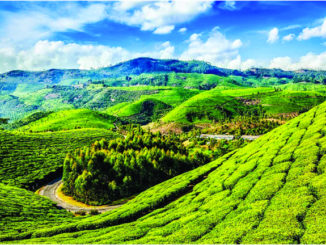
Popularly known as “God’s Own Country”, Kerala is one of the most sought after tourist destinations in the world. This exotic land is renowned for its rich cultural heritage, tropical climate, palm fringed beaches, misty hill stations, health resorts, wild life sanctuaries, enchanting art forms, grand festivals and, the serenity of the backwaters and the emerald blue Arabian Sea which promise an unforgettable holidaying experience to travellers. According to “National Geographic Travel”, the leading travel Magazine, Kerala is one of the 50 must see destinations of a lifetime and one of the 10 paradises of the World.
Top Places to Visit
Munnar
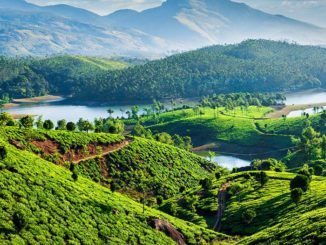
Munnar is a popular hill station of Kerala perched at an altitude of 1600 metres in the Western Ghats. Famous for its tea estates, various shades of green, blankets of mist forming natural-view points, Munnar is aptly known as the ‘Kashmir of South India’.
Munnar is a popular destination for a honeymoon with an abundance of resorts and cottages. Situated on the banks of three rivers- Madupetti, Nallathanni and Periavaru.
Munnar is divided into Old Munnar, where the tourist information office is, and Munnar, where the bus station and most guest houses are located. The Eravikulam National Park, Salim Ali Bird Sanctuary and tea plantations are its major attractions.
Alleppey
Officially called Alappuzha, Alleppey is the picture-perfect place known for its beautiful backwaters and the houseboats offering overnight stays. The coastline of Alleppey offers some of the best beaches in Kerala with water sports during the dry season.
Alleppey is located close to Kochi in the South Indian state of Kerala. Its palm-fringed inter-connect network of canal backwaters attracts a lot of tourists from all over the world. Coupled with other beautiful places in Kerala, Alleppey is often considered for a honeymoon or for a great family vacation.
There are plenty of houseboats, homestays, and rejuvenating Ayurvedic resorts that make staying in Alleppey brilliant. The houseboats pass through the serene backwaters, where you can catch glimpses of green paddy fields, choir-making activities, beautiful avifauna, and witness the life of locals in Kerala.
Be sure to catch a traditional snake boat race in the months of August and September and try out some toddy (palm wine) at a local toddy shop for adding a touch of authenticity to your travel experience in Allepey.
Wayanad
Replete with waterfalls, historical caves, comfortable resorts and homestays, Wayanad in Kerala is famous for its spice plantations and wildlife. Walking through the sprawling spice plantations, trekking to the pre-historic caves and experiencing a resort holiday are one of the many things you can do to get a taste of Wayanad.
Wayanad is best known for the wildlife reserves – Wayanad wildlife reserve which is home to an exquisite variety of flora and fauna. Wayanad wildlife reserve is an integral part of the Nilgiri biosphere reserve peacefully located amidst the serene hills of Western Ghats. Wayanad homes a wide variety of wildlife like elephants, leopards, and bears. Wayanad is a perfect weekend idea from the cities of South India. If taking a road trip from Bangalore, you will drive through three national parks: Nagarhole, Bandipur and Mudumalai.
Thekkady
Home to the country’s largest Tiger Reserve- Periyar, Thekkady is a great way to enjoy a jungle vacation. Periyar National Park, being a major attraction, is one place where you can enjoy bamboo rafting in the catchment area of Mullaiperiyar Dam, hiking, and in the midst of the wilderness, shopping! Popular for its good eating joints, you can also enjoy its vast stretches of spice gardens and various adventure sports. You can also enjoy a night trek in the wilderness of Periyar. The early morning ride in the boat within the sanctuary is an extremely awesome experience and you might be able to spot wild elephants, bisons, wild boars, various kinds of birds, etc. Anakarra is also located nearby which is a great place to enjoy nature. Murikaddy is located around 5 km from the city and is famous for coffee and spices plantations. Chellar Kovil is another area located nearby with a lot of picturesque waterfalls and cascades. Mangala Devi Temple, located at an altitude of 1337 m and at a distance of around 15km from Thekkady opens only on the Chitra Pournami Festival.
Varkala
Varkala is a coastal town in the southern part of Kerala known for the unique 15m high ‘Northern Cliff’ adjacent to the Arabian Sea. It is popular for its hippie culture, shacks on the cliff serving great seafood and playing global music and the samadhi of Kerala’s saint Sree Narayana Guru. Varkala is also known for Jardana Swami Temple, also known as Dakshin Kashi. Varkala has some of the best pristine beaches, hills, lakes, forts, lighthouses, natural fisheries and springs – all of this together makes this town a little paradise. You will also find a lot of shops with signboards in Hebrew selling Yoga mats, oxidised silver jewellery and harem pants made of cotton. Ayurvedic spas, affordable resorts, hostels, clean beaches make it a must-visit city of Kerala.
Poovar
Poovar is a small rustic town situated 27 kms from Thiruvananthapuram with unspoilt, unexplored golden sand beaches and beautiful backwaters of Kerala. Also known as a fishing village, the tranquil Poovar island lies between the Arabian Sea and the Neyyar River. Hiring a boat, (especially during the sunset)that will take you through the mangrove forest of backwaters is a must-do activity. The town has some of the beautiful resorts and hotels that are known for the hospitality they offer.
While regional parties will continue to be significant in various States of the Union, the principal challenge of overcoming majoritarianism lies in the Hindi heartland, especially in U.P. Oppositional electoral alliances, notably the formation of a federal front, are important strategies in this battle but it is no less important to challenge the ideological foundations of the majoritarian project through progressive and inclusive politics.
The landslide victory of the All India Trinamool Congress in the West Bengal Assembly elections and the pushback of the Bharatiya Janata Party (BJP) in West Bengal, Tamil Nadu and Kerala have given rise to a pervasive belief that right-wing politics can be defeated by regional assertions. Undoubtedly, regional and cultural assertion in these States acted as an effective bulwark against the BJP’s expansionary plans in southern and eastern India. The regional-cultural tropes deployed by Mamata Banerjee, for example, worked so well that at one point, Home Minister and BJP leader Amit Shah was even forced to clarify that if the BJP is elected, someone from Bengal would be the Chief Minister. This underlines the effectiveness of regional culture and politics in trumping communal politics. However, this claim needs to be tempered by the realism that it cannot work in the Hindi heartland, which is dominated by caste and communal politics, and has so far not seen any serious ideological and political challenge to politics based on these identities.
Encompassing nine States whose official language is Hindi, namely Bihar, Chhattisgarh, Haryana, Himachal Pradesh, Jharkhand, Madhya Pradesh, Rajasthan, Uttar Pradesh (U.P.) and Uttarakhand, this region retains a central position in the electoral strategies of the BJP and its larger political imagination. The party’s stunning show in these States propelled it to power in the 2014 and 2019 parliamentary elections. Its continued political dominance in the heartland will neutralize its losses now as well as in future in States where it has been bested by regional players. I will focus here on U.P. to illustrate the limits of the regional assertion.
Dimensions in the heartland
The Hindi heartland is clearly different. There are at least four important dimensions of this difference. First is the absence of regional identity in States such as U.P. This is evident from the debate on States reorganization and the reorganization of Uttar Pradesh in the 1950s. The compulsions of nation-oriented identity emerged very clearly from the discussions in the States Reorganization Commission on suggestions for the division of U.P. for administrative convenience. U.P. leaders argued for a large and powerful State in the Gangetic valley as a guarantee of India’s unity.
In this sense, U.P. was considered the backbone of India and the centerpiece of political identity in modern India. Importantly, it was supposed to provide the chief bulwark against growing regionalization and fragmentation elsewhere. Instilling a sense of regional pride, an essential part of Congress strategy in southern and coastal India, was not followed in U.P. U.P. was seen as the political heartland in contrast to Punjab and Bengal for instance, which were splintered and incorporated into two different nation states. As is well known, the bases of this post-colonial identity varied from its location in the freedom struggle to staking claim as the cultural homeland of Hindi and Hinduism. In both cases, it was centered in the idiom of the nation-state and strong central authority.
Second, although U.P.’s cultural homogeneity remains a matter of disagreement, the idea of the heartland had great resonance among the political elite who opposed the demand for U.P.’s reorganization. The long-standing traditions of composite cultural identity and shared plural cultures began to yield place to a singular homogenized identity. The Hindi-Urdu divide, which mirrored the communal cleavage of U.P. society, played a crucial role in this process. Urdu was excluded as it was seen to symbolize Muslim cultural identity in independent India, while Hindi was boosted to promote the development of a Hindi-Hindu heritage for this region. The project of homogenization of Indian/U.P. culture as Hindu culture was quickened in later decades. Even though it would be hard to assume a direct link between Hindi dominance and communal politics of subsequent decades, it is nevertheless a fact that all political parties in the State used it as an ingredient of social and cultural differentiation and a means to consolidate political dominance.
Role of communal politics
Third, it is clear that communal politics and communal movements have played a key role in U.P.’s modern history which in turn have diluted other identities.
In some respects, this process gained momentum in the wake of Partition which cast its long shadow upon political institutions and culture in U.P. and to a great extent affected the perspectives of Hindus and Muslims alike. Hindu nationalism was marginalized within the Congress party but many of its ideas were accepted in framing party policies. The State leadership was instrumental in forging a conservative consensus in the State under Chief Minister G.B. Pant who steered the affairs of the state for eight years after Independence.
The intensification of communal politics took a new turn with the mass mobilization for the construction of a Ram temple at Ayodhya which was deftly used by the Hindu right to establish a major presence in U.P. and to facilitate the political reconstruction of U.P. through the promotion of a collective Hindu identity. The crusade for the appropriation of disputed shrines is central to the communalization of politics and short circuiting the more complex process of political expansion for the BJP.
Importantly, this has laid the groundwork for building permanent electoral majorities through the deployment of ascriptive symbols in U.P. which, given its huge size, helps it to establish a strong base in the Hindi heartland to offset the appeal of countervailing identities elsewhere in India.
Caste politics too
Finally, caste politics which was expected to counter Hindutva expansion has failed to do so; in fact, caste politics has become a building block for the BJP’s expansion. The party has reached out to Dalits, actively mobilizing them and other backward castes to assimilate them into the Hindutva meta-narrative. Instead of erasing caste from electoral politics, the BJP-Rastriya Swayamsevak Sangh has sought to court fragments of castes as a way of undermining broad-based political movements and opposition to it. It has used the wider appeal of Hindu nationalism to co-opt backward castes and Dalits who are keen to align themselves to the larger narrative of Hindu nationalism.
A reset is needed
While regional parties will continue to be significant in various States of the Union, the principal challenge of overcoming majoritarianism lies in the Hindi heartland, especially in U.P. Oppositional electoral alliances, notably the formation of a federal front, are important strategies in this battle but it is no less important to challenge the ideological foundations of the majoritarian project through progressive and inclusive politics. This requires a reset of the basic political mindset in U.P. which can only be done by reviving the splendid heritage of the national movement in which this region played a central role and in which Gandhiji and Nehru played a heroic part. Invoking the spirit of the Bhakti movement which was the first major challenge to the religious orthodoxy of Hinduism would also help in resetting the cultural clock. This must, however, combine with much greater concern for the fundamental social and economic issues of the State, and making the struggle between communal and secular forces the central issue through public campaigns that address the problems of religious traditionalism and the cultural underpinning that this provides to the push to make India a Hindu state.
(Zoya Hasan is Professor Emerita, Jawaharlal Nehru University)
India on Thursday, March 11, logged 22,854 new Covid-19 cases, the highest in nearly three months as well as this year, as Maharashtra, Kerala, Punjab, Karnataka, Gujarat and Tamil Nadu continued to fuel the pandemic burden. The total cases reached 1,12,85,561, riding on a surge in 24-hour infections. It was 76 days ago on December 25 that 23,067 cases were recorded. India’s active cases have gone up from a low of 1.35 lakh on February 12 to a high of 1.89 lakh today, but the government said the disease graph was stable nationally. The high-burden states, it said, needed to prioritise vaccinations. The surges have been high in six states in particular. The daily new cases in Punjab grew around 4.5 times between February 11 and March 11, from 2,112 to 9,402. The rise is around six-fold when compared with 1,388 cases in the first week of February. With around 8,000 cases and over 100 deaths reported over the past one week, Punjab appears headed towards a spike worst than the one in September last when over 60,000 cases were reported in a month. The active cases too have shot up five times—from around 2,000 in February first week to almost 10,000 today. The state today also saw imposition of night curfew in Patiala and Ludhiana districts in view of the rising cases. The government said India had seen active cases as high as 10 lakh on September 18 last and the situation nationally was overall in control, except in six states. The eight of the country’s 10 highest active case burden districts are in Maharashtra and one each in Kerala and Karnataka. The government said Haryana, Gujarat and Madhya Pradesh were at a tipping point and were yet to enter a surge, said Union Health Secretary Rajesh Bhushan. In MP, daily cases have risen from 1,951 on February 11 to 3,915 on March 11; corresponding period rise in Haryana is 824 to 2,440 and in Gujarat from 1,800 to 3,529. On vaccinations, the government said the speed was satisfactory with 2,56,90,545 doses administered till today morning. Globally, India is second only to the US on the speed and scale of inoculation. As of March 9, the US had delivered 9.36 crore doses followed by India (2.43 crore) and the UK (2.37 crore). “The signs from Maharashtra are very worrying. Do not take the virus for granted. It can come up unexpectedly. We also need to caution Delhi as many adjoining districts like Gurugram, Ghaziabad and Gautam Budhh Nagar are seeing surges,” the government said. Punjab health officials said the state may see the worst spike by March-end with cases expected to soar to 3,000 a day. The state has recorded around 8,000 cases and over 100 deaths in a week. Meanwhile, PM Narendra Modi’s mother Hiraben, a centenarian, took her first dose of Covid-19 vaccine on Thursday.
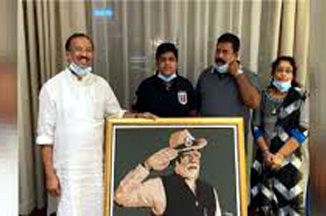
DUBAI (TIP): A 14-year-old Indian – origin student in Dubai has made a special portrait of Prime Minister Narendra Modi as a gift for the Republic Day. The six-layered stencil portrait made by Saran Sasikumar from Kerala was handed over to Minister of State for External Affairs and Parliamentary Affairs V Muraleedharan on the concluding day of his three-day visit to the UAE on Thursday. “Happy to meet in #Dubai the talented young artist Saran Sasi Kumar from Kerala, now a resident in #UAE. He presented this beautiful portrait, a 6 layered stencil painting, to our PM @narendramodi ji as a Republic Day gift. Truly inspiring! My best wishes to him,” Mr Muraleedharan tweeted on Friday, sharing a photograph of him accepting the portrait from the boy and his parents. In the portrait, Prime Minister Modi is seen saluting, wearing a wide-brimmed cavalry hat with the logo of the Central Industrial Security Force (CISF). According to a media report, the portrait measures 90 cm by 60 cm.
It took around six hours to draw the picture with layers of six color shades, said Saran, who has drawn 92 portraits including those of top UAE leaders during the COVID-19 pandemic.
This is not the first picture of PM Modi that Saran has drawn. The grade nine student of Dubai-based New Indian Model School had also made a five-layered stencil portrait of PM Modi — which measured 1.5m by 1m — in October last year. He has bagged a grandmaster certification from Asia Book of Records and another certificate from India Book of Records for that stencil art portrait, the report said.
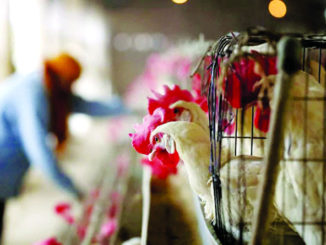
New Delhi (TIP): As a Bhopal-based laboratory confirmed that 437,000 poultry birds in Haryana died because of bird flu, the Centre on Friday, January 8, asked the six states where deaths because of the disease have been confirmed to increase their vigil and act to curb the outbreak. The Centre has confirmed bird flu in Kerala, Rajasthan, Madhya Pradesh, Himachal Pradesh, Gujarat and Haryana, the government said in a statement.
“So far, the disease has been confirmed from six states. It is learnt that culling operations have been completed in both the affected districts of Kerala. The disinfection process is underway,” the statement read.
Following the confirmation of bird flu, Haryana is set to start the biggest culling of birds in any state. Officials said 166,000 birds would be killed in the next few days. Culling of birds is to take place within 1 km of Kheri and Ghanauli villages from where samples tested positive for bird flu, they said. Two of the three samples sent by the Haryana animal husbandry department from poultry farms in Panchkula’s Barwala belt to the National Institute of High Security Animal Diseases (NIHSAD) laboratory in Bhopal tested positive for avian influenza on Friday. “As per the report received, it has been confirmed that birds of two poultry farms were infected with avian influenza (H5N8). Though this bird flu strain is less pathogenic, the state government has issued a notification for the affected poultry farms of Panchkula as a precautionary measure,” Haryana’s animal husbandry and dairying minister JP Dalal said on Friday. Tests done on three batches of samples sent to a Jalandhar lab from Barwala were inconclusive, following which the samples were sent to the Bhopal lab. More than 437,000 poultry birds have died in Panchkula’s Barwala and Raipur Rani areas, considered to be Asia’s second largest poultry belt, over the past 26 days. On Friday, the central team visited the community health centre in both areas. Arrangements have been made at the community health centre in Raipur Rani, and isolation wards set up, while Tamiflu tablets have been procured to check human-to-human transmission of the influenza, said Dr Saroj Aggarwal, deputy civil surgeon, Panchkula. “We are ready to deal with any situation.” (Source: HT)
Budget session will be as long as earlier: Speaker
Indicating that the upcoming Budget session of Parliament will have a Question Hour, Lok Sabha Speaker Om Birla on Friday, Jan 8, said questions of Opposition parties will be answered and issues raised by them discussed when the House meets for the next session.Speaking to reporters in Dehradun, Birla said the upcoming Budget session will be of the same duration as it had been in the past and there will be discussions on all issues. The Lok Sabha Speaker was in Dehradun to address an event part of an outreach programme for Panchayati Raj Institutions — ‘Panchayati Raj System: Strengthening the Decentralised Democracy’. The event was aimed at introducing panchayat members to the functioning of Parliament and to provide them with an exposure to democratic principles and ethos.
India-UK flights resume
Weeks after flights between the United Kingdom and India were suspended following the detection of a more infectious strain of the novel coronavirus, air services between the two countries resumed Friday. The first flight carrying 256 passengers from London landed in New Delhi on Jan 8 morning, reported news agency ANI. The government had suspended flights on December 23. As flights resume in a calibrated manner, for the next two weeks, till January 23, only 15 flights will operate between the two countries. The incoming flights will land only in Delhi, Mumbai, Bengaluru, Chennai and Hyderabad. The government has put out the standard operating procedure for travellers entering India. According to the guidelines, all passengers will have to undergo mandatory self-paid RT-PCR tests on arrival.
India, Japan sign pact for 50-bn yen loan
India and Japan on Friday signed an agreement for a loan of up to 50 billion yen (about Rs 3,550 crore) to back New Delhi’s economic support programmes for the poor and vulnerable affected by the Covid-19 crisis. CS Mohapatra, additional secretary in the department of economic affairs and Japanese ambassador Satoshi Suzuki signed the agreement in New Delhi for the loans with an interest rate of 0.65% per annum and a repayment period of 15 years, including a five-year grace period. Japan had earlier provided budget support of 50 billion yen and grant assistance worth one billion yen (about Rs 71 crore) to support the Indian government’s efforts to counter the Covid-19 crisis.
The results of the Bihar elections have a message for all states headed for polls in the months ahead on taking on the BJP under Modi.
By Neerja Chowdhury
Bihar has sent a strong message to the Opposition parties. They will have to combine effectively to have any chance of taking on the Modi-led BJP in states going to the polls. The RJD’s alliance with the Left parties in Bihar— CPI(ML), CPI(M) and CPI— did well, leading to a high strike rate.
Even though Nitish Kumar has been weakened, the BJP will find it difficult to replace the chief minister with one of its own, having burnt its fingers in Maharashtra, where Uddhav Thackeray, denied the chief ministership, joined hands with the Congress and the NCP. The BJP is expected to tread more carefully in Bihar after the outcome.
Economic distress of an unprecedented kind, compounded by a health pandemic of the last nine months, the migrant march of lakhs of workers on foot with probably the largest number walking back to their villages in Bihar, incursions made into Indian territory by China in the last few months which could have created a nationalistic upsurge against the government, palpable anger against Chief Minister Nitish Kumar that was evident — if these could not bring about a change of government in Bihar, it only shows that the other factors were more dominant. This when, in this instance, there was a clear alternative in Tejashwi Yadav leading the charge on the Opposition side and getting a popular response.
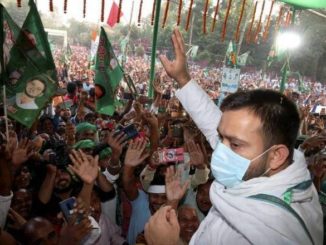
Clearly, Brand Modi managed to slow down the Tejashwi chariot, though it was a closely run race. And Tejashwi, though not able to form a government in Patna, has established himself as a leader of the Mahagathbandhan at the age of 31. He set the terms of the poll narrative when he flagged ‘joblessness’ as the central theme of Bihar 2020, for the first time giving an economic — and aspirational — spin to caste which has determined poll outcomes in Bihar for three decades and more.
Given the downturn in the economy, creation of jobs is increasingly going to find resonance, particularly among the young, as also in other states going to polls in the next few months. The first phase of the election was going the Tejashwi way. The turning point came with Narendra Modi’s invocation of ‘jungle raj’ of the Lalu Yadav-Rabri Devi years. This sent those among the most backward castes and women, who were beginning to look at Tejashwi with new eyes — Yeh naya ladka hai— scurrying back to the NDA again. The upper castes are anyway more enamored of the Hindutva, nationalist theme than of any economic hardship, and stayed by the BJP’s side.
Bihar has reinforced the invincible image of Narendra Modi. He swayed the voters in national elections. This was not always the case in state polls. The BJP did not make it in many states, be it Maharashtra, Jharkhand, Telangana, Andhra Pradesh, Karnataka, Delhi, Rajasthan, Madhya Pradesh and Chhattisgarh. In Bihar, the Prime Minister made a difference to the poll outcome. The Bihar strategy may help the BJP in states which are going to the polls in the coming months — in West Bengal, Assam, Punjab, Kerala and then UP in 2022. It combined Modi’s undimmed popularity and sharp articulation, with Hindutva and nationalism (Ayodhya, Pulwama, Jai Shree Ram) as not so covert a theme, undergirded by a subtle appeal to certain castes. The PM has for some time now emphasized the help given to the poor by his government at the Centre, through the programs he has initiated. So, if money was transferred to the people in Bihar during COVID-19 times, they saw it coming ‘from Narendra Modi’ and ‘not from Nitish Kumar’. In the handling of the pandemic, which exacerbated the problems of the migrants, the Central Government successfully managed to shift the responsibility to the chief ministers. In Bihar, the BJP went one step further. It even managed to distance itself from the Bihar CM, even though it was part of the government headed by him. By going hammer and tongs at only Nitish Kumar, and urging the people to vote for the BJP, Chirag Paswan helped shield the BJP while directing the popular ire towards the CM. The BJP’s seats went up substantially, and those of the JD(U) came down, equally substantially. The BJP as the senior partner in the government will have its obvious advantages, and will increase its clout in the decision-making process.
Even though Nitish Kumar has been weakened, the BJP will find it difficult to replace the chief minister with one of its own. Having burnt its fingers in Maharashtra, where Uddhav Thackeray, denied the chief ministership, joined hands with the Congress and NCP, the BJP is expected to tread more carefully in Bihar. For Nitish Kumar, with his reputation for doing ‘flip flops’, can always extend outside support to Tejashwi Yadav, if the BJP tries to replace him. Unless the BJP can, at a future date, break the JD(U), the Congress and wean away MLAs also from the RJD to form its ‘own’ government. But that does not seem to be on the cards for the moment.
Bihar has sent a strong message to the Opposition parties. They will have to combine effectively to have any chance of taking on the Modi-led BJP in states going to the polls. The RJD’s alliance with the Left parties in Bihar— CPI(ML), CPI(M) and CPI— did well, leading to a high strike rate.
Tejashwi Yadav might have just made it, had he not allowed Mukesh Sahni’s Mallah (Most backward)-based VIP party to leave the Mahagathbandhan over the issue of seat-sharing. This might have been possible had he given less seats to the Congress and accommodated the ‘VIP’ party and enabled Left parties to fight more seats, the ticket distribution based on the ground level strength of the parties today rather than on the position they enjoyed in the past. This Congress’ tally came down from what it was in 2015. While the RJD was able to transfer its votes to the Congress, the Congress could not ensure this for the RJD candidates. As it is, the Congress’ kitty does not have much to transfer.
The five seats won by Asaddudin Owaisi, who did well in the Muslim-dominated areas of Bihar (Seemanchal) should come as a wake-up call for the Congress. The Muslims, who feel beleaguered and apprehensive, particularly with the way they have been targeted by the BJP, after the NRC, CAA and abrogation of Article 370, have looked to the Congress as the only party which would be able to take on the BJP nationally. For them to turn to Owaisi’s party which was not in a position to form the government in Bihar, being part of the small so-called ‘Third Front’, and not to the Congress, shows their growing sense of alienation from the grand old party. This is not good news for the Congress.
The crisis — and drift — in the Congress is not likely to go away unless the party settles the question of its leadership, which is hanging out there unaddressed.
Given the Bihar outcome, will the Opposition parties look afresh at the new challenge being mounted by a BJP determined to increase its footprint all over India, state after state, and go for one-party dominance in the country? Or will it remain business as usual?
NEW ZEALAND (TIP): Priyanca Radhakrishnan, who on Monday became New Zealand’s first-ever Indian-origin minister, has been receiving a large number of congratulatory messages on social media. Kerala Chief Minister Pinarayi Vijayan is one of the many leaders who’ve praised her after her big career leap. The 41-year-old is a member of the Labour Party, “which has its roots in Kerala,” Mr Vijayan said in a tweet today. “It gives us immense happiness to learn that Priyanca Radhakrishnan (@priyancanzlp) became the first-ever Indian-origin minister of New Zealand. The Labour party leader has her roots in Kerala. On behalf of the people of the State, we extend our warmest greetings. (sic),” he said a tweet.Congress leader and Thiruvananthapuram MP Shashi Tharoor, in his congratulatory message on Twitter, shared a report that said Ms Radhakrishnan is from Paravoor in Ernakulam. “Congratulations to @priyancanzlp on becoming the first NewZealand Cabinet Minister of Indian origin. Keralites taking great pride in this news! (sic),” Mr Tharoor tweeted.
Weeks after her re-election and a landslide win, New Zealand Prime Minister Jacinda Arden on Monday appointed Ms Radhakrishnan and four other new ministers.
The Indian-Origin leader has been appointed as the minister for the community and voluntary sector, minister for diversity, inclusion and ethnic communities, minister for youth and associate minister for social development and employment.
Calling it an “incredibly special day”, Ms Radhakrishnan yesterday said in a Facebook post: “I’m feeling a lot of things including an overwhelming sense of privilege to become part of our government. Huge thanks to everyone who has taken the time to message / call/ text congratulatory messages- thank you all. Humbled to be appointed a minister and I’m looking forward to working with an incredible line up of ministerial and caucus colleagues this term. (sic).”
Today has been an incredibly special day. I’m feeling a lot of things including an overwhelming sense of privilege to…
Posted by Priyanca Radhakrishnan MP on Monday, 2 November 2020
Ms Radhakrishnan has spent her work life advocating on behalf of people whose voices are often unheard – women survivors of domestic violence, and migrant workers who have been exploited, news agency PTI reported.
Priyanca Radhakrishnan was elected first as a Member of Parliament belonging to the Labour Party in September 2017. She will be sworn in on Friday.
The world has indeed taken notice of how well Kerala has handled the Coronavirus threat so far and widely applauded for steps the state has undertaken to mitigate the crisis. However, as the virus fear sweeps through Kerala, some of the stories coming out of my home state are very disconcerting. It doesn’t bring out the best of humanity, especially from those who have lived and prospered on the largesse of the NRI remittances and significant revenue from the tourism boom.
I am referring here about the treatment some of the Keralites meted out to NRIs and foreign nationals who are either returning from foreign countries or trapped in the state due to state-imposed travel restrictions. Most of the NRIs are Indian citizens, and they have the right to return to their home country. Some of the tourists might have been caught off guard and stranded by these fast-moving developments around the Coronavirus or made the trip regardless due to their long-term planning for a dream vacation or fearing potential losses in terms of prepaid bookings.
Kerala’s prosperity in the last five decades can be primarily attributed to the ‘money-order economy’ where the foreign currency remittances fast-tracked the socio-economic development in the state. According to World Bank reports, India retained its position as the world’s top recipient of remittances with its diaspora sending a whopping 79 Billion dollars back home in 2018. Kerala tops in that category, with almost 20% of that remittances directly going to the state. The money the NRIs send home helps not only the families but also the balance of payments of the country.
The flow of that amount of money into the Kerala economy by way of remittances has a very significant impact on the living conditions of its citizens. It is important to note that 80% of emigrants from Kerala went to the Gulf, and they contribute a large chunk of the remittances that flow into Kerala. According to a previous study done by the Middle East Institute, remittances were 1.74 times the revenue receipts of the state. Remittances in Kerala were 5.5 times the finance received from the central government and 36 times the exporting earnings from cashews and 30 times that from marine products.
The study also pointed out the impact of remittances to Kerala and how it has manifested in household consumption, saving and investment, the quality of houses, and the possession of modern consumer durables. Remittances also played a role in enhancing the quality of life and contributing to a high human development index for Kerala in terms of education and health, along with the reduction of poverty and unemployment.
The overall result for the state has been quite impressive. Kerala’s rating for the Human Development Index (HDI) 0.790, is the highest in India, resulting from the vast improvements state has made in the fields of sanitation, health, education, and poverty reduction. In 2016, the state was also declared ‘open defecation free’ with toilets in every household. The female literacy rate in Kerala stands at 94%, and it is the only state in the union where the female population exceeds the male population.
Nevertheless, the stories being aired about some of the experiences of returning NRIs and stranded tourists at these difficult times are heart-wrenching. It is critical that the returning NRIs ought to be truthful to the authorities and mindful of their vulnerability in terms of spreading this virus. They need to behave responsibly as per the rules and be accountable for their actions. However, they shouldn’t be blamed for the failures of the state from properly screening all arrivals. It is the responsibility of the authorities to ascertain origins of travel and routings and to decide whether anyone should be quarantined. The infrastructure should have been already in place at all airports for health screenings, and the medical personnel should have been fitted with protective gear.
Instead, what we are witnessing is an act of demonization of some of those who happened to carry the Coronavirus, probably of no fault of their own. Some of them might have contracted the virus during the travel and possibly even asymptomatic upon their arrival. Therefore, there is very little justification for the harassment and name-calling they were subjected to and the contempt with which they have been treated.
The experiences of some of the foreign tourists at the hands of my fellow Malayalees are even more appalling. An alien couple was found to be traumatized and crying incessantly in the middle of a road as they haven’t had food for three days. According to the reports, they were denied food or lodging by panicky guest houses and hotels across the state and finally had to be rescued by the Police department. There were stories of tourists sleeping in cemeteries because their reservations to the hotels were not being honored.
It is not only a phenomenon in Kerala but also across the country where foreign tourists are being evicted from their apartments, made to feel unwelcome in Taxis, asked to leave restaurants, and have been subjected to hostile looks in public spaces. Social media also bears some responsibility in spreading this panic-driven disinformation that all foreign tourists are carries of the Coronavirus. Even students from Northeast are not spared this time around as many have experienced harassment at the hands of other students, and their interactions were marked by suspicion and rudeness often bordering racism.
Finally, Keralites are one of the largest groups of economic refugees on this planet, constantly exploring opportunities and daring to break barriers to travel to the ends of the earth to better themselves. We do expect those foreign countries and their nationals to treat us fairly, provide us with opportunities, respect our cultures, and honor our religious traditions. Besides, we also request them to transfer part of their wealth to our state so that folks who are left behind may do better with their own lives as well.
Therefore, it is obligatory to keep our end of the bargain in treating foreign tourists as well as returning NRIs fairly in good times as well as bad. We simply cannot have it both ways! I am encouraged to see that the government of Kerala, which saw more than a million tourists set foot in the state in 2018, came out to denounce such attacks on foreign tourists asking locals not to see them as carriers of virus. A national crisis often reveals the character of a people. Kerala is often dubbed as ‘God’s own country’ and not let the world call us ‘Devil’s own people’!
(The writer is a former Chief Technology Officer of the United Nations and Vice-Chairman of the Indian Overseas Congress, USA)
NEW DELHI (TIP): The Lok Sabha passed the Citizenship (Amendment) Bill, which seeks to provide Indian citizenship to non-Muslim refugees coming from Pakistan, Bangladesh and Afghanistan after facing religious persecution there, a little past midnight on Monday, December 9, after a heated debate that lasted over seven hours.
The Bill, which was passed in the Lok Sabha with 311 members favoring it and 80 voting against it, will now be tabled in the Rajya Sabha for its nod.
Several amendments brought by opposition members, including one by a Shiv Sena MP, were defeated either by voice vote or division.
According to the proposed legislation, members of Hindu, Sikh, Buddhist, Jain, Parsi and Christian communities, who have come from Pakistan, Bangladesh and Afghanistan, till December 31, 2014 facing religious persecution there, will not be treated as illegal immigrants but given Indian citizenship.
In a hard-hitting reply to the debate on the proposed legislation, Union Home Minister Amit Shah said people belonging to any religion should not have any fear under the Modi government as he asserted that the bill will give relief to those minorities who have been living a painful life after facing persecution in neighboring countries.
Shah also said the Modi government will definitely implement the National Register of Citizens (NRC) across the country and when it will be done, not a single illegal immigrant will remain in the country.
Shah said there is a difference between illegal immigrants and those who have come after facing religious persecution in the three neighboring countries.
“No one should have any fear of being persecuted under the Narendra Modi government,” he said after nearly seven-hour-long debate which was marked by fiery speeches by MPs belonging to both the opposition and the ruling alliance.
The home minister said had India not been divided on religious lines in 1947, there was no need for the Citizenship (Amendment) Bill.
“Muslim population in India has increased from 9.8 per cent in 1951 to 14.8 per cent in 2011 while the Hindu population has decreased from 84 per cent in 1951 to 79 per cent in 2011.
“Whereas, the minority population in Pakistan has decreased from 23 per cent in 1947 to 3.7 per cent in 2011. Similarly minority population in Bangladesh has decreased from 22 per cent in 1947 to 7 per cent in 2011,” he said, adding India does not discriminate against anyone on the basis of religion.
The home minister said the Citizenship Bill will give relief and constitutional respect to those who have been living a painful life after facing persecution in neighboring countries.
Shah dismissed the suggestions that the Bill is violative of Article 14 of the Constitution, which guarantees equality for everyone, as it aims to give citizenship to persecuted people only.
“This Bill is not unconstitutional and not in violation of Article 14 and has nothing to do with Muslims in India,” he said but made it clear that Rohingya Muslims, coming from Myanmar, will not be given Indian citizenship.
The home minister countered the Congress charges that the bill is communal in nature, by taking a dig at the opposition party, saying “Congress is such a secular party which partners Muslim League in Kerala and Shiv Sena in Maharashtra”.
“Modi government’s only religion is the Constitution,” he asserted.
He also said India doesn’t need a refugee policy as the country has enough laws for the protection of refugees.
Earlier, initiating the debate, Shah said the bill has the endorsement of India’s 130 crore citizens as it was part of the BJPs’ election manifestoes in 2014 and 2019.
Opposition leaders Adhir Ranjan Chowdhury, Saugata Roy, N K Premchandran, Gaurav Gogoi, Shashi Tharoor and Asaduddin Owaisi opposed the introduction of the bill, saying it was violative of various provisions of the Constitution, including move to grant citizenship on the basis of religion.
While defending the introduction of the bill, Shah said the Congress had “divided” the country on the basis of religion that is why it was necessary to bring the bill and added that it was brought on the basis of reasonable classifications provided under the Constitution.
The tabling of the emotive bill through division of votes came in the wake of protests and incidents of violence in Northeastern states with most of the student unions and regional political parties opposing it, saying it will nullify the provisions of the Assam Accord of 1985, which fixed March 24, 1971, as the cut-off date for deportation of all illegal immigrants irrespective of religion.
“We will have to differentiate between intruders and refugees. Citizenship amendment bill does not discriminate against anyone and does not snatch anyone’s rights,” Shah said while initiating the debate on the contentious bill.
Trying to allay apprehensions of people of the Northeast, Shah said the Narendra Modi Government is committed to protect the customs and culture of people of the region and informed that Manipur will be brought under Inner Line Permit regime, where the proposed law will not be applicable.
The home minister said under the proposed legislation, citizenship will be granted to refugees coming from the three countries after facing religious persecution there even without documents, including ration cards.
Noting that India has given similar rights to people in the past, Shah said Manmohan Singh and L K Advani could become prime minister and deputy prime minister respectively due to this after they came from present-day Pakistan.
“This bill is not even .001 per cent against Muslims. It is against infiltrators,” he said earlier while introducing the bill.
During the debate, which was marked by heated arguments, AIMIM chief Asaduddin Owaisi also tore the bill, saying it was aimed at making Muslims “stateless” and will lead to another partition.
Opposing the bill, Congress MP Manish Tewari said the bill is “unconstitutional” and “contrary to the spirit of the Constitution which is secular”.
“Equals cannot be treated as unequal. When a person comes to India, he is a refugee. You cannot discriminate against him on the basis of religion,” he said during the debate.
“The bill is against the Constitution, against the spirit of Constitution and against the ideology propounded by Babasaheb Ambedkar,” Tewari said.
Discrimination on the basis of religion, he further said, was not in tune with the Preamble of the Constitution which specifically mentions the word ‘secularism’.
“Secularism is embedded in the Constitution,” he said.
Supporting the bill, BJP MP Rajender Agarwal said the country cannot ignore the suffering of the people who have come here after facing religious persecution.
He said Pakistan has failed to protect its minorities under the Nehru-Liaquat pact.
While NDA allies the JD(U) and the LJP extended support to the bill, fence sitters, including the BJD and the YSRCP also supported the bill while suggesting that Muslims should also be included in the bill.
Meanwhile, West Bengal Chief Minister Mamata Banerjee said the NRC and the CAB will never be allowed in Bengal as long as the TMC is in power.
“It’s a divisive bill and shall be opposed at any cost,” she said in Kharagpur while claiming that at least 30 people have committed suicide in the state due to panic over the implementation of the National Register of Citizens (NRC).
Adhir Ranjan Chowdhury, Leader of the Congress in Lok Sabha, said the government was trying to create impression that by opposing the legislation, the party was anti-Hindu.
“We are opposing the bill because it is discriminatory in nature. It wreaks havoc on the very foundations of the Constitution. This is a step towards Hindu Rashtra. India should maintain the essence of humanity,” Chowdhury said.
Surpriya Sule (NCP) said the perception is that every Muslim is feeling insecure and the largest minority community should not be felt left out.
Referring to DMK MP K Kanimozhi, Sule also asked, “What happens to those who practice atheism?”
As per the bill, “on and from the date of commencement of the Citizenship (Amendment) Act, 2019, any proceeding pending against a person under this section in respect of illegal migration or citizenship shall stand abated on conferment of citizenship to him.”
“Provided that such person shall not be disqualified for making application for citizenship under this section on the ground that the proceeding pending against him and the central government or authority specified by it in this behalf shall not reject his application on that ground if he is otherwise found qualified for grant of citizenship under section.”
The BJP-led NDA government had introduced the bill in its previous tenure and got Lok Sabha’s approval. But it did not introduce it in Rajya Sabha, apparently due to vehement protests in the Northeast and lack of majority in the House. That bill lapsed following the dissolution of the last Lok Sabha.
NEW YORK (TIP): Ms Bhuvana Rao, Air India Regional Manager, Americas, has been promoted as General Manager , Southern Region. She will be based in Chennai overseeing Air India’s operations in the fast-growing Southern states of Tamil Nadu, Karnataka, Andhra Pradesh, Telangana and Kerala as well as Sri Lanka and Maldives. She leaves for India on June 14 and will join her new posting on June 19.
Ms Bhuvana Rao had joined the present position in New York on October 17, 2018, succeeding Ms Vandana Sharma
In a brief parting message to The Indian Panorama, Ms Rao said “During my brief stint in New York, I am happy to have had the privilege of meeting and associating with many diverse and brilliant minds in the business community and the vibrant Indian community in New York. I take with me wonderful memories of the warm interactions and learnings. I look forward to continuing the association in my new capacity in India, which I would be assuming from 19th June.
“I shall be contactable on my official Air India email b.rao@airindia.in and personal email Bhuvana_rao@yahoo.com”.
The Indian Panorama extends Ms Rao the best wishes for a successful and happy future.
NEW YORK (TIP): Association of Indians in America is the grassroots organization established in 1967 . It is well known for its social, cultural and educational activities. AIA has been serving India by sending funds from time to time, like during Earthquake , Flooding Disasters etc.
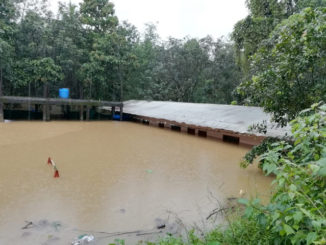
This is the first time AIA has undertaken to do complete renovation of a school destroyed by flooding In Kerala
AIA leadership is committed to the task
AIA is renovating a school in Ayoor village in Kerala . This school was totally submerged and destroyed by Floods in Aug. 2018. Funds were raised in Oct. 2018 and again on May 5th 2019 . The school was up to 4th grade but on request of villagers, AIA will sponsor for school to be a Higher Secondary School. This School will benefit several villages . School will be run by Vidya Bharati Shiksha Sansthan.
Vidya Bharati gives both education and Sanskaras to its students.Children learn Yoga , Meditation, Martial Arts etc. Most of children from this school go for higher education and become professionals . PM Narendra Modi praised the education at Vidya Bharati Schools. He said students at these schools are usually patriotic , and come out as great citizens . AIA national president Urmilesh Arya said, “Education is the best gift we can give to children back home , and good patriotic citizens are the best gift to our Motherland”.
“These guys are frightening some of the innocent and ignorant Hindus to believe that “Hinduism is in danger” and posing themselves as the freaking saviors. Hinduism does not need these men to save it. It is a 5000-year-old robust religion and will always be there like all other religions.”
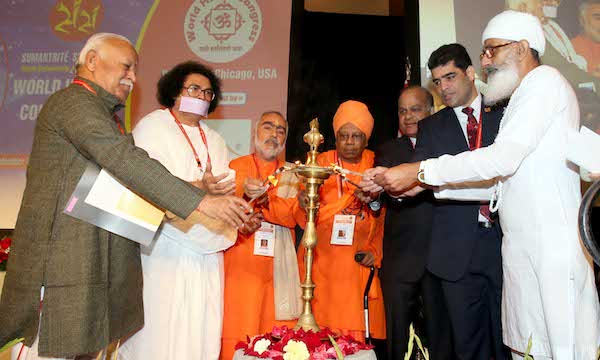
The World Hindu Congress held a conference in Chicago in the first week of September 2018, and it was attended by about 3000 Hindus from around the world. Unfortunately, many speakers fouled. Here is an accounting of the two who were divisive and sowed the seeds of ill-will between Indian communities.
Every faith group holds similar conferences. As Americans, we have an opportunity to guide these conferences towards the goal of civility and pluralistic societies, that is, “Respecting the otherness of others.” When we do that, conflicts fade, and solutions emerge.
Each one of us must work towards building cohesive societies where we can live without apprehensions and tensions. No matter what religion you belong to, you must put in that effort.
This conference listed over 100 speakers including the Rashtriya Swayam Sevak Sangh Chief Mohan Bhagwat and Vice President of India Venkaiah Naidu. Can we expect them to talk about the idea of living your life and letting others live theirs? I hope so, but their history points to the opposite. They want to ‘dictate’ what you eat, wear or believe.
Almost all speakers at the event were hell-bent on breaking India to pieces by placing wedges between fellow Indians, at this time, I am familiar with two of the most virulent speakers, and they are Rajiv Malhotra and Dilip Amin.
We unequivocally condemn their false preaching, but spare them, for they know not.
Malhotra panders to the base instincts of humans, some of whom have fallen for him. A few weeks ago, he sent a message urging Hindus to contribute to help Hindus only in the Kerala flood disaster and not Christians and Muslims. Instead of criticizing him for his egregious tweet, a small percent of Hindus has showered him with glory. I am not sure if these Indian Americans have imbibed the American values of caring for fellow humans – which is the value in all religions.
Malhotra is not only wrong but advocating evil acts in the Indian society, dividing it further, causing everyone to live in the hell of tensions.
These guys are frightening some of the innocent and ignorant Hindus to believe that “Hinduism is in danger” and posing themselves as the freaking saviors. Hinduism does not need these men to save it. It is a 5000-year-old robust religion and will always be there like all other religions.
The other guy speaking at the World Hindu Congress in Chicago is Dilip Amin, whose poster heads as “Interfaith Marriages – Silent Holocaust of Hindus.” On his website, he has placed a few good token messages of interfaith marriages, but his goal seems to frighten Hindus to prevent their daughters from marrying Muslims or Christians.
“Every faith group holds similar conferences. As Americans, we have an opportunity to guide these conferences towards the goal of civility and pluralistic societies, that is, “Respecting the otherness of others.” When we do that, conflicts fade, and solutions emerge.”
Amin rightfully claims that 38% of Hindus marry outside their faith and alludes that Hinduism is losing out to Muslims and Christians. Dumbly, he also quotes a similar figure of Muslims and Christians marrying outside their faiths as if they are not losing their flock.
On his website, he points out that these marriages ultimately will not pan out as one 18 years-married Hindu man says, we are divorcing, she calls me a Kafir. This is the dumbest idea he is selling in Chicago. When people go through a divorce, they resort to saying anything that pisses off the other. It has nothing to do with religion; it is all about personal conflicts. When a Hindu woman and man go through a divorce, they label some other reason for their divorce including an abusive, violent relationship, but when there is a religion, they make a scapegoat of religion. There is no need to blame the faith for the acts of individuals.
Over the last seven years, I have officiated nearly 75 interfaith weddings of all combinations. Hindu-Muslim, Muslim-Jain, Hindu-Atheist, Christian-Muslim, Jewish-Muslim and other combinations. The only divorce thus far has been between a Jewish-Christian couple – not because of their religion, but because of the differences in raising their combined children.
They come to me because I do not require conversions and deliver the sermon in both their religious traditions. Only two people have converted thus far out of their free will, which is a part of the pre-wedding counseling. More at Interfaith Marriages http://interfaithmarriages.org/
Those who convert, do feel comfortable sacrificing their belief for the love they have for the other, and to live with least conflicts and more harmony. Why should it matter to you or me? Do we own them and their souls?
“There are millions of Dalit Hindus who live in utter humility and are humiliated on a daily basis. Let these fake saviors of Hinduism give them dignity, treat them as equals, consider them as Brahmins. If not, let them find dignity in other faiths. To a majority of Hindus, Hinduism is an open universal tradition that has a large umbrella to give its beneficence to all faiths. Hinduism is not a dogmatic religion.”
Hindus, Muslims, Christians, Jews or others are individuals who have the freedom to fall in love with anyone and marry anyone for their good. Who are you to dictate who marries whom? American born kids will laugh at these ridiculous attempts to save Hinduism.
One of the members of RSS writes, “Take particular note of World Vision – the worst of the whole bunch bent on harvesting the Lost (Hindu) souls in India via any means – deception, disguise in helping victims. Majority of Christian NGOs are not much better. The Muslims Charities only help fellow Muslims.”
This man is very short-sighted and ill-informed. If everyone in the society starts caring for their own, we will have a disaster on hand. During the Gujarat Earthquake, Tsunami, Kerala Floods and other disasters, Indians have come together for each other. Americans have gone all over the world to serve fellow humans. That’s the right thing to do.
These men also need to know that Saint Mother Teresa saved so many souls and brought dignity to them; the Catholic Charities have helped so many Dalits that the upper Caste Hindus refuse to even go near. Islamic Relief has gone and helped people regardless of their religion in every corner of the world and the majority of Hindus have done the same and will continue to serve and care for fellow beings.
If American Christian Charities had taken the same stinky attitude and not sent shiploads of wheat and corn to non-Christians during the famine in the late sixties, India would have suffered a major crisis, that includes extremist Hindus like the men quoted above.
There are millions of Dalit Hindus who live in utter humility and are humiliated on a daily basis. Let these fake saviors of Hinduism give them dignity, treat them as equals, consider them as Brahmins. If not, let them find dignity in other faiths. To a majority of Hindus, Hinduism is an open universal tradition that has a large umbrella to give its beneficence to all faiths. Hinduism is not a dogmatic religion.
Didn’t some of these guys come to America for making money? So, what if Dalits convert to Christianity for money and uplifting their own lives.
Hinduism is not in danger, these guys are making it appear so, so that they can cash in on the fears of innocent and honest Hindus. I appeal to every Indian not to support divisive individuals or organizations.
We all have to work towards creating better societies.
(The author is the Executive Director of the Center for Pluralism in Washington, DC. He is committed to building cohesive societies and offers pluralistic solutions on issues of the day. More about him at https://www.linkedin.com/in/mikeghouse/)
Cow is not sacred and beef is not forbidden to Hindus, according to Vedas
By Dave Makkar
The author finds no mention in Hindu scriptures about cow being referred to as “mother” or as “holy”. He finds no evidence that cow slaughter was ever prohibited, that beef eating was forbidden. He wonders why Hinduwadis are so obsessed with cow. The Indian Panorama, with this article, is initiating a debate on an issue which has fiercely divided the Indian nation. The views expressed here are the author’s own.
The current atmosphere in India on the issue of cow defies all sane logic, Hindu religious Texts, thousands of years old sacred history, historians and scholars. On one hand the current Modi government talks of making India the biggest economic power in the world surpassing America and China. On the other hand, his own party and his Hindu affiliate’s members talk of what people can eat or cannot eat, how many children the Hindu couples should produce, what the women should wear, adult girls cannot be seen in the company of opposite sex friends, Hindu girl cannot marry a non-Hindu and any criticism of government policies make you anti-national that includes refusing to say Bharat Mata ki Jai or Cow is our mother.
Modi himself and his team members are biggest hypocrites on the issue of cow or meat. As CM of Gujarat under Modi meat production 10,600 tons in 2001-2 went up to 35,286 tons in 2011-12. Still Modi accused UPA government for cow slaughter for their support to meat exporters “Pink Revolution” during the run up to the 2014 elections that brought him to power. Ironically under Modi’s watch bovine/cow meat export has gone up by 70% according to the Commerce Ministry website. Now India is number 1 exporter of bovine/cow meat in the world.
Modi’s confidante Amit Shah during the 2014 campaign made several speeches that cow slaughter will not be banned in north eastern states of India. As BJP’s party president on May 28, 2015 in Goa; Amit Shah ruled out a nation-wide beef-ban or cow slaughter. Union Government and Goa Government both under BJP are jointly running a slaughterhouse in Goa.
Sangeet Som, the Hindutva poster boy & one of the main accused in 2013 Muzzafarnagar communal riots, UP Assembly Member and now Minister in Adityanath Yogi’s government had been personally associated with two meat processing and export companies, Al-Dua and Al-Anam. Al-Dua is one of the India’s leading halal meat export companies which exports meat to Arab countries.
BJP candidate Sreeprakash on April 2, 2017 in the run up to the Mallapuram Lok Sabha by election in Kerala said, “I will ensure quality beef and standard abattoirs in my constituency.”
Modi’s Minister of State for Home Affairs Kiren Rijiju in Aizwal on May 27, 2017 said that, “I eat beef, I’m from Arunachal Pradesh and can anybody stop me? So let us not be touchy about somebody’s practices. This is a Democratic country. Sometime some statements are made which are not palatable.” Kiren Rijiju also described as “unpalatable” his colleague Mukhtar Abbas Naqvi’s remarks that those who eat beef should go to Pakistan, and questioned whether anyone could stop him from eating beef. The BJP leaders in Arunachal, Meghalaya, Sikkim, Mizoram, Nagaland have been making statements to their constituents, sale of beef at subsidized rates is their commitment to them. After the new Cattle Trade Rules announced by the Modi government they went to the extent of saying “No Beef No Support to BJP”
BJP’s Karnataka spokesperson Vaman Acharya on May 28, 2017 while participating in a panel discussion on Suvarna News opposed the beef ban. He said that people from all communities including the Brahmin community, consumed beef. Before India became an agrarian nation, beef had been a staple diet. Even today, several people, including indigenous tribes in the North Eastern States consumed beef as a staple. Acharya had also said that as chairman of the Karnataka Pollution Control Board, he gave permission for the setting up of 16 abattoirs in the State. Lastly, he had said that he didn’t subscribe to the religious sentimentality attached to the cattle. He retracted his statements on June 6, 2017 under party pressure.
Modi’s Home Minister Rajnath Singh in Aizwal on June 12, 2017, said that people are free to choose what they want to eat. When asked about protests against the government’s ban on sale of cattle for slaughter, Singh clarified that the Centre will not impose any restrictions on one’s choice of food. However, even as Singh spoke, scores of people in the Mizoram capital participated in a “beef ban bashing banquet” organized by a local organization. (PTI)
Kerala BJP and RSS have joined hands to start a co-operative society to sell meat which includes bovine meat as well as fish, a Malayalam daily Deshabhimani reported on July 5, 2017.
July 17, 2017 Goa’s BJP CM Manohar Parikar who also holds the animal husbandry portfolio in the assembly session replied to BJP assembly members concern over the poor quality of Beef imported from Congress ruled neighboring state Karnataka; “Approximately 2,000 kg beef is produced per day at the state abattoir of the Goa Meat Complex Limited, while rest of beef is brought in from Karnataka. Parrikar said he would issue directions to the department concerned to carry proper inspection of beef imported from Karnataka. Parrikar further added that “The Goa Meat Complex Ltd has no problem in slaughtering more animals if they are brought there by traders,”
Modi’s New Cattle Trade Rules that have been stayed by the SC on July 12, 2017 violates Right of a Person to Freedom of Choice regarding Food as enshrined in Indian Constitution and it is also violating the rights of the farmers to trade. Under this law farmers cannot sell the cattle in the market for slaughter but slaughter houses can come to the farmer and buy cattle for slaughter. Then majority of the farmers are not educated how they can comply with filling out numerous forms about the origin & ownership of the animal in question? First, the farmers/dairy operators will be exploited by the bureaucracy and then by Slaughterhouses that can make a cartel to give them less price for their cattle.
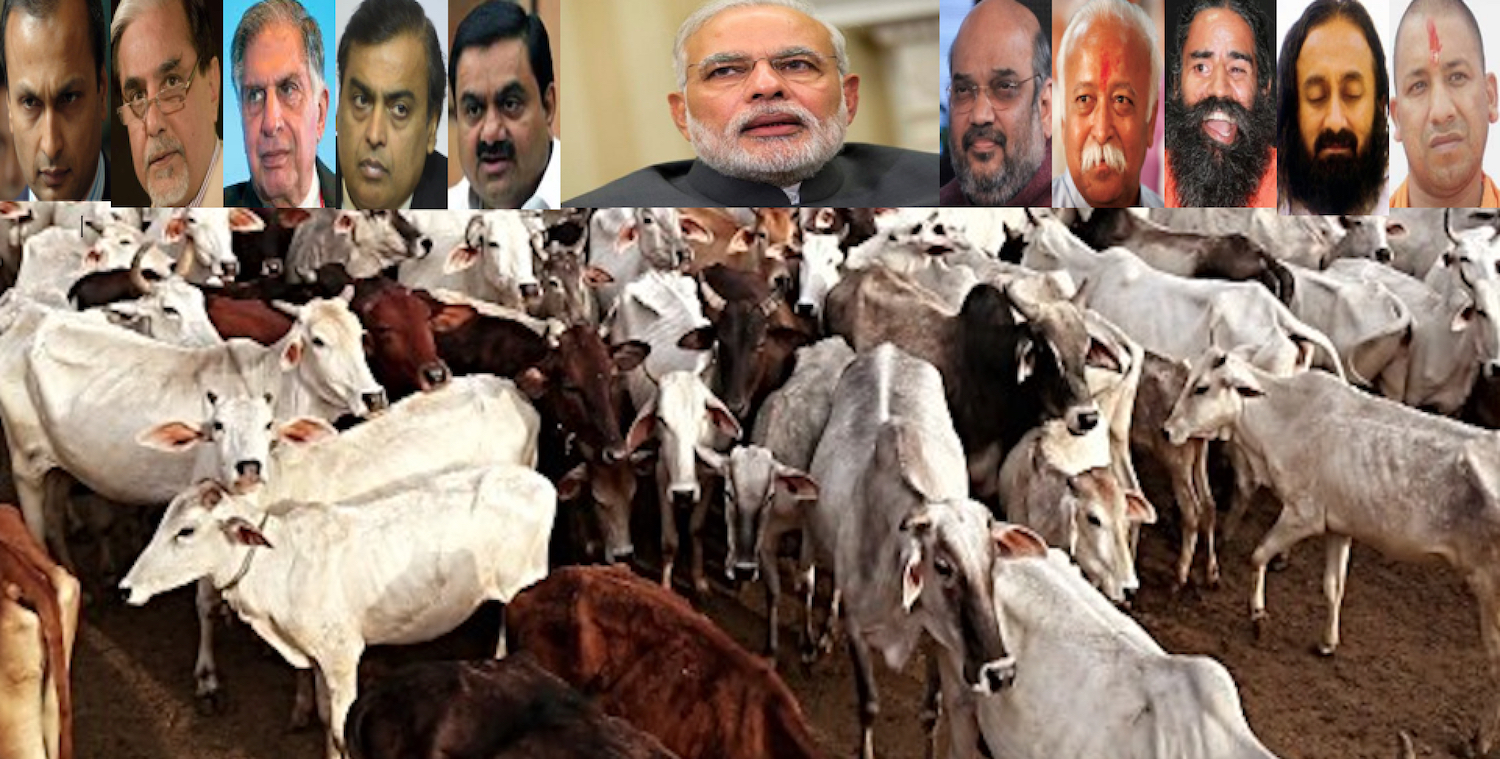
Modi aka BJP is paving the way for its handlers like Adani, Ambani, Tata and other foreign MNC’s to control the meat and animal hide trade that is worth Billions of Dollars. UP slaughterhouses alone employ 25 lac people with a turnover of Rs. 15,000.00 crore, the highest producer of meat in India. The meat industry is likely to grow at a compound growth rate of 8.4% over the next five years. The processed meat industry is growing even much faster, at about 20%. The meat export from India is about $4.5 billion and raw hide to leather goods is another $5.5 billion. About 22 million people are in the workforce and the meat export industry is expected to grow 50% in 5 years. Beside that 70% of Indians are non-vegetarians. Domestic per capita meat consumption in India is very low — around 5 kg as compared to the world average of 47 kg. With rising incomes between 2003 and 2012, their meat consumption rose by 6.3% a year. It is expected to rise by another 3.5% a year between 2013 and 2022.
Apart from 73.7 lakh tons of meat in 2016-17, India also produced 108 lakh tons of fisheries in 2015-16 ranking 2nd after China. India is the number One the and largest exporter of shrimp fish in the world. This industry is growing at a robust pace of 8% per annum. The business is valued at Rs. 1 Lakh Crore and employs about 150 lakh people. Andhra Pradesh occupies the first place, West Bengal 2nd and Modi’s Gujarat at 3rd place in fish production in India.
The demonetization was also done for these very influential people so that they can control food business worth billions that is traditionally run on cash basis by the informal sector. On top of that to pave the way for billions of dollars that can be made in transaction fees in the guise of digital money from the less fortunate and financially most vulnerable people of Indian society. Rich have credit cards; they don’t pay any fees to use it; rather they are rewarded with points and cash back for its use; it is the merchant that pays the fees for accepting it. The poor has to get a “Pre-Paid Debit Card” for a fee with a monthly maintenance fee and fee for loading money; one of the biggest Ponzi schemes ever invented by the American Financial Industry to loot the poor.
Coming to Team Modi & Hinduwadi’s understanding of Hinduism, its history, its writing on eating meat and views of various learned scholars, all of them are a very big disappointment. Team Modi should do some soul searching why Atal Behari Bajpai avoided the trap of cow laid by the bogus Hindutva supporters that has no love for their own 50 crore (500 million) extremely poor Hindus living a miserable life.
According to Sanskrit ScholarRajani K Dixit, “there is no such thing as Holy Cow in the Vedas”. The Vedas consider bovines important for milk, beef, agriculture and transport but not divine or holy. The word ‘Aghnyaa’ applies only to a milch cow because it is not economical to kill it. A Vaisha cow is meant for beef, and especially reserved to an extent for Brahmins only. Atharva 12.4(13) tells us that in case a Brahmin begs for a cow from a non-Brahmin, “even if that person has a beef-dinner at his house, he has to select another cow to slaughter for his own dinner, than the one that is asked for”. The word ‘Aghnyaa’ (not to be killed) coined by Rigveda for young milch cows was the main cause of the Hindu misunderstanding that cows or bovines are not to be slaughtered.
The Rigveda has never used the word ‘mother’ for a cow. There is no punishment recommended for a cow slaughterer even if someone kills a young milch cow. Beef-eating is also not taboo. Beef parties are not only allowed but highly appreciated, and a person who cooks beef for his guests is praised by the term ‘Atithi-gva’ ‘one who offers beef to guests’.
Ritual sacrifice of a bull is a must in worship to God Indra.Beef parties also seem a regular affair in weddings (RV 10.85). Cows are not sacred and beef is not forbidden to Hindus. Here is a line from a verse ascribed to god Savita, the presiding deity of the Gayatri Mantra, describing a dinner party he is hosting: “At night we are going to kill cows” (RV.10.85(19). RV 10.89 (14) mentions “cows for food, laying scattered on the grounds of a slaughter house”. Mark that the author does not use the word ‘animals’ but ‘cows’, showing that beef was the most popular item, and the cow the most slaughtered animal. RV 10.95(6) says that “old cows which do not give milk” are “only fit to be cooked”. It further states that “useless cows ….are taken to be cooked, but never milch cows”. It is clear that slaughter houses are not banned, beef is allowed and useless bovines are allowed to be slaughtered in Hinduism.
Aadi Shankaracharya born in 788 CEin Kerala: in his commentary on Brahadaranyako Upanishad 6/4/18 says: ’Odaan’ rice mixed with meat is called ‘maansodan’ on being asked whose meat it should be, he answers ‘Uksha’ is used for an ox, which is capable to produce semen. Currently 72 communities including some upper caste Hindus in Kerala prefer beef to the mutton and some prefer it because it is cheaper than mutton.
Hinduisms great propagator Swami Vivekaanand said: “You will be surprised to know that according to ancient Hindu rite and rituals, a man cannot be a good Hindu who does not eat beef “. (The complete works of Swami Vivekanand vol :3/5/36)
Vinayak Damodar Savarkar, the Hindutva Icon and Icon of Hindu religious & political parties including BJP, espoused his views in Vidnyan Nishta Nibandh, that the cow, like the peepal tree, should be cared for, as something useful to humans, which meant eating it as well if need be. He insisted that a superstitious mindset towards cows would ruin India’s intellect and that cows should be protected for their economic use to man, and not because of their ‘divinity’. Attributing religious qualities to it gives it a godly status. Such a superstitious mindset destroys the nation’s intellect. “When humanitarian interests are not served and in fact harmed by the cow and when humanism is shamed, self-defeating extreme cow protection should be rejected.”
Every now and then, an admirer of Savarkar raises the topic. “Can anyone imagine that the ‘Father of Hindutva’ advocated beef-eating (in special circumstances), rejected the divinity of the Vedas, denounced the sanctity of the caste system and launched a virulent attack on the hypocrisy of the priests?” wrote Ved Pratap Vaidik, a journalist close to several Hindutva figures. “Incidentally, Savarkar was a beef-eater,” wrote Varsha Bhonsle on Savarkar’s birth anniversary, February 26, in 1998. “For he was, above all else, a rationalist – a true Hindu – and eons ahead of contemporary Hindutvawadis.” (“Why is the Cow a Political Animal?” S. Joshi)
Mahatma Gandhi was approached for total ban on Cow Slaughter in India. His reply was, “I have been long pledged to serve the cow but how can my religion also be the religion of the rest of the Indians? It will mean coercion against those Indians who are not Hindus. The assumption of the Hindus that India now has become the land of the Hindus is erroneous. India belongs to all who live here. Earlier on 25th July 1947 he also said that “The Hindu religion prohibited cow slaughter for the Hindus, not for the world. The religious prohibition came from within. Any imposition from without meant compulsion. Such compulsion was repugnant to religion.”
A Brahmin’s Cow Tales by D. N. Jha, a high cast Brahmin himself. The cow as a sacred animal, Jha believes, did not really gain currency until Dayanand Saraswati’s cow protection movement in the 19th century”. The cow became a tool of mass political mobilization with the organized cow-protection movement,” the historian points out. “The killing of cows stopped gradually with the agrarian society and caste rigidity. The Brahmins found it convenient to say that those who ate beef were untouchable. But they themselves continued to consume it, recommending it for occasions such as shraadh. The beef-eating habits of Indians which existed in Rig Vedic times and continued till the 19th century and after, despite repeated Brahminical injunctions against cow-killing. That ancient Hindus, including Brahmins, were beef-eaters, willing to incur the minor penalty that an agrarian society began imposing on cow-killers, and that this fondness for cattle meat had nothing to do with Islam or Christianity.
For those who blame Muslims for the practice of Cow slaughter in India. Babar’s first act after conquering Delhi was to forbid the killing of cows. They must read Babar’s Directives (Wasiyyat namd-i-majchfi) a secret testament to his son Humayun and his future generations. For the stability of the Empire, O my son!, “The realm of Hindustan is full of diverse creeds. Praise be to God, the Righteous, the Glorious, the Highest, that He hath granted unto thee the Empire of it. It is but proper that thou, with heart cleansed of all religious bigotry, should dispense justice according to the tenets of each community.’ “And in particular refrain from the sacrifice of cow, for that way lies the conquest of the hearts of the people of Hindustan; and the subjects of the realm will, through royal favour, be devoted to thee. And the temples and abodes of worship of every community under Imperial sway, you should not damage. Dispense justice so that the sovereign may be happy with the subjects and likewise the subjects with their sovereign. The progress of Islam is better by the sword of kindness, not by the sword of oppression.” (Abstracted from the 1936 book The Mughal Empire From Babar To Aurangzeb, by SM Jaffar of Peshawar. It mentions that “the original document is in Persian and is treasured in the Hamida Library at Bhopal as one of its heirlooms.”)
The British Origin of Cow-Slaughter in India (published 2002) by Gandhian historian Dharampal. His book draws from official documents to show that the riots of 1880-1894 were not the obvious Hindu-Muslim conflagration they were made out to be. The book cites accounts of how “many prominent Muslims as well as the Parsis and Sikhs actively participated in the (cow protection) movement.” Dharampal wrote that large-scale cow slaughter was not the handiwork of Muslims who came to India from central and western Asia. “The question of the sacrifice of a cow did not arise as the land where Islam arose did not have many cows.”
Mughals were habituated to the meat of goats and mutton, sacrificing camels on the occasion of festivals like Eid or for large feasts, the book says. Dharampal rues the lack of research on cow killing between 1200 and 1700, when a series of Muslim kings ruled over a large part of India. But he goes on to show that systematic slaughter of cattle began in India with the East India Company establishing itself. The British, unlike the central and west Asians, were habituated to beef. The first slaughterhouse in India was built in Calcutta (now Kolkata) in 1760 by Robert Clive, then Governor of Bengal. It could kill 30,000 animals per day. Several more slaughterhouses were set up in various parts of the country by the Commissariat Wing of the three British armies of Bengal, Madras and Bombay Presidencies. A total of 350 slaughterhouses were constructed by 1910.
Nitya Sambamurti Ghotge, a veterinary surgeon who heads Anthra, a group in Pune that has worked with rural livestock rearers since 1992. Laws against cow slaughter and Trade Rules will only criminalize the livestock trade, not protect the animals, said Ghotge. Only the smugglers and the law enforcement officials will benefit from the ban on cow slaughter, not the poor farmers or the livestock. Like the agriculture scientist Ramanjaneyulu, Ghotge holds that the cow protection laws are unjust; it is about powerful urban people outsourcing the burden of cow protection on the rural poor, she said.
As for the BJP’s claim that “cow is the only divine animal that exhales oxygen”, no living being other than plants exhale oxygen is also a myth. Animals, however, exhale unused oxygen, as lungs cannot process all the oxygen that is inhaled. According to the 2006 FAO report, the livestock sector accounts for 9 per cent of carbon dioxide derived from human-related activities, but produces a much larger share of even more harmful greenhouse gases.
Team Modi is least concerned about the millions of Indians- Hindus as well as non-Hindus employed directly and indirectly in the cattle trade. The millions especially children and elderly that depend on bovine meat as the cheapest source of protein. In the name of misguided Hindutva they are imposing their personal believes on the cattle breeders, traders, farmers and bovine meat eaters without considering the economic realities. There was a time when the owner could get Rs 12,000.00 to Rs. 15,000.00 for the unproductive animal from a slaughterhouse, now that has been reduced to Zero by the Gau Rakshaks/cow vigilantes. Rs 2,500.00-3,000.0 per month is the cost just to keep the animal alive for 8-10 years after the end of its economic utility. If the 10 million or so cattle that possibly end up at the abattoir every year are not culled, farmers will simply stop caring for them and let them loose in towns and cities. It will cost upward of Rs 22,000 crore to take care of them. And since the 10 million-plus will keep adding each year, till they die in their natural course, these costs would only keep on mounting up every year. Just in the 4th year the cost could be more than Rs. 88,000.00 crore. In BJP ruled state Rajasthan the state government is providing Rs 70.00/day for cow and Rs 35/day for calf and at the same time it is providing Rs. 25.63/person on welfare schemes in the state. Under Modi, India has become an international joke where cow is more valuable than human beings.
(The author is a New Jersey based community activist and a regular commentator on burning issues. He can be reached at davemakkar@yahoo.com)
(The Indian Panorama invites comments on the article)
NEW DELHI (TIP): A team of Indian astronomers has discovered an extremely large supercluster of galaxies, as big as 20 million billion suns, which they have named Saraswati, Pune-based Inter University Centre for Astronomy and Astrophysics (IUCAA) said on July 13.
This is one of the largest known structures in the neighbourhood of the universe, 4,000 million light-years away from Earth and roughly more than 10 billion years old, IUCAA said. Its mass extends over the scale of 600 million light years, it said. Scientists of this institute were also involved in the path-breaking discovery of gravitational waves last year.
The supercluster was discovered by Shishir Sankhyayan, a PhD student at the Indian Institute of Science Education and Research (IISER), Pune, Pratik Dabhade, IUCAA research fellow, Joe Jacob of the Newman College, Kerala, and Prakash Sarkar of the National Institute of Technology, Jamshedpur.
Their findings were published in the latest issue of The Astrophysical Journal, the premier research journal of the American Astronomical Society. “Superclusters are the largest coherent structures in the cosmic web. They are a chain of galaxies and galaxy clusters, bound by gravity, often stretching to several hundred times the size of clusters of galaxies, consisting of tens of thousands of galaxies,” the IUCAA said in a statement.
Sankhyayan said this “newlydiscovered Saraswati supercluster” extends over a scale of 600 million lightyears and may contain the mass equivalent of over 20 million billion suns. A cluster could roughly have galaxies ranging from 1,000 to 10,000. A supercluster could have clusters ranging from 40 to 43, he added.
“Our own galaxy is part of a supercluster called the Laniakea supercluster,” the IUCAA said. Joydeep Bagchi from IUCAA, the lead author of the paper in the journal, and co-author Sankhyayan said they were “astonished to spot this giant wall-like supercluster of galaxies”, visible in a large spectroscopic survey of distant galaxies, known as the Sloan Digital Sky Survey.
Sankhyayan said the data was then analysed, following which the discovery was made. “This supercluster is clearly embedded in a large network of cosmic filaments traced by clusters and large voids,” Bagchi said.
He said previously “only a few comparatively large superclusters” had been reported, such as the Shapley Concentration or the Sloan Great Wall in the nearby universe. Source: PTI
“This is a direct infringement of the fundamental right of the people as to what to consume, and this order may even have usurped the State rights in deciding vital issues that impact its citizens. The federal structure that stood the test of time since Independence may also be in the crosshairs. The socio-economic consequences from nutrition to the poor and backward in the society who rely on cheap meat as a staple food, and to the small farmers and traders who rely on these animals for their livelihood are yet to be seen”, says the author.
The long anticipated cow slaughter ban across India under the BJP rule is already here! Most observers were expecting a legislative move probably after the 2019 election when BJP could muster majorities at both houses of the parliament. However, the Modi Sarkar found an ingenious way to test these waters under the guise of the ‘Prevention of Cruelty to Animals Act’ that was enacted in 1960 to prevent the infliction of unnecessary pain or suffering on animals.
It is indeed a sinister move by the Environmental Ministry issuing new rules to regulate these animal markets with an eye towards limiting or stopping cow slaughter across the nation. The new rule states that animal markets can no longer be used to sell or purchase cattle for the purposes of slaughtering. The regulations apply to bulls, cows, buffaloes and camels. The reactions from the southern states were quick and predictable and the Chief Minister of Kerala, Pinarai Vijayan, took the lead in saying that “Malayali diet need not be decided by Delhi (read Union Government) or Nagpur (read RSS headquarters). Nobody can change our diet,” he said. Student organizations belonging to the Left front as well as Congress in Kerala protested the ban by organizing ‘beef fests’ across the state.
However, some of the youngsters who belong to the Youth Congress wing of the Congress Party went to the extreme in slaughtering a bull in the open and thereby eliciting strong condemnation from the national leadership in addition to receiving walking papers from the Party’s State leadership. It is regrettable that their stupefied action did cast a shadow on the merit of their arguments in defense of the constitutional protection from the onslaught of religious fundamentalism and may have negatively impacted on the seriousness of the issue at hand.
Nevertheless, what is most shocking to many of us who are living abroad is the overt and loud reaction to the slaughter of a bull in the open in comparison to the low-key responses to the ongoing lynching of human beings by the self-appointed vigilantes of cow protection. The medieval barbarism by these outlaws was on full display in 2015 when they falsely accused and then dragged Mr. Mohammed Akhlaq from his home in Dadri, U.P. to the street and lynched him before the gathering public.
On 1 April 2017, Pehlu Khan and at least four others were injured when a mob attacked them while transporting cows that were legally bought in the market. Khan in his fifties later succumbed to his injuries suffered at the hands of these vigilantes. In March 2016, two Muslim cattle traders were found hanged to death in Jharkhand’s Latehar district. Mazlum Ansari and teenager Imteyaz Khan were heading to an animal fair in a nearby district when they were allegedly lynched and hanged by a mob.
According to the report in The Indian Express, a 20-year old truck driver from Saharanpur was lynched by a village mob in Himachal Pradesh allegedly for carrying cattle from Uttar Pradesh.
Mustin Abbas, a 27-year-old father of four, was traveling back home after buying bulls from Haryana was allegedly fired upon by Gau Raksha Dal members on April 5, 2016. A month later, a probe into his murder was ordered, according to ‘The Wire.’ In an incident that went viral on the social media, on 11 July 2016 Dalit youths were beaten up outside Mota Samadhiyala village, when they were skinning a dead cow brought from Bediya village.
The victims included Vashram Sarvaiya, His brother Ramesh, and their cousins Ashok and Bechar, all residents of Mota Samadhiyala. Later the members of Gau Rakshak Dal took them to nearby Una town and again thrashed them with sticks and iron rods after tying them to a vehicle.
They were paraded half-naked on the road in full display of public view. These are few of the ongoing instances cruel justice meted out to the human beings and the country and its leadership remained largely silent.
With the issuance of this new order, the Gau Rakshak Dal will be further emboldened and will have the license to terrorize farmers and traders across the land.
If the issue is indeed borne out of cruelty to animals, why this ban only applies to cattle, camels, and buffaloes but not extended to other species like sheep, goats, and chickens. India exports about 4 Billion dollars worth of beef every year, and it looks simply duplicitous on the part of the Government to close its eyes to the so-called ‘cruelty’ by these big slaughterhouses, many of them owned and operated by the cronies of those are close to power centers.
This order may effectively cut the flow of red meat to consumers in those states where beef is consumed. All animal markets will be strictly regulated and will be brought under the control of the bureaucrats. As per the new rules, your butcher cannot buy any cattle from the market, and a declaration will have to be signed stating that ‘I promise not to resell the cattle for slaughter.’ In short, the center has made it near impossible to buy or sell cattle for meat or animal markets.
By circumventing the legislative process in this instance, BJP is busy at work promoting its saffron agenda by imposing a uniform diet code on the people of India. The reason they have rushed it through as a directive may have dual purposes. The first and foremost will be to sow the seeds of division and intolerance well before the upcoming 2019 campaign, a vital environment to profit from.
Also, this is a direct infringement of the fundamental right of the people as to what to consume, and this order may even have usurped the State rights in deciding vital issues that impact its citizens. The federal structure that stood the test of time since Independence may also be in the crosshairs. The socio-economic consequences from nutrition to the poor and backward in the society who rely on cheap meat as a staple food, and to the small farmers and traders who rely on these animals for their livelihood are yet to be seen!
However, let us not be under any illusion that all these developments are taking place in a vacuum.
But rather, it is part of a calculated plan being implemented by the Modi-Shah power structure to impose a majoritarian view and rule on the country thereby undoing the progress achieved post independence under the Nehruvian vision: respect for the minority religions and its traditions and equal protection under the law. The regressive forces that were in control of the nation in collusion with colonial powers are back indeed, and they are back with a vengeance!
Mahatma Gandhi, who was a great advocate of Ahimsa said once: “How can I force anyone not to slaughter cows unless he is himself so disposed? It is not as if there were only Hindus in the Indian Union. There are Muslims, Parsis, Christians and other religious groups here.” Will we hear such sane voices of enlightenment ever from the heartland of India again!
(The author is a former Chief Technology Officer of the United Nations and Chairman of the Indian National Overseas Congress, USA. He can be reached at gta777@gmail.com)
Indian American urologist shot dead in Detroit: the third Indian American to be killed over a 24-hour period
Ramesh Kumar, a 32-year-old Indian American physician, was found shot dead in the passenger seat of his car on a highway near Detroit in Michigan on Thursday, May 4He was a research fellow at Henry Ford Hospital’s Vattikutti Urology Institute.
DETROIT (TIP): Ramesh Kumar became the third Indian American to be killed in a little over a 24-hour period, beginning Wednesday, May 10 night. A tech executive and his wife were killed in San Jose on Wednesday night by the ex-boyfriend of their daughter at their home on Wednesday night.
Police found Kumar’s body after his father reported that his son, who left for the hospital on Thursday morning, hadn’t reached work.
He is the son of Dr. Narendra Kumar, a former President of American Association of Physicians of Indian Origin (AAPI). An autopsy has been conducted on Kumar’s body. Police are yet to reveal the motive behind the murder. Local Indian American news sites quoted Narendra Kumar as saying that the killing was racially motivated.
A relative of the Kumars from Alappuzha, in Kerala, told the local Malayalam media that the family was informed of Kumar’s death on Friday morning.
According to reports, a colleague at the urology department notified Narendra Kumar that his son had not showed up for work. The father tried to reach the son on phone and sent several text messages. After getting no response from his son, Narendra Kumar reportedly drove to his apartment, which was found empty.
This prompted Narendra Kumar to lodge a complaint with the police. The police apparently asked him to wait as he was missing only for a few hours.
Hours later, after he didn’t get any response from his son, Narendra Kumar once again approached the police, who conducted a search operation that found Kumar shot dead in the passenger seat of his car that was parked on the highway in Michigan. Kumar’s body was identified and the police informed the parents. Kumar’s family has confirmed that his funeral will be held on Monday. A prayer service will be held at the family’s residence in Freeland, MI, on Sunday.
According to his father’s personal website, Ramesh Kumar graduated from Cranbrook-Kingswood High School in Bloomfield Hills, Michigan, and attended Boston University. He earned his medical degree from Amrita Institute of Medical Sciences in Kochi, India.
NEW DELHI (TIP): Coca-Cola is preparing to launch packaged coconut water in India, as increasing consumer preference towards non-sugary drinks take the fizz out of cola sales.
In India, Coke is test marketing Zico, a US coconut water brand it acquired in late 2013. Packaged coconut water is one of the fastest growing beverage categories in the world and the 2013 deal has given the company the top position in the segment. Positioned as a ‘natural replenishment’, brand Zico has been gaining traction in world markets, information posted on its website said.
Coke is importing the product and testing it in at least two Indian markets, two trade officials directly aware of the matter said. “Though brands such as these are niche, Coca-Cola has to prepare the decks and hedge bets, as the backlash on cola consumption and health activism is gaining ground in the country,” one of them said.
A Coca-Cola spokesperson didn’t respond to an email seeking comment. In India, Coke and rival PepsiCo are facing more troubles. Some trader associations in Tamil Nadu and Kerala said their members would not sell the soft drinks made by the two companies, which they accuse were drawing too much groundwater and depleting the water resources in the states facing a severe drought.
THIRUVANANTHAPURAM(TIP): A man wearing a white check lungi (kallimundu) was denied entry into the visitors’ gallery in the Kerala assembly on the ground it was an ‘informal’ dress, following which the state Human Rights Commission has sought a clarification from the officials.
Kunjimoyin from Kondotty in Malappuram, who had come with a group of 38 persons to witness the assembly proceedings on Nov 8, was denied permission as he was wearing the white lungi.
An upset Kunjimoyin filed a complaint before the Kerala Human Rights Commission stating that he was not prevented entry either at the gate or at the entrance of the assembly building.
But he was not allowed to enter the visitor’s gallery. Commission has sought a clarification from legislative Secretary V K Babu Prakash on whether there was a dress code in the assembly.
Meanwhile, the Assembly Speaker’s office said that ‘informal dressing is not allowed inside the house and gallery. That is the usual practise. A decorum has to be followed. The ‘Kallimundu’ is an informal dress and so the person was not allowed’, an official said.
“We are adhering to the procedures followed by Parliament on dressing. Only exception is given to religious symbols,” he said.
Mumbai, Oct 3 (PTI) Four Indian Rio Paralympics medal winners — Devendra Jhajharia, Mariyappan Thangavelu, Deepa Malik and Varun Singh Bhati — were today felicitated here today by a host of personalities, including cricket legend Sachin Tendulkar.
Jhajharia had won the gold medal in mens javelin throw F46 and is the only Indian to have clinched two gold medals in Paralympics.
Thangavelu also clinched a gold medal in mens high jump T42 while Bhati won a bronze in the same event.
Malik became the first Indian woman to bag a medal in Paralympics by clinching a silver in womens F53 shot put.
Each of the medal winners received a cheque of Rs 15 lakh. It was also announced that medal winners in earlier editions of Paralympics will also be presented Rs 15 lakh each.
These include Murlikant Petkar (1972), Bhimrao Keskar, Joginder Singh Bedi (both 1984), Rajinder Singh Rahelu (2014) and H N Girisha (2012).
The GoSports Foundation would also receive Rs 35 lakh to continue its endeavour in supporting and developing future Paralympic champions.
The contributors to the corpus of fund include Tendulkar, V Chamundeshwarnath (President Hyderabad District Badminton Association), Nimmagadda Prasad (Industrialist and Co-owner Kerala Blasters), Dr Azad Moopen (Chairman and Managing Director, Aster DM Healthcare), Sanjay Ghodawat (Chairman, Sanjay Ghodawat Group) and Abhay Gadgil (Director, Abhay Gadgil Constructions).
Speaking on the occasion, Malik said, “It is sad that every time we say Paralympics, we have to add it is Olympics Paralymics. It is still not understood that Paralympics also means Olympic-level competition (for the differently abled). I am grateful to Sachin Sir (for the initiative).”
“My world record was broken after 12 years in Rio. Before this, I held the world record in 2004, which no one was able to break. I went to Finland for training and used to train for 8 hours which is the longest training of my life,” said Jhajharia.
“I was the flag-bearer of the country in Rio, so the responsibility was more on me for India. People discussed that Devendra is 35 years-old and will not be able to do. But age is not a factor, your efforts (matter). “I consider Sachin Sir as my role model. I am happy I could meet him,” he added.
BENGALURU (TIP): The Sports Authority of India’s fears came true when marathon runner OP Jaisha, who left the campus as soon as she landed from Rio last week, tested positive for H1N1on August 25.
Jaisha, who fainted after the women’s marathon at the Olympics owing to dehydration, submitted her blood samples on Wednesday, four days after she returned to the city along with middle distance runner Sudha Singh last Saturday. Test results confirmed that she was also suffering from the flu.
“OP Jaisha has tested positive for H1N1 and has been admitted to Fortis Hospital, Bannerghatta road, following a recommendation made by Dr Sunanda (district surveillance officer of the state health and family welfare department). Her reports came from NIMHANS today and she has already been put on antiviral drugs. She will be provided all support from our side till she gets completely well,” Dr Harshvardhan, Karnataka surveillance officer, told media.
While Sudha, who complained of fever and bodyache, was the first to test positive for H1N1 after she was admitted to a hospital hours after she had landed in the city, Jaisha was keen on going back to her home town in Kerala for Ayurvedic treatment. She left SAI soon after but did not return to Kerala. She was staying at her friend’s house close to the campus, it is learnt.
On Wednesday, doctors from the state health department and surveillance as well SAI officials tracked her down and convinced her to submit her blood samples. A day later, they admitted her to hospital. The athlete, who has been ill and racked by cough ever since she landed in the city, has not fully recovered from dehydration, it is learnt. Doctors at the hospital have been told that she needs to be treated for electrolyte imbalance too, sources told media.
DUBAI: An Indian businessman here has announced a cash prize of Rs. 50 lakh for India’s silver-medalist ace shuttler P V Sindhu and Rs. 25 lakh for wrestler Sakshi Malik for winning the bronze medal at the Rio Olympics 2016.
Mukkattu Sebastian, who is based in UAE for four decades, announced Rs. 5 million for Ms Sindhu, who became the youngest and the first-ever woman to win a silver medal at the Rio Olympics, the Gulf News reported.
Mr Sebastian also announced Rs. 2.5 million for Sakshi Malik, who is the first-ever woman to win a medal in wrestling at the Olympics, the first medal for India.
“These two girls saved the face of India at Rio. I am so proud of them and wanted to honor them with a cash award,” Mr Sebastian said.
“I am not a very rich person. But I want to do whatever I can,” he said.
Mr Sebastian, who is from Kottayam district in Kerala, also owns Mukkadan Plantations there and Autobahn Car Rentals in Bengaluru. He said he had kept Rs. 10 million as the cash prize for gold medallists and had hoped Ms Sindhu would win gold.
He plans to host a function in Kochi to honour the Olympic medalists who made India proud.
RIO DE JANEIRO (TIP):Two of India’s 2016 Olympians, gymnast Dipa Karmakar+ and shooter Jitu Rai, have been recommended for this year’s Rajiv Gandhi Khel Ratna award, India’s highest honour in sports.
The Khel Ratna is traditionally awarded to one Indian sportsperson each year. The most recent recipient is Sania Mirza.
It is learnt that Dipa Karmakar’s name was not on the list but her Olympics performance not only vaulted her in the reckoning for this year’s Rajiv Gandhi Khel Ratna but may also fetch her coach Biseshwar Nandi a Dronacharya award.
“My daughter couldn’t get an Olympic medal. But we are very happy to know that her name has been recommended for the Rajiv Gandhi Khel Ratna award. This is the highest award for a sportsperson. I am sure she will bring home the gold medal for our country at the 2020 Olympics,” Dipa’s father Dulal Karmakar said.
“Biseshwar Nandi’s name for Dronacharya Award was sent to the ministry before the deadline ended and before the commencement of the Olympic Games. After Dipa’s Olympics performance, he should get the award,” PTI reported quoting a source.
At her maiden Olympics – in which she became India’s first gymnast at the Summer Games in 52 years – the 23-year-old Dipa+ qualified for the vault final were she finished fourth with a score of 15.006 – well past her previous best – and missed a bronze medal by just 0.150 points. Dipa was at third place after her second attempt at the Produnova but slipped to fourth after the final contestant, American Simone Biles, put in an outstanding performance to win gold with a score of 15.966.
Dipa had earlier created history by winning bronze in the 2014 Glasgow Commonwealth Games, becoming the first Indian woman gymnast to win a medal. Later that year she won bronze at the Asian Championships in Hiroshima. In 2015, this daughter of a weightlifting coach won five gold medals at the National Games in Kerala – in individual all-round, table vault, balancing beam, uneven parallel bars and floor exercises and was one of the top medal winners at the event. Later in the year, she won a bronze medal at the Asian Artistic Gymnastics Championships in Japan.
Rai+ , ranked third in the world in the men’s 10m air pistol, was one of just two Indian shooters in Rio de Janeiro to make the final of their respective events (the other being Abhinav Bindra, who came within 0.1 of winning a second Olympic medal). Rai, 29, finished eighth out of eighth in the men’s 10m air pistol event, having claimed sixth place with 580 points across six series during the qualification round.
A 2014 Asian Games and Commonwealth Games gold medalist as well as two-time ISSF World Cup medalist, the Nepal-born shooter was viewed as a genuine medal contender at his first Olympic appearance but stumbled in the final. (PTI)
THIRUVANANTHAPURAM (TIP): The CPM-led LDF government in Kerala on Friday presented its budget for 2016-17, focusing on strengthening social welfare schemes, public health and education.
The budget, the first by the Pinarayi Vijayan-led government which came to power in the May assembly polls, proposed a slew of new tax proposals including a ‘fat tax’ of 14.5 per cent for burgers, pizzas and pastas served in branded restaurants. The budget has also proposed five per cent tax on certain packed foods.
Stating that the state was passing through a severe financial crisis due to various factors, the budget proposed an ‘anti-slowdown package’ of Rs 12,000 crore for taking up various development and infrastructure projects like roads, bridges and IT parks. The budget, presented by state finance minister TM Thomas Isaac, also said steps would be taken to increase the tax revenue by 25 per cent per annum by various measures including elimination of corruption and implementation of trader-friendly measures.
NEW DELHI (TIP): The Supreme Court on Thursday directed the Kerala Police to form a special investigation team (SIT) headed by a deputy inspector general rank officer to probe into allegations of wife-swapping among a group of Indian Navy officers.
A three-judge bench presided by Chief Justice T S Thakur declined a plea made by one accused Naval officer’s estranged wife for a CBI probe into the charges.
“The facts and circumstances in which the offence is alleged to have been committed can be better investigated into by the state police,” the bench, also comprising Justices R Banumathi and U U Lalit, said, after noticing the plea by Kerala Police that as many as 70 witnesses had already been examined by them.
The Navy was rocked in 2013 by the shocking charges of wife-swapping when an officer’s wife accused her husband as well as five other naval officers — two captain and three lieutenant rank — posted at Kochi, and wife of one of the naval officers of sexual abuse. Subsequently, an FIR was registered by the Kerala Police against her husband and other officers.
WASHINGTON: An Indian Professor has become the president of a scholarly group in the US dedicated to international studies.
Professor TV Paul took over as the 56th president of International Studies Association (ISA), at its annual convention at Atlanta, Georgia this week.
In his address, which among others was attended by former Canadian Prime Minister, Joe Clarke, Mr Paul called on international relations scholars to explicitly deal with grand strategies of peaceful change more effectively, especially in the context of the rise of new powers such as China and India.
Born in Kerala, Mr Paul in his speech encouraged scholars with historical understanding to offer ideas for policy makers about which strategy produced conflict and which strategy generated unnecessary violence.
The James McGill Professor of International Relations at McGill University, Montreal, Canada he is a leading scholar of international security, nuclear proliferation, and South Asia.
In his speech he called upon the International Relations discipline to become the lead source of ideas for peaceful change and not to leave strategy to a narrow group of politicians, their advisors and diplomats who sometimes lack deep vision or historical understanding.
“The need for strategies for peaceful change is growing in a complex, globalised world, and with the rise of China, India and the resurgent Russia along with several other pivotal centers of power and transnational forces challenging peace,” Mr Paul said.
He was ISA’s vice president during 2013-14, founding Director of the McGill/-University of Montreal Center for international Peace and Security Studies (CIPSS) and founding Editor of the Georgetown University Press book series: South Asia in World Affairs.
Signup to our Newsletter!
Don’t miss out on all the happenings around the world