
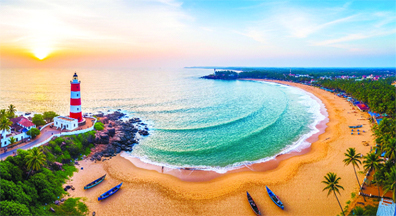

Nestled along the Arabian Sea coast in the southern state of Kerala, Kovalam remains one of India’s most celebrated beach destinations. Known for its crescent-shaped beaches, swaying coconut palms, tranquil backwaters, Ayurvedic wellness retreats, and vibrant coastal culture, Kovalam has long attracted travellers seeking both relaxation and adventure.
Located close to Thiruvananthapuram, the beach town combines natural beauty with the warmth of Kerala’s hospitality. Over the years, Kovalam has evolved from a quiet fishing village into an internationally recognised tourist hotspot while still retaining its laid-back charm and tropical appeal.
The Story Behind Kovalam’s Popularity
The name Kovalam is believed to have originated from the Malayalam word meaning “grove of coconut trees,” a fitting description for the lush landscape that surrounds the coastline. Though local fishing communities have lived here for generations, Kovalam gained international attention during the 1970s when it became popular among foreign backpackers and hippie travellers searching for peaceful beach escapes.
Today, the town welcomes tourists from around the world who come for its scenic beaches, wellness tourism, seafood cuisine, and serene atmosphere.
LIGHTHOUSE BEACH
So named because of the lighthouse perched on top of Kurumkal Hill, the southernmost beach of Kovalam—Lighthouse Beach—is one of the most stunning beaches in India. You’ll be tempted to spend a laidback afternoon at the beach but do make the effort of climbing up the spiral staircase of the red and white watchtower which will offer you the most spectacular views of the pristine waters and vast sandy stretch. The lifeguards here are quite alert and will give you pointers on which parts of the beach are safe to swim in on that particular day, as well as high-tide timings. The line of restaurants and shacks on the beach serve up fresh seafood, and there are a number of hotels (to suit every budget) on Lighthouse Road that leads up to the beach.
VIZHINJAM ROCK CUT CAVE TEMPLE
A small, 8th century rock cut temple, Vizhinjam Rock Cut Caves may not be grand enough, but patrons of ancient Indian architecture may appreciate the one-celled shrine with a loose sculpture of Vinandhara Dakshinamurthi in this granite sculpture. Located about 17 kilometres from the city of Thiruananthapuram, the cave remained nondescript for many years. It features Tripurantaka (Shiva) carrying a bow and arrow in two of his four hands and HIS divine consort Parvati. Visit it only if you have a serious thing for ancient temple architecture.
VIZHINJAM MARINE AQUARIUM
This gem of an aquarium is actually full of marine wealth such as fishes, corals and other aquatic fauna. Vizhinjam Marine Aquarium also boasts unique technique of Image Pearl production which involves embedding a pearl oyster into a mould of any shape, made of shell cement. After a couple of months, what you get is a lovely pearl shaped like the mould in which it was set. Find this spot at the busiest fishing harbours in Vizhinjam, near Theatre Junction.
NAPIER ART MUSEUM & GALLERY & SHRI CHITRA ART GALLERY
Kovalam is a friendly city with a rich history. And, the Napier Art Museum, in Thiruvananthapuram, named after the erstwhile Governor of Madras, Lord Napier, has documented that for posterity very well. There’s plenty for all types of visitors to see, from ivory carvings, traditional ornaments, zoological garden etc. Make sure to hit the Shri Chitra Art Gallery, in the vicinity, to appreciate the works dating back to the Mughal and Rajputana times.
PADMANABHAPURAM PALACE
The Padmanabhapuram Palace, located near Thuckalay in Kanyakumari, continues to attract history buffs and connoisseurs of antiquity. Currently maintained for posterity by the Govt. of Kerala Archaeology Department, this palace was erected around 1601 AD by the ruler Iravi Varma Kulasekhara Perumal, and was rebuilt in 1750 by the founder of modern Travancore, King Anizham Thirunal Marthanda Varma (1706–1758). King Marthaanda Varma dedicated the kingdom to his family deity Sri Padmanabha, a form of Lord Vishnu and ruled the kingdom as Padmanabha dasa or servant of Lord Padmanabha.
The features of this palace are especially noteworthy. The clock tower in the palace complex has a 300-year-old clock, which still keeps time. There’s large hall with a capacity to accommodate around 1000 guests, and it was once upon a time a space for holding ceremonial feasts on auspicious occasions. Interestingly, the palace has a secret passage, now blocked, through which the king, his immediate family members, and their entourage could escape to another palace, located several miles away in case of a serious threat. The palace complex also has old Chinese jars, all gifts by Chinese merchants, weapons, brass lamps, wood and stone sculpture, a variety of furniture, large mirrors made of polished metal, paintings portraying the history of Travancore and a wooden cot made of up to 64 wooden pieces of a variety of medicinal tree trunks.
KARAMANA RIVER
Karamana River, with its starting point near the southern point of the Western Ghats at Agastyar Koodam, flows westward to merge with the Arabian Sea at Panathura near Kovalam. In between, the river passes through a small, namesake suburb in Thiruvananthapuram called Karamana. You’ve got to appreciate the expansive green patches of tropical flora dotting the gorgeous lake. Karamana River has its own unique charm and ways to entertain tourists. Visit the Thiruvallam Boat Club located on the river bank, and buy a ticket or two for canoe rides, houseboat cruises, kayaking etc.
VELLAYANI LAKE
You’ve got to visit the lake that came into being due to the divine intervention of a holy sage. According to the local lore, once upon a time, a thirsty beggar visited a meditating saint in search of water. When the saint, however, saw that his vessel has only a few drops of water, not enough to quench the thirst of the humble seeker, he took the drops in his palm and threw them as far as he could with sacred intentions.


Be the first to comment