Tag: leadstory1

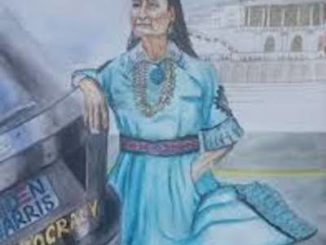
  • Indian American artist Sujata Tibrewala’s painting “Bloody Immigrant” depicts Deb Haaland

    Indian American artist Sujata Tibrewala’s painting “Bloody Immigrant” depicts Deb Haaland

    SAN JOSE, CA (TIP): Back in 1637, there was a massacre in which Pilgrims killed Native Americans and stole their land.  And so goes the story of Thanksgiving, where the Native Americans taught the Pilgrims how to live in the winter, ploughing the land and growing food, and Pilgrims then thanking their host. A plague perishing all Native Americans is a whitewashed story – a story where they insist that there are no rightful owners of the land that was usurped, so they don’t have to pay back for sins or atone to anyone.

    In reality, the Pilgrims stole the Native American land, raped and killed them as a manner of “giving thanks”. This killing symbolically continues today by the mainstream America pretending that they don’t exist. For example, Donald Trump said that Sen. Elizabeth Warren was not Native American since her blood is mixed with white blood. This is an age-old technique colonialism has used to make their victims disappear.

    When I think about their story, I really feel pity for them because they don’t get to tell their side of the story and have to continue living with their oppressors. Although in India, British did equally bad, at least they left and then we rewrote our history, teaching children about our freedom fighters and soldiers. Whereas in America, the opposite happened: the Native Americans are portrayed as savages, uncivilized tribes who don’t even exist today.

    It must be noted that I am not calling them Indians, because they were never Indians. I am an Indian from South Asia, not a Native American. It is like Columbus came here, discovered Native Americans thinking they were Indians, and instead of correcting their mistake, now insist on continuing to call them Indians hundreds of years later.

    These were some of the thoughts that were running in my mind when I painted this work. So, this painting is a tribute to 5 million Native Americans who live in the United States today. A majority of them are living on reservation land as forced by the famous “trail of tears” displacement, perpetrated by state where thousands died in transit or after reaching their destinations due to diseases. This happened between 1830 and 1850, because the US government wanted to acquire the land east of Mississippi. And this continues to this day. Native American land is where most polluting industries are likely to be located and they are in danger of being acquired to lay pipelines for fossil fuel industry or being dug for mining.

    There is a savior complex within the white population and yet within their own backyards, the indigenous people are always struggling to keep their land. Deb Halaand, one of the first two Native Americans to enter U.S. Congress and first from New Mexico, has a history of fighting for tribal sovereignty and advocating for natural resources. She was nominated by Joe Biden for interior secretary to serve in the new administration.

    Hence it is just fitting that she gets to do the honors in my painting to be squashing out Trump, an immigrant-hating president who has no place in American democracy.  The imagery used is based on actual footage of George Floyd’s killing while he was crying for help “I can’t breathe,” which has become an anthem for the Black Lives Matter movement. I used this image to comment that though the position of blacks in America is bad, at least they are in popular consciousness, however the Native Americans and their issues are not even part of the dialogue.

    (Sujata Tibrewala is an eco-feminist, artist and engineer, based in San Jose, California. She has exhibited her works at various prestigious venues in the United States and India. More of her work can be seen on www.Pratibimba.info.)

  • We have to move forward with mantra of ‘Make in India’ as well as ‘Make for World’, says PM Modi

    We have to move forward with mantra of ‘Make in India’ as well as ‘Make for World’, says PM Modi

    Prof. Indrajit Saluja

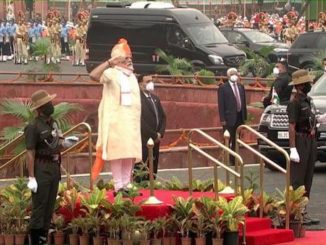
    DELHI (TIP): Prime Minister Narendra Modi unfurled the Indian National Flag at the Red Fort to mark the 74th Independence Day of India. In his address following the flag hoisting Prime Minister paid  tributes to freedom fighters and security forces. He then expressed the nation’s gratitude to Corona commandos- doctors and nurses who, at grave risk to their lives, worked to save precious human lives, adding “We will achieve victory over coronavirus with resolve of people of country”.

    Coronavirus may be a big challenge but not so big as to stop India’s march towards self-reliance, said Modi.

    Prime Minister reassured full support to citizens affected by natural calamities and disasters.

    Touching upon his favorite theme of self-reliance (Atma Nirbhar), he said “In midst of coronavirus pandemic, Indians resolve to become ‘self-reliant’; this is not a word but mantra for all people. It is necessary for us to prepare ourselves to make India self-reliant.”

    India’s share in world economy should increase for which we have to be self-reliant, he said.

    “For how long India will export raw materials and import finished products? Country has to become self-reliant. We have to go beyond reducing our imports”,  PM Narendra Modi said.

    While we focus on economic growth and development, humanity must retain a central role in this process.

    Mindset today should be ‘vocal for local’. Today, many big companies of world are turning to India: PM Modi on Indian economy

    I am confident that measures like opening up space sector will generate many new employment opportunities for our youth.

    Self-sufficient India means not only reducing imports, but also increasing our skills, our creativity.

    We have to move forward with mantra of ‘Make in India’ as well as ‘Make for World’.

    About 7,000 projects of different sectors have been identified to bring new revolution in infrastructure.

    We have to remove silos and entire country has to move towards multi-modal connectivity infrastructure.

    About Rs 90,000 crore directly transferred to bank accounts of poor; over 80 crore people provided free food grains: PM Modi

    Seven crore poor families were given free gas cylinders.

    Self-reliant India has an important priority — self-sufficient agriculture sector and self-reliant farmers.

    An agriculture infrastructure fund of Rs 1 lakh crore has been created to give modern infrastructure to farmers.

    Over one lakh households are being provided drinking water under Jal Jeevan mission.

    Middle-class has potential and wants new opportunities

    We have decided to connect all 600,000 villages with optical fiber  within 1,000 days.

    New education policy aims to connect our children with their roots while making them global citizens.

    PM Modi announced  launch of national digital health mission .From today, all Indians will  get health IDs, he said. National Digital Health Mission will bring a new revolution in India’s health sector.

    Three corona vaccines are in various stages of trial in India; large-scale production will begin once we get nod from scientists, he disclosed. “Our roadmap to bring corona vaccine to all Indians in shortest possible time is ready”.

    Modi announced that India  is committed to hold assembly elections in Jammu and Kashmir once delimitation exercise is completed. It was a year of a new development journey for Jammu and Kashmir, he said.

    Just as Sikkim has made its mark as an organic state, efforts are being made to make Ladakh a carbon neutral region.

    A special campaign with a holistic approach is also being worked out to reduce pollution in 100 selected cities of country.

    Touching upon border incursions and aggressions by neighbors, without naming a country, Modi said “Those who challenge India’s sovereignty, be it LOC or LAC, have been given a befitting reply in their own language”. “What India can do, world has seen it in Ladakh”, he said.

    Respect for India’s sovereignty is supreme for us. Today, neighbors are not only those with whom we share our geographical boundaries but also those with whom our hearts meet.

    In next 1,000 days, Lakshadweep will also be connected with high-speed internet, he announced. .

    We are expanding NCC in border areas; special training will be provided to about one lakh new NCC cadets.

    (With inputs from PTI)

  • Trump raises possibility of delaying the election—but that power rests in Congress

    Trump raises possibility of delaying the election—but that power rests in Congress

    Trump also said he would not trust results of an election that included widespread mail voting

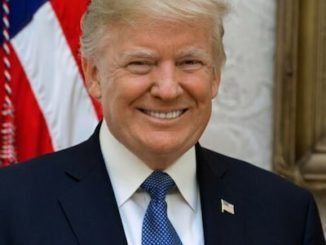
    WASHINGTON (TIP): US President Donald Trump on Thursday, July 30, raised the possibility of delaying the nation’s November 3 presidential election, though the Constitution bestows that power on Congress, not the president.

    The move drew immediate objections from Democrats and it was not clear whether Trump was serious.

    Trump also said he would not trust the results of an election that included widespread mail voting—a measure that many election observers see as critical given the coronavirus pandemic.

    Trump, without evidence, repeated his claims of mail-in voter fraud and raised the question of a delay, tweeting: “delay the election until people can properly, securely and safely vote???”

    Trump’s tweet came shortly after the United States reported its worst economic downturn since the Great Depression: a second-quarter crash in gross domestic product due to widespread shutdowns prompted by the coronavirus pandemic.

    Trump, who is trailing challenger and former Vice President Joe Biden in opinion polls, had previously intended to focus his re-election bid on the nation’s economic performance.

    Trump had previously suggested he would not trust election results—complaints similar to those he raised going into the runup to the 2016 election—but had not so directly suggested changing the November 3 date.

    Representatives for the White House did not immediately respond to a request for comment, the Reuter report says.

    Trump has cast doubt on the legitimacy of mail-in ballots, which have been used in far greater numbers in primary elections amid the pandemic.

    He has also made unsubstantiated allegations that voting will be rigged and has refused to say he would accept official election results if he lost.

    Democrats, including Biden, have already begun preparations to protect voters and the election amid fears that Trump will try to interfere with the November election.

    “A sitting president is peddling lies and suggesting delaying the election to keep himself in power,” Democratic Representative Dan Kildee wrote on Twitter.

    “Don’t let it happen. Every American — Republican, Independent and Democrat — should be speaking out against this President’s lawlessness and complete disregard of the Constitution.”

    US Senator Tom Udall, also a Democrat, said, “There is no way @POTUS can delay the election. We shouldn’t let him distract us from his #COVID19 incompetence.”

    Nonpartisan US election analyst Kyle Kondik of the University of Virginia said the tweet seemed to follow Trump’s typical approach of trying to distract voters from bad news.

    “Trump suggesting delaying the election (he can’t do this w/o congressional approval) seems to be one of his more obvious attempts to change the subject given this morning’s wretched GDP numbers,” Kondik wrote on Twitter.

    Attorney General William Barr was asked in congressional testimony earlier this week whether Trump could change the election date: “I’ve never been asked the question before. I’ve never looked into it.”

    Barr also testified that to his knowledge, a sitting president cannot contest the results of an election if the vote tallies are clear.

    (Source: Reuters)

  • “Era of expansionism has ended; it is time for development”: Modi warns China

    “Era of expansionism has ended; it is time for development”: Modi warns China

    Prime Minister Narendra Modi on Friday, July 3  paid a surprise visit to Ladakh to assess the border situation.

    I.S.Saluja

    LEH / NEW YORK (TIP): :Modi, who reached Leh in the morning of July 3, had  a major strategic session with the army commanders, where the 14 Corps Commander gave a detailed view of the situation since May, how the standoff started and also how it looks like as of today in terms of the estimated strength of the soldiers and their machinery on both the sides.

    The PM was greeted with slogans of ‘Bharat Mata ki Jai’ and ‘Vande Mataram’ by the soldiers, who also raised their arms.

    Modi was also briefed about the evolving situation since May at Galwan Valley, Pangong Tso, Demchok and Hot Springs in the eastern Ladakh by Lt Gen Harinder Singh, who had led the Indian delegation in the three rounds of talks with his Chinese counterpart Major General Liu Lin.

    According to the latest situation, the soldiers on the two sides are to disengage as part of  de-escalation, that is, both sides have to scale down the aggressive posturing, though the standoff position would remain till the two sides sort out all the issues.

    The PM was accompanied by Chief of Defense Services Gen Bipin Rawat and Chief of Army Staff Gen MM Naravane.

    In an obvious warning to China, Modi said : “Era of expansionism has ended; it is time for development”.

     Here are some excerpts from Modi’s address to soldiers posted at India – China border.

    “I am again paying respect to brave soldiers who sacrificed their lives in Galwan Valley”.:

    “Bravery you have shown recently has sent a message to the whole world about India’s strength”.

    “Our resolve for ‘Atmanirbhar Bharat’ becomes stronger because of you and your strong resolve”.

    “Your willpower is as strong and firm as the Himalayas; the whole country is proud of you”..

    “Era of expansionism has ended; it is time for development”.

    “We are putting adequate focus on requirement of armed forces”.

    “Bravery is a prerequisite for peace”.

    “You have shown exemplary dedication in Galwan Valley; the country is proud of all of you”.

    Background to the conflicts:

    India and China, two nuclear-armed Asian neighbors, are in a tense diplomatic and military standoff following their first deadly border clash in more than 40 years.

    The June 15 incident in the disputed Galwan Valley, an arid Himalayan area along the Line of Actual Control (LAC), the de facto border between the two nations, left 20 Indian soldiers dead. China has yet to officially declare its casualties.

    Indian and Chinese troops have been engaged in the standoff since early May at several points along the 3,500km (2,200-mile) LAC, most of which remains undemarcated.

    The fighting on June 15 was triggered by a disagreement over two Chinese tents and observation towers that Indian officials said had been built on its side of the LAC.

    Chinese troops breached the Line to set up temporary “structures” in the Galwan Valley even after military officials had reached an agreement on June 6 to de-escalate, Indian Foreign Minister Subrahmanyam Jaishankar told China’s senior diplomat, Wang Yi, in a phone call.

    The problem arose when an Indian patrol visited the area near a ridge to verify a Chinese assertion that its troops had moved back from the LAC, two government sources told Reuters news agency.

    The Chinese troops had thinned out, leaving behind two tents and small observation posts, which the Indian party demolished, the sources said.

    A large group of Chinese soldiers arrived and confronted the Indian troops. It was not clear what happened next, but the two sides soon clashed, the Chinese soldiers reportedly using iron rods and batons with spikes, killing 20 Indian soldiers and wounding dozens of others.

    China has not said anything about any losses in the hand-to-hand combat.

    Experts mainly cite two reasons for the deadliest clash since 1975.

    A major reason, according to some experts, is linked to India’s unilateral move last year to repeal Article 370 of the Indian constitution, which had guaranteed a measure of autonomy to the former Jammu and Kashmir state, which also included the disputed areas in Ladakh region.

    China, which, like Pakistan, saw India’s move as unilaterally affecting its territory, strongly denounced the move at the UN Security Council last year.

    Analysts also believe the current standoff is also a result of China’s pushback against India’s recent construction of infrastructure in border areas.

    India inaugurated the 255km (158-mile) Darbuk-Shyok-Daulat Beg Oldie (DSDBO) road, built along the LAC, last year. China objected, seeing the move as a threat to its interests in the region.

    The heightened tensions between the world’s two most populous countries have drawn international concerns, with the United Nations urging both sides “to exercise maximum restraint”.

    China’s economic corridor to Pakistan and Central Asia passes through Karakoram, which is close to Galwan Valley, the site of the June 15 clash. Galwan Valley is close to Aksai Chin Plateau, which is under Chinese control but claimed by India.

    According to Happymon Jacob, professor of international relations at New Delhi-based Jawaharlal Nehru University, China considers the Ladakh region crucial for its “access to Central Asia and CPEC project with Pakistan in which they [China] have invested billions of dollars [about $60bn].”

    Chinese foreign ministry spokesman Zhao Lijian said he was unaware of the specifics but that the Indian army had crossed into Chinese territory in several places in recent days – violating the agreement reached on June 6 – and that they should withdraw.

    Calling it a “deliberate provocation” on New Delhi’s part, Zhao said: “The rights and wrongs… are very clear and the responsibility rests entirely with the Indian side.”

    In response, India’s foreign ministry spokesman Anurag Srivastava cautioned China against making “exaggerated and untenable claims” on the sovereignty of the Galwan Valley area.

    India says China occupies 38,000 sq. km (15,000 square miles) of its territory in the Aksai Chin Plateau in the Himalayas, with 12,000 Chinese soldiers reportedly pushing across the border.

    Modi’s denial of a Chinese incursion triggered a controversy, with opposition leaders accusing the government of intelligence failures and asking why the clash happened in the first place.

    Ashley Tellis, senior fellow at the Carnegie Endowment for International Peace, believes the latest Chinese advances in the Ladakh region leaves India with “painful” choices.

    “Beijing has moved into disputed territories that did not host a continual Chinese presence as recently as January 2020,” Tellis wrote on June 4, days before the brawl.

    Satellite pictures taken by Earth-imaging company, Planet Labs, in the days leading up to the clash, also suggest increased Chinese activity at the Galwan Valley.

    “Looking at it in Planet, it looks like China is constructing roads in the valley and possibly damming the river,” Jeffrey Lewis, director of the East Asia Nonproliferation Program at California’s Middlebury Institute of International Studies, told Reuters.

    “There are a ton of vehicles on both sides [of the LAC] – although there appear to be vastly more on the Chinese side. I count 30-40 Indian vehicles and well over 100 vehicles on the Chinese side.”

    In addition to its dispute with China, India has found itself at loggerheads with two other neighbors – long-standing rival Pakistan, and Nepal.

    Nepal and India have historically enjoyed good ties, but now find themselves engaged in what experts have called a cartographic war over border regions.

    Last week, Nepal’s Parliament approved a new map for the country, which includes land controlled by India.

    “On the one hand, the major power in the region, China, is against India and on the other hand, smaller neighbors, which have been traditionally very friendly to India, are also negatively disposed to India. I think that is a major policy failure,” Jacob told Al Jazeera.

    India-China Face off in Ladakh

    The Reaction in India

    The reaction in India to Chinese advances has been one of outrage, with citizens and trade associations calling for the Modi-led government to boycott Chinese goods.

    Protesters across the country were seen burning Chinese flags and products, while videos on social media showed teenagers destroying their Chinese-made mobile phones.

    The Reaction abroad

    Some Indian American groups in  US, owing allegiance to the ruling BJP , have called for boycott of Chinese goods. These groups, at places , like New York, have called for protests against China.

    Beijing is India’s biggest trading partner, with annual bilateral trade worth $92bn. The trade imbalance between the two is significant and favors China heavily.

    In an interview to The Economic Times, Shyam Saran, former Indian foreign secretary, said India should avoid any “knee-jerk reactions” against China, claiming that it would be impossible for New Delhi to find alternative suppliers in the near future.

    Jacob believes India should reach out to Quadrilateral Security Dialogue, also known as Quad – an informal strategic forum that includes India, Japan, Australia and the United States – to take on China.

    “If the USA makes noises in favor of India and strengthens the Quad, it will send a message to China that we will take aggressive steps and will defend our interest,” he said.

    Meanwhile, India has bolstered  defense amid tensions along China border.

    India on Thursday, July 2,  approved the purchase of 33 Russian fighter jets and upgrades to 59 war planes at a cost of ₹18,148 crore amid rising tensions with China and about two weeks after the deadliest border clash in more than four decades between the two Asian nations.

    The order includes 21 MiG-29s that would be purchased directly from Russia and a dozen Sukhoi Su-30MKIs that would be produced under license by state-run Hindustan Aeronautics Ltd (HAL). In addition, 59 MiG-29 jets would be upgraded in Russia, the defense ministry said in a statement.

    The approval by the ministry’s defense acquisition council came on a day Prime Minister Narendra Modi spoke to Russian President Vladimir Putin. The Russian President reiterated his commitment to “further strengthen the special and privileged strategic partnership between the two countries in all spheres”, an Indian foreign ministry statement said. The statement did not say whether the two leaders discussed India’s border tensions with China .

    India’s foreign ministry spokesman Anurag Srivastava said on Thursday, July 2,  that New Delhi and Beijing will “continue their meetings both at the military and diplomatic levels… in the future to resolve the issue (current boundary tensions) to mutual satisfaction.”

    That Russia seemed to respond to India’s list for defense purchases at a time of tensions with China—seen a strong partner of Russia—together with support for New Delhi from countries like the US and France shows what “the global mood is like” on the issue of India-China tensions, said Harsh Pant, professor of international relations at London-based King’s College. “The support for India remains broad. It would be a smart strategy on the part of China to take this into account,” he said.

    The orders for the fighter jets as well as 248 indigenously developed beyond-visual-range ASTRA air-to-air missiles, with the capacity to engage and destroy highly maneuvering supersonic aircraft during night or day—besides long-range land attack missile systems having a firing range of 1,000km are expected to come as a shot in the arm for India’s military, especially the Indian Air Force whose squadron strength is now down to 30 from the sanctioned 42.

    An IAF helicopter flies in the sky, in Leh on Thursday, July 2.

    “While the MiG-29 procurement and upgradation from Russia is estimated to cost ₹7,418 crore, the Su-30 MKI will be procured from HAL at an estimated cost of ₹10,730 crore,” the statement said.

    In total, the defense acquisition council approved contracts worth ₹38,900 crore, of which ₹31,130 would be purchased locally including ammunition for Pinaka multiple rocket launcher, long-range land attack cruise missile and the Astra missiles for navy and air force.

    The tensions with China had prompted defense minister Rajnath Singh to visit Russia last month and meet senior members of government in Moscow to ensure supplies of spares and weapons systems. Despite India diversifying the sources from where it buys its military hardware in recent decades, an estimated 60% of its arsenal contains Russian origin systems making Delhi depend on Moscow for critical spares .

    India’s defense equipment purchases from Russia may irk US which has always expressed displeasure with India buying defense equipment from Russia.

    (With inputs from PTI, ALJAZEERA)

  • A chill in U.S.-China relations

    A chill in U.S.-China relations

    A binary choice between the U.S. and China is likely to test India’s capacity to maintain strategic and decisional autonomy

    By Vijay Gokhale
    Both sides are acutely aware how closely their economies are tied together: from farm to factory, the U.S. is heavily dependent on supply chains in China and the Chinese have been unable to break free of the dollar. If Mr. Trump’s wish is to disentangle China’s supply chains, Mr. Xi is equally determined to escape from the U.S. ‘chokehold’ on technology. To what extent the de-coupling is possible is yet to be determined, but one thing is inevitable, India will become part of the collateral damage.”

    A slew of recent announcements on China by U.S. President Donald Trump is a clear indication that the competition between the U.S. and China is likely to sharpen in the post-COVID world. On May 29, the Trump administration said it would revoke Hong Kong’s special trade status under U.S. law. The administration also passed an order limiting the entry of certain Chinese graduate students and researchers who may have ties to the People’s Liberation Army. The U.S. President has also ordered financial regulators to closely examine Chinese firms listed in U.S. stock markets, and warned those that do not comply with U.S. laws could be delisted.

    Complicit in China’s rise

    Americans have had a strange fascination for China ever since the early 1900s when Protestant missionaries decided that it was God’s work to bring salvation to the Chinese. Books like The Good Earth by Pearl S. Buck and Red Star Over China by Edgar Snow in the 1930s romanticized the country. Even after the Chinese communists seized power, the Americans hoped to cohabit with Mao Zedong in a world under U.S. hegemony. The Chinese allowed them to believe this and extracted their price. U.S. President Richard Nixon gave China the international acceptability it craved in return for being admitted to Mao’s presence in 1972; President Jimmy Carter terminated diplomatic relations with Taiwan in order to normalize relations with China in 1978; President George H.W. Bush washed away the sins of Tiananmen in 1989 for ephemeral geopolitical gain; and Bill Clinton, who as a presidential candidate had criticized Bush for indulging the Chinese, proceeded as President to usher the country into the World Trade Organization at the expense of American business. All American administrations since the 1960s have been complicit in China’s rise in the unrealized hope that it will become a ‘responsible stakeholder’ under Pax Americana.

    Disguising its real purpose

    The Chinese are hard-nosed and unsentimental about the U.S. They have always pursued America with a selfish purpose, albeit couched in high principle. They have spoken words that the Americans wanted to hear — anti-Soviet rhetoric during the Cold War and market principles thereafter — to disguise their real purpose of thwarting U.S. hegemony. Ever since Cold Warrior John Foster Dulles spoke in 1958 of weaning China and other “satellites” away from the Soviets through regime change, known as “peaceful evolution”, every Chinese leader from Chairman Mao to President Xi Jinping has been clear-eyed that the U.S. represents an existential threat to the continued supremacy of the communist regime. Mao put it best, when he told high-ranking leaders in November 1959, that the “U.S. is attempting to carry out its aggression and expansion with a much more deceptive tactic… In other words, it wants to keep its order and change our system.” (Memoirs, Chinese leader Bo Yibo). The collapse of the Soviet Union only reinforced this view and strengthened China’s resolve to resist by creating its own parallel universe. China is building an alternate trading system (the Belt and Road Initiative); a multilateral banking system under its control (Asian Infrastructure Investment Bank, New Development Bank); its own global positioning system (BeiDou); digital payment platforms (WeChat Pay and Alipay); a world-class digital network (Huawei 5G); cutting-edge technological processes in sunrise industries; and a modern military force. It is doing this under the noses of the Americans and some of it with the financial and technological resources of the West.

    Voices of caution have been few and far between, among them political scientist John Mearsheimer, who wrote in 2005 that the rise of China would not be peaceful at all, but the world chose to believe General Secretary of the Communist Party of China Hu Jintao’s assurances about “peaceful rise”. When satellite evidence showed that China was building military installations in the South China Sea, China’s Southeast Asian neighbors and the U.S. preferred to believe assurances to the contrary given by Mr. Xi on the lawns of the White House in 2015.

    It is only under Mr. Trump that the Americans are finally acknowledging the uneasy fact that the Chinese are not graven in their image. He has called China out on trade practices. He has called China out on 5G. It was Mr. Trump’s 2017 National Security Strategy document that, perhaps for the first time, clubbed China along with Russia as a challenge to American power, influence and interests. His recent China-specific restrictions on trade and legal migration are, possibly, only the beginning of a serious re-adjustment.

    A full-spectrum debate on China is now raging across the U.S. Former White House Chief of Staff Steve Bannon declared that the U.S. is already at war with China. Others like diplomat Richard  Haass and former president of the World Bank, Robert Zoellick, warn that a new Cold War will be a mistake. Scholar Julian Gewirtz, in his brilliant essay, ‘The Chinese Reassessment of Interdependence’, talks about a similar process under way in Beijing. Both sides are acutely aware how closely their economies are tied together: from farm to factory, the U.S. is heavily dependent on supply chains in China and the Chinese have been unable to break free of the dollar. If Mr. Trump’s wish is to disentangle China’s supply chains, Mr. Xi is equally determined to escape from the U.S. ‘chokehold’ on technology. To what extent the de-coupling is possible is yet to be determined, but one thing is inevitable, India will become part of the collateral damage.

    The Hong Kong question

    Will Hong Kong become a game-changer in the post-COVID world? China’s decision to enact the new national security law for Hong Kong has been condemned in unison by the U.S. and its Western allies as an assault on human freedoms. Why is this significant? The points of divergence, even dispute, between them have so far been in the material realm. With Hong Kong, the U.S.-China rivalry may, possibly, be entering the ideological domain. For some time now there are reports about Chinese interference in the internal affairs of democracies. Countries in the West have tackled this individually, always mindful of not jeopardizing their trade with China. Hong Kong may be different. It is not only a bastion for Western capitalism in the East, but more importantly the torchbearer of Western democratic ideals. Think of it as a sort of Statue of Liberty; it holds aloft the torch of freedom and democracy for all those who pass through Hong Kong en route to China. This is an assault on beliefs, so to speak.

    This comes on the back of not unreasonable demands that China should come clean on its errors of omission in the early days of COVID-19, when greater transparency and quicker action might have prevented, or at least mitigated, the pandemic. In the months ahead, more information may become public, from sources inside China itself, about the shortcomings of the regime, that will further fuel a debate on the superiority of the Chinese Model as an alternative to democracy. Will this form the ideological underpinning for the birth of a new Cold War? That will depend on who wins in Washington in November; on whether profit will again trump politics in Europe; and on how skillfully the Wolf Warriors of China can manipulate global public opinion. The lines are beginning to be drawn between the Americans on the one side and China on the other. A binary choice is likely to test to the limit India’s capacity to maintain strategic and decisional autonomy.

    (The author is a former Foreign Secretary of India and a former Ambassador to China)

  • A plan to revive a broken economy

    A plan to revive a broken economy

    By Jayati Ghosh, Harsh Mander, Prabhat Patnaik
    A combination of wealth and inheritance taxation and getting multinational companies to pay the same effective rate as local companies through a system of unitary taxation will garner substantial public revenue. They will also reduce wealth and income inequalities which have become horrendous. A 2% wealth tax on the top 1% of the population, together with a 33% inheritance tax on the wealth they bequeath every year to their progeny, could finance an increase in government expenditure to the tune of 10% of GDP.

    An estimated 12.2 crore Indians lost their jobs during the coronavirus lockdown in April: CMIE

    There are clear, implementable steps the Centre can take in fiscal terms to revive the economy and support livelihoods

    The Prime Minister has just announced Lockdown 4.0. Despite some resulting increase in economic activity, vast numbers of working people will remain without their regular incomes. He also announced a package of ₹20 lakh crore, but this includes already allocated money of ₹6-lakh crore and monetary policy directives to banks and non-banking financial companies. The announcements by the Finance Minister thus far involve no additional public spending, even though this is urgently required to revive the economy and prevent further contraction. Here we discuss what the government should do immediately in fiscal terms for reviving the economy and supporting livelihoods.

    Food and cash transfers first

    The immediate need is to provide free food and cash transfers to those rendered incomeless. Providing every household with ₹7,000 per month for a period of three months and every individual with 10 kg of free food grains per month for a period of six months is likely to cost around 3% of our GDP (assuming 20% voluntary dropout). This could be financed immediately through larger borrowing by the Centre from the Reserve Bank of India. The required cash and food have to be handed over to State governments to make the actual transfers, along with outstanding Goods and Services Tax compensation.

    This is easily doable for several reasons. First, food grains are plentiful, as the Food Corporation of India had 77 million tons, and rabi procurement could add 40 million tons. Second, because of the lockdown restrictions, the multiplier rounds of such expenditure are heavily truncated at present and would not generate as much demand as in normal times. Third, cash transfers in many spheres will only enable current demand to continue (such as payment of house rent to continue occupancy) and not create any fresh demand. Fourth, when greater normalcy finally allows pent-up demand to surface, output could also expand because of resumed economic activity. Finally, putting money in the hands of the poor is the best stimulus to economic revival, as it creates effective demand and in local markets. Hence, an immediate program of food and cash transfers must command the highest priority.

    Revamp MGNREGA work

    But the post-lockdown world will be different for several reasons. First, millions of migrant workers have endured immense hardships to trudge back home, and are unlikely to return to towns in the foreseeable future. Employment has to be provided to them where they are, for which the Mahatma Gandhi National Rural Employment Guarantee Scheme (MGNREGS) must be expanded greatly and revamped with wage arrears paid immediately. The 100-day limit per household has to go; work has to be provided on demand without any limit to all adults. And permissible work must include not just agricultural and construction work, but work in rural enterprises and in care activities too.

    The revamped MGNREGS could cover wage bills of rural enterprises started by panchayats, along with those of existing rural enterprises, until they can stand on their own feet. This can be an alternative strategy of development, recalling the successful experience of China’s Township and Village Enterprises (TVEs). Public banks could provide credit to such panchayat-owned enterprises and also assume a nurturing role vis-à-vis them.

    The second change is the palpable unsustainability of the earlier globalization, which means that growth in India in the coming days will have to be sustained by the home market. Since the most important determinant of growth of the home market is agricultural growth, this must be urgently boosted.

    The MGNREGS can be used for this, paying wages for land development and farm work for small and medium farmers; apart from government support through remunerative procurement prices, subsidized institutional credit, other input subsidies, and redistribution of unused land with plantations. Agricultural growth in turn can promote rural enterprises, both by creating a demand for their products and by providing inputs for them to process; and both these activities would generate substantial rural employment.

    The Urban focus

    In urban areas, it is absolutely essential to revive the Micro, Small and Medium Enterprises (MSMEs). Simultaneously, the vast numbers of workers who have stayed on in towns have to be provided with employment and income after our proposed cash transfers run out. The best way to overcome both problems would be to introduce an Urban Employment Guarantee Program, to serve diverse groups of the urban unemployed, including the educated unemployed. Urban local bodies must take charge of this program and would need to be revamped for this purpose.

    “Permissible” work under this program should include, for the present, work in the MSMEs. This would ensure labor supply for the MSMEs and also cover their wage bills at the central government’s expense until they re-acquire robustness. It should imaginatively also include care work, including of old, disabled and ailing persons, educational activities, and ensuring public services in slums.

    These measures are in direct contrast to those that seek to entice private investors by easing labor laws. The humanitarian crisis of the lockdown reveals the imperative for more, not less labor protection. Such measures, far from reviving investment or employment, would also further reduce domestic demand.

    96% migrant workers did not get rations from the government, 90% did not receive wages during lockdown: survey

    The ‘care’ economy

    The pandemic has underscored the extreme importance of a public health-care system, and the folly of privatization of essential services. The post-pandemic period must see significant increases in public expenditure on education and health, especially primary and secondary health including for the urban and rural poor.

    The “care economy” provides immense scope for increasing employment. Vacancies in public employment, especially in such activities, must be immediately filled. Anganwadi and Accredited Social Health Activists/workers who provide essential services to the population, including during this pandemic, are paid a pittance and treated with extreme unfairness. We must improve their status, treat them as regular government employees and give them proper remuneration and associated benefits, and greatly expand their coverage in settlements of the urban poor.

    These could easily come within the total package announced by the Prime Minister, which could be financed by printing money. But in the medium term, public revenues must be increased. This is not because there is a shortage of real resources which, therefore, has to be taken from other existing uses through taxation. Rather, since much unutilized capacity exists in the economy, the shortage is not of real resources; the government has to just get command over them.

    A combination of wealth and inheritance taxation and getting multinational companies to pay the same effective rate as local companies through a system of unitary taxation will garner substantial public revenue. They will also reduce wealth and income inequalities which have become horrendous. A 2% wealth tax on the top 1% of the population, together with a 33% inheritance tax on the wealth they bequeath every year to their progeny, could finance an increase in government expenditure to the tune of 10% of GDP.

    It would be argued that this might cause large financial outflows, which the country can ill-afford. Contrarily, even foreign capital is more likely to be attracted to a growing economy than one in sharp decline because of lack of stimulus. Also, a fresh issue of special drawing rights by the International Monetary Fund (which India has surprisingly opposed along with the United States) would provide additional external resources.

    These additional resources, we estimate, would suffice to finance the institution of five universal, justiciable, fundamental economic rights: the right to food, the right to employment, the right to free public health care, the right to free public education and the right to a living old-age pension and disability benefits. The broken economy must be rebuilt in ways to ensure a life of dignity to the most disadvantaged citizen.

    (Prabhat Patnaik is Professor Emeritus, Centre for Economic Studies and Planning, Jawaharlal Nehru University (JNU), New Delhi. Jayati Ghosh is a professor of economics at JNU. Harsh Mander is a human rights worker, writer and teacher)


  • Banking on the banks for expansion

    Banking on the banks for expansion

    By Pulapre Balakrishnan

    Presently, we are witnessing an interesting strategic interaction. The government accepts that the economy needs more growth but insists that this can only come via private investment and the private sector awaits an improvement in growth before deciding whether to invest. It is not clear whether the basis of the government’s insistence on private investment alone is ideological or based on fiscal considerations. Whatever it may be, it is clear that if it does not get proactive now, it could be left waiting for a private investment that may not be forthcoming.

    The government accepts that the economy needs more growth but could end up paying for its inaction.

     In 2005, a Nobel laureate in economics claimed that the “… problem of depression-prevention has been solved”. He was exulting over an innovation in economic theory according to which fiscal policy, associated with profligacy, had no role whatsoever. Just a few years later, following the North Atlantic financial crisis, the U.S. fiscal deficit had to be raised three-fold, he responded, “I guess everyone is a Keynesian in the foxhole”, implying that in the face of an impending crisis it is alright to rely on fiscal policy after all. A similar pragmatism is absent from economic policymaking in India today.

    By meeting industrialists for policy inputs so soon after the Budget for the year had been presented and then, via a press conference held a few weeks later rolling back some of the tax proposals in it, the government revealed its anxiety about the state of the economy. This is only to be expected of a party that came to power promising to transform it. Far from having significantly improved the performance of the economy in its first term in office it has been presiding over an economy in which growth has been declining for close to two-and-a-half years by now. So what did the Finance Minister offer in her press conference? And can we expect it be game-changing?

    Three sets of announcements pertain to concessions impacting upon the automobile sector, proposals for the banking sector and a change in a practice of the Income-Tax Department. Of the first it may be said that addressing the problems of any one sector when several are equally stressed is not fair governance. There have been reports of severe stress in the packaged foods industry for instance and we have long been aware that the agricultural sector has been troubled after demonetization.

    Of the revision of the procedure adopted for issuing an IT notice, it can be said that it does address the issue of tax terrorism, but only a thorough social audit of the processes adopted by the tax authorities can establish whether it would be sufficient to ensure that honest firms are not be hounded and that the government receives all the revenue due to it. Industrialists are under pressure to not speak out against high-handedness, and the compulsory retirement of income tax personnel for malpractice recently point to not everything being well within that department. That leaves us with the proposals for the banking sector. Of these it can be said right away that some of them are quite sound; but if the government’s intention was to reverse the slowing of growth, they are unlikely to make much of a difference.

    Infusion without reforms

    Most significant among the measures related to banking is the infusion of capital up to ₹70,000 crore into the public sector banks. This is expected to contribute to a potential ₹5 lakh crore expansion of credit. With this the government has frontloaded a provision already announced in the Budget. This transfer is now going to be made right away. This is a major step in the direction of taking the banking sector to a more solid foundation. There is also a proposal to ensure that loan decisions taken by bankers are treated as economic decisions and not as instances of corruption when a loan goes awry.

    Public sector banking has been hobbled by the colonial attitude that India’s public servants cannot be trusted, leading to a continuous surveillance that is not conducive to their exercising initiative in lending. At the same time, the present non-performing assets crisis points to the role of political pressure on banks in the past. Without addressing both these issues we can never transit to a strong banking sector. So the capital for the long-term infusion should have been accompanied by governance reforms that both enforce honest behavior and ring-fence the public banker from political pressure.

    Policy rate cuts

    Finally, there was the announcement that public sector banks will pass on more of the policy rate cuts that the Reserve Bank of India (RBI) has effected in several rounds by now. The government’s frustration at this not having happened is easily imagined but is the proposal for a near automatic adjustment sound by itself? It is tantamount to the lending rate of banks being determined by the RBI’s actions. There is after all the risk premium that banks tack on to their prime lending rate, which itself depends on factors other than the policy rate. Overall, the move towards having commercial bank rates move in tandem with the repo rate by fiat is not advisable. The decision should be left to the banks.

    Let us, however, assume for a moment that lending rates are set to be lowered whatever be the mechanism. Will this revive the economy? It is apparent from the Finance Minister’s press conference that the government thinks this will happen. Generally, the potency of monetary policy in reversing sluggishness in the economy is considered to be weak. The belief among economists is that while a rise in the rate of interest can hold back a decision to invest by raising the cost of finance, an interest rate reduction can do little in the absence of an urge among investors to commit capital. A lack of understanding of the factors governing investment is evident in the suggestion often seen in the press that the government must ‘revive animal spirits’ in the economy. Animal spirits were originally imagined as the spontaneous urge to either undertake investment or hold back from it. The expectation of future profits is the key element here for potential investors. The government can have a role only if it can affect long-term profit expectations. Certainly not by lowering interest rates.

    Focus on private investment

    Presently, we are witnessing an interesting strategic interaction. The government accepts that the economy needs more growth but insists that this can only come via private investment and the private sector awaits an improvement in growth before deciding whether to invest. It is not clear whether the basis of the government’s insistence on private investment alone is ideological or based on fiscal considerations. Whatever it may be, it is clear that if it does not get proactive now, it could be left waiting for a private investment that may not be forthcoming.

    Our experience of the five years of very high growth over 2003-08, when the economy grew at its fastest ever, tells us that three factors had played a role in it. These were unusually high rates of agricultural growth, record levels of public investment and buoyant exports. The package announced by the Finance Minister on August 23 did not relate to any of these. Of course, exports depend to an equal extent on factors beyond India’s control but the government could have addressed the other two factors. Notably, it had nothing for the rural sector which clearly needs attention. For a start an expansion of the Mahatma Gandhi National Rural Employment Guarantee Scheme, with attention paid to building assets that most strongly impact agricultural output, may be considered. As for public investment, it is the elephant in the North Block. The government is reluctant to step it up, harping on fiscal space, but fiscal space is for a smart government to make up. Instead this one shrunk the space for public investment by introducing an income scheme exclusively meant for farmers just before the elections and then expanding it soon after it returned to power. It was a case of rewarding political support rather than attending to the needs of an economy known to be slowing. When in the foxhole you imagine that you are on a mountain top, you end up paying for your fancy.

    (The author is Professor, Ashoka University, Sonipat and Senior Fellow, IIM Kozhikode)

  • Local Group of Indian Americans Helps North Texas Food Bank Provide More Than 4 Million Meals

    Local Group of Indian Americans Helps North Texas Food Bank Provide More Than 4 Million Meals

    DALLAS (TIP): With a rally cry of “Hunger Mitao” -meaning wipe out hunger- the North Texas Food Bank’s Indian American Council (NTFB-IAC) has quickly mobilized and engaged the Indian-American community through issue awareness, increasing volunteerism and raising critical funds to benefit the mission of the NTFB. In less than two years the Council has helped provide access to more than 4 million meals. Fueled by a passionate Indian American community, the group originally planned to provide support for one million meals annually. Thanks to an outpouring of support the group exceeded their year goal in a mere 7 months and now in their second year, has shown no signs of slowing down.

    In celebration of India’s Independence Day, the NTFB-IAC is launching the Second Annual Hunger Mitao Week, their signature campaign which works to showcase the unity, philanthropy and spirit of the Indian-American community by conducting peanut butter and fund for food drives all over the region served by the North Texas Food Bank. The week will conclude with a special volunteer shift on August 17 while the call for peanut butter donations continues throughout the month of August.

    “It is gratifying to see how much the IAC has grown in two short years,” said Raj Asava, co-founder of the NTFB-IAC alongside his wife, Aradhana “Anna” Asava. “We have known this community to be compassionate and generous problem solvers, but to see the momentum that started in North Texas translate into a major national-level movement is thrilling.

    The NTFB-IAC is the original Indian American Council that was created to benefit Feeding America Member Food Banks. Thanks to the success in North Texas, the concept is now being replicated in other US cities including Houston, New York City, Atlanta, Seattle, New Jersey, and Washington DC.

    “When we launched the IAC in North Texas, we were confident that the community would galvanize around the issue of hunger,” said Anna Asava, NTFB-IAC co-founder. “What we couldn’t have predicted is how quickly the movement would grow and how dedicated the community is to fighting hunger; it truly is all about the spirit of ‘give where you live.’”

    As the NTFB-IAC works to plan for the next 4 million meals, those that have benefitted the most from their efforts are the people facing food insecurity in North Texas.

    “Hunger is a complex issue, and it takes a community to ensure that we have the resources in place to feed those that need our help,” said Trisha Cunningham, President and CEO of the North Texas Food Bank. “The Asavas and each of the families and companies that make up the NTFB-IAC have played a critical role in ensuring our neighbors have the foods that they need to thrive.  We can’t thank them enough for their efforts to provide 4 million meals in less than two years and can’t wait to see what the next two years will bring for this tenacious group!”

    To find out more about Hunger Mitao Week and how to get involved with the NTFB-IAC visit ntfb.org/iac

    About the North Texas Food Bank

    The North Texas Food Bank(NTFB) is a top-ranked nonprofit hunger-relief organization operating a state-of-the-art volunteer and distribution center in Plano—the Perot Family Campus. Last year, the Food Bank worked hard in partnership with member agencies from our Feeding Network to provide access to almost 77 million nutritious meals across a diverse 13-county service area—this means more than 200,000 meals per day for hungry children, seniors and families. But the need for hunger relief in North Texas is complex, in order to meet the need, the NTFB is working to increase our food distribution efforts with a goal of providing access to 92 million nutritious meals annually by 2025.

    NTFB is a member of Feeding America, a national hunger-relief organization.

    About the Indian American Council

    The Indian American Council was formed to raise awareness, improve engagement, as well as channel resources and contributions of the Indian American community towards the overall mission of a hunger-free United States. In less than two years since its launch, the purely volunteer-run Indian American Council has helped enable over 6 million meals for those served by the North Texas Food Bank, Houston Food Bank, and Food Bank for New York City.

    (Source: Globe News Service)


  • Indian Origin Hindu Priest brutally attacked; Incident widely condemned

    Indian Origin Hindu Priest brutally attacked; Incident widely condemned

    NEW YORK(TIP): Indian diplomats, US lawmakers  and  Community leaders in one voice condemned the brutal attack on a Hindu priest in New York City’s Borough of Queens in open daylight.

    According to available reports, around 11 a.m. Thursday, July 18, near the Shiv Shakti Peeth in Glen Oaks in Queens, while Swami Harish Chander Puri was walking down the street in his religious attire, a man came up from behind and started hitting him, repeatedly.

    The priest suffered bruises and abrasions all over his body, including his face during the attack. 52-year-old Sergio Gouveia, who reportedly screamed “this is my neighborhood” during the assault,was arrested by police in connection with the attack. He’s being charged with assault, harassment and criminal possession of a weapon.

    “Swami Ji Harish Chander Puri spent this weekend recovering from a brutal, despicable act of hate. Our city is praying for him. But he says he’s praying for his attacker”, tweeted NYC Mayor Bill de Blasio.

    “Glad that Hindu priest Swami Ji Harish Chander Puri is now recovering at home & that @NYPDnewshas arrested the man who allegedly attacked him. We cannot & will not stand for this violence in our city. We all stand w our Hindu neighbors”, said U.S. Rep. Carolyn B Maloney.

    “I am disgusted over the violent attack on a Hindu priest in our borough. This type of brutal act is un-American and the person who committed this heinous crime is a coward. People from across the globe call Queens home and we are proud to embrace this rich diversity that exists in our communities and neighborhoods. I commend the NYPD for making a swift arrest in this case and I’m confident that justice will be served. I stand with the Hindu community and wish the victim a full recovery”, said U.S. Rep. Grace Meng (D-Queens).

    “I will continue to stand in solidarity with the Hindu community in my district and across America. May god grant Swami Ji strength, so he may fully recover,” Tom Suozzi, representing New York’s 3rd Congressional District including parts of Queens, Nassau and Suffolk counties, said on Twitter.

    Meanwhile India’s Consul General in New York Ambassador Sandeep Chakravorty met Swami Harish Chander Puri on July 21.

    “Met with Swamiji of Shiv Shakti Peeth who was attacked by a miscreant. He is at home, recovering well and resumed his spiritual duties. Thanks to the Police for quick arrest of the assailant. Many thanks to @RepGraceMeng & @RepTomSuozzi & the Indian Community for their support,” Ambassador Chakravorty tweeted.

    The Hindu American Foundation urged police to investigate the attack as a hate crime. “Such an attack — occurring as it did in the borough of Queens, perhaps the most ethnically diverse place in the entire world — is particularly senseless and tragic. We’re pleased that Swamiji is recovering from his injuries. We’re also pleased that Representatives Tom Suozzi, Grace Meng, and Carolyn Maloney have offered their support to the local Hindu community. In addition, we praise the office of Mayor Bill de Blasio for its quick response, sending community liaison officer Rohan Narine to the mandir. HAF urges police to investigate the attack as a hate crime, and if it is determined that bias was indeed the motivation for the appropriate charges added to those of assault, harassment, and weapons possession that Gouveia already faces”, HAF Director of Communications Mat McDermott, based in New York, said in a statement.

    Brooklyn Borough President Eric L. Adams condemning  the  assault on the Hindu Priest in Glen Oaks, NY, said in a statement sent to The Indian Panorama :-

    “This vicious, reprehensible assault was evil, plain and simple. If the reports indicating that the suspect viciously beat a Hindu priest for walking in his neighborhood in Glen Oaks, Queens, that is the textbook definition of a hate crime, and the perpetrator should be charged as such. We cherish our Hindu community, and while all violence must be condemned, it is particularly galling to see a man of faith beaten within an inch of his life for looking different.

    “I spoke with Swami Ji Harish Chander Puri on Sunday over the phone and reiterated that we will always stand united against hate and will not tolerate attacks on our fellow New Yorkers. I was struck by his resiliency in the face of a horrific attack, and his willingness to forgive his assailant after all he had been through was truly awe-inspiring. We should all be inspired by his example and determination to move forward, and we should recommit ourselves to stopping the resurgence of hate in our city and beyond”.

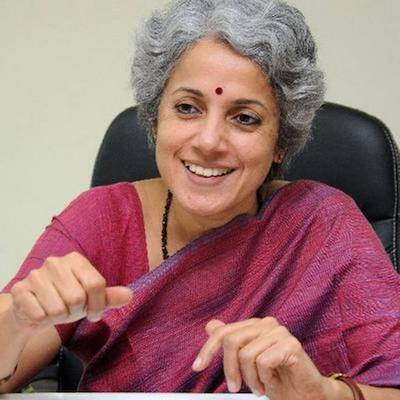
  • Soumya Swaminathan is WHO Chief Scientist

    Soumya Swaminathan is WHO Chief Scientist

    NEW DELHI(TIP): As part of the reforms at the World Health Organisation (WHO), Soumya Swaminathan has been moved from the position of Deputy Director-General to Chief Scientist heading the division created to strengthen the organisation’s core scientific work and ensure the quality and consistency of its norms and standards.

    Previously, she was one of the three Deputy Director-Generals supporting the Director-General in overseeing all programs. She was the first Indian to hold the post. WHO said in a statement: “the world has changed, which is why we have articulated a new mission statement.”

  • Trump to declare national emergency to build border wall: Democrats say “will challenge the move in the Supreme Court”

    Trump to declare national emergency to build border wall: Democrats say “will challenge the move in the Supreme Court”

    WASHINGTON, DC(TIP): US President Donald Trump will sign an executive order declaring a national emergency, which will empower him to fund the construction of a massive wall along the US-Mexico border to prevent illegal immigrants from entering the country and curb drug smuggling.

    The move would help Mr. Trump get $5.6 billion for the construction of the wall that, he has asserted, is essential for national security.

    President Trump will sign the government funding bill, and as he has stated before, he will also take other executive action – including a national emergency – to ensure we stop the national security and humanitarian crisis at the border, White House Press Secretary Sarah Sanders said in a statement.

    The President is once again delivering on his promise to build the wall, protect the border, and secure our great country, she said.

    The White House statement came soon after Senate Majority leader Mitch McConnell made the move public.

    “I had an opportunity to speak with President Trump and he, I would say to all my colleagues, has indicated he’s prepared to sign the bill. He also (will) be issuing a national emergency declaration at the same time. I indicated I’m going to support the national emergency declaration,” Mr. McConnell said.

    On the Democrats saying they will challenge the move in the Supreme Court, Sanders said, “We’re very prepared, but there shouldn’t be [legal challenges]. The president’s doing his job. The Congress should do theirs.”

    Senate Minority Leader Chuck Schumer and House Speaker Nancy Pelosi said that declaring a national emergency would be a lawless act, a gross abuse of the power of the presidency and a desperate attempt to distract from the fact that Trump broke his core promise to have Mexico pay for his wall”.

    It is yet another demonstration of President Trump’s naked contempt for the rule of law. This is not an emergency, and the president’s fearmongering doesn’t make it one, they said in a joint statement.

    He couldn’t convince Mexico, the American people or their elected representatives to pay for his ineffective and expensive wall, so now he’s trying an end-run around Congress in a desperate attempt to put taxpayers on the hook for it. The Congress will defend our constitutional authorities, they said.

    Opposing the proposed move, American Civil Liberties Union (ACLU) said that Mr. Trump’s hankering for a wall at the southern border cannot be justified by calling a national emergency.

    This would be a clear abuse of presidential power — one that sidesteps the role of Congress in the appropriation of funds. Shame on any member of Congress who doesn’t clearly and vigorously speak out on this illegitimate invocation of emergency authorities, ACLU said.

    Senator James Inhofe said Mr. Trump had no choice but to declare a national emergency.

    I want to make sure this declaration has minimal, if any, impact on our military and reimburse all the necessary accounts affected by the decision. As I heard in a hearing yesterday, military housing and all military installations are facing disrepair and poor conditions. We cannot afford to allow them to be further impacted, he said.

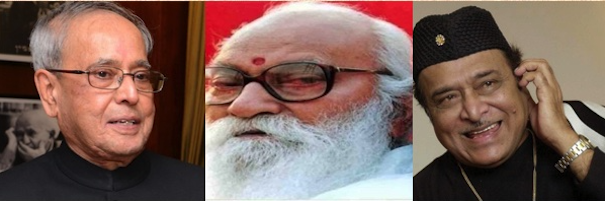
  • Bharat Ratna for former President Pranab Mukherji, Nanaji Deshmukh (posthumous), Bhupen Hazarika (posthumous)

    Bharat Ratna for former President Pranab Mukherji, Nanaji Deshmukh (posthumous), Bhupen Hazarika (posthumous)

    Padma Vibhushan for 4; Padma Bhushan for 14; Padma Shri for 94 

    NEW DELHI(TIP): Bharat Ratna and the Padma Awards for the year 2019 were announced here  on Friday, January 25.

    One of the highest civilian Awards of the country, the Padma awards are conferred in three categories, namely, Padma Vibhushan, Padma Bhushan and Padma Shri.

    The awards are given in various disciplines or fields of activities: social work, public affairs, science and engineering, trade and industry, medicine, literature and education, sports, civil service, etc. The Padma Vibhushan is awarded for exceptional and distinguished service; the Padma Bhushan for distinguished service of high order and the Padma Shri for distinguished service in any field. The awards are announced on the occasion of Republic Day every year.

    These awards are conferred by the President of India at ceremonial functions which are held at Rashtrapati Bhawan usually around March or April every year. This year the President of India Ram Nath Kovind approved conferment of 112 Padma Awards including one duo case (in a duo case, the Award is counted as one). The list comprises 4 Padma Vibhushan, 14 Padma Bhushan and 94 Padma Shri Awards.  21 of the awardees are women and the list also includes 11 persons from the category of Foreigners/NRI/PIO/OCI, 3 Posthumous awardees and 1 transgender person.

    Here is the full list of awardees:

    Padma Vibhushan

    Ms. Teejan Bai (Art-Vocals-Folk)

    Shri Ismail Omar Guelleh (Public Affairs)  Djibouti

    Shri Anilkumar Manibhai Naik (Trade & Industry-Infrastructure)

    Shri Balwant Moreshwar Purandare (Art-Acting-Theatre)

    Padma Bhushan

    Shri John Chambers (Trade & Industry-Technology)

    Shri Sukhdev Singh Dhindsa (Public Affairs)

    Shri Pravin Gordhan (Foreigner) for Public Affairs

    Shri Mahashay Dharam Pal Gulati (Trade & Industry-Food Processing)

    Shri Darshan Lal Jain (Social Work)

    Shri Ashok Laxmanrao Kukade (Medicine-Affordable Healthcare)

    Shri Kariya Munda (Public Affairs)

    Shri Budhaditya Mukherjee (Art-Music-Sitar)

    Shri Mohanlal Viswanathan Nair (Art-Acting-Film)

    Shri S Nambi Narayan (Science & Engineering-Space)

    Shri Kuldip Nayar (Posthumous) for Literature & Education (Journalism)

    Ms. Bachendri Pal (Sports-Mountaineering)

    Shri V K Shunglu (Civil Service)

    Shri Hukumdev Narayan Yadav (Public Affairs)

    Padma Shri

    Shri Rajeshwar Acharya (Art-Vocal-Hindustani)

    Shri Bangaru Adigalar(Others-Spiritualism)

    Shri Illias Ali (Medicine-Surgery)

    Shri Manoj Bajpayee (Art-Acting-Films)

    Shri Uddhab Kumar Bharali (Science & Engineering-Grassroots Innovation)

    Shri Omesh Kumar Bharti (Medicine-Rabies)

    Shri Pritam Bhartwan (Art-Vocals-Folk)

    Shri Jyoti Bhatt (Art-Painting)

    Shri Dilip Chakravarty (Others-Archaeology)

    Shri Mammen Chandy (Medicine-Hematology)

    Shri Swapan Chaudhuri (Art-Music-Tabla)

    Shri Kanwal Singh Chauhan

    Shri Sunil Chhetri (Sports-Football)

    Shri Dinyar Contractor (Art-Acting-Theatre)

    Ms. Muktaben Pankajkumar Dagli (Social Work-Divyang Welfare)

    Shri Babulal Dahiya (Others-Agriculture)

    Shri Thanga Darlong (Art-Music-Flute)

    Shri Prabhu Deva (Art-Dance)

    Ms. Rajkumari Devi (Others-Agriculture)

    Ms. Bhagirathi Devi (Public Affairs)

    Shri Baldev Singh Dhillon (Science & Engineering-Agriculture)

    Ms. Harika Dronavalli (Sports-Chess)

    Ms. Godawari Dutta (Art-Painting)

    Shri Gautam Gambhir (Sports-Cricket)

    Ms. Draupadi Ghimiray (Social Work-Divyang Welfare)

    Ms. Rohini Godbole (Science & Engineering-Nuclear)

    Shri Sandeep Guleria (Medicine-Surgery)

    Shri Pratap Singh Hardia (Medicine- Ophthmology)

    Shri Bulu Imam (Social Work-Culture)

    Ms. Friederike Irina (Foreigner) (Social Work-Animal Welfare)

    Shri Joravarsinh Jadav (Art-Dance Folk)

    Shri S Jaishankar (Civil Service)

    Shri Narsingh Dev Jamwal (Literature & Education)

    Shri Fayaz Ahmad Jan (Art-Craft-Papier Mache)

    Shri K G Jayan (Art-Music-Bhakti)

    Shri Subhash Kak (Foreigner) (Science & Engineering-Technology)

    Shri Sharath Kamal (Sports-Table Tennis)

    Shri Rajani Kant (Social Work)

    Shri Sudam Kate (Medicine-Sickle Cell)

    Shri Waman Kendre (Art-Acting-Theatre)

    Shri Kader Khan (Posthumous-Foreigner) (Art-Acting-Films)

    Shri Abdul Gafur Khatri (Art-Painting)

    Shri Ravindra Kolhe and Ms. Smita Kolhe (Medicine-Affordable Healthcare)

    Ms. Bombayla Devi Laishram (Sports-Archery)

    Shri Kailash Madbaiya (Literature & Education)

    Shri Ramesh Babaji Maharaj (Social Work-Animal Welfare)

    Shri Vallabhbhai Vasrambhai Marvaniya (Others-Agriculture)

    Ms. Gita Mehta (Foreigner) (Literature & Education)

    Shri Shadab Mohammad (Medicine-Dentistry)

    Shri K Muhammed (Others-Archaeology)

    Shri Shyama Prasad Mukherjee (Medicine-Affordable Healthcare)

    Shri Daitari Naik (Social Work)

    Shri Shankar Mahadevan Narayan (Art-Vocals-Films)

    Shri Shantanu Narayen (Foreigner) (Trade & Industry-Technology)

    Nartaki Natraj (Art-Dance-Bharatnatyam)

    Shri Tsering Norboo (Medicine-Surgery)

    Shri Anup Ranjan Pandey (Art-Music)

    Shri Jagdish Prasad Parikh (Others-Agriculture)

    Shri Ganpatbhai Patel (Foreigner) (Literature & Education)

    Shri Bimal Patel (Others-Architecture)

    Shri Hukumchand Patidar (Others-Agriculture)

    Shri Harvinder Singh Phoolka (Public Affairs)

    Ms. Madurai Chinna Pillai (Social Work-Microfinance)

    Ms. Tao Porchon-Lynch (Foreigner) (Others-Yoga)

    Ms. Kamala Pujhari (Others-Agriculture)

    Shri Bajrang Punia (Sports-Wrestling)

    Shri Jagat Ram (Medicine-Ophthalmology)

    Shri R V Ramani (Medicine-Ophthalmology)

    Shri Devarapalli Prakash Rao (Social Work-Affordable Education)

    Shri Anup Sah (Art-Photography)

    Ms. Milena Salvini (Foreigner) (Art-Dance-Kathakali)

    Shri Nagindas Sanghavi (Literature & Education-Journalism)

    Shri Sirivennela Seetharama Sastry (Art-Lyrics)

    Shri Shabbir Sayyad (Social Work-Animal Welfare)

    Shri Mahesh Sharma (Social Work-Tribal Welfare)

    Shri Mohammad Hanif Khan Shastri (Literature & Education)

    Shri Brijesh Kumar Shukla (Literature & Education)

    Shri Narendra Singh (Others-Animal Husbandry)

    Ms. Prashanti Singh (Sports-Basketball)

    Shri Sultan Singh (Others-Animal Husbandry)

    Shri Jyoti Kumar Sinha (Social Work-Affordable Education)

    Shri Anandan Sivamani (Art-Music)

    Ms. Sharada Srinivasan (Others-Archaeology)

    Shri Devendra Swarup (Posthumous) (Literature & Education-Journalism)

    Shri Ajay Thakur (Sports-Kabaddi)

    Shri Rajeev Tharanath (Art-Music-Sarod)

    Ms. Saalumarada Thimmakka (Social Work-Environment)

    Ms. Jamuna Tudu (Social Work-Environment)

    Shri Bharat Bhushan Tyagi (Others-Agriculture)

    Shri Ramaswami Venkataswami (Medicine-Surgery)

    Shri Ram Saran Verma (Others-Agriculture)

    Shri Swami Vishudhananda (Others-Spiritualism)

    Shri Hiralal Yadav (Art-Vocals-Folk)

    Shri Venkateswara Rao Yadlapalli (Others-Agriculture)

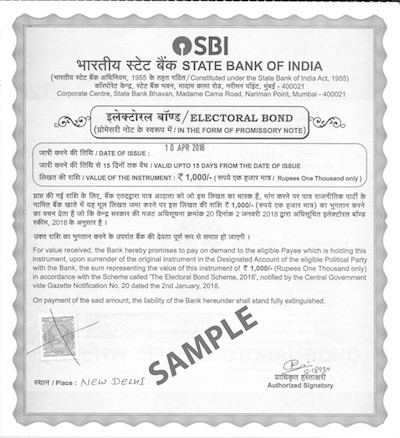
  • Over 90% electoral bonds sold are of Rs 10 lakh, Rs 1 cr

    Over 90% electoral bonds sold are of Rs 10 lakh, Rs 1 cr

    BJP gets Rs 210 cr of Rs 222-cr bonds sold in FY18; donors remain anonymous

    NEW DELHI(TIP): Notwithstanding the aim to bring in transparency in funding to political parties by giving an alternative to cash donations, the latest data reveals that after six rounds of sale of electoral bonds, donors continue to be anonymous, as the norms allow them to remain secretive.

    Sources reveal that as per the data, despite being available in five denominations — Rs1,000, Rs10,000, Rs1 lakh, Rs10 lakh and Rs1 crore — more than 90 per cent of electoral bonds were sold in the top two units, which apparently were purchased by big business houses.

    It is also learnt that the total number of bonds sold in six phases were 2,134 of which 2,007 went for higher denominations of Rs10 lakh and Rs1 crore, as they were mostly bought in metros like Mumbai, Hyderabad, Kolkata and the national capital.

    Incidentally, for financial year 2017-18, the ruling BJP in its declaration to the Election Commission said it received an income of Rs210 crore from contribution through electoral bonds. Sources said during this period (2017-18) electoral bonds worth Rs 222 crore were sold. Therefore, it is clear from the figures that almost 95 per cent of the total bonds went to the BJP account.

    On several occasions, experts and even the poll panel raised the issue of secrecy norm in the electoral bond, saying it will only cement the nexus between political parties and corporate donors.

    As the government, while notifying the electoral bond scheme, had claimed it envisaged total clean money and substantial transparency coming into the system of political funding, the Election Commission had raised concerns and had written to the Law Commission in May 2017 over amendments in the Finance Act, 2017, which brought about changes in the Income Tax Act, the Companies Act, 2013, and the Representation of People Act, 1951, to enable the launch of the electoral bonds scheme.

    Former Chief Election Commissioner OP Rawat is also reported to have talked about grey areas with respect to electoral bonds. “Earlier, we had expressed concern regarding transparency and the possibility of shell companies, which can buy electoral bonds,” he had said.

    Donation process

    Electoral bonds are available in five denominations: Rs 1,000, Rs 10,000, Rs 1 lakh, Rs 10 lakh and Rs 1 crore

    Bonds will not carry the name of the payee and will be valid for 15 days

    Can be used to donate funds to registered parties only

    Can be encashed only through that party’s bank account

    Denomination Bonds sold

    Rs1 crore 950

    Rs10 lakh 1,057

    Rs1 lakh 25

    Rs10,000 0

    Rs1,000 2

    (Source: Tribune)

  • Apple to Add $1 Billion Texas Campus and Thousands of Jobs Across U.S.

    Apple to Add $1 Billion Texas Campus and Thousands of Jobs Across U.S.

    The company said it was building a new facility that would double the size of its workforce in the city.

    DALLAS, TX(TIP): Apple said on Thursday, December 13,  that it would expand its operations in Austin, Tex., with a new $1 billion campus on the north side of the city that would nearly double the size of the company’s current 6,000-employee work force in the area.

    The technology giant said it also planned to establish new, 1,000-worker operations in San Diego, Seattle and Culver City, Calif., and to add hundreds of workers in offices in New York, Pittsburgh and Boulder, Colo. over the next three years.

    The new 133-acre campus in North Austin will initially employ 5,000 workers in engineering, research and development, operations, finance, sales and customer support. It will ultimately have the capacity to accommodate up to 15,000 workers. Apple said it expected that its expanded presence would make it the area’s largest employer.

    “Apple is proud to bring new investment, jobs and opportunity to cities across the United States and to significantly deepen our quarter-century partnership with the city and people of Austin,” Tim Cook, Apple’s chief executive, said in a statement.

    Apple had become synonymous with hoarding money overseas after deferring tax payments on its foreign earnings for years. In January, it said that it would increase its spending in the United States substantially after last year’s tax cuts led it to bring back most of the $252 billion it had stashed abroad.

    The company said at the time that it planned to invest more than $30 billion in the United States over the next five years and to create 20,000 jobs by expanding its operations and adding a new campus.

    President Trump, who had chided Apple over various issues in the past, reacted to the January announcement by praising the company while crediting his own policies for getting it to make the investments.

    In September, though, Mr. Trump took aim at Apple over jobs after the company told trade officials in a letter that the administration’s tariffs would affect a wide range of products.

    “Make your products in the United States instead of China,” Mr. Trump wrote on Twitter. “Start building new plants now.”

    None of the new positions announced by Apple on Thursday appeared to involve manufacturing.

    Unlike Amazon, which held a highly publicized yearlong beauty contest before deciding to put major new hubs in New York and Virginia, Apple has been relatively quiet about its expansion plans. But the $5 billion headquarters the company opened in Cupertino, Calif., last year may hint at the effect the new Austin campus will have on the city, Texas’s capital.

    Apple has had a mixed year financially. In August, it became the first publicly traded American company worth more than $1 trillion after a series of remarkably profitable quarters. But its stock took a hit in November after the company said it would stop reporting how many iPhones, iPads and Mac computers it sold each quarter, figures central to understanding Apple’s performance.

    A slowdown in iPhone sales, which account for nearly 60 percent of Apple’s revenue, has weighed heavily on the company’s share price since then. It has been pulled down further by Mr. Trump’s suggestions last month that tariffs might be placed on Apple devices imported from China.

    The smartphone maker is also embroiled in a legal fight in China with Qualcomm, its chip supplier, which resulted in a Chinese court ordering Apple to stop selling older iPhone models in China.

    Another complication for Apple is the simmering tensions between China and the United States, which Mr. Cook had previously warned could hurt the company’s business in China. The recent arrest of Meng Wenzhou has added to the strain.

  • Court orders FIR against Manjit Singh GK in Gurdwara Financial Irregularities Case

    Court orders FIR against Manjit Singh GK in Gurdwara Financial Irregularities Case

    Shiromani Akali Dal (SAD) dissolves Delhi, UP, Rajasthan units

    NEW DELHI(TIP): A court on Thursday, December 13,  ordered filing of a FIR against DSGMC leader Manjit Singh GK and others in a financial irregularities case.

    Metropolitan Magistrate Vijaita Singh, Patiala House Court, in her judgement, ordered the Delhi Police to lodge a complaint against DSGMC leader Manjit Singh GK, general manager Harjit Sigh Subedar and joint secretary Amarjit Singh Pappu for alleged financial irregularities in gurdwara committee.

    The court pronounced the order on a petition of Gurmeet Singh Shanty who alleged that the accused had embezzled Rs 51 lakh from the gurdwara fund. Shanty alleged that a fake bill of 82,000 books of Sikh heritage and a fake bill of safari suit were also submitted by the accused.

    Shanty had first lodged a complaint with North Avenue police station.

    When police allegedly failed to lodge the FIR, Shanty filed a petition in the court. After getting the case investigated, the court, on December 13,  ordered for registration of the FIR.

    The court also ordered the police to appear before the court on December 14.

    Manjit  Singh GK was president of the Delhi unit of the SAD and Manjinder Singh Sirsa was the youth president.

    Meanwhile, ahead of the 2019 Lok Sabha elections, SAD chief Sukhbir Singh Badal on Thursday, December 13,  dissolved the party units in Delhi, Uttar Pradesh and Rajasthan with immediate effect.

    The decision, aimed at overhauling the state units, was taken based on suggestions by party observers for the two states and the national capital – MPs Balwinder Singh Bhundar and Prem Singh Chandumajra, and former minister Sikandar Singh Maluka, SAD senior vice-president  and spokesperson Daljit Singh Cheema said.

    Cheema said the process of making major changes in the organizational structure of the party had been going on in the wake of the upcoming Lok Sabha polls.

    “New organizational structure will be announced in the next two months after having extensive deliberation with the senior leadership of the party,” he said.

    (With inputs from PTI)

  • J&K polls to be held before May: CEC Rawat

    J&K polls to be held before May: CEC Rawat

    NEW DELHI (TIP): The Election Commission on Thursday, November 22,  said fresh elections in Jammu and Kashmir would be held within the next six months even as it did not rule out the possibility of holding polls there before the Lok Sabha polls due next year.

    “The Jammu and Kashmir assembly polls must be held on the first occasion before May … it could be held before parliament elections also,” Chief Election Commissioner O P Rawat said.

    He said as per the Supreme Court, the outer limit for holding fresh polls after dissolution of a house is six months, that is May 2019.

    At the same time, he made it clear that the Commission will decide on poll dates after “considering all aspects.”

    He said, SC verdict, an outcome of Presidential reference, also said polls will have to be held on the first occasion which means even before six months.

    He said the same principle was applied in Telangana where the assembly was dissolved prematurely.

    The state Governor Satya Pal Malik dissolved the assembly on Wednesday evening, after People’s Democratic Party leader Mehbooba Mufti staked claim to form government along with her arch-rival Omar Abdullah’s National Conference (NC) and the Congress. They claimed the support of 56 lawmakers in the 87-member state assembly.

    Shortly after, People’s Conference leader Sajad Lone also staked claims to form the government. Lone, who has two lawmakers, said he had the support of the BJP’s 25 legislators and “more than 18” others.

    (Source:  PTI)

  • Richardson Residents ‘Astonished’ after Campaign Signs in Yard Burned

    Richardson Residents ‘Astonished’ after Campaign Signs in Yard Burned

    RICHARDSON, TEXAS(TIP): Some Richardson residents say they are astonished after someone burned two political campaign signs in their front yard after 11:00 p.m. Monday, October 22.

    In all, the Richardson Fire Department says five different signs were torched in the Heights neighborhood, which is west of Central Expressway and south of Arapaho.

    One of the homeowners whose signs were burned is Chris Terry who said she and her wife Michael Graffeo were surprised when a man rang their door bell Monday night to alert them.

    Terry says she remembers thinking, “Steal the sign, but don’t light it on fire when there’s a possibility that other things could catch on fire. But you know, I think it’s a reflection that we’re so polarized.”

    Fire Chief Curtis Poovey said no one was hurt.

    The signs that were lit on fire were for Beto O’Rourke, the Democrat running for U.S. Senate and Colin Allred, the Democrat running for the 32nd Congressional District.

    Poovey said investigators don’t have a suspect or suspects in mind.

    Graffeo, says, “I think it’s indicative of where we are, but it seems to be taking it a step further.”

    They placed new signs in the yard Wednesday afternoon, not waiting for the rain to stop.

    Dallas County Community College adjunct professor Janet Johnson is writing a book about social media and rhetoric in politics.

    “People need to realize that there are consequences wherever we burn signs, that it’s not ok. We need to start having conversations.”

    She says those conversations should not include any yelling, but rather, be cordial.

    (Source: CBSDFW.COM)

  • Hurricane Michael batters Florida Panhandle: At least Six Dead; 1.3 Million without Power

    Hurricane Michael batters Florida Panhandle: At least Six Dead; 1.3 Million without Power

    PANAMA CITY(TIP): At least six people were killed by the most powerful storm to hit the Florida Panhandle in recorded history. Officials warned Thursday, October 11, that the number was likely to rise as search crews struggled to gain access to ravaged areas and sift through the piles of debris.

    Utility companies said more than 1.3 million customers remained without power from Florida to Virginia on Thursday evening as Michael — still a tropical storm more than a day after landfall — remained dangerous, with maximum sustained winds of 50 mph.

    Michael made landfall in Mexico Beach, Florida, on Wednesday just shy of Category 5 hurricane strength, with winds gusting at 155 mph. While the storm weakened through the night as it passed over Georgia, it still proved deadly.

    “Unfortunately, in these types of things as we go through and sift through damage, ultimately those who didn’t heed warnings, particularly around the Mexico Beach area — we typically see deaths climb, unfortunately,” Brock Long, administrator of the Federal Emergency Management Agency, said on CBS on Thursday.

    Florida Gov. Rick Scott said Thursday morning: “This hurricane was an absolute monster. And the damage left in its wake is still yet to be fully understood.”


  • Chanda Kochhar quits ICICI Bank; Sandeep Bakhshi to be new MD

    Chanda Kochhar quits ICICI Bank; Sandeep Bakhshi to be new MD

    ICICI Bank says probe to continue

    NEW DELHI (TIP): Facing inquiry over charges of nepotism and conflict of interest, ICICI Bank Managing Director and CEO Chanda Kochhar today, October 4, quit the bank, six months before her current tenure was to end.

    Kochhar, 57, has also resigned from all subsidiaries of the bank, including ICICI Securities where she had sought reappointment as the chairperson.

    The board elevated Chief Operating Officer (COO) Sandeep Bakhshi as the new MD and CEO for five years.

    The bank said the external inquiry instituted by the board against Kochhar in May would continue and the benefits to her would be subject to its outcome.

    Following the board’s decision to institute an inquiry by retired Supreme Court Judge BN Srikrishna, Kochhar had gone on leave in May. There are allegations of involvement of Kochhar and her family members in a loan provided to Videocon group on a quid pro quo basis. Kochhar’s current five-year tenure as CEO was to end on March 31, 2019. —  PTI

  • India unhappy over Pak raising Kashmir at OIC

    India unhappy over Pak raising Kashmir at OIC

    NEW YORK(TIP): India has raised objections over Pakistan raking up the Kashmir issue at the Organization of Islamic Cooperation (OIC) meeting, saying it is completely “unwarranted” for the grouping as well as its member countries to discuss matters related to India’s internal affairs in any multilateral set up.

    Pakistan raked up the Kashmir issue at the OIC Contact Group meeting held Wednesday, September 26, on the sidelines of the 73rd session of the UN General Assembly.

    “We always note with regret that the matter which is very internal to Indian affairs was again discussed at the OIC,” Ministry of External Affairs spokesperson Raveesh Kumar told reporters here when asked about Pakistan raising the issue at the OIC meeting. He said India rejects such references to a matter which is very internal to it.

    “We have said in the past that OIC has no locus standi to comment on India’s internal affairs” and it is completely unwarranted for OIC as well as its member countries to discuss matters related to India’s internal affairs in any multi-organization set up.

    When asked about Pakistan’s Foreign Minister Shah Mehmood Qureshi also raising the Kashmir issue in his bilateral meetings on the sidelines of the UN General Assembly, Kumar said Islamabad has been doing this for a long time.

    “It is not the first time they are raising the issue in their bilateral meetings. You would note that what they come up with is their side of the story. What they share and what they say has no acceptance anywhere in the international community,” he said. He said Pakistan has realized its “falsehood” and what it has been projecting had already been rejected by the global community.

    (Source: PTI)

  • Air India Regional Manager Americas Vandana Sharma Transferred to Delhi

    Air India Regional Manager Americas Vandana Sharma Transferred to Delhi

    NEW YORK(TIP) Air India Regional Manager Vandana Sharma has been transferred to Delhi. She will assume charge as Deputy General Manager at the Indira Gandhi International Airport.

    Ms Sharma’s tenure of nearly 3 years (she took over as RM Americas in 2015) has been an eventful one. She has since helped Air India to grow from 21 flights per week out of three gateways in the United States to approximately 36 flights per week out of five gateways.

    Having achieved a high leadership role at Air India—which she noted has the highest percentage of women pilots in the world—Sharma said she believed that it is important that companies hire an equal number of men and women.

    A workaholic, Ms Sharma says: “Each day is a test of skills and capabilities and gives me an opportunity to learn”.

  • AAPI-QLI, IALI Help build Restrooms in Chennai Schools

    AAPI-QLI, IALI Help build Restrooms in Chennai Schools

    CHENNAI / NEW YORK(TIP):  America Tamil Sangam and Shri Vari Foundation, New York have adopted two corporation schools in Chennai and constructed 10 restrooms partly with donations from American Association of Physicians of Indian Origin (AAPI) QLI and Indian Association of Long Island (IALI) New York.

    The two Long Island, NY based associations jointly donated around $15,000 to Chennai flood relief fund of the Tamil Sangam two years ago which was now utilized to construct restrooms for girl students in two schools.

    The kids were peeing in public in one school without any privacy while the other school had fewer restrooms for over a hundred children.

    At a function held at Dr Janaki MGR College in Chennai, Tamil Nadu State Minister for Social Welfare Dr V Saroja, an OBGYN, said building restrooms helps improve the health of girl students and praised America Tamil Sangam and Shri Vari Foundation for implementing the project. She said the role of AAPI-QLI and IALI was praiseworthy in reaching out to the needy in their motherland. She announced a government grant of Rs 10 lakhs to the anganwadi (day care center) to be set up in an aided school in Thuluvapushpagiri in Tamil Nadu whose principal in charge was honored at the event.

    Dr V. Maithreyan, Member of Parliament (Rajya Sabha), guest of honor at the event, said non-resident Tamils played a big role in attracting investments for the development of the state and acting as a bridge between the state government and the country of their residence.

    Dr. J Jayavardhan, Member of Parliament (Lok Sabha- South Madras), guest of honor at the event, said Tamil sangams abroad fostered language, culture, music and heritage and in addition America Tamil Sangam also chipped in to provide social welfare measures.

    Sivasankari, celebrated author and novelist, praised the role of American Tamil Sangam in putting a smile on the face of hapless children.

    Dr. R Natraj, Member of the Tamil Nadu Legislative Assembly and former Director General of Police, presiding over the function, offered his support and cooperation to any Tamil associations from abroad willing to take up development work in his Mylapore constituency.

    American Tamil Sangam honored Meena Rajan, headmistress in charge of government aided middle school in Thulvapushpagiri village in Thiruvannamalai district in Tamil Nadu. She had sold her jewels and her house to build classrooms and restrooms in the government school that had dilapidated class rooms with asbestos roof and no restrooms. She then went on to collect Rs 75 lakhs through donations to convert the dingy school into a smart class school with high tech facilities.

    The Sangam also honored Dr TG Srinivasan, Chennai City Health Education Officer of the Corporation of Chennai for his untiring work in spreading the message of hygiene and cleanliness under Swatch Bharat program in schools, colleges, welfare associations and slum areas. It also felicitated principals of the two adopted schools – Soundarya Priya and Murugan- for their dedicated service. Two social workers – MV Ramani and Raja Mohan, advocate were also honored.

    Prakash M Swamy, president of America Tamil Sangam, said the two schools were chosen for one school produced 100 percent results in tenth standard government exams for the past 8 years and the other excelled in promoting hygiene and discipline among students. Future plans include providing free sanitary napkins to girl students, improving the library and computer education, providing uniforms to students and sprucing up the campus. S Ravishankar, proposed a vote of thanks.

  • Air India gets fresh fund infusion from Centre; disinvestment on hold for now

    Air India gets fresh fund infusion from Centre; disinvestment on hold for now

    Government working on new turnaround plan for Air India

    NEW DELHI(TIP): Speaking to reporters on the sidelines of the International Aviation Summit on Tuesday, September 4, civil aviation secretary RN Choubey said that the government was continuing to fund Air India despite a decision being taken to sell it so that the company’s value doesn’t erode till the time it is disinvested in. “Our first aim is to work out the necessary support for Air India’s healthy functioning. We will not like value destruction to happen. If we do not support, there may be value erosion. Otherwise, when we actually find that environment has improved, oil prices have come down and we actually want to sell, we may find that value has eroded,” Choubey said.

    Late August, the Ministry of Civil Aviation, in its representation to the Parliamentary Standing Committee for transport, tourism and culture, said that disinvestment of Air India is not going to be happening any time soon. The first attempt by the government to sell its stake in the airline – codenamed Project Royal – failed mainly due to the government not parting with the entire stake, the high debt-levels and a high employee-to-aircraft ratio. To help the airline survive, the government had announced a financial restructuring plan (FRP) in 2012 as part of the original turnaround plan, as per which the airline’s working capital loans were restructured to long-term debt.

    “If FRP was working, Air India wouldn’t have been in a dire strait. FRP didn’t go wrong. The FRP earmarked crude at $45 a barrel and today the crude is at $75 a barrel. Dollar was still high. The plan, now, is to make Air India stand on its own feet so that it can be sold in future when its conducive to sell the airline. Unlike the FRP, where the government did financial restructuring, the new plan will focus more on organizational reform. Will make it a board managed company. One more outsider may join the board,” a senior Air India official said, on condition of anonymity. Last month, the government appointed ITC Chairman YC Deveshwar and Aditya Birla Group Chairman Kumar Mangalam Birla as independent directors on the board of Air India.

    As per estimates by aviation consultancy CAPA India, the national carrier is expected to lose more than $2 billion in value during 2018-19 and 2019-20. “Air India’s value will continue to erode, making future privatization unlikely. In the absence of full recapitalization and a clear direction, Air India is likely to see a continued decline in its domestic and international market share, and head towards strategic irrelevance. This will diminish its potential to be revived and to secure a strategic investor. In the meantime, it will remain a structural distortion for the industry and a burden on the tax payer. The quantum of losses will become increasingly unacceptable,” CAPA India said in its mid-year aviation outlook for 2018-19.

    The Air India official pointed out that the carrier’s financials for the 2017-18 did not show any signs of improvement, primarily due to the soaring fuel costs. “I can’t reveal more on this as the results are being audited,” he said. For the year 2016-17, Air India reported a net loss of Rs 6,288 crore. Choubey said the ministry was yet to take a call whether the new turnaround plan for Air India will require a Cabinet approval or can be done bilaterally between the ministries of civil aviation and finance.

    Meanwhile, Air India Ltd will raise ₹500 crore in debt to meet working capital needs and pay interest on its outstanding loans, a senior official at the state-run carrier said on Wednesday, September 5.

    “Air India will soon issue a tender to raise ₹500 crore from domestic banks,” said the official who didn’t want to be named.

    The latest fundraiser will exhaust the sovereign guarantee limit of ₹2,000 crore offered by the government to the loss-making airline, the official said.

    Air India had in August raised ₹1,500 crore from Bank of Baroda under a sovereign guarantee to service bank loans and dues of international vendors, including leasing companies.

    The latest fund-raising follows a failed government attempt to privatize Air India to stem the flow of public funds into running the airline.

    Civil aviation secretary Rajiv Nayan Choubey on Tuesday, August 4 said the government has agreed to make a fresh equity infusion in Air India and also provide a sovereign guarantee.

    “At the moment, we are borrowing from domestic banks as it doesn’t make sense to borrow from international lenders due to the value erosion of the rupee (against the dollar),” the official said.

    Air India also used the ₹1,500 crore debt raised in August to “normalize debt accounts”, some of which were in danger of turning into non-performing assets, the official said.

    Air India has a net debt of about ₹55,000 crore, including about ₹21,000-22,000 crore of aircraft debt, the official said. “We are hoping to repay the aircraft debt fully by 2021.” The carrier took on the loans to pay for new planes from Boeing and Airbus.

  • Gauri Lankesh killers had a long hit-list?

    Gauri Lankesh killers had a long hit-list?

    Most of 16 pistols recovered in Maharashtra were acquired recently: police

    K.V. Aditya Bharadwaj

    BENGALURU(TIP): Most of the 16 country-made pistols recovered from the three right-wing activists arrested in Maharashtra were procured recently, most likely after the arrest of K.T. Naveen Kumar — one of the accused in the Gauri Lankesh case — in February 2018. Sources said this is a cause for concern as it indicates that the people involved were plotting to kill more people on their hit list, many in a short span of time.

    These are suspected to include the two pistols used in the murders of Narendra Dabholkar, Govind Pansare, M.M. Kalburgi and Gauri Lankesh. They are being tested for possible matches with cartridges found at the crime scene.

    During the course of their investigation into the murder of Gauri Lankesh, the SIT in May 2018 had recovered a hit list of 34 intellectuals from Amol Kale’s diary, eight of who were from Karnataka. The probe revealed an ambitious plan to set in motion multiple murder plots simultaneously in Karnataka.

    The probe revealed a plot to kill Mysuru-based rationalist Prof. K.S. Bhagavan, which investigators said was at an advanced stage of implementation. K.T. Naveen Kumar, 37, of Hindu Yuva Sena, a fringe group, was arrested by Bengaluru police in February 2018 when he was trying to procure a country-made pistol for the murder. This indicated that the gang had no weapon other than the one used to kill Gauri Lankesh. FSL reports have linked the weapon to the murder of M.M. Kalburgi.

    The pistol, which was used to kill Narendra Dabholkar and was also one of the weapons used in the murder of Govind Pansare, is not working, the probe had indicated.

    Amol Kale reportedly told interrogators that they were trying to create ‘multiple self-contained teams’ to execute multiple plots. His diary had entries pointing to several plots targeting rationalists in Karnataka.

    “At that time, we doubted their ability to carry out multiple assassinations. But now, the 16 pistols indicate that they seemed to have been moving towards that goal,” said a senior officer, who said it is alarming as it indicates that remnants of the gang continue to be active and furthering the conspiracy even after the arrest of most of their key players.

    Sources said Srikanth Pangarakar, a former Shiv Sena councillor from Jalna who was arrested by the Maharashtra ATS, was a close associate of Amol Kale, the alleged kingpin in the Gauri Lankesh case. The investigation indicates that they were in constant touch for the past one year and Pangarkar had visited well-known country-made pistol hubs in central India.

    (Source: The Hindu)


  • NY Congressman Collins Arrested, Charged with Insider Trading

    NY Congressman Collins Arrested, Charged with Insider Trading

    NEW YORK(TIP): The FBI has arrested New York Rep. Chris Collins on securities fraud-related charges, law enforcement officials said.

    Collins, a Republican who hails from western New York, his son and his son’s future father-in-law have all been charged with insider trading, U.S. Attorney Geoffrey Berman said.

    The congressman surrendered to the FBI at 26 Federal Plaza Wednesday, August 8 morning, officials said.

    Collins pleaded not guilty at an appearance in Manhattan federal court Wednesday afternoon.

    Hours after he was released on bail, Collins spoke to reporters in Buffalo, professing his innocence and saying he would remain on the ballot for re-election this fall.

    Collins was one of the first members of Congress to endorse President Donald Trump during his presidential campaign.

    Last fall, the Office of Congressional Ethics released a report that said the congressman may have violated House rules when he bought discounted stock that wasn’t available to the public and was offered to him based on his status as a politician.

    The report also found that Collins, a board member of Australia-based Innate Immunotherapeutics, may have shared nonpublic information about the company, another possible violation.

    Innate had been in the process of developing a drug to treat multiple sclerosis in 2017, according to the indictment. When the product failed drug trials in June 2017, however, the public results sent Innate stock prices plummeting by 92 percent.

    Collins — one of Innate’s largest stockholders — had access to information about the company and its research that wasn’t available to the public, the indictment alleges.

    When Collins found out about the trial results, he allegedly told his son Cameron Collins, also an Innate stockholder, who told his then-girlfriend’s father Stephen Zarsky, as well as several other stockholders.

    Cameron Collins, Zarsky, and the stockholders Collins told subsequently sold their Innate stock before prices plunged, narrowly avoiding hundreds of thousands of dollars in losses, the indictment says.

    The congressman, his son and Zarsky have all been charged with conspiracy, securities fraud, wire fraud and making false statements to the FBI, the Manhattan U.S. Attorney’s office said. The Securities and Exchange Commission has filed its own civil action against the three men.

    “Representative Collins, who, by virtue of his office, helps write the laws of this country, acted as if the law did not apply to him,” Berman said. “These charges are a reminder that this is a nation of laws, and everyone stands equal before the bar of justice.”

    “I believe I acted properly and within the law at all times,” he said. “I will mount a vigorous defense in court to clear my name. I look forward to being fully vindicated and exonerated.”

    The congressman’s attorneys Jonathan Barr and Jonathan New, of BakerHostetler, also said Wednesday they would “answer the charges filed against [Collins] in court and… mount a vigorous defense to clear his good name.”

    “It is notable that even the government does not allege that Congressman Collins traded a single share of Innate Therapeutics stock,” they said in a statement. “We are confident he will be completely vindicated and exonerated.”

    House Speaker Paul Ryan said in a statement the congressman would no longer serve on the House Energy and Commerce Committee, pending the ultimate outcome of the indictment.

    “While his guilt or innocence is a question for the courts to settle, the allegations against Rep. Collins demand a prompt and thorough investigation by the House Ethics Committee,” he said. “Insider trading is a clear violation of the public trust.”

    House Democratic leader Nancy Pelosi, meanwhile, said Americans “deserve better than the GOP’s corruption, cronyism and incompetence.”

    “The charges against Congressman Collins show the rampant culture of corruption and self-enrichment among Republicans in Washington today,” she said. “The Ethics Committee must accelerate its own investigation into Congressman Collins’ illegal abuse of the public trust.”

    The congressman is expected to appear in court again on Oct. 11.