

For a media that dares to question, winning back public trust is a crucial task
The news media in India is finding itself in the crosshairs of the State and its agencies. Concurrently, it is also under attack from a distrustful public and broken by deep ideological divisions from within. Leaving aside the important debate over who qualifies as a journalist, the news media’s impact and relevance depend on how it navigates and repairs its complicated relationship with the State, the public and itself.
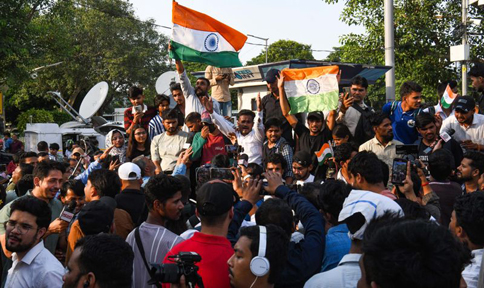
Over the past week, the protests seeking the resignation of Chief Election Commissioner Gyanesh Kumar have pitted the media against a brutal police force in Delhi. On October 11, there were 20 documented instances of journalists’ detention, assault, sexual harassment of women journalists and the seizure of mobile phones and camera equipment by the Delhi Police.
Each protest raises the stakes for both the protesters and the State. The police action on October 11 and 12 signaled the State’s most concerted attempt to police the narrative on the ground. Despite the detentions, the attempt didn’t work, as a veritable army of independent news media information gatherers, almost entirely operating on social media, recorded events and put out videos in real time.
Like their counterparts in the established media, some independent journalists bore the brunt of assault and detention by cops, but with far less acknowledgement or even recognition of their identity and work. A Press badge gave slim protection, despite advisories by Delhi Police about journalists displaying ID cards prominently. Videos and reels of protesters and journalists, who were picked up by the police in uniform but without name badges or other identification, are being removed. Account holders have been warned that the content they post violates laws, without specifying which content is deemed unlawful and under which provisions of the law.
The large-scale detention and attacks on journalists were violations of the Supreme Court’s order of October 11, wherein Justices Joymalya Bagchi and V Mohana had said that “lawyers, journalists and other professionals shall not be hindered in discharge of their professional duties in any manner whatsoever.” (The Court has now issued notice on a contempt petition filed by this writer on behalf of the Free Speech Collective, and the next hearing is on November 3).
To date, no FIR has been registered on a woman journalist’s allegation that ACP Vivek Bhagat sexually assaulted her, but the latter’s counter FIR on charges under the Prevention of Atrocities Act was quickly registered by the Parliament Street police station.
In response to the argument of senior advocate Indira Jaising, representing the Network of Women in Media, India, in a petition filed before the Supreme Court concerning the assault and arbitrary detention of women journalists, the Court directed no coercive action be taken against the scribes. In another application, the Court agreed to hear an application alleging that the Leader of Opposition Rahul Gandhi pushed a pregnant woman journalist during a protest march to the Supreme Court on the SIR issue.
The detentions were only one part of the brutal police crackdown on journalists. Surveillance, with the deployment of face recognition software, was already part of the police toolkit during the July protests seeking the resignation of then Education Minister Dharmendra Pradhan. In this round of protests, the personal data of detained journalists has been collected, and with reports that electronic devices are yet to be returned to them, it is anybody’s guess what data the police have garnered from them.
The relationship between the media and the government has always been fraught, as it should be in a functioning democracy with a robust, questioning and assertive media. Over the last decade, the relationship has gone steadily downhill, with the government making no secret of its disregard for time-honoured mechanisms of engagement with the media and its blanket refusal to hold press conferences or allow any unscripted interaction with journalists.
While an unquestioning media remains passive, sections of the media that were seen as recalcitrant and combative face raids, criminal cases for investigative reports or the routine takedown of content. They struggle to survive, dependent on a subscriber base and bogged down by expensive litigation. Established media, whether in print or broadcast, risks the drying up of advertising revenue and plays safe through the self-censorship route.
Statutory self-regulatory mechanisms have all but broken down as they exclude even token participation from across the political spectrum. Challenges to a plethora of laws that impact media freedom are still pending before the apex court.
The government’s shutout of an independent media has been enabled by an increasingly partisan media that openly aligns itself with the ruling NDA and aggressively defends government action. It has manufactured opinion against activists and dissenters, demonized them as anti-national forces and actively sought criminal action against them. Serious investigative reports by independent media are debunked and discredited.
The fissures run deep, and this was evident when reporters of Republic TV heckled AISA leader Neha Bora and CJP leader Abhijeet Dipke during a press conference at the Press Club of India. Other journalists present shouted them down and they were finally made to leave.
Public distrust of the media came out into the open during the farmers’ agitation of 2020-21 with the unequivocal rejection of the partisan, government-supported “Godi media”.
Anger against this section of the media was palpable. Protesters flatly refused to speak or allow themselves to be interviewed. Others listened to the live reporting challenging journalists, heckled reporters calling them out for spreading falsehoods on camera while mobs even roughed up and attacked some of them.
Journalists, especially from independent news sites, were hard put to explain how they were different from the “Godi media” and were there to report fairly and accurately, committed to upholding the highest journalistic principles. For the public, seeing was believing and they watched everything as it happened.
The upsurge in videos, memes and reels on social media, provided what broadcast media couldn’t or didn’t show. Raw, immediate and unfiltered, they have become the central mode of communication about the protests. The continuous stream of social media-driven content may have over-run established media, even as it was fed by it. In this tumultuous scenario, counter narratives, false and misleading reports abound, but in the competition for attention, videos of the ground protests hold sway, at least till they are taken down.
For a media that dares to question, winning back public trust is a crucial task. The rift within the media, a section of which openly speaks for the current dispensation, has prevented any united response to the government and its law enforcement agencies. A punitive police goes unchecked and remains unaccountable. And the government remains safely in the shadows.
(Geeta Seshu is co-founder, Free Speech Collective, an organization which aims to defend the right to freedom of expression and vigorously promote free speech and the right to dissent.)


Be the first to comment