

Two groups of astronomers working independently in Germany have discovered a massive new exoplanet that’s quite strange–for a few reasons.
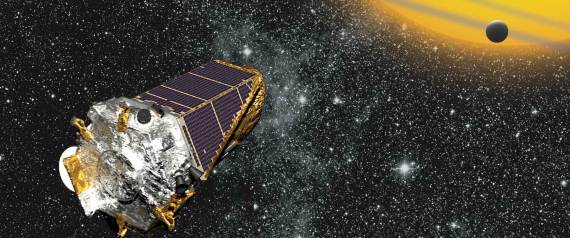
The newfound exoplanet, dubbed Kepler-432b, was monitored by NASA’s Kepler space telescope from 2009 to 2013 and identified as a planetary candidate in 2011. Using the 2.2-meter telescope at Calar Alto Observatory in Andalucía, Spain and the Nordic Optical Telescope on La Palma in the Canary Islands, the researchers are now confirming that, indeed, it’s a planet.
The teams, one led by Mauricio Ortiz of the Centre for Astronomy of Heidelberg University (ZAH) and the other by Simona Ciceri of the Max Planck Institute for Astronomy (MPIA) in Heidelberg, report that the planet has six times the mass of Jupiter, but about the same size.
The shape and the size of its orbit are also unusual for the planet named Kepler-432b that is revolving around a giant star.
Analyzing the data from both telescopes, the researchers discovered Kepler-432b is incredibly dense; though it’s around the same size as Jupiter, its mass is six times that of the gas giant. Its orbit around its host star, a red giant with a radius that’s four times that of our Sun, is also unusual.
“The majority of known planets moving around giant stars have large and circular orbits,” Dr. Davide Gandolfi, an astronomer at Heidelberg University’s Center for Astronomy in Germany and a researcher involved in the discovery, said in a written statement. “With its small and highly elongated orbit, Kepler-432b is a real ‘maverick’ among planets of this type.”
“During the winter season, the temperature on Kepler-432b is roughly 500 degrees Celsius. In the short summer season, it can increase to nearly 1,000 degrees Celsius,” said astronomer Dr. Sabine Reffert from the state observatory Konigstuhl.
Kepler-432b was previously identified as a transiting planet candidate by the NASA Kepler satellite mission. From the vantage point of Earth, a transiting planet passes in front of its host star, periodically dimming the received stellar light.
The orbit brings Kepler-432b incredibly close to its host star at some times and much farther away at others, thus creating enormous temperature differences over the course of the planet’s year, which corresponds to 52 Earth days.
Both groups of researchers used the 2.2-metre telescope at Calar Alto Observatory in Andalucia, Spain to collect data.
The group from the state observatory also observed Kepler-432b with the Nordic Optical Telescope on La Palma.
The research was published in the journal Astronomy and Astrophysics.
And the planet is only one of five observed orbiting a red giant host star at such a close distance. Red giants are stars in their last stage of life. They can grow to become anywhere from 10 to 100 times their original size, and as they grow, any planets nearby are at risk of being devoured.



Be the first to comment