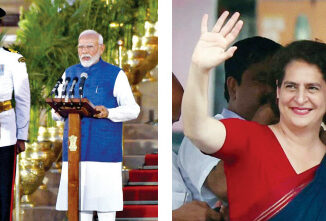
The year 2024 was significant for Indian politics as the Election Commission carried out the world’s largest electoral exercise with 642 million people voting to decide who would rule the nation for the next five years.
The elections were carried out in seven phases between April and June with thousands of government functionaries — who were manned by an even greater number of security forces — managing a whopping 10.5 lakh polling booths across the country.
The year also witnessed several states electing their new governments, with all but two retaining those in power. The opposition also got a new lease of life this year despite being on the losing side in the general elections.
Congress leader Rahul Gandhi became the Leader of Opposition in Lok Sabha as his party won 99 seats, nearly double the number it had scrambled to in 2019. The grand old party celebrated the performance like a win against the larger-than-life figure of Narendra Modi, who became the Prime Minister for the third consecutive time, though with figures far below the BJP’s expectations.
In the national capital, the tug of war between the Centre and the elected Aam Aadmi Party government witnessed strong pulls and drags this year. The tension peaked when AAP chief Arvind Kejriwal was jailed in March for his alleged role in the Excise Policy Scam. He functioned as Delhi Chief Minister behind bars for the next seven months until the Supreme Court granted him bail with conditions, following which he quit, paving the way for his party leader Atishi to take over as Delhi CM.
The resignation, arrest, and return of Hemant Soren in Jharkhand, the fall of the Biju Janata Dal government in Odisha after 24 years, the return of Chandrababu Naidu as Andhra Pradesh Chief Minister, the maiden Assembly Elections in the Union Territory of Jammu and Kashmir, and the NDA’s landslide victory in Maharashtra Elections were some of the other major political developments the country witnessed in 2024.
Here is a sneak peek into these and other landmark events in Indian politics this year.
Hemant Soren’s Fall And Rise
Four-time Jharkhand Chief Minister, Hemant Soren dogged it out against the central government in the very first month of 2024 but managed to retain power amid a high-decibel political drama at the fag end of the year.
The gripping political potboiler saw Soren quitting as chief minister hours before he was arrested by the Enforcement Directorate in a land scam case on January 31. Ahead of his arrest, the agency could not confirm his whereabouts for around 24 hours before he showed up in Ranchi. Soren claimed the charges against him were nothing but a vindictive action on the part of the BJP-led central government.
His chosen replacement Champai Soren functioned as Jharkhand CM for barely five months till Hemant was released on bail on June 28. Less than a week later, Champai Soren resigned as CM, making way for Hemant who took oath as CM on July 4. The move did not go down well with Champai Soren who quit JMM and joined the BJP on August 30.
In the November Assembly Elections, Hemant Soren signed off the year with flying colours as the JMM-led alliance won 56 seats, the party’s best performance since inception. Soren was unanimously elected as leader of the legislature party and again took oath as Chief Minister on 28 November.
Delhi CM Arvind Kejriwal Is Jailed
Embroiled in controversies that saw him running the Delhi government from behind bars for several months, Aam Aadmi Party National Convener Arvind Kejriwal was on a political roller-coaster in 2024.
With several of his key party members and ministers in the Delhi government already arrested in the alleged excise policy scam, Kejriwal also was on the Enforcement Directorate’s radar.
He managed to dodge multiple summons by the central agency before he was arrested on March 21 after the Delhi High Court rejected his plea for anticipatory bail. Kejriwal knew his arrest was around the corner and had time and again mentioned it in his prior public speeches.
The BJP were all but sure of him resigning from his post but Kejriwal stayed put and ran the Delhi government from jail for several months. He attempted to get bail from the Delhi High Court however the same was rejected multiple times.
During his jail time, Kejriwal’s legal battles took several twists and turns. He was granted interim bail by the Supreme Court from May 10 to June 1, 2024, to allow him to campaign for the Lok Sabha elections. After his interim bail expired, Kejriwal surrendered at Tihar Jail on June 2.
Delhi Rouse Avenue Court granted him bail on June 20. However, the Enforcement Directorate challenged the trial court order before the Delhi High Court which stayed the bail order on June 21. Five days later, the CBI arrested Kejriwal in a different case linked to the alleged excise policy scam.
The Supreme Court granted Kejriwal interim bail on July 12, but he remained in jail due to the CBI arrest. He was finally granted bail by the Supreme Court on September 13, 2024, after spending over five months in prison.
The bail, however, came with certain conditions including prohibiting him from making public statements about his arrest by the CBI. He was also ordered not to enter the office of the Delhi Chief Minister and sign any official files in his capacity as the Chief Minister.
Just four days later, on September 17, Kejriwal resigned as the Chief Minister of Delhi. He made it clear that he would only consider taking up the role again if he received a public mandate. On September 21, Atishi, the Delhi education minister till then, replaced Kejriwal as the youngest woman CM of Delhi.
2024 General Elections:
A Mammoth Exercise
India witnessed its 18th general elections this year as the entire country voted to choose the next central government. Of the 96.8 crore (968 million) people who were eligible to vote, 64.2 crore exercised the right including 312 million women, the highest-ever participation by female voters.
The 44-day electoral exercise was the second longest in country after the first parliamentary elections of 1951-52, which lasted for more than four months. The polls were conducted in seven phases beginning April 19 and ending June 1. The results were declared on June 4.
The BJP-led NDA alliance won the elections with Narendra Modi returning as Prime Minister for the third consecutive time. The BJP’s performance, however, was below expectations and it had to heavily rely on two main allies—the Telugu Desam Party of Andhra Pradesh and Janata Dal (United) of Bihar—to form a coalition government.
Eyeing 400 of the 543-seat Lok Sabha, BJP managed to win only 240 while its main partners TDP and JD(U) won 16 and 12 seats respectively. Overall, the NDA won 293 seats.
In 2019, the BJP won 303 seats with the NDA’s final tally at 353. In contrast, Congress recorded a turnaround winning 99 seats, nearly double its 2019 tally of 52, thereby coming back as a potent opposition.
Narendra Modi Takes Oath As PM For Third Consecutive Time
On June 9, Narendra Modi took oath as the Prime Minister of India for the third consecutive time after his BJP-led NDA alliance registered a victory in the 2024 Lok Sabha elections.
The ruling party’s rallies ahead of the elections were powered by the ‘Modi ki Guarantee’ campaign, which managed to help it win 240 seats, a lacklustre performance but strong enough to form a coalition government with the BJP as its most powerful constituent.
Three days after the results were declared on June 4, Modi confirmed the support of 293 MPs to President Droupadi Murmu after which he was sworn-in as the Prime Minister for the third time on June 9.
As for his individual performance from the Varanasi Lok Sabha seat, PM Modi had a shocking start on the result day as Congress’ Ajay Rai was seen leading in the first hour of vote counting.
PM Modi raced past in the second half defeating Rai by a margin of 1,52,513 votes. It was the second-lowest-ever victory margin (in percentage points) for a sitting prime minister and a steep fall for Modi compared to his 2019 margin of 4.5 lakh votes.
In his victory speech, Prime Minister Modi pledged to work with all states, regardless of the party in power, to build a developed India. He also laid out his vision for the third term saying it would be a tenure of big decisions and a key emphasis would be on uprooting corruption. He thanked TDP supremo Chandrababu Naidu and Bihar Chief Minister Nitish Kumar, his NDA allies for the electoral successes in Andhra Pradesh and Bihar.
Rahul Gandhi’s Resurgence As LoP, Priyanka’s Debut in Parliament
Ridiculed as ‘Shehzada’ and dismissed as ‘Pappu’, Congress leader Rahul Gandhi had the last laugh in the 2024 Lok Sabha election as he managed to gain big even though his party lost the elections.
Gandhi contested from Kerala’s Wayanad and Uttar Pradesh’s Rae Bareli, winning the southern seat by 3.64 lakh votes against his nearest rival Annie Raja of CPI and the northern one by 3.9 lakh votes against BJP’s Dinesh Pratap Singh. Rahul retained Rae Bareli and his sister Priyanka fought and won from Wayanad by an even greater margin in the by-elections later in the year, making her Parliament debut as she took oath as Lok Sabha MP on November 28.
Congress credited its spirited performance in the general elections to Rahul Gandhi for a campaign that focussed on people’s issues and welfare measures. The party lauded Gandhi for creating a new narrative through his Bharat Jodo Yatras, the on-foot marches he undertook from one end of the nation to another during which he was seen meeting people on the ground and getting to know about the real issues facing mainland India.
Even the harshest of his critics would concede that Gandhi’s 2024 campaign was by far his best one as he focussed on bread-and-butter issues and the party’s welfare guarantees which struck a chord with a section of the voters.
With Congress winning 99 seats in the elections (more than the requisite 55 or 10 per cent of the 543 seats), it meant that for the first time since 2014, it had the opportunity to pick a Leader of Opposition (LoP) in Lok Sabha. As an obvious choice, the party nominated Gandhi who was appointed the LoP on June 24, his maiden constitutional position since his entry into politics in 2004.
As LoP Gandhi was accorded a Cabinet Minister’s rank, enhancing his position in the protocol list. The work of the Leader of the Opposition in the Lok Sabha is opposite to that of the Leader of the House.
TDP Wins Andhra Elections,
Naidu Returns As CM
Andhra Pradesh saw a power transfer in 2024 as the ruling YSR Congress party lost the Assembly Elections to Telugu Desam party-led NDA. The elections were held in a single phase on May 13 with counting of votes on June 4. The polls were held simultaneously with the Lok Sabha elections.
The incumbent Jagan Mohan Reddy’s YSRCP faced a crushing defeat as it won just 11 seats against 151 in 2019. In contrast, the TDP won 135 seats in the 2024 elections against just 23 in 2019.
TDP Chief N Chandrababu Naidu returned as Chief Minister, taking oath on June 12. His last term as CM was from 2014 to 2019. Before the state bifurcation, he served as the CM of United Andhra Pradesh twice – 1995-99 and 1999-2004.
The other highlights of the 2024 Andhra Elections were Naidu’s son Nara Lokesh and Janasena leader Pawan Kalyan entering the Assembly for the first time. The BJP got a much-needed boost with the NDA alliance winning 21 out of the total 25 Lok Sabha seats in the state. YSRCP got just four MP seats.
Analysts said strong anti-incumbency coupled with a united fight by the opposition parties routed the ruling YSRCP. Though the Reddy-led government shelled out Rs 2.60 lakh crore towards doles over the last five years, there was no perceivable development in the state.
BJP Wins Odisha, Naveen
Patnaik’s 24-Year Rule Ends
Odisha crossed a political milestone in the 2024 Assembly Elections as the electors voted for the BJP, ending the 24-year Biju Janata Rule (BJD) rule. Naveen Patnaik’s party could manage only 54 seats in the elections, a huge dip from 113 in the previous elections.
BJP, on the other hand, secured a simple majority, winning 78 seats in the 147-seat Legislative Assembly. Held simultaneously with Lok Sabha elections, the elections were carried out in four phases with the first on May 13 and the last on June 1. The BJP also made significant gains, winning 20 out of 21 Lok Sabha seats in Odisha marking one of the strongest wins for the saffron party in the general elections.
As for Naveen Patnaik, the BJD leader contested from two seats – Hinjili and Kantabanji. He won from Hinjili with 66,459 votes, defeating BJP candidate Sisir Kumar Mishra by a narrow margin of 4,636 votes.
The election campaign by the BJP was intense, with Prime Minister Narendra Modi addressing several rallies and holding two road shows in Bhubaneswar and Puri. The BJP’s high-profile electioneering seemed to overshadow the BJD’s campaign, which was largely led by Patnaik and his aide VK Pandian.
2024 Tripura Peace Accord
On September 4, India’s northeast region witnessed a historic moment when the 35-year-long insurgency in Tripura came to an end following the signing of an agreement between the Centre, the Tripura government and two insurgent outfits of the state–the National Liberation Front of Tripura (NLFT) and All Tripura Tiger Force (ATTF).
The agreement was signed at North Block in the presence of Union Home Minister Amit Shah, Tripura Chief Minister Dr Manik Saha, and top leaders of both NLFT and ATTF. As per the agreement, the Centre sanctioned a special economic development package amounting to Rs 250 crore for a period of four years to be implemented by the state government for the overall development of tribals of Tripura.
“The Government of India and the Government of Tripura have been making concerted efforts to engage the tribal armed groups of Tripura in order to bring peace and harmony in the state, and rehabilitate the cadres so as to enable them to lead a normal life in the society,” the agreement stated.
The agreement stated that NLFT and ATTF would not extend any support to any other militant or armed groups by way of training, supply of arms, providing protection or in other manner.
Jammu And Kashmir UT Gets Maiden Elected Government
The Union Territory of Jammu and Kashmir flipped a page in its political history in 2024 as it witnessed its first assembly elections after the abrogation of Article 370 and downgrading of the state into two federally controlled territories in 2019.
The long-pending elections were finally carried out in three phases from September 18 to October 1 with counting of votes on October 8. They were held in the backdrop of the Supreme Court direction in December 2023 in which it had asked the Election Commission to “restore the democratic process” in the union territory by September 2024.
The opposition bloc led by the National Conference in the Union Territory won the elections bagging 49 of the 90 Assembly seats. NC emerged as the single largest party winning 41 seats followed by BJP (29) and Congress (6). Mehbooba Mufti-led PDP was able to win only three seats, the worst performance by the party since it was founded by Late Mufti Sayeed 25 years ago.
Former CM and National Conference leader Omar Abdullah was sworn in as the first Chief Minister of the J&K UT on October 16. Interestingly, a few months before the election dates were announced, the Ministry of Home Affairs increased the powers of the L-G Manoj Sinha-led administration by amending the Jammu and Kashmir Reorganisation Act, 2019.
The amendment entrusted more powers to the L-G for making decisions on police, all-India services officers and appointment of advocates and other law officers. He was also given powers for sanctioning prosecution in certain cases and taking decisions on anti-corruption bureau-related matters.
BJP’s Hat-Trick In Haryana
Buoyed by its success in Odisha, BJP recorded a hat-trick win in Haryana leaving the opposition stunned while managing to overcome anti-incumbency with ease.
The single-phase elections were held on October 5 and the votes were counted on October 8. The victory in Haryana was a significant milestone for the BJP as, despite predictions of a Congress-led alliance win, the saffron secured a majority with 48 seats in the 90-member Assembly, marking its third consecutive win in the state.
The election saw a high voter turnout of 67.90 per cent, with the BJP winning 39.94 per cent of the popular vote. The Congress, led by Bhupinder Singh Hooda, won 37 seats with 39.09 per cent of the popular vote.
Nayab Singh Saini, the 54-year-old OBC leader who was made CM in March to replace Manohar Lal Khattar in an unexpected appointment, took oath as the new Haryana Chief Minister for the second term on October 17.
The BJP’s victory was attributed to its strong campaign and the popularity of its leaders. The party’s decision to contest the election without a chief ministerial face also seemed to have worked in its favour.
The Congress, on the other hand, faced internal conflicts and was unable to capitalize on the anti-incumbency factor. The party’s alliance with the Communist Party of India (Marxist) also failed to yield the desired results.
The Jannayak Janta Party (JJP), which had allied with the BJP in the previous election, contested the election alone but failed to win any seats. The Indian National Lok Dal (INLD) also failed to make a significant impact, winning only two seats.
Mahayuti’s Landslide Victory In Maharashtra, Fadnavis Returns As CM
The BJP-led Mahayuti alliance registered a landslide victory in Maharashtra as the key western state went to polls on November 20. In the 288-seat Legislative Assembly, the BJP won 132 and its allies Shiv Sena and NCP bagged 57 and 41 seats respectively. The opposition Maha Vikas Aghadi (MVA) was handed one of the worst defeats in recent history as the three main constituents of the alliance could manage wins in just 50 seats–Congress 16, Shiv Sena (UBT) 20, and NCP (SP) 10.
The BJP was at the forefront of this spectacular performance, comprehensively managing to buck the anti-incumbency and emerge as the largest party in the state pocketing 132 of the 149 seats it contested in the politically significant western state. BJP’s success was led by its senior leader and state deputy CM Devendra Fadnavis, who eventually became the Chief Minister for the third time after some hiatus on the part of the Eknath Shinde-led Shiv Sena.
Fadnavis’ name was finalised for the Maharashtra Chief Minister post at a key meeting on December 4. A day later, he took an oath as the Chief Minister for the third time. The swearing-in ceremony was attended by Prime Minister Narendra Modi and other top political figures of the country. The results came as a fillip for the BJP after the unprecedented hat-trick in Haryana and helped the party overcome some of its setbacks in the general elections where it bagged just 240 seats.
Voters in the politically significant western state of Maharashtra, which sends 48 MPs to the Lok Sabha and gave the MVA a decisive 30 seats, clearly decided to go against the trend of that parliamentary victory just five months ago.
Tag: Shiv Sena
-

Modi returns, Rahul finds foothold: Revisiting the grand political tamasha India witnessed this year
-

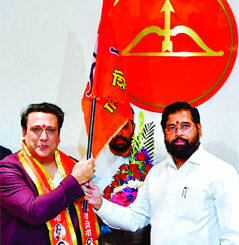
Actor Govinda joins CM Eknath Shinde’s Shiv Sena
Bollywood actor Govinda made a political comeback on Thursday, March 28, after joining the ruling Shiv Sena in the presence of Maharashtra CM Eknath Shinde in Mumbai. The actor had earlier won elections on a Congress ticket from the Virar constituency after defeating BJP stalwart Ram Naik.
The ‘Raja Babu’ actor made his political debut in 2004 when he emerged as a “giant killer” after defeating senior BJP leader Ram Naik in the Mumbai North Lok Sabha seat with a Congress party ticket. The 60-year-old actor was welcomed by Maharashtra CM Eknath Shinde saying he was a popular figure in all sections of the society.
“I am back (in politics) after a 14-year-long ‘vanvas’ (exile),” Govinda remarked after joining the Shiv Sena. The actor said he would work in the art and culture field if given a chance.
Applauding the work done by the central government under Prime Minister Narendra Modi’s leadership, Govinda, fondly called Chi Chi, said, “We have seen the same level of progress here (in Maharashtra) in the last two years, as we have seen in the country in the last 10 years. We will focus on the beautification of the state and the growth of art and culture.”
Govinda, who started his acting career in the 1980s, said after his first stint in politics from 2004 to 2009, he never felt he would come back to the same field. -

Maharashtra Governor’s decision to call floor test wrong: Supreme Court of India
NEW DELHI (TIP): The Supreme Court of India, in a unanimous judgment, effectively opened the doors for disqualification proceedings against Maharashtra Chief Minister Eknath Shinde for defection from the Shiv Sena and held that the then Governor Bhagat Singh Koshyari “erred” in calling for a trust vote, which triggered the fall of the Uddhav Thackeray-led Maha Vikas Aghadi (MVA) government in mid-2022.
The court also said that Governor Koshyari was right in inviting Mr. Shinde to form the new government as Mr. Thackeray had resigned before the floor test. This means that the Shinde government will continue in power for now.
“The Governor had no objective material on the basis of which he could doubt the confidence of the incumbent government… Floor test cannot be used as a means to settle differences within a political party… The Governor erred in concluding that Mr. Thackeray had lost support… The discretion to call for a floor test is not an unfettered discretion,” a Constitution Bench led by Chief Justice D.Y. Chandrachud observed.
The court said that it could not quash the voluntary resignation of Mr. Thackeray as CM, and thus reinstate his MVA government. “Had Mr. Thackeray refrained from resigning from the post of the Chief Minister, this court could have considered the grant of the remedy of reinstating the government headed by him,” it said.
-
Unlaundered truth: On Sanjay Raut’s bail and the functioning of central agencies
Central agencies should reflect about the way they are used for political ends
A Special Court dealing with cases under the Prevention of Money Laundering Act (PMLA) in Mumbai has made some extraordinarily scathing observations about the way the Enforcement Directorate (ED) functions. While granting bail to Sanjay Raut, Shiv Sena (Uddhav Thackeray) MP, the court has termed his arrest not only illegal but also one recorded for “no reason” at all. The grant of bail and the observations made by Special Judge M.G. Deshpande have galvanized the ED to file an immediate appeal before the Bombay High Court, but the lengthy order contains enough material to substantiate the charge by Opposition parties that central agencies are being utilized to hound political opponents. The judge has found that the underlying criminal case of cheating concerned another set of people who had committed misdeeds, but they were not arrested. As far as Mr. Raut and his associate, Pravin Raut, who has also been given bail, were concerned, it was essentially a civil dispute, and there was nothing to show that money involved in their transactions were “proceeds of crime.” Their arrest under the PMLA was illegal, the court said, because there was no underlying scheduled offence. The ED has alleged that the proceeds of the fraudulent sale of tenements pertaining to a re-development project at Patra Chawl in Mumbai, amounted to ₹1,039 crore. It had further alleged that Mr. Pravin Raut was a proxy for Sanjay Raut, and that the latter and his wife had utilized ₹95 crore out of the proceeds to buy assets.
The misuse of agencies seems to be an unlaundered truth, going by the court’s remarks. There has indeed been a disproportionate targeting of non-BJP political leaders by investigating agencies of the Union government. While lawyers and activists have been arrested under anti-terrorism laws, mainstream political opponents often see tax raids and money-laundering cases. The latter class of cases is made possible by the PMLA that permits the ED to register a money-laundering case whenever there is an FIR by the police involving a given list of offences. In a sardonic comment, the Special judge has noted that the ED works at great speed while making an arrest, but proceeds with the trial at a snail’s pace. ED officers seem to be aware only of Section 19 (power to arrest) and Section 45 (stringent conditions for bail), but not the fact that they should also hold a trial. The judge’s remarks also drive home the fact that money-laundering prosecutions have an abysmally low rate of convictions. Instead of rushing to file appeals against adverse orders, central agencies ought to reflect on the manner in which they are being utilized for political ends.
(The Hindu)
-

Know how President of India is elected
On July 18, elected MLAs and MPs across the country will vote to elect India’s 15th President. Under Article 62(1) of the Constitution, “an election to fill a vacancy caused by the expiration of the term of office of President shall be completed before the expiration of the term”. President Ram Nath Kovind’s tenure ends on July 24. The counting of votes will take place on July 21 and the new president will take oath on July 25.The notification for the presidential election has been issued on June 15 and the last day of filing a nomination will be June 29. The papers will be scrutinised on June 30. The last day to withdraw the nomination papers will be July 2.
“The Election Commission, in consultation with the Central Government, appoints the Secretary General of Lok Sabha and Rajya Sabha, by rotation, as the Returning Officer,” the EC said.
“Accordingly, the Secretary General, Rajya Sabha will be appointed as the Returning Officer for the present election to the Office of the President,” it added.
Here’s the process of electing a President
According to Article 55 of the Constitution, the President of India is elected by members of the Electoral College consisting of elected Members of Parliament and that of all the state assemblies including the National Capital Territory of Delhi and the Union Territory of Puducherry. It follows the system of proportional representation utilising a single transferable vote system and secret ballots.
Nominated members of Parliament, state assembly and members of legislative council are not eligible to vote.
Importantly, the members who are nominated to either House of Parliament or the Legislative Assemblies of State including NCT of Delhi and UT of Puducherry are not eligible to be included in the Electoral College.
This year, a total of 776 Members of Parliament and 4,033 MLAs will vote in the Presidential elections. The total value of votes is 10,86,431. The value of votes of MLAs is 5,43,231 and MPs are 5,43,200.
Who is eligible?
To be eligible for the election, the person: must be a citizen of India; have completed the age of 35 years; and is qualified for election as a member of the House of the People (Article 58).
The person will not be eligible if he/she holds any office of profit under the Government of India or the Government of any State or under any local or other authority that is controlled by any of the state governments.
What’s the process?
The process starts with the nomination. The Presidential candidate should get his nomination paper subscribed by at least 50 electors as proposers and at least 50 electors as seconders. Importantly, the elector should not subscribe to more than one nomination paper either as a proposer or as a seconder. The candidate is required to deposit security, which is Rs 15,000. It is supposed to be made along with the nomination paper. More than four nomination papers can not be filed by or on behalf of a candidate or received by the Returning Officer.
Where does the voting take place?
Voting for the Presidential election will take place in Parliament and the premises of state assemblies, while Rajya Sabha Secretary-General will be the returning officer. MPs cast their vote in Parliament and MLAs in their respective state assemblies.
Process of voting
The election follows proportional voting which means that the value of each vote varies as it based on the post. The value of each vote based on the population is also predetermined for an MLA vote. This year, the total number of electors for the election will be 4,809 – 776 MPs and 4,033 MLAs.
Who will be India’s next President?
India’s President does not exercise executive powers, but all executive decisions are carried out in her name. She is required by the Constitution to act on the advice of the council of ministers led by the Prime Minister.
But the President can ask the government to reconsider actions and offer advice. In matters of legislation, for example. So, it would be wrong to say that the role is only ceremonial or that the President is a mere figurehead or rubber stamp. Presidents like Pranab Mukherjee have been quite assertive, especially while dealing with mercy petitions from death row convicts. One of the most crucial roles of the President is seen when no party is able to get a parliamentary majority in a national election.
So, the presidential election is crucial, and you should care about it. The election is indirect, but the result does indicate how much popular support both camps, the government and the opposition, have in the country.
On your mind could be several key questions, from the poll process to front-runners to the numbers game, and to possible scenarios. But first let’s get some important dates out of our way.
The President is elected by members of the Electoral College comprising elected members of both Houses of Parliament, and elected members of the Legislative Assemblies of all states and the National Capital Territory of Delhi and the Union Territory of Puducherry.
This means nominated members of the Rajya Sabha and the Lok Sabha or Legislative Assemblies of states are not part of the Electoral College. Similarly, members of Legislative Councils also do not participate in the election process.
The value of votes of MPs and MLAs varies based on the population of states they come from.
It is mandatory for 50 MPs to propose the candidate, followed by another 50 seconding the candidature.
Polling will be held in the Parliament House and on the premises of the State Legislative Assemblies.
The election is held by secret ballot. A single transferable vote is used per the system of proportional representation.
On the ballot paper, there are two columns. The names of candidates are listed in the first column, and the order of preference is listed in the second column.
THE NUMBERS GAME
The Electoral College has 4,809 electors, including 776 Members of Parliament (MPs) and 4,033 Members of Legislative Assemblies (MLAs).
The total value of votes will be 10,86,431. To win, a candidate must get at least 5,43,216 votes.
In the last election in 2017, Ram Nath Kovind of the NDA defeated joint Opposition candidate Meira Kumar. Kovind polled 7,02,000 votes compared with Kumar’s 3,67,000, out of a total of 10,69,358 votes.
Roughly speaking, the ruling BJP-led National Democratic Alliance (NDA) has 48 per cent of the votes this time. It is 23 per cent for the Congress-led United Progressive Alliance (UPA).
So, the NDA should not have any problem in getting its candidate elected. But the contest will become tight if all non-BJP parties unite (this explains hectic consultations on both sides). Then the opposition will have about 51 per cent of the votes.
This is unlikely. Some reports say that “independents” such as Andhra Pradesh’s ruling YSRCP and Odisha’s ruling BJD may support the NDA. The BJP’s Tamil Nadu ally, the AIADMK, may also do so.
The BJP has authorised its party president JP Nadda and Union minister Rajnath Singh to hold consultations with constituents of the NDA and the UPA, besides other political parties, as well as independent members. A consensus candidate is always preferable.
PROBABLE CANDIDATES
The general impression is that the BJP is unlikely to re-nominate Kovind. Rajendra Prasad was the only President to get two full terms. Both camps have not named their candidates yet. But that does not mean we’re short of suggestions. Former West Bengal Governor and Mahatma Gandhi’s grandson, Gopalkrishna Gandhi, has been approached by some leaders to be a joint Opposition candidate. He is the Left’s suggestion. There is talk about NCP chief Sharad Pawar exploring the possibility of pushing dissident Congress leader Ghulam Nabi Azad as the Opposition nominee. On the other hand, NDA probables may include Kerala Governor Mohammad Arif Khan, former Jharkhand Governor and tribal leader from Odisha Draupadi Murmu, Chhattisgarh Governor and tribal leader Anusuiya Uikey, Telangana Governor Tamilsai Soundararajan, Karnataka Governor and Dalit leader Thawar Chand Gehlot, former Lok Sabha Speaker Sumitra Mahajan, and Odisha’s tribal leader Jual Oram
A disclaimer: The BJP remains capable of surprising everyone, like when it nominated APJ Abdul Kalam in 2002. The name of TMC leader Yashwant Sinha (though Bengal’s ruling party TMC has indicated none of its own members will be a candidate) is also being talked about. Earlier reports said that the Congress, the TMC, the AAP and the Shiv Sena wanted Pawar to be the opposition’s candidate, but he has declined the offer.
JD(U) leader and Bihar minister Shravan Kumar has said party chief and Bihar CM Nitish Kumar could be a good candidate. Maharashtra minister and NCP spokesperson Nawab Malik has said Kumar’s candidature as an opposition choice can be considered if the latter snaps ties with the BJP/NDA in Bihar. On his part, Nitish Kumar has clarified that he never wanted to, and will not, contest the President’s election.
CRACKS IN OPPOSITION
Cracks have appeared in the opposition camp. The Congress is currently preoccupied with rallying support for its leader Rahul Gandhi, being questioned by the Enforcement Directorate in the National Herald money-laundering case.
Actually, there is no one opposition camp. There is the Congress-led United Progressive Alliance (UPA). But that’s mostly the Congress with non-ruling allies like the RJD of Bihar. The Congress rules Rajasthan and Chhattisgarh and is a junior partner in states such as Maharashtra, Jharkhand and Tamil Nadu.
West Bengal Chief Minister and TMC leader Mamata Banerjee has met Sharad Pawar, whose party NCP is part of Maharashtra’s ruling coalition MVA, led by the Shiv Sena and also comprising the Congress. Banerjee is trying to bring everyone on a single platform but Congress, while attending consultations driven by her, does not want to be overshadowed by a former Congresswoman. The grand old party is also holding its own meetings.
The Left is not happy with Banerjee’s “unilaterally” organised deliberations. Delhi Chief Minister Arvind Kejriwal’s AAP (which is also ruling Punjab) has been a Congress critic and cautious of Banerjee in matters of national politics. On the other hand, Telangana Chief Minister K Chandrashekar Rao of TRS has his own ambitions.
The Congress has asked its leader Mallikarjun Kharge to hold talks with all like-minded parties on the possibility of fielding a joint candidate. Kharge met NCP chief Sharad Pawar at the latter’s residence in Mumbai on June 9.
Congress president Sonia Gandhi has herself reached out to Opposition leaders, including DMK chief MK Stalin, Pawar, CPM’s Sitaram Yechury. Banerjee and Telangana CM K Chandrashekar Rao, both non-UPA leaders, have also met leaders of the MVA. On June 15, Banerjee held a meeting with Opposition leaders in Delhi where no one from the AAP, the TRS and the BJD came despite invitations. Those who attended the meeting convened to prepare a joint strategy included Pawar, PDP’s Mehbooba Mufti, NC’s Omar Abdullah and SP’s Akhilesh Yadav, besides some Congress leaders including Kharge.
Looks like a fractured opposition may again end up helping the BJP in an important election. Unless, of course, the mirage of oft-cited total opposition unity finally becomes a reality.
-

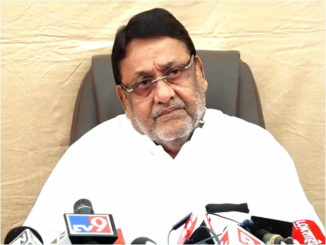
Supreme Court rejects Nawab Malik’s plea in money laundering case
NEW DELHI (TIP)- Maharashtra minister Nawab Malik’s plea to release him from jail in a money laundering case was on Friday rejected by the Supreme Court. “It is too nascent a stage to interfere with the investigation. We can’t interfere with the due process at this stage. You (should) move the competent court,” the top court said in its remarks. The 62-year-old NCP leader was arrested in February in a case linked to Dawood Ibrahim, the mastermind of 1993 Mumbai blasts. Earlier the Bombay High Court had rejected the application by the minister to release him from jail. The ruling Shiv Sena-NCP-Congress alliance in Maharashtra – in an attack on the BJP – has been claiming that the NCP leader’s arrest in the investigation by the central probe agency was “politics of vendetta”.
Earlier on Thursday, the Enforcement Directorate – that probes financial crimes – submitted a 5,000-page chargesheet in a Mumbai court. The special court for Prevention of Money Laundering Act (PMLA) cases will take cognizance of the charge-sheet after verification of the documents, news agency PTI reported, citing the probe agency’s lawyers.
The case is based on an FIR filed recently by the National Investigation Agency (NIA) against Dawood Ibrahim and his aides under the Unlawful Activities (Prevention) Act (UAPA).
Malik, the ED has alleged, funded a prominent member of ‘D-Gang’ (Dawood gang) for illegal occupation of a property.
Last week, the ED had provisionally attached eight properties belonging to Maharashtra minister Nawab Malik and his family members.
-

India in history this Week-January 21, 2022, to january 27, 2022
21 JANUARY
2008 India successfully launched a spy satellite of Israel and installed it in Polar Arbit.
1958 Copyright Act enacted.
1945 Renowned lawyer and freedom fighter Ras Bihari Bose died.
22 JANUARY
1965 Steel factory started in Durgapur, West Bengal.
1966 Mughal emperor Shah Jahan died.
1963 The National Library for the Blind was established in 1963 in Dehradun.
23 JANUARY
1897 India’s freedom fighter Netaji Subhash Chandra Bose was born in Cuttack, Odisha.
1926 Bal Thackeray, Indian politician and founder of Shiv Sena was born.
1966 Indira Gandhi became the third Prime Minister of India.
1977 Janata Party was formed.
2009 The ban on smoking scenes in film and television programs is over.
24 JANUARY
1950 On this day, the Constituent Assembly elected the first President of the country. Apart from this, the National Anthem was adopted by the Constituent Assembly on 24 January 1950.
1966 Air India’s Boeing 707 crashes near the summit of Monblaw in the hills of the Alps. 117 people died in it.
1950 Jana Gana Mana was accepted as the national anthem.
1857 University of Calcutta was established.
1950 Dr. Rajendra Prasad became the first President of independent India.
1950 Jana-gana-mana got the status of national anthem of India in 1950.
1951 Prem Mathur became India’s first female commercial pilot in 1951.
1952 The first International Film Festival was held in Bombay in 1952.
2002 The Indian satellite INSAT-3C successfully orbited in 2002.
25 JANUARY
1971 Himachal Pradesh came into existence as a state.
1980 The Indian Brahmo Samaj was started in 1880 by the famous social reformer Keshav Chandra Sen.
1980 After a gap of three years, in 1980, Padma Vibhushan, Bharat Ratna, etc. civil honors started being awarded again.
1980 The famous philanthropist Mother Teresa was awarded the Bharat Ratna in 1980.
2002 In 2002, Arjun Singh became the first Air Marshal of the Indian Air Force.
2009 The Central Government announced the Padma Bhushan and Padma Shri awards in 2009.
26 JANUARY
1956 In the year 1956, Humayun, son of Mughal emperor Babur, died.
1930 Swaraj Day was celebrated for the first time in India under British rule.
1931 Mahatma Gandhi was released for talks with the British government during the ‘Civil Disobedience Movement’.
1949 The Constitution of India was made to Dr. Rajendra Prasad, President of Constituent Assembly. The Constitution of India was prepared on this day.
1950 India is declared a sovereign democratic republic and the Constitution of India comes into force.
1950 Chakravarti Rajagopalachari, the first and last Governor General of independent India, resigned from his post and Dr. Rajendra Prasad became the first President of the country.
1950 Ashoka Pillar was adopted as the national emblem.
1963 The Government of India declared it a national bird on 26 January due to the peacock’s amazing beauty.
1972 The National Memorial Amar Jawan Jyoti was established at India Gate in Delhi.
1981 Keeping in mind the ease of air traffic in Northeast India, Air service Vayudoot started.
1955 The first parade of Republic Day took place on 1955 at Rajpath in Delhi.
1930 The Indian Constitution was implemented on 26 January keeping in mind the full Swaraj Day (26 January 1930).
27 JANUARY
2008 Bird flu spread in 13 districts of West Bengal.
1974 President VV Giri dedicated the Nehru Memorial Museum at Teen Murti in New Delhi to the nation.
1988 The helicopter postal service was inaugurated for the first time.
1922 Famous Indian actor Bharat Bhushan passed away.
2009 The eighth President of India, Shri. R. Venkataraman died.
-

With an Eye on 2024, 19 Opposition parties decide to hold nationwide protest
NEW DELHI (TIP): Leaders of 19 Opposition parties, on August 20,2021 announced a joint agitation plan from September 20 to 30 after Congress president Sonia Gandhi urged them to rise above political compulsions to defeat the BJP in the 2024 Lok Sabha elections.
It’s time to rise above political compulsions — Sonia Gandhi, Congress
All secular, democratic forces must join hands — Sharad Pawar, NCP
Mamata proposes core committee to steer fight against BJP
Tejaswi Yadav seeks ‘driving seat’ for regional parties
In a signed statement, Opposition stalwarts, including NCP’s Sharad Pawar, TMC’s Mamata Banerjee, DMK’s MK Stalin, Shiv Sena’s Uddhav Thackeray and JMM’s Hemant Soren, called upon the people of India to defend “the secular, democratic, republican order with all their might”.
11 demands
- Augment production and ensure free vaccination
- Give Rs7,500 a month to families outside income tax bracket
- Reduce prices of fuel
- Repeal three farm laws & guarantee MSP to farmers
- Pegasus probe under SC
- Release political prisoners, including those in Bhima Koregaon case, anti-CAA protests
- Restore J&K’s full statehood
- Stop, reverse privatization
- Revive MSMEs
- Expand MGNREGA
Jabs for teachers, pupils
“Save India today, so that we can change it for a better tomorrow,” they said listing 11 demands, including restoration of full statehood and elections in Jammu and Kashmir, repeal of three farm laws and institution of an SC-led inquiry into the Pegasus snooping row.
The statement followed a major Opposition outreach in which Sonia Gandhi said, “Our ultimate goal is the 2024 Lok Sabha poll for which we have to begin planning systematically with the single-minded objective of giving to our country a government that believes in the values of the freedom movement and in the principles and provisions of our Constitution. This is a challenge, but together we can and must rise to it because there is simply no alternative to working cohesively together. We all have our compulsions, but clearly, a time has come when the interests of our nation demand that we rise above them.”
Bengal CM Mamata Banerjee proposed the formation of a core group of Opposition leaders to chalk out joint programs. The like-minded parties “needed to unite to defeat the BJP”, she said.
The meeting was attended by leaders of the TMC, NCP, DMK, Shiv Sena, JMM, CPI, CPM, NC, RJD, AIUDF, VCK, Loktantrik Janta Dal, JDS, RLD, RSP, Kerala Congress Mani, PDP and IUML. The BSP, AAP and SP skipped the event, but the Congress claimed SP chief Akhilesh Yadav had intimated about his absence.
In the meeting, symbolically organized on the birth anniversary of her husband and late Prime Minister Rajiv Gandhi, Sonia blamed the government for the recent Parliament washout.
(Agencies)
-

Centre, states in war of words over O2 deaths
New Delhi (TIP): The ruling Bharatiya Janata Party (BJP) and several Opposition parties were locked in a war of words over how many people in India died due to lack of oxygen supplies while battling Covid-19, a day after the Union government told Parliament that no state reported such fatalities.
The submission to Parliament brought back focus on a crisis that in part defined the devastation of the second wave, but with little accountability being fixed since. A database of media reports from the time has identified at least 619 deaths that likely occurred because of lack of oxygen, while many more may have taken place outside of inundated hospitals. Still, with most states unwilling, even on Wednesday, to accept that there were deaths on account of oxygen supplies, the Union government’s submission, while insensitive, could well be technically correct.
The BJP accused the states of playing politics, and pointed to submissions by some of them to reaffirm that the central government was merely reporting data that states sent to it.
“The Centre says that health is a state subject. It says that it just collects the data, it doesn’t generate it. None of them said that a death occurred in their state and Union territory due to shortage of oxygen, there is no data for that. Did the Centre generate this data? No,” said Sambit Patra, BJP spokesperson.
Patra in particular pointed to the Congress, the Shiv Sena and the Aam Aadmi Party to accuse the rivals of “playing politics”.
“Rahul Gandhi is part of a coalition in Maharashtra and Sanjay Raut said he is shocked. The Maharashtra high court was given an affidavit by the state government where it stated that no death took place due to oxygen shortage,” he said. “On April 23 and 24, Arvind Kejriwal said 21 people died in Jaipur Golden Hospital due to oxygen shortage. He did a press conference and politicised it. This matter went to the high court. The Delhi government formed a committee and a report was submitted — it said patients got oxygen and no there was no mention of a shortage,” he said.
Patra’s comments appeared to be targeted at a tweet by Gandhi on Tuesday afternoon, in which the Congress leader said: “The shortage wasn’t only of oxygen; it was also of empathy and facts. The shortage was there then, and it’s there now.”
On Wednesday, July 21, Shiv Sena MP Sanjay Raut, whose party shares power with the NCP and Congress in Maharashtra, said people whose relatives died due to oxygen shortage should “take the Union government to court”.
Delhi health minister Satyendar Jain, too, attacked the Centre, saying it was “completely false” to say no one died for want of oxygen. “If no deaths occurred due to oxygen shortage, why did hospitals move high court one after another every day? Hospitals had been saying that oxygen shortage led to deaths. The media, too, flagged this issue daily,” Jain told reporters.
The AAP leader said the Delhi government set up a committee to collect data on such deaths and give ?5 lakh compensation to the families of the deceased, “but the Centre got the panel disbanded through the lieutenant governor”.
A day earlier, his cabinet colleague and deputy chief minister Manish Sisodia accused the Centre of a cover-up following its submission in Parliament. Neither Jain nor Sisodia put a number to deaths in Delhi on account of lack of oxygen.
As the controversy raged, officials in eight states – Goa, Maharashtra, Tamil Nadu, Madhya Pradesh, Odisha, Bihar, West Bengal and Uttar Pradesh – told HT that there were no deaths due to oxygen shortage in their hospitals.
Experts said the controversy was “unnecessary and unfortunate”. “The answers to parliamentary questions are compiled by respective ministries depending on inputs from various states and institutions, which means none of the states actually accepted that there were deaths due to oxygen shortage. The minister, however, could have just said that this is the official record and unofficially, there have been reports of deaths but there was no data,” said Dr MC Misra, former director of All India Institute of Medical Sciences.
Source: HT
-

Ajay Devgn sets up emergency Covid-19 facility at Mumbai’s Shivaji Park
Bollywood actor Ajay Devgn is doing his bit to help Mumbai in the time of the Covid-19 crisis. The Maidaan actor and a few of his colleagues have joined hands with Hinduja Hospital to set up an emergency facility at Mumbai’s Shivaji Park. As per reports, BMC has converted a hall at Shivaji Park into a 20-bed Covid-19 facility equipped with ventilators and oxygen support. Devgn, Anand Pandit, Boney Kapoor, Luv Ranjan, Sameer Nair and many others have also joined forces to contribute over Rs 1 crore to BMC’s “Smiley Account”. Shiv Sena corporator Vishaka Raut said, “It is great that Ajay Devgn supported BMC.” The Tanhaji actor has contributed the funds through his social service wing NY Foundations. Joy Chakraborty, COO, said, “It will be an extension of Hinduja Hospital.” The foundation will also be helping with food and medicine. In 2020, Ajay Devgn helped by donating ventilators to Mumbai’s Dharavi as the area was badly struck by Covid-19. On the work front, Ajay is looking forward to the release of Maidaan, RRR, Gangubai Kathiawadi.
-

Maharashtra Mahabharat : Devendra Phadnavis Announces his Resignation as Chief Minister
MUMBAI(TIP): The beleaguered Devendra Fadnavis announced at a press conference here on November 26 that he will submit his resignation to the Governor.
Fadnavis in his statement said that the people of Maharashtra had given a clear mandate to BJP- Shiv Sena combine to form a government. But Shiv Sena claimed chief minister’s position with BJP on a rotational basis, something BJP had never agreed to. BJP made all efforts to have its old alliance partner to drop the demand but was stonewalled. Shiv Sena chose the parties it had always opposed.
NCP offered BJP support to form a government and a claim of majority was submitted to the governor who invited Fadnavis to form the government.
However, situation has changed. “We do not have majority. We will sit in the opposition”, said Fadnavis.
All eyes are now on Maharashtra Governor who is expected to accept the resignation of Fadnavis and invite the leader of the legislature party of Shiv Sena-NCP-Congress alliance to form a government.
(It is a developing story)
-

Maharashtra Mahabharat: Supreme Court Orders Floor Test on November 27
Sena, NCP, Congress hail apex court order; BJP says will prove majority
Ajit Pawar resigns as deputy chief minister

Ajit Pawar has resigned as deputy chief minister Developing story
I.S. Saluja
NEW DELHI / MUMBAI(TIP): The high drama over government formation in Maharashtra is full of surprises and interesting twists. The efforts for a ghar vapasi of Ajit Pawar seem to be succeeding with Ajit Pawar resigning as deputy chief minister, November 26 afternoon.
Earlier in the morning, Supreme Court of India delivered its verdict on petitions filed by Shiv Sena, NCP and Congress challenging Maharashtra Governor’s “arbitrary and unconstitutional” action in inviting Fadnavis to form a government and swearing him in as chief minister who does not command majority. The petitioners claimed that they had the numbers and demanded immediate floor test.
The Supreme Court directed that the floor test for Chief Minister Devendra Fadnavis to prove his majority in the Maharashtra Assembly be conducted on Wednesday, November 27.
It directed Governor Bhagat Singh Koshyari to ensure that all elected members of the House were sworn in on Wednesday itself.
The apex court said the entire proceedings had to be telecast live. Voting in the Assembly would not be on the basis of secret ballot, it said.
Fadnavis was sworn in as chief minister and NCP’s Ajit Pawar as his deputy by the governor at a hush-hush ceremony in Raj Bhavan on Saturday morning.
In the 288-member House, the BJP will have to prove support of 145 MLAs to remain in power.
The BJP and the Sena, which fought the last month’s Assembly polls in an alliance, secured a comfortable majority by winning 105 and 56 seats, respectively.
The Sena, however, broke its three-decade-long ties with the BJP after the latter declined to share the chief minister’s post.
The NCP and Congress won 54 and 44 seats, respectively.
Welcoming the Supreme Court’s order calling for a floor test in the Maharashtra Assembly on Wednesday, the Shiv Sena, NCP and Congress on Tuesday said truth would win and asserted that the BJP would be defeated.
On its part, the BJP said it respected the verdict and expressed confidence that it would prove majority on the floor of the House.
NCP chief Sharad Pawar, whose nephew Ajit Pawar rebelled against the party last week and supported the BJP to form government in the state, hailed the apex court for upholding the constitutional principles.
“I am grateful to Hon’ble SC for upholding democratic values and constitutional principles. It’s heartening that the Maharashtra Verdict came on the #ConstitutionDay, a Tribute to Bharatratna Dr Babasaheb Ambedkar!” Pawar tweeted after the ruling.
Shiv Sena’s Rajya Sabha MP Sanjay Raut said truth could not be defeated.
“Satyamev jayate” (truth shall prevail), Raut tweeted.
“Satya pareshan ho sakta hai…parajit nahi ho sakta…Jai Hind!!” (Truth can get frustrated, but cannot get defeated), he said in another tweet.
Sena leader Eknath Shinde said Chief Minister Devendra Fadnavis should resign as the Uddhav Thackeray’s party-led coalition had the support of “162 MLAs” to prove majority in the Maharashtra Assembly.
He claimed that during the floor test, the ‘Maha Vikas Aghadi’ of the Sena, NCP and Congress would have the support of “170 legislators”.
NCP chief spokesperson Nawab Malik also hailed the Supreme Court order.
“Satyamev Jayate BJP ka khel khatm (Truth alone shall win, end of the BJP’s game),” Malik said on the micro-blogging site.
Welcoming the ruling, the Congress said the Constitution is supreme in a democracy, “which is more powerful than money and muscle power”.
Maharashtra BJP president Chandrakant Patil exuded confidence that his party would be able to prove majority on the floor of the House.
“We respect the court order. We are ready to prove majority and we will show it,” Patil told reporters here.
The BJP would hold a meeting of its senior leaders on Tuesday to work out a strategy ahead of the floor test, he said.
(With inputs from agencies)
-

Narendra Modi Takes Oath as Prime Minister of India for the Second Term
* 36 ministers sworn in for a second term
* 20 MPs take oath of office as cabinet ministers for the first time
* 24 cabinet ministers, ministers of state sworn in
* Nine sworn in as MoS (Independent charge)
* Smriti Irani, 5 other women in Modi government
NEW DELHI (TIP): Narendra Modi took oath of office and secrecy as the Prime Minister of India for a second consecutive term amid thunderous applause from a select gathering in the sprawling forecourt of the Rashtrapati Bhavan, May 30th evening.
President Ram Nath Kovind administered the oath to Modi, 24 Cabinet colleagues, nine Ministers of State (Independent Charge) and 24 Ministers of State. The loudest cheer was reserved for BJP chief Amit Shah, whose induction means the party will have to elect a new president.
The event was marred by ally Janata Dal (United) deciding not to take oath even as party chief Nitish Kumar marked his presence by attending the ceremony. Among the allies, Lok Janshakti Party chief Ram Vilas Paswan retained his place in the Cabinet, as did Harsimrat Kaur Badal of the SAD.
Arvind Sawant, who defeated Milind Deora in South Mumbai, made it from the Shiv Sena quota. There was no representation from Tamil Nadu. Tamil-speaking Nirmala Sitharaman, who took oath as a Cabinet minister, represents Karnataka in Rajya Sabha.
Besides Shah, the new members from the BJP include Prahlad Joshi, former Chief Ministers Ramesh Pokhriyal Nishank and Arjun Munda, while party’s UP chief Mahendra Nath Pandey makes a comeback into the Council of Ministers and has been elevated to Cabinet rank, as was Giriraj Singh, who was MoS (Independent Charge) earlier.
Former Foreign Secretary S Jaishankar was the lone surprise inductee into the Cabinet, becoming the second former ranking Indian Foreign Service officer to be drafted into the new team led by Modi. Modi has retained former diplomat Hardeep Singh Puri as Minister of State (Independent Charge).
Missing among the Cabinet ministers from the outgoing government were Arun Jaitley and Sushma Swaraj. While the former opted out, Swaraj did not contest the polls, both citing health concerns.
Similarly, missing from the MoS (Independent Charge) list were Dr Mahesh Sharma, Rajyavardhan Singh Rathore and K Alphons, while Manoj Sinha failed to make the cut as he lost the election.
The new Ministers of State include Nityanand Rai, Suresh Angadi and first-time MPs G Kishan Reddy (Telangana), Debosree Chowdhury (West Bengal) and Pratap Chandra Sarangi (Odisha).
PM Narendra Modi has dropped parliamentarians and key economic ministers in the previous NDA government like Suresh Prabhu, Jayant Sinha and Manoj Sinha. The name of Rajyavardhan Singh Rathore was also missing from the list of ministers who took oath.
-

It’s time airlines took a tough line against unruly VIP behavior
“Air rage” – or sudden and violent behavior by a passenger affecting those who work on flights or associated people – is a menace that has led to civil aviation authorities issuing strict guidelines on deterrence and punishment for those responsible for such acts.
In India, while the laws on unruly and disruptive behavior in an airliner are clear, they are difficult to enforce when the perpetrators take the cover of their positions of power.
The outrageous conduct of Ravindra Gaikwad, the Member of Parliament from Osmanabad who belongs to the Shiv Sena, with Air India staff after seeking a business class seat in an all-economy flight from Pune to Delhi, required more than just a legal response by the airline.
The Air India cabin crew had its task cut out but handled the incident well as can be gleaned from raw video images of what transpired on March 23.
The consequent steps taken by the national carrier and members of the Federation of Indian Airlines to put him on a “no-fly list” is a welcome one.
While the Aircraft Rules of 1937 have outlined a course of actions to be taken after such disruptive behavior, the application of a “no-fly list” is a new development and is in line with similar practices adopted in many countries. This practice should deter such outrageous actions by anyone, irrespective of whether the malefactor is in a position of power or not.
Such behavior is, unfortunately, not uncommon among legislators. In 2015, a Jet Airways woman cabin crew member complained about alleged misbehavior by Bihar MLA Pappu Yadav during a Patna-Delhi flight.
In November 2015, a case was registered against YSR Congress Party MP P. Mithun Reddy and others for allegedly assaulting an Air India station manager at Tirupati airport. These incidents are symptomatic of a culture of entitlement that pervades many in power today and, sadly, gives credence to the flawed notion that political representatives are a law unto themselves. Mr. Gaikwad’s actions were compounded by the fact that he brazenly justified his behavior – of hitting an airline employee with his slippers after the latter said that he would complain to the Prime Minister.
While the Shiv Sena has said it does not condone his actions, its leader and MP, Sanjay Raut, has in bizarre fashion put the onus on Air India, asking it to think over “what would happen if the public decides to blacklist the airline”. The Shiv Sena has a history of high-handedness and use of political muscle. Party president Uddhav Thackeray had sought to move away from the rough-arm tactics of the past and to align his party to a new form of provincial politics. Mr. Gaikwad’s behavior suggests that the party is no closer to that goal.
-

With 82 seats, BJP makes gains in BMC polls, finishes 2 short of Shiv Sena’s tally
MUMBAI (TIP): The Shiv Sena on Thursday (February 23) emerged as the largest party in the Brihanmumbai Municipal Corporation (BMC) elections with 84 seats, but the BJP, which made massive gains, said it could take control of the civic body with the backing of independents.
Shiv Sena activists celebrated earlier in the day as it appeared it was set to take control of the BMC, but at the end it finished with just 84 of the 227 seats. The BJP came close with 82 seats.
Any party or combine will need 114 corporators for a simple majority.
Across Maharashtra, however, the Bharatiya Janata Party made major gains in elections held for municipal bodies. The Shiv Sena victory came in Thane.
BJP Mumbai president Ashish Shelar said the party had bagged 82 seats in Mumbai and had the support of four independents and that it was in a position to claim the crucial post of mayor.
“This is a historic victory for the BJP … We are only three seats less than the Shiv Sena … The credit goes to the development agenda of Prime Minister Narendra Modi and Chief Minister Devendra Fadnavis,” he said.
An aggressive Shiv Sena had snapped ties with the BJP+ ahead of the municipal elections and its leader Uddhav Thackeray had expected the Sena to win at least 100 seats, if not an outright majority.
The BMC, which is also the country’s largest municipal body, has an annual budget of Rs 37,000 crore in 2016-17.
The Congress trailed at a distant third in Mumbai, forcing its city unit chief Sanjay Nirupam to accept moral responsibility. He has offered to resign from the post.
The Maharashtra Navnirman Sena (MNS) of Raj Thackeray, Uddhav’s estranged cousin, finished with seven seats. The Nationalist Congress Party (NCP) bagged nine seats and the Hyderabad-based Majlis-e-Ittehadul Muslimeen three. The BJP’s solid gains came in other major cities of Maharashtra. The BJP raced towards victory in the Pune Municipal Corporation, pushing the ruling NCP to a poor second spot. The Shiv Sena, the MNS and the Congress fared poorly in the state’s cultural and IT capital.
The contest was close in Pimpri-Chinchwad Municipal Corporation near Pune, with the ruling NCP leading in 27 seats and the BJP at the second place with 21 seats.
-

Saffron leaders push for Ram Mandir before UP polls
MUMBAI/NEW DELHI (TIP): The Shiv Sena asked the Narendra Modi government on Oct 13 to start constructing the Ram Temple at the disputed site in Ayodhya, joining other pro-Hindut va leaders in ra king up the contentious issue ahead of assembly polls in Uttar Pradesh.
An editorial in the Shiv Sena mouthpiece Saamana said the BJP was well placed to settle the issue. “If the temple cannot be built today, it will never be built,” the Sena said.
The Sena comments followed B JP parliamentarian Sub ram an ian Swamy and firebrand Vishwa Hindu Parishad leader Praveen Toga di a prod ding the government on temple construction at the site where the historic Babri mosque was demolished by a Hindu mob on December 6, 1992.
The Sena’s stand on the temple is seen as an attempt to woo hardline Hindu voters in the state where it plans to expand its presence by fielding candidates in 200 constituencies despite failing to win a single seat in 2012.
The BJP is attempting to capture power in UP where it has been out of power for 14 years.
However, the party has so far taken a neutral stand apparently in a bid to not antagonise the sizeable Muslim voters.
“There has been plenty of politics over the Ram mandir issue. Now, decide once and for how long you want to go on politicising it… Don’t just raise slogans, start picking up bricks,” the Sena mouthpiece said, taunting Modi by pointing out that his own constituency was in the state.
In an interview to a TV channel on Wednesday, Swamy said Ram mandir will be a crucial issue in the UP elections.
“If we don’t raise it in UP, then where will we raise it? It is on our manifesto and will definitely be our main focus,” Swamy was quoted as saying.
After Modi chanted ‘Jai Shree Ram’ in Lucknow’ on Tuesday, To g adia asked the Prime Minister to build the temple.
BJP leaders, however, remained non-committal.
“We appreciate the emotions and faith in Ram mandir and even (the) BJP manifesto is a reflection of that faith and emotion. However, being a responsible government, we have to follow the Constitution, which says either though discussion or court,” BJP secretary Sidharth Nath Singh said.
-

Devyani Khobragade Appointed Private Secretary to Minister Athawale
NEW DELHI (TIP): Former Deputy Consul-General of India in New York Devyani Khobragade has been appointed as the private secretary to Minister of State for Social Justice and Empowerment Ramdas Athawale.
A source close to the Republican Party of India chief said an order appointing Devyani was passed July 14.
Her father Uttam Khobragade, a former IAS officer, is the national executive president of RPI-A, which is part of the Bharatiya Janta Party-Shiv Sena-led Mahayuti (grand alliance) in Maharashtra, and had joined the party in September 2014.
The 1999-batch IFS officer was arrested on Dec. 12, 2013, in the U.S. when she was India’s deputy consul-general in New York on visa fraud charges and for allegedly providing false declarations in a visa application for her maid.
She later was released on a $250,000 bond.
The incident had triggered a diplomatic row between the U.S. and India
-

Modi expansion: Shiv Sena roars, Akali Dal chooses silence
When asked to comment on the recent changes at the Centre, a Shiv Sena leader observed: “It was the BJP government’s expansion, not the NDA’s”. NDA coalition partners have reason to be unhappy. They have not just been left out in the ministry expansion; they were neither consulted nor briefed. Basic niceties and coalition dharma, it appears, are no longer in fashion. By now reconciled to the way it is treated in “Modi Durbar”, the Akali Dal leadership has stopped complaining. Only the Shiv Sena makes public its anger at the deliberate neglect. Unafraid of jeopardizing its arrangement in Maharashtra, the Shiv Sena’s reaction varied from “we do not beg for Cabinet berths” to questioning the caliber of Modi’s ministers. In the BJP’s growth and expansion scheme in states, allies serve a limited purpose.
BJP leaders’ arrogant behavior annoys the Shiv Sena but the Akali Dal has apparently learnt to put up with it. Whatever the portfolio, it appears content with the Badal bahu’s adjustment in the ministry. The Centre’s “discrimination with Punjab” used to be a recurring theme of Chief Minister Badal’s speeches at one time. It is a different tune he plays today. If he does make a demand – like seal the border – it is more to shrug off responsibility for the drug menace than genuinely find a solution. Larger issues – terror attacks, neglect of agriculture, meagre hikes in MSPs, river cleanup, Central stand on SYL etc – no longer agitate the Badals as they did in the past. Only Delhi Akali leader Manjit Singh GK has shown some courage while accusing the Modi government of having “the same mindset as the Congress on the issue of the 1984 anti-Sikh riots”.
The RBI has pointed to a loss of Rs 12,000 crore of bank loans in the wheat procurement in Punjab, but both the Central and Punjab governments have failed to come clean on the issue. A cover-up in this day and age does not last long. An otherwise aggressive Akali leadership turns meek while taking up Punjab’s legitimate demands with the Centre. It has a right to keep its peace with Modi but, as a Congress leader has pointed out, Punjab is under-represented at the Centre.
-

Bharat Mata ki jai
The rather intriguing debate over what it means to be nationalistic – or variably, a patriot – that started with RSS chief Mohan Bhagwat declaring that all Indians are Hindus, and was given a far Left turn in JNU, finally seems to have arrived at a consensus. A nationalist is one who can ‘spontaneously’ chant “Bharat Mata ki jai”. For some freshly self-anointed priests of nationalism, that is the only definition. The Shiv Sena believes citizenship should be decided by that. Waris Pathan – a Maharashtra MLA of the All India Majlis-e-Ittehad-ul Muslimeen (AIMIM) and a worthy follower of his maverick party chief Asaduddin Owaisi -has been suspended by a unanimous, even if patently illegal, resolution of the Maharashtra Assembly for refusing to give this proof of his nationalism.
Asaduddin Owaisi may be forging his AIMIM as a perfect counterfoil to the RSS, but the Congress supporting the resolution in the Maharashtra Assembly is proof that the country may be perilously close to giving in to the easiest-to-sell far-right nationalistic ideology. If you can’t beat them, join them. The Maharashtra Speaker said the action against Pathan followed the ‘sentiment’ of the House. When perceptions matter, they have to matter on all sides. It is not the words ‘Bharat Mata’, but the idea behind it that is sought to be conjured in certain quarters, that makes some among the minorities wary. Forcing someone to do something itself raises a red flag. In any case, if a person is accused of being anti-national, it is for the prosecutor to prove the guilt, not for the suspect to demonstrate his innocence.
Sober political leadership demands that the “nationalist” rhetoric be reined in before it gets totally out of hand. India is a fragile democracy. It is a dangerous game to allow narrow ideas and narrower men to deplete and disrupt our social harmony. The road to harmony in India is not to be paved with a steamroller of a single definition of nationalism but must be cemented with accommodation and cooption. Assimilation will follow, all it needs is patience.
-

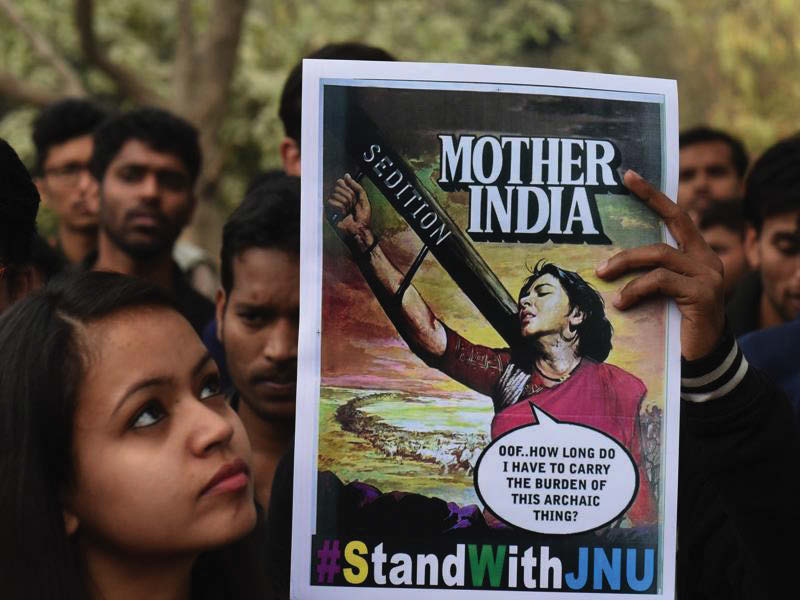
JNU ROW | PROTEST OVER AFZAL GURU HANGING, SEDITION ROW AND WHO SAID WHAT
NEW DELHI (TIP): The protests in Jawaharlal Nehru University (JNU) began on Wednesday, Feb 10, when Left-oriented students’ group planned to organise a cultural program and a protest march to protest against the ‘Judicial Killing of Afzal Guru’ and also to dislplay solidarity with Kashmiri migrants who are struggling at varsity’s Sabarmati Dhaba.
The Akhil Bhartiya Vidyarthi Parishad (ABVP) staged a protest outside the office of the vice chancellor to protest over the event against the hanging of 2001 Parliament attack convict Afzal Guru.
Feb 11
- JNU set up a proctorial committee on to inquire into an event organised by some former members of Democratic Students’ Union (DSU) that led to violent clashes on the campus.
- Maheish Giri, the BJP Lok Sabha member from East Delhi, on Thursday, Feb 11 lodges an FIR against ‘anti-national’ students of Jawaharlal Nehru University who opposed the death penalty to parliament attack convict Afzal Guru.
Feb 12
- Talking tough, Home Minister Rajnath Singh on Friday, Feb 12, warns of
“strongest possible” action against those involved in raising anti-India slogans at an event in JNU campus here, saying such activities will not be tolerated. - Former Delhi University lecturer SAR Geelani is booked for sedition in connection with an event at Press Club of India, in which a group shouted slogans hailing Parliament attack convict Afzal Guru.
- The president of Jawaharlal Nehru University’s students union (JNUSU) is arrested by Delhi police, in a case of sedition and criminal conspiracy.
- Left parties question the arrest of JNUSU president Kanhaiya Kumar and asks Delhi Police to not act in “connivance” with ABVP to target “entire Left” even as they likened the ongoing developments in the varsity campus to “situations during Emergency”.
- Union minister Kiren Rijiju says the government will not allow anyone to spread anti-national sentiment in the country.
- 8 students get debarred from academic activities by JNU pending a disciplinary enquiry into an event at varsity against hanging of Parliament attack convict Afzal Guru.
- Congress Vice President Rahul Gandhi says Modi government “bullying” an institution like JNU was “completely condemnable”, but at the same time asserted that anti-India sentiment is “unquestionably unacceptable”.
Feb 13
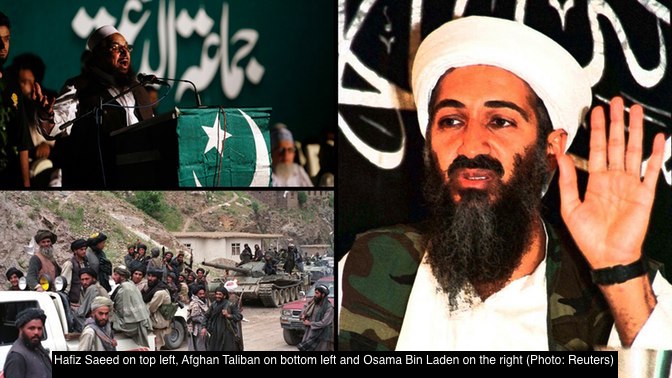
- Delhi police issued an alert across the country in the wake of a tweet allegedly posted by 26/11 mastermind Hafiz Saeed. Tweet said, “We request our Pakistani Brothers to trend
#SupportJNU for our pro-Pakistani JNUites brothers.” - A group of ex-army officials threaten to return their degrees as mark of protest. Communist Party of India-Marxist General Secretary Sitaram Yechury meets Union Home Minister Rajnath Singh regarding the JNU campus incidents and demands the release of a student leader arrested over sedition charges.
- Home Minister Rajnath Singh asserts that no innocent will be harassed but the guilty “will not be spared” as Left leaders met him questioning the police action against students including arrest of JNUSU leader.
- Delhi police have detains seven students in connection with the JNU campus row.
- Union Minister Kiren Rijiju says the premier academic institute cannot be allowed to be a hub of anti-national activities.
- Delhi Chief Minister Arvind Kejriwal orders a magisterial inquiry into the JNU incident and accuses Prime Minister Narendra Modi of using police to “terrorise everyone” even as he asserted that anti-national activities should not be tolerated under any circumstances and those guilty must be identified and punished.
- Congress vice president Rahul Gandhi says the government is trying to crush students’ voice in the country by ordering police action in university campuses.
- Hitting out at Rahul Gandhi and other opposition leaders who criticised the arrest of a JNU student leader, BJP alleges that they were speaking in the voice of terror outfit LeT which was an insult to the martyrs and would boost the morale of anti-national forces.
- Senior Congress leader Anand Sharma alleges that he was attacked physically by ABVP activists in JNU campus when he was returning with Rahul Gandhi after attending a protest meeting held by students there.
Feb 14
- “Please do not call my son a terrorist,” says JNUSU President Kanhaiya’s mother as she breaks down while watching the news flashes on TV at a neighbour’s house in Bihar’s Begusarai district.
- Rajnath Singh appeals to political parties to unite in opposing incidents where anti-national slogans are raised.
- Delhi police says enough evidence for sedition charges.
Feb 15
- JNU students go on strike till Kanhaiya Kumar is released. Shiv Sena says all politicians who support the students’ agitation should be stripped off their ‘elected status’ and those raising slogans against India put behind bars.
- The Delhi Police again filled the role of a “silent spectator” as attackers defied the Supreme Court’s order for restricted entry to the trial court complex, bashed up Kanhiya Kumar en route to his court hearing and hurled the choicest abuse, gravel and a jagged end of a flowerpot piece at a six-member team of senior advocates, including Kapil Sibal, hand-picked by the Supreme Court to verify and report back on the ground situation in the court complex.
Feb 16
- Delhi police have formally arrested ex-Delhi university teacher S A R Geelani in connection with the JNU campus row case. Delhi police launches a hunt for several students who are on the run.
- A First Information Report (FIR) registered over some lawyers thrashing journalists at Patiala House court. JNU teachers join students in boycotting classes in protest against arrest of its student union leader in a sedition case and say they would take classes on
“nationalism” in the varsity lawns. - Congress condemns the attack on teachers and journalists in Patiala House court premises, calling it an “act of facism”. Delhi High Court rejects petition seeking NIA probe into JNU incident.
- Delhi journalists stage a protest march against the violence that took place in Patiala House Courts on Monday, where some of them as well as students were beaten up.
Feb 17
- Lawyers turn lawless again. Mobs of lawyers heckled journalists and kicked and punched Kanhaiya Kumar when he was brought to court to face sedition charges on Wednesday, prompting the Supreme Court to ask officials to ensure the JNU student leader’s safety.
Feb 18
- A snowballing political row over the JNU crisis reached the President’s doorstep on Thursday as Congress vice-president Rahul Gandhi and Delhi chief minister Arvind Kejriwal attacked the Centre and sought Pranab Mukherjee’s intervention to resolve the issue.
Feb 19
- No relief for Kanhaiya Kumar, SC transfers bail plea to Delhi HC.
-

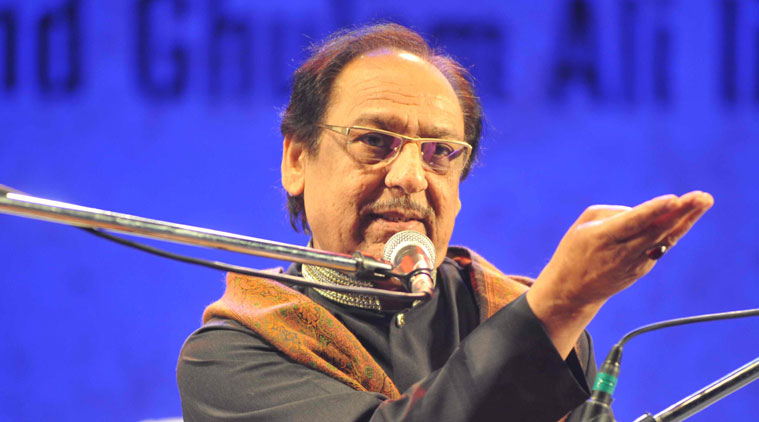
Ghulam Ali Cancels All his Concerts in India
New Delhi Nov 5: Pakistani ghazal singer Ghulam Ali, whose concert in Mumbai was called off after resistance from the Shiv Sena, canceled all his future performances in India, saying he won’t return to India until “things settle down.”
Ali expressed his disappointment over recent incidents, but asserted that Indian fans have always welcomed him and his music with open arms.
“I have cancelled all my future concerts in India, will never come back to India. I will not perform until things settle down. I’m hurt by recent incidents in India.
As of now I have decided not to come to India. Indian fans have been very supportive. I’m a singer, I will talk about music, not politics,” the singer told CNN-IBN news channel.
All his scheduled concerts, including the one in Delhi on Nov. 8, and another in Lucknow, have been scrapped.
According to a report in ibnlive.com, Ghulam Ali, who made an entry into Indian cinema with his popular song “Chupke chupke raat din” for B.R. Chopra’s “Nikaah“, is “hurt by the politics being played over his concerts in India” and “how political points were trying to score brownie points by not letting him perform in India”.
-

Musharraf equates Bal Thackeray with Hafiz Saeed, calls Osama a Hero
In an interview to a Pakistani channel, Pakistan’s former president General Pervez Musharraf made scathing comments about Bal Thackeray and Pakistan’s support to extremist outfits in the past. Haqqani is our hero of 1980s & Osama was our hero. Yes, CIA’s as well. (al-Qaida chief Ayman) al-Zawahiri was our hero,” he added while referring to the Pakistan introduced religious militancy from 1979.
Comparing Hafiz Saeed with RSS and Shiv Sena, former Pakistan president Parvez Musharraf said that those demanding action against Jamaat-ud-Dawah chief in his country were toeing in the Indian line.
He said Afghan and Kashmiri mujahideen were their heroes in the 1990s, but the situation has now changed while referring to Saeed “I do not want to discuss this (Saeed) issue,” Musharraf shot back at his interviewer on a popular Pakistani TV channel on Saturday night. “Since India is going after this, we are also following them.”
Musharraf rantingly asked the interviewer to ascertain what RSS was doing in India. “They do not play cricket with us. You saw what happened with (Pakistan cricket board chief) Shahryar Khan,” he said. “The face of (ex-Pakistan foreign minister Khurshid Mahmud) Kasuri’s book release organiser was blackened. Ghulam Ali’s concert was banned and he was thrown out.”
“This is what is happening there. Are we catching any Sena leader? Was not Bal Thackeray a terrorist… did anybody catch him… a serving Army colonel was involved in the Samjautha blast in which 100 (sic) Pakistanis were killed. You are talking about Saeed, give us that Colonel,” he said.
He cited PM Narendra Modi and his Cabinet’s presentations to the RSS brass to draw a link between Shiv Sena’s protests against Pakistan’s and BJP’s parent organisation.
He cited Pakistan’s support for the US-backed Afghan war and said the atmosphere changed after 1979 when Islamabad introduced religious militancy in its favour to throw the Soviets out. “We brought mujahideen from around the world. We trained the Taliban… and sent them in. They were our heroes. (Afghan warlord Jalaluddin) Haqqani is our hero of 1980s. Osama (bin Laden) was our hero. Yes, CIA’s as well. (al-Qaida chief Ayman) al-Zawahiri was our hero,” he acknowledged.
But he added that the atmosphere has changed now. “The hero has become a villain.”
He said a similar thing was replicated in Kashmir in the 1990s. “A freedom struggle started there in the 1990s. They (Kashmiris) were killed badly. Indian Army killed them, they came to Pakistan. We gave them heroes’ reception.”
Musharraf acknowledged Pakistan trained and supported Kashmiri rebels. “They were mujahideen who would fight the Indian Army for their rights. LeT was formed along with 10-12 such groups,” he said. He called these groups their heroes who were putting their lives at stake. “Now this has converted into terrorism.”
-

Complaint against Shiv Sena for ‘insulting’ President
MUMBAI (TIP): The state unit of Congress has filed a complaint against Shiv Sena for “insulting” President Pranab Mukherjee through an “objectionable” poster, which claimed that he “bowed” before the late saffron party supremo Bal Thackeray. A delegation of Maharashtra Pradesh Congress Committee (MPCC), led by party legislator Bhai Jagtap lodged the complaint at the Shivaji Park Police Station.
“The objectionable write up on the poster was close to the President’s picture. Mukherjee had visited Thackeray during the Presidential election campaign. In keeping with Indian culture and tradition, Mukherjee folded his hands on meeting Thackeray. But, a write up on the poster says the President bowed before him,” the complaint said.
Congress has accused the Sena of using the poster showing the President, who is the constitutional head of the country, for “political mudslinging”.
-

RSS Chief plays down communal attacks
Since Prime Minister Modi and his ministerial colleagues have chosen to report to the RSS and invite its inputs on policy issues, it is important to take note of RSS chief Mohan Bhagwat’s annual Vijayadashmi address, delivered at Nagpur on Thursday and telecast live by Doordarshan despite Opposition protests last year. While his emphasis on “unity in diversity” is welcome, Mohan Bhagwat has, without naming any of the recent incidents – killings of writers and rationalists, beef and ink attacks and the Dadri lynching – said that “small incidents” were being “blown up”.
He chose to give an indirect message to hardliners in the Sangh Parivar and other outfits by saying that his organization believed in “cooperation and coordination” and “such small incidents do not affect Indian and Hindu culture.” While Mohan Bhagwat talks of inclusivity being “the core of our culture”, the Union Culture Minister is known to violate the basic values of Indian culture very time he opens his mouth. Prime Minister Modi, BJP chief Amit Shah and Finance Minister Jaitley too have reacted to these incidents but none has given the recalcitrant ministers, MPs and MLAs a message strong enough to silence them and others. The latest to display characteristic insensitivity is Union minister VK Singh, who, reacting to the burning to death of two Dalit children in Haryana, said: “If someone throws stones at a dog, the government is not responsible”. For the benefit of the BJP in Bihar, Bhagwat did not say anything damaging. He did not touch on the reservation issue. But there seems no one to control the likes of Gen VK Singh and Kiren Rijiju, who too has been encouraged to make irresponsible comments about north Indians.
If so many loose cannons have sprung up creating social tension, it is because there is no fear of the law or disciplinary action. If Bhagwat considers the recent incidents, which have forced writers to return their awards, as “small”, then he is not expected to contain the elements threatening India’s culture of tolerance and liberalism. His silence on the Shiv Sena, which has launched a hate campaign against anything and anyone Pakistani, is understandable, but not desirable.