Tag: United Nations

  • Ekal Foundation’s Unprecedented$6.5 Million Magnificent Gala

    Ekal Foundation’s Unprecedented$6.5 Million Magnificent Gala

    Prakash Waghmare

    NEW YORK (TIP): On Saturday, December 5, “Ekal Vidyalaya Foundation (EVF)” hosted a magnificent Star-studded Gala, called ‘Future of India’. This Gala-2020 raised record-setting $6.5 Million in pledges & donations for the special projects. The highlight of this virtual event wasnot only the participation of a galaxy of outstanding personalities, but also, the way they expressed their vote of confidence in‘Ekal’ movement (as “EVF” is popularly known). The celebrities that lent their wholehearted support were iconic cricketer Kapil Dev, Moviestar Vivek Oberoi, Hon. Minister Piyush Goyal, leading entrepreneur Ajay Piramal, Bollywood singer Sanjeevani Bhelande and numerous entrepreneurs. The Gala was chaired by Mohan Wanchu, Chairman  & CEO of EC Info Systems who, like all previous Galas, had ushered the concept in the first place. The main objective of the eveningwas, not only, to raise funds, but also, to acknowledge gratitude to loyal philanthropists who had consistently supported ‘Ekal’ through the years. Earlier in the year, after successfully controlling ‘Covid-19 pandemic in 102,000 rural & tribal villages of India, ‘Ekal’ had raised funds through 10 regional mid-year virtualconcerts for its conventional activitieseven in the current covid-19 pandemic.

    Despite a snowstorm and tornado that created some technical problemsin transmission, the delayed startfor the evening could not dampenthe spirit of generous philanthropists to support their favoriteprojects at Ekal. There was overwhelming support for ‘Integrated Village Development’ (IVD),E-Shiksha, Tailoring Center, Telemedicine, ‘Arogya Initiative’, Ekal-on-wheels’, ‘Gramotthan Research Ctr’ (GRC), Computer Center etc. Among the high net-worth donors, 15 pledged $250,000 or more while Ajay Keshap confirmed donation of cool $1,000,000.

    Mohan Wanchu, welcoming the virtual audienceopened up the evening withan anecdote about a ‘Rikshaw-puller’ and how a ‘Lok-kathakars’ (a cadre of cultural storyteller) from an Ekal village transformed his life for better. Kamlesh Shah, co-chair of Gala started the pledge-drive by contributing $580,000 and appealing donors to raise the bar of Gala-2020 to unprecedented level. Ranjani Saigal, Executive Director of “EVF” gave a brief outline of all Ekal special projects, which was followed by former ZEE-TV CEO & Chairperson of Ekal-Global, Dr Subhash Chandra giving an overview of what Ekal is all about. The person that stole the show was the movie star, philanthropist Vivek Oberoi who also happens to be the Ekal-brand Ambassador. He emphasized that “the donation to Ekal wasn’t a subsidy for the needy, but a divine investment in India’s future”. He further appealed to the youths of India to join ‘inquisitive, creative and passionate organization like Ekal’ to give purpose to their life. Global business tycoon, Ajay Piramal said,” Ekal’s emphasis on dispensing quality education and primary healthcare in rural area is a game changer. No one understands rural-tribal mindset better than Ekal with its widespread presence in villages nor anyone has a committed pool of huge selfless volunteers”. Sajjan Agarwal, not only donated $250,000 for ‘Arogya Sevika’ (Healthcare Assistant) in the villages, but also,appealed other donors to match his willingness to donate additional $250,000. This challenge, in the very next moment, was met by Manubhai Shah. When it comes to healthcare, it is imperative to know that the donation of $250,000 benefits 7,500 people in 150 villages. A new initiative, called ‘GRANE’ (Gramotthan Atma-Nirbharata for Ekal), that is going to change farmer’s life forever, was introduced by Vivek Sharma. It is aimed at bringing E-commerce activities to the villages so as to avail villagers with new profitable economic opportunities. Hon. Minister Piyush Goyal affirmed his own and his family’s long association with Ekal. He lauded Hon PM Modi’s August 15 speech whereby all villages would be interconnected by digital broadband in next 1,000 days. Itis likely to promote widespread digitization of Education & Telemedicine. It is worth noting that Ajay Poddar of ‘Artech Int’L and Himanshu Shah of ‘Shah Capital’ have established “Gramotthan Research Ctr” that would soon circuitously help up to one Million people, at each place with the state-of-the-art information on multiple levels .The evening was interspersed with brief video-clips of Ekal’s outstanding work, its impact on rural lives and its initiatives to empowerrural folks. Kapil Dev was interviewed live for his unique achievements in Cricket. He asserted that, “in life, winning is not everything”. The most endearing memoryto him was the fact that he got to play his game for his beloved country – and not winning the ‘World Cup’ or the captainship of the team etc. He was impressed by Ekal’s infusion of fun-sports in education. Earlier this year in September, Bajrang Bagra, CEO of ‘Ekal Abhiyan’ (umbrella organization of all ‘Ekal’ satellite-divisions) had proposed to keep 102,000 school tallies ‘as is’ and embark on a transformative ‘roadmap’ that would revolutionize rural life in all its aspects. Among the primary goals proposed were to increase parameters of various special project, in next 5 years –forexample : to increase ‘Ekal On Wheels’ vans from current 25 to 85; ‘Integrated Village Clusters’ (30 villages each) from current 12 to 51; ‘Skill Development Ctrs’ from current 33 to 100; ‘Gramotthan Resource Ctrs’ (GRC) from current 16 to 27; ‘Telemedicine’ from current 120 villages to 6,000 villages and ‘Intensive Health Care’ from current 1,200 villages to 6,000 villages. In addition, the most ambitious project that Ekal wants to push hard is that of ‘E-Shiksha’ or digital education. It wants to spread it from current 1,200 villages to 100,000 villages. With the success of Gala-2020, it is quite apparent that Ekal is on the wayto achieve its ambitious goals. For more information to join this organization or to support it, kindly tap into www.ekal.org.

  • Children’s Hope India Gratitude Awards Conferred

    Children’s Hope India Gratitude Awards Conferred

    NEW YORK (TIP):  Children’s Hope India, a 501c3 nonprofit organization dedicated to lifting children from poverty to prosperity in India and the United States, announced, November 28,  the honorees for its first-ever Gratitude Awards, recognizing individuals who have made bold civic and charitable contributions in a particularly challenging year.

     CHI co-founder, board member and journalist, Lavina Melwani, hosted the virtual event on Thanksgiving Day. “In these uncertain times of the pandemic, we may be isolated from our loved ones and unable to share the joy of a Thanksgiving meal in person but we can still warm ourselves by sharing thanks,” Melwani said.

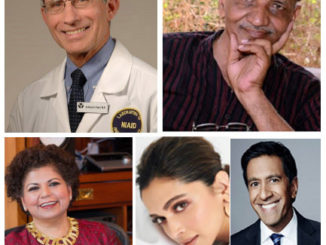
    Children’s Hope India’s inaugural Gratitude Awards honored the heroes around the world who contributed to helping the community weather such uncertain times. Dr. Anthony Fauci, Director of the National Institute of Allergy and Infectious Diseases, was honored for being the voice of comfort, reason and science.

    Dr. Sanjay Gupta, host of the CNN show Sanjay Gupta MD and co-host with Anderson Cooper of global town halls throughout the pandemic, for coming into our homes and giving us wisdom and truth. Follow him on Twitter @drsanjaygupta.

    Deepika Padukone, actress, producer and founder of The Live Love Laugh Foundation, for her bold and courageous championship around mental health issues. Follow her on Twitter @deepikapadukone.

    Chandrika Tandon, Grammy-nominated artist, humanitarian, and business leader, for her calming chants and dedication to helping children succeed. Follow her on Facebook @chandrikatandon.

    Hindu Singh Sodha, Rajasthan-based activist working on refugee rights, conflict resolution and peace movements, and founder of the Universal Just Action Society, for his passionate advocacy and support of the refugee communities in Jodhpur, providing them hope for a new life. Follow him on Twitter  @HinduSinghSodh1.

    Dina Pahlajani, Cofounder and President of Children’s Hope India added that this year’s awards were also dedicated to, “the braveheart children of Children’s Hope India for adapting in such difficult times and staying committed to learning despite the challenges of the pandemic.”

    Children’s Hope India launched the Gratitude Awards to showcase the work of individuals around the world who give what they can–whether a monetary contribution, a helping hand or a kind word. The Gratitude Awards will take place annually to recognize the many that truly make our world better and safer, and empower us all to be stronger individuals. In honor of this year’s awards, Children’s Hope India donated gift certificates, turkeys and Thanksgiving meals to families and individuals in Manhattan, Queens and Long Island.

    About Children’s Hope India

    Children’s Hope India was founded in 1992 when a group of professional women in New York gathered to make a difference in the lives of children. Now, as then, the mission of Children’s Hope India is to lift children from poverty to prosperity through education. This is accomplished with a whole child approach that seeks to ensure that each child is healthy, safe, supported, engaged and challenged with comprehensive programming including informal learning and vocational training, critical medical support, and nutrition.

    Today, Children’s Hope India supports more than 20 projects and 300,000 children across India and the United States to improve children’s health and education prospects. To learn more, please visit www.childrenshopeindia.org.

  • A Misnomer Causes Confusion

    A Misnomer Causes Confusion

    • India’s 10- Year Multiple Entry Visa is wrongly termed as Tourist Visa
    • Prem Bhandari recommends entry visa on departure (E-VoD)
    By Prof I.S.Saluja

    My friend Prem Bhandari who is Chairman, Jaipur Foot USA , was at JFK airport in New York on December 2, 2020 where he is a regular visitor to find for himself how NRI’s are being taken care of. Ever Since the government of India launched the Vande Bharat Mission to help stranded Indians to get back to India, Mr. Bhandari has been a regular visitor to extend a helping hand to travelers and Air India. In fact, he led from the front and exhibited rare courage in what he was doing for community at a time when most of us took refuge within the safe four walls of our homes. Undeterred by the raging pandemic, he was out at the airport day after days, helping people.  On December 2, he was, as usual visiting JFK to see if travelers were receiving proper attention of airline offici

    Prem Bhandari at JFK, New York with travelers he helped during Vande Bharat Mission in May 2020

    als when he came across 6 persons who told him they were not allowed to board an Air India flight to India. One of them was a lady with 2 toddlers. Mr. Bhandari, a man well known in India and USA, particularly in New York, as a committed social activist and do-gooder was upset to find the lady in distress for not being able to board the flight.
    Mr. Bhandari who has often raised issues impacting Indian Americans , among others, tried to get at the bottom of the situation. He spoke with the passengers who were denied travel. He spoke with Air India staff present at the JFK airport.
    Mr. Bhandari said the lady was traveling in an emergency to be with her people in India. She was not going for tourism. It was under compelling circumstances that she was going with the two toddlers, aged to India, in extreme weather and under dangerous COVID-19 conditions. Nobody goes to India these days for tourism, anyway. They all travel only driven by a desire to see a family member who may be sick, or to be with family to mourn the loss of a loved one. So it was with the lady.


    A travelers’ advisory well publicized in print, electronic and social media can prove educative for travelers

    The Air India people at JFK told the lady to visit the Consulate in New York to get an emergency visa for the kids. Now, this lady who has come from outside New York will need to hire a cab and go to the Indian Consulate in Midtown Manhattan. Pay for the cab. She may not get the emergency visa then and there. She may have to wait for a day. She will need a hotel room for which she will have to pay. If she is lucky, and if there are no intervening holidays, she gets the visa on the next day. Now the flight. She has to wait until she can be accommodated in the next available flight, subject of course to availability of seats. And when finally, the seats are available, she has to pay an extra amount for the change in her flight schedule. She does it. She settles the hotel bill for all these days of stay.
    The next scene now. The lady with two toddlers in tow reaches Delhi. Now she is to go to a different destination in India. She has missed the flight originally booked. Her tickets are canceled. She has to rebook a flight and pay for it, besides waiting, may be, for a day or two to get seats. She spends again, another few hundred dollars on buying tickets and for stay in a hotel. What a colossal loss of time and money!, one may say. No, friends, it is much more than that. It is a stressful experience which may make one sick. It is only loss of time, money, inconvenience, stress, it is a frightening threat of being exposed to rampaging COVID-19.
    Whose fault is it? Government officials will say the travel advisory is posted on website of each embassy and consulate, and travelers should look into guidelines before undertaking travel. Well, nobody can dispute this claim. All embassy and consulate websites carry the advisory.
    The Indian Panorama asked Mr. Bhandari for his comment, because he was much upset to see the plight of the stranded travelers.
    Mr. Bhandari concluded that the villain of the piece was a wrong term used for 10-Year Multiple Entry Visa. It is a misnomer to call this visa a Tourist Visa.
    One can understand the constraint of the airline, which did not permit boarding to any tourist, because tourist visa has been cancelled in the wake of COVID-19.
    In October this year, the Indian government had decided to restore with immediate effect the validity of all existing visas, except electronic, tourist and medical category visas, almost eight months after their suspension following the coronavirus outbreak and subsequent imposition of a nationwide lockdown.

    Mr. Bhandari explained to The Indian Panorama that almost 80% Indians do not apply for OCI card for children. They feel quite comfortable with the 10-Year Multiple Entry Visa which is wrongly termed as Tourist Visa. The denial to board the flight arose out of the fact that the two kids had “Tourist Visa”. And because, government of India had canceled the Tourist Visa , as stated above, the kids could not be allowed to board the flight.
    Mr. Bhandari had enough reason to sympathize with those denied boarding a flight to India, and at the same time think deep how the situation could be rectified. The first thing he did immediately was to call concerned officials in India government in Delhi. He called the Foreign Secretary Mr. Harsha Vardhan Shringla, Mr. Ajay Bhalla, the Home Secretary, and Civil Aviation Secretary Pradeep Singh Khasola, and apprised them of the suffering of the passengers he had met at the airport. Each one of them appeared to sympathize with the harassed passengers, and assured Mr. Bhandari that a way will be found to remedy the situation. Mr. Bhandari told The Indian Panorama that he was very happy to see the positive attitude of the officials, and that he is grateful to them.
    Mr. Bhandari followed up with an identical letter to each one of them, drawing their attention to the problem, and suggesting immediate solutions.
    In his letter, Mr. Bhandari pointed out that the core of“ the issue is lack of information and deficiency in educating travelers on visa eligibility (visa issued prior to March 12, 2020 are ineligible)”.
    His suggestions to all three Secretaries mentioned above are given below:-
    1. All airlines flying into India under the air-bubble arrangement should proactively verify travelers with foreign passports have eligible visas at time of ticket booking
    2. Key websites in this air-bubble program, namely Air Suvidha, Air India, United Airlines, MoCA, MHA, BOI.gov, MEA, all Consulates, Indianvisa.gov etc. must advertise eligible and ineligible visas
    3. MoCA & AI have been very active in advertising flight schedules in social media. Similarly, it is imperative that the visa eligibility is broadly advertised on the same social platforms.
    As a more considered solution to ease a broad swath of travelers all over the world facing similar situation, I propose the following , Mr. Bhandari wrote:-
    1. Any Indian origin person with either of parents with Indian passport/PIO/OCI card be allowed to travel with their US born minor sons/daughter under the age of 14 with any unexpired visa obtained anytime without applying emergency visa at consulate. As per US federal law, children under 14 cannot be left alone without their legal custodians, which in almost all cases are their parents.
    2. Likewise, all unexpired visas issued in the past should be restored to avoid unnecessary burden as well as expenses of obtaining the emergency visa. It is a fallacy to assume anyone will like to travel to India for tourism during Corona pandemic. This step will alleviate workload on embassy staff, smoothen out travel process for global diaspora and will generate goodwill for the country.
    3. In case it is difficult to carry out above suggested measures, it may be explored to either grant Emergency Visa on Departure (E-VoD) on the line of Visa on arrival OR restore immediate e-Visa process for immediate approval online – travelers can be able to do so digitally from the airport. This small gesture will win heart of the NRI community not only from US but from all over the World.

  • Gurdwara Baba Makhan Shah Lobana Sangat  rallies to support agitating farmers in India

    Gurdwara Baba Makhan Shah Lobana Sangat rallies to support agitating farmers in India

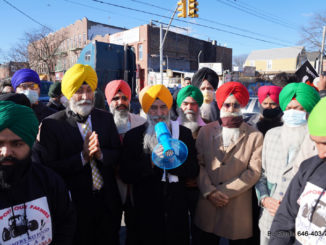
    Picture of rally organized by Gurdwara Baba Makhan Shah Lobana

    RICHMOND HILL, NY (TIP): Hundreds of Sikhs participated in a rally organized by the management of Gurdwara Baba Makhan Shah Lobana, one of the two largest Sikh shrines in New York, December 6. The Sikh community which hails from Punjab in India is deeply upset with the recent farm laws promulgated by government of India which, farmers allege,  go against their interests.

    In India, Punjab farmers have been demanding repeal of these laws since their promulgation in June 2020. When the government of India did not consider their demand, they decided to go to the national capital Delhi to demand justice. They have been on sit in for a fortnight now, joined by farmers from all over India.

    They have made their intentions clear to government of India that they will not be satisfied with anything less than the repeal of the anti-farming and anti-farmer farm laws.

    Punjabis the world over have expressed their solidarity with the agitating farmers I India. In New York and New Jersey, a number of rallies have been held, and more are planned.

  • Pakistan reports 2,500 new cases of coronavirus: Health Ministry

    Pakistan reports 2,500 new cases of coronavirus: Health Ministry

    Islamabad (TIP): Pakistan has reported over 2,500 new cases of coronavirus, taking the total number of infections in the country to 365,927, the health ministry said on Thursday. The Ministry of National Health Services said a total of 2,547 new infections were reported and a total of 18 people had died due to the coronavirus in the last 24 hours. “The new coronavirus toll stands at 7,248 while infections at 3,65,927,” the health ministry said in a statement.Some 886 people recovered in the last one day and with it the number of total recuperated people reached 326,674. Another 1,535 were in critical conditions.

    Sindh recorded a total of 158,559 cases, Punjab 112,284, Khyber-Pakhtunkhwa 43,052, Islamabad 25,278, Balochistan 16,582, Pakistan-occupied Kashmir 5,690 and Gilgit-Baltistan 4,482 cases. The authorities performed 36,899 tests in the last 24 hours and the positivity rate remained 6.9 percent. PTI

  • Ethiopia claims victory in west Tigray, suffering worsens

    Addis Ababa (TIP): Ethiopia’s military has defeated local forces in the west of Tigray state, Prime Minister Abiy Ahmed said on Thursday, accusing his foes of atrocities during a week of fighting that threatens to destabilise the Horn of Africa. Airstrikes and ground combat have killed hundreds, sent refugees flooding into Sudan, stirred Ethiopia’s ethnic divisions and raised questions over the credentials of Abiy, Africa’s youngest leader who won a Nobel Peace Prize in 2019. “The western region of Tigray has been liberated,” tweeted Abiy (44), who comes from the largest ethnic group the Oromo and once fought with the Tigrayans against neighbouring Eritrea.
    “The army is now providing humanitarian assistance and services. It is also feeding the people,” he added.
    With communications down and media barred, independent verification of the status of the conflict was impossible.
    The Tigray People’s Liberation Front (TPLF), which rules the mountainous northern state of more than five million people, announced a local state of emergency against what it termed an “invasion by outsiders”.
    Abiy accuses the TPLF of starting the conflict by attacking a federal military base and defying his authority, while the Tigrayans say his two-year rule has persecuted them.
    The premier said some of his soldiers had been found dead in the town of Sheraro, shot with their legs and arms tied behind their back. “This kind of cruelty is heartbreaking,” he said.
    He did not say how many bodies were found or provide proof.
    Reuters could not verify his allegation and there was no immediate response from the TPLF, which has accused federal troops of being “merciless” in bombing Tigrayans.
    More than 10,000 Ethiopian refugees have crossed into Sudan since fighting started and aid agencies say the situation in Tigray is becoming dire. Even before the conflict, 600,000 people there were reliant on food aid.
    The United Nations’ Office for the Coordination of Humanitarian Affairs said aid agencies were unable to restock food, health and other emergency supplies due to lack of access.
    “Shortages of basic commodities are reportedly appearing, impacting the most vulnerable first and the most,” it said.
    ARRESTS AND PROTESTS
    The United Nations’ refugee agency’s representative in Ethiopia, Ann Encontre, told Reuters negotiations were under way with both sides for humanitarian corridors to be opened.
    A “major emergency” may be brewing with so many people escaping to Sudan, she warned. About two dozen vehicles of non-essential U.N. and other workers were pulling out of Tigray and returning to the capital Addis Ababa in convoy. Abiy has so far resisted calls by the United Nations, the African Union and others for a ceasefire and talks.
    His army chief of staff Birhanu Jula was quoted by state-affiliated Fana broadcaster as saying that the federal troops’ Northern Command had survived a five-day siege and was recapturing places including Dansha, Humera airport and Baeker. “I would like to thank these members of the army for being a model of our heroic defence force and their persistent battle, though deprived of food and water for four or five days,” he said, accusing the TPLF of using people as a human shield.
    There was no immediate response to that accusation.
    The army said the transitional rule would be set up in parts controlled by federal troops and urged local forces to surrender or fight the Tigrayan leadership.
    “We are determined that this (TPLF) force has to either surrender or be destroyed,” said Belay Seyoum, head of the powerful Northern Command unit, which some Tigrayans are thought to have defected from so as not to fight their own people.
    In a wider push against the TPLF, Ethiopia’s parliament stripped 39 members, including Tigray regional president Debretsion Gebremichael, of immunity from prosecution.
    And the government’s newly formed State of Emergency task force for Tigray said about 150 “criminal” operatives for the TPLF had been arrested in the capital Addis Ababa and elsewhere on suspicion of planning “terror attacks”.
    There are fears of reprisals against Tigrayans living around Ethiopia. Thousands marched in anti-TPLF protests in the Oromia, Somali and Afar regions, Fana reported, in what appeared to be a government-backed attempt to win the propaganda war over Tigray. Reuters

  • Immortal legacy of Nehru

    Immortal legacy of Nehru

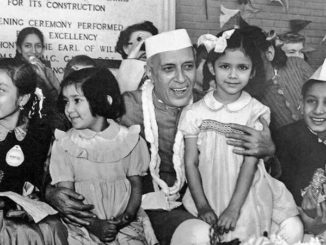
    Pandit Jawaharlal Nehru was born November 14, 1889 in  Allahabad, India, and died May 27, 1964 in  New Delhi. The first Prime Minister of Independent India from 1947 to 1964,  Nehru is credited with establishing  parliamentary government and making India   powerful voice among  the nonaligned  nations of the world.  He was also one of the principal leaders of India’s independence movement in the 1930s and ’40s.

    By George Abraham

    Here is an article by George Abraham on the occasion of the 131st birth anniversary of one of the best-known leaders of the modern world.- EDITOR

     “Regardless of how hard some might oppose, Nehru’s vision and the democratic path he has shown the nation will continue to remain relevant, without which a modern and democratic India might cease to exist! To revise a famous quote to fit this narrative, ‘if India is to progress, Nehru is inescapable…we may ignore him at our own risk’!”   

    An article was published in Modern Review in Calcutta, a leading journal of the progressive politics under the title ‘Rashtrapati’ written ostensibly by one ‘Chanakya’ in November 1937. It turned out to be pseudonymous with the man who a decade later would be India’s first Prime Minister. The article describes Nehru as ‘some triumphant Caesar passing by’ who might turn dictator with ‘a little twist.’ Chanakya criticizes Nehru as unsafe for democracy, an aristocrat, and has all the makings of a dictator’.

    Nehru’s own article went on to say, “For two consecutive years Jawaharlal has been President of the Congress, and in some ways, he has made himself so indispensable that there are many who suggest that he should be elected for a third term. But a greater disservice to India and even to Jawaharlal can hardly be done. By electing him a third time, we shall exalt one man at the cost of the Congress and make the people think in terms of Caesarism. We shall encourage in Jawaharlal the wrong tendencies and increase his conceit and pride. He will become convinced that only he can bear this burden or tackle India’s problems. Let us remember that, in spite of his apparent indifference to office, he has managed to hold important offices in the Congress for the last seventeen years. He must imagine that he is indispensable, and no man must be allowed to think so. India cannot afford to have him as President of the Congress for a third year in succession”.

    It is quite extra-ordinary that Nehru would write a strong criticism of himself scrutinizing his own assets and liabilities from the vantage point of the nation’s best interests. He has written the article after his election as the President of the Indian National Congress for the third time. Obviously, he was worried that his dominance in Indian politics would be perceived as the dictatorship of Roman Emperor Julius Caesar, who ran his Empire with a cult of personality. By writing this piece, Nehru was highlighting the importance of checks and balances in the accountability of those who hold power.

    Jawaharlal Nehru, the prime minister of India from 1947-1964, was a man on a mission. He was born into a feudalistic and caste-driven system that he wanted to transform, promoting education for all as a way out of the status quo. He felt strong as well that an educated nation is critical to an independent India.  In his book, An Autobiography, he tells the world that he wanted to accomplish more, that he did not bring India far enough, but again, he may be expressing disappointment instead of not necessarily indulging in self-pity.

    As we are celebrating the 131st birth anniversary of Jawaharlal Nehru on November 14, 2020, we are still in awe as we recollect his contribution, not only towards gaining India’s independence but also for laying a strong foundation of a pluralistic and forward-looking India. Nehru brought together exceptional people of differing ideologies such as B. R. Ambedkar, S.P. Mookerjee, John Mathai, C.H. Bhabha, and Shanmukham Chetty to be reflective of India’s secular and multi-faceted character in the Constituent Assembly. The Congress Party, under the leadership of Nehru, delivered on the promise that the constitution they were about to create would reflect the aspirations of the people. The constitution of India is  amongst the largest in the world, with 395 Articles and 9 Schedules. The preamble spells out the basic philosophy and the solemn resolve of India’s people to secure justice, liberty, equality, and fraternity for all its citizens. What Nehru accomplished through this document with significant help from Ambedkar also is part of his vision to empower marginalized sections of the society. Nehru was a strong proponent of self-reliance, clearly recognizing that underdevelopment was the result of a lack of technological progress. Consequently, a new Industrial policy was enacted to develop key industries. While independent India was in its infancy, he identified the production of power and steel for self-sufficiency and planning. In collaboration with other countries, India built steel plants in Rourkela, Bhilai, and Durgapur. Dam projects were undertaken in various places to produce hydro-electric power, including the flagship Dam at Bhakra Nangal. The first Oil Refinery was inaugurated in Noonmati in 1962 as another leap towards industrialization. Nehru called them ‘the temples of Modern India.’

    Nehru was determined to foster a ‘scientific temper’ as he provided leadership in establishing many new Engineering Institutes, the most important being the Indian Institute of Technology, 5 of which were started between 1957 and 1964. His farsightedness is also evident in granting deemed university status to the Indian Institute of Science in Bengaluru, setting up the Council of Scientific and Industrial Research, and the Defense Research and Development Organization, and laying the foundation stone for the Tata Institute of Fundamental Research. Nehru’s own words state that these would become visible symbols of building up the new India and providing life and sustenance to our people’. Nehru recognized the importance of education as a tool for empowerment and established University Education Commission under the Chairmanship of Dr. S. Radhakrishnan and the Secondary Education Commission under the Chairmanship of Dr. A.L. Mudaliar. The Indian Council of Cultural Relations was also established under Maulana Azad to promote India’s external cultural relations policies.

    Soon after independence, India embarked upon a Nuclear Program aimed at developing its nuclear capacity for peaceful purposes. As we know by now, Dr. Homi Bhabha’s pioneering work in this regard is widely acclaimed in enhancing India’s capabilities in that area. Dr. Vikram Sarabhai, the Indian Space program’s father, helped establish the Indian Space research Organization (ISRO).

    Unfortunately, there are forces hard at work today, undoing the great legacy of Nehru. Among the reflective NRIs, especially those who were beneficiaries of the valuable education at IITs and IIMs, nevertheless spending their time on the ‘Net denouncing Nehru and downplaying the accomplishment of the successive Congress Governments, an introspection is very much in order. Regardless of how hard some might oppose, Nehru’s vision and the democratic path he has shown the nation will continue to remain relevant, without which a modern and democratic India might cease to exist! To revise a famous quote to fit this narrative, ‘if India is to progress, Nehru is inescapable…we may ignore him at our own risk’!

    (The author  is a former Chief Technology Officer at the United Nations and the Vice-Chairman of the Indian Overseas Congress, USA)


  • Time for a Healing Touch and Unity

    Time for a Healing Touch and Unity

    By Prof. Indrajit S Saluja

    I am assuming Mr. Biden has won the presidency. Mr. Biden may have to wait a little to be certified a winner; may have to wait a little longer in view of the lawsuits the Trump campaign has filed. But, unless there is a divine intervention on his behalf, Mr. Trump stands a loser.

    America has demonstrated to the world that the election system of the greatest democracy in the world is strong and fair. It was indeed a mammoth task to be handling voting and counting of votes which have outnumbered any in the past – a whopping 160 million-, up from 138 million in 2016. My friend Ven Parameswaran who has lived in this country for more than 60 years now, and has been closely studying elections, tells me it is a record percentage since 1900. On top of the numbers handled, the elections have been conducted in all fairness. It speaks of the integrity and efficiency of the huge number of officials involved in the management of elections. They deserve gratitude of the whole nation.

    However, there have ben some murmurs that all is not right with the election. Well, if at all there is something wrong, it is not with the system or the people working in that system. It is a section of people who, instead  of lauding a dynamic system, berate it just because the fairness of system has denied them their cherished dream of winning the election by hook or by crook.

    The cries of “stop counting” remind me of the cries of “stop testing” when  the rising numbers of coronavirus became a subject of concern for health officials and Americans. Mr. Trump was anguished that tests resulted in throwing up more positive cases of the disease. Similarly, when Trump found the number of votes going up in favor of Biden, he demanded a halt to counting. Between the first shout from him to now, we have seen how the number of votes for Biden have gone up in major battleground States, particularly, Georgia and Pennsylvania, leaving a bewildered Trump wondering where his lead has evaporated. It  is all the because  of mail-in votes which were counted after November 3 in person voting. And, all know, it is the Democrats who preferred to send in their votes by mail. So., there should be no surprise that Joe Biden came from behind and overtook Trump in many States. While Trump vented his frustration with the system,  and threatened to litigate, his rival on the ascendancy, Joe Biden advised calm  and patience to Americans, asking them to let the democratic process play out. But we cannot expect such restraint and patience from Mr. Trump , who until the other day, demanded from his base that they chant, not just four years more, but “twelve years more”. The egotistical sublime in him is hurt and hurt beyond words. Not to give in easily, and he has suggested it so often, Mr. Trump  must play out all cards available to him even at the cost of the great American nation, the great American people, the great American institutions, including the great American Justices of the Supreme Court who , erroneously he thinks, will do his bidding because they are there because of him. He forgets that God Himself resides within a Judge and guides his / her conscience. Unfortunately for America, there are always a few around Mr. Trump (many have since distanced themselves from him seeing his imminent defeat, and have been criticized also), who, like Iago in Shakespeare’s “OTHELLO” driven by “motiveless malignity” must goad Trump into more crimes, , to heap on himself greater insult and ignominy. The world knows them. Only Mr. Trump does not. Alas!

    And these people, I am sure, readers know them, are telling Mr. Trump to fight back the “perceived injustice” of the election system, the imagined wrong that the election  is being stolen from him, without any evidence, whatsoever. They are not Trump’s friends. They have their own agenda which they want to play out. I wish Mr. Trump could understand their designs,  show maturity, accept  there are always opportunities, and bide his time.

    And now, I am assuming Mr. Biden has won the presidency. Mr. Biden may have to wait a little to be certified a winner; may have to wait a little longer in view of the lawsuits the Trump campaign  has filed. But, unless there is a divine intervention on his behalf, Mr. Trump stands a loser.

    Let Mr. Trump accept that Americans preferred Mr. Joe Biden to him. They probably were not satisfied with what he gave them. By the way, in the long history of American democracy, Mr. Trump probably is the 4th sitting president, not to be elected for a second term, according to my friend Ven Parameswaran. Ford who was VP with Nixon , took up presidency after Nixon resigned. Technically, Ford was not an elected President. However, let us count him in. He ran for president but was defeated. Jimmy Carter was not re-elected for a second term. And, then Bush was not elected for a second term, again, according to the information provided by my friend Ven Parameswaran. Mr. Trump has certainly become a part of history.

    Mr. Trump should have shown the grace befitting the President of America, as did the Democratic Presidential candidate Al Gore in 2000. Though Al Gore was a clear winner, the Supreme Court accepted the claim of George W. Bush who became the 43rd President of the U.S. Al Gore congratulated Bush, and “offered to meet with him as soon as possible to heal the divisions of the campaign and the contest through which we have passed”.

    Almost a century and a half ago, Senator Stephen Douglas told Abraham Lincoln, who had just defeated him for the presidency, “Partisan feeling must yield to patriotism. I’m with you, Mr. President, and God bless you”.

    I am glad Joe Biden asked people to be “calm”  and “patient”  and let the “Democratic process play out”. That’s being a leader.

    President Biden faces a daunting task. He is inheritor of a divided nation. The first task for him will be to unite the people of America. It will not be easy. It is heartening to find Joe Biden pledging to be the President of all Americans. But mere words will not heal and unite. The world will keenly watch how Biden restores the exceptional  American spirit of unity and brotherhood which makes America great. The second important task for Biden is to free Americans  of the deadly  pandemic  which has been raging for months now and has claimed  2.36K American lives. As at the time of writing this comment, America has recorded 9.76 million cases, with 100,000 new cases being reported on a daily basis. The new administration must ensure the virus is contained, and Americans get back to their normal life. Still another and immediate task before President Biden is to provide economic relief to millions of people across all walks of life who have been battered by the long spell of the pandemic, rendering them unemployed, and without adequate means to sustain themselves. They need to be rehabilitated. Their dignity needs to be restored, so they take , once again, pride in being Americans.

    Yet another immediate issue of concern to President Biden should be providing jobs to millions who have during the months of pandemic lost jobs and have not had enough to support their families., with many benefits having been withdrawn by the Trump administration.

    Related to job creation is the question of wages. Even though t is the States which decide on minimum wages to workers in their State, Federal government should take initiative to persuade States to agree on a fair minimum wage, which then should be applicable across the nation. The guarantee of a uniform minimum wage across the nation  will allow people to freely migrate to the State of their choice, fulfilling a basic strength of American democracy. Business and industry are other areas which need immediate attention of the new administration. America must bring back manufacturing  to its shores, which alone can create jobs, and give to the nation self-reliance which are the crying needs of the present times.

    Nobody can deny that environment is an important part of our existence. Mr. Biden has rightly announced that America under him will immediately rejoin the Paris Climate Agreement, from which Trump had pulled out because he thinks climate change is  “a hoax”, and may be, because it has  President Obama’s stamp on it.

    November 11 is Veterans Day. It makes me unhappy to think that we do not show the veneration the veterans deserve. They need not only veneration , but also better care. Hope, President Biden will come up with some idea to give the heroes  their due. Related to Veterans are our brave soldiers. It is time to review US engagement in futile conflicts abroad.  We must bring back our soldiers who have for long been involved in conflicts which are not ours in any way and serve no legitimate American interests. Let America initiate a new era of world peace and brotherhood of entire human world. In respect of friends and foes across the world which, in other words, means foreign policy, while there is need to further strengthen ties with friendly countries, including India, there is also an urgent need to have a fresh look at US alliances.  The ruptured relationship with NATO countries must immediately be repaired.

    In this context, the Trump administration’s failures in maintaining decent relationship with the United Nations and countries of the world should not be forgotten. All nations are equal partners in managing the world. They need to be treated with respect. It is the first requirement of civility. And America is a civilized nation.

    It is my fervent hope that President Biden will keep his promise  to be “the president of all America, and all Americans”, and as Senator Stephen Douglas , a century and a half ago said, “Partisan feeling must yield to patriotism”. Hope, the US Senate and the US House of Representatives will lend their bipartisan support to President Biden to restore the glory of America  as the First and the Greatest Nation in the World.

    God bless America!

    (The author is Chief Editor of The Indian Panorama. He can be reached at salujaindra@gmail.com)


  • Trump Jr criticizes Nikki Haley for ‘sitting on the sidelines’ on prez’s vote counting fraud claims

    Trump Jr criticizes Nikki Haley for ‘sitting on the sidelines’ on prez’s vote counting fraud claims

    NEW YORK (TIP): In an apparent attack on popular Indian-American Republican politician Nikki Haley, Donald Trump Jr has accused that “2024 GOP hopefuls” are “sitting on the sidelines” and not speaking out against the “fraud” in counting of votes as claimed by his father and US President Donald Trump. Trump, 74, is trailing behind his Democratic rival Joe Biden, who is nearing the magical figure of 270 electoral votes to win the race to the White House. The former US vice president has so far bagged 253 votes as compared to 213 won by Trump, according to latest US media projections. To win the election, a candidate has to win at least 270 electoral college votes out of the 538 up for grabs.

    The incumbent president has claimed without presenting any evidence that there has been “fraud” in counting of votes and he will legally challenge the election result.

    “All of a sudden everything just stopped. This is a fraud on the American public. This is an embarrassment to our country. We were getting ready to win this election. Frankly, we did win this election…Our goal now is to ensure integrity, for the good of this nation…This is a major fraud on our nation. We want law to be used in a proper manner. So we’ll be going to the US Supreme Court,” Trump told his supporters on Wednesday.

    Responding to a tweet on Thursday, Trump Jr said, “This is an important point! Everyone should be watching who is actually fighting this flagrant nonsense and who is sitting on the sidelines. Republicans have been weak for decades which has allowed for the left to do these things. Let’s end that trend once and for all.”  He was responding to a Twitter user who wrote, “Where are the so-called future of the GOP? Nikki Haley is doing what?”

    In a series of tweets later, Trump Jr said, “The total lack of action from virtually all of the ‘2024 GOP hopefuls’ is pretty amazing. They have a perfect platform to show that they’re willing & able to fight but they will cower to the media mob instead. Don’t worry @realDonaldTrump will fight & they can watch as usual!” The 48-year-old former US Ambassador to the United Nations, Haley is seen as a potential Republican candidate for president in 2024.

    She also has the distinction of being the first ever Indian-American Cabinet ranking official in any administration. Haley, who had campaigned for Trump during the just concluded presidential election, later tweeted, “We all owe @realDonaldTrump for his leadership of conservative victories for Senate, House, & state legislatures.”    “He (President Trump) and the American people deserve transparency & fairness as the votes are counted. The law must be followed. We have to keep the faith that the truth will prevail,” she added.

    (Source: PTI)

  • Biden vows to rejoin Paris Climate Agreement

    Biden vows to rejoin Paris Climate Agreement

    NEW YORK (TIP): On November 4, the US formally withdrew from the 2015 Paris Agreement on Climate Change. Democratic presidential candidate Joe Biden has pledged that his administration would rejoin the historic Paris Agreement on climate change.

    Mr. Biden, 77, has not won the presidential elections yet, but is inching closer to be declared the winner by garnering 253 electoral votes out of the required 270. His Republican rival and incumbent US President Donald Trump has got 213 electoral votes, according to latest projections released by the US media. On November 4, the US formally withdrew from the 2015 Paris Agreement on Climate Change, a decision originally announced three years ago.

    “Today, the Trump Administration officially left the Paris Climate Agreement. And in exactly 77 days, a Biden Administration will rejoin it,” Mr. Biden tweeted on Wednesday night, reflecting his decision to reverse one of the key policies of the Trump administration on day one.

    The US, under the Obama administration, had acceded to the Paris Agreement in 2016. It was a signature achievement of the Obama administration.

    The Paris accord committed the US and 187 other countries to keeping rising global temperatures below 2C above pre-industrial levels and attempting to limit them even more, to a 1.5C rise.

    Mr. Trump argues that the agreement is disadvantageous for the US, while it gives benefits to countries like China, Russia and India. According to him, it could be economically detrimental and cost 2.5 million Americans their jobs by 2025. The decision by the US – one of the world’s biggest emitters of greenhouse gases – to quit the agreement has led to condemnation from environmentalists and expressions of regret from world leaders.

    Mr. Biden has proposed a USD 5 trillion plan to combat climate change.

    The US is the second leading producer of all carbon dioxide emissions globally, behind China.

    President Trump originally announced his intention to withdraw from the agreement in 2017 and formally notified the United Nations last year. The US exited the pact after a mandatory year-long waiting period that ended on Wednesday.

    The US is the only country to withdraw from the global pact. It can still attend negotiations and give opinions, but is relegated to observer status. Mr. Trump had stated that he intended to renegotiate the details of the US’ membership within the Paris Agreement that can better protect US workers in industries like coal, paper, and steel.

    (Agencies)

  • UN chief urges G20 to unite on coronavirus fight

    UN chief urges G20 to unite on coronavirus fight

    UNITED NATIONS, NY (TIP): The UN chief says it’s very frustrating that leaders of the 20 major industrialized nations didn’t come together in March and establish a coordinated response to grapple with the coronavirus in all countries as he proposed.

    The result, he says, is every country is taking its own,  sometimes contradictory actions, and the virus is moving from east to west, north to south, with second waves of infections now affecting many countries.

    Ahead of the Group of 20 summit next month, Secretary-General Antonio Guterres said in an interview with The Associated Press that he hopes the international community now understands they need to be much more coordinated in fighting the virus.

    Mr. Guterres said the United Nations also will be strongly advocating during the G-20 summit for a guarantee that when a vaccine is available, it becomes indeed available and affordable for everyone, everywhere.

    (Source: AP)

  • Wedding Bells Ring in Harry and Manjeet Panaser’s  Family

    Wedding Bells Ring in Harry and Manjeet Panaser’s Family

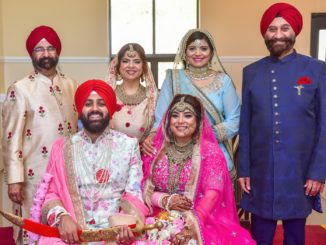
    MONROE, NJ (TIP): Mr. Harry Singh Panaser and Dr. Manjeet Kaur’s lovely daughter Ajooni Kaur got married to Harvind Singh Jassal son of Mr. Gurdeep Singh and Mrs. Hardeep Kaur of Canada, on October 17, 2020.
    The marriage ceremony was performed according to Sikh tradition, at Gurdwara Bridgewater, under COVID norms of social distancing and face covering. The wedding party of 14 came from Canada and were joined by their relations and friends in New Jersey. Mr. Tript P. Singh, Ajooni’s maternal uncle was at hand to organize the events, leading up to wedding, which included Bridal Shower, Sagan, Mehndi, and Haldi.
    The wedding guests were treated to lavish lunch post wedding ceremony, at Harry Panaser’s sprawling house in Monroe, NJ. Those present at the events included Consul General of India Mr. Randhir Bansal, Deputy Consul General Mr. Shatrughna Sinha, Senator Bob Menandez, Senator Cory Booker, NJ Senator Linda Greeenstien and Assemblyman Dan Benson, besides relations and friends.
    The Indian Panorama congratulates Panasers and Jassals, and wishes the newlyweds a long and happy married life.
    Incidentally, Mr. Harry S. Panaser is The Indian Panorama’s special correspondent at the United Nations.

  • “The UN: if it doesn’t exist, we would have to invent it”

    “The UN: if it doesn’t exist, we would have to invent it”

    By George Abraham

    Here is a special article on the occasion of the diamond jubilee of the United Nations. The United Nations officially came into existence on 24th October 1945 when the Charter was ratified by China, France, the Soviet Union, the United Kingdom, the United States of America , and a majority of other signatories.

    George Abraham who has had a long association with the United Nations underscores the relevance of the world body  in the past, in the present, and in the future. -EDITOR

    Today, thousands of Indian citizens are employed by the United Nations around the world. The Asian Headquarters for the World Health Organization is located in New Delhi. UNICEF is highly active in India, helping Children in responding to emergencies and providing them essentials to survive. India’s own contribution to the regular budget assessment is less than half of what the Netherlands pays. Therefore, all the casual talk about getting out of the UN from certain circles are not only ludicrous but a disservice to the people of India.

    Peace, dignity and equality on a healthy planet.
    The San Francisco Conference: Egypt signs the UN Charter. A facsimile copy of the Charter is superimposed on the photo. The Charter of the United Nations was signed on 26 June 1945, in San Francisco, at the conclusion of the United Nations Conference on International Organization, and came into force on 24 October 1945. Preamble to the UN Charter was read out by Sir Lawrence Olivier. Photo / Courtesy UN

    “The International Community must ask if the UN is still relevant 75 years after its founding”, said Prime Minister Narendra Modi addressing the General Assembly in a virtual conference in its 75th session. He demanded that a UN reform is the need of the hour and questioned whether the Organization has been effective in tackling Covid-19. Some commentators even went further to say that India should get out of the UN, and it no longer serves any purpose. Sir Brian Urquhart, a former Under-Secretary-General of the United Nations with special responsibility for peacekeeping operations, once quoted as saying, “to be called irrelevant is, I suppose, the most biting insult you can possibly give to anything, a person or an institution, and it’s been used quite a bit about the UN. But it is still here. And for better or worse, I think that its demise is somewhat unlikely, certainly in the near future”.

    It again shows the United Nations’ predicament, where it is a challenging job to get everybody to agree on any single issue. If we look back at history, the United Nations was founded in 1945 to save the succeeding generations from the scourge of another war just as the world was emerging out of World war II. It is also important to remember that the UN Charter and the UN’s whole concept was the brainchild of Franklin D. Roosevelt. The assumption then was that the Allies who were on the way to victory then would continue to observe the peace and, if necessary, enforce it.

    The World war has led to the cold war between the United States and the Soviet Union, resulting in proxies fighting all over the globe. However, the United Nations may still take consolation because it has succeeded in thwarting a large-scale war between nuclear-armed superpowers. Moreover, in the Cold war era, peacekeeping became a strategic tool in the UN’s hands in containing regional conflicts in places like the Middle East, Kashmir, Cyprus, Congo, Sudan, and so forth.

    The critics are often eager to paint a negative view of the UN primarily because of its failures on the political front. However, if one closely examines the structure of the Security Council, the most important organ of the United Nations, it still reflects the status quo in the immediate aftermath of World War II.  It is almost as if it was built to fail. All permanent members of the Security Council have one time, or another misused their right to veto in preventing a potential solution to a crisis and often leaving the UN remain largely paralyzed with expanding rifts and mounting tensions. Although the challenge is to shake up the Council’s structure, most governments continue to pay lip service to the need for reform, and the public seems to direct their fire and fury at the Organization.

    There is great merit to the argument that Security Council is woefully ill-prepared to deal with the contemporary challenges, and the chamber should accommodate countries like India, Germany, Japan, and Brazil with or without veto powers. However, it is a tall order that would require two-thirds of the votes in the General Assembly and the endorsement of all five permanent members. The growing ideological division among council members in dealing with sanction regimes or protracted regional conflicts may not give any ray of hope that the status-quo may change anytime soon. Nevertheless, it provides an excellent forum for the global community to air their grievances and let off steam.

    Apart from the political front, the United Nations and its Specialized Agencies have done a phenomenal job, especially in the Social and Economic arena. Having worked for the Organization on two different continents, I have had the opportunity to view the UN activities from a front-row seat. UN personnel have been directly involved as advisors and technical experts in many projects in many developing countries, especially in Africa. I have witnessed some of those valuable contributions from dedicated civil servants around the world, often under very trying conditions, working with the local officials, whether in the areas of food security, land use planning, deforestation, water, sanitation, or preventive medicine.  Of course, these efforts may not make headlines anywhere but have made an incredible difference in the daily lives of those ordinary folks who live in some of the remotest parts of the world.

    India played a seminal role in the early history of the United Nations. Although not part of the Security Council, India focused its attention on the General Assembly and worked with the newly independent nations in Asia and Africa on decolonization and socio-economic development. India may have a lot to do with the Organization’s evolution from a security-driven one to a developmental and promotional body.

    India was also one of the leaders that led the campaign against Apartheid resulting in the General Assembly adopting a resolution against racial discrimination in South Africa. Sanctions were also imposed on South Africa and Rhodesia (now, Zimbabwe) as part of the continuing opposition to Apartheid, and India played a significant role in that effort. India was also at the forefront in advocating reforms for the global economic order and was instrumental in setting up the UNCTAD to provide developmental assistance to developing countries.

    India is a major contributor to the UN’s peacekeeping efforts across the globe. As per the 2019 data, it has provided about 240,000 personnel in 49 of the 71 peacekeeping operations. Currently, Indian Military personnel is participating in 9 out of 14 peacekeeping missions. More than 160 Indian peacekeepers have paid the ultimate price in service to peace, losing lives serving under the UN flag.

    UN  is also known for its work on behalf of democracy and human rights.  With so much pride, India can remember that it has contributed significantly to the Universal Declaration of Human Rights content. Indian leadership – represented by Indian National Congress – articulated its concern for human rights and called upon the world body to learn from the coalescing of ideas and vision learned from India’s freedom struggle and urged for peoples’ self-determination everywhere.

    India truly deserves to be in the Security Council, given the demographics and its rising economic might. However, it is worth remembering that India has influenced and changed the UN’s trajectory from a security organ to a developmental body and has been a trailblazer for emerging nations towards a path forward in freedom and self-sufficiency. It was all done without having a seat at the Security Council.

    Today, thousands of Indian citizens are employed by the United Nations around the world. The Asian Headquarters for the World Health Organization is located in New Delhi. UNICEF is highly active in India, helping Children in responding to emergencies and providing them essentials to survive. India’s own contribution to the regular budget assessment is less than half of what the Netherlands pays. Therefore, all the casual talk about getting out of the UN from certain circles are not only ludicrous but a disservice to the people of India. “The UN: if it doesn’t exist, we would have to invent it.”

     (The author is a former Chief Technology Officer of the United Nations)

  • On Ravi Batra’s article ‘Can the United States Renege on the Payment Due to the WHO?’

    Dear Indrajit,

    I found it very interesting to read Ravi Batra’s legitimate complaint against the Government of China in his article ‘Can the United States Renege on the Payment Due to the WHO?’,  published in the September 18 edition of The Indian Panorama.

    Ravi Batra is a highly experienced and professional attorney.  He has presented a very convincing argument.  It appears that there is no doubt that the corona virus emanated at the lab in Wuhan.  It did not spring from the market.   Everyone keeps wondering why China took all the measures to make sure the virus did not spread across China but was totally negligent on its spread abroad.  It is true that China knowingly kept its international airports open for normal international traffic.  What is sauce for goose should be sauce for the ganders also.

    It is also true that China confided with the Director General of the W.H.O. to treat the matter of origin of the virus confidential and top secret.

    President Trump has withdrawn the USA as a member of the WHO in protest.  He has already levelled diplomatic protests.  This week, he also brought it to the attention of the members of the General Assembly of the U.N.   I hope the U.N.General Assembly will pass a resolution requesting China to pay damages to all the victims of the world.  Perhaps, Ravi Batra could work with the U.S.Secretary of State and U.S. .Ambassador to the U.N. in drafting the most appropriate resolution.   China must pay for the war reparations.

    200,000 Americans have died on account of coronavirus stemmed from Wuhan, China.  As Ravi Batra had indicated previously, not only American victims but also all victims of the world have legitimate grievance and complaint against the Government of China.

    I strongly recommend to Ravi Batra that he should file a class action lawsuit on behalf of the American victims.  I would even recommend that Ravi Batra join the forces of the U.S. Government in coordinating action against China.

    What China has done is worse than a world war,  and tantamounts  to  a war against humanity.

    Warmest regards.

    Very truly yours,

    Ven Parameswaran

    Email: vpwaren@gmail.com

  • India should consider withdrawing from the United Nations

    India should consider withdrawing from the United Nations


    India’s population of 1.32 billion, 20% of World population is not

    represented (in the Security Council).   

    India is an original member of the U.N. even before it became independent.  India is the largest democracy in the world.     India has been an outstanding leader and contributed maximum during the formative years of the U.N. from 1945 to 1965.   India’s record of performance in the General Assembly, the Trusteeship Council and the  Economic & Social Council is most outstanding.


    By Ven Parameswaran


    2020 is the 75th birthday of the U.N., founded in 1945 by the victors of World War II.  The victors, U.S.A., France, U.K., Republic of China, and the Soviet Union automatically made themselves permanent members of the Security Council with a veto power.  Just compare the maps of 1945 and 2020.  The geopolitics of 1945 is totally obsolete today.    The present U.N. does not represent the realities of the geopolitics of today.    The Security Council is the most unrepresentative and undemocratic organization.

    The Charter of the U.N. begins with the sentence: “WE, THE PEOPLE OF THE WORLD…..”

    Therefore, it is only logical that the Security Council should represent the PEOPLE OF THE WORLD.

    The world has a population of 7.8 billion.  Out of this, the Security Council does not represent 5.81 billion.  A minority of 1.99 billion (25%)  is represented:  China 1.39 billion (20%); USA 330 million; Russia 144 million; UK 65 million; France 67 million. Thus 75% of the world population is not represented.  If India is admitted two thirds of the world would be represented.  THUS, THE SECURITY COUNCIL IS THE MOST UNDEMOCRATIC ORGANIZATION, AS OF NOW.

    Today, the U.K. and France have each a population of approximately 65 million, representing 1/10th of India’s population.   Both are from Western Europe.  Why should two countries represent Western Europe with a population of 300 million?   Furthermore, in 1945 the colonial powers of the  U.K. and France represented many colonies in Asia, Africa and other parts of the world.   Without amending the charter, both the U.K. and France were allowed to  continue as permanent members of the Security Council when they stopped representing former colonies representing large population.

    The Peoples Republic of China was established in 1949.  The victor, Mao-Tso-Tung defeated Chiang-Ki-Sheik, head of the Republic of China, who took refuge in the island of Formosa, now known as Taiwan.

    Although the People’s Republic of China represented the largest population of any country in the world, it  was excluded by the U.N.   It is a political joke that Taiwan, representing less than 10 million people was allowed to continue as member of the Security Council for almost 30 years without amending the Charter.

    The Soviet Union represented several Eastern European and Central Asian countries in 1945.  After the Cold War ended in 1989, the Soviet Union was disintegrated resulting in many countries winning their own independence.  Thus, the remaining Russia with 140 million people was allowed to continue as a permanent member of the Security Council without amending the Charter.

    India’s population of 1.32 billion, 20% of World population is not represented.    India is an original member of the U.N. even before it became independent.  India is the largest democracy in the world.     India has been an outstanding leader and contributed maximum during the formative years of the U.N. from 1945 to 1965.   India’s record of performance in the General Assembly, the Trusteeship Council and the Economic & Social Council is most outstanding.

    INDIA’S MAJOR CONTRIBUTIONS TO THE U.N.

    1. The Trusteeship Council was entrusted with the responsibility of decolonization of former Trust territories and colonies. India’s chief delegate, V. K. Krishna Menon’s speech on Decolonization was published in two full pages by the NEW YORK TIMES in 1946 (See the internet).   Krishna Menon represented the Interim Government of India.   He was the Chairman of the Indian Delegation till 1962.
    2. KOREAN WAR: Krishna Menon’s formula was applied and Armistice was signed.  President Eisenhower praised India’s leadership in bringing the Korean war to an end.
    3. SUEZ CRISIS: Krishna Menon negotiated with Egypt, U.K. and France in solving the Suez Canal crisis resulting from Egypt nationalizing Suez Canal.  Here again, President Eisenhower credited Indian leadership.
    4. France did not want to give up its colonies – Tunisia, Algeria, and Morocco and walked out of the U.N. Krishna Menon negotiated and brought them back resulting in decolonization.
    5. Krishna Menon championed the decolonization of colonies in Africa, Asia and elsewhere and succeeded in obtaining independence for the colonies.
    6. Krishna Menon spoke on behalf of the Peoples Republic of China to correct its misrepresentation by Taiwan.
    7. Just like the Security Council, the Western powers wanted to create a new international Atomic Energy Agency, a private club of nuclear powers then. Krishna Menon challenged this concept and negotiated hard resulting in the new International Atomic Energy Agency of all members oi the UN.
    8. Krishna Menon was responsible to admit 16 new members in 1956 as a package deal.
    9. India was an active member of the Capital Development Committee that created U.N.D.P. Similarly, India was very active in creating almost all Specialized Agencies including the World Bank, IMF, WHO, UNICEF, UNESCO, ITU, ICAO, ILO, UNCTAD, FAO, WMO, and others.  Indian diplomats participated very actively in preparatory committees.
    10. 11 American fliers were shot down by Communist China during the Korean War. Krishna Menon went to China to negotiate release of these prisoners.  President Eisenhower invited Krishna Menon to the oval office to thank him personally.
    11. India was the first member to contribute to Peace Keeping Force. India continued to contribute substantial peace keeping force in the Middle East, Africa, and Asia.  General Inderjit Rikhi served as Military Adviser to the Secretary General.

    Any serious scholar of the U.N. or any active U.N. diplomat should be able to recognize the major contributions of V.K.Krishna Menon, Defence Minister of India.  American and international media has covered India’s contributions.

    INDIA CANNOT BE ADMITTED AS A PERMANENT MEMBER WITHOUT AMENDING THE CHARTER IS A POLITICAL JOKE!

    We know the Security Council, without amending the Charter has admitted Russian Federation by political agreement.  Similarly, after decolonization of former colonial countries,  the U.K. and France were allowed to continue as members representing the same region (Western Europe) and a population of 130 million people.      Therefore, India should not accept the flimsy argument that India cannot be admitted without amending the Charter.

    U.S.A., U.K., FRANCE, AND RUSSIA HAVE OFFICIALY AND PUBLICLY SUPPORTED THE ADMISSION OF INDIA AS A PERMANENET MEMBER.   INDIA IS YET TO CAPITALIZE THIS UNITED SUPPORT

    India received 184 votes in the UN General Assembly  this year  in favor of admitting India as a temporary member.  Based on this strength, India should try to get a resolution approved by two thirds of the majority of the U.N.General Assembly to admit India as a permanent member based on the support of four members of the U.N.Security Council and major contributions of India to the U.N.    India must take the initiative to achieve this.   So far, Indian diplomats unfortunately have left it to China to postpone or not decide. It is time India capitalizes on the united support of 4 permanent Security Council members.

    India should not be surrendering to China even at the U.N.   India should not and cannot accept the status quo after 75 years of the U.N.   It is not up to China to decide the rights of 1.3 billion people of India.

    AGGRESSIVE INDIAN DIPLOMACY REQUIRED

    Apparently, the Indian diplomacy succeeded in enlisting the support of 184 out of 193 members of the General Assembly for temporary membership.  Aggressive Indian diplomacy should be employed at all capitals of the world seeking support for admission as a permanent member of the Council.    Once India has a resolution approved by two thirds of the U.N.General Assembly, then it is easier for the US, UK, France, and Russia to pressure China not to veto admission of India.   American diplomacy has succeeded in getting cooperation of China before sanctions against North Korea resolution was adopted.      India must continue to use diplomacy and pressure on the USA, UK, France, and Russia  for admission of India as a permanent member.

    Before India is admitted, India should not be wasting its time in discussing the admission of the enemies of World War II, Germany and Japan.

    Unlike his predecessors, Prime Minister Modi should even consider withdrawing from the U.N. if India is not admitted as a Permanent Member with a Veto power.  The honor of India and its 1.3 billion people is at stake.

    (Ven Parameswaran was with the Permanent Mission of India to the U.N. from 1954 to 1964.  He was first Private Secretary to V. K. Krishna Menon and later Advisor, Economic & Social Council Affairs.  He is currently writing a biography of V. K. Krishna Menon.  His email: vpwaren@gmail.com)

  • India’s engagement with the United Nations- past, present, future

    India’s engagement with the United Nations- past, present, future

    By Asoke Mukerji

    Special article on the occasion of the  75th anniversary of the United Nations

    UN Member States agreed in June 2019 that the UN will mark its 75th anniversary with a one-day, high-level meeting of the UN General Assembly on Monday, 21 September 2020 on the theme, ‘The Future We Want, the UN We Need: Reaffirming our Collective Commitment to Multilateralism’.

    India was among 26 countries that participated in the January 1942 Conference of Allied Nations at the invitation of President Franklin Delano Roosevelt of the United States. The Conference issued a “Declaration by United Nations”, which committed its signatories to the objective of creating what we today call the United Nations (UN).

    India raises importance of Economic and Social Cooperation for UN, April 1945
    Sir. A. Ramaswami Mudaliar, Supply Member of the Governor General’s Executive Council, Leader of the Delegation from India, addresses the Third Plenary Session. T. V. Soong (China), on stage, Minister for Foreign Affairs and Chairman of the Delegation of the Republic of China presiding the Third Plenary Session, 25 April 1945, San Francisco.
    Photo / Courtesy UN

    The UN was conceptualized as a post-Second World War global governance structure, which would rest on three pillars: political, economic and human rights. The UN General Assembly (UNGA) would oversee the functioning of the political pillar of the UN, entrusted under the Charter to the UN Security Council (UNSC), while its socio-economic work, including upholding fundamental human rights and freedoms, would be handled by the Economic and Social Council (ECOSOC).

    The intention of the countries creating the UN was to both “secure” and to “sustain” the peace that would come once the Second World War ended.

    The San Francisco Conference, 25 April – 26 June 1945: India Signs the United Nations Charter
    Sir A. Ramaswami Mudaliar, Supply Member of the Governor-General’s Executive Council; Leader of the delegation from India, signing the UN Charter at a ceremony held at the Veterans’ War Memorial Building on 26 June 1945. Sir V.T. Krishamachari, standing behind him, also signed the Charter on behalf of India’s Princely States.
    Photo / Courtesy UN

    The first structures to “sustain” the peace were created in July 1944 when 44 countries participated in the UN Financial and Monetary Conference held at Bretton Woods in the United States. The International Monetary Fund (IMF) and International Bank for Reconstruction and Development (World Bank) were established to coordinate a supportive role for monetary and development policies.

    India played an active role in the negotiations at Bretton Woods. Sir C.D. Deshmukh and Sir R.K. Shanmukham Chetty, both of whom were to become Finance Ministers of independent India, were part of the Indian delegation. They are widely credited to have placed “poverty and development” into the mandate of the World Bank and secured for India permanent membership of the Executive Board of the IMF and World Bank because of her economic profile.

    Madame Pandit, First Woman President of the U.N. General Assembly, 1953
    The eighth session of the United Nations General Assembly elected Madam Vijaya Lakshmi Pandit, of India, as its first woman President. Madam Pandit is photographed here with U.N. Secretary – General Dag Hammarskjöld.
    Photo / Courtesy UN

    Between April and June 1945, India joined 49 other countries in negotiating the provisions of the San Francisco Treaty, known as the UN Charter. The leader of the Indian delegation Sir A. Ramaswami Mudaliar played a prominent role in chairing the discussions on economic and social issues to “sustain” the peace.

    Decolonization Resolution of UN General Assembly, 4 October 1960
    Leading statesmen from all over the world are attending the UN General Assembly. The historic Decolonization Resolution was adopted unanimously by the Assembly.
    Seen here, left to right, are: Gamal Abdel Nasser, President of the United Arab Republic; Dr. Sukarno, President of the Republic of Indonesia; Jawaharlal Nehru, Prime Minister of India; Dr. Kwame Nkrumah, President of the Republic of Ghana; and Mr. Saeb Salaam, President of the Council of Ministers of Lebanon.
    Photo / Courtesy UN

    The San Francisco Treaty (the UN Charter) was signed on 26 June 1945. India became the first country to be elected President of the ECOSOC in 1946. Under India’s presidency of the ECOSOC, several major initiatives were taken by the newly formed UN. These included the creation of regional UN bodies for coordinating socio-economic policies, such as the Economic and Social Commission for Asia and the Pacific (ESCAP). India was elected the first Executive Secretary of ESCAP from 1947-1956.

    Among the significant initiatives taken under India’s Presidency of the ECOSOC for upholding fundamental human rights and freedoms, three stand out. The first was non-discrimination. In 1946, India successfully inscribed the need to abolish the discrimination based on color against Indians in South Africa, a UN member-state. This metamorphosed into the wider Anti-Apartheid Movement, which culminated with the successful multi-racial elections in South Africa in April 1994 and the election of President Nelson Mandela, who led South Africa’s delegation to the UNGA in September 1994. The second was the outlawing of mass atrocity crimes.

    Security Council Holds First Summit-Level Meeting, 31 January 1992
    At a time of momentous change, the first summit-level meeting of the United Nations Security Council was held on 31 January 1992. The meeting reaffirmed the central role of the Security Council in maintaining world peace and upholding the principle of collective security as envisioned in the United Nations Charter. Attending the meeting were 13 Heads of State and Government, as well as two Foreign Ministers, representing the members of the Security Council.
    Shri P.V. Narasimha Rao, Prime Minister of India, addressed members of the Council.
    Photo / Courtesy UN

    India joined Cuba and Panama to co-sponsor the 1946 UNGA resolution mandating the negotiation of the UN Genocide Convention in 1948. The third was gender equality. India’s delegate Hansa Mehta, who became the first Vice Chancellor of MS University in Baroda, successfully replaced the words “all men” by “all human beings” to expand the scope of the first UN document on human rights (the Universal Declaration on Human Rights) in 1948. Article 1 of the UDHR reads: “All human beings are born free and equal in dignity and rights.”

    The principle of democracy in international relations, contained in the provision of one-country one-vote in Article 18 of the UN Charter, was given substance following the independence of India in August 1947. Along with leaders of other newly independent former colonial countries, India spearheaded the unanimous adoption in December 1960 of the historic Decolonization Resolution in the UNGA, opening the doors for scores of newly independent countries to join the UNGA.

    Prime Minister of India Addresses Summit on Sustainable Development, 25 September 2015
    Shri Narendra Modi, Prime Minister of India, addresses the United Nations summit for the adoption of Agenda 2030 on Sustainable Development.
    Photo / Courtesy UN

    This resulted in a prominent Indian role in two platforms within the UNGA. The first was the political grouping of 24 member-states that created the Non-Aligned Movement (NAM) in September 1961. Today the NAM has 122 member-states in the UNGA. The second was the creation of the Group of 77 (G-77) developing countries in 1964, which turned the focus on accelerated development priorities as the focus of the UN and its ECOSOC. In turn, this led to the convergence of development issues with the growing concerns on environmental protection, which is today encapsulated in the ambitious UN Agenda 2030 for Sustainable Development with its 17 Goals. The G-77 today has 134 out of the 193 member-states in the UNGA.

    Eradication of poverty, articulated by India at Bretton Woods in 1944, is the over-arching Goal of Agenda 2030, which counts as a major achievement of the UN after 1945.

    At the heart of India’s current and future engagement with the UN is the objective of “reformed multilateralism”. Essentially this means making the UN, its specialized agencies such as the World Health Organization (WHO), and sister institutions like the IMF, World Bank and World Trade Organization (WTO) more responsive to the challenges facing mankind.

    An anomaly in the UN Charter has allowed decision-making without democratic participation. This anomaly gives the five militarily dominant powers of June 1945 (the Republic of China, France, the United Kingdom, the United States and the Soviet Union) permanent non-elected membership (P5) in the UN Security Council, and the privilege of the “veto”. The veto provision allows any of the P5 to oppose proposed UNSC decisions without giving any reason at all. This is an anachronism in 2020, and primarily responsible for the UNSC’s ineffectiveness today in maintaining international peace and security,

    Since June 1945, the world has undergone a “surge to democracy”, illustrated by the membership of 193 member-states in the UNGA. As a British colony in June 1945, India had not been able to amend the UN Charter provision giving privileged powers to the P5. Those provisions had been agreed to before the San Francisco Conference by the United States, United Kingdom and Soviet Union at Yalta in February 1945. These privileges were extended to the Republic of China and France before the San Francisco Conference.

    The key to reforming multilateralism lies in ensuring the equal and effective participation of member-states in decisions and policies that have a global impact. In the political sphere, this means reforming the UN Security Council to make it effective in “securing” the peace, by replacing its anti-democratic “veto” provision with majority voting using the one-country one-vote principle of the UN Charter. In the socio-economic sphere, this means closer coordination to ensure that monetary, development and human rights policies can sustain development.

    To be effective, the scope of reformed multilateralism will have to expand beyond the narrow inter-governmental provisions of the UN Charter. It must also take cognizance of the rapid emergence of a digital world order. By including relevant stakeholders in global issues, including businesses, academia and civil society, reformed multilateralism would be able to provide a coherent and sustainable global response to global challenges. The UN is already moving towards such a “multi-stakeholder” structure through the implementation of the Agenda 2030 for Sustainable Development. This process needs to be reflected across the board to make the UN “fit for purpose”.

    (The author  is a former Indian diplomat and writer. He was Permanent Representative of India to the United Nations from April 2013 to December 2015)

  • Remembering Dr. Sarvepalli Radhakrishnan

    Remembering Dr. Sarvepalli Radhakrishnan

         Remembering Dr. Sarvepalli Radhakrishnan

     By Dr. V.K. Raju       

    Plato’s concept of philosophy king, and the Indian idea of Rajarishi have a                                                    striking similarity.  This idea was realized in Marcus Aurelius, Janaka,                                                              Ashoka   and Akbar.  In modern times, Dr. Radhakrishnan  exemplified this                                                    concept when he was elected President of India in 1962.  In 1964, the Pope                                                      conferred with Dr. Radhakrishnan in Bombay (Mumbai) the                                                                                  decoration of one of the Chiefs of Golden Army of Angels.


    “Na tatra suryo bhaati na Chandra taarakam

    Nemaa vidyuto bhaanti kutyamagnih

    Tameva bhaantam anubhaati sarvam

    Tasya bhasa sarvam idam vibhaati

    (Katopanishad 28 5-15)”

    He is there where the sun does not shine,

    Nor the moon, stars and lightning.

    Then what to talk of this small flame (in my hand),

    Everything (in the universe) shines only after the Lord,

    And by His light alone are we all illuminated.

    Nirvikara, Nirvisesha

    “Sun shines not, moon is not there; stars are not there.”

    But if it is so transcendental, so completely exceeds our human comprehension, what is the next goal? -Try within.  Look into yourself, you will see the deepest there! – Dr. S. Radhakrishnan


    For Dr,. Radhakrishnan,  everything, psychology, epistemology, metaphysics, ethics, education, politics, economics, science, religion, converges and culminates in spirit.  He was a philosopher by temperament, teacher by vocation, a statesman by choice, an administrator by discipline and he had demonstrated that versatile potentiality of the human mind suffused with the spirit of service.

    It is truly significant that he had been able to offer masterly interpretation of the philosophy of Tagore and the ideology of Mahatma Gandhi even as he had given a lucid exposition of gospel of action enshrined in Bhagavat Gita, and the doctrine of nonviolence preached by Gautama Buddha.

    There was a time when Indian philosophy and literature were looked down upon by the West.  McCauley, an English historian, had this to say in his minute on Indian Education, “It is, I believe, no exaggeration to say that all the historical information which has been collected from all the books written in the Sanskrit language is less valuable than what may be found in the most paltry abridgement used at preparatory schools in England.” But Dr. Radhakrishnan successfully demolished the profound ignorance of the West.  He said, “There are narrow minded people all over the world who think that their religion is the greatest and other people should accept.  That has not been the tradition of this country.  Our culture has spread in different directions in the East and West.”  After Sri Vivekananda, his concern was to present to the West the richness of the Eastern thought.  It is not a common saying that Indian Philosophy begins where Western Philosophy ends.

    It is true from his works that East is East, and West is West, it cannot be denied that East plus West is the best.  He once said, “So far as the world of religion is concerned, freedom is the atmosphere in which religion can grow.” When wisdom dawns, ignorance dies, and evil is cut off at the root.  Man’s only hope is world community, a brotherhood, where truce is the abiding reality.  His philosophy was grounded in Advaita Vedanta, reinterpreting this tradition for all contemporary understanding.

    He continued as an academic, he was absorbed into constructive politics. Dr. Radhakrishnan was awarded several high awards during his life, including a Knighthood in 1931, the Bharata Ratna, the highest civilian award in India, in 1954 and honorary membership of the British Royal order of Merit in 1963.  He was born in Madras presidency (present Tamil Nadu) to a Telugu speaking family and attended and studied at Madras Christian College.  He was Vice Chancellor of Andhra University and Banares Hindu University.  He was the Spalding Professor of Eastern Religion and Ethics at the University of Oxford.  He was also appointed Haskell Lecturer in Comparative Religion at the University of Chicago.  He was first ambassador to Soviet Union, then first Vice President of Indian Republic.

    Plato’s concept of philosophy king, and the Indian idea of Rajarishi have a striking similarity.  This idea was realized in Marcus Aurelius, Janaka, Ashoka and Akbar.  In modern times, Dr. Radhakrishnan exemplified this concept when he was elected President of India in 1962.  In 1964, the Pope conferred with Dr. Radhakrishnan in Bombay (Mumbai) the decoration of one of the Chiefs of Golden Army of Angels.  He passed away in 1975.  Dr. Radhakrishnan started as a teacher and spent almost all of his life as a teacher.

    He was also one of the founders of Help Aged in India; Dr. Radhakrishnan believed that “teachers should be the best minds in the country”.  Since 1962, his birthday has been celebrated in India as Teachers’ Day on the 5th of September, every year.

    In Dr. Radhakrishnan’s life, there is a message of fulfillment.  His journey from a village was neither easy nor fast, but it was accomplished by sheer ability and faith.  There is an extraordinary reassuring message of self confidence and determination.  He said, “All that we have to do is to develop this solidarity about country.  An act of one man to inspire that spirit of oneness to belong to one country, one culture, one tradition.  That is very essential.”  This was his message to youth of the country.

    Sarvepalli Radhakrishnan, (born Sept. 5, 1888, Tiruttani, India—died April 16, 1975, Madras [now Chennai]), scholar and statesman  was president of India from 1962 to 1967. He served as professor of philosophy at Mysore (1918–21) and Calcutta (1921–31; 1937–41) universities and as vice chancellor of Andhra University (1931–36). He was professor of Eastern religions and ethics at the University of Oxford in England (1936–52) and vice chancellor of Benares Hindu University (1939–48) in India. From 1953 to 1962 he was chancellor of the University of Delhi.

    In this June 4, 1953 picture at the United Nations, Dr. Radhakrishnan (third from right) is seen shaking hands with Mr. Byron Price, Acting Secretary-General of the U.N., as Mr. Rajeshwar Dayal (left), India’s Permanent Representative to the United Nations, and Mr. Shamaldharee Lall, Assistant Secretary-General of the U.N. in charge of the Department of Conference and General Services, look on.

    Photo / courtesy United Nations

    Radhakrishnan led the Indian delegation to the United Nations Educational, Scientific and Cultural Organization (UNESCO; 1946–52) and was elected chairman of UNESCO’s executive board (1948–49). From 1949 to 1952 he served as Indian ambassador to the Soviet Union. On his return to India in 1952 he was elected vice president, and on May 11, 1962, he was elected president, succeeding Rajendra Prasad, who was the first president of independent India. Radhakrishnan retired from politics five years later.

    Radhakrishnan’s written works include Indian Philosophy, 2 vol. (1923–27), The Philosophy of the Upanishads (1924), An Idealist View of Life (1932), Eastern Religions and Western Thought (1939), and East and West: Some Reflections (1955).  In his lectures and books he tried to interpret Indian thought for Westerners. (Encyclopedia Britannica)

    Here is a list of the major books  he authored. 

    1. Religion, Science and Culture
    2. The Heart of Hindusthan
    3. The Principal Upanishads
    4. Indian Philosophy (2 volumes)
    5. Eastern Religions and Western Thought
    6. A sourcebook in Indian Philosophy
    7. The Philosophy of Rabindranath Tagore
    8. An Idealist View of Life
    9. East and West in Religion
    10. Hindu View of Life

    11.Makers of Indian Literature

    1. Pursuit of Truth

    (The author is a West Virginia based ophthalmologist whose mission in life is to make the world free of preventable childhood blindness.  The Eye Foundation of America he founded almost 4 decades ago  is fully committed and dedicated to fulfilling his vision)

  • Keeping Peace Alive: A Tribute to UN Peacekeepers

    Keeping Peace Alive: A Tribute to UN Peacekeepers

    General Rikhye (left)with UNSG Boutros Ghali in1995. General Rikhye was the first Military Adviser of the UN Secretary General (1960-67) and was instrumental in establishing the International Peace Institute in New York


                                                            By Ambassador Asoke Kumar Mukerji

    The human cost of UN peacekeeping has been high. Deployed under the Blue Flag of the United Nations, UN peacekeepers have operated under volatile conditions. However, in recent years, these peacekeepers have themselves become victims of violence, making the supreme sacrifice to safeguard their mandate, and the principles of the UN Charter.

    A total of 110,000 UN peacekeepers are currently deployed across the world in 13 missions, funded by a peacekeeping budget of $6.5 billion.

    India is justifiably proud of her contributions to UN peacekeeping. She has sent the largest number of troops for UN peacekeeping from among the 193 member-states of the United Nations, with more than 200,000 troops deployed in 49 out of the 71 peacekeeping operations mandated so far by the UNSC.

    29 May 2020 is being commemorated as the International Day of UN Peacekeepers. It was on this day in 1948 that the United Nations Security Council (UNSC) attempted to innovate a mechanism to keep the peace by deploying a small number of UN military observers to monitor the Armistice Agreement between Israel and its Arab neighbors.

    Since then, UN peacekeeping has been used extensively by the UNSC over the past seven decades to provide stability in conflict situations for implementing peace agreements between member-states of the United Nations, and to stabilize conflict situations within the UN’s member-states.

    The human cost of UN peacekeeping has been high. Deployed under the Blue Flag of the United Nations, UN peacekeepers have operated under volatile conditions. However, in recent years, these peacekeepers have themselves become victims of violence, making the supreme sacrifice to safeguard their mandate, and the principles of the UN Charter.

    India is justifiably proud of her contributions to UN peacekeeping. She has sent the largest number of troops for UN peacekeeping from among the 193 member-states of the United Nations, with more than 200,000 troops deployed in 49 out of the 71 peacekeeping operations mandated so far by the UNSC.

    On the International Day of UN Peacekeepers, we remember with respect the supreme sacrifice made by 3925 troops from UN member-states.

    India has suffered the largest number of casualties in UN peacekeeping among the troop-contributing member-states, with 170 fatalities in 25 peacekeeping missions. Of these, as many as 39 Indian UN peacekeepers were killed during their deployment in the Congo as part of ONUC in 1960-64.

    At its 70th anniversary in 2015, the UN convened a Leaders’ Summit on Peacekeeping to take stock of the contribution made by UN peacekeeping to maintaining international peace and security. Addressing the gathering of world leaders, India’s Prime Minister Shri Narendra Modi conveyed India’s commitment to participate proactively in implementing the peacekeeping mandates given by the UNSC. He also referred to the UN General Assembly’s unanimous decision to build a Commemorative Wall in honor of the fallen UN peacekeepers from all countries and said “it would be most fitting if the proposed memorial wall to the fallen peacekeepers is created quickly”.

    A total of 110,000 UN peacekeepers are currently deployed across the world in 13 missions, funded by a peacekeeping budget of $6.5 billion. As many as 54,000 troops serve in just four peacekeeping missions in Africa – MONUSCO in the Democratic Republic of Congo (annual budget $1.01 billion), UNMISS in South Sudan (annual budget $1.18 billion), MINUSMA in Mali (annual budget $1.13 billion) and MINUSCA in the Central African Republic (annual budget $ 1.2 billion).

    India is a major contributor to two of these four operations, with 1864 troops as part of the 16,215 military personnel deployed on the ground in MONUSCO in the Democratic Republic of Congo and 2343 troops on the ground as part of the 13,795 contingent troops in UNMISS in South Sudan.

    The increasing challenges being faced by UN peacekeeping are compounded by the growing resistance of some major powers represented as permanent members in the UNSC to contribute financial resources to sustain UN peacekeeping operations. In April 2019, the UN Secretary General Antonio Guterres had reported that over $250 million were owed to troop contributing countries, among which India was owed $38 million, the highest for any member-state.

    As the United Nations prepares to mark its 75th anniversary later this year, it is time to look to the future of UN peacekeeping. Two issues are relevant in this context.

    First, it is time to augment the effectiveness of UN peacekeeping by enhancing the role played by UN women peacekeepers. 2020 marks the 20th anniversary of the landmark UNSC resolution on “women, peace and security”. India was the first UN member-state to deploy an all-women’s peacekeeping unit in Liberia in 2007. The impact of UN women peacekeepers from India in performing their mandate, as well as acting as force multipliers to sustain the resilience of national governance structures during a period of volatile conflict, has been acknowledged by President Ellen Johnson Sirleaf of Liberia, who was the first elected female head of state in Africa. Building on this experience, India has deployed her women UN peacekeepers as part of UNMISS in South Sudan, where the challenges posed by violent conflict (and their impact on women in particular) are greater.

    Major Suman Gawani of the Indian Army has been given the UN Military Gender Advocate Award for 2020

    It is a fitting tribute to India’s women UN peacekeepers that the UN Military Gender Advocate Award for 2020 has been given to Major Suman Gawani of the Indian Army. The UN highlighted that Major Gawani mentored over 230 UN Military Observers on conflict-related sexual violence and ensured the presence of women military observers in each of UNMISS’ team sites. She also trained South Sudanese government forces.

    The second issue is the long overdue reform of the decision-making process of the UNSC, which decides on the mandates to deploy UN peacekeepers. This reform, mandated by world leaders 15 years ago at the 60th anniversary Summit of the United Nations, must be completed urgently if the UN is to be seen as an effective multilateral institution for maintaining international peace and security. The unprecedented challenges facing the UN today due to the Covid-19 pandemic prioritize the need to break the current deadlock in inter-governmental negotiations in the UN General Assembly. Polarization among the permanent members of the UNSC  and their resistance to UNSC reform cannot be allowed to paralyze or compromise the effectiveness of the Security Council, especially when millions of lives of people caught in conflicts where UN peacekeeping missions are deployed are at stake.

    (The author is a former Indian diplomat and writer. He was Permanent Representative of India to the United Nations from April 2013 to December 2015. He can be reached at 1955pram@gmail.com)


  • Keeping Peace Alive: A Tribute to UN Peacekeepers

    Keeping Peace Alive: A Tribute to UN Peacekeepers

    By Ambassador Asoke Kumar Mukerji

    The human cost of UN peacekeeping has been high. Deployed under the Blue Flag of the United Nations, UN peacekeepers have operated under volatile conditions. However, in recent years, these peacekeepers have themselves become victims of violence, making the supreme sacrifice to safeguard their mandate, and the principles of the UN Charter.

    A total of 110,000 UN peacekeepers are currently deployed across the world in 13 missions, funded by a peacekeeping budget of $6.5 billion.

    India is justifiably proud of her contributions to UN peacekeeping. She has sent the largest number of troops for UN peacekeeping from among the 193 member-states of the United Nations, with more than 200,000 troops deployed in 49 out of the 71 peacekeeping operations mandated so far by the UNSC.

    On the International Day of UN Peacekeepers, we remember with respect the supreme sacrifice made by 3925 troops from UN member-states.

    29 May 2020 is being commemorated as the International Day of UN Peacekeepers. It was on this day in 1948 that the United Nations Security Council (UNSC) attempted to innovate a mechanism to keep the peace by deploying a small number of UN military observers to monitor the Armistice Agreement between Israel and its Arab neighbors.

    Since then, UN peacekeeping has been used extensively by the UNSC over the past seven decades to provide stability in conflict situations for implementing peace agreements between member-states of the United Nations, and to stabilize conflict situations within the UN’s member-states.

    The human cost of UN peacekeeping has been high. Deployed under the Blue Flag of the United Nations, UN peacekeepers have operated under volatile conditions. However, in recent years, these peacekeepers have themselves become victims of violence, making the supreme sacrifice to safeguard their mandate, and the principles of the UN Charter.

    India is justifiably proud of her contributions to UN peacekeeping. She has sent the largest number of troops for UN peacekeeping from among the 193 member-states of the United Nations, with more than 200,000 troops deployed in 49 out of the 71 peacekeeping operations mandated so far by the UNSC.

    Indian women peacekeepers in Liberia from 2007 when they first landed there.

    On the International Day of UN Peacekeepers, we remember with respect the supreme sacrifice made by 3925 troops from UN member-states.

    India has suffered the largest number of casualties in UN peacekeeping among the troop-contributing member-states, with 170 fatalities in 25 peacekeeping missions. Of these, as many as 39 Indian UN peacekeepers were killed during their deployment in the Congo as part of ONUC in 1960-64.

    At its 70th anniversary in 2015, the UN convened a Leaders’ Summit on Peacekeeping to take stock of the contribution made by UN peacekeeping to maintaining international peace and security. Addressing the gathering of world leaders, India’s Prime Minister Shri Narendra Modi conveyed India’s commitment to participate proactively in implementing the peacekeeping mandates given by the UNSC. He also referred to the UN General Assembly’s unanimous decision to build a Commemorative Wall in honor of the fallen UN peacekeepers from all countries and said “it would be most fitting if the proposed memorial wall to the fallen peacekeepers is created quickly”.

    A total of 110,000 UN peacekeepers are currently deployed across the world in 13 missions, funded by a peacekeeping budget of $6.5 billion. As many as 54,000 troops serve in just four peacekeeping missions in Africa – MONUSCO in the Democratic Republic of Congo (annual budget $1.01 billion), UNMISS in South Sudan (annual budget $1.18 billion), MINUSMA in Mali (annual budget $1.13 billion) and MINUSCA in the Central African Republic (annual budget $ 1.2 billion).

    India is a major contributor to two of these four operations, with 1864 troops as part of the 16,215 military personnel deployed on the ground in MONUSCO in the Democratic Republic of Congo and 2343 troops on the ground as part of the 13,795 contingent troops in UNMISS in South Sudan.


    The increasing challenges being faced by UN peacekeeping are compounded by the growing resistance of some major powers represented as permanent members in the UNSC to contribute financial resources to sustain UN peacekeeping operations. In April 2019, the UN Secretary General Antonio Guterres had reported that over $250 million were owed to troop contributing countries, among which India was owed $38 million, the highest for any member-state.

    As the United Nations prepares to mark its 75th anniversary later this year, it is time to look to the future of UN peacekeeping. Two issues are relevant in this context.

    First, it is time to augment the effectiveness of UN peacekeeping by enhancing the role played by UN women peacekeepers. 2020 marks the 20th anniversary of the landmark UNSC resolution on “women, peace and security”. India was the first UN member-state to deploy an all-women’s peacekeeping unit in Liberia in 2007. The impact of UN women peacekeepers from India in performing their mandate, as well as acting as force multipliers to sustain the resilience of national governance structures during a period of volatile conflict, has been acknowledged by President Ellen Johnson Sirleaf of Liberia, who was the first elected female head of state in Africa. Building on this experience, India has deployed her women UN peacekeepers as part of UNMISS in South Sudan, where the challenges posed by violent conflict (and their impact on women in particular) are greater.

    Major Suman Gawani of the Indian Army has been given the UN Military Gender Advocate Award for 2020

    It is a fitting tribute to India’s women UN peacekeepers that the UN Military Gender Advocate Award for 2020 has been given to Major Suman Gawani of the Indian Army. The UN highlighted that Major Gawani mentored over 230 UN Military Observers on conflict-related sexual violence and ensured the presence of women military observers in each of UNMISS’ team sites. She also trained South Sudanese government forces.

    The second issue is the long overdue reform of the decision-making process of the UNSC, which decides on the mandates to deploy UN peacekeepers. This reform, mandated by world leaders 15 years ago at the 60th anniversary Summit of the United Nations, must be completed urgently if the UN is to be seen as an effective multilateral institution for maintaining international peace and security. The unprecedented challenges facing the UN today due to the Covid-19 pandemic prioritize the need to break the current deadlock in inter-governmental negotiations in the UN General Assembly. Polarization among the permanent members of the UNSC and their resistance to UNSC reform cannot be allowed to paralyze or compromise the effectiveness of the Security Council, especially when millions of lives of people caught in conflicts where UN peacekeeping missions are deployed are at stake.

    (The author is a former Indian diplomat and writer. He was Permanent Representative of India to the United Nations from April 2013 to December 2015. He can be reached at 1955pram@gmail.com)


  • Reforming the UN system after Covid-19

    Reforming the UN system after Covid-19

    By Ambassador Asoke Mukerji

    The current global crisis demands global leadership. This is a major opportunity for India, together with a coalition of member-states whose national aspirations in a post-Covid19 world depend on effective international cooperation, to rise to the challenge.

    When the United Nations (UN) was conceptualized during the Second World War to “save succeeding generations from the scourge of war”, its two major objectives were to secure and to sustain international peace and security. Among the six principal organs of the UN, the UN Security Council (UNSC) was mandated by all signatory states of the UN Charter with the “primary responsibility” for securing international peace and security. The Economic and Social Council (ECOSOC) of the UN General Assembly (UNGA) was entrusted with sustaining international cooperation to achieve socio-economic progress, including upholding human rights and fundamental freedoms for all. As the UN commemorates the 75th anniversary of its establishment in September 2020, it is apparent that the implementation of this holistic vision of the UN Charter has been fragmented. That is the basis for calls for reform of the UN.

    On the positive side, the ECOSOC and the UN General Assembly have succeeded in responding to the single biggest change in international relations since the end of the Second World War. Decolonization enabled hundreds of millions of people in former colonies to be integrated into the UN system based on freedom and equality. Their aspirations have become the focus of the work of the UN and its specialized agencies.

    In the past four decades, these two organs of the UN have succeeded in creating a vibrant framework for upholding human rights. They have converged the twin objectives of climate change and accelerated development into Agenda 2030, with its 17 Sustainable Development Goals. Adopted unanimously by world leaders in September 2015, Agenda 2030 is the first multi-stakeholder universally agreed global framework for socio-economic progress. The adoption of Agenda 2030 signaled an awakened hope in ordinary people for better health, education, infrastructure, employment, and equality of opportunity.

    A crucial sentence in the Preamble of Agenda 2030 encapsulates the inter-linked nature of the global challenges of the 21st century. World leaders unanimously agreed that “there can be no sustainable development without peace and no peace without sustainable development”. This can only be ensured if there is a supportive global environment of peace and security, which requires an effective UNSC.

    However, the UNSC’s ineffectiveness in responding to challenges to international peace and security has become a major factor behind the fragmentation of international cooperation. Such challenges include the increased recourse to unilateral policies by its five permanent members (China, France, the Russian Federation, the United Kingdom and the United States of America, known as the P5), the increasing number of intra-state conflicts within UN member-states, the unfettered activities of designated terrorist entities and individuals, and the lack of a coherent political direction by the UNSC to support the UN’s response to global challenges, including the current Covid-19 pandemic. More than 70 million people across the five continents are currently impacted by the breakdown of international peace and security. This is the largest such number since the Second World War ended. The responsibility for this disaster lies squarely with the UNSC.

    The main reason for the UNSC’s ineffectiveness is the ‘veto’ provision of the P5 applied to decision-making by the Council. Although used in public as a measure of last resort during voting on a UNSC resolution, the P5 have consistently leveraged their ‘veto’ power to pursue their increasingly narrow self-interest. Most recently, China used this power during its Presidency of the UNSC in March 2020 to prevent any discussion on the impact of Covid-19 on international peace, security, and sustainable development. The United States used this power to prevent the adoption of a UNSC resolution supporting an all-of-UN response to Covid-19 on 8 May 2020.

    Fifteen years ago, at the 60th anniversary of the UN in 2005, world leaders had unanimously agreed that a malfunctioning UNSC needed to undergo early reform. They mandated such reform to make the UNSC “more broadly representative, efficient and transparent and thus to further enhance its effectiveness and the legitimacy and implementation of its decisions.” In 2007, the UNGA unanimously agreed to establish an inter-governmental negotiating platform to implement this mandate. In 2008 the UNGA unanimously agreed on five specific areas for reform of the UNSC including the question of the veto. In 2015, the UNGA unanimously agreed to use written proposals by over 120 member-states on these five areas to negotiate a resolution to amend the UN Charter.

    Since then, the momentum in the negotiations has been stymied by the P5, led by China. At the core of the status quo position of the P5 is their shared interest in keeping intact the provision of Article 27.3 of the UN Charter that confers on each of them the power to ‘veto’ substantive decisions of the UNSC. Historically, the ‘veto’ provision was agreed upon between the United States, United Kingdom and USSR at Yalta in February 1945. Despite calls to discuss this provision during the San Francisco Conference held between April-June 1945, the permanent members resisted any attempt to reopen the Yalta agreement on the veto.

    Participating countries at the San Francisco Conference eventually acquiesced with the P5’s veto provision in the expectation that this would ensure a supportive framework of peace and security for their reconstruction and development after the war. Their view was facilitated by the understanding, contained in Article 109 of the UN Charter, that the provisions of the treaty would be reviewed ten years after the Charter was ratified (i.e. by 1955) by a General Conference of the UN.

    Despite this provision, such a General Conference has never been convened. The last major opportunity for the UN to do so was following its 60th anniversary Summit in 2005. In the Summit declaration, world leaders had unanimously agreed to amend provisions of the UN Charter to delete references to “enemy state” (Germany, Japan and Italy), the Trusteeship Council (which had “no remaining functions”) and UNSC reforms.

    Since 2005, the UN has undertaken significant activities which need to be integrated into the provisions of its Charter. These include the establishment of the UN Human Rights Council (2006), the creation of UN Women for gender equality and the empowerment of women (2010), the agreement on Agenda 2030 on Sustainable Development (2015), a coordinated approach to countering terrorism through a Global Counter-Terrorism Strategy (2006) and Office of Counter-Terrorism (2017), and the ongoing impact of digital technologies on peace, security and development. Only a General Conference can enable a review of the provisions of the 1945 UN Charter to bring these initiatives into the context of making the UN “fit for purpose” in the 21st century.

    During the last decade, any initiative to implement Article 109 of the UN Charter and convene a General Conference has been deflected by pointing to the ongoing inter-governmental negotiations on UNSC reforms, which were expected to result in amending provisions of the UN Charter. Today, the hard reality is that these inter-governmental negotiations on UNSC reform are deadlocked with no end in sight.

    World leaders meeting at the UN’s 75th anniversary Summit on 21 September 2020 therefore must address this paradoxical situation, which holds the key to any reform of the UN. To do so, they must agree to convene the General Conference provided for in Article 109 of the UN Charter. Any proposal to hold such a Conference can be put on the agenda of the UNGA “if so decided by a majority vote of the members of the General Assembly and by a vote of any seven members of the Security Council.”

    The current global crisis demands global leadership. This is a major opportunity for India, together with a coalition of member-states whose national aspirations in a post-Covid19 world depend on effective international cooperation, to rise to the challenge.

    (Ambassador Asoke Mukerji served in the Indian Foreign Service for more than 37 years, retiring as India’s Ambassador and Permanent Representative to the United Nations in New York in December 2015)

  • The fall of the ‘last Citadel’ of justice: Supreme Court of India

    The fall of the ‘last Citadel’ of justice: Supreme Court of India

    Former Chief Justice of India (CJI) Ranjan Gogoi takes oath as Rajya Sabha MP during the ongoing Budget Session of Parliament, in New Delhi, Thursday, March 19, 2020. (RSTV/PTI Photo)(PTI19-03-2020_000012B)

    “I am surprised as to how Justice Ranjan Gogoi, who once exhibited such courage of conviction to uphold the independence of the judiciary, has compromised the noble principles on the independence and impartiality of the judiciary,” said retired Justice Kurian Thomas.

    He was reacting to the appointment of recently retired Chief Justice of the Supreme Court to the Rajya Sabha by the Modi Administration. “Mr. Gogoi’s decision to accept the nomination to Rajya Sabha has certainly shaken the confidence of the common man on the independence of the judiciary,” Mr. Joseph added.

    It is to be noted that not so long ago, on January 12, 2018, to be exact, Mr. Gogoi was part of the four-member Supreme Court Justices along with Justice Kurian Joseph, who held an unprecedented news conference to warn about dangers of political interference in the judiciary. “The four of us are convinced that unless this institution is preserved and it maintains its equanimity, democracy will not survive in this country,” Justice Jasti Chelameswar said during the press conference held at his home.

    Since independence, the Supreme Court remained a firewall against abuse of power by the Executive branch or the elites in the ruling class. The integrity of judges has been a critical component in rendering impartial decisions that have far-reaching effects on every segment of society. Judicial independence is vital in reassuring the public that judges would dispense cases with honesty and impartiality only in accordance with the law and evidence presented to them. The Supreme court must be free of fear and favor from the Executive, then only it would be trusted by the public.

    If we look at the record of Gogoi as the Chief Justice, he has headed a five-member constitution bench that delivered a historical and unanimous judgment deciding the fate of the Babri Masjid land in Ayodhya in favor of Hindus and also headed the bench that put SC’s stamp of approval on the Rafale fighter jet deal between India and France clearing the BJP government of serious corruption charges from the Opposition. Moreover, Supreme Court headed by Gogoi appeared to have dragged its feet in setting up a quick hearing on the violations of the civil rights of Indian citizens in Kashmir after the abrogation of Article 370 by the Modi Administration.

    Therefore, his nomination to the Rajya Sabha raises a serious question of quid pro quo that would have a diminishing effect on the judges who serve in the Court and debilitating impact on the Institution and its Independence the public have come to rely on for its final word. One may argue that Mr. Ranjan Gogoi’s nomination to Rajya Sabha is not unprecedented as it has happened under the rule of the Congress Party as well. When Justice Rangnath Mishra, the former Chief Justice of India, was nominated to Rajya Sabha in 1998, most observers also saw it as a case of quid pro quo. Two wrongs don’t make it right.

    There are indeed widespread criticisms around this nomination, and some of the prominent citizens have spoken out loud. “What concerns me is that Justice Gogoi had relinquished charge as the CJI as recently as on November 17, 2019, exactly four months ago. In my view, offering the higher members of the judiciary nominated positions such as the Governor of a State or a Membership in the Rajya Sabha undoubtedly sets an unhealthy precedent, as it tends to weaken the institution of the judiciary,” wrote E.A.S Sarma, a former IAS officer of 1965 batch in a letter written to President Ram Nath Kovind.

    Some others are also wondering about the evolution of Ranjan Gogoi from an independent justice who has spoken out against the tyranny of the executive interference in the judiciary to a vassal of a Machiavellian ruling hierarchy that is hellbent on controlling the judicial process promoting their political agenda. As soon as Mr. Gogoi was nominated to the position of CJI, a 35-year-old junior court assistant wrote to 22 Justices in the Supreme Court, accusing him of sexual harassment. Later, a three-member Supreme Court panel investigating the allegations gave a clean chit to Gogoi in the matter. The woman who filed the charges was fired, and her family was said to be harassed. In a statement, the complainant said, “Today, my worst fears have come true, and all hopes of justice and redress from the highest Court of the land have been shattered. “However, in a curious and shocking twist and turn to the whole story, the woman was magically reinstated after Gogoi has vacated his office. One indeed wonders who is behind this entire drama and how the justice may have been compromised!

    When those four justices, including Gogoi, conducted that famous 2018 press conference, they were expressing their disapproval about how then Chief Justice Dipak Misra was assigning the cases, especially the one pertaining to a petition seeking an independent investigation into the mysterious circumstances surrounding the death of BH Loya in 2014. At the time of death, Loya was presiding over the Sohrabuddin encounter case, in which the current Home Minister was a prime accused. In November 2017, the caravan reported the shocking claims raised by the family of Judge Loya.

    In Expressing their strong disapproval of the process, on behalf of the four Justices, Mr. Chelameswar said “they don’t want another twenty years later some very wise men in the country to say that Chelameswar, Ranjan Gogoi, Madan Lokur and Kurian Joseph sold their souls; they didn’t take care of their institution; they didn’t think of the interest of the nation. So, we place it before the people of the country,”

    Only time will tell whether Mr. Ranjan Gogoi has sold his soul or compromised the noble principles. Still, his actions during his tenure as CJI and now his acceptance of Rajya Sabha seat from BJP has indeed cast a cloud suspicion around him and may have irreparably damaged the independence of the institution he was sworn to protect and proclaimed to defend. Moreover, for the people India, it is a steep and tragic fall of the ‘last citadel’ of justice and a threat to freedom itself!

    (Writer is a former Chief Technology Officer of the United Nations and Vice-Chairman of the Indian Overseas Congress, USA)

  • Four eminent diplomats honored with 2019 ‘Diwali – Power of One Award’

    UNITED NATIONS (TIP): Four prominent diplomats were honored with ‘The Diwali – Power of One’ award in recognition and celebration of their work, especially at the United Nations, for a secure and peaceful world, at a ceremony

    The diplomats who were honored  with the 2019 Diwali Power of One Award at the United Nations, December 6, included  former foreign minister and Permanent Representative of Kazakhstan to the UN Kairat Abdrakhmanov, former Permanent Representative of Cyprus to the United Nations Nicholas Emiliou, former Chef de Cabinet to the President of the 72nd Session of the UN General Assembly and Permanent Representative of Slovakia to the UN Frantisek Ruzicka and Permanent Representative of Ukraine to the United Nations Volodymyr Yelchenko .

    The awards, which have come to be known as the ‘Oscars of Diplomacy’, were established by the Diwali Foundation USA, Inc in 2017. Diwali Foundation USA, Inc was established in 2017 to promote a “peaceful and consensus-based process to achieve societal good,” as befitting the “high hopes and ideals of humanity enshrined in the United Nations Charter.

    They are awarded to former Permanent Representatives or high-level UN diplomats or those diplomats who will soon finish their tenure at the world organization for working selflessly “to help form a more perfect, peaceful and secure world for all.’ Diwali Foundation USA Chair Ranju Batra said this year’s awardees, all ‘exceptional world class diplomats’, have well-earned the award ‘by their lifetime of principled efforts to help enhance peace and security by their many victories of ‘good’ over ‘evil’ and ‘light’ over ‘darkness’.’ ‘Whatever the UN Charter dreams of, the Diwali Foundation USA’s Power of One awardees have helped to make it a reality,’ she said during the ceremony at the UN’s the Economic and Social Council (ECOSOC) chamber.

    India’s Permanent Representative to the UN Ambassador Syed Akbaruddin, in his remarks at the event, said that as a tribute to the power of one to bring about change, as exemplified by the ‘passionate pursuit” by Batra of the Diwali Forever Stamp in 2016, “we have also celebrated the pursuit of excellence at the UN.’ “We annually honor those who have made exemplary contributions in upholding the values that the United Nations stands for,” he said, congratulating UN colleagues who have stood up for the timeless spirit of Diwali. Noting that Diwali is observed as a floating holiday at the United Nations, with no official meetings scheduled for the day, Akbaruddin said celebration of Diwali at the world organization “has also evolved as an expression of our collective commitment to promote peace, prosperity, justice and dignity for all as enshrined in the UN Charter and Universal Declaration of Human Rights.’ ‘At a more personal level, Diwali is a time to turn inward and introspect. It is a time to rekindle the light of knowledge and truth in our heart and to dispel the dark forces of ignorance,” Akbaruddin said.

    In his message, India’s Consul General in New York Sandeep Chakravorty applauded the efforts of Ranju Batra and eminent Indian-American attorney Ravi Batra ‘for taking the unifying message of Diwali far and wide and for making it truly international.

    The ‘Power of One’ award  institutionalizes the Diwali Stamp effort of Ranju Batra and her partners who worked tirelessly and made it the most popular stamp issued by the US Postal Services, Akbaruddin said.

    Ravi Batra, in his remarks honoring the four awardees, said that “the world needs diplomacy, and excellence in diplomacy can, and does, enhance peace and security by preventing the start of, or bringing to an end, our present-day endless wars.’ Ranju Batra had spearheaded efforts for nearly seven years to get a commemorative ‘Forever Diwali’ stamp issued by the US Postal Service in 2016, reaching out to the Indian American community members and influential lawmakers, garnering support for petitions for the stamp.

    Previous honorees of the award include former Deputy-Executive Director of UN Women Lakshmi Puri, former Permanent Representative of Greece to the UN Catherine Boura, the Permanent Representative of Tunisia to the UN Mohamed Khaled Khiari, former Permanent Representative of Slovenia to the UN Andrej Logar, Azerbaijan’s former envoy to the UN Agshin Mehdiyev, Vietnam’s former Permanent Representative to the UN Nguyen Phuong Nga and Thailand’s former Permanent Representative to the UN Virachai Plasai.

    The co-organizers of the awards this year were the Permanent Missions of Belarus, Georgia and India to the UN, along with 32 co-sponsors, including the Permanent Missions of Albania, Algeria, Armenia, Azerbaijan, Bhutan, Cyprus, Kazakhstan, Kyrgyzstan, Kuwait, Malaysia, Morocco, Oman, Philippines, South Korea, Thailand, Turkey, Viet Nam and the Permanent Observer Mission of State of Palestine.

     (With inputs from PTI )

  • Imran Khan at UN General Assembly demanded  India  lift ‘inhuman curfew’ in Kashmir

    Imran Khan at UN General Assembly demanded India lift ‘inhuman curfew’ in Kashmir

    UNITED NATIONS(TIP): Pakistan Prime Minister Imran Khan on Friday raised the Kashmir issue in his maiden address to the UN General Assembly and demanded that India lift the “inhuman curfew” in Kashmir and release all “political prisoners”.

    In his speech that went on for about 50 minutes, exceeding the 15-minute limit for UN speeches during the general debate, Mr. Khan devoted half of his address to the Kashmir issue, warning that if there was a face-off between two nuclear-armed neighbors, the consequences would be far beyond their borders.

    Article 370

    Mr. Khan spoke at length about India’s decision to revoke Article 370 in Jammu and Kashmir and criticized the government’s move to put in place a communication lockdown.

    He said India ended the special status of Jammu and Kashmir, flouting 11 resolutions of the UN Security Council, the Shimla agreement and its own Constitution.

    “What is the world community going to do? Is it going to appease a market of 1.2 billion, or is it going to stand up for justice and humanity,” the Pakistani Prime Minister asked.

    “…This is the time to take action. And number one action must be that India must lift the inhuman curfew” in Kashmir, he said. “It must free all political prisoners,” he added.

    Self-determination

    He went on to say that the world community must give the people of Kashmir the right to self-determination.

    Asserting that the situation in Kashmir will deteriorate once India lifts the curfew, Mr. Khan said, “You hope for the best but be prepared for the worst.”

    He said once the curfew is lifted, “there will be a reaction” and India would blame Pakistan.

    “Two nuclear-armed countries will come face to face, like we came in February,” he said, a reference to the stand-off between the two nations following the Pulwama terror attack on an Indian police convoy and India’s subsequent air strikes on terror camps in Balakot in Pakistan.

    (Source : PTI)

  • India Secures UNSC Non-Permanent Membership with Unanimous Support of Asia-Pacific Group

    India Secures UNSC Non-Permanent Membership with Unanimous Support of Asia-Pacific Group

    UNITED NATIONS (TIP): In an extremely significant diplomatic victory for India, the Asia-Pacific group of the world body, including Pakistan and China, unanimously endorsed India’s candidature for a non-permanent seat at the United Nations Security Council for a two-year term.

    “A unanimous step. Asia-Pacific Group UN unanimously endorses India’s candidature for a non-permanent seat of the security council for two-year term in 2021-22. Thanks to all 55 members for their support,” India’s Permanent Representative to the UN Ambassador Syed Akbaruddin tweeted on June 25.

    The Council is composed of 15 Members: Five permanent members: China, France, Russian Federation, the United Kingdom, and the United States, and ten non-permanent members elected for two-year terms by the General Assembly. Each year the 193-member UN General Assembly (UNGA) elects five non-permanent members for a two-year term.

    Previously, India has been elected as a non-permanent member of the Council for the years 1950–1951, 1967–1968, 1972–1973, 1977–1978, 1984–1985, 1991–1992 and most recently in 2011–2012.

  • Huge Enthusiasm for Yoga: More than 15,000 people participated in various Yoga Day Celebrations

    Huge Enthusiasm for Yoga: More than 15,000 people participated in various Yoga Day Celebrations

    NEW YORK (TIP): Consulate General of India in collaboration with Friends of Yoga celebrated the 5th International Day of Yoga on June 23rd, 2019 at Fair Bridge Hotel & Conference Center, 195 Davidson Avenue, Somerset, NJ 08873. Over 2000 Yoga enthusiasts joined this grand celebration. World’s oldest Yoga instructor and practitioner Padma Shri Ms. Tao Porchon Lynch taught some Yoga Asanas at the event. Mr. Vikas Khanna, celebrity chef and film maker spoke at the event. Motivational Speaker Mr. Gaur Gopal Das also spoke to the audience about the importance of Yoga. Assemblyman Mr. Daniel R. Bensen, New Jersey, Mr. Philip Kramer, Mayor, Franklin Township, New Jersey, Mr. Rajiv Prasad, Councilman At-Large, Franklin Township, New Jersey and Ms. Crystal Pruitt, Council woman At-Large, Franklin Township, New Jersey also attended the IDY 2019 celebration.

    Yoga enthusiasts doing Yoga

    Welcoming the participants to the Yoga Day celebrations, Mr. Sandeep Chakravorty, Consul General of India in New York, said that ‘Yoga for all and all for Yoga’ should be our motto. He highlighted worldwide momentum that Yoga is gathering in combating lifestyle related diseases, he noted that Yoga is a timeless gift from India to humanity. A guided yoga session based on the Common Yoga Protocol was performed by the participants.

    The session was led by Dr. Dayashankar Vidyalankar, Teacher of Indian Culture at the Consulate General of India, New York. Various other yoga sessions were conducted by professionally trained Yoga teachers. The Consulate had organized several curtain-raiser events in collaboration with yoga organizations resulting in a record turnout for the Yoga Day celebrations. In addition to the Consulate’s flagship event, Yoga enthusiasts gathered to celebrate the 5th International Day of Yoga in Pittsburgh, Westchester and Time Square, New York. The Times Square’s Summer Solstice Yoga event saw a gathering of over 11,000 participants.

    Representatives of participating organizations and guest speakers with Consul General Sandeep Chakravorty, Deputy Consul General Shatrughna Sinha who coordinated the celebrations, and the Consulate staff who all made it a memorable event. Seen in chair is Padma Shri Ms. Tao Porchon Lynch

    International Day of Yoga 2019 successfully managed to create a broad-based awareness about the benefits of yoga to all sections of the society and also reintroduced the ancient mind -body practice and breathing techniques to a technology driven, fast-paced world. The celebration in Somerset, NJ offered a wonderful and enriching experience thanks to the energetic performance by yoga schools and associations. The IDY event also featured several cultural performances by talented local artists and partner organizations.

    More than 30 organizations participated with the Consulate in the celebration of International Day of Yoga 2019. More than 15,000 people participated in the various Yoga day Celebration this year.

    Yoga is an ancient Indian discipline, which has evolved over thousands of years for physical and spiritual wellbeing of the humankind. The word ‘Yoga’ derived from Sanskrit, means to join or to unite, symbolizing the union of body and consciousness. It has gained worldwide popularity due to its immense health benefits. It not only helps in improving physical health but also brings about inner peace by reducing stress and anxiety. Medical research in recent years has uncovered many physical and mental benefits that Yoga offers, corroborating the experience of millions of practitioners.

    The United Nations General Assembly (UNGA) on December 11th,  2014 declared June 21st as the International Day of Yoga. The date of June 21st was chosen since this is the summer solstice which is the longest day of the year in the northern hemisphere and has special significance in many parts of the world.