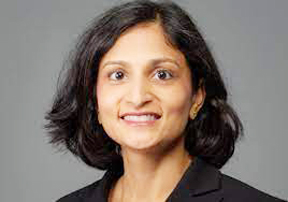
WASHINGTON (TIP): Indian American health policy expert Dr Meena Seshamani, who served on the leadership of the Biden-Harris transition Health and Human Services (HHS) agency review team, has been appointed as the Director of the US Centre for Medicare. Sheshamani, 43, will lead the Centre’s efforts in serving the people 65 or older, people with disabilities and people with End-Stage Renal Disease that rely on Medicare coverage. Dr Seshamani’s position as Deputy Administrator and Director of Centre for Medicare started on July 6.
“Dr Meena Seshamani brings her diverse background as a health care executive, health economist, physician and health policy expert to CMS,” said CMS (Centers for Medicare & Medicaid Services) Administrator Chiquita Brooks-LaSure.
“Providing quality health care to the people who rely on Medicare and advancing health equity as we do it is a priority for CMS. I am delighted to say Dr Seshamani will bring her unique perspective on how health policy impacts the real lives of patients to her leadership role as Deputy Administrator and Director of the Centre for Medicare,” she said.
Seshamani most recently served as Vice President of Clinical Care Transformation at MedStar Health, where she conceptualized, designed, and implemented population health and value-based care initiatives and served on the senior leadership of the 10 hospital, 300+ outpatient care site health system, a media release said.
“BELLY OF THE BEAST” FILMEXPOSES MODERN DAY ‘EUGENICS’
ON PBS: STREAMING FREE NOW UNTIL JULY 31
DIRECTOR ERIKA COHEN: DOC NYC’S 2019 “40 UNDER 40”
CALIFORNIA: FIRST STATE TO SIGN REPARATIONS FOR ABUSES OF WOMEN IN CRIMINAL JUSTICE SYSTEM
#EndEugenicsLegacy
#ItsTime
Blurbs
“To this day, many survivors who were sterilized while in prison still don’t know that their reproductive capacities were stolen from them. With the launch of reparations, we will finally receive justice that we have fought so long for and the healing process can truly begin. It’s time,”said Kelli Dillon, founder of ‘Back to the Basics,’ sterilization survivor, and film participant.
“I’m thrilled “Belly of the Beast” contributed to this historic moment and we will continue to shine a light on our nation’s dark past until these heinous practices are eradicated.” – Erika Cohn, Director-Producer
“Belly of the Beast,” Poster (Photo / bellyofthebeastfilm.com)
Hailed by CBS Sunday Morning as one of the best documentaries of 2020 and a 2021 Peabody Awards nominee, the timely and powerful film “Belly of the Beast” exposes human rights abuses of women in the criminal justice system. The film supported and expanded a movement towards reparations – dozens of screenings and advocacy actions were held around California and across the nation.
The film features the Oscar Shortlisted original song “What You’ve Done” from Grammy Winning and Oscar nominated singer-songwriter Mary J. Blige who wrote and performed the song. “I was moved by Erika Cohn’s important documentary ‘Belly of the Beast.’ I immediately knew I wanted to be involved and was inspired to write a song that would amplify the voices of women in prison. ‘See What You’ve Done’ is a testimony, a call to be strong, and an anthem for a movement,” Mary J. Blige told ‘Variety.’
Kelli Dillon, the film’s protagonist, a survivor of domestic and state violence, and community intervention specialist, was humbled by Mary J. Blige’s interest in the film: “I cried when I first listened to the song. When I heard the passion behind her voice, it affirmed my strength, my ability to survive what happened, and fight.”
These injustices are exposed in the award-winning PBS documentary “BELLY OF THE BEAST.” The 2020 feature documentary film “Belly of the Beast” has its streaming re-release on PBS.ORG this week and available for free to the public until July 31. A wider on demand release is planned for later this year.
Watch the trailer till the end – youtu.be/IoD7VgFl9EI
BELLY OF THE BEAST
When an unlikely duo discovers a pattern of illegal sterilizations in women’s prisons, they wage a near impossible battle against the Department of Corrections. Filmed over seven years with extraordinary access and intimate accounts from currently and formerly incarcerated people, the documentary feature “BELLY OF THE BEAST” exposes modern-day eugenics and reproductive injustice in California prisons.
Directed by Emmy and Peabody award-winning filmmaker Erika Cohn (The Judge and In Football We Trust), “BELLY OF THE BEAST” features the original song ‘See What You’ve Done’ written and performed by Mary J. Blige, the nine-time Grammy winner and two-time Oscar nominated singer-songwriter. The song was shortlisted for the Academy Awards for Best Original Song.
The pastoral farmlands surrounding the Central California Women’s Facility, the world’s largest women’s prison, help conceal the reproductive and human rights violations transpiring inside its walls. A courageous woman who was involuntarily sterilized at the facility, teams up with a radical lawyer to stop these violations. They spearhead investigations that uncover a series of statewide crimes, primarily targeting women of color, from inadequate access to healthcare to sexual assault to illegal sterilization. Together, with a team of tenacious heroines, both in and out of prison, they take to the courtroom to fight for reparations. But no one believes them.
As additional damning evidence is uncovered by the Center for Investigative Reporting, a media frenzy and series of hearings provide hope for some semblance of justice. Yet, doctors and prison officials contend that the procedures were in each person’s best interest and of an overall social benefit. Invoking the weight of the historic stain and legacy of eugenics, “BELLY OF THE BEAST” presents a decade long, infuriating contemporary legal drama.
CALIFORNIA SIGNS BILL FOR REPARATIONS
This week, California Governor Newsom signs a bill for landmark reparations for the modern-day eugenics and reproductive injustices in California state prisons. Forced Sterilization survivors are featured in the award-winning PBS documentary “BELLY OF THE BEAST.”
This will make California the first state to both provide notification of coerced sterilization and reparations to survivors who were sterilized while incarcerated in its state women’s prisons and the third state in the nation to provide monetary compensation to survivors who were sterilized under state eugenics laws. The award-winning filmmakers behind the PBS documentary “Belly of the Beast” uncovered nearly 1,400 questionable sterilizations in California prisons during labor or unrelated abdominal surgeries between 1997-2013. The film, released widely in 2020, helped garner nearly 20,000 signatures on a petition to Governor Newsom demanding reparations for California forced sterilization survivors.
Between 1909 and 1979, California sterilized at least 20,000 people under State law — accounting for one third of eugenics sterilizations nationwide. People with disabilities, Latinas, women, and poor people were disproportionately targeted for sterilization. Although the State repealed its eugenics law in 1979, coerced and forced sterilizations continued in State prisons into the 2010’s.
“Lack of government accountability for its eugenic past made possible the contemporary sterilization abuse in California prisons. Reparations for survivors is a giant step toward accountability and ensuring we end eugenic State violence against families of color.” Film participant and attorney Cynthia Chandler, who has led efforts for reparations for imprisoned survivors.
Governor Newson’s budget approves 7.5M funding for the reparations program. The budget request and accompanying bill, AB1007, was authored by California Assembly member Wendy Carrillo. Cynthia, Kelli and the “Belly of the Beast” team are a part of a larger cross-movement coalition for reparations including the AB1007 sponsors, Back to the Basics, California Coalition for Women Prisoners, California Latinas for Reproductive Justice and the Disability Rights and Education Defense Fund.
KEY CREDITS
BELLY OF THE BEAST is directed and produced by Erika Cohn, produced by Angela Tucker, Christen Marquez, Nicole Docta, executive produced by Geralyn Dreyfous, Blye Faust, Mark Lipson, Patty Quillin, Doree Friedman, Diane Philips, Lois Vossen, and Sally Jo Fifer, and music supervised by Tracy McKnight.
To learn more, visit the Official Film Website &social media
bellyofthebeastfilm.com
facebook.com/bellyofthebeastfilm
#EndEugenicsLegacy
#ItsTime
twitter.com/BOTBFilm
instagram.com/bellyofthebeastfilm
(Mabel Pais writes on Social Issues, The Arts and Entertainment, Spirituality, and Health & Wellness)
The New Jersey Symphony Orchestra (NJSO) announces NJSO Edward T. Cone Composition Institute composers:
Elise Arancio: “Wake”
Kevin Day: “Tango Oscuro”
Erin Graham: “Increase”
Jared Miller: “Under Sea, Above Sky”
Cone Institute Performers with NJSO (Photo : Courtesy NJSO)
The New Jersey Symphony Orchestra announces the composers for the seventh NJSO Edward T. Cone Composition Institute, presented July 19–24 at NJPAC, Newark. NJSO gives world premieres of institute works at public concert July 24 at NJPAC in Newark with conductor Ludovic Morlot.
The composers include Elise Arancio (Curtis Institute of Music) and her work “Wake,” Kevin Day (University of Georgia) and his work “Tango Oscuro,” Erin Graham (UC San Diego) and her work “Increase,” and Jared Miller (The Juilliard School) and his work “Under Sea, Above Sky.”
The four composers will hear their music performed by the NJSO and participate in in-depth sessions with Institute Director Steven Mackey, guest conductor Ludovic Morlot and industry leaders including Boosey and Hawkes, New Music USA, Subito Music Corporation and speech and presentation coach Sims Wyeth. To learn more, visit njsymphony.org/institute
By the conclusion of the Institute’s immersive laboratory experience, participants will have gained invaluable musical and practical feedback about writing for orchestra and how to get their music published and performed. The NJSO Edward T. Cone Composition Institute grew out of reading sessions the Orchestra has held with Princeton University graduate students biennially for more than a decade. The Institute celebrates its namesake Cone’s legacy as both a composer and a Princeton University professor. The event is a collaboration between the NJSO and Princeton University Department of Music. Learn more at njsymphony.org/institute.
TICKETS
Purchase nominally priced tickets at njsymphony.org/scores
Elise Arancio
To learn more about Elise Arancio, visit elisearancio.com
Program Notes: “Wake”
Wake (v.) To emerge from a state of sleep.
“While this piece occurs in the wake of a traumatic event, the overwhelming focus is on using inner momentum to awaken from a slumber of desolation and return to a place of joy. It is ultimately about finding life amidst death, and while not ignoring dark echoes, overcoming them, to reach a place where the heartbeat can clearly be heard among the sounds of renewed vitality,” says Arancio.
Kevin Day
To learn more about Kevin Day, visit kevindaymusic.com
Program Notes: “Tango Oscuro”
“Tango Oscuro” (“Dark Tango”), says Day, is a chamber orchestra work that was composed over the span of five days’ time, from an out-of-the-blue inspiration. This intense composition depicts a dark, wild and passionate dance between two aspiring lovers. He says: “‘Tango Oscuro’ is dedicated to the Gabriela Lena Frank Creative Academy of Music, and to my friend and mentor Gabriela Lena Frank, who inspired me to experiment and try new things, helped me to believe in myself and encouraged me to embrace my voice as a composer.”
Erin Graham
To learn more about Erin Graham, visit erinegraham.com
Program Notes: “Increase”
Graham says: “Narratives which feature some form of systematic overthrow fascinate me. “Increase” is a study in various methods of escalating dramatic tension on both small and large scales, and in allowing a seemingly inconsequential idea to gradually rise to the foreground.”
Jared Miller
To learn more about Jared Miller, visit jaredmiller.com
Program Notes: “Under Sea, Above Sky”
“When I started writing this piece for the National Youth Orchestra of Canada, ‘Under Sea, Above Sky.’” The piece was ultimately written as an ode to planet Earth. On one hand, Earth is massive, majestic and wild. On the other, it is incredibly fragile as climate change continues to wreak havoc upon it. “Under Sea, Above Sky” aims to capture this duality by contrasting passages of thundering resonance and textures of frail, ethereal tranquility. Ultimately, this piece serves not as an elegy for planet Earth but rather, as a reminder of both its beauty and its vulnerability.
To learn more about NJSO and the CI composers, visit njsymphony.org/institute
——————————————————
NJSO-NEWARK MUSEUM CONTINUE OUTDOOR MUSIC CONCERTS
By Mabel Pais
The New Jersey Symphony Orchestra (NJSO) continues in-person outdoorchamber music series in The Newark Museum of Art’s (newarkmuseumart.org) Alice Ransom Dreyfuss Memorial Garden this summer in July and August.
In nine performances from June through August, the NJSO Chamber Players
perform a three-concert series curated by Resident Artistic Catalyst Daniel
Bernard Roumain (DBR), a three-concert series curated by Concertmaster Eric
Wyrick and a three-concert family series for music lovers of all ages.
Family Concerts. (Photo : Courtesy NJSO)
Arts in the Garden
With the New Jersey Symphony Orchestra Chamber Players, in collaboration with The Newark Museum of Art
Beethoven & Wind Serenades
Wed, July 21, at 7 pm
ERIC WYRICK violin & curator
BEETHOVEN Septet in E-flat Major
VARIOUS Wind Serenades
Peter and the Wolf – Family Program
Sat, July 31, at 10 am
Experience Prokofiev’s classic tale about an adventurous boy and a hapless wolf. Instruments portray the duck, bird, cat, wolf, hunters, Peter and his Grandfather, making this a wonderful introduction to the orchestra, as well as a charming story.
NJSO Storytime – Family Program
Sat, Aug 14, at 10 am
Bring your family as New Jersey Symphony Orchestra Chamber Players tell stories through the sound of music.
Who We Are with DBR
Wed, Aug 11, at 7 pm
DANIEL BERNARD ROUMAIN curator
To learn more about Resident Artistic Catalyst Daniel Bernard Roumain, visit danielroumain.com
New Jersey Symphony Orchestra
Connect with NJSO:
Website: njsymphony.org
Facebook, Twitter and Instagram: @NJSymphony
YouTube: @NewJerseySymphony
Email: information@njsymphony.org
The Newark Museum of Art
To learn about the Museum, newarkmuseumart.org
——————————————–
NJPAC – STANDING IN SOLIDARITY
By Mabel Pais
Free on Zoom – Mon, Jul 19 @ 7PM
Reflections on Social Justice. (Photo : Courtesy NJPAC)
For a year, we’ve all been thinking deeply about social justice. What would a more just world look like? How can we improve our schools, our hospitals, our companies, our relationships, to ensure that everyone is treated equally, with respect and dignity? Should reparations be made to Black citizens — and how can we calculate the cost of centuries of injustice?
Throughout this year, NJPACs “Standing in Solidarity” gatherings have examined all angles of these questions.
To conclude this year-long project of reflection on questions of race, equity and justice, NJPAC revisits some of its most thought-provoking panels, in live sessions with members of the Arts Center’s own Social Justice Programming Task Force.
Join NJPAC at 7PM on Monday, July 19, to revisit two of the most intriguing discussions: “White Fragility” and “Policing the Police,” during a live Zoom session.
For the discussion on the concept of white fragility, and the popular book by the same name by Robin DiAngelo, panelists will be Donna Walker-Kuhne, Senior Advisor, Diversity Equity and Inclusion at NJPAC, and Chelsea Keys, the Arts Center’s Director of Special Projects.
Reflections on the “Policing the Police” panel will follow, with observations and reflections by Kitab Rollins, NJPAC’s Director of Performance and Broadcast Rentals, and the producer of the Arts Center’s “Standing in Solidarity events,” and Eyesha K. Marable, Assistant Vice President, Community Engagement at NJPAC.
NJPAC
To learn about NJPAC, visit njpac.org
(Mabel Pais writes on The Arts and Entertainment, Social Issues, Spirituality, and Health & Wellness)
Strange are the ways the National Sports Federations (NSFs) in general and Hockey India in particular function. Even in the Olympic year, there have been no dearth of controversies in the NSFs. While the BJP government changed the union Sports minister a fortnight before the Olympic games, the IOA was still squabbling whether to include an official whose sport had no athlete representing the country at Tokyo. Covid 19 pandemic notwithstanding, Indian contingent will be 220-plus strong with 125-odd athletes in it.
In this one of biggest ever Olympic squad to leave the shores of the country, medal hopefuls are countable on fingertips. The replaced Sports minister, Kiran Rijeiju, was hopeful that India’s medal tally at Tokyo will be in double figures. Starting with hockey, many feel that there is a clear chance for a medal in men’s hockey. Going by India’s world ranking of four and its recent showings in the FIH Pro League, the team looks to be in good shape. Its only handicap has been that it did not get enough of international exposure. Most of its FIH Pro League matches were cancelled because of Covid 19 related travel restrictions.
The announcement of teams, both men and women, could have been better organized than leaving scope for unnecessary speculations and controversies. On the first day, Hockey India announced the teams without naming their captains.
Secondly, both the team managements were unanimous in not including a second goalkeeper. Instead, an extra defender was taken to complete the final 16.
Men’s team had some surprises as experienced forwards Akashdeep and Ramandeep were left out. Also dropped was second goalkeeper K. Pathak. Incidentally all three are from Punjab.
The Hockey India realized its folly of not naming captains. When it did, it came out with long lists of team commanders and deputy commanders. Both men and women teams, Hockey India said, will have a captain and two vice captains each.
While midfielder Manpreet Singh was named captain of the Olympic-bound men’s team, Rani Rampal was given the honors of leading the women’s team.
The vice captain’s role of the men’s team will be shared by experienced defenders Birendra Lakra and Harmanpreet Singh. In case of the women’s team, goalkeeper Savita and deep defender Deep Grace Ekka will share the responsibility of the vice-captain.
Never any Indian team, bound for Olympic games had two vice captains.
The only exception had been 1968 when the then Indian Hockey Federation (IHF) named deep defenders Prithipal Singh and Gurbux Singh Kohli as joint captains of the Mexico-bound Indian men’s team. And that experiment was disastrous as Indian team failed to make the final for the first time.
Manpreet Singh has been named Captain of the Indian Hockey Team to Tokyo Olympics. Under his leadership, the team has improved their world ranking to number 4.
Under Manpreet’s captaincy, the Indian team over the past four years has achieved important milestones including winning the Asia Cup in 2017, winning the Asian Champions Trophy in 2018 as well winning the FIH Series Final in 2019. The team also made it to the quarterfinals of the FIH Men’s World Cup 2018 in Bhubaneswar. It also performed exceedingly well in the FIH Hockey Pro League 2020 before the pandemic disrupted its schedule. This will be Manpreet’s third Olympic games and under his leadership, the team has also improved their world ranking to number 4.
Birendra is a veteran defender who was also part of the London Olympic Games but missed playing in Rio owing to a major knee surgery in 2016. But since his return to the squad following the brief break, Birendra has shown considerable improvement in his performance.
Meanwhile, Harmanpreet Singh, who has since his debut in the seniors team in 2015 is now a top drag-flicker and defender. In the absence of skipper Manpreet in 2019, he led the team to a win at the FIH Olympic Test event in Tokyo.
Congratulating the three players, Chief Coach Graham Reid said, “All of them have been an integral part of the team’s leadership over these past couple of years and have shown a lot of maturity in guiding the youngsters during these challenging times. Naming two vice captains we believe will also strengthen our leadership in what is going to be a demanding tournament. We are confident that together they will guide the team to success
Expressing his gratitude on being named captain, Manpreet said, “This Olympics will be truly special, and I am humbled to have this opportunity of representing India at the Olympics for the third time, this time as team Captain. It is a very proud moment for me to be given this charge. Over these past few years, we have developed a strong leadership group and have successfully overcome the challenges posed by the pandemic to keep our form and minds and fitness focused towards doing well at the Olympics.”
Birendra said that this Olympics is special for him and being named the Vice-Captain of the team has only made this all the more special. “This will be a very special Olympic Games as we have prepared really well and are poised to win a medal in Tokyo. Being named as a vice captain along with Harmanpreet Singh is a matter of pride for me and over these past years with India we have seen players show great mental toughness during our preparations despite these trying times. We just hope to make the hard work and sacrifices count by winning big,” stated Lakra.
Harmanpreet on the other hand thanked Hockey India and the Coaching staff for the opportunity. He said, “When I came into the team as an absolute newcomer in 2015, there were a lot of seniors who guided me and I hope to play the same role now. We have a good, well-prepared team and everyone is excited to make this opportunity count.” Indian men will begin their campaign in Tokyo on July 24 when they take on New Zealand in their first Pool match.
For the women’s team, Rani was the obvious choice not just for her on-field exploits but also for her innate ability to guide the youngsters in the team.
Rani Rampal will lead Indian Women Hockey Team at the Tokyo Olympics. Under her captaincy, the Indian team over the past four years has achieved significant results.
Under her captaincy, the Indian team over the past four years has achieved significant results including winning the Asia Cup in 2017, winning silver at the Asian Games 2018, silver at Asian Champions Trophy 2018 as well winning the FIH Series Final in 2019. The team also made it to the quarterfinals of the FIH Women’s World Cup 2018 in London for the first time. She was the cynosure of India’s performance during the FIH Olympic Qualifiers in Bhubaneswar where her goal put the team ahead (6-5) against USA to secure the qualification.
Hockey India also announced dependable defender Deep Grace Ekka and experienced goalkeeper Savita as the two vice captains of the women’s team. Both the players have been in the Indian Core Group for nearly a decade and have been an integral part of the leadership group. They also played a key role in India’s feats that saw it attain the best ranking of World No.9 in 2018 following a strong performance at the FIH Women’s World Cup.
Congratulating all three players named for their leadership roles, Indian women’s Chief Coach Sjoerd Marijne said, “I congratulate Rani on being named the Captain of the Indian Women’s Hockey Team for the Olympic Games Tokyo 2020. I also congratulate Deep Grace Ekka and Savita on being named vice captains of the team. All these three players have been part of the leadership group for a long time and have proven their abilities with this added responsibility and have guided many youngsters in the Core Group. Having two Vice Captains will also strengthen the core leadership group for the future. Their experience and role will be of importance as we aim to achieve good results in Tokyo. It has been a long journey for the team and we continue into a tough challenge at the Olympics. The team needs to be mentally strong and I am confident with these three players at the helm, they are headed in the right direction.”
Expressing her gratitude on being named Captain, Rani said, “It is a huge honor to lead the Indian Team at the Olympic games. In these years my role as a captain was made easy with teammates who have shared the responsibilities as senior players. I look forward to this added responsibility and thank Hockey India, coaching staff and selectors for this honor.” Vice Captain Deep Grace Ekka too stated that this new responsibility will motivate her to ensure the team does well in Tokyo. “To lead India as vice captain at the Olympics is a huge honor and it will surely motivate me further to do well for the team. We have players from different regions of India in the team, but we have come closer as a unit over these past 15 months during the pandemic which has been challenging for all.” stated Grace who will be playing her second Olympic games.
Savita also expressed her gratitude as she said, “I thank the team’s support staff and Hockey India for giving me this responsibility. We are all eagerly awaiting to do well at the Olympics in Tokyo, and it will be great to lead India to good wins.”
When Prithipal Singh was crowned penalty king
The architect of Indian victory at Tokyo Olympics 1964, Prithipal Singh has become a Hockey legend.
No story about the Tokyo Olympics 1964 can be considered complete without the mention of India’s deep defender and penalty corner specialist Prithipal Singh.
Initially dropped from the Indian team, this courageous postgraduate in Agriculture, not only walked his way back into the team but also stood firm for his position.
His story needs to be told. In 1963, Prithipal Singh, a fullback in Punjab police, had some differences with the then Indian Hockey Federation chief and a senior Punjab police official, Mr. Ashwani Kumar. Blunt and temperamental as he was, Prithipal Singh put in his papers and joined the equally strong Northern Railways hockey team. This was unacceptable to Mr. Ashwani Kumar as he wanted Punjab police to remain the number one team in the country. As ill luck would have it, Punjab police ran into Northern Railway in the final of the prestigious Aga Khan Hockey Tournament in Bombay (1963). Mr Ashwani Kumar flew to Bombay specially to watch the game. The first day game ended in a draw and was scheduled for a replay the next day. Northern Railway won the replay with a penalty corner goal by Prithipal Singh. Mr. Ashwani Kumar was furious with his team. Some weeks later when the Indian team for the Tokyo Olympic games was announced, the name of Prithipal Singh was missing. Prithipal went underground as the media took up his ouster from the team as an act of vengeance. Ultimately, the IHF relented and Prithipal Singh was included in the team, not as a fullback but as a half back. He refused to accept that position. It was left to the team management to decide who will play where. On its way to Tokyo, the Indian team had an extensive training-cum-competition program in New Zealand. India lost its first Test match to New Zealand 1-3. Prithipal refused to play as half back. There was hue and cry at this defeat. Even Prithipal told the team management that he would love to go back home than play as a half back. The team management relented and Prithipal was played as fullback in the second Test that India won 5-1 with a brace of penalty corner goals. India also won the third Test with a big margin. Once the team was in Tokyo, Prithipal scripted history by emerging as the top scorer with eight penalty corner goals. It was his penalty corner shot that India got a penalty stroke in the final against Pakistan. Mohinder Lal converted that stroke to give India 1-0 win and gold medal. Prithipal Singh was crowned penalty king for his performance.
India has won a record number of eight gold medals in hockey, starting with the 1928 Olympic games. Indian team won gold medals in subsequent 1932, 1936, 1948, 1952, 1956, 1964 and 1980 Olympic games. In 1960 India got a Silver losing the final to Pakistan. In 1968 and 1972 India won a bronze each in hockey.
After the 1980 Moscow Olympic games, India has not won any Olympic medal in hockey.
____________ ___________ _______
Medal hopefuls…
Other than hockey, India is hopeful of winning medals in weightlifting, badminton, boxing, wrestling, shooting, athletics, archery and tennis.
In archery, India has world number one pair in Atanu Das and Deepika Kumari. Deepika was recently conferred world number one title and has been doing well this year. Weightlifter Mirabal Chanu is another medal hopeful. And is rated among the world’s best in her weight category.
Badminton star PV Sindhu who lost the gold medal match to Carolina Marin of Spain in the 2016 Olympic games is another medal prospect. This time Carolina is not playing as she had undergone a surgery. Wrestler Bajrang Punia, who will be the flag bearer at the closing ceremony and Vinesh Phogat also have bright chances of figuring in the medals list. Vinesh was unfortunate in twisting her leg against a Chinese wrestler in the Rio Olympics and had to be carried off the mat on a stretcher. But now she is a much better and mature wrestler who finished third in the World Wrestling championship recently.
Shooters Saurabh Chaudhary and Elavenil Valarivan, too, are expected to have podium finishes.
In athletics, Indian hopes rest on javelin thrower Neeraj Chopra, who after recovering from injury has shown considerable improvement and is touching the world standards.
Boxer Amit Panghal is another Olympic medal aspirant. His recent performances are laudable.
Veteran Sania Mirza will have Ankita as her partner in women’s doubles in tennis while Monika Batra will compete in table tennis.
__________. __________
Four players of Indian origin will represent Canada in Tokyo Olympic games. They are wrestler Amar Dhesi, water polo player Gurpreet Sohi and hockey players Sukhpal Panesar and Keegan Pereira.
Incidentally Gurpreet Sohi is the first woman player of Indian origin to represent Canada in Olympic games. She is training to be a medical science specialist and has represented Canada in several international sports events with distinction before.
Two Table tennis players – Kanak Jha and Nikhil Kumar – will represent the USA in the Tokyo Olympics. In the Rio Olympics, Rajiv Ram of Indian origin had won a silver medal in mixed doubles in tennis in partnership with Venus Williams.
And only last Sunday, an American boy of Indian origin, Samir Banerjee (17), won the Boys singles title at Wimbledon, a great honor.
The 2020 Summer Olympics, officially the Games of the XXXII Olympiad and branded as Tokyo 2020, postponed because of COVID-19 , is an upcoming international multi-sport event scheduled to be held from 23 July to 8 August 2021 in Tokyo, Japan.
Roger Federer has been feted by plenty of ovations at Wimbledon’s Centre Court. None quite like this one, though. This was not a celebration and didn’t come at the end of the match.
Instead, it delayed the beginning of what turned out to be the last game of his quarterfinal loss and felt more like a “thank you” or — just in case — a “goodbye.” And Federer acknowledged afterward he isn’t sure whether he’ll be back.
The eight-time champion at the All England Club bowed out 6-3, 7-6 (4), 6-0 against 14th-seeded Hubert Hurkacz of Poland on Wednesday, a surprisingly lopsided finish to Federer’s 22nd appearance in the tournament.
Asked whether it also might have been his last appearance here, he replied: “I don’t know. I really don’t know. I’ve got to regroup.”
As for whether retirement is an immediate possibility, he offered this: “No, I hope not. … The goal is to play, of course.”
That likely was on thousands of minds in the stadium when Federer stepped to the baseline to serve while trailing 5-0 in the third set: He waited while fans in the full-to-capacity stands applauded and cheered, some rising to their feet.
Soon enough, it was over, only the third shutout set ceded by Federer in 429 career Grand Slam matches; both of the others came at the French Open.
“The last few games, obviously, you can feel that you’re not coming back from it,” said Federer, who spoke steadily and did not betray any emotion in his news conference.
“I’m not used to that kind of situation, obviously, very much. Especially not here.”
England’s makeshift one-day international team put the COVID-19 issues that hit the previous squad behind them to bowl out Pakistan for 141 runs before cruising to a clinical nine-wicket win in the series opener in Cardiff on Thursday, July 8.
Stand-in skipper Ben Stokes led an entirely fresh England XI, including five debutants, after a COVID-19 outbreak in the squad during the recent series win over Sri Lanka meant all 16 players initially selected had to self-isolate.
But the revamped hosts were on the front foot from the start, with paceman Saqib Mahmood marking his return to the side with four wickets for 42 to help bowl out Pakistan with just under 15 overs to spare.
Chasing 142 for a 1-0 lead in the three-match series, England lost Phil Salt in the fifth over before fellow opener Dawid Malan and Zak Crawley steadied the ship.
London (TIP): After five decades of heartbreak and anguish, of shootout defeats and unfulfilled dreams, England again will play for a major men’s soccer trophy.
The Three Lions on Wednesday, July 7, took another step toward their first title since the 1966 World Cup, defeating Denmark, 2-1, in extra time at Wembley Stadium to advance to the European Championship final.
On Sunday, July 11, they will return to the famous venue in northwest London to face Italy, which advanced Tuesday with a penalty-kick triumph over Spain.
“They can see what it’s meant to the whole country and what it’s meant to the fans in the stadium,” said Coach Gareth Southgate, who guided England to the 2018 World Cup semifinals in Russia. “I’ve never known the new Wembley like this. Nights like tonight make it all worthwhile.”
England has not witnessed its national team in a major final since it won the World Cup at home 55 years ago — an eternity for a country that invented the modern game in the 19th century and boasts the sport’s most popular club circuit, the Premier League.
It will mark England’s first appearance in the Euro final in 10 attempts. (It lost in the semifinals twice.)
“We know we haven’t won nothing yet, but you have to enjoy winning,” said striker Harry Kane, who scored the winning goal on a rebound of his saved penalty kick in the 104th minute. “There is always that feeling in the back of your mind we’ve got one more to go, so you don’t want to get too carried away. … We’re obviously excited about a final on our home ground.”
The outcome ended an emotional ride for Denmark, a decided tournament underdog that, in its group opener last month in Copenhagen, watched in horror as star midfielder Christian Eriksen suffered a cardiac arrest on the field. His life was saved by teammates and medics.
The Danes lost their first two matches before winning three straight and getting within two victories of repeating their 1992 European crown.
“We needed the support. We needed the empathy when that happened with Christian,” Coach Kasper Hjulmand said. “We have received a lot of love and support. It was an amazing feeling. These guys are outstanding. The whole nation should be proud.”
The outcome was not without controversy. Although England was the better side in the second half and extra time, following a 1-1 draw through 45 minutes, the deciding goal came after referee Danny Makkelie awarded a questionable penalty kick.
England’s Raheem Sterling tumbled in the box after light contact, and following Makkelie’s ruling, video review upheld the call.
Popularly known as “God’s Own Country”, Kerala is one of the most sought after tourist destinations in the world. This exotic land is renowned for its rich cultural heritage, tropical climate, palm fringed beaches, misty hill stations, health resorts, wild life sanctuaries, enchanting art forms, grand festivals and, the serenity of the backwaters and the emerald blue Arabian Sea which promise an unforgettable holidaying experience to travellers. According to “National Geographic Travel”, the leading travel Magazine, Kerala is one of the 50 must see destinations of a lifetime and one of the 10 paradises of the World.
Top Places to Visit
Munnar
Munnar is a popular hill station of Kerala perched at an altitude of 1600 metres in the Western Ghats. Famous for its tea estates, various shades of green, blankets of mist forming natural-view points, Munnar is aptly known as the ‘Kashmir of South India’.
Munnar is a popular destination for a honeymoon with an abundance of resorts and cottages. Situated on the banks of three rivers- Madupetti, Nallathanni and Periavaru.
Munnar is divided into Old Munnar, where the tourist information office is, and Munnar, where the bus station and most guest houses are located. The Eravikulam National Park, Salim Ali Bird Sanctuary and tea plantations are its major attractions.
Alleppey
Officially called Alappuzha, Alleppey is the picture-perfect place known for its beautiful backwaters and the houseboats offering overnight stays. The coastline of Alleppey offers some of the best beaches in Kerala with water sports during the dry season.
Alleppey is located close to Kochi in the South Indian state of Kerala. Its palm-fringed inter-connect network of canal backwaters attracts a lot of tourists from all over the world. Coupled with other beautiful places in Kerala, Alleppey is often considered for a honeymoon or for a great family vacation.
There are plenty of houseboats, homestays, and rejuvenating Ayurvedic resorts that make staying in Alleppey brilliant. The houseboats pass through the serene backwaters, where you can catch glimpses of green paddy fields, choir-making activities, beautiful avifauna, and witness the life of locals in Kerala.
Be sure to catch a traditional snake boat race in the months of August and September and try out some toddy (palm wine) at a local toddy shop for adding a touch of authenticity to your travel experience in Allepey.
Wayanad
Replete with waterfalls, historical caves, comfortable resorts and homestays, Wayanad in Kerala is famous for its spice plantations and wildlife. Walking through the sprawling spice plantations, trekking to the pre-historic caves and experiencing a resort holiday are one of the many things you can do to get a taste of Wayanad.
Wayanad is best known for the wildlife reserves – Wayanad wildlife reserve which is home to an exquisite variety of flora and fauna. Wayanad wildlife reserve is an integral part of the Nilgiri biosphere reserve peacefully located amidst the serene hills of Western Ghats. Wayanad homes a wide variety of wildlife like elephants, leopards, and bears. Wayanad is a perfect weekend idea from the cities of South India. If taking a road trip from Bangalore, you will drive through three national parks: Nagarhole, Bandipur and Mudumalai.
Thekkady
Home to the country’s largest Tiger Reserve- Periyar, Thekkady is a great way to enjoy a jungle vacation. Periyar National Park, being a major attraction, is one place where you can enjoy bamboo rafting in the catchment area of Mullaiperiyar Dam, hiking, and in the midst of the wilderness, shopping! Popular for its good eating joints, you can also enjoy its vast stretches of spice gardens and various adventure sports. You can also enjoy a night trek in the wilderness of Periyar. The early morning ride in the boat within the sanctuary is an extremely awesome experience and you might be able to spot wild elephants, bisons, wild boars, various kinds of birds, etc. Anakarra is also located nearby which is a great place to enjoy nature. Murikaddy is located around 5 km from the city and is famous for coffee and spices plantations. Chellar Kovil is another area located nearby with a lot of picturesque waterfalls and cascades. Mangala Devi Temple, located at an altitude of 1337 m and at a distance of around 15km from Thekkady opens only on the Chitra Pournami Festival.
Varkala
Varkala is a coastal town in the southern part of Kerala known for the unique 15m high ‘Northern Cliff’ adjacent to the Arabian Sea. It is popular for its hippie culture, shacks on the cliff serving great seafood and playing global music and the samadhi of Kerala’s saint Sree Narayana Guru. Varkala is also known for Jardana Swami Temple, also known as Dakshin Kashi. Varkala has some of the best pristine beaches, hills, lakes, forts, lighthouses, natural fisheries and springs – all of this together makes this town a little paradise. You will also find a lot of shops with signboards in Hebrew selling Yoga mats, oxidised silver jewellery and harem pants made of cotton. Ayurvedic spas, affordable resorts, hostels, clean beaches make it a must-visit city of Kerala.
Poovar
Poovar is a small rustic town situated 27 kms from Thiruvananthapuram with unspoilt, unexplored golden sand beaches and beautiful backwaters of Kerala. Also known as a fishing village, the tranquil Poovar island lies between the Arabian Sea and the Neyyar River. Hiring a boat, (especially during the sunset)that will take you through the mangrove forest of backwaters is a must-do activity. The town has some of the beautiful resorts and hotels that are known for the hospitality they offer.
One of India’s biggest religious festivals, the Jagannath Puri Rath Yatra, is unique in that three Hindu gods are taken out of their temples in a colorful procession to meet their devotees.
The biggest of these processions takes place in Puri in the eastern state of Orissa, while the other takes place in the western state of Gujarat.
Believed to be the oldest Rath Yatra or chariot procession in the world, this festival marks the annual ceremonial procession of Lord Jagannath, his elder brother Balabhadra and younger sister Subhadra, from their home temple to another temple, located in what is believed to be their aunt’s home.
This journey is documented in undated Hindu sacred texts known as the Puranas which are believed to have been written a few thousand years ago.
However, the Supreme Court has rejected the petitions seeking permission to conduct the Rath Yatra this year at various places in Odisha apart from the Puri Jagannath temple where it has been allowed.
The religious festival will be held on 12 July. Last year too, the devotees were barred from taking part in the yatra due to Covid-19.
What makes it so interesting?
This is the only festival in the world where deities are taken out of temples to travel to devotees, and it is also the largest chariot procession in the world.
Millions of people come to watch as a “king” sweeps the road with a golden mop and three massive 18-wheeled chariots bearing the sibling deities make their way through massive crowds. Their chariots, which are mini architectural marvels, are constructed over 42 days from over 4,000 pieces of wood by the only family that has the hereditary rights to make them.
Legend says it always rains on the day of the procession. For a whole week before, the temple doors are shut and no one is allowed inside, because it is believed that the sibling deities have a fever after bathing in the sun with 108 pitchers of water. The breaking of their fever calls for a change of scene, which is why they go to their aunt’s home for a few days.
The size, pomp and splendour of this procession has even contributed a word to the English dictionary: Juggernaut.
What is the legend of the sibling deities?
Unlike the ornate, carefully crafted metal idols everywhere else, these three deities are fashioned from wood, cloth and resin. They are malformed with large heads and no arms: reminders of the legend of an impatient King.
The legend begins in different ways.
One speaks of an arrogant Indrayumna, King of Puri in the east, who tried to steal the Hindu god Krishna’s heart. It had been immersed in the legendary Dwarka sea after his cremation and had reappeared to the tribes people of the place as an idol. When Indrayumna tried to claim its possession, the idol disappeared. The repentant king sought absolution from Krishna by sanctifying him in another form.
Another speaks of how Krishna’s grief-stuck siblings – his elder brother Balabhadra and younger sister Subhadra- rushed into the Dwarka sea carrying his half-cremated body. At the same moment, King Indrayumna dreamed that Krishna’s body had floated back up on his shores as a log. The two legends merge here: Indrayumna decided to build a temple to house the log. His next task was to find someone to craft the idols from it. Legends say that Vishwakarma, God’s own architect, arrived as an old carpenter. He agreed to carve the idols, but on the condition that he was not to be disturbed. However, when he did not emerge from his workshop for weeks, going without food, water or rest, a worried and impatient King threw the door open.
At the time the images were only half-finished, but the carpenter disappeared. Still, believing the idols to be made from the very body of God, the King sanctified them and and placed them in the temple.
When the deities disintegrate, they are remade in the same half-done image with new wood every 12 years. They were last remade in 2015.
Why are there two rath yatras and
how are they connected?
Dwarka in Gujarat – where Krishna’s half-cremated body is believed to have been immersed into the ocean – is located on the west coast of India and Puri in Orissa- where it is said to have re-emerged as a log – is located in the east.
About 500 hundred years ago, a travelling Hindu saint and temple priest of a Hanuman temple in Gujarat, Shree Sarangdasji, arrived in Puri to offer prayers at the historic Jagannathan temple.
While sleeping at the temple guest house, it is believed that he received visionary instruction from Lord Jagannathan to go back to Ahmedabad in Gujarat and install three idols of Jagannathan, Balbhadra and Subhadra there. Carrying out the instructions received in his dream, he founded the Ahmedabad Jagannathan Temple.
By doing so, he sanctified the two locations – one where Krishna’s mortal remains began their journey from the west, to their transformation as Puri’s Lord Jagannathan in the east.
About 142 years ago, one of the founder’s disciples, Shree Narsinhdasji Maharaj, began the Ahmedabad Rath Yatra. The deities on chariots, pulled by elephants and humans, replicate their own journey in Puri, completing a set of rituals that sanctify the two places where Krishna’s mortal remains are believed to have come to rest.
What happens to the chariots and elephants after the journey?
At the end of the festival, the chariots are dismantled and their wood is used as fuel in the temple kitchens – believed to be the largest in the world that cook 56 things every day and feed anywhere between 2,000 to nearly 200,000 people.
The elephants are returned to the lands managed by the temple trusts to roam free – until the procession the following year. This year’s festival was, however, marred by controversy over the elephants.
Following the death of some of the temple elephants in Gujarat, there was massive outcry over plans to replace them with elephants from the north-eastern state of Assam.
The four elephants would have had to make a perilous train journey of more than 3,100km (1,926 miles) in heatwave conditions to participate in the festival.
This decision was suspended by a wildlife official after activists went to court.
Alphabet Inc.’s Google was sued by three dozen states alleging that the company illegally abused its power over the sale and distribution of apps through the Google Play store on mobile devices.
State attorneys general said in a complaint filed Wednesday in federal court in San Francisco that Google used anticompetitive tactics to thwart competition and ensure that developers have no choice but to go through the Google Play store to reach users. It then collects an “extravagant” commission of up to 30% on app purchases, the states said.
Google was accused of paying Samsung Electronics Co., the largest Android manufacturer, to ensure that the Korean company didn’t develop its own competing app store. Additionally, after Fortnite maker Epic Games Inc. began distributing its app outside of Google’s store, Google “bought off” developers to dissuade them from doing the same, according to the complaint. Details of those payouts were blacked out in the complaint.
The company said the lawsuit “gets it wrong” by limiting the definition of the app marketplace to Android devices and ignoring that Google competes with Apple Inc. for developers and consumers.
“We don’t impose the same restrictions as other mobile operating systems do,” Wilson White, Google’s Senior Director of Public Policy, said in a blog post. “So it’s strange that a group of state attorneys general chose to file a lawsuit attacking a system that provides more openness and choice than others.”
New York is leading the case with Utah, North Carolina and Tennessee.
“Google has served as the gatekeeper of the internet for many years, but more recently, it has also become the gatekeeper of our digital devices –resulting in all of us paying more for the software we use every day,” New York Attorney General Letitia James said in a statement.
The complaint, filed by 36 states and the District of Columbia, marks a new attack by government officials in the U.S. against the search engine’s business practices. The Justice Department and a group of states filed separate complaints over Google’s search business last year, while another state coalition sued over Google’s digital advertising business.
Luxury carmaker Jaguar Land Rover Automotive Plc issued a profit warning on Tuesday citing the impact of semiconductor chip shortage on vehicle production, sending shares of its parent Tata Motors Ltd as low as 10%.
The British carmaker, which saw sales reviving over the last six months, said it will report a negative operating margin and an operating cash outflow of £1 billion this quarter. The company said it expects the supply of semiconductor-based parts to improve in the fiscal second half, though the problem will continue to impact vehicle production for the next year-and-a-half, until suppliers boost output.
Tata Motors shares recouped some of the losses later in the day, closing 8.14% lower on the BSE, while the benchmark Sensex remained unchanged. “The company had about £3.7 billion of cash and short-term investments (unaudited). Based on this and broadly in line with expectations given the supply constraints, the company expects to report a cash outflow of about £1 billion with a negative Ebit margin for the quarter. Total liquidity at the end of the first quarter was over £5.6 billion, including a £1.9 billion undrawn committed credit facility (RCF),” JLR said.
Didi Global Inc. plunged in U.S. trading as the ride-hailing company faced scrutiny over its data security and a broader Chinese crackdown on companies listing their shares abroad.
China’s State Council issued a sweeping warning to China’s biggest companies, vowing to tighten oversight of data security and overseas listings. That announcement followed the opening of a security review by China’s internet regulator last week and a demand for app stores to remove Didi.
Didi’s American depositary shares fell 20% to $12.49, wiping out about $15 billion of market value and taking the stock below the $14 price from its initial public offering. Beijing-based Didi controls almost the entire ride-hailing market in China and raised $4.4 billion last week in the second-largest U.S. IPO for a Chinese firm.
The State Council’s broadside marked an escalation in President Xi Jinping’s campaign to bring the nation’s technology firms — and their reams of valuable data — under control. Over the weekend, China also moved against two other companies that also recently listed in New York, — Full Truck Alliance Co. and Kanzhun Ltd., Ltd. The warning “is aimed at securities violations, but it also makes special provisions for cross-border data supervision, which signals that data supervision has become one of the most important regulatory fields in China,” said Xia Hailong, a lawyer at the Shanghai-based Shenlun law firm.
“Sine there is no mechanism in place for cross-border supervision of securities, conducting a security review on data could serve as an effective tool for Chinese regulators to rein in overseas listed companies,” he said. Source: Bloomberg
Food delivery platform Zomato has received SEBI’s nod to raise Rs 8,250 crore through an IPO. The IPO comprises fresh issue of equity shares worth Rs 7,500 crore and an offer-for-sale to the tune of Rs 750 crore by Info Edge (India) Ltd, according to draft red herring prospectus. Zomato obtained its observation on July 2, an update with the regulator showed.
Saudi Arabia’s energy minister pushed back against opposition by fellow Gulf producer the United Arab Emirates to a proposed OPEC+ deal and called for “compromise and rationality” to secure agreement when the group reconvenes. It was a rare public spat between allies whose national interests have increasingly diverged, spilling over into OPEC+ policy setting at a time consumers want more crude to aid a global recovery from the Covid-19 pandemic.
Fitch Ratings on Wednesday, July 7, cut India’s growth forecast to 10% for the current fiscal, from 12.8% estimated earlier, due to slowing recovery post second wave of Covid, and said rapid vaccination could support a sustainable revival in business and consumer confidence.
In a report, the global rating agency said the challenges for banking sector posed by the coronavirus pandemic have increased due to a virulent second wave in the first quarter of the financial year ending March 2022 (FY22).
Fitch believes that rapid vaccination could support a sustainable revival in business and consumer confidence; however, without it, economic recovery would remain vulnerable to further waves and lockdowns.
It said localized lockdowns during the second wave kept economic activity from stalling to levels similar to those during 2020, but disruption in several key business centres has slowed the recovery and dented Fitch’s expectations of a rebound to pre-pandemic levels by FY22. India’s economy contracted 24.4% in June quarter of 2020.
A security researcher has discovered a funny bug that can completely disable your iPhone’s ability to connect to Wi-Fi.
Carl Schou said in a tweet that if an iPhone comes within range of a network named %secretclub%power, the device won’t be able to use Wi-Fi or any related features.
He found that certain Wi-Fi networks with the percent symbol (%) in their names can disable Wi-Fi on iPhones and other iOS devices, reports 9to5Mac.
Once an iPhone or iPad joins the network with the name ‘%p%s%s%s%s%n’, the device fails to connect to Wi-Fi networks or use system networking features like AirDrop.
The issue persists after rebooting the device.
The ‘%’ symbol is commonly used in programming languages to format variables into an output string.
“In C, the ‘%n’ specifier means to save the number of characters written into the format string out to a variable passed to the string format function. The Wi-Fi subsystem probably passes the Wi-Fi network name (SSID) unsanitised to some internal library that is performing string formatting, which in turn causes an arbitrary memory write and buffer overflow,” explained the report.
“This will lead to memory corruption and the iOS watchdog will kill the process, hence effectively disabling Wi-Fi for the user,” it added.
Chinese researchers want to send more than 20 of China’s largest rockets to practice turning away a sizable asteroid – a technique that may eventually be crucial if a killer rock is on a collision course with Earth.
Sometime between late 2021 to early 2022, the United States will launch a robotic spacecraft to intercept two asteroids relatively close to Earth, reports Reuters.
When it arrives a year later, the NASA spacecraft will crash-land on the smaller of the two rocky bodies to see how much the asteroid’s trajectory changes.
At China’s National Space Science Center, researchers found in simulations that 23 Long March 5 rockets hitting simultaneously could deflect a large asteroid from its original path by a distance 1.4 times the Earth’s radius.
Their calculations are based on an asteroid dubbed Bennu, orbiting the sun, which is as wide as the Empire State Building is tall. It belongs to a class of rocks with the potential to cause regional or continental damage. Asteroids spanning more than 1 km would have global consequences.
China’s National Space Science Center cited a recently published study in Icarus, a journal on planetary science. Long March 5 rockets are key to China’s near-term space ambitions – from delivering space station modules to launching probes to the Moon and Mars.
Microsoft has released security updates for Windows users to patch a security flaw impacting the Windows Print Spooler service. The vulnerability called “PrintNightmare,” that was discovered last week, allows attackers to remotely execute malicious code with system privileges and install programs, make changes in the existing programs, and create new accounts with full user rights. Microsoft has brought the emergency patch for all major Windows versions — starting from Windows 7 to Windows 10. Windows Server users have also been provided with specific security updates to fix the critical flaw.
The list of Windows versions that have received the security updates to patch the PrintNightmare vulnerability comprises Windows Server 2004, Windows Server 2008, Windows Server 2012, Windows Server 2012 R2, Windows Server 2016, Windows Server 2019, Windows 7, Windows RT 8.1, Windows 8.1, and Windows 10. Microsoft said that the updates contain protections for the issue that has been recorded as CVE-2021-34527.
Since the Windows Print Spooler service exists on all Windows versions, the vulnerability has impacted all Windows machines. However, the security updates list is currently limited to a few versions initially. Microsoft said that it would update the remaining Windows versions soon.
Meanwhile, users on a Windows machine that is yet to receive the security fix are recommended to manually disable the Print Spooler service or disable inbound remote printing. The Print Spooler can be disabled by passing the “Stop-Service -Name Spooler -Force” and “Set-Service -Name Spooler -StartupType Disabled” commands through PowerShell.
Inbound remote printing, on the other hand, can be disabled by going to Computer Configuration > Administrative Templates > Printers and switching off the Allow Print Spooler to accept client connections option. You need to restart the Print Spooler service for the change to take effect.
The PrintNightmare flaw was reported by researchers at Chinese cybersecurity firm Sangfor Technologies last week. It is known as a remote code execution vulnerability that could be exploited to run arbitrary malicious code with system privileges. The flaw exists when the Windows Print Spooler service improperly performs privileged file operations, Microsoft explained.
The Apple Watch has again been credited with helping to detect a user’s potentially life-threatening heart condition, media reports said.
Diane Feenstra from Michigan said her Apple Watch alerted her to an abnormally high heart rate, sending her to urgent care where an EKG revealed that she had had a recent heart attack without realising it, reports 9To5Mac.
“The day in question, April 22, I had 169 beats per minute heart rate even though the most vigorous exercise I had done was to walk up 12 steps. So I called my husband at work and said do you think this is concerning? And he said call your doctor,” Feenstra told WZZM in an interview.
At the local urgent care centre, doctors performed an EKG, which revealed that Feenstra had recently had a heart attack without realising it.
According to the report, the symptoms of a heart attack may vary a lot in both men and women.
“I had pain going down my left hand, I had a little swelling in my left foot, I had indigestion that I just explained away as acid reflux that I was experiencing as I got older,” Feenstra said.
“The biggest thing was a pain in my shoulder and I figured I had vacuumed and put my muscles out of whack somehow,” she added.
Feenstra then visited a clinic located at Grand Rapids in Michigan where additional testing uncovered that she had a full blockage in the widow maker artery, following which she had a stent procedure done to rectify the situation. Source: IANS
The Delta variant of coronavirus is eight times less sensitive to antibodies generated by vaccines as compared to the original strain that came from China’s Wuhan, according to a new study.
The study, which was conducted on more than 100 healthcare workers (HCWs) at three centres in India including Sir Ganga Ram Hospital (SGRH) here, found that the B.1.617.2 Delta variant not only dominates vaccine-breakthrough infections with higher respiratory viral loads compared to non-Delta infections (Ct value of 16.5 versus 19) but also generates greater transmission among the fully vaccinated HCWs.
The collaborative study, “Sars-Cov-2 B.1.617.2 Delta Variant Emergence and Vaccine Breakthrough: Collaborative Study”, from India with scientists from Cambridge Institute of Therapeutic Immunology and Infectious Disease is yet to be peer-reviewed.
It revealed that in vitro, the Delta variant is approximately eight-fold less sensitive to vaccine-elicited antibodies compared to Wuhan-1.
“Across all scenarios considered, our results suggest the Delta variant is both more transmissible and better able to evade prior immunity elicited by the previous infection compared to previously circulating lineages,” the findings of the study read.
Dr Chand Wattal, chairperson of the Institute of Clinical Microbiology and Immunology, SGRH, said, “From this study, it appears that we have miles to go before we sleep in case of Covid-19 pandemics. These mutations are bound to happen if we lower our guard and allow ourselves to fall prey to this virus, giving it an opportunity to multiply.”
“This is a straight eye-opener to the fully vaccinated people that you cannot lower guard in the name of vaccination. The virus is on the prowl, still looking for its prey. This mutant has come back with enhanced spike proteins for attachment to the lung epithelial cells which have provided it with a much higher capacity to infect many more people than the Wuhan strain,” he said. Source: PTI
Kriti Sanon has made a ‘humble request’ to the media and the paparazzi who are sharing visuals from Dilip Kumar’s funeral. The actor took to her Instagram Stories and urged the media to avoid covering celebrity funerals for it’s disturbing to see ‘videos of such a sensitive event with photographers talking casually in the background’. Dilip Kumar died on Wednesday, July 7 morning. In the evening, the actor was buried at the Juhu Qabrastan in Mumbai. Videos and pictures from the funeral were shared on social media.
In her appeal to the media, titled ‘A humble request’, Kriti Sanon said, “Is it necessary for media and paparazzi to cover someone’s funeral? A funeral is a very personal affair and media should let people mourn in peace without a camera flashing in their faces! It’s disturbing to see videos of such a sensitive event with photographers talking casually in the background. I urge the media to please not cover funerals and give the family and closed ones their privacy. Would you like such a personal loss being flashed all over? Lets change things a bit.. Lets put humanity before profession!”
Angelina Jolie and Brad Pitt‘s divorce has spilled over to the south of France, or, more particularly, Château Miraval, the French winery and castle shared by the duo. Angelina, 46, has accused her estranged husband, 57, of blocking the sale of their winery to a third-party buyer in court documents filed on Tuesday, July 6 in Los Angeles. (HollywoodLife has reached out to Angelina and Brad’s reps for comment.)
In the documents obtained by HollywoodLife, Angelina has asked for the removal of an automatic temporary restraining order (ATRO), a routine order that prevents divorcing parties from making financial decisions that would affect the other amid proceedings, in order to finalize the sale — but Brad has not consented to the removal yet, stalling the process.
Angelina’s lawyers have stated that the actress is “extremely desirous of closing the pending agreement for the sale” and would very much like to “extricate herself from being business partners with her ex-husband.” The document further read: “Petitioner should not be indefinitely held hostage to being Respondent’s business partner with respect to separate property assets in a family court proceeding to divide community property.”
Filmmaker Richard Donner, who helped create the modern superhero blockbuster with 1978’s Superman and mastered the buddy comedy with the Lethal Weapon franchise, has died. He was 91.
Richard died Monday, July 5, in Los Angeles, his family said through a spokesperson.
Richard gained fame with his first feature, 1976’s The Omen. A then-unheard-of offer followed: $1 million to direct 1978’s Superman. Richard channeled his love of the character into making the film, repeatedly facing off with producers over the need for special effects that would convince the audience that a superhero could really fly. In the title role, Richard cast Christopher Reeve, who was associated with Superman for the rest of his life.
By the 21st century, the genre was dominating the box office in the US and thriving overseas. The heads of Marvel Studios and DC Entertainment—producers of most of today’s superhero fare—both worked for Richard when they were starting out in Hollywood.
Signup to our Newsletter!
Don’t miss out on all the happenings around the world