
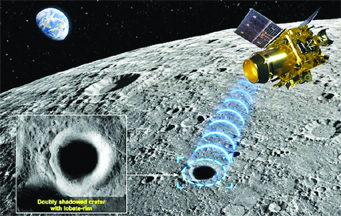

When India launched the Chandrayaan-2 mission in 2019, the spotlight largely remained on the lander’s hard landing near the Moon’s south pole. But nearly seven years later, the orbiter is quietly delivering what could become one of the most important discoveries in the new lunar race: strong evidence of subsurface water-ice hidden beneath permanently shadowed craters near the lunar south pole. The findings, made using the Chandrayaan-2 Orbiter’s Dual Frequency Synthetic Aperture Radar (DFSAR), are not just another scientific milestone. They strike at the heart of why the Moon’s south pole has become the most strategically valuable region beyond Earth.
Scientists from the Physical Research Laboratory analysed “doubly shadowed craters,” depressions inside permanently shadowed regions where sunlight never reaches and temperatures plunge to nearly minus 248°C. In these deep-freeze conditions, water-ice can survive for billions of years. Using advanced radar polarimetry, the team identified signatures consistent with subsurface ice in four craters. One 1.1-km-wide crater inside the Faustini basin showed especially compelling evidence, including radar reflections and unusual lobate rim structures that suggest an impact may have excavated ice-rich material buried underneath.
This matters because water on the Moon is no longer just a scientific curiosity. It is the fuel for humanity’s next phase in space. Water can be converted into drinking supplies, breathable oxygen, and hydrogen fuel for rockets.
Instead of launching every kilogram from Earth at enormous cost, future astronauts could “live off the land” using lunar resources, a concept known as in-situ resource utilisation (ISRU). Whoever masters this first gains a major advantage in long-duration space exploration. That is precisely why every major space power is targeting the Moon’s South Pole.
NASA plans to return astronauts to the lunar surface under the Artemis programme and eventually establish a sustained human presence near the south pole. The agency sees the region as the ideal location for future Moon bases because shadowed craters may hold accessible ice reserves. At the same time, nearby peaks receive near-continuous sunlight for power generation.



Be the first to comment