Month: August 2020

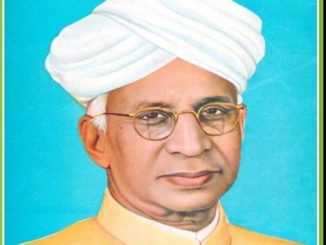
  • Remembering Dr. Sarvepalli Radhakrishnan

    Remembering Dr. Sarvepalli Radhakrishnan

         Remembering Dr. Sarvepalli Radhakrishnan

     By Dr. V.K. Raju       

    Plato’s concept of philosophy king, and the Indian idea of Rajarishi have a                                                    striking similarity.  This idea was realized in Marcus Aurelius, Janaka,                                                              Ashoka   and Akbar.  In modern times, Dr. Radhakrishnan  exemplified this                                                    concept when he was elected President of India in 1962.  In 1964, the Pope                                                      conferred with Dr. Radhakrishnan in Bombay (Mumbai) the                                                                                  decoration of one of the Chiefs of Golden Army of Angels.


    “Na tatra suryo bhaati na Chandra taarakam

    Nemaa vidyuto bhaanti kutyamagnih

    Tameva bhaantam anubhaati sarvam

    Tasya bhasa sarvam idam vibhaati

    (Katopanishad 28 5-15)”

    He is there where the sun does not shine,

    Nor the moon, stars and lightning.

    Then what to talk of this small flame (in my hand),

    Everything (in the universe) shines only after the Lord,

    And by His light alone are we all illuminated.

    Nirvikara, Nirvisesha

    “Sun shines not, moon is not there; stars are not there.”

    But if it is so transcendental, so completely exceeds our human comprehension, what is the next goal? -Try within.  Look into yourself, you will see the deepest there! – Dr. S. Radhakrishnan


    For Dr,. Radhakrishnan,  everything, psychology, epistemology, metaphysics, ethics, education, politics, economics, science, religion, converges and culminates in spirit.  He was a philosopher by temperament, teacher by vocation, a statesman by choice, an administrator by discipline and he had demonstrated that versatile potentiality of the human mind suffused with the spirit of service.

    It is truly significant that he had been able to offer masterly interpretation of the philosophy of Tagore and the ideology of Mahatma Gandhi even as he had given a lucid exposition of gospel of action enshrined in Bhagavat Gita, and the doctrine of nonviolence preached by Gautama Buddha.

    There was a time when Indian philosophy and literature were looked down upon by the West.  McCauley, an English historian, had this to say in his minute on Indian Education, “It is, I believe, no exaggeration to say that all the historical information which has been collected from all the books written in the Sanskrit language is less valuable than what may be found in the most paltry abridgement used at preparatory schools in England.” But Dr. Radhakrishnan successfully demolished the profound ignorance of the West.  He said, “There are narrow minded people all over the world who think that their religion is the greatest and other people should accept.  That has not been the tradition of this country.  Our culture has spread in different directions in the East and West.”  After Sri Vivekananda, his concern was to present to the West the richness of the Eastern thought.  It is not a common saying that Indian Philosophy begins where Western Philosophy ends.

    It is true from his works that East is East, and West is West, it cannot be denied that East plus West is the best.  He once said, “So far as the world of religion is concerned, freedom is the atmosphere in which religion can grow.” When wisdom dawns, ignorance dies, and evil is cut off at the root.  Man’s only hope is world community, a brotherhood, where truce is the abiding reality.  His philosophy was grounded in Advaita Vedanta, reinterpreting this tradition for all contemporary understanding.

    He continued as an academic, he was absorbed into constructive politics. Dr. Radhakrishnan was awarded several high awards during his life, including a Knighthood in 1931, the Bharata Ratna, the highest civilian award in India, in 1954 and honorary membership of the British Royal order of Merit in 1963.  He was born in Madras presidency (present Tamil Nadu) to a Telugu speaking family and attended and studied at Madras Christian College.  He was Vice Chancellor of Andhra University and Banares Hindu University.  He was the Spalding Professor of Eastern Religion and Ethics at the University of Oxford.  He was also appointed Haskell Lecturer in Comparative Religion at the University of Chicago.  He was first ambassador to Soviet Union, then first Vice President of Indian Republic.

    Plato’s concept of philosophy king, and the Indian idea of Rajarishi have a striking similarity.  This idea was realized in Marcus Aurelius, Janaka, Ashoka and Akbar.  In modern times, Dr. Radhakrishnan exemplified this concept when he was elected President of India in 1962.  In 1964, the Pope conferred with Dr. Radhakrishnan in Bombay (Mumbai) the decoration of one of the Chiefs of Golden Army of Angels.  He passed away in 1975.  Dr. Radhakrishnan started as a teacher and spent almost all of his life as a teacher.

    He was also one of the founders of Help Aged in India; Dr. Radhakrishnan believed that “teachers should be the best minds in the country”.  Since 1962, his birthday has been celebrated in India as Teachers’ Day on the 5th of September, every year.

    In Dr. Radhakrishnan’s life, there is a message of fulfillment.  His journey from a village was neither easy nor fast, but it was accomplished by sheer ability and faith.  There is an extraordinary reassuring message of self confidence and determination.  He said, “All that we have to do is to develop this solidarity about country.  An act of one man to inspire that spirit of oneness to belong to one country, one culture, one tradition.  That is very essential.”  This was his message to youth of the country.

    Sarvepalli Radhakrishnan, (born Sept. 5, 1888, Tiruttani, India—died April 16, 1975, Madras [now Chennai]), scholar and statesman  was president of India from 1962 to 1967. He served as professor of philosophy at Mysore (1918–21) and Calcutta (1921–31; 1937–41) universities and as vice chancellor of Andhra University (1931–36). He was professor of Eastern religions and ethics at the University of Oxford in England (1936–52) and vice chancellor of Benares Hindu University (1939–48) in India. From 1953 to 1962 he was chancellor of the University of Delhi.

    In this June 4, 1953 picture at the United Nations, Dr. Radhakrishnan (third from right) is seen shaking hands with Mr. Byron Price, Acting Secretary-General of the U.N., as Mr. Rajeshwar Dayal (left), India’s Permanent Representative to the United Nations, and Mr. Shamaldharee Lall, Assistant Secretary-General of the U.N. in charge of the Department of Conference and General Services, look on.

    Photo / courtesy United Nations

    Radhakrishnan led the Indian delegation to the United Nations Educational, Scientific and Cultural Organization (UNESCO; 1946–52) and was elected chairman of UNESCO’s executive board (1948–49). From 1949 to 1952 he served as Indian ambassador to the Soviet Union. On his return to India in 1952 he was elected vice president, and on May 11, 1962, he was elected president, succeeding Rajendra Prasad, who was the first president of independent India. Radhakrishnan retired from politics five years later.

    Radhakrishnan’s written works include Indian Philosophy, 2 vol. (1923–27), The Philosophy of the Upanishads (1924), An Idealist View of Life (1932), Eastern Religions and Western Thought (1939), and East and West: Some Reflections (1955).  In his lectures and books he tried to interpret Indian thought for Westerners. (Encyclopedia Britannica)

    Here is a list of the major books  he authored. 

    1. Religion, Science and Culture
    2. The Heart of Hindusthan
    3. The Principal Upanishads
    4. Indian Philosophy (2 volumes)
    5. Eastern Religions and Western Thought
    6. A sourcebook in Indian Philosophy
    7. The Philosophy of Rabindranath Tagore
    8. An Idealist View of Life
    9. East and West in Religion
    10. Hindu View of Life

    11.Makers of Indian Literature

    1. Pursuit of Truth

    (The author is a West Virginia based ophthalmologist whose mission in life is to make the world free of preventable childhood blindness.  The Eye Foundation of America he founded almost 4 decades ago  is fully committed and dedicated to fulfilling his vision)

  • Unemployed and Others Can Get Additional Financial Benefits

    Unemployed and Others Can Get Additional Financial Benefits

    This past week, states like New York and New Jersey finally decided to accept Trump’s offer of $400 per week in Federal subsidy for every unemployed  in their states. They realized, based on the pressure from their residents, that taking $300 or $400 additional was better not only for the unemployed, it was also good for their states’ economies.

    When COVID-19 Federal Assistance of $600 per week for unemployed Americans seemed to be in peril because of the Democrat, House Leader Nancy Pelosi and Senator Chuck Schumer, and Republican, Treasury Secretary Steve Mnuchin and White House Chief of Staff Mark Meadows were not coming to a compromise, Trump made his move. On August 8, 2020, he signed four orders to help the working-class families in financial peril.

    One of the four orders will allow an assistance of $400 per week for every American on unemployment. The amount of $300 of this will come from the new Federal allocation and $100 from the respective states, drawing on the COVID-19 money already assigned to them.

    If the states move fast, Americans will see money in their unemployment benefits soon. While this amount is reduced from the untenable $600 per week, compare it to what the Obama Administration paid during the Great Recession of 2009. It was only $25 per week in Federal assistance to the unemployed; $400 per week by that measure is a very substantial amount.

    Another order from Trump is designed to help those who are employed. This gives those making up to $104,000 a year a payroll deduction holiday (Social Security reduction) until December 31, 2020. This will amount to approximately 7% increase in take-home pay for the eligible Americans. The deferred amount will be pardoned by Trump during his second term.

    Trump has also signed an executive order that will protect renters from being evicted for the lack of paying rent because the moratorium on evictions that was given during the CARES Act (Coronavirus Aid, Relief, and Economic Security Act) had expired on July 24, 2020. This executive order will protect tenants until December 31, 2020.

    The fourth executive order signed by Trump is aimed to help those holding student loans. This order will allow them to defer payments and waive interests on all student loans held by the Department of Education until December 31, 2020.

    (The author is Professor of Management, Stillman School of Business, Seton Hall University, South Orange, NJ 07079, USA. He can be reached at  Ad.amar@shu.edu)


  • Town Must Remove Roadblocks for Homeless Families

    Town Must Remove Roadblocks for Homeless Families

    MINEOLA (TIP): In a letter to the editor, Arnold W. Drucker, Nassau County Legislator 16th  LD has demanded that  Oyster Bay Town officials  remove  roadblocks for homeless families in Jericho.

    The Jericho Family Support Center is a laudable concept that deserves our support, he said, and continued , “The plan involves conversion of the former Hampton Inn on Jericho Turnpike into a transitional housing facility equipped to provide approximately 80 families with case management, childcare, workforce readiness training, health referrals, and 24-7 security.

    “Currently, there are approximately 50 families living in inhumane squalor at dilapidated motels in Jericho. They are homeless during a global pandemic, at a time when our neighbors have lost their jobs and incomes at a level not seen since the Great Depression.

    “Despite the clear merits of the plan presented by service provider Community Housing Innovations (CHI) and their nearly 30-year track record of success in this field, Oyster Bay Town officials have nevertheless obstructed this project. They have embarked upon a politically motivated campaign notable for its embrace of fearmongering, misinformation, shameless self-promotion and wasteful lawsuits – all bankrolled by you, the taxpayer.

    “It is the height of callous, heartless hypocrisy. Town of Oyster Bay officials who recently sent self-congratulatory, glossy, full-color mailers to Jericho residents to announce that they “fully enforce local zoning laws… to protect your suburban way of life” have no right to take such a disingenuous victory lap. They are the same people who have consistently failed to apply town code and its enforcement mechanisms to compel the owners of these squalid motels to clean up their act.

    “In fact, CHI’s facility is likely to do more to ameliorate any level of perceived blight than Oyster Bay Town officials have in many years.Eligible families residing in those motels or elsewhere in the County would be relocated to the Jericho Family Support Center, where they would benefit from individualized case management with defined goals in support of their return to independent housing. Children would have access to recreational and enrichment programs, academic assistance, and transportation to Jericho schools or their home districts. Of the 80 families who have the leap from economic stability to instability is no longer so unimaginable. As compared to July of last year, the Nassau/Suffolk unemployment rate has increased by 10 percent, rendering an additional 135,000 residents without work. Amidst the pandemic, Nassau County has been asked to consider a proposal to lay off 2,900 hard- working men and women. Food insecurity has tripled as rent and mortgage assistance programs have ended. The face of homelessness has changed, and the next family who becomes homeless could look just like mine or yours.

    “To the individuals choosing to engage in hurtful, divisive rhetoric that, by its design, fuels the stigma that keeps  struggling people in the shadows of our society, I pray that no one you love will ever be in need of the services CHI is seeking to provide. Just like you and I, these homeless families have been endowed by their Creator with the basic, inalienable human rights of dignity and respect. Their government has a constitutional and moral obligation to aid them.

    “Not only is this endeavor the right thing to do, it is the epitome of fiscally responsible governing. By investing in the long-term wellness of at-risk populations, we affirm their humanity and reduce the burden on social service safety nets by empowering these individuals to once again become self-supporting, independent and productive citizens.

    “I understand why residents are angry about the process, and I have expressed my frustration directly to Nassau County Executive Laura Curran and to CHI. However, I cannot allow my displeasure with a flawed process to prevent me from supporting a proposal that I know will provide potentially life-saving resources for families in  need.

    “In 2016, I made the decision to run for the Nassau County Legislature to succeed the late Judy Jacobs – a woman of the highest integrity and conviction. I ran because I wanted to help people. My desire to help people is the reason I became an attorney, and it is the reason my wife and I made the conscious decision to teach our children these same values.

    “At a time marked by such great suffering and hardship, I refuse to forsake my humanity for the sake of political expedience.”

    (Arnold W. Drucker, of Plainview, was first elected to the Nassau County Legislature in 2016. He represents the 16th Legislative District in the Nassau County Legislature)

  • Mushaira-Kavi Sammelan is a manifestation of India’s diversity—Anurag Kumar

    Mushaira-Kavi Sammelan is a manifestation of India’s diversity—Anurag Kumar

    Mushaira/Kavi Sammelan  celebrating the 74th Independence Day of the Subcontinent

    By Dr. Zafar Iqbal 


    Greeting authors, poets and the audience, Program Coordinator Dr. Zafar Iqbal said “The goal of this annual program is to provide a forum where diverse people—transcending political, religious, regional, and geographical boundaries—could assemble under the same umbrella and appreciate the Ganga-Jamuni culture of the Subcontinent.”


    MARYLAND (TIP): “India is proud of its diversity and this program is a manifestation of this diversity,” said Mr. Anurag Kumar, Minister for Community Affairs, Embassy of India. He thanked the organizers for holding such a beautiful program every year and appreciated showcasing of new talents through this program. He also conveyed the best wishes from the Ambassador of India, H.E. Taranjit Singh Sandhu. Kumar indicated that subject to easing of COVID-situation, the Embassy would consider hosting this program.

    The Aligarh Alumni Association-Metro DC (AAA-DC), in association with the Global Organization of People of Indian Origin-Metro DC (GOPIO-DC), hosted a successful Mushaira/Kavi Sammelan on Sunday, 9th August 2020, celebrating the 74th Independence Day of the Subcontinent.  This annual event has been a part of Washingtonians’ literary life for the last fourteen years. AAA-DC and GOPIO-DC are the only organizations that bring local poets of Urdu and Hindi at one platform to promote a sense of brotherhood in the best traditions of Sanjhi Virasat, as well as to encourage and promote the local talents of these literature(s).

    This year, because of the COVID-19 situation, the program was conducted using Zoom technology and it was simultaneously broadcast on YouTube, Facebook, and Twitter. Several hundred literary enthusiasts enjoyed the event and many encouraging and positive comments were posted on the media.  A recording of the event is now available on Facebook ( https://www.facebook.com/AligarhAlumniAssociationOfDC/) and AAA-DC YouTube channel (https://youtu.be/qNmkjJ-jAso).

    Greeting authors, poets and the audience, Program Coordinator Dr. Zafar Iqbal said “The goal of this annual program is to provide a forum where diverse people—transcending political, religious, regional, and geographical boundaries—could assemble under the same umbrella and appreciate the Ganga-Jamuni culture of the Subcontinent.” In addition to sharing poetry, this event also recognizes local poets and authors by releasing their recently published books, he added.  He recognized the leaders of four cultural community organizations —Mr. Kaleem Kawaja of the Association of Indian Muslims (AIM), Mr. Pavan Bezwada and Mr. Shammi Singh of the National Council of Asian-Indian Associations, Inc. (NCAIA, Inc.), Mr. Sunil Singh & Mr. Kirpa Shankar of the National Council of Asian-Indian Associations (NCAIA), Mr. Moazzam Siddiqi and Mr. Mohsin Alikhan of the Hyderabad Association of Washington Metro Area (HAWMA), and Dr. Mike Ghouse of the Center for Pluralism (CFP), who were co-sponsors of the program. “We are pleased that the Embassy has been supporting this program from the beginning, and it hosted the First Bilingual Poetry recitation program on 10th June 2011 with the help of AAA-DC and Metro GOPIO,” Iqbal added.

    Mr. Afzal Usmani, President AAA-DC welcomed and thanked the participants and the audience on behalf of the association. He also applauded the increasing popularity of the program. Welcoming on behalf of GOPIO-DC, Dr. Zafar Iqbal appreciated the participation of poets and guests attending the program. “We have been with this program promoting Ganga-Jamuni culture since the start of the program in 2007,” said Iqbal. GOPIO-DC Chairperson, Dr. Renuka Misra could not join the live broadcast due to technical problems.

    The event brought the diaspora with multiple ethnic backgrounds together using social media. A special treat was the participation of Dr. Ashok Narayan from his home in India. He retired from the Indian Administrative Service. Participating poets (in alphabetical order) included: Abdullah, Ashok Narayan, Astha Naval, Daler Ashna Deol, Khurram Yusufzai, Mike Ghouse, Mohammad Akbar, Mohammad Jaweed, Narendra Tandon, Preethi Govindaraj, Razi Raziuddin, Satyapal Anand, Sukesh Chopra, Suman Vardhan, Vandana Singh, Vinita Tiwari, Vishakha Thaker, and Yusuf Rahat. Stalwart poet, author, and critic Professor Satyapal Anand presided over the mushaira. Afzal Usmani compered the poetry recitation session with remarkable literary skill.

    Several poets and authors in the past have released their books through our program. Some of them are Professor Satyapal Anand, Professor Asghar Wajahat, Dr. A. Abdullah, Dr. K. Mohan, Mr. Raj Kumar Qais, Mr. Anadi Naik, Dr. Astha Naval, Mr. Dhananjaya Kumar Mrs. Rashmi Sanan, Mrs. Daler Deol Aashna, and Mr. Surender Deol.

    This year also three recently published books were presented at the event by Dr. Abdullah. Commenting on Dr. Salman Akhtar’s book Meer Nama, he said that the beauty of the book that each couplet of 54 Ghazals Meer in it.  This book is published in both Urdu and Devanagari scripts. The second book Urdu Ghazal- A Gift of India’s Composite Culture was co-authored by Professor Gopichand Narang and Surinder Deol.  Dr. Abdullah also presented Deol’s book Sahir—A Literary Portrait that has a foreword by Dr. Narang. This book emphasizes Sahir’s passion for democratic ethos, Sanjhi Virasat, bhajans, women’s rights, and world peace. Reminiscing his fascination with Sahir, Deol said that Sahir’s book Talkhian was the first book he had bought during his student days and he reads it now and then.

    The AAA-DC started this Independence Day annual Mushaira-Kavi Sammelan tradition more than a decade ago, and GOPIO-DC joined its efforts soon after. It is very gratifying to see that other community organizations are also supporting this program.

    (Zafar Iqbal, Ph.D. can be reached at  Raabta.india@gmail.com / 240-328-0162)


  • August 28 New York & Dallas E – Edition

    [vc_row][vc_column][vc_column_text]

    E-Editions

    [/vc_column_text][/vc_column][/vc_row][vc_row][vc_column width=”2/3″][vc_custom_heading text=”” font_container=”tag:h2|text_align:center” google_fonts=”font_family:Istok%20Web%3Aregular%2Citalic%2C700%2C700italic|font_style:700%20bold%20regular%3A700%3Anormal” link=”url:https%3A%2F%2Fwww.theindianpanorama.news%2Fwp-content%2Fuploads%2F2020%2F08%2FTIP-August-28-Dual-Edition.pdf|||”][vc_single_image image=”100926″ img_size=”full” add_caption=”yes” alignment=”center” onclick=”custom_link” link=”https://www.theindianpanorama.news/wp-content/uploads/2020/08/TIP-August-28-Dual-Edition.pdf”][/vc_column][vc_column width=”1/3″][vc_single_image image=”82828″ img_size=”medium” alignment=”center” onclick=”custom_link” link=”https://www.theindianpanorama.news/advertising-media-kit-portal-indian-panorama/”][vc_single_image image=”82829″ img_size=”medium” alignment=”center” onclick=”custom_link” link=”https://www.theindianpanorama.news/advertising-media-kit-portal-indian-panorama/”][/vc_column][/vc_row][vc_row][vc_column width=”2/3″][vc_custom_heading text=”Lead Stories This Week” font_container=”tag:h2|text_align:center” google_fonts=”font_family:Istok%20Web%3Aregular%2Citalic%2C700%2C700italic|font_style:700%20bold%20regular%3A700%3Anormal” link=”url:https%3A%2F%2Fwww.theindianpanorama.news%2F%20|||”][/vc_column][vc_column width=”1/3″][vc_widget_sidebar sidebar_id=”mh-sidebar”][/vc_column][/vc_row]

  • Indian Overseas Congress, USA, seeks dismissal of Ankhi Das, FACEBOOK content Chief in India

    Indian Overseas Congress, USA, seeks dismissal of Ankhi Das, FACEBOOK content Chief in India

    NEW YORK (TIP): Indian Overseas Congress, USA, an advocacy group that promotes democracy, freedom, and equal justice in India, condemns the FACEBOOK management for its election-year interference, content bias, and suppression of free expression by Indian citizens to help the Bharatiya Janata Party (BJP), that is in power.

    The Wall Street Journal dated August 14, 2020    (https://www.wsj.com/articles/facebook-hate-speech-india-politics-muslim-hindu-modi-zuckerberg-11597423346),  wrote a story on how FACEBOOK’s blatant bias and dubious practices in India in favor of the Modi government is having an impact on the social media as regards its citizen’s right to express their opinions in public. These revelations shine a light on how major business houses that include Ambani’s Jio platform and Tech companies in Silicon Valley are heavily invested in India’s current politics and interferes in its communal fault lines.

    “It is quite unfortunate that a company founded in a free society undermines the very essence of that philosophy in a sister democracy in the world and that too in favor of a political party that demonstrated its disdain for pluralism, democracy and freedom of religion, “ said George Abraham, Vice-Chairman of the Indian Overseas Congress, USA.

     It has been reported that Ms. Ankhi Das, the content manager in charge of FACEBOOK in India, is said to have told her colleagues “punishing violations by politicians from the @narendramodi party would damage the company’s business prospects in the country.” Reuters reported that a handful of employees had written a letter asking FACEBOOK to denounce “anti-Muslim” bigotry” from BJP politicians that Ankit Das said to have protected.            

    “Congress party valiantly fought for freedom and independence and the dignity of every Indian for the last 74 years, and it is regrettable to see that India’s democracy has now been undermined by a profit-making company such as FACEBOOK,” said Mohinder Singh, president of the IOC, USA.

     It is a well-known fact that India is the largest market for FACEBOOK and WhatsApp, and these companies have a huge responsibility in managing the content without bias and bigotry. However, they have chosen the side of those that incite violence and encourage instability that has led to destruction of lives and property. Facebook shoulders a heavy responsibility for what has transpired.    

     IOC, USA, supports the proposal by the AICC asking Facebook to set up a panel to investigate the blatant bias regarding BJP-RSS and punish those who have engaged in such dubious practices. As a first step, Ankhi Das, who is the content manager for FACEBOOK in India, should be relieved of her duties and be investigated for her connection to a political party since her actions have tainted the company’s reputation as an independent arbiter of opposing viewpoints.

  • Independence Day of India celebrated across USA

    Independence Day of India celebrated across USA

    Taranjit Singh Sandhu, Ambassador of India, unfurled the tricolor at flag-hoisting ceremony on 15 August 2020 at the India House.


    Indian Embassy in Washington DC Celebrates India’s 74th Independence Day


    WASHINGTON DC (TIP): The 74th Independence Day of India was celebrated in Washington D.C. with a flag-hoisting ceremony on 15 August 2020 at the India House. Members of the Indian community joined the celebrations in large numbers virtually through digital platforms in view of local public health guidelines.

     Taranjit Singh Sandhu, Ambassador of India, unfurled the tricolor, which was followed by singing of the National Anthem. Ambassador Sandhu addressed the guests, and the address to the nation by Hon’ble President of India on the eve of Independence Day was played. This was followed by a cultural program involving rendition of patriotic songs by the students of Gandharva School of Music, Richmond.

  • Indian-American Diaspora to be wooed by Biden, ‘Team of Six’ Democrats

    Indian-American Diaspora to be wooed by Biden, ‘Team of Six’ Democrats

    NEW YORK (TIP): Having announced Kamala Harris his running mate, Democratic candidate Joe Biden will begin his battle with incumbent Donald Trump for the Indian-American votes with a special message on India’s Independence Day.

    Of special interest will be the six Democrats who will feature with him. They include four Indian-Americans, three of them women. It is expected that these six will play a prominent role in Biden’s foreign policy pitch during the elections.

    The four are Seema Sadanandan, Sonal Shah, Nisha Biswal and Richard Varma

    Some of them will also help fine-tune Biden’s message for the Indian diaspora whose large section is also looking at the Republicans, especially because of the tough words spoken by some Democrat leaders on Kashmir and the turmoil due to CAA and NRC.

    A former flatmate of Biden’s daughter, Seema Sadanandan has been involved with the former Vice-President’s social work and has spoken on police reforms even during Barack Obama’s first tenure as President.

    Another Indian-American is Sonal Shah, who once called herself a proud Vishwa Hindu Parishad member, but recanted from her involvement and condemned the Gujarat riots after joining the Obama administration in 2009.

    Nisha Biswal has remained in the limelight here as she became president of the US-India Business Council soon after handling the India desk among other responsibilities at the State Department during the Obama administration.

    Honored by the Modi government with the Pravasi Bharatiya Samman, Biswal like the fourth Indian-American Richard Varma has been deeply involved with policy matters involving India and is aware of the pressure points and red lines. Varma had served three years as the US Ambassador to India and is closely associated with the Democrats.

    The other two — Jakes Sullivan and Tony Blinken — were heavyweights in the Obama administration and are tipped for posts of National Security Adviser or even Secretary of State if Biden wins in November.

  • India’s Ambassador to US urges students not to panic as COVID-19 Pandemic is Temporary

    India’s Ambassador to US urges students not to panic as COVID-19 Pandemic is Temporary

    WASHINGTON (TIP): India’s Ambassador to the US Taranjit Singh Sandhu has given a pep talk to Indian students here and urged them not to panic over the “uncertainties” surrounding their academic sessions, saying the COVID-19 pandemic is temporary.

    Speaking to over 50 Indian students in a virtual interaction, Sandhu said such unprecedented situations should instead inspire them to work harder and contribute towards a self-reliant modern, prosperous and happy India.

    “The uncertainties, surrounding the academic session and adoption of novel teaching practices, by educational institutions in India as well as in the US may have seemed in-surmountable. However, do remember, the age-old saying tough times don’t last, tough people do,” Sandhu said.

    Observing that such challenges are temporary, Sandhu urged the students not to be daunted by them and not give up pursuing their dreams and aspirations.

    “These unprecedented times should in fact inspire us to work harder and contribute towards building a self-reliant, modern, prosperous and happy India. For the hundreds of challenges we face, we have the capacity to provide billions of solutions. We should take inspiration from the tenacity shown by our country in fighting the pandemic,” Sandhu said.

    During the interaction, Sandhu also referred to the India-US education partnership as an important aspect of the bilateral relationship between the two countries.

    Appreciating the students’ proactiveness, Sandhu in his remarks stressed that the Indian Embassy and the consulates in America would support the students in all possible ways.

    There are about 200,000 Indian students in the US.


  • Indian-American Sabrina Singh Named Press Secretary of Kamala Harris

    Indian-American Sabrina Singh Named Press Secretary of Kamala Harris

    NEW YORK (TIP): Indian-American Sabrina Singh, who was earlier part of the communications team of former US Secretary of State Hillary Clinton’s 2016 presidential campaign, has been named Press Secretary of Democrat Vice-President candidate and Joe Biden’s running mate Kamala Harris.

    “I’m so excited to join the #BidenHarris ticket as Press Secretary for @KamalaHarris! Can’t wait to get to work and win in November,” Singh said in a post on Twitter.

    Singh, 32, also worked as the spokesperson for two Democratic presidential candidates – New Jersey Senator Cory Booker and former New York Mayor Mike Bloomberg.

    Sabrina Singh was born into the family of Sardar Jag Jit Singh, who affected change in United States of America when it was unfathomable. The handsome, 6-ft Sikh of the India League of America, championed the cause of the right to immigration. The long, arduous, nationwide campaign culminated in the then president Harry Truman signing the Luce-Celler Act on July 2, 1946. The signing of the Act allowed a quota of 100 Indians to immigrate to the United States per annum.


  • Ace Hockey Player Charanjit Singh Raheja has died

    Ace Hockey Player Charanjit Singh Raheja has died

    NEW DELHI / NEW YORK (TIP): August 18th, 2020 was a sad day for all hockey aficionados. Ace hockey player Charanjit Singh Raheja breathed his last in New Delhi, India.

    New York based Harvender Pal Singh who has worked with Charanjit Singh Raheja reminisced about the dear departed. “Charanjit Singh breathed and lived for hockey. His dedication towards this Indian national sport was unparalleled.

     “ Being a hockey  enthusiast and having worked long at Punjab &  Sind Bank, gave him the opportunity to promote this sport further. He was instrumental in creating the PSB Hockey Team in 1982 which ultimately produced    many international players , some  Olympians.

    “While he was working as Chief Manger at the bank, he also  served as the Secretary of Delhi Hockey Association (DHA), General Secretary of Banks Sports Board (IBA) and  as Organizing Secretary of  S.Balwant Singh Kapur Memorial Hockey Society. He was also the Secretary , Sports of Punjab & Sind Bank for over two decades, and organized sports events for employees each year.

    “Under his stewardship, in the first year of its formation, PSB Hockey team brought laurels to the bank by winning Indira Gandhi Gold Cup Hockey tournament at J&K. Under his continued encouragement and leadership, the team went on to win all the esteemed tournaments in India. Needless to add, PSB Hockey team was a force to reckon with under his charge.

    “Going a step further, Charanjit Singh had a vision for  encouraging hockey in India. He instituted the PSB Hockey Academy which has also proven its worth by producing world class hockey players for the Indian Hockey Team. Besides being a good sportsman and a proponent of hockey, Charanjit Singh was a person who would go out of his way to help people. Words at this point will not be enough   to sum up his life. However, those we have loved cannot be lost because they are always a part of us.

    Rest in peace, Charanjit Singh Raheja.”


  • August 21 New York & Dallas E – Edition

    [vc_row][vc_column][vc_column_text]

    E-Editions

    [/vc_column_text][/vc_column][/vc_row][vc_row][vc_column width=”2/3″][vc_custom_heading text=”” font_container=”tag:h2|text_align:center” google_fonts=”font_family:Istok%20Web%3Aregular%2Citalic%2C700%2C700italic|font_style:700%20bold%20regular%3A700%3Anormal” link=”url:https%3A%2F%2Fwww.theindianpanorama.news%2Fwp-content%2Fuploads%2F2020%2F08%2FTIP-August-21-Dual-Edition.pdf|||”][vc_single_image image=”100861″ img_size=”full” add_caption=”yes” alignment=”center” onclick=”custom_link” link=”https://www.theindianpanorama.news/wp-content/uploads/2020/08/TIP-August-21-Dual-Edition.pdf”][/vc_column][vc_column width=”1/3″][vc_single_image image=”82828″ img_size=”medium” alignment=”center” onclick=”custom_link” link=”https://www.theindianpanorama.news/advertising-media-kit-portal-indian-panorama/”][vc_single_image image=”82829″ img_size=”medium” alignment=”center” onclick=”custom_link” link=”https://www.theindianpanorama.news/advertising-media-kit-portal-indian-panorama/”][/vc_column][/vc_row][vc_row][vc_column width=”2/3″][vc_custom_heading text=”Lead Stories This Week” font_container=”tag:h2|text_align:center” google_fonts=”font_family:Istok%20Web%3Aregular%2Citalic%2C700%2C700italic|font_style:700%20bold%20regular%3A700%3Anormal” link=”url:https%3A%2F%2Fwww.theindianpanorama.news%2F%20|||”][/vc_column][vc_column width=”1/3″][vc_widget_sidebar sidebar_id=”mh-sidebar”][/vc_column][/vc_row]

  • Indian Origin Doctor in UK Wins Royal Academy Award for Transformative Work during Pandemic

    Indian Origin Doctor in UK Wins Royal Academy Award for Transformative Work during Pandemic

    LONDON (TIP): Dr Ravi Solanki, an Indian-origin physician is among 19 winners of the UK’s Royal Academy of Engineering President’s Special Awards for Pandemic Service for exceptional engineering achievements in tackling COVID-19 throughout the UK.

    During the early stages of the UK’s COVID-19 lockdown, two things were obvious: the NHS needed more support and the public wanted to help. As everyone was required to stay indoors as isolation requirements intensified, it became clear this goodwill needed to be channeled digitally.

    Dr Pimenta’s idea for HEROES, the NHS charity founded by and for NHS workers, was quickly supported by former premiership footballer Joe Cole, and the race to build a secure and fully functioning website was live before it was talked about on primetime TV.

    Ravi Solanki, a physician working on neurodegenerative diseases, and Raymond Siems, an engineer working in machine learning, volunteered to fulfil this need. They started building www.helpthemhelpus.co.uk only 36 hours before Cole appeared on Good Morning Britain to promote the newly launched charity. The website included a crowdfunding page and resources for NHS staff as well as directing members of the public to NHS-approved COVID-19 information, crucial at a time when misinformation was spreading rapidly.

    The duo then worked alongside Evan Martin and Wilson Griffiths to make the platform more sophisticated and efficient, ensuring it could enable funding, provide counselling and wellbeing services, childcare support and sustainable PPE to NHS workers. This included building secure end-to-end infrastructure to allow NHS workers to apply for and receive financial relief grants digitally. Staff can now submit an application through the HEROES website and, if approved, payments are made directly to their bank account with notifications sent to their NHS email address.

    Solanki and Siems built the website using GatsbyJS, Netlify, Firebase and introduced a content management system so that non-engineers within the leadership team could more easily update content with resources ranging from mental health resources to ambassador announcements. They also partnered with low-cost payment processor Banked to allow members of the public to make donations without paying administration fees to other platforms.

  • Indian classical music’s greatest voice falls silent

    Indian classical music’s greatest voice falls silent

    NEW JERSEY (TIP): Mozart, Beethoven, Pavarotti and Jasraj are up there in the skies somewhere, planets all in a cosmos of stars big and small.

    Pandit Jasraj Ji being received by Prime Minister Narendra Modi

        Pandit Jasraj died in his New Jersey home on Monday, August 17. The  voice that soared and swooped for over eight decades to touch a chord with music lovers the world over fell  silent forever. He was 90.

        It was only last year in September that the International Astronomical Union named a minor planet after Jasraj, an honor that was previously only reserved for classical greats like Amadeus Mozart, Ludwig van Beethoven, Luciano Pavarotti — and then Pandit Jasraj.

        The Hindustani vocalist, the first Indian to be honored so, was considered a great stalwart of classical Indian music. With a voice range that travelled 3.5 octaves, Pandit Jasraj appealed to the most fastidious aficionado looking out for the smallest nuance as well as the untutored fan who just sat back and enjoyed the music flow over her.

        Jasraj, who was from the Mewati gharana, belonged to the league of great vocalists such as Bade Gulam Ali Khan, M S Subbulakshmi and Bhimsen Joshi.

         The Haryana born Jasraj made classical music accessible to all with his soulful renditions of ‘khayal’ mixed with ‘thumri’.

         It was not just about the voice but also perfect diction, clarity in ‘sur’ and ‘gayaki’. Such was his command over ragas that Pandit Jasraj would sometime wake up in the middle of the night to compose a ‘bandish’. He is credited with creating new ragas such as ‘abiri todi’ and ‘patdeepki’ besides introducing a new style of ‘jugalbandi’, the ‘Jasrangi’.

         It was never just about the purists. Awarded the Padma Vibhushan, the Padma Bhushan and the Padma Shri, Pandit Jasraj also popularized semi-classical music like ‘haveli sangeet’ and reached out to devotees with his ‘bhajans’, a particular favourite for his fans being “Om Namo Bhagavate” in praise of Lord Krishna.

        He clearly had a feel for Urdu too.

        The music legend, who celebrated his 90th birthday in January this year, also had great love for ghazals and once wistfully quoted the popular Ghalib ghazal, “Hazaaron khwahishen aisi ki har khwahish pe dam nikale” to describe all the things left undone in his life.

        Born on January 28, 1930 in Haryana’s Hisar district, Pandit Jasraj was initiated into classical music by his father, Pandit Motiram and honed his craft under the guidance of his elder brother Pandit Maniram.

        In fact, Pandit Jasraj started his musical journey as a tabla player. The turn towards singing came perhaps after he heard Begum Akhtar’s voice. He was just a schoolboy then.

        Describing this change, Pandit Jasraj had told PTI Bhasha in an interview that he started learning tabla with his elder brother Pandit Maniram but turned to classical singing at the age of 14.

        “While going to school in Hyderabad, there was a hotel where Begum Akhtar’s ghazal ‘Deewana banana hai to deewana bana de, varna taqdeer tamasha na bana de’ used to play. The hotel owner would play the same ghazal every time.

        “And my feet would stop there. Such was the pull in her voice that I could not take a step forward so I started spending more time in the hotel instead of the school,” he had said.

         His first public concert was for Nepal king Tribhuwan Bir Bikram Shah in 1952.

    Sixty-eight years later, he recalled in vivid detail what had happened.

         “The king told his men to announce that he has awarded me 5,000 gold coins. I was shocked, I couldn’t believe it. I was sweating and I almost fainted, I was maybe 22 years old then,” he told PTI in an interview in January this year.

        He also spoke about being self-critical and never giving up on ‘riyaz’ despite advancing age.

        The musician, like his music, was completely in sync with the times.

            “I teach through Skype. I suggest everyone do it. I am walking with time and that’s what one should do. I don’t like when people say ‘Woh zamaana achha tha’ (Those were the good times).

        “I believe the current phase is good. One should not compare it with the past — good or bad. One has to walk with time and only then you will like the current time,” he said in the interview.

        Talking about his fondness for Lata Mangeshkar, he had said, “She is my favourite singer. There is no one like her”.

    Pandit Jasraj with Lata Mangeshkar

       He loved listening to music from every part of the world and was someone who could appreciate the Beatles and Mehdi Hassan as much as he did Bhimsen Joshi.

         The musician, who married great director V Shantaram’s daughter Madhura, also sang in the movies. The couple has a son, Shaarang Dev Pandit, and a daughter, Durga Jasraj, both musicians.

           Pandit Jasraj’s first song was in 1966 with the bhajan “Vandana Karo” in raga Ahir Bhairav for his father-in-law V Shantaram’s “Ladki Sahyadri Ki”. The bhajan was composed by Vasant Desai.     

            The second film song came almost after a decade in the 1975 movie “Birbal My Brother”, for which he collaborated with another legend, classical vocalist Pandit Bhimsen Joshi, on a ‘jugalbandi’ in raga Malkauns.

            Pandit Jasraj’s last Bollywood song was in 2008 for Vikram Bhatt’s horror movie “1920”. The song, titled “Vaada tumse hai vaada”, was composed by Adnan Sami.

            His rendition of raga Ahir Bhairav was also used by filmmaker Ang Lee in his Hollywood movie “Life of Pi”.

         Pandit Jasraj will live on – in his endless recordings and also in the many students he mentored.

    TRIBUTES POUR IN FOR THE MUSIC LEGEND

    The legend’s demise has sent the nation into mourning. Remembering Pandit Jasraj’s unparalleled contribution to classical Indian music, President Ram Nath Kovind, Prime Minister Narendra Modi, Lata Mangeshkar and others in the music industry condoled the death of the classical Indian vocalist at the age of 90.

    The President said he was sad to hear about Pandit Jasraj’s passing away.

    “Spanning a distinguished career of over 8 decades, Pandit Jasraj, a Padma Vibhushan recipient, enthralled people with soulful renditions. Condolence to his family, friends & music connoisseurs,” the President said in a statement posted on his official Twitter handle.

    PM Modi said Pandit Jasraj’s death had created a huge void in the Indian cultural sphere.

    Prime Minister Narendra Modi honoring Pandit Ji

    “The unfortunate demise of Pandit Jasraj Ji leaves a deep void in the Indian cultural sphere. Not only were his renditions outstanding, he also made a mark as an exceptional mentor to several other vocalists. Condolences to his family and admirers worldwide. Om Shanti,” Modi tweeted Celebrating Jasraj’s storied legacy spanning almost eight decades, Vice President M Venkaiah Naidu credited the music maestro for creating timeless masterpieces in Indian classical music.

    Melody queen Lata Mangeshkar, who was Pandit Jasraj’s favourite singer, said she was devastated by the death of the music legend.

    “I am devastated by the news of demise of great classical vocalist and worshiper of goddess Saraswati, Sangeet Marthand Pandit Jasraj ji. May his soul rest in peace,” Mangeshkar wrote on Twitter.

    Vocalist Madhup Mudgal called Pandit Jasraj the last of the five pillars of Indian classical music.

    “He was one of the greatest singers of our country. I always considered him one of the five pillars of Indian classical music – Pandit Bhimsen Joshi, Kumar Gandharva, Mallikarjun Mansur, Kishori Amonkar, and Pandit Jasraj. We have lost an irreplaceable artiste today,” Mudgal told PTI.

    Sarod maestro Ustad Amjad Ali Khan said Pandit Jasraj’s “passing away marks the end of an era in the world of music”.

    “I shared so many festivals with Jasraj bhai right from the sixties. He gave a different dimension to vocal music. His musical approach and genius endeared him to the planet. His legacy lives on timelessly. I will miss him immensely both musically and personally! May his soul rest in peace!,” Khan wrote in a Facebook post.

    Veteran singer Asha Bhosle said in Pandit Jasraj’s death she has lost a big brother and she would always remember his “childlike demeanor”.

    “I have lost someone who was extremely fond of me, I have lost a big brother indeed! Sangeet ka sooraj doob gaya… I will always remember his childlike demeanor. May his soul rest in peace,” the singer said in a statement.

    Veteran lyricist-writer Javed Akhtar said a “huge pillar of Hindustani sangeet has fallen today”.

    “My heartfelt condolence to Pandit Jasraj’s family . I can see him standing on the stage with his arms raised as if he is blessing all of us and in his soft and silken voice for the last time he is saying,” Akhtar added.

    Other celebrities including AR Rahman, Shabana Azmi, Vishal Dadlani, Shankar Mahadevan among others took to Twitter to pen tributes for the legend.

    A.R.Rahman

    @arrahman

    #RIPPanditJasraj indian classical music has lost one of its shining stars.

    Shankar Mahadevan

    @Shankar_Live

    Devastated after hearing the news that Sangeet marthand pandit Jasraj has moved on to the next dimension .  A big void in the world of Indian Classical music . His music will live on in this planet .

    VISHAL DADLANI

    @VishalDadlani

    Just heard of the passing of the Legendary #PanditJasraj Ji. My condolence to music itself, and to every musician on the planet. A truly monumental loss.

    My heart goes out to my friends Jatin & Lalit Pandit, Shweta & Shraddha Pandit & of course @DurgaJasraj ji, and the family.

    Azmi Shabana

    @AzmiShabana

    Deeply saddened to hear abt the passing away of #Pt Jasraj.Ever since my accident in Jan 2020, Ive been waking up to the strains of #The BestofPanditJasraj n am deeply grateful 4 d solace his voice has given me over d yrs.Condolences to Durga and the http://family.RIP

    salim merchant

    @salim_merchant

    Sangeet Martand Pandit Jasraj ji has left us.. his voice & music has inspired & left a deep impact on the history of Indian classical music.

    Om Shanti

    Shafqat Amanat Ali

    @ShafqatAmanatA

    Deeply saddened by the news of the demise of #PanditJasraj ji. Honoured to have shared a stage with him.

    A true legend & an affectionate human being. A monumental loss to the world of music. My condolences to his family & fans.

    Amaan Ali Bangash

    @AmaanAliBangash

    With passing away of Pandit Jasraj ji, we have lost a timesless Legend of Music! Our heartfelt condolences to his family. Prayers for his soul to rest in eternal peace. We have lost one of the biggest jewels of our fraternity! ?? #panditjasraj

    Pandit Jasraj Ji is honored by former President Abdul Kalam

    DISCIPLES AND FOLLOWERS IN US PAY TRIBUTES TO LEGENDARY CLASSICAL VOCALIST

    New York (TIP): Disciples and followers of music legend Pandit Jasraj in the US paid their tributes to the Indian classical vocalist and described his passing away as an irreparable loss to India and its cultural heritage while fondly recalling his humble and gentle nature.

    Former president of the diaspora organization, US Federation of Indian Associations (FIA), Alok Kumar, paid his respects to the legendary artist at the Hindu Funeral Home in Highland Park in New Jersey.

    Kumar said a large number of people had gathered at the funeral home during the day to pay their respects to Pandit Jasraj.

    Keeping in mind the social distancing requirements amid the pandemic, a limited number of people were being allowed at a time to enter the funeral home and pay their tributes.

    “We will all miss the musical legend. It is indeed the end of an era in Indian classical music. With Pandit Jasraj’s death, we have lost a ‘sargam’ of shastriya sangeet,” Kumar told PTI. “No one can match the legend that he was.”

    Hari, one of Pandit Jasraj’s disciples, said that all his pupils are still in a state of shock and are trying to come to terms with the tremendous loss.

    “We are trying to make sense of it. We are deeply feeling his loss but we also see the wealth of love that he has left behind,” he said.

    Hari said Pandit Jasraj was surrounded by his disciples and they are constantly communicating with his family in India. They are making necessary arrangements to fly his mortal remains to India for the funeral.

    “Pandit Jasraj’s demise is a loss for India, for the cultural tradition of India but broadly it is a loss for music overall. He stands for music everywhere, his passing is a big loss for music,” Hari said.

    New Jersey-based Alka Aneja fondly recalled her association with the Padma Vibhushan recipient and said he was a maestro and a legend, “but the humanity, kindness and generosity” that came from him was unparalleled.

    Aneja said Pandita Tripti Mukherjee, Hindustani classical vocalist and disciple of Pandit Jasraj, as well as two-three other disciples are expected to take the mortal remains of Pandit Jasraj to Mumbai on an Air India flight on Tuesday afternoon.

    Aneja, who was Pandit Jasraj’s realtor and had known him for the last three years, said she last met him on the festival of Janmashtami last week.

    “He was a legend for the world but he was a very kind and gentle soul for me. I got to know him at a personal level. He had a great sense of humor and was very humble,” she said.

    Aneja said a legend like Pandit Jasraj, who had achieved so much in life, was a very humble person who “allowed people in his life. People don’t have their feet on the ground when they achieve as much as he did”.  He was very humble and a gentle soul, she said.

    Recalling that he used to call her ‘Son Pari’, Aneja said whenever she touched his feet, he would say ‘betiyaan pair nahin chhooti hain (daughters don’t touch feet)’. Aneja said she is blessed to have known him.

    FIA Chairman Ankur Vaidya recollected multiple interactions he had with Pandit Jasraj, saying he was a “very inspiring and mesmerizing personality”.

    Vaidya said Pandit Jasraj was the Guest of Honor at FIA’s India Day parade in 2013 and was honored again by the organization in 2018 for his distinguished accomplishment and significant contribution to the Indian classical music.

    Pandit Jasraj, who belonged to the Mewati gharana, was in the US when the coronavirus-led lockdown happened and decided to stay back in that country.

    Demonstrating his ability to adapt with the times, his last performance was in April this year. He sang on Hanuman Jayanti for the Sankat Mochan Hanuman temple in Varanasi through Facebook Live.

  • GITCC Webinar founded with a vision to enhance economic and cultural cooperation between the US and India

    GITCC Webinar founded with a vision to enhance economic and cultural cooperation between the US and India

    A Conversation with   the Global Indian Trade and Cultural Council Founder  President Harry S. Panaser  on GITCC Webinar  Vision

    EDISON, NJ (TIP): Harry S. Panaser, founder-president of the Global Indian Trade and Cultural Council (GITCC) has already organized two extremely successful webinars with top  brass of pharmaceutical companies and universities in US and India. He is poised for the third one.

    The Indian Panorama spoke with Harry about the vision and program of the GITCC.


    TIP:  What is the Global Indian Trade and Cultural Council and  its vision?

    Harry:  Global Indian Trade & Cultural Council (GITCC) is founded with a vision to enhance economic and cultural cooperation between the US and India. With cutting edge policy research and advisory to National and State governments on trade issues with an India focus, GITCC is one of the organizations with established credentials for enhancing economic and cultural cooperation. We serve as a facilitator, enabling trade and investment between both the countries. We promote legitimate interests of the US – India community for their legitimate secular and non-political developmental interest globally. Geographically, we have a reasonably strong base in both India and the US. We will assist in building partnerships through our consulting and advisory services for a large base of clients, which includes the Government of India, corporate clientele, non-governmental bodies and the Embassies in India.


    TIP: What was the thought in pioneering the first of its kind US-India Webinar Series in healthcare in the USA?

    Harry: The market size of India in Pharmaceuticals alone is estimated to be $100 billion and medical devices is $25 billion by 2025. India is looking towards growth tenure as the 55 billion US dollar product line is going off patents and this will certainly help India accelerate a higher market share and exports. The coronavirus pandemic has fanned anxieties in Washington over America’s dependence on India and China for certain critical drugs. In recent weeks, both Democrats and Republicans in Congress have penned legislation attempting to retool America’s drug supply chain. But Trump’s proposal is the most dramatic action to date. If we learned anything from the [coronavirus] pandemic, it is simply that we are dangerously overdependent on foreign nations for our essential medicines, for medical supplies and the medical equipment. We pioneered this online workshop representing Industry, Academia and Government from countries. As an Advisor on Board you are at the end of each webinar presenting the summary of each session. Our panelists included Consulate General of India, NY, Vice Chancellor, Eminent Professors from Harvard, John Hopkins, Punjab University and US Sciences bureaucrats and high-level dignitaries,  CEOs, ,COOs  and CFOs from companies like Bharat Biotech, Bharat Serum, Birlasoft, Drug Controller, bureaucrats and high-level dignitaries


    TIP:  Under Covid 19 Challenge in your 2020 series what is your understanding on US India Relations in future developments?

    Harry: Both  the United States and India will be key players in future developments in the medical supply trade relevant to the COVID-19 crisis, as each is a giant on the world stage in pharmaceutical production. India is the second largest exporter of pharmaceuticals to the United States and the United States is the largest exporter of medical devices to India. However, each has now put into place—or is considering—trade restrictions in these sectors. India has banned exports of certain active pharmaceutical ingredients in order to counteract recent interruptions in supplies from China and has just put into place a ban on exports of ventilators and surgical and patient masks. The United States is reportedly considering new “Buy American” restrictions on pharmaceutical products and India considering “Make in India” policy. The White House advisor insisted that deregulation of industry and incentives for new forms of manufacturing would help keep drug prices down. The so-called “Buy American” and “Make in India” order could represent a seismic shakeup of the drug industry. Our webinar series promotes this very concept of mutual dependent partnerships.


    TIP: What is your say on innovation and cost control in the healthcare process which could be beneficial to both the countries?

    Harry: From India for America, there is innovation and cost control. Please allow me to bring a study which I have in my notes , sorry I don’t remember where I read it but yes in 2018, Dartmouth professor Vijay Govindarajan and Northeastern University professor Ravi Ramamurti published a book, ”Reverse Innovation in Health Care: How to Make Value Based Delivery Work”. Their book is based upon visiting over two dozen hospitals in India and interviewing more than 125 health care executives in India and the US. In an article on their book they state, “We learned that some of the most proactive hospitals in the West are adopting world-class innovations of Indian healthcare institutions in order to boost quality, lower costs, and expand access to the underserved. Also according to various reports, the US spends close to 18 percent of its GDP on healthcare compared to less than just 4 percent of GDP by India. The average expenditure per capita in the US is more than $10,000 in the US and less than $100 in India. This makes it very important for cost reduction via collaborations in Pharmaceuticals as India will be the most important destination for APIs and other productions along with a joint production concepts, I will also mention India could be a US government’s Medical Tourism destination to save hospital cost here in USA as India has many Super Specialty  Hospitals which are JCI approved for meeting US Standards. In the end I will reiterate that we follow our motto: Together Towards Tomorrow.

  • Indiaspora Releases Report on Philanthropic Impact of Indian Americans on COVID-19 Relief

    Indiaspora Releases Report on Philanthropic Impact of Indian Americans on COVID-19 Relief

    WASHINGTON (TIP):  Indiaspora, a nonprofit organization of global Indian diaspora leaders from various backgrounds and professions, released  last month 2020 Indian Diaspora in Action: Tracking the Indian American Response to COVID-19, a report detailing the philanthropic impact of the diaspora on COVID-19 relief.  The tremendous outpouring of support for both the U.S. and India has been witnessed across the board from helping to provide meals to migrant workers in India, personal protective equipment to frontline healthcare workers, education through e-learning and healthcare.

    The report details the actions of 58 non-profit organizations re-purposing their efforts in response to the pandemic and illustrates the power of the Indian Diaspora community.

    “Never before have we witnessed such a united all-out community relief effort amongst the diaspora. One of the most unique aspects we witnessed was the efforts by the next generation of philanthropists through their incredible volunteer efforts,” said Gabrielle Trippe, Indiaspora Philanthropy Initiatives Manager.

    A notable group that has been at the forefront of the response since the onset of the pandemic is the India Philanthropy Alliance (IPA). IPA is a coalition of twelve development and humanitarian organizations working together to mobilize resources and build alliances to benefit India. Charmain of India Philanthropy Alliance Deepak Raj stated, “It is an honor to lead such a remarkable group of organizations coming together in a historic response to support those most in need during these incredibly challenging times.”

    The actions taken by the Indian Diaspora show they are committed to providing sustained long-term relief during the pandemic and serve as a model and inspiration for individuals and communities across the globe.

    “We feel it is our dharma, or duty, to help others during this time,” said Arun Kankani, President at Sewa International, USA, whose nonprofit has been providing on-the-ground relief, and also began a COVID-19 plasma registry to help physicians treat patients with respiratory failure from COVID-19. “When we saw so many affected, we didn’t feel like we had a choice in the matter.”

  • Indian-Americans Protest in Washington against China

    Indian-Americans Protest in Washington against China

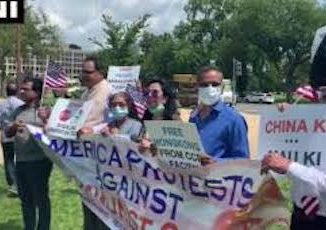
    WASHINGTON (TIP): A group of Indian-Americans from in and around the national capital held a protest here against China’s aggression towards India and the human right violations of Uyghur minority groups in the country’s restive Muslim-majority Xinjiang region.

    Maintaining social distancing and wearing masks, the peaceful protestors on Sunday gathered at the historic national mall facing the US Capitol and displayed anti-China posters, banners and raised slogans against the Communist Party of China and its leaders.

    “This summer while the world was fighting coronavirus, China was trying to encroach upon other’s land. It’s not only in Ladakh in India but also against its other neighbors as well. It’s time that the world unites against this Chinese aggression,” said Adapa Prasad from Overseas Friends of BJP USA.

    Indian and Chinese troops have been locked in a bitter standoff in several areas along the Line of Actual Control (LAC) in eastern Ladakh since May 5. The situation deteriorated after the June 15 Galwan Valley clashes in which 20 Indian Army personnel were killed and an unconfirmed number of Chinese soldiers died.

    “China’s Communist party has infringed on the religious rights of the Uyghur community and violated human rights of people of Hong Kong,” Puneet Ahluwalia, who is an Indian-American Republican and founder of the Proud American Political Action Committee, said.

    Mr Ahluwalia, who is exploring to run for the post of Lieutenant Governor of Virginia, said US President Donald Trump’s hard measures against China was in the right direction.

    “China has to play international rules,” he said.

    “We have seen what they have done in Africa. We have seen that they are doing in Iran…. Most importantly, they recently backstabbed India,” Ahluwalia said, alleging that China is spying on Americans through various social media applications and by stealing data and information.

    Sunil Singh, an eminent Indian-American from the Greater Washington DC area, praised Prime Minister Narendra Modi for banning Chinese applications in India.

    Noting that people of India have stopped buying China made goods, he said there was also a need for the Americans to make a similar move.

    This was the second major anti-China protest by Indian-Americans here in Washington DC.

  • Indian American Congressman Krishnamoorthi Introduces Legislation to Ensure Safety and Efficacy of any COVID-19 Vaccine

    Indian American Congressman Krishnamoorthi Introduces Legislation to Ensure Safety and Efficacy of any COVID-19 Vaccine

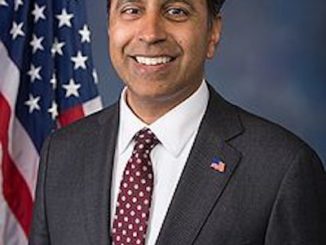
    WASHINGTON, DC (TIP): On Aug 6, Indian American Rep. Raja Krishnamoorthi (D-IL), Chairman of the House Oversight Subcommittee on Economic and Consumer Policy, introduced the “Expeditious Vaccine Advice with Legitimate, Unbiased, Apolitical, and Technical Expertise Act,” or the “EVALUATE Act,” to require the Food and Drug Administration (FDA) to solicit and consider advice from the Vaccines and Related Biological Products Advisory Committee (VRBPAC) before licensing or authorizing any COVID-19 vaccine. Rep. Krishnamoorthi introduced the bill with all of the Democratic Members of the Subcommittee: Representatives Mark DeSaulnier (D-CA), Ro Khanna (D-CA), Ayanna Pressley (D-MA), Rashida Tlaib (D-MI), Gerald Connolly (D-VA), and Katie Porter (D-CA).

    “While it is essential that a COVID-19 vaccine become available to the public as quickly as possible, it is even more important that quality is not sacrificed for speed in testing and evaluating any such vaccine,” said Congressman Raja Krishnamoorthi. “Though the FDA has refused to commit to subjecting coronavirus vaccines to an independent advisory committee, we owe it to the American people to ensure a scientifically rigorous review. The EVALUATE Act would address this need by requiring the FDA to present its analysis of clinical trial data for independent examination in a public setting, so that the country can put their trust in COVID-19 vaccines.”

    As the urgency of the coronavirus crisis has placed pressure on the FDA to approve a COVID-19 vaccine quickly, concerns have been raised in the scientific community that the FDA might approve a vaccine before its safety and efficacy is fully established. In lieu of the typical licensure process, the FDA could issue a more flexible Emergency Use Authorization. Meanwhile, any perception of hastiness or political meddling has the potential to erode public confidence in any vaccine that is approved and could lead to a substantial portion of the American population refusing to be inoculated. On July 15, the Subcommittee heard from an expert panel about the value of VRBPAC review to protect scientific integrity and increase public confidence.

    The EVALUATE Act would require the FDA to first solicit and consider advice from VRBPAC before licensing or authorizing any potential COVID-19 vaccine. Such advice would have to pertain to the safety and efficacy of the vaccine and whether there should be additional studies to evaluate the vaccine. This advice would be received at a meeting open to the public, and all materials presented for or by the Advisory Committee would have to be promptly made available to the public.

  • Ambassador Sandhu Discusses India-Pennsylvania Relationship with Governor Tom Wolf

    Ambassador Sandhu Discusses India-Pennsylvania Relationship with Governor Tom Wolf

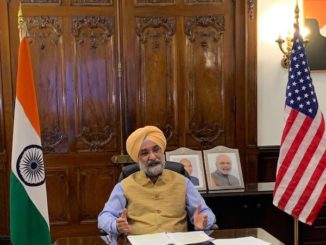
    WASHINGTON (TIP): Ambassador of India to the United States Taranjit Singh Sandhu and Pennsylvania Governor Tom Wolf discussed important areas of the vibrant India-Pennsylvania relationship, encompassing economic and people-to-people ties during a conversation Aug 7.

    Ambassador Sandhu and Governor Wolf discussed the ever-increasing trade and investment complementarities in the India-US relationship and cooperation in the fields of education and healthcare. Ambassador shared with the Governor the latest developments in the Indian healthcare and education sectors, including recent reform initiatives taken by India.

    Both noted the important contributions, especially in economy, of over 200,000 members of the Indian diaspora in Pennsylvania, including those of nearly 10,000 Indian students in Pennsylvania’s higher education institutions. Ambassador highlighted the new opportunities available for investments in India’s higher education sector under the New Education Policy recently announced in India.

    The total trade between India and Pennsylvania has grown to $3.21 billion (2019). Today over 18 Indian companies, with investments of $540 million, are supporting 3,000 jobs in Pennsylvania. Many Pennsylvania based US companies spread across Food Processing, Agriculture, IT, and Chemicals sectors are present in India. Some notable investments include Hershey’s, Kraft Heinz, Unisys, Air Products & Chemicals, FMC among others.

    Indian entrepreneurs and professionals have a significant presence in Pennsylvania in the IT and telecommunications, life sciences and manufacturing sectors. Indian high skilled talent adds to the competitive edge of the U.S. economy.

    Ambassador Sandhu and Governor Wolf agreed to work together to further enhance the India-Pennsylvania relationship.

    (Based on a Press Release)


  • INTERVIEW- Consul General Of India, New York

    INTERVIEW- Consul General Of India, New York

    Prof. Indrajit S Saluja & Bidisha Roy

    We are pleased to introduce to the  readers of The Indian Panorama   a very special person. He  is India’s 23rd Consul General at New York. Ambassador Randhir Jaiswal succeeded Ambassador Sandeep Chakravorty who is now at  Ministry of External Affairs in New Delhi . Ambassador  Jaiswal  assumed charge   on July 19, 2020. 

    Ambassador Randhir Jaiswal is a career diplomat. He joined the Indian Foreign  Service in 1998. In his over two decades of diplomatic career so far, he has served in Portugal, Cuba, South Africa and at the Permanent Mission of India in New York.

    In between his overseas assignments, he served in New Delhi at the Ministry of External Affairs, first as Deputy Secretary  looking after India’s relations with the United States of America, and then as Joint Secretary  managing India’s relations with West European countries. In the middle of 2017, he was deputed to serve the President of India as Joint Secretary managing his international relations portfolio.

    Randhir Jaiswal is passionate about sports, environment, culture, monuments, old cities and cuisines. He is deeply interested in strategic, sustainable development and public policy issues. He has been part of India’s delegation at various Climate Change Conferences and was the lead negotiator for the G-77 countries at the RIO+20 Conference held in Brazil in 2012.

    He holds a Master’s degree in History from Delhi University, India.

    He speaks Hindi, English, Portuguese and Spanish and  is conversant with several dialects of Bihar, India.

    He is married to Dr. Abha Jaiswal, a public health expert. The couple has two daughters.

    On August 5, editor Prof. Indrajit Saluja and assistant editor Bidisha  Roy  got to formally interview in person the new Consul General.

    The full text of conversation runs into 8000 words. However, keeping in mind that readers prefer brevity, which is the soul of wit, as William Shakespeare said, we have edited the interview and are  giving below a few excerpts. Should  The Indian Panorama Readers have any question, they may write to us at editor@the Indianpanorama.com or go to https://pramit.indiainnewyork.gov.in/ and send  their questions/ queries/ concerns to the Consulate.

    We have the solemn commitment from Ambassador Randhir  Jaiswal that he will ensure the community receives efficient  consular services and the best cooperation from the Consulate. Communicate directly with the Consulate; no agents or intermediaries are welcome, he says.

    Here are excerpts from the interview.

    TIP: What do you think of accomplishing as consul general which would create a legacy?

    CG:  You  have asked  me very straight question.  I would like to answer a little differently. You know our engagement with the United States of America and the engagement with the Indian community in this part of United States for which the Indian consulate of NY is responsible. We see this engagement as a continuation . Therefore,  the question of legacy etc. is part of this continuation. You know this consulate has had very close relationship,  very engaging relationship with the Indian diaspora. It would be my endeavor to further strengthen  and further deepen  this connection. We want the community to continue to warmly embrace the consulate. There are new developments happening on a daily basis. We live in a hyperconnected world. We  are living in a digital world and these new developments provide new opportunities for us to be connected with the community and serve them better. So it would be my endeavor to see how best  we can  bring these new technologies and new developments in our engagement with the community. So,  community work and community engagement, of course,  will be top priority.  We would also like   to see how best we can engage with the community and strengthen economic ties  between  India and United States. That is the priority  for government of  India to strengthen  ties with United States in trade, technology , and investment . There are immense  opportunities waiting for US business es and  corporate houses. The  Indian community here plays  an important role in people to people partnership. The Indian community,  given it size, given its achievements in the United States has played a leading role in  enhancing the ties. And being a living bridge between US and India,  I would seek their support to see how  best we can take our mutual understanding between the two countries forward with their help and with their participation.

    TIP: You have spoken about three areas of cooperation.  The top priority  you have said is  promotion and strengthening  of relationship with the community. The second  area you  spoke of  is to have better relationship, economic , trade and business relationship between India and the United states. And,  you also spoke of immense opportunities for investment in India. Are you looking at the Indian American community to be investing  in India or you are looking at the bigger picture of American investment in India?

    CG: We are looking at bigger picture. But the Indian American community because of their close connection with  India,  understand business eco system in India very well. So, that gives them extra edge to play out important facilities between business houses. Business  they can hand hold and they can bring shoulders together and see how best we can make investments to happen between India and United States; both ways from India to the United States and from United States to India. Recently, Prime Minister announced reforms  in the space sector, in financial services and insurance sector, in health. In the agriculture sector we have  undertaken several new reforms and these open up new opportunities for participations. I specifically focus on health,  financial and insurance,  defense and agriculture sectors because there are immense possibilities between  what we can learn and  what we can gain from United States. There is a whole new world of opportunities waiting.

    TIP: You have been in New York earlier as Consul at PMI.  You already know the Indian community. So,  do you think it will give you advantage?

    CG: Yes, in a sense that I am familiar with the territory here,  familiar with people and organization s and also the kind of functions. It gives me an advantage  which will help me in carrying out my responsibilities. Indian organizations are organized here on culture lines, economic lines etc. So, I am familiar with the landscape and that surely will help me.  If you go any country and you are familiar with the city,   it becomes  easier  to engage with people. In the last two weeks that I have been here, I have started to meet diaspora organization in Ohio, Pennsylvania, Philadelphia so far,  and also speaking to diaspora through The Indian Panorama and through  channels as well to connect with them.  You know this relationship is about partnership not for ourselves but for both the countries. Whatever we do we are going to be promoting mutual understanding and mutual interest in both the countries.

    TIP: I come back to the economic  aspect of relationship. There is a much better investment opportunity in the pharmaceutical sector  because India is probably one of the largest producers of generic drugs and other drugs. And there are a lot of companies in America that are interested in working  with Indian pharmaceutical companies. What special advantages can  the Govt. of India offer to the big pharma industries here? What  special incentives do you think government of  India can offer to attract American investment?

    CG: India is  known  as the pharmacy of the world. We  produce a  lot of generic drugs in  India which are exported to the United States. So what India does today is being helpful to the world and to the United States as well. Even on research side we are collaborating very closely even during  the Covid-19. You would  be aware that there are several Indian companies, several Indian entities and US entities which are working together to produce a vaccine for Covid-19 . We have rolled out FDI  policies which are  of  best  interest to people who want to invest in India. We also have a large skilled manpower which can be taken advantage of by American companies and entities which want to invest in India in pharmaceutical sector. Even research and development  infrastructure is expanding,  and there again,  because R& D is important component for pharmaceuticals industry. We have dedicated parks for pharmaceuticals industries located in various part of India. Those are some of the incentives that could be utilized  by American companies. The prime minister recently talked about ATMA NIRBHAR  BHARAT. ATMA NIRBHAYA BHARAT  is about strengthening domestic capacity so that we can then  strengthen  global supply chains and make the global economy escalate.

    TIP:  A large number of our youth who are  mostly  students, and professionals  are not at all sufficiently attracted towards Indian way of life and Indian culture. Do you think the consulate should be trying to promote Indian culture among this vast number of people who are responsible or who will be responsible for passing on the Indian values to their own children?

    CG: So you know as far as consulate is  concerned,  we are actively promoting Indian culture and various forms of Indian culture from dance, drama,  theater, music, languages etc.  We have several programs including the one to send young people from various parts  of the world  to go and see India and see various specifics of India. That is one exposure program that we have. We also conduct several other programs such as quizzes about India-  “know  India”. This 15th of August here in  this consulate we are organizing an essay competition wherein we are asking the participants,  and mostly they will be young friends from the Indian American community,  and of course open to everybody else,  to write about Indian freedom struggle and the contribution of overseas Indians in that freedom struggle. You would be aware that we had our leaders  and freedom fighters who were  based in United States from Ghadar Party  and others, in San Francisco  and elsewhere and they played a leading role and the Indian community here and people in general should be aware of the kind of role that freedom fighters staying in United States played in India’s freedom struggle.  You know Mahatma Gandhi himself was influenced by the great American  Thoreau .  So,  it’s important that historical dimension of the relationship is not missed by young leaders, young community members . So,  we are trying our best but obviously it’s such a huge expansive community. We  look forward to partnership with  cultural organizations. . We are living in a digital age. One thing which people understand,  specially the youngsters, is that it  the world of technology. Through the world of technology, we are  trying to connect with the youth here to tell them all the excitement that is happening in India.. They will feel more connected .

    TIP: Prospective investors are afraid of Red tape in India. My friend Harry S. Panaser who is a lobbyist shared with me how he prepared  some to invest in India, but they feared it will not be easy to work in India.

    CG: You know we have moved more than 65-70 places in the last five , six years in the ease of doing business. . We have made a significant jump. From 142 four years back  we came down to 65.

    TIP: I come to relationship with consulate’s relationship with media. How do you plan to effectively communicate with media?

    CG: We are fully aware that media  people are important partners in our engagement with the United States. Media has important role to play. We of course look forward to engaging with each and every segment to the media.. We are open about it. We would like to engage with them as much as possible.

    TIP: August 5 is a significant day. What are your thoughts on this historic day?

    CG: Today is one year of Kashmir action, of abrogation of article 370. Through your newspaper I would like to inform your readers and others here that a lot has happened on the ground  in Jammu & Kashmir. In terms of development  and giving good governance , much has been done. . After abrogation of article 370,  various acts of India are now applicable to people in Jammu and Kashmir, whether  it be women empowerment , domestic violence, the  right to education, right to information ,  and so on. There is a long list for that. We also made  changes for that transgender community who can benefit from social securities.  50 new educational institutions have been established,  including 7 medical colleges and 5 nursing colleges. New modern infrastructure in terms  of  transit system for 2 cities have been planned. We have established international trading center for saffron growing  in Kashmir because saffron is an  important item that is  grown  in Kashmir and it is  known globally. And it got a GI Tax.

    We also brought  benefits of digital technology to farmers in Jammu and Kashmir,  to apple growers and establishing marketplace for them. Over  half a million  Kashmiri  youth have benefitted  from scholarships  given in  just one year alone There is a long list of things that we have done. Not  everybody would be aware of the kind of things  that are happening , and the changes that are taking place on the  ground. 300,000 villages have been given electricity in just one year. Almost 300,000 household have been given tap water. People living in remote areas get tap water in their homes. Block development council elections have been held. For the first time in so many years. So we have a grassroots  support approach. We have a pro- people approach and we have a right space approach. All these things put together are empowering people who now have more   more economic choices.

    TIP: What message will you like to give to the Indian American community?

    CG: My message is in  beautiful words of Tagore .We have done very well to connect with everybody here but it would be my endeavor  to bring the distance near,  as near as possible.

  • Indian Independence Day-2020 Messages

    Indian Independence Day-2020 Messages

    Minister of State (1/C), Housing & Urban Affairs Minister of State (1/C), Civil Aviation, Minister of State, Commerce & Industry – Hardeep S. Puri

    Hardeep S. Puri

    I extend my warm greetings to fellow Indians, the Indian-American community and to the readers of The Indian Panorama on the occasion of India’s 74th Independence Day. I am happy to connect with you through the medium of this special issue being published to commemorate this historical day.

    On 15 August 2019, from the ramparts of the Red Fort, Hon’ble Prime Minister Shri Narendra Modi Ji laid out a vision for India as a $5 Trillion economy by 2024-25 anchored in inclusive, sustainable and self-reliant development. In the past six years, we have made significant progress in areas such as financial inclusion, rapid housing and infrastructure development, drastic improvement in Ease of Doing Business and rolled out one of the world’s largest health care initiatives – Ayushman Bharat.

    In the last few months, Covid-19 pandemic has brought unprecedented health and economic challenges before the governments worldwide. On 12 May 2020, Hon’ble Prime Minister launched the Atmanirbhar Bharat Abhiyaan which aims to promote the domestic manufacturing industry and integrate us further with the global supply chains. Indian professionals have a critical role in making this ambitious initiative successful as you are one of our biggest strengths.

    Indian professionals across the globe are also at the forefront of this battle against Covid-19. In these times of distress, where in some of you were stranded, we carried out the Vande Bharat Mission which has transported more than one million Indians till now. We will continue to take further necessary steps to assist all of you in these troubled times.

    Prime Minister Modi Ji’s government is committed towards the economic resurgence of our nation while supporting our most vulnerable citizens ‘ tide over these difficult times. I urge everyone to keep practicing social distancing norms for the safety of your family and community. I wish you all a happy Independence Day.

    ____________________________________________________________________________________________________________

    Ambassdor Taranjit S. Sandhu

    Ambassador Of India – Taranjit Singh Sandhu

    I extend my warm greetings to fellow Indians and Indian-Americans on the occasion of the 74th Independence Day of India. I am delighted that Indian Panorama is bringing out a special issue on this occasion.

    1. In the last 73 years, leaving the challenges of poverty and illiteracy in the dust, India is now leading the world in science, technology, commerce and innovation. At a time when the entire world is reeling under the pandemic, India is a beacon of hope forthe global revival in the post COVID world.
    2. India’s relationship with the United States has seen tremendous progress in the last few years under the leadership of Prime Minister Shri Narendra Modi. Both the countries are united in the fight against the pandemic. Going ahead, the cooperation between India and the United States will be crucial for a better, more stable, and peaceful
    3. The Indian-American community has been a strong pillar in our bilateral relationship with the United I take this opportunity to greet all of them on Independence Day and for their relentless work in strengthening the partnership between India and the US.

    Jai Hind.

    ____________________________________________________________________________________________________________

    CONSUL GENERAL OF INDIA NEW YORK – Randhir Jaiswal

    CG Randhir Jaiswal

    On the occasion of 74th Independence Day of India, I convey my warmest greetings and felicitations  to all  readers  of The Indian  Panorama.  This weekly  has served as a living bridge between India and the Indian  Diaspora  in the United States  for long. As in past, it is yet again bringing out a special edition to commemorate India’s Independence Day 2020. We are thankful to it for getting us ever closer !

    These are difficult time for all of us. The Covid-19 pandemic has hit us  hard.  I take this opportunity to pay my respects to and remember all our dear friends and well­ wishers whom we lost to the pandemic and those who were able to fight it through. And we remain grateful to the health workers and other professionals in the US, in India and around the world, for their selfless service and sacrifice, who have been there for us. As Covid warriors,you deserve our highest respect and praise.

    India and U.S. have a deep and meaningful partnership. Our close bonds of engagement are rooted in history. India’s freedom struggle drew inspiration from American values and thought. Mahatma Gandhi, the Father  of  our  Nation,  delved into the works  of  Henry David Thoreau, the great American thinker, as he grappled   to give shape to his political thought  and  action.  Ever  since,  as two  democracies, we have continued to champion freedom, justice and peace, and these  timeless values continue  to guide us as we  take our  partnership  into the 21 st  century.  We  are together thinking long-term and as much to solve the most immediate, most pressing challenge -a solution  for  the  pandemic-  for  ourselves  and  for  the humanity at large.

    I look forward to doing my best for India-US relations and to serve our community to the best of our ability. It would be my endeavor to maintain and enhance the people-oriented nature of our Consulate. May our freedom struggle ever inspire us.

    I once again extend my heartiest greetings to all readers of The Indian Panorama.

    ___________________________________________________________________________________________________________

    PERMANENT REPRESENTATIVE OF INDIA TO THE UNITED NATIONS, NEW YORK – T. S. Trimurti

    T.S. Tirumurti

    On the occasion of the 74t h Independence Day of India, I extend my hearty felicitations to The Indian Panorama for bringing out an illustrated special issue to mark this momentous occasion. I also take this opportunity to convey my greetings and best wishes to all the Indian nationals living in the United States as well as to the vibrant Indian-American community.

    India continues to be a beacon of hope for all those who believe in strong family values, preservation of heritage and culture, continued nourishment of democracy and democratic principles, adherence to pluralism and tolerance as well as in a strong voice for international cooperation and development partnership to promote peace andprosperity.

    75 years on, India remains committed to the purposes and principles of the United Nations and is proud to have made a significant contribution in shaping the agenda of the United Nations in a range of important areas including decolonization, apartheid, human rights, disarmament, environment, terrorism, development and other critical issues.

    I extend my congratulations to Chief Editor Prof. lndrajit S. Saluja and his team for their commitment to promote greater understanding and friendship between India and the United States.

    ____________________________________________________________________________________________________________

    CONSUL GENERAL OF INDIA HOUSTON – Aseem R. Mahajan

    Aseem R. Mahajan

    I am happy to know that the Indian Panorama is publishing a special illustrated issue on India’s 74th Independence Day on 15 August 2020.

    Independence Day is a special day for all Indians. It is a day on which we commemorate our long and hard freedom struggle and remember the sacrifices of those who led India to become a free nation. It is an occasion for us to take stock of the progress we have made as a nation, the challenges that we face and to reaffirm our resolve to overcome them collectively.

    The Consulate is striving to deepen the close multi-faceted ties between India and United States. We look forward to the continued support of the Indian Panorama to strengthen our outreach and promote events which we plan to organize with the community and various other stakeholders.

    I extend my warm greetings to the readers of the Indian Panorama on India’s Independence Day and wish them continued success.

    ____________________________________________________________________________________________________________

    Ambassador Asoke Kumar Mukerji

    Ambassador Asoke Mukerji – Former Permanent Representative of India to the United Nations

    On 15 August 1947, India began her “tryst with destiny” as an independent nation. This year on Independence Day, India is at another major crossroads in her evolution as a modern nation state. The importance of a supportive international environment for the transformation of India is greater today than ever before.

    The ongoing Covid-19 pandemic has accelerated the process of change underway in international relations. This global challenge has elicited a strong response. Over 150 countries across the world including some highly developed economies and many developing countries have benefited from partnering with India in responding to this challenge. This is the best example of the meaning of true international cooperation which drives the aspirations of most countries in the world.

    However, the principle of international cooperation has been steadily undermined during recent years. This has serious implications for India. The Covid-19 pandemic has impacted adversely on the economies of all countries, including India. The contraction of international trade, conducted on agreed principles of non-discrimination, is a major area of concern. India’s foreign trade contributes almost 40% of her GDP. India’s aspirations to become a $5 trillion economy by 2024 require international cooperation to be sustained, not fractured.

    Together with the adverse impact of the pandemic, creeping protectionist sentiments have grown in major markets. The raising of protectionist barriers has begun to restrict the opportunities for emerging markets such as India. Decisions on curtailing the movement of skilled Indian workers abroad, including to the United States, will have long-term consequences.

    A related development is a trend towards using technologies that accelerate and sustain development as political levers. Since integrating her national development objectives with the global Agenda 2030 on Sustainable Development in September 2015, India has moved rapidly to establish platforms that rely on such technologies for inclusive development so that no one is left behind. The JAM (Jan Dhan-Aadhar-Mobile) trinity has driven this policy in the financial services sector. This has already yielded significant results by combining the opening of about 400 million new bank accounts, including for 220 million women, with a unique identity number and a mobile connection. The result has benefited over 700 million persons through direct benefit transfers of $150 billion, while ensuring 813 million citizens have received the benefit of food security programs.

    Protectionism and a possible “balkanization” of communications technologies represent two global challenges confronting India’s re-emergence one of the world’s leading economies today. The slide towards more strident political confrontation, especially between the United States and China, represents a third critical challenge for India’s aspirations.

    India is well placed to play a pro-active role to counter these challenges. From 1 January 2021, she will take her seat as an elected member of the UN Security Council for a two-year term. In 2022, India will chair the G-20, the premier platform for global economic cooperation. India’s emphasis on a “more nationalistic approach to international relations” will need to be calibrated to reform international relations to meet her national objectives. This means a fresh effort to overcome the difficulties facing international structures that are responsible for ensuring effective international cooperation.

    India’s priorities in this regard must focus on making existing multilateral institutions “fit for purpose”. These include revitalizing the World Trade Organization, implementing the agreed reforms in decision-making in the International Monetary Fund, and fulfilling the unanimous mandate given by world leaders fifteen years ago for “early reform” of the UN Security Council to make it more equitable and representative.

    All these are today insurmountably more difficult tasks for India than they were a decade ago. Yet, these challenges provide the new emerging India with an opportunity to provide substance to the vision in the Preamble of Agenda 2030 that there “can be no sustainable development without peace and no peace without sustainable development.”

    On India’s Independence Day 2020, my warmest greetings to the readers of The Indian Panorama! Jai Hind!

    ___________________________________________________________________________________________________________

    Kevin M. Thomas – Senator, 6th District

    Kevin M. Thomas

    Dear Friends,

    It is with great pleasure that I offer my warmest greetings and congratulations to The Indian Panorama and the Indian-American Community as we celebrate 74 years of Indian Independence. As the first Indian-American to be elected to serve in the New York State Senate, I am honored to be a part of this special publication to commemorate this momentous occasion.

    The Indian Panorama has distinguished itself by capturing the diverse voices and perspectives of the South Asian community and its growing place in the complex mosaic of contemporary American life. Thispublication’s fine work in showcasing the positive impact of the Indian community in New York, as well as itsefforts to promote and uphold the interests of the South Asian diaspora, is worthy of our deepest appreciation, gratitude, and respect.

    In addition to marking this important day in India’s history, Independence Day is an opportunity for the Indian-American diaspora to celebrate our vibrant culture, heritage, and aspirations. It is also an occasion to reflect on the vast and deep contributions that Indian immigrants and Indian Americans have made throughout Americanhistory.

    Once again, I am honored to join The Indian Panorama to commemorate the 74th anniversary of India’s Independence, and I give my heartfelt congratulations to each of you as we celebrate. Jai Hind!

    ____________________________________________________________________________________________________________

    Tom Suozzi ,US Congressman ,D-NY 3rd District

    Tom Suozzi

    Today, we celebrate the 74th anniversary of Indian Independence Day. Throughout my career in public service, I have worked to elevate the US-India partnership and believe it to be one of our most important relationships for the next 50 years.

    Our relationship is driven, in part, by our vibrant Indian American community, one of the most industrious and successful diaspora populations in the world. Today, we also celebrate their contributions to our communities here on Long Island and in Queens.

    I wish all my friends in the Indian community happy, healthy, and safe celebrations. Jai Hind!

    ____________________________________________________________________________________________________________

    Dr. VK Raju

    VK Raju, MD,FRCS,FACS ,Ophthalmologist, Regional Eye Associates , President and Founder, Eye Foundation of America, President and Founder, Goutami Eye Institute, Clinical Professor, West Virginia University, Director, International Ocular Surface Society, Adjunct Professor, GSL Medical School

    Ralph Waldo Emerson, having read the UPANISHADS and VEDAS, said he could not put them away. “They haunt me. In them I found eternal compensation, unfathomable power, unbroken peace.”  That is our heritage and you often hear in Indian media that we are loud and proud about this. I agree. I often visit India, which gave me a nearly free, stellar medical education, to pursue a career in ophthalmology and dedicate my work to the prevention and treatment of eye problems in children.  (www.EyefoundationofAmerica.org)

    Since the 90s, India has made tremendous economic progress; however, some say that India is in a moral crisis. This crisis is largely political. In the 50s, many eminent men in public life were every inch gentlemen while the 60s brought us many public figures who were every alternate inch a gentleman. The 70s showed an unacceptable number of politicians who were no inch a gentleman.  Nani Palkhivala, the great statesman and Indian ambassador to the U.S., wrote in “We, the People”(1984) that the tricolor flag fluttering all over the country is black (money), red (tape) and scarlet (corruption). May I add nepotism?

    In 1947, when the British were leaving, India had more than 560 princely states. Rulers surrendered their sovereignty in exchange for privy purses and other benefits. Prime Minister Indira Gandhi (“the only man in the Indian cabinet” as critics called her) argued for the abolition of privy purses based on equal rights for all citizens and the need to reduce the government’s budget deficit. India has tried to rid itself of dynasties since the 1980s; however, politics have become more and more dynastic. According to a recent publication from the election commission of India, the total number of registered parties was 2,598, including 8 national 52 state and 2,538 unrecognized parties.  Quoting Palkhivala again, “One Indian is highly intelligent, two Indians are one political party, and three Indians are two political parties.”

    Does this reflect our Vedic wisdom and Vasudhaiva Kutumbakam?

    I wish publisher and  readers of The Indian Panorama a happy Independence Day of India.

    ____________________________________________________________________________________________________________

    Ravi Batra P.C.

    Ravi & Ranju Batra

    Dear Professor,

    Ranju joins me in wishing India, Indian-Americans, friends of a secular and democratic India and readers of The Indian Panorama: Happy Independence day India!

    What has set America and Americans apart and on a pedestal – President Ronald Reagan called us “that Shining City on the Hill” – is not that humanity is anymore “perfect” on our soil than on another nation’s, but our founding documents – created by our exceptional Founders all, be they Thomas Jefferson or James Madison or Ben Franklin to name a few – knew of humanity’s follies, and madestructural change then-unknown in human history: they separated “power,” and destroyed “control” by any one. Thus, our Declaration of Independence was born July 4, 1776, and American Exceptionalism was cemented in our cherished Constitution. As Ben Franklin answered gingerly in 1787: “[w]e are aRepublic Madam, if you can keep it.” And, we have!

    And, I am happy to note that India – after borrowing from our Declaration and Constitution – also has! America is the oldest democracy and a nation oflaws, and India is the largest democracy, and also a nation oflaws – be it Art.370, CAA or NRC. That every Indian in secular India – at a DNA-level – believes in the rule of law, freedom of religion, human rights is the core bond between our nations. Just as Law & Order is demanded now, thanks to criminal-looters on our American streets, it is even more indemand in India as she is buffeted by cross-border Terror.

    Indian in India paid the bill for the American Revolution: Indian Tea starred in the birthing of the American Revolution in 1773 Boston Harbor; and painfully, when Lord Cornwallis lost to General George Washington, King George sent him to India as Viceroy – where upon arrival he ordered the killing of 5,000 Indian men, women and children – General Reginald Dyer’s infamous massacre at Jallianwalla Bagh cemented the thirst for Freedom in India.

    Enjoy the Freedoms – defend the Freedoms – as Free martyrs

    ____________________________________________________________________________________________________________

  • REMEMBERING  JOHN LEWIS: THE FILM  “GOOD TROUBLE”

    REMEMBERING JOHN LEWIS: THE FILM “GOOD TROUBLE”

    By Mabel Pais
    “The word ‘Satyagraha’ in Sanskrit means two things ‘non-violence’ and ‘insistence on the truth’….. And that is what John Lewis was all about.”
    Nancy Pelosi, Speaker – US House of Representatives
    He Always ‘Insisted On The Truth’
    ‘The Conscience of the Congress’
    ‘When He Spoke,  People Listened When He Led,  People Followed’
    ‘One Country, One Destiny’
    ‘Living Example of Courage and Faith and Action’
    Among Big Six leaders of the Civil Rights Movement

    At the funeral of Civil Rights Icon Congressman John Lewis held on July 30 at the Ebenezer Baptist Church in Atlanta, Georgia, Speaker Nancy Pelosi said of John Lewis, “when he spoke, people listened; when he led, people followed.” She also said that ‘Satyagraha’ is what John Lewis was all about.

    He said to Pelosi, “ In my life I have done all I can to demonstrate that the way of peace, the way of love and non-violence is the more excellent way. Answer the calling of your heart and stand up for what you truly believe in.” Pelosi went on to say, “Non-violently he insisted on the truth wherever he went: in Nashville, in Selma, in Washington D.C., at the Lincoln Memorial; and he insisted on the truth in the Congress of the United States.”

    John Lewis, Voting Rights Demonstration
    USA. Selma, Alabama. October 7, 1964. The Student Nonviolent Coordinating Committee (SNCC) organized “Freedom Day”, an attempt to get residents registered to vote. John Lewis being arrested.

    John Lewis died on July 17, 2020.

    Inspired and mentored by Rev. Martin Luther King and his visit to India, in 2009 Congressman John Lewis led a congressional delegation visit to India in order to commemorate the 50th anniversary of Dr. Martin Luther King Jr’s visit to India.

    Inspired by his own visit, Congressman Lewis started the Gandhi-King Exchange Act to seek to apply the philosophies of Mahatma Gandhi and Dr. Martin Luther King, Jr. to conflict resolution efforts and current policy challenges.

    The Congressional committee on July 29 honored the two icons (King and Lewis) of Civil Rights by passing a bill written by the late American Civil Rights leader John Lewis (and co-sponsored by Congressman Ami Bera). The Act would establish an exchange initiative between the United States and India to study the work and legacies of Mahatma Gandhi and Martin Luther King Jr.

    JOHN LEWIS: GOOD TROUBLE, The Film

    “She’s (Dawn Porter, Director) dedicated her career to giving voice to the voiceless, and I like to think of my job as an ally, fighting for her vision.” – Laura Michalchyshyn, Co-Producer

    “Dawn Porter directed this documentary and she brilliantly puts the spotlight squarely on Congressman John Lewis. Good Trouble is his show. – Erica Alexander, Co-Producer

    “RIGHT ALWAYS WINS” – John Lewis

    JOHN LEWIS: GOOD TROUBLE, directed by acclaimed filmmaker Dawn Porter (TRAPPED, GIDEON’S ARMY), chronicles the life and career of the legendary Civil Rights activist and Democratic Representative from Georgia. Using interviews and rare archival footage, JOHN LEWIS: GOOD TROUBLE chronicles John Robert Lewis’ 60-plus years of social activism and legislative action on civil rights, voting rights, gun control, health-care reform and immigration. Using present-day interviews with Lewis, now 80 years old, Porter explores his childhood experiences, his inspiring family and his fateful meeting with Dr. Martin Luther King Jr. in 1957. In addition to her interviews with Lewis and his family, Porter’s film also includes interviews with political leaders, Congressional colleagues, and other people who figure prominently in his life.

    In Porter’s film, John Lewis gets the opportunity to tell us about his life, in his own words. His story. And it’s a good story.

    A Profile in Courage and Principles: Persistent Yet Calm

    ‘It’s going to be okay, because right always wins,’ he told co-producer Erica Alexander “to keep my eyes on the prize and never give up, never give in. Don’t become bitter and hostile.” She learned from John Lewis how to be young, gifted and black in American politics when she campaigned with him and other supporters in Georgia. “Mr. Lewis was the perfect teacher and a patient host. He was also a gentleman, who opened our doors and helped us up the steps. It was heaven. I didn’t know then that that real-world work, and access, would lead to making the congressman’s documentary.” Alexander said.

    John Lewis with peaceful protestors, Edmund Pettus Bridge in Selma, Alabama, on March 7, 1965.

    Early Life

    Now we get to know what it was like for him growing up a black sharecropper in Alabama in a large, loving family. He honed his fiery, oratorical skills, by preaching to the family’s chickens. He tells us how he met Martin Luther King and began his work as a student activist with the Student Nonviolent Coordinating Committee (SNCC), traveling through Jim Crow south as a Freedom Rider. As the young chairman of the SNCC from 1963 to 1966, Lewis was one of the ‘Big Six’ Civil Rights leaders of the era. This all leads to the fateful day on the Edmund Pettus Bridge (Selma, AL), where white policemen stormed their peaceful march and cracked his skull open, nearly killing him. In his appearance on national television that afternoon, bloodied and bruised, Lewis called for President Lyndon Johnson to intervene on behalf of voting rights. Until his last, he still bore scars from that brutal encounter.

    ABOUT REP. JOHN R. LEWIS :

    The Conscience of the Congress

    But John Lewis not only survived all of that, and more, he thrived and became a husband to his beautiful wife and political partner, Lillian Miles, a father to his son John Miles Lewis, and was elected to the Congressman from Georgia who earned the respect of his red and blue state peers, who lovingly call him, “The conscience of the Congress.”

    “To young legislators, he demonstrates that you can live your principles and get things done, while still being true to yourself. To his seasoned colleagues, he’s a consistent and loyal friend. So, my goal was to include the kinds of voices that would speak to each of these different experiences,” Porter said.

    A Timely Topic

    John Lewis: Good Trouble explores a variety of issues that are associated with Lewis but pays particular attention to one that is perhaps most closely associated with the Congressman’s tenure in politics: the Voting Rights Act. “Speaker Nancy Pelosi (D-CA) made the comment that John Lewis can’t be separated from the Voting Rights Act, and she’s absolutely right,” says Porter. “Many of his early activities were centered on gaining access to the vote, so we really wanted to highlight what that battle has been like for both him and the country. And considering how much voter suppression we’ve seen recently, that subject speaks volumes right now.”

    Key Credits

    Dawn Porter: Director

    Laura Michalchyshyn, Dawn Porter, Erika Alexander and Ben Arnon: Producers

    Jessica Congdon: Editor

    Tamar-kali: Music

    Length: 1h 36m

    Release Date: Currently running

    Tickets:  johnlewisgoodtrouble.com

    (Mabel Pais writes on Social Issues, Spirituality, The Arts and Entertainment, and Health & Wellness)


  • Indian American Named Fellow of Two Prestigious National Organizations

    Indian American Named Fellow of Two Prestigious National Organizations

    NEW YORK (TIP): Surita R. Bhatia, PhD, Vice Provost for Faculty Affairs and Professor, Department of Chemistry, at Stony Brook University has been named a fellow of the American Institute of Chemical Engineers (AIChE), the organization’s highest grade of membership, as well as a fellow of the Society of Rheology.

    “Surita’s commitment to excellence in science and engineering is apparent through the recognition she has received from such prestigious organizations as the AIChE and the Society of Rheology, as well as in her work every day,” said Nicole S. Sampson, Dean of the College of Arts and Sciences and Distinguished Professor of Chemistry. “My deepest congratulations to Surita on these well-deserved honors!”

    Recognition as an AIChE fellow reaffirms the high esteem with which colleagues and peers view distinctive professional achievements and accomplishments. Candidates for AIChE fellow are nominated by their peers, must have significant chemical engineering experience (generally 25 years), have demonstrated significant service to the profession, and have been a member of AIChE for at least 10 years.

    Dr. Bhatia was recognized by the Society for Rheology for her contributions to the understanding of structure-properties relations through the application of USANS/USAXS spectroscopic techniques along with rheology to a wide spectrum of complex fluids including colloidal glasses, micellar polymer gels, polysaccharide hydrogels and soft biomaterials; and for her contributions to the understanding of dynamically arrested states and re-entrant behavior in colloidal systems.

  • Indian-Origin Parents Plead for Return of Children from Foster Care in UK

    Indian-Origin Parents Plead for Return of Children from Foster Care in UK

    LONDON / CHENNAI  (TIP): An Indian-origin couple who won a major UK court appeal recently that prevented their children from losing their Indian citizenship are now appealing for authorities in Britain to allow their two minor children in foster care in Britain to be reunited with their family to live in India.

    The parents, who cannot be named for legal reasons, are originally from Nagapattinam in Tamil Nadu and moved to the UK in 2004. They lost all contact with their children – a son aged 11 and daughter aged 9 – in August 2015 when they were taken into the care of the local childcare authorities in Birmingham.

    Their case has been going through the family courts in Britain and last week, a UK Court of Appeal judgment concluded that the Birmingham Children’s Trust must seek the court’s approval before any attempt to apply for British citizenship for the children in the face of “parental opposition”.

    “I am an Indian national. The children are Indian nationals too. We would love to go to India. We don’t want British citizenship for the children. We have made this clear,” said the 52-year-old father, a civil engineer struggling to make ends meet in Birmingham.

    “The Indian High Commission supported the return of my children in the court proceedings,” he said.

    The Consulate General of India (CGI) in Birmingham said it has been providing consular and legal assistance to the parents in their four-year-long legal battle.

    “We had submitted in the honorable Family Court in Birmingham that the Indian Consulate wishes to provide assistance for the children’s welfare needs and provide the necessary arrangements to provide the Indian passports for the children and will fund the costs of the flights and transportation to India and overseeing their care arrangements,” the CGI in Birmingham noted in a statement.

    The CGI said that it continues to offer support and monitor the progress in the case and had also assisted the parents to procure a home study report from the Child Welfare Committee, District Nagapattinam, regarding prospective custodians of the children in Tamil Nadu.

    “We must understand that the case is sub-judice and any comments on this case may not be appropriate,” the Indian consulate noted.
    The case was described by the UK Court of Appeal as a “challenging one for everyone”, with the Tamil-speaking parents requiring interpreters.

    In the latest appeal, the father was represented by prominent Indian lawyer Harish Salve, who argued that a change of citizenship marks a “fundamental change” and “matter of great moment”, which may or may not be in the children’s interests.

    The reasons behind the children’s removal from their parents” care were not revealed in court but a previous ruling in December last year determined that the minor boy and girl must remain in long-term foster care for the remainder of their childhoods.

    “My sole purpose of staying back here [in Birmingham] is to get my children released from the UK authorities and have them returned to India, whether with or to approved relatives… The children will lead a peaceful life with safety and security in India,” said the father, speaking in Tamil.

    His wife, a 45-year-old Indian national also from Tamil Nadu, is now living in Singapore with her mother and the couple’s four-and-a-half-year-old daughter, born after she left the UK while pregnant over fears of losing her third child to foster care as well.

    “Don’t I care for my third child well now? Their accusations are just false. They separated my children from me… I was not able to comprehend what was happening and I was just stunned. I asked for an interpreter since I could not understand English much,” said the tearful mother from Singapore, also speaking in Tamil.

    In court, she was assisted by Delhi-based advocate Nandita Rao, described as a legally qualified “McKenzie friend” – or someone who assists a litigant in UK court proceedings by giving advice.

    “In my personal capacity, as a person interested in child rights, I would suggest that the Birmingham authority ought to assess its capacity to preserve the nationality of children (who are not citizens of the UK) in the foster care system,” said Mr Rao.

    “Nationality has a de jure part (i.e. identity in law) and a de facto part (cultural identity). The latter includes preserving the language, food habits, social and family contacts of the child. If the authority is not in a position to ensure the cultural identity of a child is preserved… the local authority should explore foster care for the child in his home country, unless the child is an asylum seeker or has a risk of persecution in its home country,” she said.

    The local authority, the Birmingham Children’s Trust, said it was considering the implications of the judgment handed down by the UK Court of Appeal on August 6.

    “We have received the judgement and we will be considering the outcome and implications in our future practice,” said a spokesperson for the Birmingham Children’s Trust.

    Last week’s ruling had acknowledged that changing a child’s citizenship was a “momentous step” and not a routine matter.

    “Changing a child’s citizenship is a momentous step with profound and enduring consequences that requires the most careful consideration… The local authority should now indicate whether it wishes to progress the matter, in which case we will give appropriate directions,” it noted.

  • Indian-American Muslims, Sikhs on Kamala Harris say “Great Deal to all Immigrants”

    Indian-American Muslims, Sikhs on Kamala Harris say “Great Deal to all Immigrants”

    WASHINGTON (TIP): Indian-American Muslims and Sikhs here have hailed the selection of Senator Kamala Harris as the Democratic party’s vice-presidential candidate, calling it a remarkable success for the entire community.

    Democratic party’s presidential candidate Joe Biden on Tuesday, August 11,  picked Ms Harris as his running mate, recognizing the crucial role Black voters could play in his determined bid to defeat President Donald Trump in the US presidential election.

    The 55-year-old California senator, whose father is from Jamaica and mother an Indian, becomes just the third woman to be selected as the vice president on a major party ticket. Then-Alaska Governor Sarah Palin in 2008 and New York Representative Geraldine Ferraro in 1984 were the other two.

    In a statement, the Association of Indian Muslims of America (AIM) congratulated Ms Harris on her nomination and lauded the Indian-American community for its extraordinary success in the face of tough competition in US in just about five decades.

    Kaleem Kawaja, the executive director of AIM, expressed joy at the remarkable high success of a second generation Indian-American in becoming a candidate for the second highest public office in America.

    Kamala Harris is the daughter of Prof Shyamala Gopalan, a cancer biologist, who was from Chennai, India, and had emigrated to US in 1965.

    Welcoming the addition of Ms Harris to the Democratic presidential ticket, Dr Rajwant Singh, chairman of the Sikh Council on Religion and Education and Senior Adviser to National Sikh Campaign, said that it is a great step for such as major party to add someone from the minorities for the national office in America.

    “It means a great to deal to blacks, women and to all immigrants,” he said.

    “We are thankful to both Joe Biden and Kamala Harris for reminding Americans about the 8th anniversary of the shooting at Sikh Gurdwara in Oak Creek, Wisconsin, just a few days ago. We need more of our political leaders to be forthcoming on these critical issues of gun violence and hate crimes facing America,” Dr Singh said.

    Ms Harris being on the national ticket opens the door for many people from all minority communities to aspire to lead this great nation, Dr Singh added.