CHICAGO (TIP): It was tough and challenging for the pioneer physicians of Indian origin to establish practice and find suitable job opportunities when they started coming to the US in the early 1960s and the 1970s.
So recalled Dr. Ranga Reddy, who has chronicled the history of American Association of Physicians of Indian Origin (AAPI) in a coffee table book released during the mini convention of the association Chicago last month.
“The journey to the land of opportunities was tough and challenging,” said Dr. Reddy, Chair, AAPI History Task Force & Past President, 1997-98, according to an AAPI media release.
“Faced with instances of overt as well as subtle discrimination in Residency recruitment and License Reciprocity, physicians of Indian Origin organized themselves in several states to fight the unfair treatment.”
“It was a passion for history” that made this historic moment a reality, said Dr. Ranga Reddy, a medical graduate of Kurnool Medical College, where he had obtained MBBS and M.S Degrees.
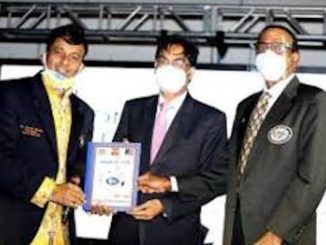
Consul General of India in Chicago, Arun Kumar, along with Dr. Suresh Reddy, Immediate Past President of AAPI released the book. The first copy of the book was presented to Dr. Ranga Reddy.
“This coffee table book is dedicated to all the ‘First Ladies’ who have sacrificed innumerable hours of their family time for the sake of AAPI,” Dr. Suresh Reddy said.
Dr. Ranga Reddy had his Training in Anesthesiology at State University of New York (SUNY). He started his career at St. Louis University School of Medicine as an Assistant Professor in the Department of Anesthesiology
He later on, moved to Springfield, Illinois to join practice in Memorial Medical Centre, where he served as the Chairman of the Department of Anesthesiology.
Dr. Ranga Reddy served AAPI in various capacities including as its President and as a member of the Board of Trustees.
During his presidency “One Member One Vote” policy was introduced for electing the leaders making the process truly democratic.
In order to comply with AAPI’s 501 (3) C status, AAPI’s Political Action Committee was replaced with Legislative Affairs Committee.
He led efforts to create AAPI’s Patron Trustee Membership to support AAPI Charitable Foundation and raised over $600,000 during his Presidency.
In India, Dr. Ranga Reddy started an AAPI Charitable Clinic in a remote village called Ellayapalle to provide medical services to the indigenous people.
He promoted “Adopt the Primary Health Care Center of Your Native Place” in Andhra Pradesh. He co-sponsored a water project with Nandi Foundation to supply clean water to the villagers.
Dr. Ranga Reddy was invited to the White House in 1995 by President Bill Clinton on behalf of AAPI Leadership.
He is the recipient of the AAPI Distinguished Service Award, Distinguished Public Service Award by American Telugu Association and Leadership Award by the Association of International College of Physicians.
“This is an excellent historical review of AAPI by Dr. Ranga Reddy,” said Dr. Anupama Gotimukula, President-Elect of AAPI.
“Over the past 37 years, AAPI has grown and is now the largest ethnic medical society in the US, representing the interests of over 100,000 Indian American physicians and Fellows,” noted Dr. Sudhakar Jonnalagadda, current President of AAPI.
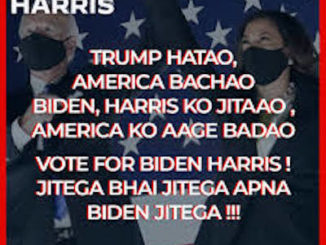
SACRAMENTO(TIP): A Silicon Valley-based Indian-American couple has released a digital graphic campaign in Hindi, urging their community members to support and vote for Democratic presidential candidate Joe Biden and his running mate Kamala Harris.
The campaign titled “Trump Hatao America Bachao” and “Biden Harris ko jitao , America ko aage badao“, was launched in 14 Indian languages on Monday, October 12said Biden supporters, Ajay and Vinita Bhutoria.
The focus of the campaign on the battle ground States where every vote matters and Indian-Americans can play an important role in the election results, Bhutoria said in a statement.
Battle ground States of Pennsylvania, Wisconsin, Michigan, Minnesota, along with three southern states Florida, Georgia, North Carolina, as well as Arizona collectively have 127 electoral votes.
“The Indian American Votes will be the margin of victory and make the winning difference in battleground states,” he said.
In 2016 Trump had a narrow win in Michigan, Wisconsin, Pennsylvania.
Democratic supporters this year are doing extensive outreach to the Indo Americans /South Asians in 14 languages through thousands of phone banking calls each week.
“We are determined to turn out the 1.3 million Indo American votes for Biden,” he said.
Earlier Ajay had released two Bollywood videos to “unite all South Asians and people of Indian origin to support Biden and Harris.
”Chale Chalo Biden ko vote do” (Let’s go, vote for Biden) the music video is now running on TV Asia as advertisement and Ajay also led by bringing Digital Graphics of “America Ka Neta Kaisa Ho Jo Biden Jaisa ho” and “Jaago America Jaago, Biden Harris ko Vote do” earlier in 14 languages.
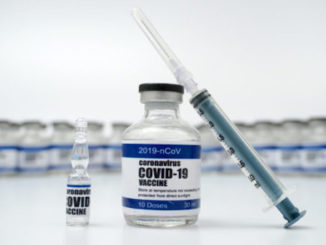
HOUSTON (TIP): The University of Houston (UH) has joined hands with an Indian American co-founded biotech company, AuraVax Therapeutics, to develop a ‘differentiated-approach’ vaccine against aggressive respiratory diseases, such as COVID-19.
AuraVax, however, has the option to exclusively license a new intranasal vaccine technology developed by its Indian-American co-founder, Navin Varadarajan, M.D. Anderson Professor of Chemical and Biomolecular Engineering at the University of Houston.
“A safe and durable vaccine is urgently needed to tackle the COVID-19 pandemic that has infected millions of people and caused over 620,000 deaths globally,” Vardarajan stated.
“We plan to stop COVID-19, a respiratory virus, at its point of entry – the nasal cavity – and we believe our intranasal platform is a differentiated approach that will lead to a vaccine with increased efficacy to create sustained immunity to COVID-19,” he said.
Based on pre-clinical experiments, Varadarajan reports his technology not only elicits a mucosal immune response, but also systemic immunity, according to the UoH.
Varadarajan is targeting the spike proteins, which allow infections to penetrate host cells, in his study. The professor also prefers proteins because of their ability to induce strong immune responses, flexibility and scalability, and the absence of infectious particles, as per an UoH statement.
AuraVax describes its vaccine administration platform as ‘next-generation’, one which could be administered at home.
“We are excited to be collaborating with the University of Houston and look forward to future success by advancing the development of this novel intranasal vaccine platform to address a multitude of respiratory viruses, starting with COVID-19. We plan to stop COVID-19, a respiratory virus, at its point of entry — the nasal cavity — and we believe our intranasal platform is a differentiated approach that will lead to a vaccine with increased efficacy to create sustained immunity to COVID-19,” said Varadarajan.
“AuraVax, being created by an UoH professor, is the ideal partner for us, and what better cause than to advance the creation of a vaccine to COVID-19, arguably the primary challenge facing our generation. The partnership has my wholehearted support,” said Amr Elnashai, University of Houston vice president for research and technology transfer.
“The race for more effective ways of vaccinating against COVID-19 and other respiratory diseases has led to a broad and extensive focus on various protective mechanisms of action. Based on pre-clinical work, our technology not only elicits a mucosal immune response, but also systemic immunity. We believe AuraVax has a competitive advantage given the immune responses and a supply chain that is well-suited for widespread distribution and self-administration distribution,” said Dr Varadarajan.
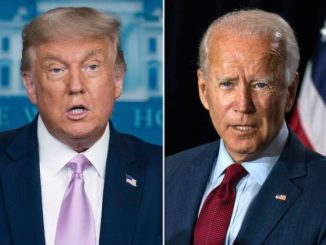
NEW YORK (TIP): Nearly three-quarters of Indian Americans plan to vote for Democratic presidential candidate Joe Biden in the U.S. election next month, believing the country is headed in the wrong direction under President Donald Trump, according to a survey on Wednesday.
Indian Americans, the second largest immigrant group in the United States, make up less than 1% of registered voters for the Nov. 3 election. But both parties have reached out to the community in case they become important in the event of a close vote.
The Indian community is also in the spotlight after Biden picked Senator Kamala Harris, the daughter of an Indian immigrant, as his running mate. Harris is the first Black woman and Asian American in history to make the presidential ticket for a major party.
The survey found 72% of registered Indian American voters supported Biden for president compared to 22% for Trump. The rest either chose “others” or said they did not intend to vote.
The survey, a collaboration between the Carnegie Endowment for International Peace, Johns Hopkins-SAIS, and the University of Pennsylvania, covered 936 Indian Americans.
It was conducted between Sept. 1 and Sept. 20 in partnership with YouGov with an overall margin of error of +/- 3.2%.
The Indian community has traditionally supported the Democratic Party, but strong personal ties between Trump and Indian Prime Minister Narendra Modi have raised expectations of a shift.
In an effort to win support from Indian-American voters, Trump hosted a 50,000-person “Howdy Modi” rally in Texas with PM Modi last year. PM Modi returned the favor in February, organizing a 110,000-attendee rally for Trump in India.
There has been speculation the Indian community in the U.S. may not favor a potential Biden presidency, fearing he may be tougher on India on issues such as human rights and civil liberties that activists say are increasingly at risk under PM Modi.
Still, the survey showed little erosion in support for Biden.
“The big takeaway from these numbers is that there is scant evidence in the survey for the widespread defection of Democratic voters toward Trump,” said Milan Vaishnav from the Carnegie Endowment for International Peace, Devesh Kapur from Johns Hopkins and Sumitra Badrinathan in their assessment.
Voters who were polled listed the economy and healthcare as their top two concerns in the lead-up to the vote. U.S.-India ties were near the bottom of the list.
Harris’s run for vice president has galvanised Indian Americans to turn out to vote, especially the Democrats.
About 49% of respondents indicated that Harris’s nomination made them more enthusiastic about Biden’s candidacy while just 15% said it made them less enthusiastic.
Harris is born to an Indian mother and a Jamaican father who both emigrated to the United States in their youth to study.
Chairman of the British Sikh Association Lord Rami Ranger CBE Launches the App named “Zozter”
Nirpal Singh Shergill in London
LONDON (TIP): Lord Rami Ranger CBE launched “Zozter-the pioneering Business Card Sharing App”. The concept has been developed by a long-standing employee of Lord Ranger’s company, Sun Mark Ltd, Mr Amritpal Sachdeva, fondly known as Lucky. Mr. Sachdeva had started his working life at Sun Mark Ltd and progressed up the ranks to become the Distribution Manager, having worked at Sun Mark for over 18 years.
Lord Ranger CBE, at the launch event, said to the local media, “I am very proud to see how Lucky has developed his business acumen and customer service skills whilst at Sun Mark and I am very impressed with his Zozter App. The pioneering Zozter App developed by Lucky provides solutions in today’s digital world. It is reducing the need to use paper and to carry business cards to help the environment. It is challenging to manage so many business cards which one gets daily when going about the businesses. It is child’s play to store the information, all the information one needs to run an effective business. The app helps you network with like-minded professionals and also helps you find suitable employment and business opportunities.”
Lucky said, “ I owe all my success to Lord Ranger who has been my guiding light and mentor and who has made me what I am today. I am proud to have created the start-up Zozter; it is the world’s first online social card sharing application based on the idea of enhancing the sharing of business cards and services to a global community, it is the next level in marketing and business networking ”.
Zozter’s unique features allow it to be used on all platforms. It is a digital business card holder for your old business cards. The mission is to create a global community to help facilitate business networking and to help both employers and employees connect in a seamless way.
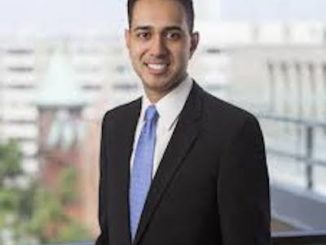
WASHINGTON (TIP): The National Law Journal has recognized prominent Indian American attorney Ronak Desai as one of its DC “Rising Stars.” The award recognizes the region’s 40 most promising lawyers age 40 and younger, “who have wielded influence in their practice areas in the D.C. area and beyond,” and is conferred upon “innovators who develop unique practice niches, secure wins for clients, and demonstrate strong leadership qualities.”
Selected from hundreds of nominees, Desai’s impactful work in the white collar, anticorruption, India, and congressional investigations spaces along with his “sustained pro bono work and commitment to public service,” earned his inclusion on the coveted list.
Desai is a longtime Indian American community leader who has fast emerged as an influential next-generation practitioner and scholar in the legal and foreign policy fields. In addition to his private sector work at some of the country’s most exclusive law firms, Desai also spent two years as counsel to the U.S. Congress. In 2014, Representative Elijah Cummings appointed Desai as legal counsel to the high-profile House Select Committee on Benghazi. The pioneering congressman passed away in October 2019.
Although his Capitol Hill tenure concluded shortly before the 2016 presidential election, Desai continues to serve as an informal advisor to several members of Congress and other high-ranking decision-makers on law and foreign policy issues. “There are few folks, particularly at his age, who have the expertise and insights Ronak has and it something we continue to rely on all the time” one member noted.
Following his government service, Desai returned to private practice. He is currently an attorney at the elite Los Angeles-based law firm of Paul Hastings LLP. The firm’s roster includes such white-collar luminaries as Robert Luskin, Kwame Manley, and Matt Herrington. With 22 offices around the world, the firm generated over $1.2 billion in revenue last year. Paul Hastings consistently ranks among the top 10 on The American Lawyer’s “A-List” of law firms.
Desai named Herrington as one of his greatest mentors in legal practice in his interview with the NLJ, along with DC Circuit Chief Judge Sri Srinivasan, and former U.S. Ambassador to India Richard Verma.
“Ronak is an outstanding lawyer who combines a razor-sharp legal mind with a natural affability. [He] is respected by clients and adversaries in equal measure,” Herrington said to media.
The view was echoed by opposing counsel Desai has worked with on Capitol Hill, who said Desai was “deeply respected by both sides of the aisle for not just for his high-caliber work and brilliance, but also for his reputation as someone you can trust and work with even in this highly partisan environment.”
Desai’s clients similarly heaped praise on him, with one calling him the “gold standard.” Another stated that “no matter how complex the [case] becomes, [Ronak] handles it with unparalleled skill, grace, and sophistication,” adding that every client should want Desai “firmly on their side.”
Kwame Manley, a former federal prosecutor and Global Chair of Paul Hastings’ award-winning White-Collar Defense practice, said “Ronak is a superstar. He has achieved tremendous success for his clients so early in his career. We are excited about his continued excellence at [the firm].”
Desai’s award from NLJ comes less than a year after he received the “Rising Star” award from DC’s South Asian Bar Association (SABA). The honor recognizes “a talented individual within…the community, who…has been practicing for fewer than 10 years, and has achieved prominence and distinction in their respective field while demonstrating a strong commitment… to the South Asian community.”
Cook County Circuit Court Judge Sanjay Tailor told the American Bazaar, “whether it’s assisting clients with the minefields of India’s regulatory environment, navigating the complexities of Congressional investigations, or bringing media and public pressure to bear on the Sureshbhai Patel case, Ronak does it all and does it with customary aplomb.” He noted that “there are few who are able to successfully employ their skills [in the service of so many] on such a wide breadth of issues. His portfolio is endless.”
Several other Indian Americans were also named members of this year’s “NLJ DC Rising Stars” class. They include: Sandeep Nandivada, a government contracts attorney at Morrison and Foerster; Kapil Pandit, an investment management attorney at Akin Gump Strauss Hauer & Feld; and Alka Pradhan, an eminent international humanitarian law and human rights attorney with the Guantanamo Bay Military Commissions Defense Organization.
Pradhan is one of the country’s most respected lawyers in this realm and was the subject a glowing New York Times Magazine profile feature spotlighting her work in December 2017.
Pradhan and Desai both overlapped during their undergraduate studies at the Johns Hopkins University in Baltimore, where Desai was elected Phi Beta Kappa. Originally hailing from Orange County, California, Desai earned joint public policy and law degrees (M.P.P./J.D.) from the Harvard Kennedy School of Government and Harvard Law School, from which he graduated magna cum laude and received the Dean’s Scholar Prize.
Outside his legal practice at Paul Hastings, Desai is an associate at the Lakshmi Mittal and Family South Asia Institute at Harvard University, a Law and Security Fellow at New America, and an Asia 21 Leader at the Asia Society. He also serves as pro bono General Counsel and board director to the Partnership for a Secure America (PSA), a foreign policy think tank that promotes bipartisanship on Capitol Hill.
Desai also maintains an unwavering commitment to public and community service. In 2016, DC Mayor Muriel Bower appointed Desai to her Commission on Asian American and Pacific Islanders (AAPI). The commission is responsible for advising the Mayor and the public on the unique needs of the AAPI communities residing in the District of Columbia. Desai was unanimously confirmed to a second term by the DC City Council last year.
Desai has also attracted recognition for his exhaustive thought leadership in publications like Forbes and Bloomberg, where he regularly publishes on a wide array of important legal and policy issues. According to one Congressional source, “virtually every community member currently in a position of public service has benefited in some way, shape, or form from Ronak’s longstanding efforts to chronicle the steady rise of the Diaspora community and raise its profile within the United States.”
Herrington appeared to capture the views of many individuals toward Desai when he said, “I was thrilled but certainly not surprised to see [Ronak] recognized as a rising star.”
Judge Tailor went on to say that despite his tremendous success and extensive accomplishments, “Ronak is down-to-earth and instinctively self-effacing. His family, community, and faith are his North Stars.”
Youth interest in voting has hit its lowest since 2000, GALLUP reports
Does Ohio provide a model?
The shy Trump vote is bigger this year…and who falls into this category should terrify Democrats. I will say it again, folks. The polling is skewed. It is a mess. Either we are right to be highly skeptical and Trump wins an Electoral College landslide, or the pollsters are right and Biden wins landslide. Young Americans are not excited about this election at all. They are not planning on voting. Gallup is reporting the youth interest in voting this cycle has hit its lowest since 2000. That is in keeping with the results from Democracy Institute’s Patrick Basham, whose polling data, which has been mentioned in The Washington Times and Forbes, suggests there will be one million fewer young people voting this cycle. Hill-Harris X Research shows younger voters are consistently more likely to say they do not plan to vote.
Basham spoke with Joseph Cotto about his new data. Pollwatch had a good thread summarizing the interview. Democracy Institute’s poll had a sample size of 1500 voters, where Trump leads Joe Biden by one point. He also noted that the “shy Trump” vote is very much alive and will be bigger this time. Suburban white women and urban black women are the two groups that are most likely to fall into the shy category for the 2020 cycle. That latter part should shake Democrats to their core. And as for Florida, a state that Biden must carry, it could already be out of his reach. Basham notes Trump cannot fall asleep at the wheel, but things are becoming more comfortable for him in the Sunshine State. And based on some recent polling from the state, it looks like the tide has shifted solidly in favor of Trump.
The outcome of Election Day 2020 would seem to be a foregone conclusion if the latest national and battleground polls are any guide as to whether President trump will win in his reelection bid.
However, the GALLUP poll has just released the results of a new survey that suggests President Trump might have a better shot than you would think.
Most Americans responded positively to the survey question asking whether they feel better off now than they did four years ago.
Trump’s odds of winning reelection seem to be growing slimmer by the day—though, it is worth remembering that we have also seen this movie play out before. This is not the first time that Trump has been in this predicament.
DOES OHIO PROVIDE A MODEL FOR PRESIDENTIAL VICTORY?
No Republican has won the Presidency without winning Ohio. Franklin D Roosevelt in 1944, and John F Kennedy in 1960 won without winning Ohio. President Trump won Ohio by 8 points in 2016. He accomplished this in spite of stiff opposition from Republican Governor John Kasich. So far, all indications are Trump will easily win Ohio. Biden has been visiting Ohio but his reception has been poor. If Trump wins Ohio like in 2016, it will influence his outcome in Michigan, Pennsylvania, Wisconsin, and Minnesota.
POINT OF CAUTION IN READING POLLS SPONSORED BY THE MAINSTREAM MEDIA:
All these pollsters have been interviewing registered voters — there are much more registered Democrats than Republicans. Polling most likely voters may give a better clue. The undecideds and third parties comprise 10% of final voters.
(Ven Parameswaran, Chairman, Asian American Republican Committee (Founded 1988), lives in Scarsdale, NY. He can be reached at vpwaren@gmail.com)
WASHINGTON (TIP): Democratic presidential candidate Joe Biden has vowed to provide citizenship to 11 million illegal immigrants if voted to power in the November 3 presidential election. Biden identified this as one of his priorities in addition to beating the coronavirus pandemic, rebuilding the economy and figuring out how to restore American leadership around the world.
At a virtual fundraiser on Wednesday, October 14, Biden said there is a need to deal with what’s going on at the border. “We’re going to have to deal with the immigration crisis,” he said.
Donald Trump has been calling for the deportation of illegal immigrants.
Meanwhile, Democratic vice-presidential nominee Kamala Harris has cancelled her travel plans through Sunday as a precaution after one of her staff members tested Covid positive.
NEW YORK (TIP): New Yorkers will be happy and proud to know that a former Consul General of India at New York Dr. Dnyaneshwar Mulay has been appointed Chair of an Inter-ministerial Working Group to develop a single national Portal titled “Pravasi Bharatiya Academic and Scientific Sampark (PRABHASS).
Dr. Mulay is a member of National Human Rights Commission, India and a former career diplomat who has held key positions in the ministry of external affairs, government of India.
The new body, PRABHASS would work towards effectively engaging with Global S&T community for enriching the Indian innovation ecosystem for networking them with Indian researchers/institutions, provide policy guidance, establish and launch joint collaborative programs/schemes etc., a press release said. This sort of initiative is first of a kind to tap the expertise of overseas Indians for India, in line with Prime Minister Narendra Modi’s vision of “Aatmanirbhar Bharat,” the press release said.
The PRABHASS committee is constituted of officers from various ministries including Sanjeev Varshney, head of the Science and Technology department, Dr. Rajani Kant from Indian Council of Medical Research, A.K. Tyagi from Department of Atomic Energy, N. Ranjana from D.R.D.O., Gopal Raman Iyengar from Ministry of Earth Sciences, M.S. Anurup from Space department, Manish Rana from Department of Biotechnology, Rama Swami Bansal from Council of Scientific and Industrial Research, Renu Paul from Ministry of External Affairs along with a member from the Department of Agricultural Research and Education.
“With his vast experience and valuable insights from a long service in the Ministry of external affairs, Dr. Dnyaneshwar Mulay would be able to guide this high-level committee to bridge the gap between Overseas Indians and India,” the press release said.
Born on November 5, 1958 in Kolhapur District of Maharashtra State (Western India), Dr. Dnyaneshwar Manohar Mulay took his primary education at the village Primary School. Subsequently, he completed bachelor’s degree in English Literature from Shahaji Chhatrapati College at Kolhapur, followed by master’s degree in Personnel Management from Mumbai University. He joined Indian Foreign Service in 1983 and, besides serving at the Ministry of External Affairs in New Delhi, has also done postings in Indian Missions in Tokyo, Moscow, Port Louis. He served as Minister in Damascus and was High Commissioner of India to Male (Maldives) from April 2009-March 2013. He was Consul General of India at New York from April 2013 to 2016. In New Delhi, he acquired diverse experience during his assignments at Ministry of Commerce and Industry, Ministry of Finance, and, of course, Ministry of External Affairs.
In his position as Secretary NRI Affairs at the external affairs ministry, he was responsible for softening or removal of many restrictive policies governing passport, visa, OCI and PIO cards. His contribution to organizing Pravasi Bharatiya Sammelan (now almost defunct) is an unforgettable chapter of history.
Dr. Mulay is an award-winning writer in Marathi and Hindi. He has contributed several books some of which have been translated into Kannada, Arabic, Urdu and Dhivehi. He has keen interest in Education, Environment (particularly water security) and socio-economic issues. Dr. Mulay is married and has three children-a daughter and two sons.
The Indian Panorama team takes pride in his new assignment and wishes him all the best, as ever, and waits to report on his charismatic performance, again, as ever.
WASHINGTON (TIP): U.S. President Donald Trump said on Thursday, Oct 15 he was willing to support a comprehensive COVID-19 coronavirus relief package larger than $1.8 trillion to make a deal with Democrats and get a bill passed.
“I would,” he said during a telephone interview with Fox Business News. “Absolutely, I would. I would say more. I would go higher. Go big or go home.”
He went on to say that he had directed Treasury Secretary Steven Mnuchin to make an offer over the $1.8 trillion package previously supported by the White House but said Mnuchin “hasn’t come home with the bacon.”
Trump said he would not accept “goodies” in the Democrats’ proposal.
House Democrats, led by Speaker Nancy Pelosi (D-CA), have been pushing for a $2.2 trillion package that would include funding for state and local governments, schools, and coronavirus testing and tracing, among other priorities.2
Republicans in the Senate support a $500 billion bill that would not offer a wide a range of measures. Senate Majority Leader Mitch McConnell said the upper chamber would be working on the bill next week.
REPUBLICANS
Democrats demanding a ‘wish list’
“(Democrats) say anything short of their multi-trillion-dollar wish list, jammed with non-COVID-related demands, is ‘piecemeal’ and not worth doing,” McConnell said in a statement. “Speaker Pelosi frequently says she feels ‘nothing’ is better than ‘something.’ And she has worked hard to ensure that nothing is what American families get.”
DEMOCRATS
Republicans have the wrong priorities
“We want to have an agreement. Yet Republicans refuse to ensure that such an agreement puts #FamiliesFirst,” Pelosi said.
Why should we support or pull down the Indian -Americans running for US Congress or Senate?
The answer is simple, almost all Indian Americans have families back in our motherland, and we must support and elect candidates who subscribe to American values. You and I came to America and have cherished this nation for its values of freedom, equal opportunities, equal justice, equal dignity, liberty, and the pursuit of happiness. We should wish the same for our fellow Indians back home or any people anywhere.
We must reject those candidates who do not want the same values as the Indians living in India and certainly pull the hypocrites down if they support the fascist Modi regime in India that is lynching, harassing, raping, and killing fellow Indians. We cannot let our motherland go down the drain with such individuals.
Law Makers Ro Khanna, Pramila Jayapal, and Kamala Harris have proved to be patriotic Americans fully subscribing to American Values. However, we have to make a critical decision about new candidates running for the legislatures. The questionable man is Sri Preston Kulkarni, a controversial person running for the US Congress from Congressional District 22 from Houston, Texas.
He is accused of taking donations from the people who run the RSS organization in India. RSS is a paramilitary organization like the Nazis, ISIS, and KKK, which runs the Indian government and believes that the Christians (30 Million) and Muslims (200 Million) who have lived in India from the 2nd Century and 8th Century respectively do not belong in India. Through his minions, Prime Minister Modi, who has similarities with Hitler has given them three choices– convert to Hinduism, live as 2nd class citizens or disappear.
The ideology of RSS is dangerous to the social fabric of India and detrimental to India’s economic stability and prosperity. Now, it is creeping into America, and we need to stop it.
I have texted Mr. Kulkarni thrice to answer simple questions. He turned it over to Jack, his field director; both have promised to respond in vain for almost a month.
Here are few of the several questions I have asked Kulkarni.
If elected, would you initiate a bill in the house about equal rights, equal pay for women and equal justice for all citizens?
If elected, would you support a bill that would require the Indian Government to treat the Dalits, Muslims, and Christians as equal citizens with equal rights and equal justice for all?
If elected, would you support a bill to restore the full freedoms to the People of Kashmir?
If elected, would you encourage the RSS to renounce its extremist ideology and accept Indian Dalits, Muslims, Sikhs, Jews, and Christians as Indians and have equal rights with all citizens?
Should a conflict arise between India and the United States, and Congress is short of one vote for passing the bill, what would be your position?
Would Kulkarni make the following statements?
“I am concerned about the violations of religious freedoms in India, particularly against minorities. Being a minority myself, I will not tolerate minorities to be treated like that in any country. I am appalled to hear the statements like Muslims are termites, and, I will throw the immigrants into the Bay of Bengal is ascribed to the Home Minister of India Mr. Amit Shah a close confidant of Mr. Modi the Prime Minister.”
“I support the request of the US Government to the Government of India to issue visas to the commissioners of the USCIRF to investigate the human rights violations and earn a clean certificate and or fix the problems and earn a clean certificate – clean chit as they call it in India.”
“I do not support the exclusionary policies of the RSS, that advocate Indian Christians and Muslims to disappear from India, live as 2nd class citizens or convert to Hinduism. Indeed, I oppose that policy and urge India to have a place among civilized nations.”
“I urge the Government of India to withdraw the unnecessary citizenship laws like the CAA** – Citizens Amendment Act. It will stop the protests and restore political stability and social unrest. As Americans, we want a stable India to invest and build a healthy relationship.”
“America is my home and my motherland, and I pledge to defend her constitution.”
Lastly, talks are going on quietly about booting the Indians out of America if they boot Christians from India.
Given the unilateral decisions Trump has taken, disregarding the societal norms, and if the White Supremacist take over the governance, all of the Indians maybe kicked out of the nation.
If we don’t correct the rogues who run the Government of India, we deserve to be kicked out. Modi was not allowed to come to the United States; it may happen again once Trump is gone. Modi should not bring shame to India.
I love my India and hate to see the RSS extremists destroying her; as an Individual, I will do my share of the work to save my motherland from the men hell-bent on destroying her. All those who are supporting Modi now will come to regret. One by one, he will push the South Indians, then the Bengalis, Marathas, and finally you. All he wants is power. Modi is a power-hungry man. If the country is destroyed, he will walk away with his jhola (shoulder bag) as if nothing has happened; he does not care about Indians.
(The author is the founder and president of the Center for Pluralism in Washington, DC and offers pluralistic solutions to the media and policymakers on issues of the day. For more information, visit www.TheGhouseDiary.com)
Country has the highest prevalence of ‘wasted children’; even Bangladesh and Pakistan score better
NEW YORK (TIP): India has the highest prevalence of wasted children under five years in the world, which reflects acute undernutrition, according to the Global Hunger Index 2020. The situation has worsened in the 2015-19 period, when the prevalence of child wasting was 17.3%, in comparison to 2010-14, when it was 15.1%.
Overall, India ranks 94 out of 107 countries in the Index, lower than neighbors such as Bangladesh (75) and Pakistan (88). 2020 scores reflect data from 2015-19. The Index, which was released on Friday, is a peer-reviewed report released annually by Concern Worldwide and Welthungerhilfe.
It uses four parameters to determine its scores. India fares worst in child wasting (low weight for height, reflecting acute undernutrition) and child stunting (low height for age, reflecting chronic undernutrition), which together make up a third of the total score.
Although it is still in the poorest category, however, child stunting has actually improved significantly, from 54% in 2000 to less than 35% now. Child wasting, on the other hand, has not improved in the last two decades, and is rather worse than it was decade ago.
India has improved in both child mortality rates, which are now at 3.7%, and in terms of undernourishment, with about 14% of the total population which gets an insufficient caloric intake.
In the region of south, east and south-eastern Asia, the only countries which fare worse than India are Timor-Leste, Afghanistan and North Korea.
Pandemic effect
Globally, nearly 690 million people are undernourished, according to the report, which warns that the COVID-19 pandemic could have affected the progress made on reducing hunger and poverty.
“The world is not on track to achieve the second Sustainable Development Goal — known as Zero Hunger for short — by 2030. At the current pace, approximately 37 countries will fail even to reach low hunger, as defined by the Global Hunger Index Severity Scale, by 2030,” says the report. “These projections do not account for the impacts of the COVID-19 pandemic, which may worsen hunger and undernutrition in the near term and affect countries’ trajectories into the future … COVID-19 has made it clearer than ever that our food systems, as they stand, are inadequate to the task of achieving Zero Hunger.”
Politicians all over the world, by and large, are guided by similar lust for power. For them, all is fair in love and war. Their standards of morality are grounded deep in immorality. Of course, there are exceptions. Once in a while, you see a politician who is unlike his breed. He is not a politician. He is a visionary. He is a philosopher. He is a saint.
For the traditional politician, to grab power, to hold on to power, and to stay on in power, by hook or by crook is his most pious duty. He is not the one to ever doubt his ability to continue to wield power. In a democracy, power flows from the people, and he knows well how to influence them and get their support and vote.
Thus, a Trump is ready to risk the lives of his blind faithfuls at his rallies where he declares his defiance to the threat of the deadly Coronavirus, encourages them to insult the wisdom of the health experts who recommend certain precautions to keep the virus away. The health experts recommend covering of face in public, but the President of the country would tell the rallyists by his example of not wearing a mask, that face covering is not required, and that the idea of social distancing is a stupid one. And his cronies join him in propagating the hoax.
We know for certain that many who attended the Trump rallies suffered the consequences. They got infected. Many of them may have recovered, but many of them may still be fighting for survival. Innocent people fall a prey to the machinations of vile politicians; we have known it for long.
Take a cue from a former Governor of New Jersey Chris Christie who until the other day was mixing around in the Rose Garden in White House, without a face covering. He realized, after he got infected, that health experts are right, and that their recommendations are for the protection of the people, and has now recommended that the guidelines issued by CDC be followed.
I will expect people like Chris Christie to take upon themselves to educate Americans of the dangerous consequences of disregarding the recommendations of health experts to protect themselves from the deadly virus which has already claimed more than 215,000 precious American lives, and struck more than a million, and is still raging all over America, threatening to bring more misery in the approaching winter season.
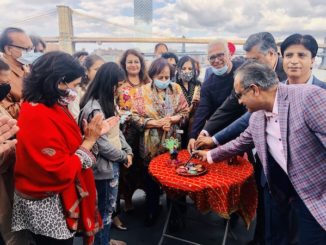
NEW YORK CITY (TIP): Undaunted by the COVID-19, AIA NY celebrated on Sunday October 4th 2020, the 33rd Deepavli festival event at Hudson river in front of South Street Seaport, NYC on a luxury boat with AIA sponsors, media partners and AIA executive members.
Due to Coronavirus (COVID 19) there were very limited number of invited guests for this event. For the last 32 years, Association of Indians in America (AIA), New York chapter has organized Deepavali festival with sparkling fireworks, classical fusion performances, fashion show, vegan expo, fun-filled children’s activities and booths with a variety of fine cuisine, handicrafts and gift items along with rich and varied works of contemporary Indian artists at South Street Seaport.
According to Harish Thakkar, President of AIA- NY chapter, Deepavali festival is one of the landmark events of AIA-NY chapter, enjoyed by over 50,000 New Yorkers every year since 1987. Considered by far the largest attraction for Indian Americans from all over the tri-state, Deepavali festival celebrates the tradition of a faraway land in a new world. This celebration has itself become a tradition that unites New York in a world of myths and colors.
AIA is a grass-roots national organization of Asian-immigrants in the U.S with chapters and membership spread across the nation. It was founded on August 20th, 1967. The New York Chapter was established in 1968 and is well known for its social, cultural and educational activities. AIA represents the hopes and aspirations of those immigrants who are united by their common Indian heritage and American commitment.
AIA is thankful to its supporters like CheapOair and Qatar Airways, McDonald’s, New York Life, ICICI Bank, all media partners, Sony Entertainment, ITV Gold, TV Asia, Jus Punjabi, South Asian Times, Desi Talk, Indian Panorama, Indian Express and Hum Hindustani “We are grateful to all our sponsors who made this festival a big success for many years” AIA president Harish Thakkar said.
PM Narendra Modi advocated India’s inclusion among the permanent members of the UNSC during the 75th session of the UN General Assembly
The only increase in the membership of the Security Council came in 1965, when the number of non-permanent members was increased from six to 10
Any reform to the Security Council would require an amendment to the UN Charter
There have been expressions of support for India’s candidature from four out of the five permanent members–USA, UK, Russia and France. But what about China? Given the nature of Sino-Indian relations, it is not surprising that Beijing does not support India’s case. China’s close friendship with Pakistan is a compounding factor in this regard.
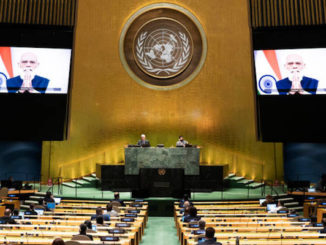
On September 26, Prime Minister Narendra Modi delivered a virtual address during the General Debate of the 75th session of the UN General Assembly in which he made an impassioned and forceful plea for India’s candidature for permanent membership of the UN Security Council. His speech was brilliant, but when he had finished I was still asking myself this question: Is India’s quest heading anywhere, or is it just a pipe dream?
The composition of the Security Council was established in 1945. The victors of the Second World War shaped the UN Charter in their national interests, giving to themselves the veto power in the Security Council. Since then the geopolitical realities have changed drastically, but the Council has changed very little. The Prime Minister did well to stress this when he said that the world of 1945 was significantly different from today’s world; the global situation, sources-resources, problems-solutions; all were quite different. Keeping this in mind, he urged that “Reform in the responses, in the processes, and in the very character of the UN is the need of the hour”.
This was not the first time in recent months that PM Modi had urged the need for UN reforms. It would be recalled that while speaking at the high-level dialogue of the U.N.’s Economic and Social Council (ECOSOC) on July 17 this year, he had said that “Only reformed multilateralism with a reformed United Nations at its center can meet the aspirations of humanity.”
PM Modi put forward several arguments that make India’s case for permanent membership appear quite strong. Highlighting India’s achievements and role in 75 years of the United Nations, he called for reforms with “changing times” and India’s inclusion in the decision-making process within the global body. He mentioned that India is the largest democracy of the world, with more than 18% of the world population; it had sent its soldiers for about 50 peacekeeping missions; it is also the country that has lost the maximum number of soldiers in the course of establishing peace; even during these very difficult times of the Covid 19 pandemic, the pharma industry of India has sent essential medicines to more than 150 countries. In this context, PM Modi assured that India’s vaccine production and delivery capacity will help all humanity in fighting the COVID-19 crisis.
Thus, articulating the role being played by India for lending a helping hand to other nations, and putting forward cogent arguments for India to be given a permanent membership of the UN, he asked the General Assembly a very pointed question: “For how long will India be kept out of the decision-making structures of the United Nations?”
It may be recalled that the only increase in the membership of the Security Council occurred in 1965 when the non-permanent membership was increased from six to 10 members, thus increasing the total strength from 11 to 15 members; fifty-five years have elapsed since then. Thus, PM Modi was right on target when he pointed out that the United Nations in its present form is out of date: “The international community today is faced with a very important question: Whether the character of the institution, constituted in the prevailing circumstances of 1945, is relevant even today”?
However, the challenges which lie in India’s path should not be underestimated. Any reform of the Security Council would require an amendment to the UN Charter. In this regard, it is useful to remember that Article 108 of the UN Charter states:
‘Amendments to the present Charter shall come into force for all Members of the United Nations when they have been adopted by a vote of two thirds of the members of the General Assembly and ratified in accordance with their respective constitutional processes by two thirds of the Members of the United Nations, including all the permanent members of the Security Council’.
Thus, any reform of the Security Council not only requires the support of at least two-thirds of UN member states, but also all the permanent members of the UN Security Council must also agree to this as they have veto powers. Assuming that India can get the support of two-thirds of the members of the General Assembly, the question which arises is simply this: Will all the Security Council’s permanent members give their nod for adding India as a permanent member?
India’s quest has to be viewed in a broader perspective. The need for Security Council reform has been actively discussed among the UN member states for quite some time. By 1992, Japan and Germany had become the second and third-largest financial contributors to the United Nations , and they started to demand a permanent seat; so too did Brazil (the world’s fifth largest country in terms of territory) and India (the largest democracy and the second largest country in terms of population) which had emerged not only as the most important countries within their regional groups but also key players in the emerging global scenario. These four countries formed an interest group which came to be known as the G-4.
On the other hand, their regional rivals opposed the idea of G4 countries becoming permanent members. Italy, Pakistan, Argentina and South Korea formed an interest group, known as the ‘Uniting for Consensus’ (also nicknamed the ‘Coffee Club’) which later grew to around 40 members. The Coffee Club members are opposed to increasing the number of the Security Council’s permanent members while wanting an increase in the non-permanent members category.
Simultaneously, the African countries also started to demand two permanent seats for themselves, arguing that historical injustices had been done to them, and also that much of the Council’s agenda related to their continent. All these developments have further complicated the situation.
On their part, the G-4 countries have shown flexibility on the veto issue in their bid to get the United Nations reform process moving. In a joint statement on their behalf delivered by India’s Permanent Representative to the UN Ambassador Syed Akbaruddin at an inter-governmental negotiations meeting in March 2017, the G4 nations– India, Brazil, Germany and Japan–stated that while the new permanent members would in principle have the same responsibilities and obligations as the current permanent members, they shall not exercise the veto until a decision on the matter has been taken during a review. Despite this flexibility, there has not been any progress in regard to the G4 demands.
There have been expressions of support for India’s candidature from four out of the five permanent members–USA, UK, Russia and France. But what about China? Given the nature of Sino-Indian relations, it is not surprising that Beijing does not support India’s case. China’s close friendship with Pakistan is a compounding factor in this regard.
There are many who believe that in actual fact, all the P-5 countries have reservations about adding any other country including India to their privileged group. The support extended to India by the US, UK, Russia and France has to be viewed against the background of their being fully aware that in any case, the process of Security Council reform is making no headway whatsoever. Many analysts think that they only render lip service by way of support to India in order to derive political mileage as they are fully aware of the Chinese position. In other words, whether their support is genuine is a matter of debate, for it is extended whilst knowing full well that the Chinese will oppose India anyway.
Meanwhile, China, the world’s biggest dictatorship sits on the high table as a permanent member of the UN Security Council while India, the world’s largest democracy has to be content with getting a seat on that table from time to time as a non-permanent member. We can raise our voice against this injustice, as Prime Minister Modi has done. However, one cannot say when the winds of change will actually reach the UN Security Council, for diplomacy, like politics is only the art of the possible.
Prime Minister Modi said in his address: “Today, people of India are concerned whether this reform-process will ever reach its logical conclusion”. He asked:” How long would a country have to wait particularly when the transformational changes happening in that country affect a large part of the world?” His words had a ring of anguish as well as disappointment.
As I reflect on Prime Minister Modi’s address at the UN, I cannot help reminding myself of a verse from the Rubaiyat of Omar Khayyam:
There is an undeniable political vacuum in the space for the Opposition in UP, but even an unrivaled political force has to stand on a structure that has strong foundational beams. The Yogi regime is beginning to disgust its own supporters. As long as the Hindutva wave was moving along smoothly, Yogi was even being spoken of as a possible successor to Prime Minister Narendra Modi in the emerging Hindu rashtra. But the Hathras episode has diminished him.
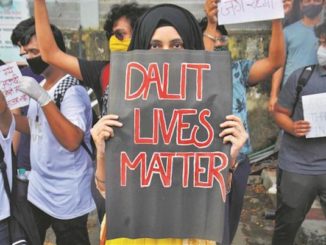
The Yogi Adityanath regime in Uttar Pradesh has responded hysterically and undemocratically to the criticism and protest generated by the terrible Hathras case. The state police have now filed FIRs against members of Opposition parties and threatened protesters with sedition charges, even as the chief minister has alleged a conspiracy to trigger caste and communal riots. The touchiness over this case comes from the fact that it has the potential to set back the BJP-RSS socio-political project in the nation’s most populous state. The most tangible damage comes from the fact that the Valmiki sub-caste of the Dalit community, to which the victim belonged, has been overwhelmingly voting for the BJP in recent elections in Uttar Pradesh (unlike the numerically larger Chamars/Jatavs who have traditionally been backers of the BSP led by Mayawati).
The Hindutva project in Uttar Pradesh rode on upending the state parties that became prominent in the Mandal era, by using cadre, narratives and mobilization, to reach out to non-dominant Dalit and backward caste groups. This was achieved by giving them a sense of belonging and telling them that they were included in the Hindutva project. In some instances, Valmikis were the foot soldiers of anti-Muslim mobilization.
To give an example from the ground in Moradabad in western UP, a seat with a large Muslim population, in the middle of the minority-dominated part of the town is a Valmiki settlement in an area known as Bhude ka Chauraha. In the 2019 Lok Sabha elections and the 2017 Assembly polls, residents of this Valmiki basti were among the most determined BJP voters and foot soldiers on the ground. They were the new voters the BJP has been getting in its consolidation of power in this electorally crucial state, achieved after consistent cadre outreach by the Sangh Parivar.
But post Hathras, the manner in which the Thakur community (to which the four rape-murder accused belong) has postured with the patronage of BJP leaders as if they are the aggrieved party with the license to protest their arrests, suggests these fragile gains could be lost. Thakurs make up 7.9 per cent of the population, while Dalits account for 21 per cent. So, the question is that as a politician, why is the CM inclined to give a free pass to his own caste although the BJP got the support of both forward and backward sections of society minus Muslims? The answer lies in the fact that despite being an MP from Gorakhpur, the seat of the Gorakhnath temple that he heads, for five consecutive terms, Yogi Adityanath is not really a politician but a religious mascot who likes to talk tough and give the license to shoot to the police in the state.
Before he got the state as his stage, stormtroopers of the Hindu Yuva Vahini, a so-called youth organization founded by Yogi Adityanath in Gorakhpur in 2002, went about dispensing vigilante justice and intimidating minorities. On its website, under ‘Type of Business’, the Yuva Vahini calls itself ‘far right Hindu nationalist organization.’ As long as just Muslims were at the receiving end, it did not really jar sensibilities in the now deeply communalized state. But now that it has become clear that crime against Dalits is increasing at an alarming rate, it’s an altogether different matter.
It is common knowledge in Lucknow and the district headquarters that the CM trusts only members of his own caste, as he was groomed and raised in the Thakur-run Gorakhnath monastic order. As the state will have elections in early 2022, it’s possible that Yogi intends to rely solely on the mix of Hindutva and muscle power that Thakurs supply. The community has clout way beyond its numerical strength; in spite of the abolition of the zamindari system, Thakurs are believed to still own half the agricultural land in parts of Uttar Pradesh.
But the Hathras incident has served the larger social purpose of shining the arc lights on the dark and regressive social impulses that have got a free run during the reign of Yogi Adityanath. Seeing the pushback from the Thakurs, imagine the scale of the bullying that can go unseen. The outrageous scale of injustice at Hathras also raises the larger question about whether the social gains of the Mandal era were superficial at best, dependent solely on a Dalit figure occupying high office? BSP leader and four-time CM Mayawati did leave monuments and parks; her coming to power did make many Dalits believe they need not sit on the floor if a high-caste individual came by; and once upon a time, she famously jailed all the notorious Thakur strongmen of the state.
But the palpable regression in the years of BJP rule raises the question about whether she left a lasting legacy or just a lot of statues. Has she hollowed out her own movement by selling tickets and making deals with whosoever could keep her person and assets safe? Or is Mayawati just helpless today, reduced to being a Team B of the BJP? During the Hathras episode, for instance, she made more attacks on the Congress than the BJP.
There is an undeniable vacuum in the space for the Opposition in Uttar Pradesh, but even an unrivalled political force has to stand on a structure that has strong foundational beams. The Yogi regime is beginning to disgust its own supporters and the pillars holding it up are looking rotten. As long as the Hindutva wave was moving along smoothly, Yogi was even being spoken of as a possible successor to PM Narendra Modi in the emerging Hindu rashtra. But the Hathras episode has diminished him.
Like Yogi, Modi was not an elected but a selected CM. But Modi would remain in control of whatever image or narrative he wished to project, be it the Hindu Hriday Samrat of the 2002 Gujarat riots or the friend of industrialists by 2007, the liberator of Gujarat, the undisputed leader and so on till he cast his eye on Delhi by 2013. Yogi Adityanath in contrast seems to have lost control of any narrative beyond his open desire to erase the names of Muslim historical figures and eras. From aspiring to be the next Hindu Hriday Samrat, he has been caught out to be a mere Thakur strongman in saffron robes. The ghost of that young woman of Hathras who met such a terrible end will haunt him.
The Uttar Pradesh government is stooping to new lows in its gross mishandling of the Hathras case. Even as the probe has been referred to the CBI, the state authorities are leaving no stone unturned to exert pressure on the victim’s family. The Special Investigation Team (SIT) has proposed a narco-polygraph test on the deceased Dalit woman’s kin to ascertain the truthfulness of their statements. Her outraged brother has rightly asserted that such a test should be conducted on the accused and the policemen who are trying to ‘twist the narrative’. The family members have also accused the District Magistrate of threatening them. The UP police, too, haven’t exactly covered themselves in glory. Citing a forensic report based on samples received over 10 days after the victim was hospitalized, the ADGP (Law and Order) jumped to the conclusion that there was no evidence of rape. He tried to pass off the case as a conspiracy to disturb communal harmony. Not surprisingly, the Hathras police have now lodged an FIR against unknown persons, invoking the sedition charge no less, for an attempt to trigger caste-based conflict.
The Yogi Adityanath dispensation has gone all out to keep media persons away from the scene of the gruesome crime. In a vicious assault on the freedom of the Press, some journalists’ phones have been tapped and their conversations leaked. The obvious motive is to divert attention away from the instant case. The meeting held outside a former BJP MLA’s house in Hathras on Sunday, during which the accused were defended, and an FIR sought against the woman’s family, is another abhorrent ploy to turn the matter on its head.
Influential accused can go to any extent to intimidate the victim and her family, as witnessed in the 2017 Unnao rape case. The girl survived a car crash in which two of her aunts lost their lives, and her father died in judicial custody after being framed for illegal possession of firearms. Justice did eventually prevail as former BJP legislator Kuldeep Sengar was convicted and jailed for life. Attempts to arm-twist the Hathras victim’s family should also not go unpunished.
LONDON (TIP): An Indian-origin couple, keen not to delay their wedding plans despite a strict restriction on the number of guests allowed to assemble under England’s coronavirus lockdown rules, are celebrating this week after pulling off a first-of-its-kind drive-in wedding near London.
London based Roma Popat and Vinal Patel were originally due to get married on April 20 but when lockdown disrupted their plans, they discussed the concept of a drive-in wedding with their wedding coordinator, Saheli Events, almost as a tongue-in-cheek thought rather than a serious plan.
However, what began as a joke became a reality last Friday, when the couple were married in front of a small gathering of their immediate family with the ceremony being projected onto a big screen in a field next door to friends and family seated in more than 100 cars at Braxted Park in Chelmsford.
“We’re delighted with how both the wedding ceremony and drive-in has gone,” said Saheli Mirpuri, Founder & Director of Saheli Events.
“This year has been so difficult for luxury Asian weddings and celebrations in particular, but this was a creative way to still ensure that guests felt they were with the couple on the day, and we’re delighted to have worked with so many amazing suppliers to bring everything together,” she said.
Under the UK government guidelines, only 15 people are allowed to be part of wedding ceremonies, which has resulted in many weddings either being postponed or couples trying to find virtual options to include friends and family to be a part of their big day.
“When we had to postpone our wedding in April, we had no idea whether we would be able to get married this year or not,” said bride Roma.
“We have so many friends and family and we wanted them to be part of our celebration. It literally meant everything to us to have everyone there, albeit in a slightly different way to the one we envisaged. It’s a day we’ll never forget,” she said.
On arrival at the drive-in wedding, guests in cars were given welcome hampers containing anti-bacterial hand gel and requested to stay in their vehicles throughout. The option to order food was available from their respective seats through a COVID-safe delivery service direct to their cars. If they needed any help, they were advised to flash their lights or hazard flashers
The traditional Hindu wedding ceremony unfolded on the big screen and as is the tradition, the groom’s grand entrance was marked by travelling around the field before the ceremony waving at all the guests in their cars.
Horns were honked as he travelled past on a specially decorated golf buggy, driven by a member of venue staff wearing a protective mask.
After the intimate ceremony inside had been completed, the newly-weds then travelled around the field on the same golf buggy, waving to their friends and families inside their cars.
The couple were also able to watch a specially filmed tribute for them on the drive-in screen made by guests unable to travel to be with them on the day.
Braxted Park, the wedding and events venue which hosted the unusual drive-in wedding, said it has since been receiving several inquiries from couples keen to organize their big day under similar Covid-secure settings.
Under tougher restrictions that came in last month, maximum guest numbers at wedding ceremonies and sit-down receptions in England were halved from an initial 30 to 15 amid a spike in coronavirus infections.
However, they were included as an exception to the wider rules banning groups of more than six from gathering.
PHILADELPHIA (TIP): Ask Ajay Raju about Indigo Global, the all-purpose elite corporate strategy and solutions firm he founded, and you’ll learn perhaps more than you ever wanted to know about the mating habits of deep sea anglerfish.
“Like the males of most species, the anglerfish exists for the sole purpose of finding a mate,” says Raju, “but unlike even the most compatible of human couples, when two anglerfish connect to reproduce, the male fuses into the female, losing its eyes, organs and its own bloodstream, literally becoming one with its partner.”
That, Raju emphasizes, is precisely the level of commitment Indigo seeks to bring to its client relationships. Offering its eligible clients tailor-made packages of executive-in-residence services and captive venture capital access, Indigo embeds experts from a range of industries with its clients, taking both ownership of the problem they’re engaged to solve, and a stake — win or lose — in the solution.
For those grossed out by the anglerfish analogy, the “What’s In a Name” tab on Indigo’s website offers an alternative working metaphor: in 1917, a young Mohandas Gandhi heeded the call of a group of unknown, destitute indigo farmers facing brutal oppression at the hands of their landlords and imperial government. Traveling to the remote province of Champaran, Gandhi would spend a year mobilizing the farmers in resistance, and developing his own visionary strategy of organized civil disobedience in the process.
Over the past decade, Indigo has been quietly but effectively swooping in to provide all manner of companies, big and small, foreign and domestic, its bespoke blend of investment, crisis management, legal, strategic communications, back office, regulatory and cultural competency guidance. Conceived in and launched from the rubble of the Great Recession, it was precisely the circumstances of the 2008 crash that made the need for an outfit like Indigo self-evident to Raju.
“Even a casual student of capitalist history like me has to know that cyclical crises are inherent in the system,” says Raju. “We knew that what happened in 2008 had happened before, and more importantly, that it would happen again. It may be impossible to predict the precise contours of a particular crisis, but for any company there are always essentially two outcomes: adapt or die.”
With Indigo, Raju was determined to build a shop that could help companies not only survive crises and adapt to a daunting new economic landscape, but leverage the variety of its subject matter experts and venture capital connections to meet any present challenge and anticipate new opportunities yet over the horizon.
By embedding its industry experts directly and deeply in clients’ c-suites, says Raju, Indigo allows its clients to “be lean and develop the first-mover advantages that existing leadership may not be equipped to exploit.” At times, he notes, Indigo’s team is able to take advantage of later-mover opportunities “to reverse-engineer operations and technology that in-house leadership lacks the bandwidth to handle.”
Indigo recently appointed Craig Snyder — a well-known and highly regarded Philadelphian of note in his own right — as its president and CEO. With Synder at the helm, the firm is now reconciling its intimate approach to client service with a step into the public spotlight. Snyder brings to Indigo a singularly robust rolodex of rarefied political contacts. As the longtime leader of the World Affairs Council of Philadelphia, former chief of staff to the late Senator Arlen Spector and a founder of his own public affairs consultancy, Snyder’s contacts and familiarity with public sector power maps add powerful new weapons to Indigo’s arsenal.
The addition of a known quantity like Snyder might suggest that Indigo is poised to shift from anglerfish mode to a mass market service provider, but it also hints at the possibility that the firm is making an intentional play to dispel a lingering cloud of mystery — not unlike the recent decision of Palantir, the data mining éminence grise, to go public.
Snyder wasn’t brought on board because he is well known, Raju insists; rather, Snyder is known because he carries a professional portfolio that harmonizes with the political, regulatory and financial tune of the current era. Indeed, as governments at all levels come to rely on private companies to handle sophisticated, tech-intensive information and infrastructure projects — and enter into rich contracts to do so, like Palantir — the line of demarcation between the public and private sectors becomes increasingly porous. Of course, that means the regulatory picture remains as blurred as ever. With an experienced political actor like Snyder able to sift through the risks and consequences of this environment, Indigo is able to offer its clients lines of communication that they might not otherwise establish on their own.
For Raju, the rationale behind the Snyder hire is simple: It enhances Indigo’s service offering. “We’ve got nothing against growth,” says Raju. “We’ve been growing since day one, but at a pace and scale that jives with our philosophy.” To Raju, transforming Indigo into an off-the-rack provider of prefabricated consultancy packages is completely antithetical to its founding principles. Far from trying to be all things to all people, Indigo seeks to be one with a select few clients, developing service strategies so closely hewn to those clients’ identities that they almost organically become part of Indigo’s own identity.
One critical distinction between Indigo and traditional consultancies like the McKinseys and KPMGs of the world is that Indigo relinquishes ownership of the intellectual property it creates for its clients. And in many cases, it opts instead to build its revenue model around acquiring an equity stake in the company. The obvious outcome of such an approach is that Indigo sinks or swims along with its client, just like a pair of mating anglerfish.
WASHINGTON (TIP): Indian nationals overtook those from China and Vietnam to file the highest number of EB-5 Immigrant Investor applications in the October-December and April-June quarters of fiscal year 2019, data sourced by non-profit Invest in the USA (IIUSA) showed.
The EB-5 investor program provides US citizenship to applicants once they invest $900,000 in any of a few specific opportunities. The investment amount was $500,000 before it was increased in November last year.
Demand for EB-5 visas, which provide applicants a direct path to US citizenship, rose 400% in India between 2016 and 2019, IIUSA said.
About a third of these applications were filed by Indians living in the United States to counter the excessively long green card processing times for Indian nationals, EB5 attorneys said.
Indians filed 756 applications in the two specified quarters in financial year 2019 – up 43% over the previous year – although there was a slump in visa filings in the first quarter of this fiscal (October-December 2019) due to the hike in the investment amount.
In comparison, there were 351 applicants from China and 240 from Vietnam, the two other big markets for the EB-5 investor program.
There is a country cap of 770 EB-5 visas in a year.
To be sure, the United States Citizenship and Immigration Services (USCIS), which follows an October-September financial year, does not make public investor data by nationality, but IIUSA was able to obtain the data under the US Freedom of Information Act, seeking the data only for the fiscal first and third quarters.
Immigration lawyers said Indian nationals who filed for EB-5 visas in the US could be at an advantage as there are no backlogs for Indians in this category.
“Current processing and absence of backlog is definitely good news for Indian EB-5 applicants. This means there won’t be any significant delay between I-526 approval and issue of the EB-5 visa on account of lack of availability of the latter,” said Vivek Tandon, CEO, EB5 BRICS, an immigration consultancy.
I-526 is the investor application form. Once approved, investors can file for consular processing.
The status is, however, unlikely to sustain for long as I-526 petitions filed before the increase in investment limit get processed.
Even in such a scenario, too, applicants staying in the US are at an advantage, said Poorvi Chothani, managing partner of immigration law firm LawQuest.
“Consular services haven’t resumed in India and most other countries, for many visa categories, so people can’t file their applications at present if they are outside the US,” she said.
Abhinav Lohia, Director-South Asia and the Middle East, CanAM Enterprises, said the EB-5 investment firm is “seeing more demand and they have filed a lot more applications in the last few months.”
However, the pool of investors with the ability to invest under the new rules is significantly smaller compared to the earlier set, he pointed out.
Still, the EB-5 investor program remains a popular option for people who want to secure their place in the US. H-1B visa holders in line for a green card opt for the EB-5 to ensure that their children do not have to leave the country if they age-out or turn 21 before their applications are processed. The program is also popular with parents keen on getting a green card so that their children have an easier path to colleges in the US as citizens.
“The EB-5 program remains popular with professionals and students,” said Mark Davies, Global Chairman, Davies & Associates, an immigration law firm.
WASHINGTON (TIP): Named by President Donald Trump as a member of the President’s Export Council, Indian American Technology entrepreneur Vinson Palathingal says removing the trade barriers to US products is critical to increase its exports.
“I am really honored to be appointed as a member of the President’s Export Council,” said Vinson, a serial entrepreneur, Asian American community leader, and a free market advocate hailing from Kochi, in Kerala State, India.
“With great pleasure and humility, I thank President Trump for this recognition,” said the McLean, Virginia, resident who has lived in the US for about 27 years.
“US has so much potential to increase our exports. Removing the trade barriers for our products is very critical to make the playing field level,” Palathingal said. “Plus, US EXIM bank need to focus more on small business exporters by simplifying credit guarantee process.”
Palathingal hoped he “will be able to use my experience as a small business exporter to advice the President in key export related policy making.”
With a bachelor’s degree in engineering from India and master’s degree in engineering from University of Nevada, Reno, he has run multiple small businesses in the US.
The winner of the SBA Small Business Exporter of the Year award in 2013, Palathingal has vast experience with engineering and technology industries over the last three decades ranging from buildings and road construction to block chains and artificial intelligence.
A proactive leader in the Indian American Community, Palathingal engages closely with the Indian diaspora. He intends to leverage the community’s success from technology to mainstream America.
In 2015, Vinson started the Indo-American Center, a free-market think tank spreading the message of liberty and small government ideals in both India and the US.
Vinson’s wife Asha Palathingal, too, is a technology leader. They have two children, Xavier & Stephen.
He believes that his Catholic upbringing in Kerala obviously contributed to his conservative values and worldview.
Last year, Palathingal had run unsuccessfully to the Fairfax County School Board.
INDIANA (TIP): A team of Indian American scientists is working to develop a unique covid-19 vaccine to protect all segments of the population, especially older adults using an adenovirus that causes disease in cattle.
Led by Purdue University virologist Suresh Mittal, the team aims to create a vaccine that uses a bovine adenovirus as a safe and effective delivery vehicle with a nearly $3.9 million grant from the National Institutes of Health.
“Adenoviral vectors have emerged as a promising gene-delivery platform for a variety of therapeutic and vaccine purposes during the last two decades,” said researcher Suresh Kuchipudi of Penn State University in a media release.
Kuchipudi is clinical professor of veterinary and biomedical sciences and associate director of Penn State’s Animal Diagnostic Laboratory.
“Historically, we have used human adenoviruses as platforms for vaccine delivery, but using a delivery system based on an animal adenovirus means that the human population will have no preexisting immunity to the vector, thereby improving its effectiveness.”
Kuchipudi explained that human adenoviruses are widespread and can cause common illnesses such as cold-like symptoms, fever, sore throat, bronchitis, pneumonia, diarrhea and pink eye.
“As a result, most people may have preexisting immunity that could impact the efficacy of vaccines delivered via a human-adenovirus-based vector.
The team which also includes immunologist Suryaprakash Sambhara from the Centers for Disease Control and Prevention, has adapted an adenovirus typically found in cattle to prevent it from replicating, which enhances safety.
The researchers also modified the adenovirus to express a peptide that stimulates a robust immune response to influenza viruses in mice.
“Our preliminary work has revealed that this novel vaccine platform provides significantly higher levels of immunity compared to that of human adenovirus vectors,” Kuchipudi said.
“We hypothesize that immunization with this vector expressing relevant antigens of SARS-CoV-2 will strengthen an effective anti-COVID-19 immunity.”
The researchers noted that because SARS-CoV-2 is a newly emerged virus for which humans have no previous immunity, any vaccine will have to be highly immunogenic to provide protection, particularly among older adults, whose immune systems naturally decline with age.
“This work suggests that the bovine adenovirus vector system could serve as an excellent delivery vehicle for the development of recombinant vaccines against emerging pathogens — for the elderly and other segments of the population,” Kuchipudi said.
“We believe this effort will yield an effective COVID-19 vaccine and could make a significant contribution to flattening the pandemic’s trajectory and helping to manage its second wave.”
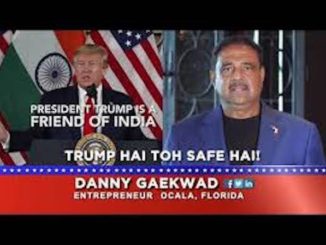
OCALA (TIP): With President Donald Trump trailing in the polls, an avid Indian American supporter has launched an ad campaign on 30 Indian channels, targeting the community which has emerged as a key constituency in 2020 presidential election.
Taking a cue from Indian Prime Minister Narendra Modi’s campaign slogan, “Modi Hai to Mumkin Hai” (With Modi, it’s possible), “Trump Hai to Safe Hai” (With Trump, it’s safe) campaign highlights Trump’s support for India and his commitment to maintain law order and economic recovery among other topics.
“I saw that President Trump is wounded in the race. So, I’m spending my own money to support him,” Ocala, Florida,-based serial entrepreneur Digvijay “Danny” Gaekwad told the American Bazaar.
“In recent months, I have had opportunities to engage the president and Vice President Mike Pence in person,” he said. “I’m convinced that Trump is the right person to lead America and spearhead an economic recovery.”
“Indian American votes are going to be crucial in battleground states such as Pennsylvania, Florida, Michigan and Ohio,” said the Baroda, Gujarat, -born Gaekwad. “I believe Indian television channels are the best way to reach many of the first-generation voters from the community.”
Adapting another Modi slogan that the Trump campaign used in the 2016 election, a one-minute ad urges 1.8 million Indian American voters to get President Trump back into office again.
“Ek Bar Aur, Trump Sarkar!!!” (Once more, Trump government) ad has Gaekwad telling voters “Why Trump? Very easy. He is a friend of India. He has proved himself; he is a friend of India.”
Citing the issues of Kashmir and the controversial Citizenship Amendment Act (CAA), he says, when the whole world was criticizing India and Modi, Trump never meddled in Indian affairs.
“We don’t want a president of America, who meddles in our world or tells us who is to be selected or elected or go and tell us what to do,” says Gaekwad. “We want a friend. When we need help, he helps us, when he needs help, we help them.”
“This time president Trump needs help from us,” says Gaekwad, urging Indian Americans to vote for him and get him elected to the White House.”
The ad ends with Gaekwad giving a double thumbs up and saying, “Ek Bar Aur Trump Sarkar” (Once more, Trump government).
A short 15-second ad simply plays a part of the President’s speech relating to the Indian Americans at Trump’s ‘Namaste Trump’ rally with Modi in Ahmedabad, Gujarat, during his India visit in February.
With visuals of Trump and Modi, the President is heard saying, “In America, we have come to know the splendor of Indian culture personally, through the 4 million Indian Americans living in the United States as our wonderful friends, colleagues, and neighbors. They are truly spectacular people.”
Another 30-second, “Why not Trump” ad has Gaekwad describing Trump as “a president who is willing to stop the looters and arsonists trying to take over our property which we built with a life time of hard work.”
Calling ‘defund the police’ as “the most nonsense idea I have ever heard in my life,” he thanks Florida governor Ron DeSantis and Trump “for stopping these looters and arsonists and please keep doing it.”
Gaekwad again urges the “Indian Americans, our community to vote for Trump. Trump Hai to Safe Hai (With Trump, It’s safe).
Other ads highlight Trump administration’s Paycheck Protection Program (PPP) Economic Injury Disaster Loans (EIDLs) and economic recovery.
A first-generation Indian American businessman, Gaekwad is the founder and CEO of NDS USA Information Technology, an IT firm, and Danny G Management that runs a chain of restaurants and hotels across Florida.
He is one of the largest Indian American GOP donors and bundlers in the nation, having donated and raised money for some of the top Republican leaders, including Trump, Florida Gov. Ron DeSantis, Sen. Rick Scott and former Agriculture Commissioner Adam Putnam, besides a number of congressmen and local officials.
Last year, he helped DeSantis host the Diwali celebration at his official residence. It was the first time that the Festival of Lights was celebrated at the 114-year-old People’s House of Florida.
Gaekwad serves on several boards including, the University of Central Florida, Enterprise Florida, Inc., Visit Florida, Florida Chamber of Commerce, Marion County Visitor and Convention Bureau, Marion County Tourism Development Council, Marion County Planning and Zoning Commissioner, Space Florida, Independence National Bank, and Taylor, Bean & Whitaker.
Gaekwad lives in Ocala with his wife, Manisha Gaekwad, and two sons Karan Gaekwad and Kunal Gaekwad.
SACRAMENTO (TIP): An Indian American woman from California has been sentenced to 15 years in prison for forced labor violations.
Sharmistha Barai and her husband Satish Kartan were found guilty of conspiracy to obtain forced labor and two counts of obtaining forced labor by a federal jury on March 14, 2019, after an 11-day trial.
Kartan will be sentenced on October 22.
“The United States abolished slavery and involuntary servitude more than 150 years ago. Yet, inhuman forced labor and deprivations of liberty and dignity persist because human traffickers are modern-day slave masters who endeavor to exploit their fellow human beings for profit and other gruesome purposes,” said Assistant Attorney General Eric Dreiband.
The Indian American couple compelled the victims into servitude for up to 18 hours a day, with minimal pay, through intimidation, threats and violence, he said, adding this is an unconscionable violation of the victims’ individual rights, freedom and dignity.
According to court documents and evidence presented at trial, between February 2014 and October 2016, Kartan and Barai hired workers from overseas to perform domestic labor in their home in Stockton, California.
In advertisements seeking workers on the internet and India-based newspapers, they made false claims about the wages and conditions of employment.
Once the workers arrived at their residence, Kartan and Barai compelled them to work up to 18 hours a day with limited rest and nourishment, federal prosecutors alleged.
Few of them were paid any wages. The couple kept the domestic workers from leaving and coerced them to continue working by threatening them, by creating an atmosphere of fear, control, and disempowerment, and at times by physically hitting or burning them.
“When a victim resisted or expressed a desire to leave, the threats and abuse became worse,” the Department of Justice added.
Signup to our Newsletter!
Don’t miss out on all the happenings around the world