

In 1777, Britain pursued a plan to isolate New England by advancing from Canada down the Hudson corridor. American forces slowed General John Burgoyne’s army and compelled its surrender at Saratoga in October.
The victory convinced France that the American cause had a serious chance of success. France formally allied with the United States in 1778, providing arms, loans, soldiers and-most decisively-naval power. Spain entered the war against Britain as France’s ally in 1779, though not as an American ally, and fought British positions along the Gulf Coast and Mississippi under Bernardo de Gálvez.
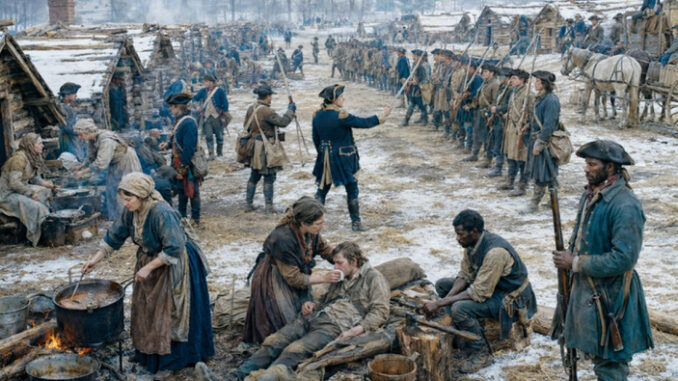
The Netherlands later joined the wider conflict. An American rebellion had become a global war. While diplomacy advanced, Washington’s army endured winter at Valley Forge. Hunger, disease, inadequate clothing and supply failures caused suffering, though the encampment was not a continuous scene of starvation. Women cooked, washed, sewed, nursed and maintained camp life; some served in disguised or exceptional combat roles. Baron Friedrich Wilhelm von Steuben introduced standardized drill and helped improve discipline and organization. The army that left Valley Forge was more cohesive than the one that entered.
“France made victory possible; Valley Forge made the army more capable of using the opportunity.”



Be the first to comment