
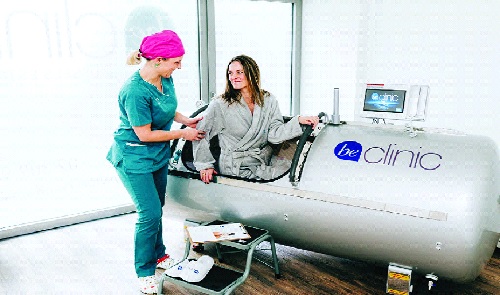

Bryan Johnson, entrepreneur and longevity enthusiast, appeared on Chris Williamson’s podcast earlier this year and said hyperbaric oxygen therapy (HBOT) is the “single best performing therapy” he has ever done.
HBOT is a specialised treatment where patients breathe pressurised, pure oxygen in specially-designed chambers.
According to Johnson, he saw improvements in most of his metrics with HBOT. Johnson is a known biohacker and is often in the news for experimental treatments. He also called HBOT the best skin rejuvenation therapy, but does it actually work?
The oxygen delivered in this therapy is around 95-100 percent pure, and typically at a pressure around 1.3-3 times higher than average. HBOT fills the lungs with pure oxygen, with the aim of repairing tissues, restoring body functions, or treating conditions like carbon monoxide poisoning, decompression sickness, scuba injuries, acutely reduced blood flow, and traumatic injuries that may not respond to other treatments.
HBOT is not new. In fact, hyperbaric therapy was first reportedly used in 1662, even before oxygen was discovered, and used pressurised air in a steel container. In 1878, the father of hyperbaric physiology, Paul Bert, documented the toxic effects of hyperbaric oxygen. It wasn’t until 50 years later that hyperbaric oxygen could be successfully used as a medical treatment. In 1937, AR Behnke and LA Shaw successfully used hyperbaric oxygen to treat decompression sickness.
Fast forward to 2026, HBOT is increasingly available not only for medical uses but also at wellness centres, and is being touted as an anti-ageing therapy, among other things. Each session typically lasts around 60 minutes. HBOT claims therapeutic benefits by increasing the amount of oxygen available to tissues.
Under normal conditions, oxygen is carried through the bloodstream primarily by haemoglobin in red blood cells. However, at high pressure, a large amount of pure oxygen dissolves directly into the plasma, which is the liquid component of blood. This increases the diffusion capacity, allowing oxygen to reach deeper tissues or areas of the body with low oxygen supply.



Be the first to comment