
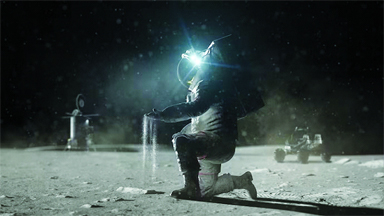

The United States space agency Nasa has unveiled an ambitious roadmap under Administrator Jared Isaacman, outlining plans to build a permanent Moon base, test nuclear-powered spacecraft, and deploy a fleet of helicopters on Mars, marking a major shift from short missions to sustained space exploration.
At the heart of the strategy is the creation of a long-term human presence on the Moon beyond Artemis-II. The US space agency is on the cusp of launching four astronauts on a maiden voyage to the Moon, first since 1972.
Unlike earlier missions that focused on brief missions, Nasa now aims to develop infrastructure that supports continuous operations, including habitats, power systems, and regular crewed and cargo landings with an investment of $20 billion.
The effort is part of the broader Artemis programme, which seeks to establish a lasting foothold on the lunar surface before pushing further into deep space.
“We have moved quickly, taken action to cut bureaucracy, and introduced deregulation focused on empowering the workforce. It reflects the reality of a great power competition underway and the consequences if we fail to deliver,” Nasa chief Jared Isaacman said.
Nasa will increase launch cadence to the Moon with crew and cargo. Nasa chief has put up a bold plan to launch at least one lunar landing every six months.
The astronauts will land on the Moon for the first time during Artemis-IV mission in 2028. The landings will build upon the lessons from Artemis-II and Artemis-III missions.
Artemis-III, which was initially the first lunar landing mission, has been repurposed as a technology demonstrator mission.
Nasa recently rolled the SLS Artemis-II rocket to the launch pad and the agency said that everything is going as per plan for the launch and the final readiness review has been cleared.
A key enabler of this vision is nuclear technology. Nasa, in partnership with the U.S. Department of Energy, is working to deploy a nuclear reactor on the Moon by 2030 to provide continuous power, even during long lunar nights when solar energy is unavailable.

Be the first to comment