
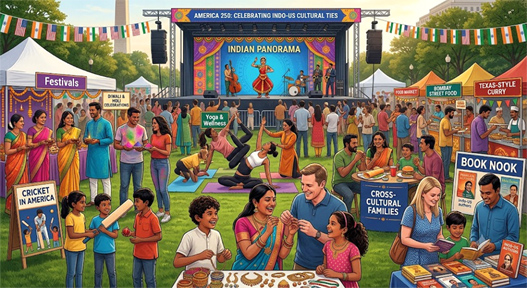

It is soft power, human connections, and organic societal ties that form the true bedrock of the Indo-US partnership.
As the United States commemorates its 250th anniversary, the narrative of American pluralism stands enriched by one of its most dynamic strands: the enduring cultural exchange and social synergy between the world’s oldest democracy and the world’s largest democracy. What began centuries ago as quiet intellectual curiosity—from Ralph Waldo Emerson and Henry David Thoreau drawing inspiration from the Upanishads—has blossomed into a vivid tapestry of reciprocal influence. Beyond defense treaties, trade corridors, and geopolitical alliances, it is soft power, human connections, and organic societal ties that form the true bedrock of the Indo-US partnership.
Cinema Sans Borders
The story of Indo-US entertainment was once defined by distant fascination. Today, it is characterized by active collaboration, co-production, and shared digital screens. Bollywood cinema and regional Indian film industries have firmly established themselves within mainstream American pop culture. Theaters from Times Square to Silicon Valley host day-and-date releases of major Indian blockbusters, while streaming platforms like Netflix, Amazon Prime Video, and Hulu have bridged the geographical divide entirely.
Concurrently, crossover talent—from Priyanka Chopra Jonas anchoring major Hollywood franchises to Indian cinematographers, composers, and VFX artists powering global blockbusters—demonstrates that the exchange is thoroughly bi-directional. American streaming audiences regularly binge multi-lingual Indian series, while Indian viewers represent one of the largest consumer bases for Hollywood content. This digital convergence has nurtured an unprecedented level of mutual cultural literacy across demographic lines.
Literary Tapestry
Indian-American literature has evolved from a niche genre of diaspora longing into a powerhouse of contemporary world literature. Authors such as Jhumpa Lahiri, Chitra Banerjee Divakaruni, Abraham Verghese, and Amitav Ghosh have reshaped the American literary canon, offering nuanced explorations of identity, assimilation, and the complex human emotional landscape.
Through novels, memoirs, and poetry, these storytellers demystify the immigrant journey, illuminating how the Indian diaspora navigates two rich heritage streams without sacrificing either. Their works are staples of American university curricula and book clubs nationwide, fostering deep empathy and intellectual engagement. As American publishers increasingly translate regional Indian literature into English, readers in New York, Chicago, and Los Angeles are gaining access to the vast breadth of India’s vernacular heritage.
Yoga and Wellness
In 1893, Swami Vivekananda introduced Vedic philosophy to the West at the Parliament of the World’s Religions in Chicago, laying the initial groundwork for spiritual connectivity. Over a century later, yoga has become an integral element of everyday American life. Millions of Americans roll out yoga mats each morning in neighborhood studios, public parks, and corporate wellness centers.
The institutionalization of June 21 as the International Day of Yoga—celebrated prominently at the United Nations headquarters in New York and the National Mall in Washington, D.C.—underscores yoga’s universal appeal. Beyond physical postures (asanas), the broader holistic framework of Ayurveda, mindfulness, and holistic wellness has seeped into Western healthcare and lifestyle consciousness. Golden turmeric lattes, mindfulness apps inspired by traditional meditation, and plant-based wellness practices illustrate how ancient Indian wisdom has been embraced to meet modern American needs.
Lighting up the Heartland
Few developments better illustrate the mainstreaming of Indian culture in America than the public celebration of Indian festivals. Diwali, once observed quietly within domestic spaces, is now celebrated on the South Lawn of the White House, marked by ceremonial candle-lightings by U.S. presidents, and recognized as an official holiday in public school districts across several states.
Similarly, Holi festivals draw thousands of participants from diverse backgrounds onto university campuses and municipal parks, transforming towns into canvases of vibrant color and communal joy. From Navratri Garba nights filling massive convention centers in New Jersey and Texas to grand Rath Yatra processions in San Francisco, these cultural celebrations are no longer isolated diaspora gatherings; they are vibrant expressions of multi-ethnic American community life.
Currying Favor
The journey of Indian cuisine in the United States mirrors the community’s social ascension. Where Indian food was once confined to standardized neighborhood buffets, it now occupies a celebrated position in the top tier of American gastronomy. Innovative chefs have elevated traditional flavors, earning prestigious James Beard Awards and Michelin stars for restaurants in New York, Chicago, Washington, D.C., and San Francisco.
At the same time, regional Indian flavors—from South Indian dosas and Mumbai street food to Chettinad spices and Bengali seafood—have earned dedicated followings. Mainstream American grocery stores now stock ghee, Garam Masala, ready-to-eat lentil dishes, and artisanal chutney products alongside traditional staples. The American palate has warmly embraced the depth and diversity of Indian cooking, viewing food as both nourishment and an invitation to cultural exploration.
Tourism To and Fro
Bilateral tourism between the two nations continues to flourish, serving as a powerful catalyst for interpersonal diplomacy. Millions of Americans travel to India annually to explore its ancient heritage sites, spiritual circuits, eco-tourism hubs, and luxury hospitality destinations. Reciprocally, Indian tourists and visiting families represent one of the fastest-growing segments of international visitors to American national parks, iconic landmarks, and metropolitan cultural centers.
Museums across the United States have played a crucial role in framing this cross-cultural dialog. The Smithsonian Institution in Washington, D.C., along with premier art institutes in Boston, Philadelphia, and Seattle, regularly host extensive galleries dedicated to South Asian art, textiles, and historical artifacts. Collaborative conservation projects and international loan exhibitions ensure that shared artistic heritage remains accessible to global audiences.
Cricket on US Soil
Perhaps no cultural transformation is as unexpected or rapid as the rise of cricket on American soil. Long considered a sport restricted to South Asian and Commonwealth expats, cricket has entered the mainstream American sports landscape. The launch of Major League Cricket (MLC), featuring world-class stadiums in Texas and California, combined with the U.S. co-hosting the ICC Men’s T20 World Cup, marked a historic turning point.
With world-class Indian entrepreneurs investing in franchises and USA Cricket securing a spot in the upcoming 2028 Los Angeles Olympics, the sport is building grassroots academies across suburban America. American youth from varied backgrounds are picking up bats and balls, turning a traditional Indian obsession into a fast-growing staple of American sports culture.
Multicultural Families
At the most intimate level of social integration stands the rise of cross-cultural marriages and multicultural families. As generations of Indian Americans study, work, and build lives across the United States, interfaith and intercultural unions have become a natural and celebrated part of the social landscape.
These blended families seamlessly weave traditions together—celebrating Thanksgiving alongside Diwali, combining traditional Indian wedding ceremonies with Western receptions, and raising children who grow up fluent in multiple cultural dialects. These homes serve as living embodiments of the Indo-US synthesis, where heritage and horizon meet seamlessly.
The Path Ahead
As America reflects on 250 years of liberty, opportunity, and pluralism, the Indo-US cultural partnership shines as a testament to the power of shared values. The ongoing exchange of ideas, art, flavors, and human aspirations ensures that the Maitri (friendship) between these two great democracies will remain dynamic, resilient, and endlessly creative for generations to come.



Be the first to comment