
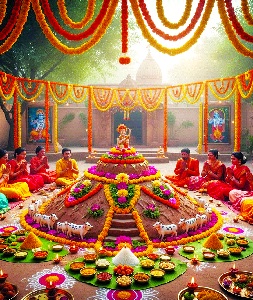

From Lord Krishna lifting Govardhan Hill to the magnificent Annakut offerings and the celebration of relationships through Padwa, the day after Diwali is a beautiful expression of devotion, gratitude and renewal. Rooted in diverse traditions, it reminds us to honour nature, share our blessings and cherish the bonds that enrich our lives.
As the glow of Diwali lamps lingers and the fragrance of festive delicacies fills Indian homes, the celebrations move into another spiritually significant day-Govardhan Puja, also known as Annakut or Bali Pratipada. Observed on the first day of the Shukla Paksha of Kartik, this occasion holds different meanings across India’s cultural and religious traditions.
For Krishna devotees, it commemorates the miraculous lifting of Govardhan Hill to protect the people of Vrindavan. For temple communities, it is an occasion to prepare elaborate Annakut offerings, presenting a mountain of food to the deity. In Maharashtra, the day is celebrated as Diwali Padwa, symbolising marital affection and prosperity, while in Gujarat, it marks the beginning of the New Year, known as Bestu Varas. In Vaishnavite traditions, it is also associated with King Bali and his devotion to Lord Vishnu.
Despite their regional differences, these celebrations share a common message: gratitude towards nature, faith in the divine, generosity towards others and love within families.
The Legend of Govardhan Puja:
When Krishna Lifted a Mountain
One of the most cherished stories associated with Govardhan Puja comes from the Bhagavata Purana and centres on Lord Krishna’s childhood in Braj.
According to the legend, the people of Vrindavan traditionally worshipped Lord Indra, the king of the devas and the deity associated with rain. They believed that elaborate rituals and offerings would ensure timely rainfall, fertile fields and abundant harvests.
Young Krishna questioned this practice, encouraging the villagers to recognise the importance of Govardhan Hill, which provided fertile pastures, vegetation, water and shelter for their cattle. He explained that their lives depended upon nature’s generosity and that the mountain and its surrounding environment deserved their gratitude.
Persuaded by Krishna, the villagers offered their prayers and food to Govardhan Hill instead of Indra. Angered by this decision, Indra unleashed torrential rains and devastating storms upon Vrindavan.
Seeing the villagers and their cattle in danger, Krishna lifted the enormous Govardhan Hill on the little finger of his left hand, providing shelter beneath it. For seven days and seven nights, he protected the people from the relentless downpour. Eventually, Indra realised his arrogance and recognised Krishna’s divine nature. He withdrew the storm and sought forgiveness.
The incident became a timeless lesson in humility, devotion and respect for nature, giving rise to the tradition of Govardhan Puja.
Annakut: A Mountain of Food and Gratitude
One of the most spectacular aspects of Govardhan Puja is Annakut, a Sanskrit expression meaning ‘mountain of food’. Devotees prepare an extraordinary variety of vegetarian delicacies and arrange them in an elaborate display before Lord Krishna, symbolising Govardhan Hill and expressing gratitude for nature’s abundance.
The offerings include sweets, savouries, fruits, vegetables, rice preparations, pulses and milk-based dishes. Among the most celebrated is Chhappan Bhog, comprising 56 different food preparations.
According to a popular devotional belief, the tradition is associated with Krishna’s seven days of protecting the villagers beneath Govardhan Hill. As he could not take his usual eight meals each day during this period, devotees offered 56 dishes afterwards as an expression of love and gratitude.
In temples across Mathura, Vrindavan, Nathdwara and ISKCON centres, Annakut is celebrated with extraordinary devotion. Food preparations are arranged in impressive tiers resembling a mountain, while the deity is beautifully decorated with flowers and ornaments.
Following the offering, the food is distributed as prasad among devotees. This tradition highlights an important message: abundance becomes truly meaningful when it is shared.
Govardhan Parikrama: A
Sacred Journey of Faith
For Krishna devotees, Govardhan Parikrama is among the most significant observances associated with the festival.
Situated in Uttar Pradesh’s Braj region, Govardhan Hill is considered sacred because of its association with Krishna’s childhood. Devotees undertake a traditional circumambulation route of approximately 21 kilometres, passing temples, sacred ponds and places connected with Krishna’s life.
Many pilgrims walk barefoot, chanting devotional hymns and offering prayers along the way. For them, the journey represents surrender, faith and an enduring connection with the divine.
Govardhan Puja Rituals:
Honoring Nature and Divinity
In many households, a symbolic Govardhan Hill is created using cow dung or clay and decorated with flowers, leaves and miniature representations of trees and animals. It represents the sacred mountain that sheltered the people of Vrindavan.
Devotees worship Lord Krishna with flowers, incense, lamps, fruits and traditional sweets. Prayers and hymns recalling Govardhan Leela are recited, followed by aarti. Another important custom is Gau Puja, the worship of cows. Associated closely with Krishna, cows are decorated with flowers, garlands and tilak, and offered food. The ritual expresses gratitude for their traditional contribution to agriculture and rural livelihoods.
The celebrations conclude with the distribution of prasad and prayers for the well-being of families, animals and communities.
Padwa and Bali Pratipada: Celebrating Love and New Beginnings
While Govardhan Puja is central to Krishna devotees, the same day carries other important meanings across India.
In Maharashtra, Diwali Padwa celebrates the bond between husband and wife. Traditionally, wives perform aarti and apply tilak to their husbands, praying for their long life and prosperity. Husbands express their affection through gifts. The occasion symbolises mutual respect, companionship and marital harmony. It should not be confused with the springtime Marathi New Year festival of Gudi Padwa.
In Gujarat, the day marks Bestu Varas, the Gujarati New Year. Families visit temples, seek blessings from elders, exchange greetings and welcome fresh beginnings. Business communities also consider the occasion auspicious for new ventures and financial activities.
The day is additionally associated with King Mahabali and the Vamana incarnation of Lord Vishnu. According to Hindu mythology, Bali was a generous and powerful ruler. Lord Vishnu appeared before him as Vamana, a young Brahmin dwarf, and requested three steps of land. Once Bali agreed, Vamana assumed a gigantic form, covering the Earth and heavens with two steps. For the third, Bali offered his own head.
Impressed by his devotion and generosity, Vishnu granted him a place in the underworld and, according to popular tradition, the blessing to visit his people once every year.
Bali Pratipada thus celebrates humility, sacrifice, generosity and unwavering devotion.
A Festival That Teaches
Us to Respect Nature
Perhaps the most relevant message of Govardhan Puja today is its connection with environmental awareness.
Krishna’s story reminds us that human survival depends upon the natural world. Mountains, forests, rivers, fertile soil and animals sustain life and deserve respect and protection.
At a time when environmental degradation, deforestation, water scarcity and climate change pose serious challenges, the festival encourages us to become responsible guardians of the Earth. Conserving water, protecting green spaces, reducing food waste, supporting sustainable agriculture and treating animals compassionately are meaningful ways to embrace its message.
Annakut further reinforces the values of sharing and community service. Food is a blessing, and distributing it through prasad, charitable giving and community meals reflects the spirit of seva (selfless service) and daan (charity).

Be the first to comment