
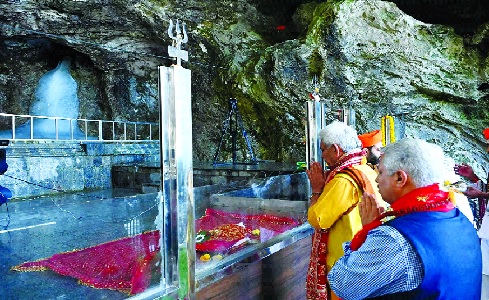

The Amarnath Yatra is one of the most revered pilgrimages in Hinduism, drawing hundreds of thousands of devotees every year to the sacred Amarnath Cave nestled high in the Himalayas of Jammu and Kashmir. More than a physical journey, it is regarded as a profound spiritual quest that symbolizes faith, devotion, endurance, and the eternal search for divine truth. The naturally formed ice Shivling inside the cave is believed to be a manifestation of Lord Shiva, making the pilgrimage one of the holiest experiences for Shaivites and spiritual seekers alike.
This year, the Amarnath Yatra is scheduled from July 3 to August 28, 2026.
The chanting of “Har Har Mahadev” reverberates through snow-clad mountains as thousands of pilgrims undertake one of India’s most challenging and spiritually uplifting pilgrimages-the Amarnath Yatra. Every step taken on the rugged Himalayan trails is considered an act of devotion, while every hardship endured is believed to bring devotees closer to Lord Shiva.
The pilgrimage is not merely about reaching a destination; it is about inner transformation. It is a journey where faith triumphs over physical limitations, where the grandeur of nature evokes humility, and where the presence of the divine is felt amidst towering peaks, icy winds, and tranquil silence.
The Sacred Cave of Amarnath
Situated at an altitude of nearly 3,888 metres (12,756 feet) in the Himalayas of Jammu and Kashmir, the Amarnath Cave is among Hinduism’s most sacred shrines. Deep inside the cave stands the naturally occurring ice Shivling, formed by the freezing of water droplets that fall from the cave’s roof.
Unlike man-made idols, this ice formation is regarded as a self-manifested (Swayambhu) representation of Lord Shiva. Its waxing and waning are traditionally associated with the phases of the moon, adding to the cave’s mystical significance.
For millions of devotees, merely catching a glimpse (darshan) of the holy Shivling is believed to wash away sins, bestow divine blessings, and aid in attaining liberation (moksha).
The Legend of the Cave
The spiritual significance of Amarnath is deeply rooted in Hindu mythology. According to ancient tradition, Lord Shiva chose this remote cave to reveal the secret of immortality-known as the Amar Katha-to Goddess Parvati. Before narrating the sacred knowledge, Shiva wanted complete isolation to ensure that no living being overheard the divine discourse.
To achieve this, he left behind everything associated with worldly existence along the route.
According to legend:
– He left Nandi, his sacred bull, at Pahalgam.
– Released the moon from his matted hair at Chandanwari.
– Allowed his snakes to remain at Sheshnag.
– Left Lord Ganesha at Mahagunas.
– Abandoned the five elements (Panchtatva) at Panchtarni.
– Finally entered the cave with Parvati alone.
Inside the cave, Shiva lit a sacred fire to eliminate every form of life present before revealing the eternal secret.
The Story of the Immortal Pigeons
One of the most beloved legends associated with Amarnath tells of two pigeon eggs that survived Shiva’s divine fire. As Lord Shiva narrated the secret of immortality, the unborn pigeons unknowingly heard the sacred discourse. Upon hatching, they became immortal.
Even today, pilgrims occasionally report seeing a pair of pigeons near the cave despite the harsh climatic conditions. Their presence is regarded as a divine blessing and a reminder of the eternal truth revealed by Lord Shiva.
Discovery of the Holy Cave
Although references to Amarnath appear in ancient scriptures, local folklore credits a Muslim shepherd named Buta Malik with rediscovering the cave several centuries ago.
According to tradition, a saint gifted Malik a bag of coal. Upon reaching home, he found that the coal had transformed into gold. When he returned to thank the saint, he instead discovered the sacred cave housing the ice Shivling.
The legend beautifully reflects India’s rich tradition of communal harmony, as descendants of Buta Malik have historically remained associated with the pilgrimage.
Routes of the Amarnath Yatra
Pilgrims generally undertake the Yatra through two routes.
Pahalgam Route
The traditional route begins from Pahalgam and passes through:
– Chandanwari
– Pissu Top
– Sheshnag
– Mahagunas Pass
– Panchtarni
– Amarnath Cave
Although longer, this route allows gradual acclimatization and is spiritually associated with the path Lord Shiva is believed to have followed.
Baltal Route
The Baltal route is much shorter but considerably steeper and physically demanding. Many pilgrims prefer it for quicker access to the shrine.
Both routes offer breathtaking views of glaciers, alpine meadows, waterfalls, and snow-covered mountains.
Spiritual Symbolism of the Journey
– Every stage of the Amarnath Yatra carries profound spiritual symbolism.
– The arduous climb represents the struggles of human life.
– The thinning air reminds devotees of the impermanence of the physical body.
– The silence of the mountains encourages introspection.
– The icy cave symbolizes the stillness of meditation, while the naturally formed Shivling represents the eternal, formless consciousness that transcends birth and death.
Pilgrims often describe the Yatra as a process of leaving behind ego, attachment, and worldly distractions.
Why the Yatra Is Spiritually Transformative
Unlike ordinary travel, the Amarnath pilgrimage demands physical discipline, mental determination, and unwavering faith. Long walks across difficult terrain, unpredictable weather, freezing temperatures, and high altitude test the devotee’s endurance.
Yet these very hardships become spiritual practices.
The pilgrimage teaches:
– Patience
– Humility
– Self-control
– Compassion
– Gratitude
– Faith in divine grace
Many devotees believe that Lord Shiva himself calls those destined to undertake the Yatra.
The Sacred Chant: “Har Har Mahadev”
Throughout the pilgrimage, the air echoes with devotional chants.
“Har Har Mahadev”
“Bam Bam Bhole”
These chants uplift tired pilgrims, unite strangers into a spiritual family, and reinforce the belief that Lord Shiva walks alongside every devotee.
The Ice Shivling: A Symbol Beyond Form
The ice Shivling is more than a sacred formation.
It represents:
– The infinite nature of consciousness.
– Creation, preservation, and dissolution.
– The union of Shiva and Shakti.
– The eternal cycle of life and death.
Its annual formation and gradual melting remind devotees that while the material world is temporary, the divine remains eternal.



Be the first to comment