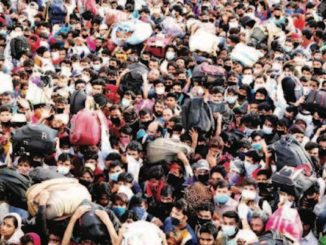
Post-Covid, it’s a fit case for the world to demand reparation, as was done after World War I, at the Treaty of Versailles, in 1919. Articles 231 and 232 made Germany sign and pay for the irreparable, willful damage, destruction and death caused to its European neighbors in particular. Germany confessed ‘war guilt’ and agreed ‘compensation will be made for all damage done to civilian population of Allies and their property.’
“The wheel has indeed turned full circle. After 101 years, reparation today is the sine qua non for a free world facing an autocratic, reckless China which is consistently failing to adhere to, or follow, the canons of collective wisdom, so very essential for the existence, nay survival, of the human race. Will China curtail its expansionist ambitions and avoid taking control of weaker landlocked territory through unfair means? The time for reparation is now.”
The Covid-19 pandemic has done more damage to the global economy in mere six months than what the two world wars did in 10 years. The Chinese-origin virus has already claimed over six lakh lives, while more than 1.6 crore cases have been recorded so far. There are debts worth billions, nay trillions, of dollars and over 200 countries are on the road to ruin.
Various sectors are counting the colossal losses, be it banking, transport, shipping, hospitality, core industrial sector or aviation. The key indicators of human welfare — education and health — are in tatters. The future of millions of students across the globe is uncertain. And, the lack of barest human needs — food, housing, clothing and fuel — is plunging millions into poverty.
Such is the havoc wrought on India that the government has extended free ration to an estimated 80 crore till November this year. The entire Europe’s 50-nation population is 58 crore. All of North and South America’s 37 countries constitute 94 crore people. And India alone faces the daunting task of feeding 80 crore people till November. Isn’t it an indication of an unprecedented economic downturn for India? How will the state fund this mega plan? How will the potentially empty state coffers be replenished once the ‘free ration’ scheme ends? Won’t the beneficiaries demand its extension?
Understandably, India is in dire straits today, thanks to the seven-decade-long tradition of misconceived and ill-advised appeasement diplomacy, the Hindi-Chini bhai-bhai (Hindustan-Chinese fraternity) policy, systematically undercutting the economics, polity, commerce, trade, industry and security systems of India.
Thus, if one were to scrutinize the single most important parameter, gross domestic product (GDP), pertaining to the economics of a nation, there’s little doubt that Indian economy is in free fall, along with that of 200-plus countries — the exception being China.
The much-touted ‘world is one’ slogan is a reality today. The world is indeed one, because it is sinking as one, sans the Chinese. Beijing is tom-tomming its success in combating, containing and crushing the disease which has ravaged the planet.
Here, a cursory glance at the 2017 GDP figures of the 15 biggest economies would be relevant: US ($19.48 trillion); Japan ($4.87 trillion); Germany ($3.69 trillion); India ($2.65 trillion); UK ($2.63 trillion); France ($2.58 trillion); Brazil ($2.05 trillion); Italy ($1.94 trillion); Canada ($1.64 trillion); Russia ($1.57 trillion); South Korea ($1.53 trillion); Australia ($1.32 trillion); Spain ($1.31 trillion); Mexico ($1.15 trillion) and Indonesia ($1.01 trillion). All are going downhill.
Yet, the second biggest economy, as per the 2017 GDP, China ($12.23 trillion), as reported by the China Daily Global Weekly (July 24-30) is on the upswing. Chinese President Xi Jinping met corporate leaders on July 21 “to protect market players and stimulate vitality as the Covid-19 pandemic has hit hard the domestic and global economy.”
Global economy isn’t just hit hard, it has tumbled. But the Dragon isn’t hit or hurt, as reported by the same daily: “China has become the world’s first major economy that’s shown robust recovery from the impact of the pandemic, with its GDP expanding 3.2% year-on-year in the second quarter, reversing a 6.8% decline in the first quarter.”
This is a fit case for the world to collectively demand reparation, as was done after World War I, at the Treaty of Versailles in 1919. Two Articles — 231 and 232 — made Germany sign and pay for the irreparable, willful damage, destruction and death it had caused to its European neighbors in particular.
The prefix ‘re’ became the economic slogan of the destroyed economies — reconstruction, recovery, reparations, retrenchment, repayment of war debts, revaluation of currencies and the restoration of gold standard. The 21st century thus far, however, has seen a war without war. Essentially because there’s hardly any power, outside of Asia, with the manpower to fight a physical war owing to the shrinking demography of the West and the impact of the Chinese virus.
It’s, therefore, time to demand reparation from China by the top economic powers of the world in unison. The formula could be arrived at by calculating the loss of the notional GDP figure between 2018-19 and 2020-21. Germany confessed ‘war guilt’ under Article 231 of the Treaty of Versailles and agreed to ‘compensation’ under Article 232: “compensation will be made by Germany for all damage done to the civilian population of the Allies and their property.”
The wheel has indeed turned full circle. After 101 years, reparation today is the sine qua non for a free world facing an autocratic, reckless China which is consistently failing to adhere to, or follow, the canons of collective wisdom, so very essential for the existence, nay survival, of the human race. Will China curtail its expansionist ambitions and avoid taking control of weaker landlocked territory through unfair means? The time for reparation is now.
The country recorded more than 4.38 million total cases.
WASHINGTON (TIP): More than 150,000 people have died of COVID-19 in the United States, according to a tally maintained by Johns Hopkins University.
The world’s worst-hit country announced its first coronavirus-related death at the end of February and has now recorded more than 4.38 million total cases, the Baltimore-based university reported on Wednesday, July 29.
Trump ally who skipped mask tests positive
A Republican lawmaker who made a habit of walking around Congress without a mask tested positive for the coronavirus Wednesday, July 29, as he prepared to leave for his native Texas with President Donald Trump.
Louie Gohmert announced his diagnosis a day after attending a major hearing featuring testimony from Attorney General Bill Barr, with whom he was seen walking and chatting at a close distance while neither wore a mask.
Gohmert, 66, said he was asymptomatic and downplayed his diagnosis.
He has worn a mask sporadically in recent weeks, and suggested Wednesday that moving it around on his face because it is uncomfortable “puts some germs in the mask” and maybe this caused his infection.
Even as the pandemic has raged in the US, President Donald Trump steadfastly ignored recommendations from US medical experts that people wear masks to help curb the spread of the virus and he did not wear one in public until July 11.
Since then, Republican lawmakers who shunned masks have begun to wear them more regularly. But to wear or not wear a mask remains a political flashpoint in America.
Gohmert was tested Wednesday at the White House because he was supposed to accompany Mr. Trump on a visit to Texas.
“So I’m asymptomatic, I don’t have any of the symptoms that are listed as part of COVID-19, but apparently I have the Wuhan virus,” Gohmert said in a video using a term that angers China.
Gohmert said he has worn the mask more in the last week or two than in all of the past four months and did so during Tuesday’s hearing with Barr.
But he took it off a few times and was seen walking and talking with Barr before the hearing.
“Wear a damn mask,” said Democratic representative Jennifer Wexton from Virginia.
“I don’t know who needs to hear this, but if you’re a Member of Congress who refuses to wear a mask on Capitol Hill, you’re not only putting your colleagues at risk — you’re endangering the staff who works here, including many of my constituents,” she said.
Health Ministry flags high human cost of herd immunity
NEW DELHI (TIP): In a densely populated country like India, herd immunity cannot be a strategic option because this will come at a very high cost in terms of human lives lost and will cripple the health care system, the Union Health Ministry said on Thursday, July 30th.
“Herd immunity can only be achieved through immunization and till then COVID-19 appropriate behavior is the only way forward,” said Rajesh Bhushan, Officer on Special Duty, Health Ministry, at a press conference.
With 786 deaths registered on Thursday, July 30, India’s death toll reached 35,800. Maharashtra (266 deaths), Tamil Nadu (100), Karnataka (83), Andhra Pradesh (68) and Uttar Pradesh (57) contributed to the bulk of the fatalities.
India now has the fifth-highest death toll in the world, surpassing Italy with 35,132 deaths, according to Johns Hopkins University’s COVID-19 tracker. The seven-day rolling average for deaths in India is now 735, next only to the U.S. (1,075) and Brazil (1,052).
The case fatality rate in the country is now 2.18%, which is “among the lowest in the world… 24 States and Union Territories have a lesser fatality rate than that of the country,” according to Mr. Bhushan.
As many as 54,660 confirmed cases were registered across the country, marking yet another high in daily cases (data from Tripura and Arunachal Pradesh were not available when this report went to press). The seven-day rolling average for cases also crossed the 50,000 mark. The total confirmed cases went up to 16,38,951 with a 64.58% recovery rate (10,58,464 people have recovered while 5,44,687 people are actively infected).
“16 States have a recovery rate more than the national average,” Mr. Bhushan said.
Maharashtra and Andhra Pradesh registered 11,147 and 10,167 cases each, both daily highs. The latter had also tested 70,068 samples on July 29, among the highest in States. Karnataka with 6,128 cases and Uttar Pradesh (3,705) also had daily highs, while Tamil Nadu’s daily case load dropped marginally from its seven-day average to 5,864.
To a question on vaccine development and how the government plans to make this available to the general public, he said, the world over, there were three vaccine candidates which were currently in phase III clinical trials.
“These three vaccines are being developed by the U.S., the U.K. and China. In India, two indigenously developed vaccine candidates are in phase I and II clinical trials. The first is being tested on 11,050 subjects at eight sites, and the second on 1,000 subjects at five sites. India has not signed any agreement with any vaccine manufacturing company so far but we are in discussions on vaccine distribution and the Ministry is in talks with stakeholders,” the official said. He added that there were multiple stakeholders within and outside the government and the Ministry of Health has started actively engaging with them.
He added that there were multiple stakeholders within and outside the government and the Ministry of Health had started actively engaging with such stakeholders.
“There has been discussion on prioritizing how a vaccine would be distributed or administered if and when it becomes available. A COVID vaccine, whenever it comes, will have to be administered on a much larger scale compared to the existing vaccines. This is something on which there is near unanimity,” he noted.
Ayodhya safeguards
Responding to a question on the proposed religious gathering at Ayodhya at a time when there was a ban on religious gatherings, Joint Secretary in the Ministry Lav Agarwal noted that “SOPs issued for social gatherings during Unlock 2.0 would be applicable for the event”.
Mr. Bhushan said so far the Central government has received 131 claims under the ₹50 lakh insurance scheme that the Central government announced in March for COVID-19 healthcare workers. “Among them 20 have been cleared; in 64 cases the payments are being processed while 47 claims are still being looked into by various State governments. Maximum claims have come in from Maharashtra, Delhi and Telangana,” he said.
The Health Ministry added that so far 1,81,90,000 tests for COVID had been conducted, including RT-PCR and rapid antigen tests.
“There has been a week-on-week increase in average tests per day. India is conducting 324 tests per 10 lakhs population per day,” said Mr. Bhushan.
Over 142,000 lives have been lost to the virus in the United States over the last five months, the highest in the world.
WASHINGTON (TIP): The deaths from the novel coronavirus in the United States rose by more than 1,000 for a second day in a row on Wednesday, July 22, including a record one-day rise in fatalities in Alabama, Nevada and Texas, according to a Reuters tally.
The United States has not seen back-to-back days with over 1,000 lives lost since June 5-6. Weeks after cases began to surge, 23 states are now seeing fatalities also rise, according to a Reuters analysis of deaths for the past two weeks compared with the prior two weeks.
While deaths are rising in the United States for a second week in a row, they remain well below levels seen in April, when on average 2,000 people a day died from the virus.
One hard-hit Texas county is storing bodies in refrigerated trucks after COVID-19 deaths doubled in the span of a week.
Hidalgo County, at the southern tip of the state on the U.S. border with Mexico, has seen cases rise 60 percent in the last week, according to a Reuters tally, with deaths doubling to more than 360.
Crematoriums in the Hidalgo County area have a wait list of two weeks, a local official said, forcing the county to use five refrigerated trucks that can hold 50 bodies each.
Over 142,000 lives have been lost to the virus in the United States over the last five months, the highest in the world. Among the 20 countries with the largest outbreaks, the United States ranks sixth highest globally for deaths per capita, according to a Reuters analysis.
SINGAPORE (TIP): A 59-year-old Indian-origin nurse in Singapore has been conferred with the President’s Award for Nurses for serving on the frontline during the COVID-19 pandemic.
Kala Narayanasamy was among the five nurses given the award, the Ministry of Health announced on Tuesday.
Each recipient was awarded a trophy, a certificate signed by President Halimah Yacob and SGD 10,000 (USD 7,228).
Narayanasamy, who is the Deputy Director of Nursing at Woodlands Health Campus, was awarded for using infection control practices, which she learned during the 2003 severe acute respiratory syndrome (SARS) outbreak, in the current pandemic.
She tapped on this experience to introduce workflows and standard operating procedures to convert wards at the Yishun Community Hospital to care for COVID-19 patients.
“All that we learned from SARS, we can put into place now,” the Channel News Asia quoted Narayanasamy who pointed the short time period to put such procedures in place.
She has been involved with the modernization of nursing in Singapore, with her past projects including the implementation of a self-checkout inventory management vending machine to track the usage of items.
She was also involved in the introduction of the use of a streamlined wound assessment process that provides accurate wound measurements and image capture.
Both measures were implemented by the Woodlands Health Campus team at Yishun Community Hospital.
Narayanasamy is currently involved with the planning for the Woodlands Health Campus, scheduled to open in 2022, drawing on almost 40 years of experience to lead the development of nursing services for the division of medicine at the campus.
Noting her previous role as a clinical nurse educator, Narayanasamy said she is passionate about grooming the next generation of nurses.
“I will always tell our nurses who come and join us: ‘I think nursing will never fail to reward you’,” she said.
“All these awards and promotions and everything have your name (on them) and are just waiting there for you to come and claim … your full passion for what you’re doing is always rewarded.” The President’s Award for Nurses recognizes nurses who have shown sustained outstanding performance and contributions to patient care delivery, education, research and administration.
Seventy-seven nurses have received the award since its introduction in 2000.
It is open to all registered nurses from healthcare institutions in the public, private, and community care sectors, as well as those in educational institutions.
The award was also given to veteran nurses Tay Yee Kian, Patricia Yong Yueh Li, Alice Chua Foong Sin, Chin Soh Mun, all specialists in various medical fields.
“Historically, pandemics have forced humans to break with the past and imagine their world anew. This one is no different. It is a portal, a gateway between one world and the next. We can choose to walk through it, dragging the carcasses of our prejudice and hatred, our avarice, our data banks and dead ideas, our dead rivers and smoky skies behind us. Or we can walk through lightly, with little luggage, ready to imagine another world. And ready to fight for it.” – Arundhati Roy
The New Jersey Performing Arts Center’s (NJPAC’s) Community Engagement team has started a new series of social justice initiatives this summer. This begins with two series of events — both of them virtual – that will address these issues.
The first series is of online panel discussions around issues of race, equity and social justice.
“Democracy, Voting, Census: A Conversation about Power” was the first of these. It was a Zoom video conference event on July 6 at 7 p.m. that NJPAC hosted with colleagues at the New Jersey Institute of Social Justice and the Newark Branch of the NAACP. It was moderated by Andrea McChristian, Law & Policy Director for the Institute.
March for Democracy, Voting, Power Photo / Courtesy NJPAC
The goal for this event was to ensure that everyone understands the importance of taking part in civic life, and how to harness the power that we have as citizens, right before New Jersey’s next election, like completing the Census (and encouraging others to do so as well!), hosting a candidate’s forum, and advocating for criminal justice reform with our elected officials.
A cohort of activist thought leaders came together as panelists for this inaugural event. They included
A’Dorian Murray-Thomas Photo / Courtesy NJPAC
A’Dorian Murray-Thomas, the founder and CEO of SHE Wins, a social action organization for middle and high school girls in Newark, who is also, at 23, the youngest person ever elected to the Newark Board of Education;
Shennell McCloud Photo / Courtesy NJPAC
Shennell McCloud, the Executive Director of Project Ready, an education advocacy group;
Henal Patel Photo / Courtesy NJPAC
Henal Patel, Director of the Democracy & Justice Program at the New Jersey Institute for Social Justice; and
Denise Quijada Photo / Courtesy NJPAC
Denise Quijada, Census and Partnership Manager for Sadie Nash Leadership Project, which promotes leadership and activism in young women.
Andrea McChristian Photo / Courtesy NJPAC
Andrea McChristian, Law & Policy Director for the Institute, moderator
The Arts Center has formed a Social Justice Programming Task Force, to workshop ways we can examine the state of civil rights in our state and our nation, and how we can move progress forward.
“Dialogue can open a door. But to walk through that door, you have to actually ‘do’ something.” – Donna Walker Kuhne, Senior Advisor – NJPAC’s Community Engagement
The second series, which represents an evolution of NJPAC’s long-running PSEG True Diversity Film Series into the PSEG True Diversity Film Club. This series always focused on issues-based films; now it will highlight works that address race and social justice. To keep things safe during the pandemic, the Film Club is moving toward a book-club inspired model: Every month a film will be picked, and the public is invited to screen that film a week in advance of the event.
This is how it is done: For example, the documentary “13th”, the first selection, can now be screened for free on Netflix, even if you’re not a subscriber, or on YouTube.
Then, once all have watched the film, participants and observers get together on a Zoom video conference to discuss it, with a moderator who can bring context and insight to what we’ve seen. Our first entry, Ava DuVernay’s searing documentary “13th”, about the relationship between the abolition of slavery (established by the 13th amendment to the Constitution) and the mass incarceration of African American men, will give us many avenues to discuss inequality in our criminal justice system. Rick Thigpen, PSEG’s Senior Vice President, Corporate Citizenship, and the chairman of the PSEG Foundation, will host the first discussion on July 20 at 7PM. To join this live conversation via Zoom, you must register at www.njpac.org
There will be another panel conversation, and another film club meeting, every month.
“Conversations about justice, equality and access have always been an integral part of NJPAC’s role as an anchor cultural institution. As America’s most diverse performing arts center in terms of programming, staff and audiences, these values are embedded in our heart and soul.” – John Schreiber, President-CEO, NJPAC
About NJPAC’s Community Engagement
NJPAC’s Community Engagement is committed to being a resource for all who seek to educate themselves about the need for social justice, and to make their own voices heard. The organization will do its part to register voters, encourage Census participation, and make the contact information of our representatives in Trenton and in Washington D.C. easily available to anyone who wishes to speak to those in power about what their community needs. Links to all these resources are at www.njpac.org.
About NJPAC
From interns to ushers, artists to donors, NJPAC is the most diverse performing arts center in the nation with the best people on the planet. They come from many backgrounds. They’ve taken many journeys to get here. And they’re all proud to be part of the NJPAC community. Those who work at NJPAC today embrace that same desire for systemic societal change. At NJPAC, they’re ready to fight for it.
NJPAC located in downtown Newark, N.J., prior to COVID-19, has been America’s most diverse performing arts center, and the artistic, cultural, educational and civic center of New Jersey – where great performances and events enhance and transform lives every day. NJPAC brings diverse communities together, providing access to all and showcasing the state’s and the world’s best artists while acting as a leading catalyst in the revitalization of its home city. Through its extensive Arts Education programs, NJPAC is shaping the next generation of artists and arts enthusiasts. NJPAC has attracted nearly 10 million visitors (including over 1.7 million children) since opening its doors in 1997, and nurtures meaningful and lasting relationships with each of its constituents.
Get Social! Follow NJPAC Online:
Website: http://www.njpac.org/
Twitter: @NJPAC
Hashtag: #NJPAC
Facebook: facebook.com/NJPAC
YouTube: NJPACtv
(Mabel Pais writes on Social Issues, The Arts and Entertainment, Health & Wellness, and Spirituality)
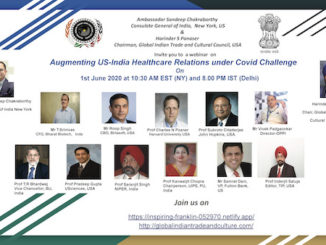
The first Webinar on Augmenting US-India Healthcare Relations under Covid Challenge organized on June 1
NEW YORK (TIP) :The first webinar on June 1 focused on augmenting US-India Healthcare Relations under Covid Challenge. The panelists included Ambassador Sandeep Chakravorty, Consul General of India at New York, Prof. T R Bhardwaj, Vice Chancellor, Baddi University, HP, India, Mr. Vivek Padgaonkar, Ex Director, Organization of Pharmaceutical Producers of India, Prof Saranjit Singh, Pharmaceutical Scientist, NIPER, India, Prof Kanwaljit Chopra, Chairperson, UIPS, PU, Prof Charles N Pozner, Head Emergency Medicine , Harvard University, Mr. Samrat Dani, Vice President, Fulton Bank, USA, Prof Pradeep Gupta, Burroughs Wellcome Professor of Pharmaceutics, Mr Roop Singh, Chief Business Officer, Birlasoft, USA, and Prof. Indrajit S Saluja, Publisher and chief editor The Indian Panorama.
H S Panaser
Welcoming and introducing the panelists Mr. H.S. Panaser, Chair, Global Indian Trade and Culture, USA. Spoke on the need for a series of webinars to deal with the subject of cooperation between the U.S. and India in the pharmaceutical sector. He said, “The dependencies and inter-dependencies of globalization especially between US and India, have been in headlines during the COVID-19 pandemic—and nowhere more so than in the Healthcare segment. More so, in pharmaceutical industry.
Mr. Panaser spoke about the Indian pharmaceutical scene and the healthcare sector. “The Indian healthcare sector is expected to reach Rs 19,56,920 crore (US$ 280 billion) by 2020. Rising income level, greater health awareness, increased precedence of lifestyle diseases and improved access to insurance would be the key contributors to growth. Indian Pharmaceuticals is a sunrise industry with a competitive advantage for India globally. we should leverage India’s position by unleashing entrepreneur spirit the bullish outlook for health care segment is now taking India in a forward momentum. The market size of India in Pharmaceuticals alone is estimated to be $100 billion and medical devices is $25 billion by 2025. Now with amendment in FDI policy where one can invest up to 100% specially if it is medical devices segment where India is importing 80% of medical devices”, Mr. Panaser said.
Ambassador Sandeep Chakravorty
Ambassador Sandeep Charkavorty, Consul General of India at New York who inaugurated the webinar series, said he was not aware there was to be a formal inauguration.
“I think webinar, zoom and WebEx conferencing are the new normal. It is high time that we start reconditioning our life to this new format . So I’m very happy to be here with such a distinguished panel. I will first like to congratulate our friend Harry Panaser for bringing up this panel of speakers .He has been working in the health care sector for several years now and he has deep knowledge and connections here in the United States and back home in India and it is not surprising that he has decided to hold a seminar on Indo US cooperation and collaboration in health care , particularly in the context of Covid challenge. To set the ball rolling, I am very happy to inaugurate this webinar”.
Mr. T Srinivas
Mr. T Srinivas, the CFO of Bharat Biotech of Hyderabad, India which owns 160 global patents said, “Our products help people in over 65 countries live to their fullest potential. Our manufacturing facilities are approved by USFDA, KFDA and WHO. We have delivered over 3 billion vaccine doses all over the world.”
Mr. Srinivas said “We started working on Covid vaccine in March 2020. We are now working on animal trials in India.
Prof. T R Bhardwaj
Prof. T R Bhardwaj, Vice Chancellor, Baddi University, HP, India said it was a matter of pride that India has emerged as a global Pharmaceutical Competitor. One third of the world’s generic drugs and formulations as well as bulk drugs, and Active Pharmaceutical Ingredients (APIs) are manufactured in India. “You will be surprised to know that one third of India’s production is from Himachal Pradesh , mainly from Baddi area, in the neighborhood of Baddi University. Baddi is Asia’s largest industrial hub and is only 45 Km from Chandigarh”.
“India has always been considering profession of Pharmacy as service to the mankind. Dr Yusuf Hamied , CIPLA Limited, has already served the poor AIDS patients of Africa by providing Anti – AID medicines at the cheapest rates. The same service to the mankind has been further repeated by our PM to provide Hydroxychloroquine and other preventive drugs to US and other countries during Corona Pandemic.”
Prof Bhardwaj said “You will be pleased to know, it is a matter of pride for us, that Baddi University extended their hostels facility to the staff, working round the clock ,of all these manufacturing companies during Covid – 19 lockdown. Although at present we have around 75 FDA and almost 70 approved by regulatory agencies of other countries such as Australia, South Africa, Europe etc.”, said Prof Bhardawaj
Mr. Vivek Padgaonkar
Mr. Vivek Padgaonkar, Ex Director, Organization of Pharmaceutical Producers of India said:” India-US partnership has been consolidating over the years and COVID-19 pandemic has further bolstered Indo-US partnership through supply of HCQ and other APIs. While there has been a huge strain on the healthcare system due to outbreak of COVID-19 pandemic, pharmaceutical companies have an unprecedented opportunity to play a significant role in this fight against the virus. With every adversity comes a learning opportunity. Covid-19 has been no exception. One major takeaway has been the power of collaboration”.
“In the middle of this global crisis, Indian pharma has proven to be consistent and reliable. The biopharmaceutical industry generates significant economic value in terms of job creation, R&D investment, and medications that improve patient productivity. However, the first quarter of 2020 saw disruption of many industries’ supply. Currently, Indian pharmaceutical companies account for around 40 per cent of the generic drug supply to the US market.”
Vivek said “We can partner with innovators (e.g., Serum Institute of India with two companies on the vaccine for COVID-19; Gilead is partnering with many Indian companies on Remdesivir.”
Prof Saranjit Singh
Prof Saranjit Singh, Pharmaceutical Scientist, NIPER, India said “Covid pandemic has helped Indian Industry to regain the stature to certain extent. Over a 10-year period (2009-2018), the U.S. saved about two trillion dollars through generic drugs. Foremost is re-building faith in Quality of Indian Generic Drug Production. He emphasized the importance of National Institute of Pharmaceutical Education and research and the visionary who initiated the institute, Late Prof Emeritus Harkishan Singh. There is a need for impetus for industry to get above the basic GMP compliance to high-tech manufacturing, so that quality is built into the product, and not tested. The academia also needs to rise to occasion and shall collaborate for training of students in high-tech emerging areas with leading International institutions using e-modes. The country needs to establish Centre’s of Excellence (COE) in areas, like viral drug research, continuous manufacturing, etc. Innovation and deep scientific research have to be thrust areas for pharma institutions in future” quoted Prof. Singh.
Prof Kanwaljit Chopra
Prof Kanwaljit Chopra, Chairperson, UIPS, PU, India emphasized the research at the university. She quoted a range of top CEOs and professionals in Academia, Government and Industry who are from Punjab University globally in Pharmaceuticals.
Prof. Charles N Pozner
Prof. Charles N Pozner, Head Emergency Medicine , Harvard University, presented the video clipping on operations process of stimulation now reaching India.
Mr. Samrat Dani
Mr. Samrat Dani, Vice President, Fulton Bank, USA presented his experience of putting finance in API and infrastructure. He highlighted the concept of mergers and collaboration in Medical Devices as well.
Prof. Pradeep Gupta
Prof. Pradeep Gupta, Burroughs Wellcome Professor of Pharmaceutics, talked on the importance of Universities participation in research and development on pharmaceutical formulations and new drug discoveries.
Mr Roop Singh
Mr Roop Singh, Chief Business Officer, Birlasoft, USA said: “Birlasoft has invested in next generation transformational PV Tools/ Platforms powered with cognitive technologies including ML/AI and natural language processing which have the capacity to deliver insights from the data-based evidence coming out of clinical trials to help us very rapidly understand which drug and vaccine candidates we should double down on because they hold the most promise to be effective and safe, vs. those in which we should stop investing.
Prof. Indrajit S. Saluja
Summing up the deliberations, Prof. Indrajit S Saluja congratulated panelists for an extremely meaningful discussion . He congratulated Harry Panaser for taking the initiative to bring the best minds together from the pharmaceuticals sector. Prof. Saluja appreciated Prof. Tilak Bharadwaj for making a solid claim for US India collaboration. Prof. Bharadwaj said India had a lot to attract US companies to operate in India. Strong manufacturing base, cost effectiveness, established network of labs, scientists and professionals, strong marketing and distribution network , potential growth of clinical trials, , fast growing health industry, quality control – all these are good enough attractions.
Prof. Saluja also recalled the great contribution of Padma Shri Prof. Harkishan Singh to promotion of pharmaceutical research and development. He recalled Prof. Kamaljit Singh Chopra’s words: “ His stellar contribution is the field of pharmaceuticals has had a great impact on research in the field of pharmaceuticals”.
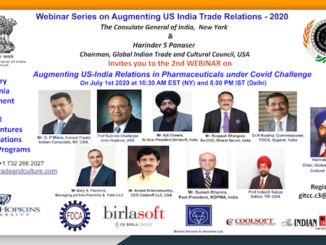
NEW YORK (TIP): The Global Indian Trade and Cultural Council in association with the Consulate General of India, New York organized the second webinar in the series “Augmenting US India Trade Relations – 2020” on July 1.
Welcoming the panelists, Mr. H.S. Panaser, President of The Global Indian Trade and Cultural Council said, “US strategic and trade affairs experts feel that US and India will be key to future production of medical supplies and pharmaceuticals not only to fight Covid-19 crisis but long thereafter.
“In the United States, every seventh American is seen by an Indian doctor, which will soon be 6:1, signifying the contribution of the diaspora in the American healthcare system. Today, as the world fights the corona pandemic and the US becomes its worst victim, with over 100,000 deaths and counting, health diplomacy has emerged as the new unifier for the two democracies and the driver for an intense partnership promising a big relief to the world with a timely vaccine against the coronavirus.
“Global Indian Trade and Cultural Council” wants to accelerate and promote US India Relation in Healthcare industry. We are helping in FDI, collaborations, mergers and technology transfers and researchers and students exchange programs. The US has already identified Indian pharmaceutical companies as one of the partners for mass productions to meet global demands. We were privileged to have CFO of Bharat Biotech Mr. T Srinivas in our first Webinar and you will find another Executive who are launching a Covid vaccine
Panelists included Devi Prasad Misra, Consul (Trade, Education and Commerce), Dr. Subroto Chatterjee, Dr. H. G. Koshia, Mr. Suresh Khanna, Mr.Roopesh Bhargava, Mr. Anand Krishnamurthy, : Mr. Gary Pasricha, Mr. Ajit Chawla, Prof. Indrajit S Saluja, and Mr. H.S. Panaser
Mr. Devi Prasad Misra
Mr. Devi Prasad Misra, Consul Trade, Education and Commerce at the Indian Consulate in New York participated briefly.
Dr. Subroto Chatterjee
Dr. Subroto Chatterjee is a Professor of Pediatrics and medicine in the division of Cardiology at the Johns Hopkins University School of a Medicine. His expertise is in the area of heart disease and inflammation. He has published over 200 papers book chapters. And has received international and national awards for his discoveries and patents. He serves as a thought leader to Merck, Novartis and has founded several Biotech companies
Prof Chatterjee said, “Studies show that inflammation is the underlying factor among others contributing to excessive morbidity and mortality in COVID-19 patients. And this pathology is attributable to the release of cytokines subsequent to the binding of the virus to the angiotensin-2 receptors in white cells circulating in the blood. One of these cytokines ,known as interleukin-6(IL-6) bind to cells in the blood vessels -further amplifying the release of cytokines causing multi-organ failure and death. Immunotherapy using antibody against IL-6 /IL-6 receptors has shown promise with delayed viral clearance and markedly improved recovery from infection and reduced hospitalization time.”
Dr. H. G. Koshia
Dr. H. G. Koshia is working as Commissioner at Food & Drugs Control Administration (FDCA), Gujarat, INDIA since January 2009. Notified as Commissioner of Food Safety of the Gujarat State from 5th August 2011. Diverse experience of 33 years in regulatory affairs working in government and industry. Leading a cross-functional team of 1465 diverse regulatory experts to implement; enforce applicable regulation to regulate 4697 drug manufacturers and 39865 sales units in Gujarat.
Hemant said, “The crisis has faded many boundaries and brought people and countries together to stand united against the fight! More so true when it comes to the pharmaceutical industry – India has stood as a strong partner and friend with many countries including the US and fulfilled the duty of ‘Pharmacy of the World’. I see tremendous avenues of US-India continued partnership in biomedical & pharmaceutical research and strengthen our regulatory & scientific relationship further. Exchange of knowledge, technology, science, and talent are few to name.”
Mr. Suresh Khanna
Mr. Suresh Khanna, Engineer by education, was Founder Chairman of M/s.Stabicon Life Sciences Pvt. Ltd. A Contract Research & Development Organization and Designated Partner of M/s. Dossiers Solutions Services LLP, a leading Regulatory Affairs Company. He is a Business Advisor and Member of the Boards of a few companies in both India and abroad. Currently he is a Steering Committee Member of KDPMA, Chairman of Pharma Training Institute and Permanent Trustee of Karnataka Pharmaceutical Trust (KPT), a not for profit Organization, engaged in the upliftment of Pharmacy Education in India.
Mr Suresh Khanna said “India stated that India has a huge potential for providing Pharma Services which people generally don’t talk about. India has very experienced and qualified pool of professionals who can assist in Formulation Product Development, Compiling Product Dossiers/API DMF’s for registration in markets worldwide, SOP Writing, Clinical/BE studies & Clinical Data Management, Validation protocols, setting up Pharmacovigilance Call etc. at a very competitive cost. These costs will be affordable by many small and medium Centers scale companies in USA, thereby making them more competitive commercially worldwide. These services are akin to services provided successfully by Indian software Industry worldwide.”
Mr. Roopesh Bhargava
Mr. Roopesh Bhargava is an Experienced in leading and growing all sectors of a business (Pharmaceuticals/ Nutraceuticals/ Vaccines) for the last three decades with Proven Credentials. He has served Companies like Sanofi as Senior Director / Besins Healthcare as Managing Director and Bharat Serums & Vaccines as Chief Operating officer till very recently .He has the experience of having Worked in Greater India, China and US markets. Currently, he is a consultant to the Pharmaceutical Companies to make it dynamic and Progressive organization. Possessing excellent communication skills and able to establish sustainable and profitable relationships with Customers, suppliers and stakeholders across the country.
He said “India and US have to augment each other to ensure that best of the Medicines / Vaccines reach to fellow humans at an affordable price with excellent Quality. India Supplies 40% of total Generic medicine required by USA. The Capacity to Produce vaccines also lies with India as required. Hence faster approvals and joint efforts by each other is the call of the day. The advantage which India has in terms of cost efficiency, Economic drivers, Policy support and Investments can be fully leveraged under the trying circumstances for a Win- Win situation.”
Mr. Anand Krishnamurthy
Mr. Anand Krishnamurthy, CEO, Coolsoft LLC, is a fast-growing company, focused on AI and ML it is providing consulting and application development services in Information Technology. COOLSOFT combines technical expertise with in-depth business knowledge to provide the best solutions to organizations in Healthcare, Transportation and Telecom.
Anand said “In the area of Pharmaceuticals, Science and technology will and should play a key role. Artificial Intelligence and Deep Learning will assist us in finding new cures for diseases. This will aid in discovery of cures for rare diseases where the ROI for the drug companies is not significant. Technologies such as blockchain will aid in the fight against counterfeit drugs which will save lives lost due to fake drug usage and administration. AI/ML and Genomics will cause as much a change to the human race as the industrial revolution did. More importantly, the close collaboration between academia, researchers and philanthropist between India and US should and will result in making new and affordable drugs for now and the future.”
Mr. Gary S. Pasricha
Mr. Gary S. Pasricha is the managing partner of the law firm of Pasricha & Patel LLC. He has been practicing law for over 25 years, specializing in representing businesses and individuals in business law matters such as contracting, mergers and acquisitions, secured lending, import and export regulations, labor law, and business immigration
Garry presented a ppt on laws in US under Covid 19 especially PPE
Mr. Ajit Chawla
Mr. Ajit Chawla is SVP & Global Head, Digital Business Unit, Birlasoft, a CK Birla group company whose Mission statement is “Making Societies more productive by helping our customers run their business”. Guided by the company mission,
“Both lives and livelihoods are important. Return-to-work strategies need to be comprehensive yet pragmatic. While on one side, organizations in sectors such as Pharmaceuticals who engage in mission-critical operations cannot afford more disruptions, their employees also look for confidence and assurance on health & safety front to return to work. Guided by its Mission statement “Making Societies more productive by helping our customers run their business”, Birlasoft has launched a solution named intelliOpen™ that leverages digital technologies to empower its customers to make their facilities safer during and post COVID-19. intelliOpen can help organizations in all industries but considering the ones in life-sciences industry touch human-lives directly, we are specially motivated in helping them balance productivity with safety.”
Prof. Indrajit Saluja
Prof. Indrajit S Saluja is the Publisher-Editor of The Indian Panorama (New York; Dallas), Advisor on Board at Global Indian Trade and Cultural Council., USA, President, Indo-US Media Inc., President, Opinio Media, Inc. is an Academician, Journalist, Writer, Poet, Speaker, Actor, Television Host/ Anchor. Recipient of many honors and awards, Prof. Saluja has served on Panjab University Academic Council and Languages Faculty and was nominated to a 2-year term on the National Youth Advisory Committee, headed by Prime Minister of India. Currently based in New York, he hails from Punjab, India where he was a college teacher of English language and literature for 35 years.
Prof. Saluja said there were enough areas and opportunities for cooperation between US and India. He underlined the present geopolitical scenario in which China which has hitherto been monopolizing trade with US , has fallen out with the nation which contributed most to its growth. It is an opportune time for India to take advantage of the situation and broaden its manufacturing base to substitute China for US needs of products from pins to toys to electronics etc.
Mr. H.S. Panaser
Mr. H.S. Panaser is the Founder and President of Global Indian Trade and Cultural Council, USA. He is a strong and innovative leader with more than three decades of experience in fortune 500 companies in Pharmaceutical, Medical Tourism and Food and Health segment in Global Marketing. Harinder had been working for over a decade as Chair for a Super PAC promoting US India relations. His Other affiliations and experience includes Chair, NJ, NY Chapter, US India Political Action Committee, Ex. President, Global Haryana Chamber of Commerce, Advisor on Board, C3Summit International LLC, Ex. President, US SAARK Business Forum, Director A I Nexus, President – Global Marketing NYSO, India and Ex. Member on Board, Automotive Aftermarket Industry Association, USA.
Panaser concluded by thanking the speakers at the panel of this webinar and saying as we quote “India has emerged as a global capital of generic medicines and can contribute to the world by producing cheap drugs, including vaccines. With US support in scientific advancement and technology at its command, a high-quality medical research enabled to India can aid the mass production of vaccines and essential drugs in India, eventually helping the world facing a crisis like Covid-19 currently.”
“In a continued effort of this series of webinars we are trying to get representatives from The Indian Council of Medical Research, Ministry of Health and Ministry of Chemicals, Government of India to join our webinar and address The Indian diaspora connected to the health care industry in the United States”, Panaser concluded. .
The pandemic unlocked hidden energy in governments. The lethargy and inertia in governance disappeared without any loss of time as the threat to the common man’s life and livelihood was perilous. It led to prompt decision-making, rapid re-formulation of programs and policies to minimize the devastation and provide relief to the vulnerable population.
The Covid-19 pandemic has wreaked unprecedented havoc on mankind and across nations. The contagion is global, and perhaps, requires a coordinated worldwide response. It has blurred the distinction between the developed and under-developed worlds and seems to be pushing for a new socio-economic world order.
The devastation caused by the pandemic is debated and feared by everyone. Trade, business and industry have been impacted in equal measure, though agriculture seems to have shown some resilience to beat the ill-effects of the virus. The producers of food grains have so far found their way through the shutdown. They have succeeded in the harvesting of winter crops and the sowing of summer crops despite the pandemic. Even the governments were at ease in distributing grains in the face of broken food supply chains because of sufficient buffer stocks. But the loss of producers of perishable commodities such as fruits and vegetables, dairy and poultry products could not be prevented owing to disruptions in transportation and demand contraction.
Likewise, loss of jobs, particularly those in unorganized sectors could not be avoided as production processes halted and the markets were closed. Even after unlocking the markets, there are not many buyers due to the declining income and liquidity crunch. The gradual opening of businesses has, however, created hope for many in the MSME sector. The revival of employment in agriculture has somehow shown more promise than the other sectors of the economy.
Without undermining the losses thrust upon society and the economy, it has to be admitted that the pandemic has compelled the people for a change in behavior that is otherwise difficult to achieve. Avoidance of non-essential travel and luxurious spending, maintenance of social distancing, hand hygiene, and the wearing of the mask or any such thing that keeps one’s health assured or good and saves life are liked or at least not abhorred by the common man. Even those who preferred free loitering in groups are now maintaining social distancing.
At times, it was difficult to persuade people to take potable piped water connections, build toilets, avoid open defecation, ensure safe food quality and maintain sanitation in galis (lanes) and mohallas (localities). Today, the demand for such basic services has increased. The communities are compelling for the provisioning of these essentials. They are even ensuring surveillance on Covid-19 cases and travelers around their villages or habitations. Health consciousness has risen to a new high. Even the addicts are seeking treatment to return to normal living, much to the detriment of drug suppliers and peddlers.
The pandemic has propelled the use of digital technology. Fintech, proptech, edutech, and agri-tech are now common in day-to-day conduct of business. Digital education, unknown to over 90 per cent of teachers, is now widely preferred. During the recent harvesting and sowing of crops in Punjab, most farmers were eager to be a part of digital messaging through WhatsApp or other apps. They downloaded e-passes for the sale of their products and used debit/credit cards more often than ever before. The disrupted food supply chains were also kicking, even in containment areas, due to the use of digital technology. The Amazons and Zomatos were able to reach more households despite restrictions.
Another satisfying change is the decline in avoidable lavish spending on social occasions such as marriages and other such celebrations that are identified as one of the major reasons for the rising indebtedness amongst the farmers and landless workers. The restrictions on social extravaganza, tried many times earlier, succeeded, though forcibly during the pandemic. No policy or programme could achieve this and hopefully, it will be maintained in the future.
The pandemic unlocked hidden energy in governments. The lethargy and inertia in governance disappeared without any loss of time as the threat to life and livelihood for the common man was grave and hugely perilous. It led to prompt decision-making; rapid re-formulation of programs and adjustment of public policies to minimize, if not avoid, the devastation and provide immediate relief to the affected vulnerable populations. The quick proclamation of lockdown, rapid upgrade of health infrastructure, swift identification and resolution of unrealized problems such as migrant workers and fiscal stimulus are some of the outcomes of a new way of life and, of course, governance.
The pandemic has surely led to a new normal in our lives. It is different, but not so unusual. It may sometimes appear to be absurd and restrictive, but is not reprehensible or difficult. In many ways, it has taught us discipline, care for one another, use of technology, financial responsibility, and prudence in life. Covid-19 has made us realize values and systems, some of which can be termed as traditional, concerning hygiene, health, education and even society and communities in which we live. ‘Leave your shoes out’; ‘Take off your shoes; ‘Spitting not allowed’ or ‘Wash your hands’, though may appear to be the new normal, are not new or unfamiliar phrases for us. The pandemic has perhaps enforced conduct that requires the use of new techniques and technologies with the widespread adoption of old but otherwise normal systems and practices, which were lost in our pursuits to grow, perhaps unknowingly. The pandemic has driven us to a new world of work and living.
(The author is Chief Principal Secretary to Punjab CM)
Coronavirus hot spots should pause reopening, not shut down again, recommends infectious diseases expert
WASHINGTON (TIP): States with spiking coronavirus cases still can contain them by pausing their reopening processes, rather than shutting down a second time, one of the nation’s top infectious disease experts said Thursday, July 9.
Dr. Anthony Fauci’s comments at an event hosted by The Hill news outlet contrast with what he said a day earlier: that states with a serious coronavirus problem “should seriously look at shutting down.”
“Rather than think in terms of reverting back down to a complete shutdown, I would think we need to get the states pausing in their opening process,” Fauci, director of the National Institute of Allergy and Infectious Diseases, told The Hill’s Editor-at-Large Steve Clemons on Thursday.
“If we can do that consistently, I will tell you, almost certainly, you’re going to see a down curve of those infections,” Fauci said.
On Wednesday, July 8, Fauci told the Wall Street Journal that a second shutdown might be the best move for states struggling with burgeoning coronavirus cases and hospitalizations.
“I think any state that is having a serious problem, that state should seriously look at shutting down,” Fauci told the newspaper in a podcast.
He did say Wednesday that simple steps short of full economic lockdowns — controlling crowds, wearing masks and doing a better job at physical distancing — would help.
The country and some states are setting records for average daily officially reported cases, ICUs in hot spots are reaching capacity, and most states are seeing spikes, recalling the uncertainty of months ago when the virus first broke out.
Another health expert echoed Fauci’s initial comment about second shutdowns.
“If you’re not doing the … things we’ve talked about in the past to get this outbreak under control, starting with test and trace … your only option is to shut down,” Dr. Ali Khan, former director of the CDC’s public health preparedness office said.
Climbing case numbers have motivated many states to pause or roll back plans to reopen economies after widespread shutdowns in the spring.
The US reached more than 3 million coronavirus cases this week, according to data from Johns Hopkins University. At least 33 states as of Thursday morning have seen an upward trend in average daily cases — an increase of at least 10% — over the last week.
Some states have recently reported alarming rates at which people are testing positive: 28% in Arizona; 26% in Texas; and 19% in Florida, according to The Covid Tracking Project.
Previous recommendations for reopening economies, expressed by the CDC, called for test-positivity rates of no greater than 20% just to reach first-phase reopenings, and less than 10% for fuller reopenings.
The country still is reckoning with job losses from the first stay-at-home orders. Though millions of jobs have come back, 18.1 million Americans currently are on continued unemployment claims, meaning they filed at least two straight weeks, the Department of Labor said Thursday, July 9.
And more than 3 million Americans appear to have lost jobs that aren’t coming back any time soon, economists say.
NEW YORK (TIP): A group of 58 Indian-origin executives heading various companies across 11 different countries, including the US, Canada and Singapore, collectively employ more than 3.6 million people and account for a combined USD 1 trillion in revenue, USD 4 trillion in market capitalization, according to a list released by a US-based top Indian diaspora organization.
Indian-origin business leaders are reaching the pinnacle of corporate success in greater numbers than ever, many use their platforms for social change advocacy, said Indiaspora, a nonprofit organization of global Indian diaspora leaders from various backgrounds and professions.
The Indiaspora Business Leaders List of 58 executives head companies headquartered across 11 different countries, including the US, Canada, England, and Singapore and these companies have delivered annualized returns of 23 per cent during the tenure of these executives, outperforming the S&P 500 by 10 per cent.
These companies collectively employ more than 3.6 million worldwide and account for a combined USD 1 trillion in revenue and USD 4 trillion in market capitalization.
“We wanted to capture this incredible feat that our community is achieving with increasing numbers,” said Indiaspora founder MR Rangaswami, a Silicon Valley-based entrepreneur and investor.
“The impact that the Indian diaspora is having in the realm of business is remarkable. It’s one of the reasons we launched this project, and we hope our lists will continue to raise the profile of those who have reached the very top of their fields while also serving as agents for positive change,” Rangaswami said.
The stereotype of the Indian CEO is someone who represents the tech sector, but this list of 58 CEOs dispels that myth, he said, adding that these leaders represent many different sectors, including banking, electronics, consumer goods, and consulting.
Releasing the list during a virtual press conference, Rangaswami said that these executives are as young as 37, all the way to age 74 with the median age of these executives being 54.
During this coronavirus pandemic, these companies have made lots of humanitarian aid contributions, and also, they’re taking care of their employees, their customers, their supply chain.
“So these companies are doing a lot to respond to COVID-19,” Rangaswami said.
Many of the executives on the list have taken an active position on issues like Black Lives Matter in making sure that they also stand along with the black community in terms of getting racial equality and racial justice, he said.
The list of Indian-origin CEOs includes immigrants from India as well as professionals born in countries such as Uganda, Ethiopia, England, and the US.
“I’m amazed to see how far we’ve come in terms of representation in business,” said Raj Gupta, former CEO of Fortune 300 company Rohm and Haas, and one of the first executives of the Indian diaspora to join the ranks of corporate leadership along with pioneers such as Indra Nooyi of PepsiCo and Dinesh Paliwal of Harman International.
“There used to be only a handful of us leading corporations. Now that we are reaching prominence, I am eager to see how the next generation leaves its own legacy,” said Gupta, an Indiaspora member, who serves as Chairman of two companies on the Business Leaders List, Aptiv and Avantor.
“It’s inspiring to see so many leaders of Indian heritage playing a significant role in business and in society,” said Ajay Banga, President and CEO of Mastercard.
“Our culture and our values are a common starting point. But it’s what we do with the opportunities presented to us that make a difference. When we lean into our diverse experiences to deal with challenges like the pandemic or racial injustice, we can have an even greater impact on the lives of those around us,” he said.
Indiaspora said that many of these diaspora executives have led their companies in advancing social change by addressing racial injustice, climate and sustainability justice, and the disproportionate effects of COVID-19 through policy and financial commitments.
Tech industry leader Sundar Pichai, CEO of Alphabet, has announced new goals for racial equity, including improving leadership representation of underrepresented groups at Google, and an “economic opportunity package” for the Black community.
Many of the leaders’ companies have created or contributed funds in response to COVID-19, with monetary and humanitarian aid totaling more than USD 400 million, Indiaspora said.
The Indiaspora Business Leaders List also calls attention to the presence of a glass ceiling that women, including Indian women, still face. Out of 1,000 companies represented on the Fortune 500 list, only 61 have women CEOs; the Indiaspora List has a marginally higher percentage of women, yet includes only five women out of the 58 leaders.
“It’s an honor to join so many outstanding leaders on this year’s Indiaspora Business Leaders list, each of whom is making a meaningful impact within their industry,” said Reshma Kewalramani, MD, CEO and President of Vertex Pharmaceuticals.
“As a physician and CEO dedicated to creating transformative medicines that improve the lives of people with serious diseases, I believe deeply in the critical role a diverse and inclusive culture plays in being able to achieve that mission at Vertex,” she said.
JOHANNESBURG (TIP): Jayraj Bachu, a founding member and national leader of South Africa’s only Hindu political party, has succumbed to Covid-19. He was 75.
The Durban resident Bachu was cremated on Saturday, July 4.
Bachu’s son Umesh told the weekly Sunday Tribune that his father passed away less than a week after he was admitted to hospital after an antibiotics course failed to address an influenza infection.
“Unfortunately, on Friday evening I received a call from the hospital to say he had taken a turn for the worse. They said two family members could go to the hospital, but by the time I got to the hospital my dad had passed on,” Umesh told the weekly.
“He was not at the stage where he was on a ventilator. Reality of the virus hits you when it happens close to home. It was devastating for my mom, me and my siblings that we could not see him one last time,” he said.
Bachu had served in community and political organizations for over five decades. Last year, he joined others to register the Hindu Unity Movement (HUM) with the Independent Electoral Commission.
He explained at the time that HUM was established because there had not been a voice in provincial, national or local governments catering to the needs of the Hindu community.
“Existing Hindu religious and cultural organizations are working from outside government to address the issues facing the community, but we need someone on the inside to get these issues addressed effectively,” Bachu said.
Bachu’s lifelong friend Ram Maharaj, who is the national chairman of HUM and also the president of the South African Hindu Dharma Sabha, said Bachu had endeared himself to the community because of his positivity and diplomatic approach to everything he did.
Maharaj said Bachu had led the fight since the 1980s to allow fireworks during Diwali when there were plans by government to ban its use at private homes.
Bachu is survived by wife, Renuka, children Vinod, Umesh, Reshma Harinarain, Rinku Singh and a number of grandchildren.
LONDON (TIP): An Indian-origin doctor working on the frontline of the coronavirus pandemic at a UK hospital was found dead in the hotel he was staying in to isolate away from his family during the lockdown.
Dr Rajesh Gupta, a consultant anesthetist at the National Health Service (NHS)-run Wexham Park Hospital in Berkshire, south-east England, was found dead earlier last week and the cause of his death is yet to be established.
“We are very sorry to pass on the sad news that our Frimley Health colleague Dr Rajesh Gupta has passed away,” Frimley Health NHS Foundation Trust said in a statement on Friday.
“Rajesh, who worked as a consultant at Wexham Park Hospital, was found on Monday afternoon in the hotel where he had been staying to protect his family while he worked with us during the coronavirus pandemic. At this stage the cause of his death is not known,” the NHS Trust said.
Gupta was described as a “popular and well-known figure” by the Trust, which said that colleagues saw him as an “outstanding clinician with a passion for pain medicine”.
He had recently been appointed to an important post at Wexham Park Hospital after working for a period as a locum consultant at Frimley Park.
“They (colleagues) also say he was a gifted poet, painter, photographer and cook who was known for his enthusiasm, good nature and kindness. He wrote several books and contributed to a number of publications. He will be greatly missed,” the Trust said.
Gupta, who studied in Jammu before moving to the UK, is survived by his wife and a young son.
The Frimley Health NHS Foundation Trust said that it is supporting his closest colleagues as the news of the sudden death has come as an “enormous shock” at his former workplace.
NEW YORK (TIP): Scientists from the University of Maryland School of Medicine (UMSOM) developed an experimental diagnostic test for COVID-19 that can visually detect the presence of the virus in 10 minutes. It uses a simple assay containing plasmonic gold nanoparticles to detect a color change when the virus is present. The test does not require the use of any advanced laboratory techniques, such as those commonly used to amplify DNA, for analysis. The authors published their work last week in the American Chemical Society’s nanotechnology journal ACS Nano.
“Based on our preliminary results, we believe this promising new test may detect RNA material from the virus as early as the first day of infection. Additional studies are needed, however, to confirm whether this is indeed the case,” said study leader Dipanjan Pan, Ph.D. Professor of Diagnostic Radiology and Nuclear Medicine and Pediatrics at the UMSOM.
“The accuracy of any COVID-19 test is based on being able to reliably detect any virus. This means it does not give a false negative result if the virus actually is present, nor a false positive result if the virus is not present,” said Dr. Pan. “Many of the diagnostic tests currently on the market cannot detect the virus until several days after infection. For this reason, they have a significant rate of false negative results.”
Dr. Pan created a company called VitruVian Bio to develop the test for commercial application. He plans to have a pre-submission meeting with the U.S. Food and Drug Administration (FDA) within the next month to discuss requirements for getting an emergency use authorization for the test. New FDA policy allows for the marketing of COVID-19 tests without requiring them to go through the usual approval or clearance process. These tests do, however, need to meet certain validation testing requirements to ensure that they provide reliable results.
NEW YORK (TIP): Global Indian Trade and Cultural Council, USA in collaboration with Consulate General of India, NY has started a Webinar series. The first webinar is scheduled for June 1st, 2020 on Augmenting US India Healthcare Relations under Covid Challenge. This will have professionals from Covid 19 vaccine manufacturing companies, IT company Birlasoft who specialize in healthcare software, distinguished Professors from Harvard, Johns Hopkins and Panjab University, Pharmaceutical Scientist from NIPER, India, Ex Director Organization of Pharmaceutical Produces of India, Banker and Media professional, according to Mr. H.S. Panaser, Chair, Global Indian Trade and Culture, USA.
Speaking to The Indian Panorama on the need for series of webinars to deal with the subject of cooperation between the U.S. and India in the pharmaceutical sector, Mr. Panaser said: “The dependencies and inter-dependencies of globalization especially between US India, have been in headlines during the COVID-19 pandemic—and nowhere more so than in the Healthcare segment. More so, in pharmaceutical industry. We don’t yet know how the medicine and vaccine challenge will end. Whether it be avipiravir, remdesivir or something else. It is unclear which drug, if any, will work. It may be an Indian company Bharat Biotech or American company or an Oxford lab that is hailed as a hero for a treatment or prevention, the task is not just about discovering a treatment or vaccine that works, but making it available to as many people as possible in as short a time as possible. Successful accomplishment of that task—especially in the global south is difficult to envisage without Indian involvement. COVID-19 ignores borders and the solutions to address it will need to overcome them too.
“Therefore, there was a need for a school of thought to bring on a platform from the field of Academia, Industry and Government, Mr. Panaser said.
Mr. Panaser spoke at length about the Indian pharmaceutical scene and the healthcare sector. “The Indian healthcare sector is expected to reach Rs 19,56,920 crore (US$ 280 billion) by 2020. Rising income level, greater health awareness, increased precedence of lifestyle diseases and improved access to insurance would be the key contributors to growth. Indian Pharmaceuticals is a sunrise industry with a competitive advantage for India globally. we should leverage India’s position by unleashing entrepreneur spirit the bullish outlook for health care segment is now taking India in a forward momentum. The market size of India in Pharmaceuticals alone is estimated to be $100 billion and medical devices is $25 billion by 2025. Now with amendment in FDI policy where one can invest up to 100% specially if it is medical devices segment where India is importing 80% of medical devices”, Mr. Panaser said.
“This webinar will discuss the US India Healthcare Relations to kickstart Exchange program of Student, research fellows in Universities, research institutes, Medical Colleges in the field of Pharmaceuticals, Medicine, Healthcare AI, MT by IT companies and Medical Devices.
‘Such webinars will set a movement to spearhead collaborative mindset and a platform for FDI, mergers and joint ventures under Prime Minister Modi’s $13 billion for three pharmaceutical parks in India and up to 100% FDI in Medical devices. Covid 19 has been an Eye opener – the present Government has done more in last few weeks than what was done in years.
“Indian government has to make new policies for top Universities with research and institutes like National Institute of Pharmaceutical Education and Research with top scientist to allow them collaboration with public private partnership and to have India’s best leadership.
The following is the list of people who along with Ambassador Sandeep Chakravorty are on the panel.
1.Mr. T. Srinivas, CFO, Bharat Biotech, Hyderabad, India
2.Mr. Sai Prasad, President QC, Bharat Biotech, India
3.Mr. Roop Singh, Chief Business Officer, Birlasoft, USA
4.Prof. Charles N Pozner, MD, Emergency Medicine, Harvard University, USA
5.Prof. Subroto Chatterjee, John Hopkins University of Medicine, USA.
6.Prof.(Dr) T.R. Bhardawaj , Vice Chancellor, Baddi University (Pharmaceuticals),India
7.Prof, (Dr) Pradeep Gupta, Burroghs Wellcome Professor of Pharmaceuticals, USciences, Philadelphia, PA, USA
8.Prof.(Dr) Saranjit Singh, Pharmaceutical Scientist, National Institute and Pharmaceutical Education and Research, Mohali, Punjab, India
9.Prof. (Dr) Kanwaljit Chopra, Chairperson, University Institute of Pharmaceutical Sciences, Panjab University, Chandigarh, India
10.Mr. Vivek Padgaonkar, Director- Project & Policy, OPPI (Organization of Pharmaceutical Producers of India)
11.Mr. Yash Dani, VP, Fulton Bank, NJ, USA
12.Prof. Indrajit Saluja, Editor, The Indian Panorama, NY, USA, Media
Moderator: H S Panaser, Chair, Global Indian Trade and Culture, USA
NEW YORK (TIP): Indian American Nayan Parikh , owner of Ashnu International, Inc. an award winning, premier/MWBE Construction and Management provider to host of Federal, State and City Agencies, Corporations and other industries, is one of the 30 New Yorkers named on Mayor de Blasio’s real estate reopening council. The panel will guide the industry’s economic reboot.
Nayan Parikh has, over the past fifteen years, continued hard to establish his name within the corridors of Government Agencies and has continued to build his reputation to his expertise in bringing excellent performance to the projects undertaken by his company. He has been the champion in leading many professional and community organizations and continues to give back to the society in many different ways. He has brought new ideas to fruition, both for profit and non-profit organizations. After graduation from college, Nayan began his career as a Civil Engineer in India, before migrating to the USA. In his new homeland, he began his career as an estimator in a small construction company, before quickly finding his own strength to become the founder and Managing Director of Ashnu International, Inc.
Parikh’s vision, entrepreneurial aptitude, civil engineering background and broad range of expertise have made AIC a name to be envied within the construction industry. His company has credit to many well-known projects including Sandy Repair work at Coney Island, Rockaway Beach, multiple schools renovation for New York City School Construction Authority and Signal Modification at 71st Continental Ave with the Metropolitan Transportation Authority.
Serving the community comes naturally to Parikh. From his first days of being a new immigrant to this country till now, he has been involved and giving his time, knowledge and wisdom to non-profit organizations, both within the community and professional. Although he is a part of many organizations and affiliations, he takes pride in each and every one and maintains an active leadership role in these organizations. Currently he is the president of the NAMC NY Tri-State Chapter, during his term he would like to bring more project procurement to his local chapter members. From humble beginnings and a minority himself, he understands the struggle to make to make the right connections or get that big break. Parikh isn’t afraid to reach out to make the necessary connection, which is one of his many strengths. Because of this, his network of associations varies in different influencers, who hold his opinion in high regards and has created a foray into creating an outreach program for his chapter members.
ATLANTA, GA (TIP): An Indian American led team has developed a low-cost, portable ventilator meant to help doctors around the world treat COVID-19 patients. Devesh Ranjan, a professor and associate chair in the prestigious Georgia Tech’s George W Woodruff School of Mechanical Engineering and his research team at the Georgia Institute of Technology has created a prototype for a low-cost, portable emergency ventilator that uses electronic sensors and computer control to manage key clinical parameters such as respiration rate, tidal volume (the amount of air moved into and out of the lungs during each cycle), inspiration and expiration ratio, and pressure on the lungs.
The Open-AirVentGT was designed to address acute respiratory distress syndrome (ARDS), a common complication for COVID-19 patients which causes their lungs to stiffen, requiring their breathing to be assisted by ventilators. Unlike many other emergency ventilators, the new Georgia Tech device endeavors to make breathing more natural by allowing patients to trigger their own breaths instead of relying on a respiration rate pre-set in the device.
The ventilator works by pneumatically compressing a BVM (Bag Valve Mask) assembly of the kind used in hospitals and carried in ambulances as resuscitation devices. The ventilator is envisioned for use outside the United States in countries that do not have significant medical infrastructure in place, and is designed to be produced for around $300.
A projected shortage of ventilators prompted by the COVID-19 pandemic has led to development of makeshift ventilators, many of them based on differing mechanical strategies to compress BVM devices. Ranjan and his research team evaluated what others had done and sought input on clinician needs from critical care specialists at two Atlanta hospitals during the design of the Open-AirVentGT.
NEW YORK (TIP): Dr. Sudheer S Chauhan, a kindhearted physician of Indian Origin, who had dedicated his life at the service of his thousands of patients in the New York region, succumbed to the deadly corona virus on May 19th.
Dr. Chuhan, an Internal Medicine specialist in South Richmond Hill, New York, who was diagnosed with COVID-19 and battling for his life for the past few weeks, died of complications from the illness.
“Our Father, Dr. Sudheer Singh Chauhan, Internal Medicine Physician and Associate Program Director IM Residency Program at Jamaica Hospital, New York passed away on May 19 after battling with COVID for two months. We will miss this unique, kind, gentle and caring spirit. May his soul rest in peace,” wrote his daughter, Sneh Chuhan on COVID-19 Physicians Memorial.
Dr. Chauhan, who had attended and graduated from medical school in 1972, has had nearly half a century of diverse experience, especially in Internal Medicine. Dr. Chauhan received his graduate medical education from GSUM Medical College, University of Kanpur, India in 1972. He was chief resident in Internal Medicine at Jamaica Hospital and graduated in 1997. He is Board Certified in Internal Medicine. He also received MRCP and FRCP from Royal College of Physicians and FACP from American College of Physicians.
Dr. Chauhan joined the Department of Medicine at Jamaica Hospital upon graduation in 1997 and is currently working as a faculty supervisor and attending physician. He is also the Associate Program Director in Internal Medicine Residency Program for the hospital.
Dr. Priya Khanna, 43, another Indian American nephrologist died in a New Jersey Hospital last month. The deadly virus also took the life of her father Satyendra Khanna (78), a general surgeon, after being in a critical condition in the intensive care unit in the same hospital for several days.
TRENTON, NJ (TIP): New Jersey continues to rank second in the country after New York with at least 151,472 cases and 10,843 deaths attributed to COVID-19 since the outbreak began March 4. On May 21, Officials reported 98 new deaths and 1,304 new positive tests, which is, according to the Governor ‘way down from our peaks.’
With Garden state’s outbreak showing signs of slowing and the economy continuing to suffer, New Jersey Governor Phil Murphy has been slowly lifting restrictions. He unveiled a multi-stage approach to execute a responsible and strategic economic restart to put New Jersey on the road back to recovery from COVID-19. The multi-stage blueprint, guided by the Governor’s Restart and Recovery Commission and complementary Advisory Councils, plans for a methodical and strategic reopening of businesses and activities based on level of disease transmission risk and essential classification.
“Through our combined efforts, we have flattened the curve of COVID-19 cases, and we are well-positioned to continue our restart and recovery process,” said Governor Murphy. “Our multi-stage approach uses science, data, and facts to determine which businesses and activities can reopen according to their risk level and challenges they face to safeguard public health. Additionally, we will be guided by our ability to protect against a new COVID-19 outbreak with expanded testing and contact tracing, and clear social distancing safeguards in place. We are currently in Stage 1, and we will aim to move through each stage quickly, but also judiciously, with the public health of our communities and all New Jerseyans in mind.”
More indoor businesses such barbershops, salons, and gyms in the Garden State may be allowed to reopen, with restrictions, in “a matter of weeks, not months,” Murphy said during an appearance on CNBC’s “Squawk Box.” The Governor said that he’s hopeful schools will be able to physically reopen for the beginning of the next academic year in September. Schools are closed in New Jersey through the end of the year, with students learning remotely.
Earlier on May 18, Murphy signed Executive Order No. 147, allowing certain outdoor activities at recreational businesses, including archery ranges, batting cages, golf driving ranges, horseback riding, shooting ranges, and tennis clubs as well as community gardens to open with required social distancing measures in place. The Order takes effect on Friday, May 22 at 6:00 a.m.
The redesign of economies, of businesses, and our lives, must begin with questions about purpose. What is the purpose of economic growth? What is the purpose of businesses and other institutions? What is the purpose of our lives? What needs, and whose needs, do institutions, and each of us, fulfil by our existence?
Machines do not have the capacity for emergence. Once built, their capabilities inevitably reduce with increasing entropy. On the other hand, living systems evolve and acquire new capabilities over time. Fritjof Capra and Pier Luigi Luisi point out in The Systems View of Life: A Unifying Vision that among all living species, humans have a special ability. Only humans consciously develop new concepts, new scientific ideas, and new language in their search for new visions. Institutions of governance are human inventions for directing human endeavors and for providing stability. Thomas S. Kuhn explained in The Structure of Scientific Revolutions why new ideas are invariably resisted by prevalent power structures in societies. The scientific establishment determines which ideas are worthy of admission. The King’s advisers do not want outsiders to dilute their influence in the court. The Establishment resists change. Therefore, fundamental reforms of ideas and institutions in human societies are always difficult, until a crisis.
Challenging principles
The COVID-19 catastrophe has challenged the tenets of economics that have dominated public policy for the past 50 years. Here are seven radical ideas emerging as pathways to build a more resilient economy and a more just society.
i) “De-Growth”. The obsession with GDP as the supreme goal of progress has been challenged often, but its challengers were dismissed as a loony fringe. Now, Nobel laureates in economics (Joseph Stiglitz, Amartya Sen, Abhijit Banerjee, Esther Duflo and others) are calling upon their profession to rethink the fundamentals of economics, especially the purpose of GDP. A five-point ‘de-growth’ manifesto by 170 Dutch academics has gone viral amidst the heightened Internet buzz during the lockdown. Goals for human progress must be reset. What should we aspire for? And how will we measure if we are getting there?
ii) Boundaries between countries are good. Boundary-lessness is a mantra for hyper-globalizers. Boundaries, they say, impede flows of trade, finance, and people. Therefore, removing boundaries is good for global growth. However, since countries are at different stages of economic development, and have different compositions of resources, they must follow different paths to progress. According to systems’ theory, sub-systems within complex systems must have boundaries around them, albeit appropriately permeable ones, so that the sub-systems can maintain their own integrity and evolve. This is the explanation from systems science for the breakdown of the World Trade Organization, in which all countries were expected to open their borders, which caused harm to countries at different stages of development. Now COVID-19 has given another reason to maintain sufficient boundaries.
iii) Government is good. Ronald Reagan’s dictum, “Government is not the solution… Government is the problem”, has been up-ended by COVID-19. Even capitalist corporations who wanted governments out of the way to make it easy for them to do business are lining up for government bailouts.
iv) The “market” is not the best solution. Money is a convenient currency for managing markets and for conducting transactions. Whenever goods and services are left to markets, the dice is loaded against those who do not have money to obtain what they need. Moreover, by a process of “cumulative causation”, those who have money and power can acquire even more in markets. The “marketization” of economies has contributed to the increasing inequalities in wealth over the last 50 years, which Thomas Piketty and others have documented.
When complex systems come to catastrophes, i.e. critical points of instability, they re-emerge in distinctly new forms, according to the science of complex systems. The COVID-19 global pandemic is a catastrophe, both for human lives and for economies. Economists cannot predict in what form the economy will emerge from it.
Justice and dignity
v) “Citizen” welfare, not “consumer” welfare, must be the objective of progress. In economies, human beings are consumers and producers. In societies, they are citizens. Citizens have a broader set of needs than consumers. Citizens’ needs cannot be fulfilled merely by enabling them to consume more goods and services. They value justice, dignity, and societal harmony too. Economists’ evaluations of the benefits of free trade, and competition policy too, which are based on consumer welfare alone, fail to account for negative impacts on what citizens value.
vi) Competition must be restrained: Collaboration is essential for progress. Faith in “Darwinian competition”, with the survival of only the fittest, underlies many pathologies of modern societies and economies. From school onwards, children are taught to compete. Companies must improve their competitive abilities. Nations too. Blind faith in competition misses the reality that human capabilities have advanced more than other species’ have, by evolving institutions for collective action. Further progress, to achieve the Sustainable Development Goals for example, will require collaboration among scientists in different disciplines, and among diverse stakeholders, and collaboration among sovereign countries. Improvement in abilities to share and govern common resources have become essential for human survival in the 21st century.
vii) Intellectual property belongs to the public. The earth’s resources must be conserved. We are living in an era of knowledge. Just as those who owned more land used to have more power before, now those who own knowledge have more power and wealth than the rest. Intellectual property monopolies are producing enormous wealth for their owners, though many were developed on the back of huge public investments. Moreover, powerful technologies can be used for benign or malign purposes. It is imperative to evolve new institutions for public ownership of technologies and for the regulation of their use.
Purpose of enterprises
The paradigm shift necessary after the crisis will not be easy. There will be resistance to shifts in social, economic, and political power towards those who have less from those who have more within the present paradigm.
The financial crisis of 2008 was a crisis of liquidity in the system. Recovery was achieved by putting more fuel into the system. The system then moved on; in basically the same shape it was before. COVID-19 has revealed structural weaknesses in the global economy. Putting fuel in the tank will not be sufficient. The vehicle must be redesigned too. While global attention understandably is focused on relief and recovery, this is the time to design for resilience.
The economic system cannot be redesigned by domain experts devising solutions within their silos. Such as, trade experts recommending new trade policies, intellectual property experts recommending reforms of intellectual property rights, and industry experts recommending industry policies. All the pieces must fit together. Most of all, they must fit into the new paradigm, which will be very different to the one in which the experts had developed their domain knowledge.
Innovations are required at many levels to create a more resilient and just world. Innovation is essential in the overall design of the economy. Innovations will be required in business models too, not just for business survival but also to move businesses out of the 20th century paradigm that “the business of business must be only business”. Changes will also be necessary in our life patterns, our work and consumption habits, and in our personal priorities.
The redesign of economies, of businesses, and our lives, must begin with questions about purpose. What is the purpose of economic growth? What is the purpose of businesses and other institutions? What is the purpose of our lives? What needs, and whose needs, do institutions, and each of us, fulfil by our existence?
(The author is a Former Member, Planning Commission and the author of ‘Redesigning the Aeroplane While Flying: Reforming Institutions’)
Signup to our Newsletter!
Don’t miss out on all the happenings around the world