Category: Education

  • Remembering Dr. Sarvepalli Radhakrishnan

    Remembering Dr. Sarvepalli Radhakrishnan

         Remembering Dr. Sarvepalli Radhakrishnan

     By Dr. V.K. Raju       

    Plato’s concept of philosophy king, and the Indian idea of Rajarishi have a                                                    striking similarity.  This idea was realized in Marcus Aurelius, Janaka,                                                              Ashoka   and Akbar.  In modern times, Dr. Radhakrishnan  exemplified this                                                    concept when he was elected President of India in 1962.  In 1964, the Pope                                                      conferred with Dr. Radhakrishnan in Bombay (Mumbai) the                                                                                  decoration of one of the Chiefs of Golden Army of Angels.


    “Na tatra suryo bhaati na Chandra taarakam

    Nemaa vidyuto bhaanti kutyamagnih

    Tameva bhaantam anubhaati sarvam

    Tasya bhasa sarvam idam vibhaati

    (Katopanishad 28 5-15)”

    He is there where the sun does not shine,

    Nor the moon, stars and lightning.

    Then what to talk of this small flame (in my hand),

    Everything (in the universe) shines only after the Lord,

    And by His light alone are we all illuminated.

    Nirvikara, Nirvisesha

    “Sun shines not, moon is not there; stars are not there.”

    But if it is so transcendental, so completely exceeds our human comprehension, what is the next goal? -Try within.  Look into yourself, you will see the deepest there! – Dr. S. Radhakrishnan


    For Dr,. Radhakrishnan,  everything, psychology, epistemology, metaphysics, ethics, education, politics, economics, science, religion, converges and culminates in spirit.  He was a philosopher by temperament, teacher by vocation, a statesman by choice, an administrator by discipline and he had demonstrated that versatile potentiality of the human mind suffused with the spirit of service.

    It is truly significant that he had been able to offer masterly interpretation of the philosophy of Tagore and the ideology of Mahatma Gandhi even as he had given a lucid exposition of gospel of action enshrined in Bhagavat Gita, and the doctrine of nonviolence preached by Gautama Buddha.

    There was a time when Indian philosophy and literature were looked down upon by the West.  McCauley, an English historian, had this to say in his minute on Indian Education, “It is, I believe, no exaggeration to say that all the historical information which has been collected from all the books written in the Sanskrit language is less valuable than what may be found in the most paltry abridgement used at preparatory schools in England.” But Dr. Radhakrishnan successfully demolished the profound ignorance of the West.  He said, “There are narrow minded people all over the world who think that their religion is the greatest and other people should accept.  That has not been the tradition of this country.  Our culture has spread in different directions in the East and West.”  After Sri Vivekananda, his concern was to present to the West the richness of the Eastern thought.  It is not a common saying that Indian Philosophy begins where Western Philosophy ends.

    It is true from his works that East is East, and West is West, it cannot be denied that East plus West is the best.  He once said, “So far as the world of religion is concerned, freedom is the atmosphere in which religion can grow.” When wisdom dawns, ignorance dies, and evil is cut off at the root.  Man’s only hope is world community, a brotherhood, where truce is the abiding reality.  His philosophy was grounded in Advaita Vedanta, reinterpreting this tradition for all contemporary understanding.

    He continued as an academic, he was absorbed into constructive politics. Dr. Radhakrishnan was awarded several high awards during his life, including a Knighthood in 1931, the Bharata Ratna, the highest civilian award in India, in 1954 and honorary membership of the British Royal order of Merit in 1963.  He was born in Madras presidency (present Tamil Nadu) to a Telugu speaking family and attended and studied at Madras Christian College.  He was Vice Chancellor of Andhra University and Banares Hindu University.  He was the Spalding Professor of Eastern Religion and Ethics at the University of Oxford.  He was also appointed Haskell Lecturer in Comparative Religion at the University of Chicago.  He was first ambassador to Soviet Union, then first Vice President of Indian Republic.

    Plato’s concept of philosophy king, and the Indian idea of Rajarishi have a striking similarity.  This idea was realized in Marcus Aurelius, Janaka, Ashoka and Akbar.  In modern times, Dr. Radhakrishnan exemplified this concept when he was elected President of India in 1962.  In 1964, the Pope conferred with Dr. Radhakrishnan in Bombay (Mumbai) the decoration of one of the Chiefs of Golden Army of Angels.  He passed away in 1975.  Dr. Radhakrishnan started as a teacher and spent almost all of his life as a teacher.

    He was also one of the founders of Help Aged in India; Dr. Radhakrishnan believed that “teachers should be the best minds in the country”.  Since 1962, his birthday has been celebrated in India as Teachers’ Day on the 5th of September, every year.

    In Dr. Radhakrishnan’s life, there is a message of fulfillment.  His journey from a village was neither easy nor fast, but it was accomplished by sheer ability and faith.  There is an extraordinary reassuring message of self confidence and determination.  He said, “All that we have to do is to develop this solidarity about country.  An act of one man to inspire that spirit of oneness to belong to one country, one culture, one tradition.  That is very essential.”  This was his message to youth of the country.

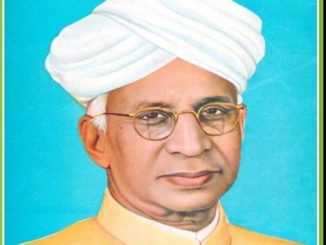
    Sarvepalli Radhakrishnan, (born Sept. 5, 1888, Tiruttani, India—died April 16, 1975, Madras [now Chennai]), scholar and statesman  was president of India from 1962 to 1967. He served as professor of philosophy at Mysore (1918–21) and Calcutta (1921–31; 1937–41) universities and as vice chancellor of Andhra University (1931–36). He was professor of Eastern religions and ethics at the University of Oxford in England (1936–52) and vice chancellor of Benares Hindu University (1939–48) in India. From 1953 to 1962 he was chancellor of the University of Delhi.

    In this June 4, 1953 picture at the United Nations, Dr. Radhakrishnan (third from right) is seen shaking hands with Mr. Byron Price, Acting Secretary-General of the U.N., as Mr. Rajeshwar Dayal (left), India’s Permanent Representative to the United Nations, and Mr. Shamaldharee Lall, Assistant Secretary-General of the U.N. in charge of the Department of Conference and General Services, look on.

    Photo / courtesy United Nations

    Radhakrishnan led the Indian delegation to the United Nations Educational, Scientific and Cultural Organization (UNESCO; 1946–52) and was elected chairman of UNESCO’s executive board (1948–49). From 1949 to 1952 he served as Indian ambassador to the Soviet Union. On his return to India in 1952 he was elected vice president, and on May 11, 1962, he was elected president, succeeding Rajendra Prasad, who was the first president of independent India. Radhakrishnan retired from politics five years later.

    Radhakrishnan’s written works include Indian Philosophy, 2 vol. (1923–27), The Philosophy of the Upanishads (1924), An Idealist View of Life (1932), Eastern Religions and Western Thought (1939), and East and West: Some Reflections (1955).  In his lectures and books he tried to interpret Indian thought for Westerners. (Encyclopedia Britannica)

    Here is a list of the major books  he authored. 

    1. Religion, Science and Culture
    2. The Heart of Hindusthan
    3. The Principal Upanishads
    4. Indian Philosophy (2 volumes)
    5. Eastern Religions and Western Thought
    6. A sourcebook in Indian Philosophy
    7. The Philosophy of Rabindranath Tagore
    8. An Idealist View of Life
    9. East and West in Religion
    10. Hindu View of Life

    11.Makers of Indian Literature

    1. Pursuit of Truth

    (The author is a West Virginia based ophthalmologist whose mission in life is to make the world free of preventable childhood blindness.  The Eye Foundation of America he founded almost 4 decades ago  is fully committed and dedicated to fulfilling his vision)

  • Indian-origin politician Pritam Singh appointed Singapore’s first Leader of Opposition in Parliament

    Indian-origin politician Pritam Singh appointed Singapore’s first Leader of Opposition in Parliament

    ‘Singapore’s legislatures have never had formally designated Leaders of the Opposition’

    SINGAPORE (TIP): Indian-origin politician Pritam Singh was on Tuesday, July 28,  designated as the Leader of the Opposition in Singapore, the first such appointment in the history of the city-state.

    The 43-year old Singh’s Workers’ Party won 10 parliamentary seats out of the 93 contested in the July 10 general elections held, making it the biggest opposition presence in Singapore’s Parliament.

    Singh is the Secretary-General of Workers’ Party.

    “Singapore’s legislatures have never had formally designated Leaders of the Opposition, and such a position is not provided for in the Constitution or the Standing Orders of Parliament,” the parliamentary offices said in its statement on Tuesday.

    “Singapore’s legislatures have never had formal Leaders of the Opposition, not even in the 1950s and early 1960s when there were substantial numbers of opposition legislative assemblymen,” the Channel News Asia quoted the statement as saying.

    Prime Minister Lee Hsien Loong’s ruling People’s Action Party won 83 seats in the general elections and his government was sworn in on Monday.

    Singh will take on more duties and be accorded additional privileges in his role as the Leader of the Opposition, authorities said on Tuesday in a statement, laying out the details of the new post.

    “Similar to other Westminster parliamentary systems, Singh will lead the Opposition in presenting alternative views in parliamentary debates on policies, Bills and motions,” said the Office of the Speaker of Parliament and Office of the Leader of the House in a joint statement.

    He will also lead and organize the scrutiny of the government’s positions and actions in Parliament, and be consulted on the appointment of opposition members to Select Committees, such as the Public Accounts Committee.

    Singh, who is also a lawyer, will receive an annual package of 385,000 Singapore dollars (USD 2,79,025.98) as allowances for his new role.

    Prime Minister Lee said on July 11 that Singh will be designated the Leader of the Opposition.

    After his swearing-in on Monday, Lee said the election results have shown a strong desire among Singaporeans for a greater diversity of views in politics and that the trend is here to stay.

    “We have to give expression to it and evolve our political system to accommodate it while maintaining our cohesion and sense of national purpose,” said Lee.

    “As with any new political appointment, the role of the LO (Leader of the Opposition) will evolve as our political system develops,” the statement from Parliament said.

    “We look forward to working with the LO to create a robust but stable political system serving the interests of Singapore and Singaporeans,” it said.

    The statement added that these duties and privileges have been conveyed to Singh, and the Leader of the House will make a statement in Parliament to formally set out these terms.

    Singapore’s 14th Parliament will have its first sitting on August 24.

    (Source: PTI)

  • Gandhi-King Exchange Act Passed in House Foreign Affairs Committee

    Gandhi-King Exchange Act Passed in House Foreign Affairs Committee

    WASHINGTON (TIP): Indian American Congressman Ami Bera, M.D. (D-CA) hailed the passage of the Gandhi-King Scholarly Exchange Initiative Act out of the House Foreign Affairs Committee. The bill, written by the late Congressman John Lewis and cosponsored by Congressman Bera, would establish an exchange initiative between the United States and India to study the work and legacies of Mahatma Gandhi and Martin Luther King Jr.

    “John Lewis was a civil rights hero not only in the United States, but across the globe. John fought for human rights, equality and justice, and democracy for all. Just like Gandhi and Dr. King, Congressman Lewis shaped the world through his actions of nonviolence, and his life story will reverberate throughout history. The Gandhi-King Scholarly Exchange Initiative Act is a fitting tribute to his incredible legacy,” said Representative Bera, who is the longest serving Indian-American Member of Congress in history. “As the world’s oldest and largest democracies, the United States and India have long traditions of upholding these shared values championed by figures like Gandhi, King, and Congressman Lewis. But they are increasingly under threat in both countries. This legislation will help those values endure and remind us that by holding true to them, we embody and live up to the best of our two nations.”

    In 2009, Congressman John Lewis led a congressional delegation visit to India to commemorate the 50th Anniversary of Dr. King’s pilgrimage to India. Inspired by his visit, Congressman Lewis created the Gandhi-King Exchange Act to seek to apply the philosophies of Gandhi and Dr. King, Jr. to conflict resolution efforts and current policy challenges.

    The Gandhi-King Scholarly Exchange Initiative Act authorizes the State Department, in cooperation with the Indian government, to:

    • Establish an annual educational forum for scholars from both countries that focuses on the legacies of Mohandas Gandhi and Martin Luther King, Jr;
    • Develop a professional development training initiative on conflict resolution based on the principles of nonviolence; and
    • Establish a foundation to address social, environmental, and health priorities in India.

    Representative Ami Bera serves as Chairman of the House Foreign Affairs Subcommittee on Asia, the Pacific, and Nonproliferation.


  • Indian American Shankari Rajagopal Named Stanford Science Fellow

    Indian American Shankari Rajagopal Named Stanford Science Fellow

    NEW YORK (TIP): Indian American Shankari Rajagopal has been named as one of the 2020 Stanford Science Fellows. She is among eight postdoctoral researchers from around the world who are studying a variety of topics, including geoscience, computational chemistry and condensed matter physics. The program arose from Stanford’s Long-Range Vision as a way to cultivate new directions in foundational scientific research by advancing and bridging disciplines in the physical, mathematical and life sciences.

    Rajagopal came to Stanford as a postdoctoral scholar studying quantum physics and will continue to pursue experimental investigations of novel phases of matter as a Stanford Science Fellow.

    The Stanford Science Fellows Program will recognize and support scholars who reflect a diversity of perspectives, identities, life experiences and backgrounds, including those from groups that are underrepresented in the sciences. Stanford Science Fellow appointments are for three-year terms.

  • Two Indian American University of Illinois Alumni Awarded Fulbright Grants

    Two Indian American University of Illinois Alumni Awarded Fulbright Grants


    URBANA-CHAMPAIGN , IL (TIP): Two Indian Americans are among Fourteen University of Illinois at Urbana-Champaign students and recent alumni who were offered Fulbright grants to pursue international education, research and teaching experiences across the globe this coming year.

    Rina Ravisundar, of Willowbrook, Illinois, and a graduate of Hinsdale Central High School, was offered an English Teaching Assistant position in India. Ravisundar graduated cum laude from Illinois in December as a James Scholar honors student with a bachelor’s degree in political science. She served as a teaching assistant for Leadership and Society, an orientation course for freshmen James Scholar honors students in the College of Liberal Arts and Sciences.

    Ravisundar also worked as a research assistant studying gender violence and substance misuse, applying that research as a legal case worker at the Parliament of the United Kingdom. A first-generation American, Ravisundar tutored refugee children in English and math through the organization Refugee Tutoring. Ravisundar is currently employed by Fragomen LLP as a paralegal and said she hopes to begin law school and pursue a career in family law.

    Aboorva Sivasankaran, of Huntley, Illinois, and a graduate of Huntley High School, was offered an English Teaching Assistant position in South Korea. Sivasankaran graduated from Illinois in 2019 as a James Scholar honors student with a bachelor’s degree in psychology. She currently resides in Atlanta. On campus, Sivasankaran served as a lead peer adviser in the Division of General Studies and as an English native speaker volunteer with English Corner. She also worked to destigmatize mental illness as a member of the National Alliance on Mental Illness.

    Sivasankaran served as an event coordinator of KConnect, a social organization for fans of Korean pop culture, and regularly participated in Korean conversation tables. Sivasankaran said she plans to attend graduate school in family counseling upon her return from her Fulbright year. She said the Fulbright would help her understand Korean families, which would inform her studies and career helping Korean and other Asian families and children in the U.S.