SHANGAHAI (TIP): A Chinese woman who sued a man for “violating her right to virginity” after he wooed her with false promises has been awarded nearly $5,000 by a court, reports said on Sept 17. The two were dating but after the woman, surnamed Chen, found out her boyfriend was already married she sued him for swindling her out of her virginity, accusing him of pretending to be single and pledging to make her his wife, Shanghai media said. A spokesman for the Pudong New Area People’s Court confirmed the case and the judgement.
After the man, surnamed Li, suddenly broke off contact, Chen burst into his home and found him with his wife. Chen sued, accusing him of violating her rights to virginity and health and demanding more than $81,000 in psychological damages, plus medical costs of $250. The court found the original demand “excessive” but said in its ruling that the “right to virginity” should be protected by law as it was a “moral right” related to “sexual freedom, sexual safety and sexual purity”. “Violating the right to virginity might lead to harm to a person’s body, health, freedom and reputation… it ought to be compensated,” the court said, though it did not explain how it reached the precise figure.
Tag: Health
Read the latest health news, diet, fitness, medical news and healthcare tips on theindianpanorama.news/health. Get all the healthcare news, including wellness, fitness, diet and weight loss & more.

-

China court: Virginity worth $5,000
-

Appeals court weighs stay on ruling over Texas abortion law
AUSTIN, TX (TIP): Most of the abortion clinics in Texas could close by the weekend depending on what happens in a New Orleans courtroom Friday, September 12. The U.S. 5th U.S. Circuit Court of Appeals will get its first look at the latest challenge to Texas’s tough new abortion law Friday morning as a three-judge panel weighs half an hour of arguments each from supporters and opponents of two regulations under dispute.
At stake is the fate of at least a dozen abortion clinics that were saved from closure or allowed to reopen, thanks to an Austin-based federal judge’s ruling last month against provisions requiring clinics to meet the standards of hospital-style surgical centers and abortion doctors to obtain admitting privileges at a nearby hospital. State lawyers appealing the district judge’s decision are asking permission to enforce the requirements as the case continues. If the appellate court agrees, all but seven of the abortion facilities in the state are expected to close almost immediately.
“I think we’re all just holding our breath,” said Amy Hagstrom Miller, CEO of Whole Woman’s Health, which operates two of the clinics hanging in the balance and filed the lawsuit in April along with other abortion providers. Legal briefs filed by lawyers for the providers and the state show that the arguments Friday likely will mirror those during the week-long trial here last month: the providers will argue the requirements severely reduce abortion access without improving women’s health, while the state will say the requirements protect women and leave enough access to satisfy federal law.
The state will have the burden of showing why it is important for the appeals court to step in and allow enforcement of the law to continue while the trial court judge’s ruling is appealed. “The State will suffer irreparable injury absent a stay because the district court’s injunction prevents the State from enforcing a duly enacted statute,” Attorney General Greg Abbott wrote in his motion for an emergency stay.
Esha Bhandari, an attorney for the providers, said they will argue there is no irreparable harm because one of the provisions at issue has not yet been enforced and enforcement is “not the type of thing a few months down the road can’t be rectified.” The district judge already has rejected a long-shot request by the state to stay his own ruling. While Friday’s arguments in New Orleans will concern only the request for a stay, advocates on both sides will be watching closely for any indication of how the court may be leaning on the overall appeal.
The 5th Circuit is considered one of the most conservative courts in the country, and it acted last fall to uphold a separate part of the tough new Texas law. Both sides acknowledge the state likely caught a break with the outcome of a random selection of the threejudge panel that will hear the arguments Friday. One of the judges on the panel, George W. Bush appointee Jennifer Walker Elrod, was on the panel that unanimously upheld the law last year. Another, Ronald Reagan appointee Jerry E. Smith, was on the panel that upheld another Texas law requiring women seeking an abortion in Texas to first get a sonogram. The third judge, Stephen A. Higginson, is an appointee of President Barack Obama who recently voted to strike down a Mississippi law that was similar to the Texas measure. -

INDIA: THE ODD BRIC OUT
India must strike a balance between its new emerging partners and beneficial Western ties
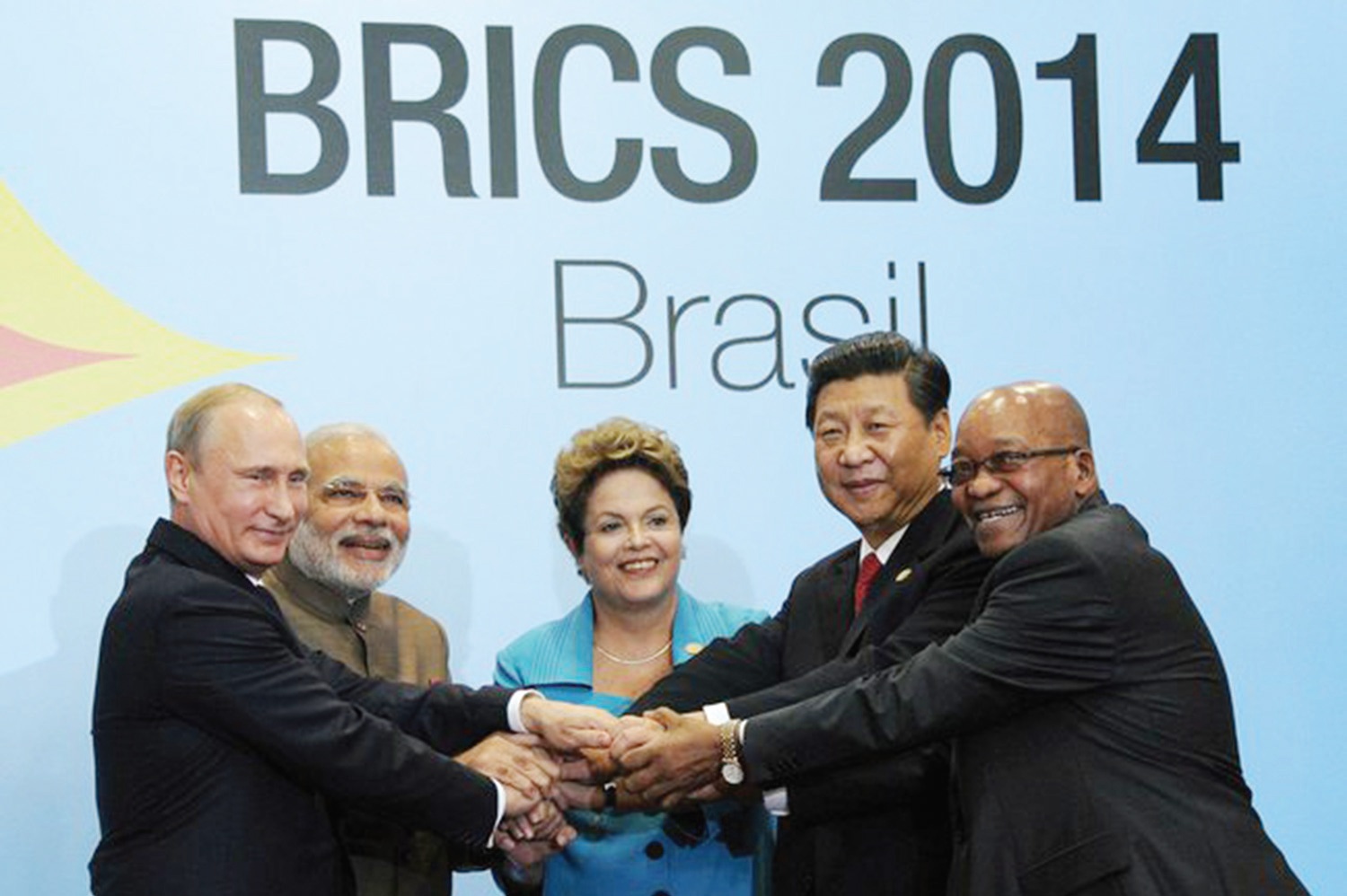
India would be foolish to join an anti-Western bloc as India’s rise is inherently tied to the West. Given the popular view that the BRICS are opposed to the West, India finds itself in the unique position of being a part of the BRICS collective as well as having overtly friendly relations with the U.S., a relationship that is likely to further improve in the future as Modi visits the U.S. and ties strengthen.
By Stephen Junor The BRICS nations have rapidly evolved from a group of emerging economies into political contenders in a new world, driven by the search for an alternative to Western hegemony. Recent Western failures have also helped to launch the BRICS concept as an alternative, and have possibly pushed the countries closer together than they may have initially intended.
There are also differences (the China-India border disputes for example) that would have seriously tested the relationship between other countries, but for now they are responsible for the multi-polar world that appears to be emerging. The Western approach toward BRICS has generally been one of skepticism, but when it comes to India there is a conspicuously different portrayal in the media compared to the rest of the countries. Although the recent U.S.-Africa summit suggests friendly relations, South Africa has always seen itself as a member of the global South and champions countries that don’t acquiesce to U.S. dominance. The conflict between the U.S. (somewhat supported by much of Europe) and Russia is well-known, and the media consistently highlights the conflict and difference between the U.S. and China.
American interference in Latin America has made relations between Brazil and the U.S. touchy, and the rhetoric from Brazil in the wake of NSA spying last year was scathing. Despite relations taking a hit last year when Indian diplomat Devyani Khobragade was arrested in New York, U.S. and Western media have generally been friendly toward India, exemplified by President Barack Obama’s invitation to newly elected Prime Minister Narendra Modi to visit the U.S., despite Modi previously being blocked from the U.S. over his failure to stop sectarian violence as Gujarat’s chief minister in 2002, when more than 1,000 people were killed. It is likely that the U.S. views India as a potential foothold in Asia.
India is often heralded in the Western media as the world’s largest democracy, in an attempt to provide common ground and a nod of disapproval to the likes of China and Russia. In contrast to the other BRICS members, Indian elites aspire to the wealth and influence of the U.S., and it is only natural that this aspiration would manifest itself in the politics of the country. Modi is a proponent of free market capitalism and this bodes well for relations with the U.S., which will see him as an accessible figure.
There are further important differences between India and the rest of the BRICS nations.World Bank data shows that India’s GDP per capita severely lags behind the rest at around $1,500, four times less than China and South Africa, seven times less than Brazil and almost 10 times less than Russia. India hasn’t replicated the rapid growth of the other BRICS countries since the turn of the millennium, and this is also reflected in a slower reduction in the poverty gap. Just under 25 percent of the population still live on less than $2 a day, compared to 10 percent or less for the other countries. Such a severe development problem will hinder Indian growth in the near future and will see it fall further behind.
Modi will be expected to implement reforms that improve growth and lift hundreds of millions out of crippling poverty. Growth alone will not solve the poverty problem in India however. When it comes to literacy rates in adults, the 2011 Indian census recorded a figure of 74 percent while the rest of the BRICS nations record over 90 percent. Literacy among women is even lower at 64 percent. Infrastructure in India is also sub-standard. An overburdened transport systems and insufficient electricity grids that are overly reliant on coal contribute to the poverty problem while hindering growth. Rapid urbanization is also putting pressure on these systems, making the problem more acute.
India also has a digital problem as only 15 percent of the population uses the internet, compared to upwards of 40 percent for the other BRICS. Connectivity is important, particularly for those often marginalized in society, as evidence points towards benefits for education and health. India has a distinctive set of problems that the other BRICS countries have largely moved beyond. Given the political and economic clout of the BRICS collective, India could soon find itself left behind within the group. Indeed the statistics above and the obvious clout of China and Russia suggest that India may lack influence within the group already, despite efforts to spread power within the recently announced New Development Bank.
This is where the U.S. could become more influential with India. In a recent interview with The Diplomat, Sadanand Dhume, a resident fellow at the American Enterprise Institute (AEI) and Wall Street Journal columnist, said that India would be foolish to join an anti-Western bloc as India’s rise is inherently tied to the West. Given the popular view that the BRICS are opposed to the West, India finds itself in the unique position of being a part of the BRICS collective as well as having overtly friendly relations with the U.S., a relationship that is likely to further improve in the future as Modi visits the U.S. and ties strengthen.
India will need to manage its relationships carefully, as it will not want to find itself isolated from either the U.S. or the BRICS. It is also important that India doesn’t become geopolitically caught between the two sides: Any point of tension between the West and an individual BRICS country could reflect on the rest of the group. Indeed if India wants to achieve strong growth and solve its development crisis, then it will need to harness relationships with both sides. The next few years will be crucial for Indian development, and as the international political situation slowly evolves, it will be interesting to see how India locates itself in relation to the West and the other BRICS countries.
(Stephen Junor writes on the rise of BRICS and geopolitics) (Source: The Diplomat) -

UN says $600 million needed to tackle Ebola as deaths top 1,900
WASHINGTON/CONAKRY (TIP): The United Nations said $600 million in supplies would be needed to fight West Africa’s Ebola outbreak, as the death toll from the worst ever epidemic of the virus topped 1,900 and Guinea warned it had penetrated a new part of the country. The pace of the infection has accelerated, and there were close to 400 deaths in the past week, officials said on Wednesday.
It was first detected deep in the forests of southeastern Guinea in March. The hemorrhagic fever has spread to Liberia, Sierra Leone, Guinea, Nigeria, and Senegal, and has killed more people than all outbreaks since Ebola was first uncovered in 1976.
There are no approved Ebola vaccines or treatments. An experimental Ebola vaccine that Canada said it would give to the World Health Organization for use in Africa was as of Wednesday still in the lab that developed it as officials are puzzled over how to transport it. Ottawa said on Aug. 12 that it would donate between 800 and 1,000 doses of the vaccine, being held at Canada’s National Microbiology Laboratory in Winnipeg.
“We are now working with the WHO to address complex regulatory, logistical and ethical issues so that the vaccine can be safely and ethically deployed as rapidly as possible,” Health Canada spokesman Sean Upton said in a statement. “For example, the logistics surrounding the safe delivery of the vaccine are complicated.” Upton said one of the challenges was keeping the vaccine cool enough to remain potent.
Human safety trials are due to begin this week on a vaccine from GlaxoSmithKline Plc and later this year on one from NewLink Genetics Corp. The US Department of Health and Human Services said on Tuesday a federal contract worth up to $42.3 million would help accelerate testing of an experimental Ebola virus treatment being developed by privately held Mapp Biopharmaceutical Inc. Dr David Nabarro, senior UN Coordinator for Ebola, said the cost of getting the supplies needed by West Africa countries to control the crisis would amount to $600 million. That was higher than an estimate of $490 million by the WHO last week.
Moving workers and supplies around the region has been made difficult by restrictions by some countries on air travel and landing rights as they try to control Ebola’s spread. “We are working intensively with those governments to encourage them to commit to the movement of people and planes and at the same time deal with anxieties about the possibility of infection,” Nabarro said.
He said the president of Ghana has agreed to allow an airbridge, or route, through the country to affected regions to move people and supplies. Ivory Coast, which closed its borders with Liberia and Guinea last month, said on Tuesday it would open humanitarian and economic corridors to its two western neighbors.
Epidemic gains, evacuation eyed for doctor Dr. Margaret Chan, director-general of the World Health Organization (WHO) told a press conference in Washington, “This Ebola epidemic is the longest, the most severe and the most complex we’ve ever seen.” Chan said there were more than 3,500 cases across Guinea, Liberia and Sierra Leone.
In Liberia, Dr Rick Sacra, a 51-yearold Boston physician infected with Ebola could be medically evacuated as soon as Thursday, according to staff at the hospital where he worked. Two other Americans recovered from the virus after being taken to the United States for treatment last month. Amid shortages of equipment and trained staff, more than 120 healthcare workers have died in West Africa in the Ebola outbreak.
The Liberian government has begun offering a $1,000 bonus to any healthcare workers who agreed to work in Ebola treatment facilities. Guinea, the first country to detect the virus, previously said it was containing the outbreak but announced that nine new cases had been found in the prefecture of Kerouane, some 750 km (470 miles) southeast of the capital Conakry.