Tag: Indra Nooyi

  • Nowhere people of a nowhere world

    Nowhere people of a nowhere world

    THE GREAT GAME: The message from New Delhi is that those who break the law deserve the punishment they get

    “Former Foreign Secretary Shyam Saran calls it “uncivilized behavior on the part of the US.” Except, civility and good manners are already casualties of Naya America’s foreign policy. The manner in which Trump is overhauling the Middle East — Gaza, Palestine, Jordan — is unprecedented. India is keeping quiet because the hyper-realist policies that it has been propagating for some time now you only get involved when you are directly affected. And you are not directly affected in Gaza, Palestine and Jordan.”

    By Jyoti Malhotra

    February is fast turning out to be the cruelest month, with apologies to TS Eliot, on India’s foreign policy calendar.

    In the east, Bangladeshi lumpen youth, with no connection to either memory or even a desire for history, danced to the Bollywood song, “munni badnam hui,” as they participated in the burning of Bangabandhu Sheikh Mujibur Rahman’s home in Dhaka. Indians watched, horror-struck, at the hammer blow to what was once a glorious chapter in the lives of both countries — and couldn’t help asking, What now?

    And in the West, questions abound as PM Narendra Modi prepares to fly to the US to meet President Trump, barely days after 104 Indian nationals, shackled and cuffed, were deported back home. Another 487 are on their way. A sense of disquiet persists on whether the PM’s decision to go to the US in these circumstances is the right one.

    Many would say, yes of course. The India-US relationship remains the most important foreign policy relationship, notwithstanding Russia’s help with slashing the price of oil these recent post-Covid years. In support of this argument, a trade roadmap is on the cards when the PM visits, as is the likely announcement of India opening up the civil nuclear sector (after 17 years), while talk of Delhi buying more US defense equipment is gaining ground.

    Which is why External Affairs Minister S Jaishankar has travelled to the US thrice in the last four months, in September, December and January, so as to make the Modi-Trump meeting count. He has put out that the PM will be only one of the three leaders to have met Trump in his first month in power — Israel’s Netanyahu, Japan’s Ishiba and India’s Modi.

    Unfortunately, barely a week before Modi lands in DC, the news has not been very complimentary. Pictures of young Indian men in second-hand jeans and cheap Chinese shoes shuffling towards a US military plane because they have chains on their feet has sent waves of shock and awe across Punjab, if not the rest of the country.

    This, of course, is exactly what Trump wants. He wants to send the message to the world that he’s not interested in the great unwashed landing up at America’s doors — talented, skilled and accomplished brigades on H1-B visas are just fine.

    Nor does he seem to have time for saving face. If the Indian PM is coming to see you in a week, you should no longer expect that the news is good on the eve of your visit. Trump has already rewritten the rules of the world order in the few weeks he’s been around.

    Former Foreign Secretary Shyam Saran calls it “uncivilized behavior on the part of the US.” Except, civility and good manners are already casualties of Naya America’s foreign policy. The manner in which Trump is overhauling the Middle East — Gaza, Palestine, Jordan — is unprecedented. India is keeping quiet because the hyper-realist policies that it has been propagating for some time now you only get involved when you are directly affected. And you are not directly affected in Gaza, Palestine and Jordan.

    As for the 104 deportees, including women, who were shackled during their flight home earlier this week, the message from New Delhi is that those who break the law deserve the punishment they get. The US Border Patrol described them as “aliens,” and so they are.

    And yet, as Jaishankar spoke in Parliament on the deported Indians, admitting on record that he was “being bureaucratically correct,” one couldn’t help wondering what his predecessor, the late Sushma Swaraj, would have said when confronted with India’s present predicament — witnessing the humiliation of its poor and unskilled masses being rightfully punished for doing a very stupid thing.

    Sushma Aunty had so stirred the bureaucratic consciousness of the toughened bureaucrats of the Ministry of External Affairs (MEA) that they were forced to be kinder to the bluest-collar workers across the world. Reforms were ordered for the protection of emigrants, laws were toughened for those wanting to work abroad, immigration agents were forced to fall in line. Not that she cleaned up the entire system, but she certainly tried. She knew her fellow citizens were more often than not on the wrong side of the foreign law in question, but she demonstrated compassion. She offered them a hanky to cry when they got caught after knowingly breaking the rules.

    The current Modi government, instead, is throwing the rule book at these people. Moreover, the MEA is pointing out, these Punjabi folk who can spend Rs 45 lakh chasing the American dream are not exactly poor. Of course, the MEA is right. These 104 men and women knowingly bought that one-way ticket to Amreeka, well aware that the “dunki route” is what it was. And still they went. Problem is, they will still go if they get a chance, if only because they need to pay the loan their families took to send them to the US.

    But back to Modi and Trump and the importance of the India-US relationship. Apart from the fact that the PM seems keen on making that early connection with the President, the fact remains that both countries are increasingly invested in each other. From intelligence-sharing to defense and technology partnerships, via military foundational agreements that have been signed over the last 25 years — an alphabet soup called GSOMIA, LEMOA, COMCASA, BECA — India is so closely integrated with the US that it would not be far wrong to describe it as an “informal ally.”

    Some would say, why not? There are as many as 5 million US citizens of Indian origin, a hugely influential group. We celebrate them all. We wallow in the appreciation of Sundar Pichai and Satya Nadella and Indra Nooyi and Ajay Banga, as if they were part of our immediate family.

    The problem arises when the Punjabis from Doaba, the Haryanvis from Kaithal and the Gujaratis from Gandhinagar bomb this pretty picture — wearing handcuffs and all. What is worse is that no one, except their immediate families, want to own these Indians. The nowhere men and women of a nowhere world.
    (Jyoti Malhotra is Editor-in-Chief of The Tribune group of newspapers. She has been a journalist for 40 years, working in print, TV and digital, both in English and Hindi media, besides being a regular contributor on BBC Radio. She is deeply interested in the conflation between politics and foreign policy. Her X handle is @jomalhotra Insta handle @jomalhotra Email: jyoti.malhotra@tribunemail.com)

  • History and origin of Pravasi Bharatiya Divas

    History and origin of Pravasi Bharatiya Divas

    The 18th PBD Convention will be held from 8 – 10 January 2025 in Bhubaneswar, Odisha. The theme of the 18th PBD Convention is ‘Diaspora’s Contribution to a Viksit Bharat’

    The Pravasi Bharatiya Divas (PBD), or Non-Resident Indian (NRI) Day, is celebrated annually on January 9th to honor the contributions of the Indian diaspora to the progress of India and to recognize their role in strengthening India’s ties with the global community. This day highlights the connection between the nation and its overseas citizens, celebrating the spirit of Indian identity, culture, and development worldwide.
    The origins of Pravasi Bharatiya Divas are deeply rooted in the larger context of India’s relationship with its global diaspora. The history behind this celebration is tied to India’s historical emigration patterns, the struggles faced by early Indian migrants, and the efforts to bring attention to their contributions to both their host countries and India. This article explores the history, significance, and origins of Pravasi Bharatiya Divas, looking at how this day evolved, its relevance today, and the broader context of the Indian diaspora.
    January 9 commemorates the return of Mahatma Gandhi from South Africa to India in 1915. To mark this day, the tradition of celebrating the Pravasi Bharatiya Divas (PBD) started in 2003. 1st PBD Convention was organised on 9 January 2003 to mark the contribution of the overseas Indian community to the development of India.
    Since 2015, under a revised format, the PBD Convention has been organised once every 2 years.
    The 17th Pravasi Bharatiya Divas Conventions have been organised till date. 17th PBD was held from 8 – 10 January 2023 in Indore, Madhya Pradesh. The theme of the 17th PBD Convention was “Diaspora: Reliable Partners for India’s Progress in Amrit Kaal”.
    The 18th PBD Convention will be held from 8 – 10 January 2025 in Bhubaneswar, Odisha. The theme of the 18th PBD Convention is “Diaspora’s Contribution to a Viksit Bharat”.
    Historical Background of Indian Emigration
    Indian migration has a long history, dating back centuries. The earliest known waves of Indian emigration can be traced to the traders, scholars, and laborers who moved across the Indian Ocean to places like Southeast Asia, the Arabian Peninsula, Africa, and beyond. However, the large-scale movement of Indians to other parts of the world began during British colonial rule.
    Indentured Labor System and Colonial Migration
    The most significant migration wave in the 19th and early 20th centuries was due to the British colonial administration’s establishment of the indentured labor system. This system saw millions of Indians sent abroad to work on plantations in places like the Caribbean, Fiji, Mauritius, and South Africa. As indentured laborers, these individuals faced harsh conditions but contributed significantly to the economic development of their respective host countries.
    In the early 20th century, a new wave of emigration occurred when skilled workers, professionals, and traders began to migrate to countries such as the United States, Canada, and the United Kingdom. This migration, especially after India gained independence in 1947, continued and saw an increase in the number of educated professionals from India seeking better opportunities abroad. Over time, the Indian diaspora grew into a global community that contributed to their host countries’ economies, cultural diversity, and political spheres.
    The Role of the Indian Diaspora
    Post-Independence
    After India’s independence, the Indian government sought to establish strong ties with its citizens abroad. The global Indian diaspora, despite being physically distant, played a key role in shaping India’s political and economic landscape. They helped raise awareness about India’s development and played an instrumental role in remittances, which became one of the primary sources of foreign exchange for the country.
    The Indian diaspora, spread across continents, helped build strong links between India and the world. They continued to make significant contributions to the development of their host countries, excelling in various fields like business, education, politics, and technology. Notable figures in the global Indian community include Dhirubhai Ambani, Sundar Pichai, Indra Nooyi, and many others who have not only succeeded in their respective fields but have also helped foster a better understanding of Indian culture and values globally.
    The Birth of Pravasi Bharatiya Divas
    The idea of celebrating the Indian diaspora on a national level was first proposed during the 2003 Pravasi Bharatiya Divas Convention. The idea to create a day to celebrate the Indian diaspora came from the efforts of the Indian government to recognize the contributions of NRIs and Persons of Indian Origin (PIOs).
    The First PBD in 2003
    The first Pravasi Bharatiya Divas was held in January 2003 in New Delhi, under the leadership of then-Prime Minister Atal Bihari Vajpayee. It was organized by the Ministry of Overseas Indian Affairs (MOIA), which was created in 2004 to specifically cater to the concerns of the Indian diaspora. The first convention aimed to provide a platform for members of the diaspora to interact with the Indian government, business leaders, and intellectuals. It was a way to acknowledge their contributions to India’s development and global standing.
    The year 2003 also marked the centenary of the return of Mahatma Gandhi to India from South Africa, where he had first developed his ideas of non-violence and social justice. In 1915, Gandhi had returned to India after being part of the Indian diaspora for over two decades. His return signaled the start of a larger movement against British colonial rule and for Indian independence. As a result, January 9th was chosen as the official date to commemorate this event, making the day even more significant. Thus, Pravasi Bharatiya Divas, which was initially conceptualized as a way to recognize the Indian diaspora, was also designed to mark the legacy of Indian leaders like Gandhi and their connection to the global Indian community.
    The Significance of January 9th
    The choice of January 9th as the date for Pravasi Bharatiya Divas is deeply symbolic. This date is significant because it commemorates the return of Mahatma Gandhi to India from South Africa. Gandhi’s experiences in South Africa had a profound influence on his methods of resistance and his eventual leadership of the Indian freedom struggle.
    Gandhi’s return to India from the diaspora marked the beginning of his pivotal role in the fight for independence. His return was seen as a powerful moment in Indian history, as it symbolized the strong link between India and its diaspora. By choosing this date, Pravasi Bharatiya Divas also honors the historical connection between the Indian diaspora and the Indian independence movement.
    Objectives and Purpose of Pravasi Bharatiya Divas
    The primary objective of Pravasi Bharatiya Divas is to acknowledge the contributions of NRIs and PIOs to India’s progress in various fields. The day provides a platform for the government of India to engage with the Indian diaspora, allowing them to discuss issues that affect their lives abroad and explore ways to contribute to India’s growth.
    Key Objectives of PBD
    – Recognition of the Contributions of NRIs and PIOs: Pravasi Bharatiya Divas serves as an occasion to acknowledge the positive impact that members of the Indian diaspora have had on their host countries and on India’s economy, culture, and political landscape.
    – Strengthening Ties Between India and the Diaspora: It provides a venue for dialogue between the Indian government and the diaspora, discussing critical issues such as remittances, legal and social protections for emigrants, and the promotion of Indian culture abroad.
    – Facilitating Collaboration: The event fosters collaboration between the Indian government, businesses, and overseas Indians, encouraging investment in India, promoting tourism, and strengthening the global reach of Indian companies.
    – Cultural Exchange and Promotion: PBD encourages cultural exchange, making the world more aware of India’s rich heritage and traditions.
    Subsequent Developments and the Global Outreach
    After its inception, the Pravasi Bharatiya Divas became an annual event, attracting thousands of NRIs and PIOs from across the globe. The government organized a series of seminars, discussions, and networking sessions during PBD to facilitate knowledge exchange and foster collaborations.
    In subsequent years, the event became increasingly inclusive, encompassing a wider range of issues important to the global Indian community, including topics related to education, healthcare, and the professional development of diaspora communities. PBD also saw the introduction of the Pravasi Bharatiya Samman Awards, which were presented to individuals and organizations that made significant contributions to India’s development or to the Indian diaspora.
    These awards became a key feature of PBD, as they not only celebrated individual and collective achievements but also showcased the diverse and vibrant contributions of the Indian diaspora across various domains, including science, business, and social activism.
    Challenges
    While Pravasi Bharatiya Divas has been a platform for celebration and recognition, there have been criticisms regarding its effectiveness in addressing the concerns of the diaspora. Some members of the Indian community have raised issues about the lack of concrete action taken by the Indian government in relation to the challenges faced by NRIs, such as immigration issues, legal matters, and the protection of their rights in host countries. Furthermore, there have been concerns about the focus on celebratory events rather than practical steps toward improving the living conditions of the diaspora.
    The Future of Pravasi Bharatiya Divas
    As India continues to develop as a global power, the role of the diaspora becomes increasingly important. The Indian government has made substantial efforts to reach out to NRIs and PIOs, particularly in areas such as trade, investment, and diplomacy. With the Indian diaspora becoming more prominent in global politics and business, Pravasi Bharatiya Divas is likely to continue evolving into a more significant event that not only honors their contributions but also acts as a catalyst for further cooperation between India and the world.
    The future of Pravasi Bharatiya Divas will likely see the development of new initiatives and programs that focus on strengthening the bonds between India and its diaspora. It may also serve as an opportunity to address the concerns of the global Indian community and promote a more inclusive, sustainable, and prosperous relationship.
    Pravasi Bharatiya Divas is a unique celebration that honors the global Indian community, recognizing their contributions to both India and the countries they have made their homes. From its origins in 2003, the day has evolved into a significant event that fosters dialogue, promotes cultural exchange, and celebrates the diverse achievements of Indians abroad. Through its various initiatives, PBD continues to serve as a bridge between India and its diaspora, helping to shape a stronger, more connected global Indian community.

  • Indian American Indra Nooyi to keynote at ITServe’s Synergy 2024 in Las Vegas

    Indian American Indra Nooyi to keynote at ITServe’s Synergy 2024 in Las Vegas

    NEW YORK (TIP) Former PepsiCo CEO Indra Nooyi is slated to deliver the keynote address at ITServe Alliance’s Synergy 2024, the flagship annual conference set for October 29-30 at Caesars Palace in Las Vegas, the event organizers announced. The conference, known for its rich history of providing pivotal business insights and networking opportunities for the IT services and solutions sector, will host over 3,000 attendees this year.

    Synergy 2024 will convene under the theme “Join, Collaborate, Accelerate,” emphasizing the event’s role in fostering strategic relationships and promoting innovation within the technology industry. Suresh Potluri, Director of Synergy 2024, highlighted the importance of the conference in connecting industry leaders and developing solutions tailored to the unique challenges of the IT sector.

    “[With] an esteemed panel of keynote speakers, industry experts, and thought leaders, who will share their insights and best practices on a diverse range of topics, Synergy 2024 will focus on developing strategic relationships with our partner organizations, sponsors, and supporters, to work for a better technology environment by building greater understanding,” said Potluri.

    Nooyi, who led PepsiCo through a transformative era, will share her extensive experience in driving growth and innovation at one of the world’s leading food and beverage companies. The Indian American executive, credited with redefining PepsiCo by focusing on healthier alternatives and sustainable practices, grew the company’s revenues by 80 percent during her tenure. Her keynote is expected to provide valuable insights into strategic leadership and market adaptation.

    The conference will feature a series of panel discussions critical to IT entrepreneurs, covering topics such as immigration, mergers and acquisitions, financial strategies, and startup incubation. These sessions aim to equip IT business leaders with knowledge and strategies to thrive in a competitive market.

    As Synergy 2024 approaches, ITServe Alliance invites IT professionals across the nation to join in Las Vegas for a chance to network, learn, and be inspired. With a lineup of esteemed speakers and a comprehensive agenda tailored to the contemporary IT landscape, the conference promises to be a pivotal event for professionals looking to navigate the complexities of the tech industry.

    For more information on Synergy 2024 and to register, visit ITServe’s official website, www.itserve.org.


  • Indian-origin Indra Nooyi and Jayshree Ullal among America’s richest

    Indian-origin Indra Nooyi and Jayshree Ullal among America’s richest

    NEW YORK (TIP): Four Indian-origin women, including Jayshree Ullal and Indra Nooyi, have been named by Forbes among America’s 100 richest self-made women, with a combined net worth of a whopping USD 4.06 billion. President and CEO of Arista Networks, a computer networking firm; Jayshree Ullal, co-founder of IT consulting and outsourcing firm Synte; Neerja Sethi, co-founder and former chief technology officer (CTO) of cloud company Confluent; Neha Narkhede and PepsiCo’s former chair and CEO Indra Nooyi made it to Forbes list of ‘America’s Richest Self-Made Women’.

    “Bolstered in part by a rebound in the stock market, they are cumulatively worth a record USD 124 billion, up nearly 12 per cent from a year ago,” Forbes said last month at the release of its ninth annual list.

    Ullal, ranked 15th on the list, has a net worth of USD 2.4 billion. She has been president and CEO of the publicly-traded Arista Networks since 2008 and owns about 2.4 per cent of its stock. Arista recorded revenue of nearly USD 4.4 billion in 2022.

    She is also on the board of directors of Snowflake, a cloud computing company that went public in September 2020.

    The 62-year-old studied electrical engineering at San Francisco State University and engineering management at Santa Clara University.

    Sethi, 68, ranked 25th on the list, has a net worth of USD 990 million.

    Syntel, co-founded in 1980 by Sethi and her husband Bharat Desai, was bought by French IT firm Atos SE for USD 3.4 billion in October 2018. Sethi got an estimated USD 510 million for her stake.

    She did her Bachelor of Arts/Science and Master of Business Administration from Delhi University and Master of Science from Oakland University.

    Narkhede, 38, is ranked 50th on the list with a net worth of USD 520 million.

    As a LinkedIn software engineer, she helped develop the open-source messaging system Apache Kafka to handle the networking site’s massive influx of data. In 2014, she and two LinkedIn colleagues left to found Confluent, which helps organizations process large amounts of data on Apache Kafka.

    The USD 586 million (2022 revenues) company went public in June 2021 at a USD 9.1 billion valuation; Narkhede owns around 6 per cent, Forbes said.

    In March 2023, Narkhede announced her new company, fraud detection firm Oscilar, where she is co-founder and CEO.

    Nooyi, the former chair and CEO of PepsiCo, retired in 2019 after 24 years with the company, half of which she spent in the top job. The 67-year-old has a net worth of USD 350 million and is ranked 77th on the list.

    As CEO, the 67-year-old thwarted a bid to break up PepsiCo, nearly doubled sales and introduced healthier products and environmentally friendly practices. Her fortune stems from stock she was granted while working at PepsiCo. Nooyi joined the board of Amazon in 2019 and grew up in India. She received an MBA from Yale before becoming one of corporate America’s few female CEOs in 2006.

    For the 6th time in a row, Daine Hendricks, the co-founder of ABC Supply, topped the list. ABC Supply is one of the largest wholesale distributors of roofing, siding and windows in the US. Hendricks, 76, has a net worth of USD 15 billion, Forbes said.

    To compile net worths, Forbes valued individual assets including stakes in public companies using stock prices from May 12, 2023, and valued private companies by consulting with outside experts and conservatively comparing them with public companies.


  • GOPIO-CT holds Annual Holiday Party; Raises funds for local charity Grassroots; Elects new team

    GOPIO-CT holds Annual Holiday Party; Raises funds for local charity Grassroots; Elects new team

    STAMFORD, CT (TIP):  GOPIO-CT organized its General Body Meeting (GBM) and elected a new team on December 5th held at the Hampton Inn suite in Stamford. In its report to the GBM, President Ashok Nichani said, “In spite of the Corona Virus pandemic, GOPIO-CT did several virtual programs in the beginning of the year on Zoom including a New Year Party which served as a fundraiser in support of soup kitchens, a Holi Celebration, interactive meetings with CT lawmakers and raising funds for sending Oxygen Concentrators to India.”

    “As the pandemic was coming down in the year, the chapter organized several programs with physical presence participating with other ethnic communities celebrating Stamford’s founding, and organizing Indian and American flag hoisting at Govt. Center in Stamford to celebrate India’s 75th Independence Day which was followed by an India Festival at the Mill River Park, hosting UConn Indian students for a Networking Welcome Dinner, an interactive session with India’s Minister of State for External Affairs V. Muraleedharan, Hosting a Conversation with Indra Nooyi and a Diwali fundraiser for local charities,” added President Nichani.

    Secretary Prachi Narayan listed all major activities for the year which included major initiatives for serving the local community and institutions during the pandemic and lockdown. These included donating cash and replenishing food items for the homeless and needy at the New Covenant House in Stamford and Food Bank of Lower Fairfield. Two other service organizations were supported by GOPIO-CT in 2021, Future 5 which helps and counsel needy students at Stamford High Schools and Building One Community which serves new immigrant communities. The chapter also held a virtual interactive meeting with Connecticut Attorney General William Tong.

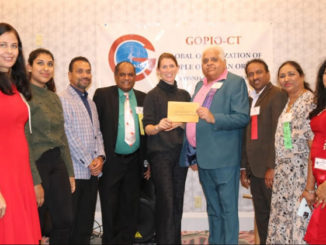
    IT Serve Alliance official Prasad Chintalapudi presenting a check to Grassroots.
    From L to R: Jayashri Chintalapudi, Samantha Hayes and Prasad Chintalapudi.

    The GBM also conducted its annual election for 2021. Mr. Ashok Nichani was re-elected as the President for one more term. Other elected officials are Mr. Prasad Chintalapudi as Executive Vice President, Dr. Jaya Daptardar as Vice President, Ms. Prachi Narayan as Secretary, Ms. Mahesh Jhangiai as Joint Secretary and Mr. Srinivas Akarapu as Treasurer. GBM also reelected two trustees, Mr. Joseph Simon and Mr. Shailesh Naik. Following the GBM, Annual Holiday Party was held which served as a fundraiser for a service organization.

    The fundraiser netted $5,500 to give to the local service organization Grassroots Tennis and Education, a youth development non-profit organization that uses sports of tennis to engage youth in out-of-school time programming in Norwalk and Stamford. The group’s volunteers teach tennis and helps students in education. Grassroots’ representative Ms. Samantha Hayes spoke about the organization and thanked GOPIO-CT for its generosity in raising funds for Grassroots. Another organization IT Serve Alliance also presented a check of $2,000 to Grassroots.

    Singers and organizers at the GOPIO-CT Holiday Party Fundraiser.
    From L to R: Shree Kanaskar, Dhilan Shah, Trupti Shah, Shilpa Kulkarni, Dr. Jaya Daptardar, Dr. Thomas Abraham, Srinivas Gunupuru, Kashyap Jani and Mike Patel.

     A musical evening followed and was organized by GOPIO-CT Vice President Dr. Jaya Daptardar. Singers at the evening were Srinivas Gunupuru, Kashyap Jani, Shilpa Kulkarni, Trupti Shah, Mike Patel and Dhilan shah. GOPIO-CT Executive Vice President Prasad Chintalapudi concluded the program and thanked everyone for making the program a success.

    Dr. Thomas Abraham, Chairman of GOPIO International said that GOPIO-CT is the most active chapter among over one hundred GOPIO chapters worldwide.

    About GOPIO-CT

    Over the last 14 years, GOPIO-CT, a chapter of GOPIO International has become an active and dynamic organization hosting interactive sessions with policy makers and academicians, community events, youth mentoring and networking workshops, and working with other area organizations to help create a better future. GOPIO-CT – Global Organization of People of Indian Origin – serves as a non-partisan, secular, civic and community service organization – promoting awareness of Indian culture, customs and contributions of PIOs through community programs, forums, events and youth activities. It seeks to strengthen partnerships and create an ongoing dialogue with local communities.

  • Indian-origin Leena Nair joins list of Indians abroad CEOs to head global giants

    Indian-origin Leena Nair joins list of Indians abroad CEOs to head global giants

    PARIS (TIP): Leena Nair, who grew up in Kolhapur in Maharashtra, will next month-end take over as the Global Chief Executive Officer of French luxury fashion house Chanel, joining the ranks of Indian-origin corporate bosses who call the shots at Global Inc. Nair, 52, was the first female and youngest-ever Chief Human Resources Officer of Unilever—a position she resigned from to join the iconic luxury group. “I am humbled and honored to be appointed the Global Chief Executive Officer of @CHANEL, an iconic and admired company,” she said on Twitter. An industry outsider, she is not a part of the Paris fashion scene and is being hailed as a “serial glass-ceiling breaker”.

    An Electronics and Telecommunications Engineer from Walchand College of Engineering in Sangli, Maharashtra, she did her MBA in Human Resources from XLRI Jamshedpur in 1992 before joining as a trainee at HUL, where she advanced up the ranks, according to her LinkedIn profile.

    Nair is due to step into her new role at January-end. In her social media posts, Nair described India-born former PepsiCo CEO Indra Nooyi as a friend and mentor.

    She joins the ranks of Indian-origin executives like Sundar Pichai, Parag Agrawal and Satya Nadella who are at the helm of top global companies. In a statement, Unilever CEO Alan Jope thanked her for her “outstanding contribution over the last three decades” at the company and praised her as a “pioneer throughout her career.” French billionaire Alain Wertheimer, a 73-year-old who owns Chanel with his brother Gerard Wertheimer and had originally taken on the CEO job on a temporary basis, will move to the role of global executive chairman.

    A British national born in India, Nair is a rare outsider at the helm of the tightly controlled family fashion house which was founded in 1910 by fashion legend Gabrielle “Coco” Chanel as a hat boutique on rue Cambon in Paris and grew to become a byword for French chic.

    Today Chanel is known for its tweed suits, quilted handbags and No. 5 perfume.

    Nair, who at Unilever oversaw 150,000 people, would be based in London in her new role.

    “Overwhelmed by the love and support my appointment as @CHANEL CEO has got. Thank you! Please trust that I am reading every comment, even if I don’t reply to everyone individually,” she tweeted. “I am so inspired by what @CHANEL stands for. It is a company that believes in the freedom of creation, in cultivating human potential and in acting to have a positive impact in the world.” Prior to her, many India-born executives had climbed the global corporate ladder. IIT graduate, Parag Agrawal was recently appointed the new Twitter CEO. Other India-born executives include Sundar Pichai, CEO of Google’s parent company, Alphabet; Satya Nadella, CEO of Microsoft; Shantanu Narayen, chairman of Adobe and Arvind Krishna, chairman of IBM. Rajeev Suri was this year named CEO of Inmarsat while Punit Renjen heads Deloitte and Vasant Narasimhan is at Novartis. Ivan Manuel Menezes (Diageo), Niraj S. Shah (Wayfair), Sanjay Mehrotra (Micron), George Kurian (NetApp), Nikesh Arora (Palo Alto Networks), Dinesh C. Paliwal (Harman International Industries), Jayshree V. Ullal (Arista Networks), Rangarajan Raghuram (VMware), Ajay Banga (MasterCard) and Anjali Sud (Vimeo) are other India-born executives at global majors.

  • The Fascinating Stories of Achievements of Women

    By Anu Jain
    Realtor

    What women have achieved and what they are capable to achieving is a fascinating topic to write about, I suppose it’s a topic every woman has thought about at one point in her life, at least those of us old enough to know that roles have changed over time. In 21st century, women enjoy more freedom and power than ever before, entering in the job market and the political arena in greater number than ever. Women’s education and income continue to rise in the 21st century due to the steadily growing percentage of women in college in the past few years.

    Women are taking care of their responsibility with pride in all fields precisely; we have many examples around usincluding our Vice President Kamla Harris is strong example of women achievements Indra Nooyi a business executive and the past Chairperson and CEO of PepsiCo, the second largest food and beverage business in the world. Indra Gandhi who was the Prime Minister of India and Janet Louise Yellen is an American economist. She is serving as the United States secretary of the treasury and she

    was the Chair of the Board of Governors of the Federal Reserve System and there are many woman entrepreneurs who are successfully leading and handling businesses.

    A decade ago, they were given roll in the movies mostly for singing dancing or supporting male actors, nowadays their rolls are so diversified including roles as a police officer or detective etc. which were initially played only by male actors. And I am convinced that women’s value will not be in trying to imitate men or in becoming more like men. Our value will be in honoring our womanhood and femininity and offering to the world the wisdom that we hold. Many women who don’t have enough confidence think that by not obtaining a degree or having work experience it means that they are not contributing anything to the world. It is very clear to me that what the world needs most urgently is not another business executive, not another PhD holder or not another lawyer. These things may be important but alone they won’t bring us a world of peace in the next century.

    What the world needs very simply are individuals with commitments and genuineness at heart. The world is starving for this heart! And as a woman of commitment, we must have the confidence that we can, and we will make a difference despite of what our background is.

    Let us remember that with our special qualities as women also comes a unique responsibility. Only a woman can bear a child. Only a woman can be a mother. In addition to bearing, nurturing and raising our own children, we share a united responsibility to maintain, uplift and improve each of our hometown cities and nation. Personally, I feel more confident and have a great feeling of flowing with the time and adjusting with whatever comes in my way and I am enjoying the new and improved womanhood on a day-to-day basis………. Naree tum Shakti ho…

  • Indian American  Indra Nooyi Named Full-Term Member of MIT Board of Trustees

    Indian American Indra Nooyi Named Full-Term Member of MIT Board of Trustees

    BOSTON (TIP): PepsiCo’s former chairperson and CEO of Indian origin, Indra Nooyi is among nine full-term members of The MIT Corporation — the Institute’s board of trustees. Elected nine full-term members will each serve for five years, effective July 1.

    Nooyi received a bachelor’s degree from Madras Christian College in 1974, an MBA from the Indian Institute of Management in Calcutta in 1976, and a master’s degree in public and private management from Yale University in 1980. Nooyi served as the chairperson and CEO of PepsiCo from 2006 to 2019. In this role, Nooyi was the chief architect of Performance with Purpose, PepsiCo’s pledge to do what’s right for the business by being responsive to the needs of the world around us. She directed the company’s global strategy for more than a decade.

    Prior to becoming CEO, Nooyi served as president and chief financial officer beginning in 2001, when she was also named to PepsiCo’s board of directors. Before joining PepsiCo in 1994, Nooyi spent four years as senior vice president of strategy, planning and strategic marketing for Asea Brown Boveri, a Zurich-based industrials company.

  • Indian American CEOs applaud Trump’s apprenticeship program

    Indian American CEOs applaud Trump’s apprenticeship program

    WASHINGTON (TIP): Appreciation is flowing in from different quarters for President Donald Trump – one of the rare instances since the presidential victory – after his proposal for the ambitious apprenticeship program aimed at enabling job-skills to the workforce.

    The top CEOs of American companies who applauded the new move of the Trump administration include Indian American Indra Nooyi, CEO of Pepsico and Ajay Banga of Mastercard.

    Indian IT company Wipro, too, hailed the decision and was one of the signatories of a full-page advertisement released in The Wall Street Journal and The New York Times Saturday.

    “We applaud the president’s commitment to industry-driven apprenticeships as a powerful tool to build the skilled workforce prepared for the jobs of the 21st century,” read the full page advertisement that has a group of CEOs as signatories.

    Abidali Neemuchwala signed in the advertisement on behalf of Wipro, which is strangely the only Indian company to feature in the premium ad space. Other than Indra Nooyi and Ajay Banga, several other Indian American CEOs of US companies have signed in the ad that congratulates Trump’s latest initiative.

    Bhavesh V Patel from Lyondell Basell Industries, Ashok Vemuri from Conduent Incorporated, Ajita Rajendra from A O Smith Corporation, Dinesh C Paliwal from Harman International Industries, are some of the other Indian American CEOs to sign the appreciation advert.

    American Airlines, Caterpillar, General Motors, General Electrics, and Verizon are some of the top US companies to share their token of appreciation to the Trump administration for the ambitious apprenticeship program.

  • Indra Nooyi and Fareed Zakaria named recipients of Ellis Island Medal of Honor

    Indra Nooyi and Fareed Zakaria named recipients of Ellis Island Medal of Honor

    NEW YORK (TIP): Six Indian-Americans have been named recipients of prestigious Ellis Island Medal of Honor 2017- the highest civilian award in the US for immigrants.

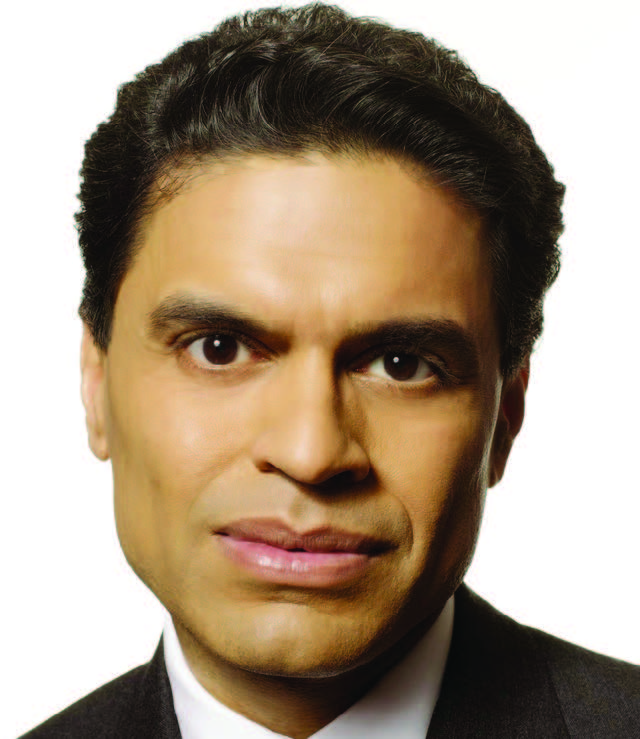
    Among 88 recipients, the six Indian- Americans are – PepsiCo CEO Indra Nooyi, Fareed Zakaria, Author and host of CNN’s “Fareed Zakaria GPS” show, Harman International Industries chairman CEO Dinesh Paliwal, Dr Annapoorna S Kini, Yashvant Patel, and Mohan H Patel. The National Ethnic Coalition of Organizations, which awards the medals, announced that 88 people will receive the Ellis Island Medal of Honor during an official ceremony on May 13.

    According to the NECO website, “the Ellis Island Medals of Honor embody the spirit of America in their celebration of patriotism, tolerance, brotherhood and diversity. They recognize individuals who have made it their mission to share with those less fortunate their wealth of knowledge, indomitable courage, boundless compassion, unique talents and selfless generosity; all while maintaining the traditions of their ethnic heritage as they uphold the ideals and spirit of America. As always, NECO remains dedicated to the maintenance and restoration of America’s greatest symbol of its immigrant history, Ellis Island.”

    Indra Nooyi was named President and CEO of PepsiCo on October 1, 2006 and assumed the role of Chairman on May 2, 2007. In addition to being a member of the PepsiCo Board of Directors, Mrs. Nooyi serves as a member of the boards of U.S.-India Business Council, The Consumer Goods Forum, Catalyst, Lincoln Center for the Performing Arts and Tsinghua University. She is also a member of the Foundation Board of the World Economic Forum, the American Academy of Arts & Sciences and was appointed to the U.S.-India CEO Forum by the Obama Administration.

    Fareed Zakaria is host of CNN’s flagship foreign affairs show, a Washington Post columnist, a contributing editor for The Atlantic and a New York Times bestselling author. Esquire Magazine called him “the most influential foreign policy adviser of his generation.” From 2010 to 2014, Dr. Zakaria served as editor-at-large for TIME. Before that, he spent ten years overseeing all of Newsweek’s editions abroad. Before joining Newsweek, from 1992 to 2000, he served as managing editor of Foreign Affairs, a post he was appointed to at only 28 years old.

  • NOOYI MEETS MODI, OFFERS HELP TO MEET ‘DEVELOPMENT GOALS’

    NOOYI MEETS MODI, OFFERS HELP TO MEET ‘DEVELOPMENT GOALS’

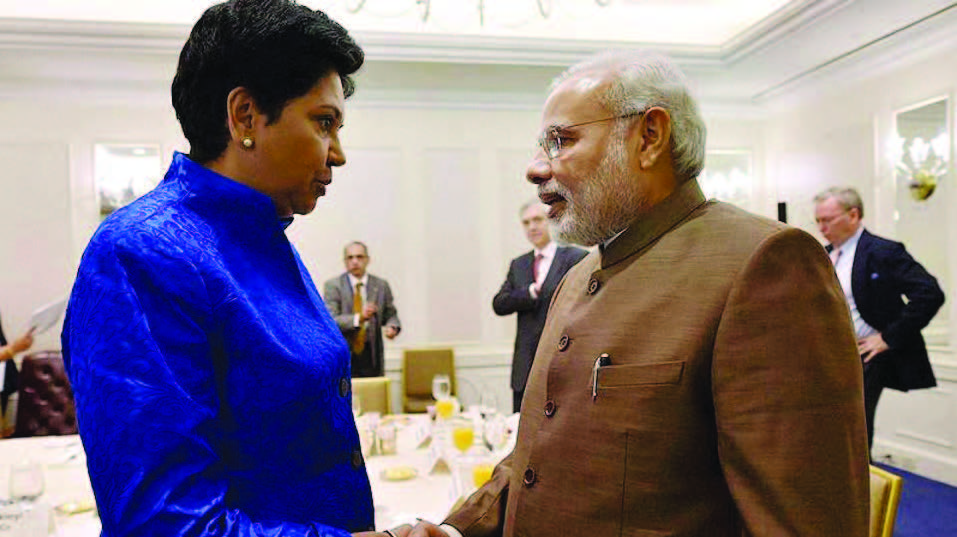
    NEW DELHI (TIP): #PepsiCo Chairperson #IndraNooyi today met Prime Minister @NarendraModi and offered the company’s participation in the government’s efforts to deliver on national development goals, especially in supporting farmers.

    She also apprised the Prime Minister on how PepsiCo’s new Quaker Oats products that take traditional recipes can contribute to improving health of Indian consumers.

    “As I shared with Prime Minister Modi, PepsiCo is well positioned to help the government deliver on the national development goals he has outlined for farmers and supporting their livelihoods,” she said in a statement. Nooyi further said: “The Prime Minister and I had an engaging dialogue on how PepsiCo is making investments to grow, process and use more Indian-grown fruit juice in our sparkling beverages.”

    She also said they discussed on how PepsiCo is focusing on new health-oriented products with local recipes. “We also discussed our launch of new Quaker Oats products that take traditional recipes and add in whole grain Quaker Oats to help Indians start their day in a healthy way,” Nooyi added.

  • Two Women among 25 Highest Paid Indian-American Executives

    Two Women among 25 Highest Paid Indian-American Executives

    BOSTON (TIP): Sundar Pichai, Chief Executive Officer of Google, and General Growth Properties CEO Sandeep Mathrani are the two highest-paid Indian-American executives in the United States, earning a whopping $100.50 million and $39.25 million respectively, according to a report released by the IndUS Business Journal.

    “Two top-ranking women also grace the list of the highest-paid Indian-American executives,” said Upendra Mishra, publisher of the IndUS Business Journal. “We hope that the number of women-led businesses increases in the near future. However, it is still exciting to see that there are at least two women in this top list.”

    Indra NooyiThe two women in the list are: PepsiCo CEO Indra Nooyi, who made $22.19 million, and Sona Chawla, Chief Operating Officer of Kohl’s Corp., who made $10.69 million. The list is based on the total compensation in 2015, including base salary, bonus, incentives and stock award value. The report is compiled based on public documents filed with the Securities and Exchange Commission, public records and news reports.

    Here is the list ranked by total compensation in 2015:

    Rank: 1
    Sundar Pichai
    Title: CEO
    Company: Google

    Rank: 2
    Name: Sandeep Mathrani
    Title: CEO
    Company: General Growth

    Rank: 3
    Name: Hari Ravichandran Title: CEO
    Company: Endurance International Group

    Rank: 4
    Name: Bhavesh (Bob) Patel Title: CEO
    Company: LyondellBasell Industries

    Rank: 5
    Name: Indra Krishnamurthy Nooyi
    Title: Chairman and CEO Company: PepsiCo

    Rank: 6
    Name: Shantanu Narayen Title: CEO
    Company: Adobe Systems

    Rank: 7
    Name: Satya Nadela
    Title: CEO
    Company: Microsoft Corp.

    Rank: 8
    Name: Ajay Banga
    Title: President and CEO Company: MasterCard

    Rank: 9
    Name: Pankaj Patel
    Title: Executive Vice President Company: Cisco Systems

    Rank: 10
    Name: Varun Mehta
    Title: Vice President of Engineering
    Company: Nimble Storage, Inc.

    Rank: 11
    Name: Akhil Johri
    Title: Executive Vice President and Chief Financial Officer Company: United Technologies Corp.

    Rank: 12
    Name: Francisco D’Souza Title: CEO
    Company: Cognizant Technology Solutions

    Rank: 13
    Name: Rajiv De Silva
    Title: President and CEO Company: Endo International Plc

    Rank: 14
    Name: Sanjay Mehrotra
    Title: President and CEO Company: SanDisk Corp.

    Rank: 15
    Name: Sona Chawla
    Title: Chief Operating Officer Company: Kohl’s Corp.

    Rank: 16
    Name: Ashish Bhutani
    Title: CEO
    Company: Lazard Asset Management

    Rank: 17
    Name: Dinesh C. Paliwal Title: Chairman and CEO Company: Harman International

    Rank: 18
    Name: Dinesh C. Jain
    Title: Chief Operating Officer Company: Spectrum Management Holding Company

    Rank: 19
    Name: Abhijit Y. Talwalkar Title: President and CEO Company: LSI Corp.

    Rank: 20
    Name: Sudhir Steven Singh Title: CEO
    Company: Concur Technologies, Inc.

    Rank: 21
    Name: Sunit S. Patel
    Title: Executive Vice President Company: Level 3 Communications, Inc.

    Rank: 22
    Name: Dharmesh Mehta Title: Executive Vice President Company: Weatherford International

    Rank: 23
    Name: Mohan R. Maheswaran Title: CEO
    Company: Semtech Corp.

    Rank: 24
    Name: Deepak Chopra
    Title: President and CEO Company: Osi Systems, Inc.

    Rank: 25
    Name: Vijay C. Advani
    Title: CEO
    Company: Franklin Resources, Inc.

  • Indra Nooyi Becomes ‘Most Generous Graduate’ Of Yale School Of Management

    Indra Nooyi Becomes ‘Most Generous Graduate’ Of Yale School Of Management

    PepsiCo’s India-born CEO Indra Nooyi has become the biggest alumni donor and the first woman to endow deanship at a top business school, after she gifted an undisclosed amount to prestigious Yale school of management.

    60-year-old Ms Nooyi gifted an amount, which was not made public, to the deanship of the school and inaugurated the Fifth Decade Innovation Fund, the Yale School of Management said.

    With this gift, Ms Nooyi becomes the “most generous graduate” of Yale School of Management in terms of lifetime giving to the school and she is the first woman to endow the deanship at a top business school, it said.

    Ms Nooyi said her experience at the Yale School of Management “forever altered the course of my life” and her gift “pales in comparison with the gift that Yale gave me-the fundamental understanding that leadership requires an expansive worldview and a deep appreciation of the many points of intersection between business and society.”

    “Business issues are never just business issues, and my most ardent hope is that this endowment will teach future generations of leaders that the most successful companies of tomorrow will do more than make money. They will make a difference and create shareholder value by improving the quality of life in every market in which they operate,” Ms Nooyi said.

    Ms Nooyi joins several prominent persons of Indian-origin who have donated generously to US universities. In October last year, Ms Nooyi’s sister Chandrika Tandon and her husband Ranjan had made a USD 100 million gift to the New York University’s School of Engineering, one of the largest philanthropic gifts by a member of the Indian-American community.

    As part of a long record of support for the Yale School of Management, Ms Nooyi has previously made substantial contributions to the construction of the Edward P Evans Hall, including gifts to name the Ms Nooyi Classroom and the Isaacson Classroom in memory of Professor Larry Isaacson.

    Commenting on the gift, Yale University president Peter Salovey said Ms Nooyi’s “sense of purpose, deep engagement with civic life, and pursuit of excellence exemplify the kind of leadership in service to society that we hope all Yale graduates will achieve.”

    “The world needs skillful, purposeful, and dedicated leaders in every field and every sector, and Indra’s name is synonymous with those core values of the university,” Salovey said.

    Edward Snyder is the inaugural dean Indra K Nooyi Dean and has led the Yale School of Management since 2011. He was recently appointed to a second five-year term as dean.

    “Indra Nooyi has become a leading voice among Fortune 500 CEOs in no small part because of her willingness to take a stand on the broader purpose of the corporation, while delivering top-echelon performance,” Snyder said.

    The Fifth Decade Innovation Fund is named in recognition of the fact that the school is entering its fifth decade; the first class entered the Yale School of Management in 1976.

  • Cisco Executive Chairman John Chambers  Elected Chairman of U.S.: India Business Council

    Cisco Executive Chairman John Chambers Elected Chairman of U.S.: India Business Council

    WASHINGTON, D.C.(TIP): The U.S.-India Business Council (USIBC) Board of Directors announced that Mr. John T. Chambers, Executive Chairman of Cisco, has been elected as the Council’s next Chairman. The formal announcement of the appointment was made at the Council’s 40th Anniversary Leadership summit that kicked off the U.S.-India Strategic and Commercial Dialogue.

    The transition will come at the end of a four-year term by Ajay Banga, President and CEO of MasterCard. Mr. Banga has been the Council’s longest-serving Chairman.

    “On behalf of the USIBC Board, it’s my privilege to announce and to welcome USIBC’s incoming chairman, John Chambers. John will of course be building on USIBC’s 40-year legacy which we’re celebrating tonight. We look forward to working with John and supporting him as his tenure officially begins the first of next year,” said Ajay Banga through a video message at the Council’s 40th Anniversary Leadership Summit.

    “As a longtime supporter of USIBC, I have witnessed the Council’s influence rise dramatically as a direct result of the leadership provided by current chairman, Ajay Banga, and former chairs such as Terry McGraw and Indra Nooyi,” said John Chambers. “It is an exceptional honor to be entrusted with such a legacy and I look forward to building on their successes as USIBC’s next Chairman. With Prime Minister Modi’s upcoming visit to the Silicon Valley, the important focus on building a digitally empowered nation through Digital India and the ongoing strategic and commercial dialogue, it is an exciting time to join the Council.”

    “We are grateful for Ajay’s leadership and commitment to furthering U.S.-India ties over the last four years. During his tenure, he blazed an equally impressive path by adding top American and Indian companies to the Council’s membership, increasing Council revenue and adding staff capacity at the Council’s regional offices to serve members. Due to Ajay’s leadership, the Council’s board of directors now includes 14 global Presidents and CEOs. The Council and its board are delighted to welcome John Chambers as the new Chairman. His global business acumen will be instrumental as we move forward to realize the full potential of U.S.-India relations. I look forward to working closely with John and the USIBC board to build on the Council’s proud, 40-year history,” said Mukesh Aghi, President of USIBC.

  • Indra Nooyi, Shobhana Bhartia get The Global Leadership Award

    Indra Nooyi, Shobhana Bhartia get The Global Leadership Award

    WASHINGTON, UNITED STATES:  PepsiCo Chairman Indra Nooyi and Hindustan Times Group chairperson Shobhana Bharatia have been presented with the 2015 Global Leadership Award of the US India Business Council, for their commitment to driving a more inclusive global economy and their roles as women leaders, reported PTI

    Ms Nooyi and Ms Bharatia were honoured with this prestigious annual award last evening during the annual gala of the USIBC, the top advocacy group for India and American companies in the US.

    US Vice President Joe Biden, Secretary of State John Kerry, among others, addressed on the occasion.

    Noting that USIBC plays a critically important role in strengthening the India-US relationship, Ms Nooyi said, there are tremendous opportunities ahead to work together in new ways that capitalise on their collective strengths and pave the way to shared prosperity for the countries, companies and citizens.

    Ms Bharatia, also Editorial Director of the HT group, said, “As the representative of a media group that realises the importance of looking at both India Shining, and the Other India to get a real picture of what is happening in our country, and as a woman leader in a nation where women are finally coming into their own, I am delighted to receive this award.”

    “Our two countries, both democracies, have a strong and free media and I see increasing opportunities for collaboration as media and technology companies from India and the US navigate the evolving digital landscape,” Ms Bhartia said after receiving the award.

    Renowned Indian-American artist, Natvar Bhavsar who is known for his abstract expressionism and “color-field” painting was awarded the Artistic Achievement Award.

    “My work aims to transcend boundaries and I am honoured to receive this award that recognises my Indian roots and my training in arts that took place in the United States,” he said.

    “I would not be the artist I am today had it not been for the inspirations that have guided me in my absorbing the gifts offered by both cultures, my birthplace India and my half a century’s participation in the creative life of New York City,” Mr Bhavsar said.

  • USIBC 40th Annual Leadership Summit

    USIBC 40th Annual Leadership Summit

    WASHINGTON (TIP): Vice President Joe Biden, Secretary of State John Kerry, India’s Minister of External Affairs Sushma Swaraj, and other high-ranking officials from both governments, along with captains of industry from both countries, will address the U.S.-India Business Council on the occasion of its 40th anniversary on September 21 in Washington, DC, to kick off the first U.S.-India Strategic and Commercial Dialogue.

    “It’s a privilege for USIBC to host government and business leaders from both countries on the eve of the U.S.-India Strategic and Commercial Dialogue and on the occasion of the council’s 40th anniversary. The founding principle of the council four decades ago – which grew out of the vision of then-U.S. Secretary of State, Henry Kissinger – remains even more true today: the world’s largest democracies share a love of freedom and an entrepreneurial spirit that – if nurtured -can help realize the full potential of India-U.S. relations,” said USIBC Chairman and MasterCard President and CEO, Ajay Banga.

    “The U.S. business relationship with India is one of the most valuable in the world, and we have seen great progress over the last 40 years,” said President of USIBC Mukesh Aghi. “We are honored to welcome these distinguished speakers from both countries – from both public and private sectors – on the occasion of this milestone anniversary. This level of bilateral engagement and commitment to furthering trust and cooperation has been one of USIBC’s hallmarks for the past four decades and will be for decades more to come,” said USIBC President, Mukesh Aghi.

    The government to government dialogue at this year’s summit will also include U.S. Secretary of Commerce Penny Pritzker, Minister of State for Commerce and Industry Nirmala Sitharaman, Minister of State with Independent Charge for Power, Coal and New & Renewable Energy Piyush Goyal.

    The Council also honors business and government leaders for their commitment towards building a more inclusive global economy. This year’s honorees include CEO and Chairman of PepsiCo Indra Nooyi and Chairperson and Editorial Director of the Hindustan Times Group, Shobhana Bhartia.

  • Global Indians – 13 Global CEOs

    Global Indians – 13 Global CEOs

    Prime Minister Narendra Modi has all along been appreciative of the struggles and achievements of NRIs. His close association with a number of NRIs all across the world is well known. There is no country in the world where Modi does not have NRI friends.

    And it is not only Modi who is appreciative of the NRI movers and shakers, the common Indian whether in India or abroad, takes great pride in the achievements of persons of Indian origin. So, here we are sharing with our readers information on the NRIs who are “global CEOs”. We congratulate them and take pride in their achievements which have done the Indian nation and its 1.3 billion people proud. They have made India’s Independence Day a very special one, with the laurels they have won.

    Sundar PichaiSundar Pichai – Pichai is an Indian American computer engineer and Indian Institute of Technology, Kharagpur alumnus. He is the new CEO of Google. The decision came after Google’s founders Larry Page and Sergei Brin decided to re-organize the company by creating a mother company called Alphabet.

    The new mother company will include, besides Google, units such as Calico (which focuses on Longevity), X lab (which incubates new efforts like Wing, Google’s drone delivery effort) and units dealing with life sciences (such as the one working on smart contact lens that detects blood sugar level). Google’s investment arms, Ventures and Capital, will also be part of Alphabet.

    The journey of Sundar Pichai from a student of IIT-Kharagpur to Google CEO has been truly remarkable.

    Satya NadellaSatya Nadella – Satya Narayana Nadella was born in Hyderabad on 19 August 1967. He is the current Chief Executive Officer (CEO) of Microsoft. He was appointed as CEO on 4 February 2014, succeeding Steve Ballmer. Before becoming CEO of Microsoft, Nadella was Executive Vice President of Microsoft’s Cloud and Enterprise group, responsible for building and running the company’s Computing Platforms, Developer Tools and Cloud Computing Services.

    Nikesh Arora Nikesh AroraNikesh Arora – Nikesh Arora is a former Google executive and President & Chief Operating Officer of SoftBank Corp.

    Arora graduated from the IIT, Banaras Hindu University, Varanasi.

    He holds a degree from Boston College and an MBA from Northeastern University. He also holds the CFA designation.

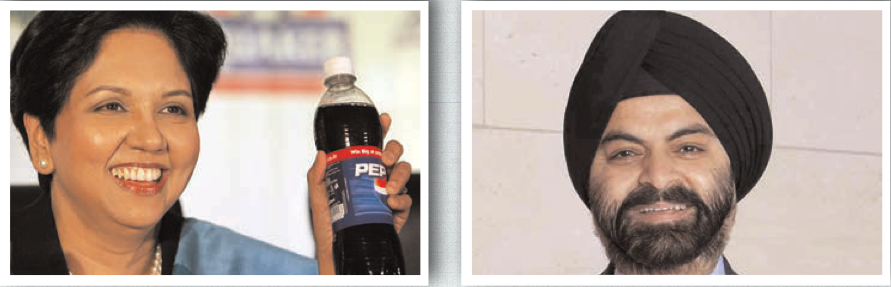
    Ajaypal Singh BangaAjaypal Singh Banga – Ajay Banga is the current president and chief executive officer of MasterCard.MasterCard announced on April 12, 2010 that Ajay Banga, previously MasterCard’s president and chief operating officer, had been named by the Board of Directors to serve as the company’s president and chief executive officer, effective July 1, 2010.

    Banga succeeded Robert W. Selander, who had been MasterCard’s chief executive officer since March 1997.

    Presently, he is also the chairman of the US-India Business Council (USIBC) representing more than three hundred of the largest international companies investing in India.

    Indra NooyiIndra Nooyi – India-born Indra Krishnamurthy Nooyi is the current Chairperson and Chief Executive Officer of PepsiCo, the second largest food and beverage business in the world by net revenue.

    She has consistently ranked among the World’s 100 Most Powerful Women.

    In 2014, she was ranked 13 in the list of Forbes World’s 100 most powerful women.

    Rakesh SachdevRakesh Sachdev – Rakesh Sachdev has been the Chief Executive Officer and President of Sigma-Aldrich Corporation since November 2010.

    He served as the Chief Financial Officer of Sigma- Aldrich Corporation from November 18, 2008 to November 2010 and also served as its Chief Administrative Officer from May 2009 to November 14, 2010 and Senior Vice President from May 2005 to November 2010.

    He is a graduate of the Indian Institute of Technology, New Delhi with a Bachelor’s Degree in Mechanical Engineering. He holds a Master’s Degree in Business Administration in Finance from Indiana University, as well as a Master’s Degree in Mechanical Engineering from the University of Illinois.

    Francisco D'SouzaFrancisco D’Souza  – Francisco D’Souza was born on 23 August 1968. He is the CEO of Cognizant and was part of the team that founded the NASDAQ-100 company in 1994.

    Francisco is Cognizant’s CEO since January 2007.

    Francisco D’Souza is among the youngest Chief Executive Officers in the software services sector. In 2007, at the age of 38, he took over from Lakshmi Narayanan, who was promoted to Vice Chairman.

    Rakesh KapoorRakesh Kapoor – Rakesh Kapoor was born 4 August 1958. He is Chief Executive of Reckitt Benckiser plc, a UK FTSE-listed multinational consumer goods company, a major producer of health, hygiene and home products.

    Anshu JainAnshu Jain – Anshuman Jain was born on 7 January 1963 in Jaipur. He took over as Co-CEO of Deutsche Bank on 1 June 2012 to succeed Management Board Chairman Josef Ackermann.

    He was a co-CEO of the bank between 2012 and July 2015. He is a member of Deutsche Bank’s Management Board.

    Earlier, as head of the Corporate and Investment Bank, he was globally responsible for Deutsche Bank’s corporate finance, sales and trading, and transaction banking business. Jain resigned as co-CEO in July 2015 though he is expected to remain a consultant to the bank until January 2016.

    Vikram PanditVikram Pandit – Vikram Shankar Pandit was born on 14 January 1957. He is the former chief executive of Citigroup, a position he held from December 2007 until he was forced to resign, on 16 October 2012.

    Shantanu NarayenShantanu Narayen – Shantanu Narayen was born on May 27 1963. He is the CEO of Adobe Systems. Prior to this, he was the president and chief operating officer since 2005. He is also the president of the board of the Adobe Foundation.

    Padmasree WarriorPadmasree Warrior – Padmasree Warrior is the former Chief Technology & Strategy Officer (CTO) of Cisco Systems, and the former CTO of Motorola, Inc.

    As of 2014, she is listed as the 71st most powerful woman in the world by Forbes.

    rajeevRajeev Suri – Rajeev Suri headed Nokia Solutions and Networks (NSN) since October 2009, has been credited for “presiding over consistently improving results leading to the successful turnaround and restructuring of the company.” Suri joined Nokia in 1995 and headed the Asia Pacific region for NSN in 2007.

    According to his official profile, Suri has a Bachelor of Engineering degree in Electronics and Telecommunications from Mangalore University. He is based in Espoo, Finland.

  • PepsiCo’s Indra Nooyi to be honored by Indian-American women

    PepsiCo’s Indra Nooyi to be honored by Indian-American women

    NEW YORK (TIP): A statement from the US-based NGO- Children’s Hope India (CHI) said Nooyi would be felicitated with the Special Impact Award at their annual gala to be held at Pier Sixty in Manhattan on October 13. Born in Chennai, Nooyi had studied business management from the premier Indian Institute of Management, Kolkata. Founded in 1992 by a group of Indian American women professionals, CHI sponsors health, education and vocational programs for thousands of children in India. They support over 20 projects reaching out to over 20,000 children per year in Delhi, Mumbai, Kolkata, Bangalore, Bhuj, Pune, Jabalpur and several villages in Rajasthan and Tamil Nadu. In addition to Nooyi’s award, CHI will also honor human rights activist Mallika Dutt, who founded the human rights group ‘Breakthrough’, with the ‘Making a Difference’ Award. Sundaram Tagore, noted gallerist and descendant of the Tagore family, Trinamool Congress MP Derek O’Brien and fashion designer Rachel Roy will receive ‘Spirit of Bengal’ Awards. Through this year’s theme ‘Viva Calcutta!’, the auditorium at Manhattan’s Pier Sixty would pay a sparkling tribute to the city of Kolkata and its riches of art, culture, fashion and cuisine. Over 500 guests from near and far, including Ambassador Dnyaneshwar M Mulay, Consul General of India, have been invited for the gala, the release said.

  • MOVERS & SHAKERS

    MOVERS & SHAKERS

    Famous Indian nuclear physicist Homi Jehangir Bhabha was born on 30 October 1909 in Mumbai. Bhabha played a key role in the development of the Indian atomic energy program. Widely referred to as the father of India’s nuclear weapons program, Bhabha had his education at the Elphinstone College and the Royal Institute of Science before obtaining his doctorate from the University of Cambridge in 1934.

    He was influenced greatly by the legendary Paul Dirac. Bhabha was a research scientist at the Cavendish Laboratories at Cambridge. When he was stranded in India as a result of the Second World War, he set up the Cosmic Ray Research Unit at the Indian Institute of Science, Bangalore under Nobel Laureate C. V. Raman in 1939. Dr. Bhabha is credited with establishing the Tata Institute of Fundamental Research(TIFR) with the help of eminent industrialist J. R. D. Tata.

    After India won independence from the British, Bhabha established the Atomic Energy Commission of India in 1948. He represented India in various international forums including the United Nations and his tenure represented a high in terms of the progress of India’s atomic energy programme. The climax of this programme came on May 18, 1974 when India exploded a nuclear device at Pokhran, Rajasthan joining a select club of nations.

    Ratan Tata
    Ratan Tata is one of the most well-known and respected Indian businessman. He served as the Chairman of the Tata Group from 1991 till 2012. As a Mumbaibased conglomerate, he is also a member of the prominent Tata family of Indian industrialists and philanthropists. Ratan Tata was born on December 28, 1937 in Mumbai. When he was a child his parents separated and he was brought up by his grandmother Lady Navajbai.

    He went to Campion School in Bombay, Bishop Cotton School in Shimla and finished his schooling from Cathedral and John Connon School in Mumbai. He graduated with a degree in Architecture and Structural Engineering from Cornell University in 1962 and also did the Advanced Management Program from Harvard Business School in 1975. He is also a member of the Alpha Sigma Phi fraternity of Yale University, United States. In 1962, Ratan Tata began his career in the Tata group.

    At first he used to work on the shop floor of Tata Steel, shoveling limestone and handling blast furnace. In 1991, JRD Tata stepped down as the chairman of Tata Industries and named Ratan Tata as his successor. Under Ratan’s stewardship, Tata Tea attained Tetley, Tata motors attained Jaguar Land Rover and Tata Steel attained Corus. These triumphs turned Tata from a large India-centric company into a global business with 65% revenues from abroad. He also contributed in the development of Indica and Nano.

    Ratan Tata has also served in various organizations in India and abroad. He is a member of the Prime Minister’s Council on Trade and Industry and he is also on the board of governors of the East-West Center, which is the advisory board of RAND’s Center for Asia Pacific Policy. He also serves on the program board of the Bill & Melinda Gates Foundation’s India AIDS initiative. He was awarded the Padma Bhushan by the Government of India in January 2000.

    He serves on the boards of several leading organizations, both in the public as well as the private sector in India. He is a member of the International Investment Council set up by the President of South Africa and serves on the programme board of the Bill & Melinda Gates Foundation’s India AIDS initiative. Ratan Tata is credited for leading Tatas’ successful bid for Corus, an Anglo-Dutch steel and aluminum producer, which was acquired for an estimated £6.7 billion by Tata Sons.

    N.R. Narayanamurthy
    N.R. Narayana Murthy, the founder of Infosys Technologies is one of the most famous personalities in India’s I-T sector. Born on August 20, 1946, he obtained a degree in electrical engineering from the National Institute of Engineering under University of Mysore in 1967 and went on to do his Masters from IIT Kanpur in 1969. He joined Patni Computer Systems in Pune. While at Pune, he met his wife Sudha Murty.

    In 1981, he founded Infosys alongwith with six otherpeople. He served as president of the National Association of Software and Service Companies, India from 1992 to 1994. Murthy was the CEO of Infosys for twenty years, and was succeeded by Nandan Nilekani in March 2002. He functioned as the Executive Chairman of the Board and Chief Mentor from 2002 to 2006.

    Dhirubhai Ambani
    Dhirajlal Hirachand Ambani was born on 28 December 1932, at Chorwad, Junagadh in Gujarat, When he was 16 years old, he moved to Aden,Yemen. Initially, Dhirubhai worked as a dispatch clerk with A. Besse & Co. Married to Kokilaben. Dhirubhai also worked in Dubai for sometime. He returned to India and founded the Reliance Commercial Corporation with an initial capital of Rs 15000.

    Dhirubhai set up the business in partnership with Champaklal Damani from whom he parted ways in 1965. Dhirubhai started his first textile mill at Naroda, near Ahmedabad in 1966 and started the brand “Vimal”. Dhirubhai Ambani is credited with having started the equity cult in India.With the passage of time, Dhirubhai diversified into petrochemicals and sectors like telecommunications, information technology, energy, power, retail, textiles, infrastructure services, capital markets, and logistics.

    Lakshmi Nivas Mittal
    Lakshmi Nivas Mittal was born on June 15, 1950 in Sadulpur, Rajasthan, India and is presently the CEO & Chairman of Arcelor Mittal. Lakshmi Nivas Mittal was listed in the Forbes List of Billionaires in 2006 as the the richest Indian and the fifth richest man in the world with an estimated wealth around of $25.0 billion and is the richest man in the United Kingdom. Young Lakshmi Nivas Mittal spent his first years in Sadulpur, before his father moved to Kolkata. Lakshmi graduated from St. Xavier’s College, Calcutta. He founded Mittal Steel in 1976, which soon became a global steel producer with operations on 14 countries. His success mantra lies in the identification, acquisition and turnaround of many loss making steel companies all across the world.

    Dr. A.P.J. Abdul Kalam
    Dr. A.P.J. Abdul Kalam, former President of India, graduated in aeronautical engineering from the Madras Institute of Technology in 1958 and joined the Defense Research and Development Organization (DRDO). In 1962, Kalam joined the Indian Space Research Organization (ISRO). In 1982, he rejoined DRDO as the Chief Executive of Integrated Guided Missile Development Programme (IGMDP). Dr. Kalam is credited with the development and operationalization of India’s Agni and Prithvi missiles.

    He worked as the Scientific Adviser to the Defence Minister and Secretary, Department of Defence Research & Development from 1992 to 1999. During this period, the Pokhran-II nuclear tests were conducted. Dr. Kalam held the office of the Principal Scientific Advisor to the Government of India from November 1999 to November 2001. Dr. Kalam has received a host of awards both in India and abroad. He was awarded the Padma Bhushan in 1981, Padma Vibhushan 1990 and the Bharat Ratna in 1997.

    He is of the view that we should work wholeheartedly to make India a developed nation by 2020. Besides being a bachelor, Kalam is a strict disciplinarian, a complete vegetarian and teetotaler. Among the many firsts to his credit, he became India’s first President to undertake an undersea journey when he boarded the INS Sindhurakshak, a submarine, from Visakhapatnam. He also became the first president to undertake a sortie in a fighter aircraft, a Sukhoi-30 MKI.

    Khushwant Singh
    One of the most prominent novelists and journalists of India, Khushwant Singh was born on 2 February 1915 in Hadali, presently in Pakistan. He writes a weekly column, “With Malice towards One and All”, published in several leading newspapers all over the country. He graduated from Government College, Lahore before studying law at King’s College, London. He has been the editor of Yojana, The Illustrated Weekly of India, The National Herald and the Hindustan Times.

    He also served as a member of the Rajya Sabha. Though he was awarded the Padma Bhushan in 1974, he returned it in 1984 to protest the siege of the Golden Temple by the Indian Army. He was awarded the Padma Vibhushan in 2007. Some of his notable works include: The Sikhs; Train to Pakistan; The Sikhs Today; Ranjit Singh: The Maharajah of the Punjab; Delhi: A Novel; Sex, Scotch and Scholarship: Selected Writings; Not a Nice Man to Know: The Best of Khushwant Singh; Paradise and Other Stories; Death at My Doorstep; The Illustrated History of the Sikhs etc.

    Amartya Sen
    Nobel Prize winner Amartya Sen was born on 3 November 1933 in Santiniketan, West Bengal. Besides being a worldrenowned economist, Amartya Sen is also a philosopher. He served as a Master at the Trinity College at Cambridge University, the first Asian academic to head an Oxbridge college. Currently the Lamont University Professor at Harvard University, Amartya Sen traces his roots to an illustrious lineage. His father, Ashutosh Sen, taught chemistry at the Dhaka University.

    Amartya completed his high-school education from Dhaka in Bangladesh in 1941. After his family migrated to India in 1947, Sen studied at the Presidency College, Kolkata and at the Delhi School of Economics before moving over to the United Kingdom to complete his higher studies. He earned his doctorate from the Trinity College, Cambridge in 1959. He has taught at various reputed Universities including the University of Calcutta, Jadavpur University, Oxford, London School of Economics, Harvard and many others. His works helped to develop the theory of social choice.

    In 1981, he published his famous work Poverty and Famines: An Essay on Entitlement and Deprivation, where he showed that famine occurs not only due to shortage of food, but from inequalities in the mechanisms for distributing food. He had personally witnessed the Bengal famine of 1943. He has done valuable work in the field of development economics, which has had a tremendous influence on the formulation of the United Nations Development Programme’s Human Development Report.

    Sabeer Bhatia
    Sabeer Bhatia-co-founder of Hotmail, is one among select group of people who have made it big in America’s Silicon Valley. Born in Chandigarh, Sabeer Bhatia did his schooling from St. Joseph’s Boys’ High School, Bangalore. He graduated from Caltech and went to Stanford to pursue his MS in Electrical Engineering. Sabeer attended many lectures by famous like Steve Jobs and was determined to make it big. After completing his Masters, he joined Apple computers. He left Apple soon after.

    He teamed up with his partner to create a web-based e-mail system Microsoft bought Hotmail on December 30th, 1997, for a reported sum of $400M. After the success of Hotmail, Bhatia in April 1999, he started another venture, Arzoo Inc, which however had to be shut down. In 2006, Arzoo was relaunched. Bhatia has won many awards. Among the notable ones include the “Entrepreneur of the Year” awarded by the venture capital firm Draper Fisher Jurvetson in 1997, the “TR100” award, presented by MIT to 100 young innovators expected to have the greatest impact on technology in the next few years. Besides, he was named by TIME magazine as one of the “People to Watch” in International Business in 2002.

    Indra Nooyi
    Indra Nooyi is the president and chief executive officer of PepsiCo and is the highest-ranking Indian-born woman in corporate America. She helped to start PepsiCo’s fast-food chains in 1997. After a Bachelor’s degree from Madras Christian College and a Post Graduate Diploma in Management from the Indian Institute of Management Kolkata, she moved on to the Yale School of Management.

    She started her career with The Boston Consulting Group (BCG), moving on to companies like Motorola and Asea Brown Boveri.She serves on the board of directors of several organizations. In August 2006, she succeeded Steve Reinemund as chief executive officer of PepsiCo. She has been named the Most Powerful Woman in Business in 2006 by Fortune Magazine. Her name was included in the Wall Street Journal’s list of 50 women to watch in 2005.

    Kiran Bedi
    The first woman to join the coveted Indian Police Service (IPS) in 1972, Kiran Bedi was born on 9 June 1949 in Amritsar, Punjab. Recently appointed as Director General of India’s Bureau of Police Research and Development, Kiran Bedi has had an illustrious career, earning widespread adulation for her no-nonsense attitude and devotion to work. She served as Police Advisor in the United Nations peacekeeping department and was honored with the UN medal for outstanding service. She earned the nickname ‘Crane Bedi’ for towing away the then Indian PM Indira Gandhi’s car for parking violation.

    Kiran Bedi graduated in English before securing a Master’s degree in Political Science from Punjab University, Chandigarh. This gutsy police officer went on to secure an LL.B degree in 1988 from Delhi University and a Ph.D. from the Indian Institute of Technology, New Delhi, even while she was in service. She was good at sports too, having been an all- India and all-Asian tennis champion.

    She has served creditably in a host of appointments ranging from Deputy Inspector General of Police, Mizoram, Advisor to the Lieutanent Governor of Chandigarh, Director General of Narcotics Control Bureau and many others.

    Rakesh Sharma
    The first Indian to fly into space, Rakesh Sharma was born on January 13, 1949 in Patiala, Punjab. He was a squadron leader with the Indian Air Force, when he flew into space in 1984 as part of a joint programme between the Indian Space Research Organisation (ISRO) and the Soviet Intercosmos space program.

    He spent eight days in space on board the Salyut 7 space station. He joined two other Soviet cosmonauts aboard the Soyuz T- 11 spacecraft which blasted off on April 2, 1984. He was awarded the Hero of Soviet Union award on his return from space. The Government of India honoured him with the Ashok Chakra. He retired with the rank of Wing Commander. He joined the Hindustan Aeronautics Limited in 1987 and served as Chief Test Pilot in the HAL Nashik Division until 1992, before moving on to Bangalore to work as the Chief Test Pilot of HAL. He retired from test flying in 2001.

    Dr. Verghese Kurien
    The “father of the white revolution” in India, Dr. Verghese Kurien is acknowledged worldwide as the brain behind the success of the largest dairy development programme in the world by the name of Operation Flood. Also known as the “Milkman of India”, he was the chairman of the Gujarat Co-operative Milk Marketing Federation Ltd. (GCMMF) and his name became synonymous with the Amul brand. Born on November 26, 1921 in Kozhikode, Kerala, he graduated in Physics from Loyola College, Madras in 1940 and pursued a B.E.(Mechanical) course from the Madras University. He was instrumental in the success story of AMUL.

  • USIBC brings CEOs of Fortune 100 to meet with P. Chidambaram

    USIBC brings CEOs of Fortune 100 to meet with P. Chidambaram

    Blankfein, Nooyi, Kravis, McGraw, Kaye, Fishman, and Banga reconfirm U.S. industry’s commitment to India’s growth

    NEW YORK (TIP): India’s Finance Minister, P. Chidambaram, met with investors, April 17, at a private interaction hosted by the U.S.-India Business Council (USIBC) as part of the Minister’s week-long North America investor “road show,” aimed at attracting foreign direct investment (FDI) at a time when the country needs it most. India currently holds a record high current account deficit and FDI could be the key to closing that gap. The off-the-record lunch meeting convened top
    global industry leaders to discuss with the Finance Minister the opportunities that exist in India and candidly addressed some of the challenges companies face in the market which affects investor sentiment. Topics of conversation included infrastructure, retail, agriculture, life sciences, financial services, legal services, and real estate. “Global industry wants India to succeed. India will succeed. I know this past year has caused a lot of concern, but this year is over and by elections we will achieve our ambitious economic agenda,” said Finance Minister Chidambaram. “We commend Minister Chidambaram for his leadership during these complex times.

    The American business community continues to look to India as a partner in the global economy ripe with investment opportunities. My colleagues and I remain committed to working collaboratively with Government of India and Indian industry to identify innovative solutions to India’s challenges,” said USIBC Chairman Ajay Banga, President & CEO, MasterCard. The intimate gathering reflected combined assets of more than $2 trillion.

    Participants included former USIBC Board Chairpersons: Indra Nooyi, CEO, PepsiCo Inc; Frank Wisner, Foreign Affairs Advisor, Patton Boggs, and former U.S. Ambassador to India; Chip Kaye, Co- President, Warburg Pincus; and Harold McGraw III, Chairman, President, and CEO, The McGraw Hill Companies. Also in attendance were Lloyd Blankfein, CEO, Goldman Sachs; Jay Fishman, CEO, The Travelers Companies; Doug DeVos, President, Amway; Olivier Brandicourt, President of Emerging Markets, Pfizer; John Hele, CFO, MetLife; Jacques Tapiero, President of Emerging Markets, Eli Lily; Peter Kellogg, CFO, Merck; and Henri Courpron, CEO, ILFC, among others.

    The U.S.-India Business Council was formed in 1975 at the request of the United States and Indian governments to advance two-way trade and deepen commercial ties. Today, USIBC is the premier business advocacy association comprised of nearly 400 of America’s and India’s top companies dedicated to enhancing the U.S.-India commercial relationship.