

The Power of One: Ten Years Since a Woman’s Determination Made History
One woman. One vision. Seven years of perseverance. Ten years of pride. A legacy for generations.
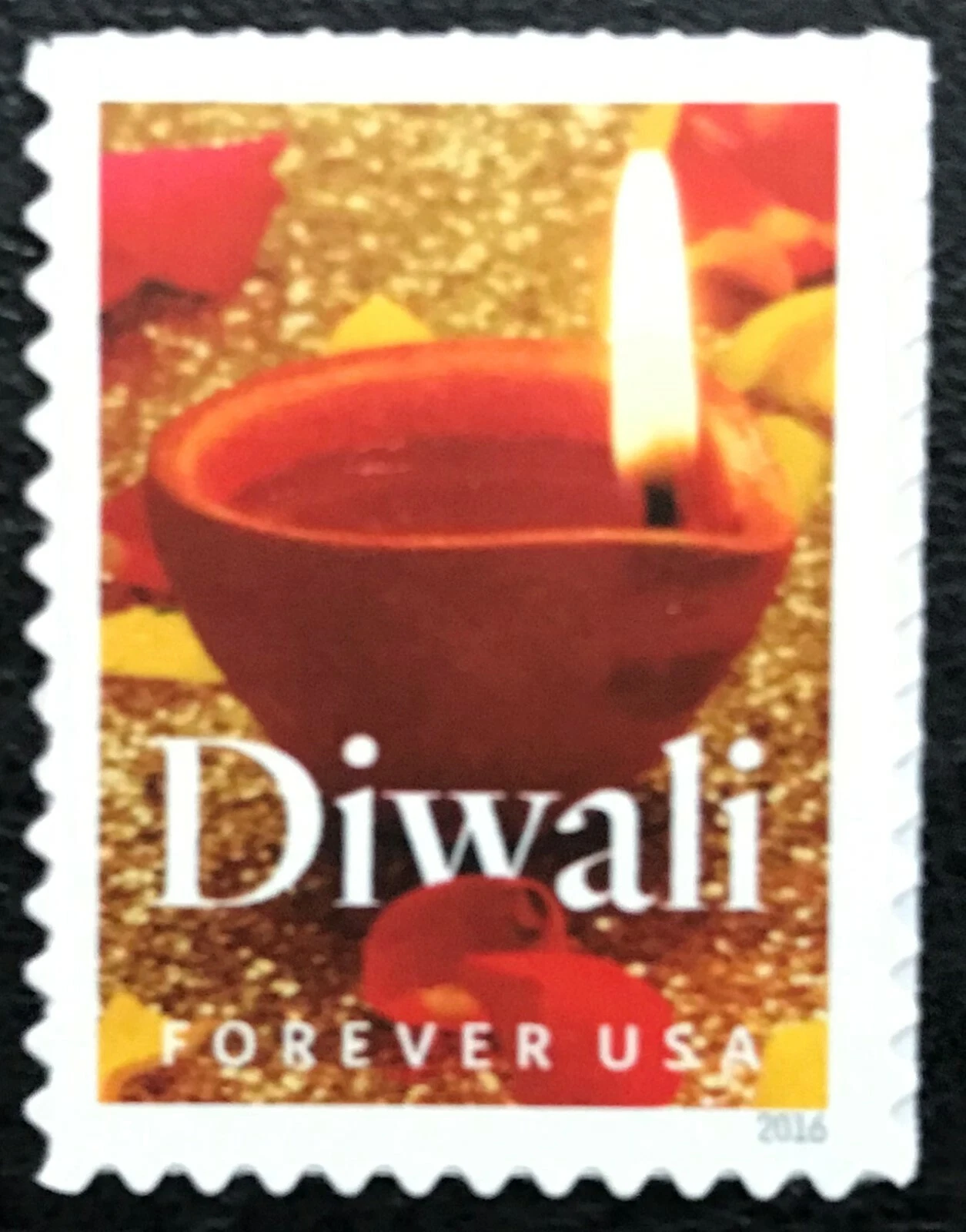

A postage stamp is a small piece of paper. Yet sometimes, within its modest dimensions, it carries a story far greater than its size: a people’s identity, their aspirations, their struggle for recognition, and their rightful place in the larger human family.
The Diwali Forever Stamp, issued by the United States Postal Service on October 5, 2016, was one such stamp.
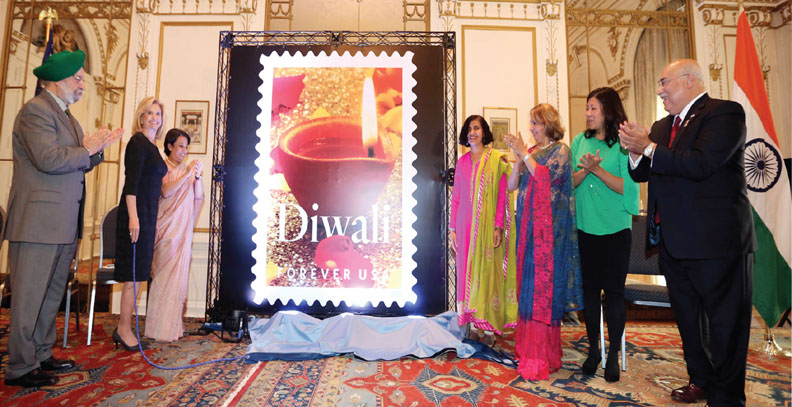
For millions of Indian Americans, it represented more than the celebration of a festival. It was a recognition that the traditions they had brought from their ancestral homeland had become part of the rich cultural fabric of America.
And behind that achievement lay an extraordinary story of determination, perseverance, friendship, and the power of one woman’s conviction.
Her name is Ranju Batra.
A Celebration That Connects Two Worlds
For Indians living abroad, Diwali is more than an annual festival. It is an occasion to reconnect with their heritage, introduce their children to ancestral traditions, and share their cultural inheritance with neighbors and friends.
Homes glow with lamps and decorations. Families exchange sweets and gifts. Temples and community centers become places of prayer and celebration. Music, dance, food, and fellowship bring together people across generations.
Diwali, or Deepavali, celebrates the triumph of light over darkness, knowledge over ignorance, and good over evil. While its religious significance varies among Hindu, Sikh, Jain, and Buddhist communities, its broader message speaks to humanity.
For immigrants, festivals such as Diwali also perform another important function: they help preserve identity while building bridges with the wider society.
And what better symbol of that acceptance than a stamp issued by the postal service of one’s adopted country?
The United States had long issued stamps recognizing Christmas, Hanukkah, Kwanzaa, and Eid. Yet Diwali, celebrated by vast numbers of people around the world, remained unrepresented.
Many had raised the issue over the years. But persuading the USPS to issue a commemorative stamp was no simple undertaking. It required patience, persistence, public support, and the ability to navigate a federal institution with its own procedures and priorities.
Ranju Batra decided that the task, however difficult, was worth pursuing.
The Woman Who Would Not Give Up
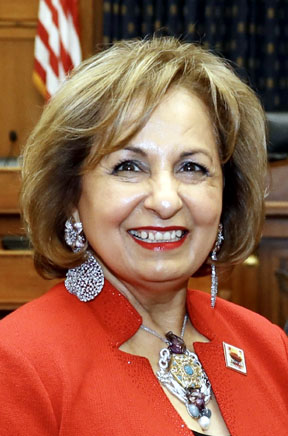
Ranju’s campaign lasted approximately seven years. It began with a seemingly simple question: Why should Diwali not receive the same recognition as other major cultural and religious celebrations?
The answer was not readily forthcoming. There was no guaranteed route to success, and the United States Postal Service was under no obligation to accept the proposal.
Indeed, the USPS receives thousands of suggestions for commemorative stamps each year, with only a small number eventually approved.
But Ranju refused to interpret institutional difficulty as a reason for surrender.
She carried petitions wherever she went. Friends, acquaintances, strangers, diplomats, and community leaders were approached for signatures. The petitions became part of her daily routine, and the campaign became a personal mission.
She wrote letters, sought meetings, encouraged supporters, and kept the proposal alive even when success appeared remote.
She reached out to prominent leaders, including President Barack Obama and Prime Minister Narendra Modi.
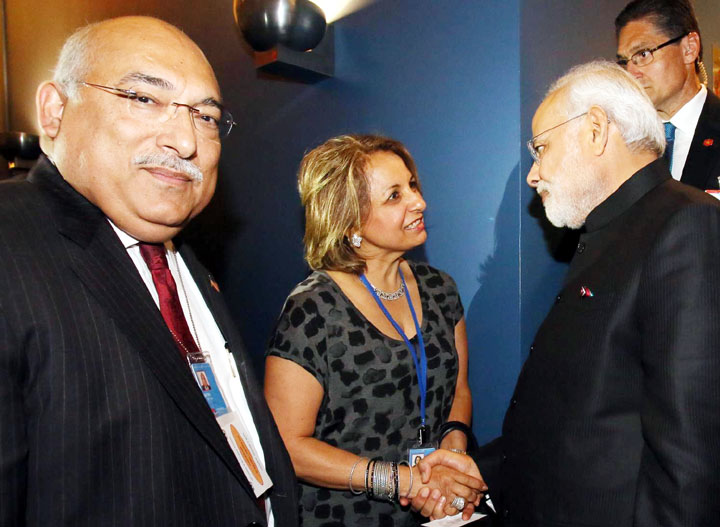
Her husband, distinguished attorney Ravi Batra, recalls that he initially doubted the feasibility of the undertaking. He regarded it as an almost insurmountable challenge, with no clear path to success. But Ranju’s determination eventually persuaded him to lend his full support.
As Ravi recalled in an earlier conversation with The Indian Panorama, Ranju had made it unmistakably clear that she would pursue the campaign with or without his assistance. He eventually joined the effort, becoming one of its strongest advocates.
There is something deeply human in this recollection.
Many worthwhile undertakings begin not with universal encouragement, but with doubt—even from those closest to us. What distinguishes the determined individual is the willingness to continue when the outcome remains uncertain.
A Campaign That Became a Community Movement
Ranju’s personal initiative gradually attracted broader support. Former Congresswoman Carolyn B. Maloney of New York became one of the campaign’s most influential political advocates. Maloney pressed the case with the USPS and its Citizens’ Stamp Advisory Committee, introduced congressional resolutions, and together with Ranju and Ravi Batra, encouraged lawmakers to support the proposal.
In January 2015, she introduced House Resolution 32, urging the issuance of a Diwali commemorative stamp. Her earlier efforts included House Resolution 47 in 2013 and correspondence with postal authorities.
The campaign also benefited from the encouragement of diplomats, community organizations, public officials, and ordinary Indian Americans. Among those associated with the effort were Ambassador Hardeep Singh Puri, Assistant Secretary General Lakshmi Puri, and Consul General Dnyaneshwar Mulay, Congresswoman Grace Meng, Congressman Ami Bera, Congressman Greg Meeks, Congressman Eliot Engel, and Congresswoman Tulsi Gabbard, among many other members of Congress, including the iconic John Lewis.
Mulay contributed an official poem to the Diwali Stamp Project, adding a literary dimension to the campaign.
What began as one woman’s determination had become a collective effort. Yet its defining characteristic remained Ranju’s refusal to abandon the cause.
She understood something that public institutions sometimes overlook: recognition has an emotional significance that cannot always be measured in money, numbers, or administrative convenience.
For a community seeking acceptance, a modest official gesture can carry immense meaning.
October 5, 2016: A Day to Remember
Finally, the long-awaited announcement came. The United States Postal Service would issue a Diwali Forever Stamp.
The first-day-of-issue dedication ceremony was scheduled for October 5, 2016, at the Consulate General of India in New York.
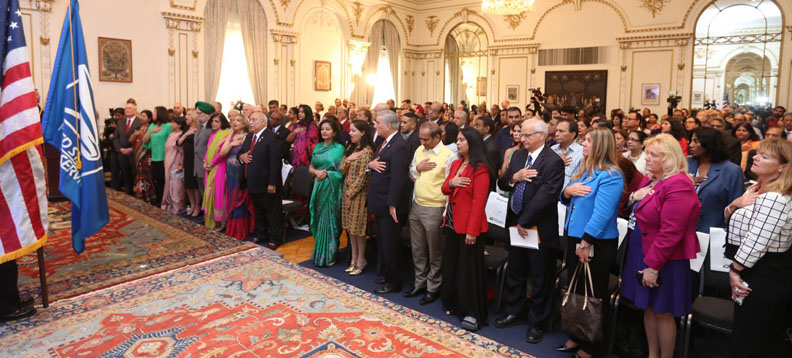
For those who had participated in the campaign, the occasion was unforgettable. The Consulate was filled with community members, supporters, public officials, and well-wishers. There was an unmistakable atmosphere of celebration and achievement.
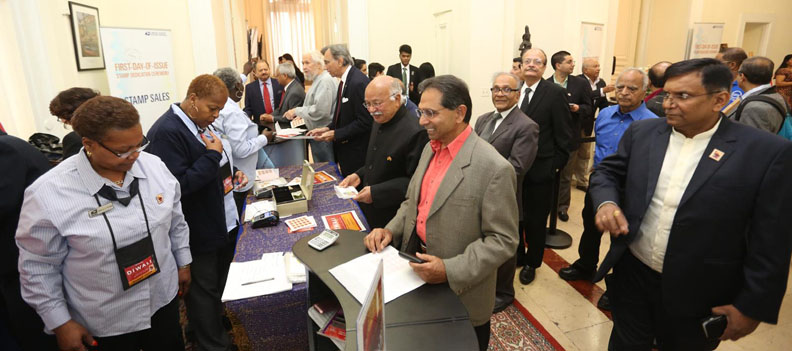
People lined up to purchase the stamps. The enthusiasm was so great that, the Diwali Stamps sold out at the Dedication venue.
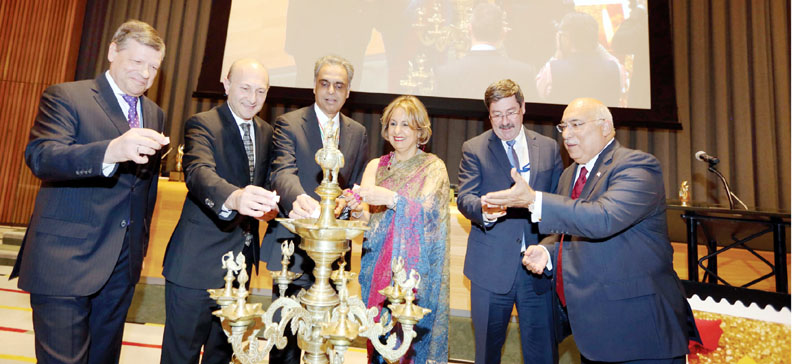
The ceremony brought together representatives of the USPS, the Indian diplomatic establishment, elected officials, and the Diwali Stamp Project.
Among the participants were Consul General Riva Ganguly Das, Congresswoman Carolyn Maloney, Congresswoman Grace Meng, Ambassador Hardeep Singh Puri, Ranju Batra, and Ravi Batra, who served as master of ceremonies.
Pritha Mehra, a senior USPS official, represented the Postal Service.
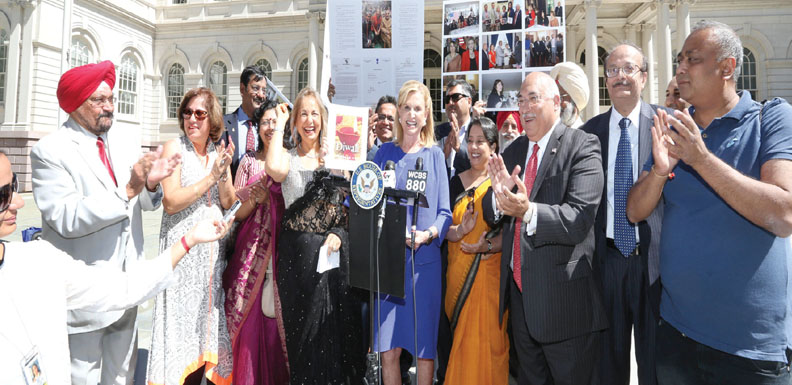
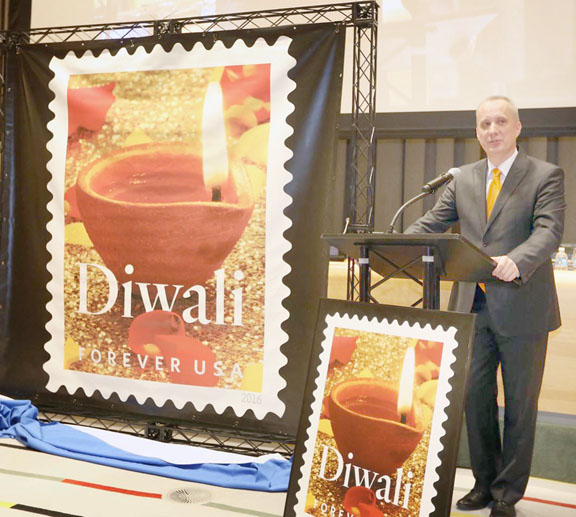
(Photos S 8, S9 , S 10, S 11, S 12 Photo caption): Glimpses of the inauguration of the elegant Diwali Stamp
The stamp itself was elegantly simple. It depicted a traditional illuminated diya, surrounded by flower petals against a shimmering golden background. The photograph was taken by Sally Andersen-Bruce, the design was created by Greg Breeding, and William J. Gicker served as art director.
Issued as a Forever Stamp, it could continue to be used for standard domestic first-class letter postage regardless of subsequent rate increases.
There was something particularly appropriate about that designation. A festival celebrating the enduring victory of light over darkness had received a stamp whose postal value would endure.
For Ranju and her supporters, the word Forever acquired an emotional meaning beyond its technical definition.
The Power of One—and the Strength of Many
Ranju had personally sold more than 170,000 Diwali stamps on Day One, making the Diwali Stamp the Number One Best Seller in USPS’s 200 plus year history. The extraordinary enthusiasm generated by the campaign and its sales was witnessed by this author who was present for the Day One Stamp Dedication- having supported this cause: to belong in the United States.
Such figures, as recounted by Ravi, illustrate the intensity of community participation, although claims about historical USPS sales records would require independent confirmation.
The campaign also attracted international recognition.
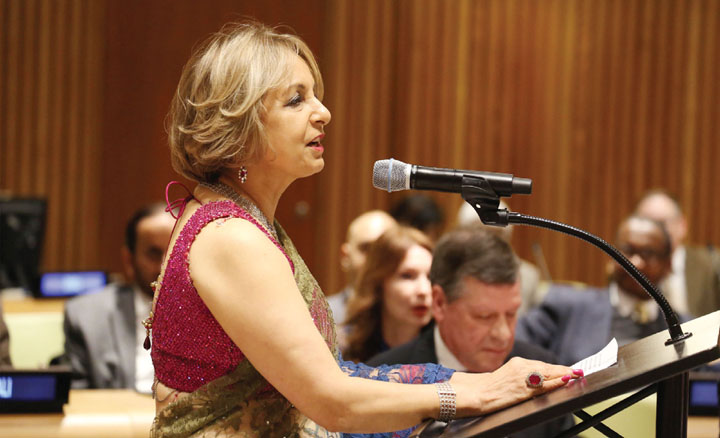
On December 5, 2016, Permanent Representatives from 24 nations co-sponsored a United Nations evening, honoring Ranju’s achievement and celebrating the Diwali Stamp. (UN Web TV: Small Stamp for a Big Festival. https://Media.un.org/en/asset/k10/k10cOTpm4k)
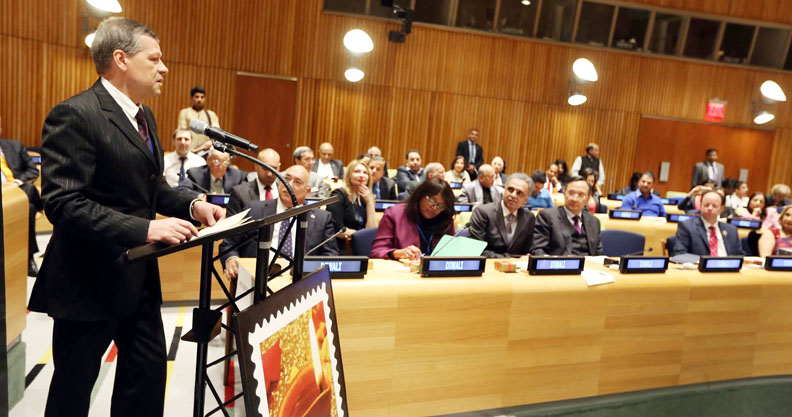
For these nations, Ranju’s journey showed “how to” achieve the highest ideals of the United Nations Charter.
Ranju herself viewed the achievement in precisely those terms. She did not see the stamp as belonging exclusively to a religion, a nation, or even the Indian diaspora. She regarded it as an affirmation of mutual respect, peaceful coexistence, and the right of different communities to celebrate their traditions with dignity.
That philosophy deserves particular attention. In a world too often divided by religion, nationality, ethnicity, and political ideology, the recognition of another community’s traditions should be seen not as a concession, but as an enrichment of our shared humanity.
A Personal Memory Rekindled
With the passage of time, even remarkable achievements gradually become familiar. The Diwali stamp has now been part of American postal history for a decade. Younger Indian Americans may have little knowledge of the struggle that preceded it. I confess that, despite having been associated with the campaign as a volunteer from its early days, I too had allowed many of those memories to recede.
They returned recently during 2026 Diwali celebrations organized by the Jackson Heights Indian Merchants Association.
Its president, Shiv Dass, honored Ranju and Ravi Batra for their contribution to securing the Diwali Stamp.
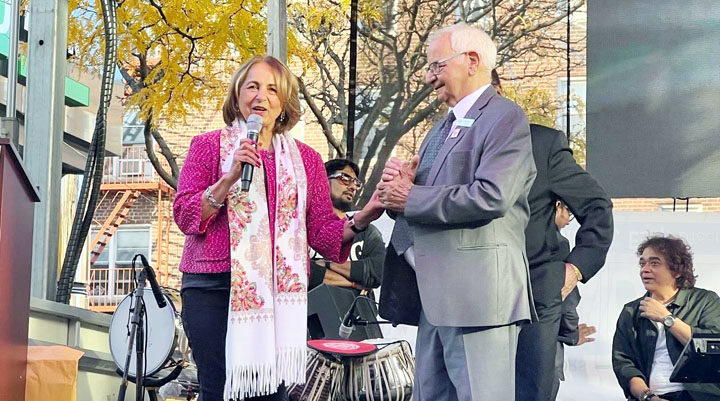
Watching that recognition brought back the excitement, the uncertainty, the countless efforts, and finally the satisfaction of seeing the stamp released.
I was reminded that achievements of lasting significance should not be allowed to disappear into the routine of everyday life.
As a journalist, I felt an obligation to revisit the story—not merely to celebrate its success, but to preserve the memory of the effort that made success possible. Future generations should know that the recognition they may now take for granted was secured through the perseverance of those who came before them. As Ranju and Ravi often say -God Bless America-we must have gratitude of America, and Americans’ generosity of heart. America deserves our love , and we must protect her from enemies -foreign and domestic.
Ten Years Later, Another Milestone
The tenth anniversary of the original Diwali Stamp has acquired added significance.
On October 21, 2026, the USPS dedicated a new Diwali Forever Stamp at the Embassy of India in Washington, D.C.
The new design features a colorful rangoli, the traditional Indian decorative art created with geometric patterns and floral imagery.
Houston-based artist Sangita Bhutada created the artwork. Jennifer Arnold designed the stamp, William Gicker served as art director, and Bijay Dixit was the photographer.
India’s Ambassador to the United States, Vinay Kwatra, participated in the dedication ceremony alongside USPS representatives.
This was the second USPS stamp design honoring Diwali and the first new design since the original 2016 issue. The newly released Diwali Stamp is proof that USPS truly treats the Forever Diwali Stamp as immortal.
The development gives the earlier campaign a fresh historical significance. What was once a hard-fought demand for recognition has become part of an established American tradition of acknowledging the cultural heritage of its people.
The second stamp does not diminish the achievement of the first. It reinforces it.
The Larger Meaning of a Small Stamp
The story of the Diwali Stamp offers lessons that extend far beyond the Indian-American community. It reminds us that meaningful change does not always begin in the corridors of power. Sometimes it begins with an ordinary citizen asking a reasonable question and refusing to accept that a worthwhile objective is impossible.
It demonstrates the importance of perseverance, the value of community cooperation, and the role that elected representatives can play when they listen to the aspirations of their constituents.
Above all, it illustrates the beauty of a democracy that can recognize and accommodate the cultural traditions of its diverse population.
America’s strength has never rested solely on its economic power, military might, or political institutions. It has also rested on its capacity—however imperfectly realized—to bring together people of different origins, beliefs, languages, and traditions under a common civic identity.
The Diwali Stamp is a small but meaningful expression of that capacity. It tells Indian Americans that their heritage need not be surrendered in order for them to belong. It tells their children that being American and cherishing their ancestral culture are not competing loyalties. And it tells the larger American society that cultural diversity, when accompanied by mutual respect, strengthens rather than weakens the nation.
As we remember Ranju Batra’s remarkable campaign ten years after its success, we should remember not merely the stamp, but the spirit that brought it into existence.
A woman had a vision. She refused to surrender it. Others joined her. An institution responded. And a community found its cherished festival honored in the postal history of its adopted homeland.
The stamp may be small, but the achievement is immense.
And perhaps its finest message is also the simplest:
When one person’s determination inspires the cooperation of many, even a small piece of paper can become a lasting symbol of belonging, dignity, and humanity.
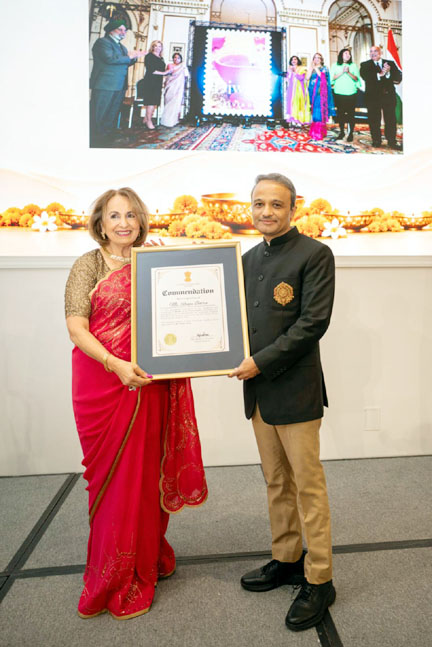
The admirable determination of Ranju Batra came to be recognized on November 10, 2026 at the Diwali dinner hosted by Ambassador Binaya Srikanta Pradhan, the Consul General of India in New York who chose the occasion to honor Ranju Batra with a commendation that read: “ Consulate General of India, New York, COMMENDATION In recognition of Ms. Ranju Batra for her outstanding contribution to the recognition and celebration of Diwali in the United States, particularly instrumental her role in spearheading the seven-year campaign that led to the issuance of the first-ever U.S. Postal Service Diwali Forever Stamp in 2016. The Consulate General of India, New York, extends its deep appreciation to Ms Ranju Batra.
/s/
Ambassador Binaya S. Pradhan
Consul General
10 November, 2026


Be the first to comment