Tag: politics

  • Indian Americans have arrived on the US Political Horizon

    Indian Americans have arrived on the US Political Horizon

    Prof. Indrajit Saluja
    • Indian Americans, according to the latest US Census are the highest family income earners, with $120,000 average income for a family of four.
    • Indian Americans are the highest educated consistently since the 2010 census. They have the highest percentage of Bachelors, Masters and Doctoral degrees.
    • They are brilliant students, researchers, scientists, scholars, teachers, authors, artists. They are everywhere- in business, professions, politics, entertainment, media and in many other fields.

    Of late, there has been a growing realization among the Indian American community that the real empowerment for the community can flow only when the community has political power. This new realization has resulted in an increase in the number of Indian Americans going in for politics, and actively participating in political processes.

    Whereas, one can see scores of Indian Americans picked up for important positions in Biden administration (there were many in Trump’s administration, too, and in the administrations of many former Presidents) , and many are elected members of the US  House of representatives,   and many in State and City legislatures, one can see clearly an increased  interest among  Indian Americans to run for elections from the numbers who have thrown their hats in the electoral ring in  the 2021 New York City elections .

    There are at least 8 Indian Americans in political fray for the 2021 New York City Council elections. Their concerns are primarily the concerns of all immigrant communities, from education to housing, to safety and security to jobs and economic prosperity.

    I will introduce here these contestants, and what they stand for.


    CITY COUNCIL DISTRICT 23.

    There is a total of 7 candidates. 4 of them are Indian American. Among them, there are 2 Sikhs, one Christian and one Hindu.

    The other three candidates are: Steve Behar, Linda Lee, Debra Markell

    Going by the alphabetical order, the first Indian American I will pick up is Harpreet Singh Toor

    HARPREET S TOOR

    Harpreet Singh Toor

                                 City Council District 23

    The three top issues Harpreet has listed are:

    • Pandemic relief
    • Safe streets
    • Health Care

    This is how Harpreet introduces himself.

     “Harpreet Singh Toor has been an advocate for working- and middle-class families his entire adult life. Now he’s bringing his unique set of skills, experience, and successful record of improving the quality of life for all who live and work in Queens, to City Council District 23. His number one priority will be on resolving the problems resulting from the Pandemic crises.

    “In more than 25 years of community service I have earned a reputation as someone who gets things done. Whether it’s getting the Religious Garb bill signed, co-naming Queens’ streets, or helping constituents navigate schools, hospitals and the PD, I have earned the respect of the people I serve, acting with integrity and full transparency.”

     For more information, please visit

    https://www.toorforcitycouncil.com/contact

    E-mail: harpreet@toorforcitycouncil.comdonald@toorforcitycouncil.com


    JASLIN KAUR

    Jaslin Kaur

                      City Council District 23

     The three top issues Jaslin has listed are:

    • Security for workers/small business
    • Reliable public transit
    • Housing stability and senior care

    This is how Jaslin introduces herself.

    “As a lifelong district resident, I would be the first woman and person of color to represent my home. Raised by a taxi driver and union grocery store worker, I was spurred upon public service by the taxi medallion debt crisis. Having dedicated my life to education equity and immigrant justice, I am running to fight for worker and small business relief, world-class public transit, fully funded public schools, and affordable housing for all.

    “Backed by key unions and progressive organizations such as CWA D1, PSC-CUNY, The Jewish Vote, Sunrise, Working Families Party, and Democratic Socialists of America, I will build a city that works for all of us.”

    For more about Jaslin, visit www.jaslinkaur.nyc

    Email: info@jaslinkaur.nyc

    KOSHY THOMAS

    Koshy Thomas

                                  City council District 23

    The three top issues Koshy has listed are:

    • Stimulate Economy
    • Health Care for all
    • Promote Peace and Prosperity

    This is how Koshy introduces himself.

    “Exited to be a candidate for the Democratic party will united various ethnical groups, assimilate them to the community to promote peace property. This will stimulate the economy and also promote tax rebate.

    “Worked with almost all associations and groups in the District.”

    For more about Koshy: https://electkoshythomas.com

    Email: koshy@electkoshythomas.com

    SANJEEV JINDAL

    Sanjeev Jindal

                        City Council District 23

    The three top issues Sanjeev has listed are:

    • Small Business Empowerment
    • Improving Public Safety
    • Ensuring Access to Healthcare

    This is how Sanjeev introduces himself.

    I am ready to fight for the people: the individuals, and the communities that make New York special. I will create a better environment for small business, increase public safety, and expand equitable health care. Through empowering individuals with resources, assistance, and knowledge, we can create job stability which will allow people to pursue a career path that motivates and inspires them. Now’s the time to put power back into the hands of the people, and I am committed to exactly that.

    “India Association of Long Island; South Asians for Strong America; South Asians for Empowerment; India Day Parade”.

    For more information: www.sanjeevkjindal.com

    Email: sanjeevjindalfornyc@gmail.com

    CITY COUNCIL DISTRICT 25

    There is a total of 8 candidates. The only Indian American Shekar Krishnan is pitted against 7 candidates, including South Asian and Asian, among others.

    The other 7 candidates are: Xi Chen, Liliana Melo, Manuel Perez, Alfonso Quiroz, William Salgado, Carolyn Tran

    SHEKAR KRISHNAN

    Shekar Krishnan

                            City Council District 25

    The three top issues Shekar has mentioned are:

    • Dignified, permanent housing for all
    • Defend immigrant New Yorkers
    • Invest in community-based safety

    This is how Shekar introduces himself.

    “Our city is facing a crisis of affordability, racial justice, and public health. We need a fighter representing us who will be fearless in standing up to powerful interests when our community’s needs are at stake. I am a civil rights lawyer fighting for housing justice and preventing displacement. I’m also a longtime activist in my community of Elmhurst and Jackson Heights, the son of immigrants from India, and the father of two small children. Together, we can rebuild our city, so it works for everyone.

    For more information: www.voteshekar.com

    Email: contact@voteshekar.com

    CITY COUNCIL DISTRICT 26

    There is a total of 15 candidates. One is a Sikh American of Indian origin. Amit Singh Bagga is pitted against 14 candidates, including South Asian and Asian, among other.

    The other 14 candidates are: Jonathan Bailey, Lorenzo Brea, Julia Forman, Glennis Gonez, Dennis-Keehan Smith, Badrun Khan, Heajin Kim, Jesse Laymon, Sultan Maruf, Brent O’Leary, Steven Raga, Emily Sharpe, Julie Won, Ebony Young.

    AMIT BAGGA

    Amit Bagga

                         City Council District 26

    The top three issues Amit has listed are:

    • Racial justice through economic justice
    • Deeply & permanently affordable housing
    • Immigrant, health, & environmental justice

    This is how Amit introduces himself.

    We need bold, progressive vision and real experience to deliver justice for NYC. Over 14 years, I’ve reunited hundreds of immigrant families, implemented paid sick leave & protections for freelancers & low-wage workers, fought predatory lending, and secured our political & economic future through NYC’s first-ever census campaign. My plan treats employment with dignity for all, housing, healthcare, & a thriving environment as human rights, and replaces our police state with a peace state.

    For more information: www.amitforcouncil.com

    Twitter: @amitsinghbagga

    CITY COUNCIL DISTRICT 28

    There is a total of 3 candidates. One is a Sikh American of Indian origin. The two others are Adrienne Adams (the sitting Council Member) and Ruben Wills.

    JAPNEET SINGH

    Japneet Singh

                                 City Council District 28

    The three top issues Japneet has listed are:

    • Government Transparency
    • Education & Social Services
    • Infrastructure

    Here is how Japneet introduces himself.

    “This campaign’s primary goal is to unite the communities that live in Southern Queens. For far too long, due to the lack of leadership that truly understands our community, we have been divided. It is time, we come together in order to advocate for better schools and infrastructure as well as social services that will help to revitalize our community.

    “Japneet Singh has been an active member of the community for years. He is one of the youngest members of Community Board 10 and also served as the Student Body President of Queens College from 2016-2018. He has played a vital role in numerous initiatives and with your support, hopes to continue his work on the City Council level.”

    Email: japneetsinghfornewyork@gmail.com

    CITY COUNCIL DISTRICT 32

    There is a total of 6 candidates. One is a Sikh American of Indian origin. Felicia Singh is pitted against 5 others who include Kaled Alamarie, Bella Matias, Michael Scala, Shaleigh Severino, Helal Sheikh.

    FELICIA SINGH

    Felicia Singh

                             City Council District 32

    The three top issues Felicia has listed are:

    Fully Fund Public Schools

    Climate & Environmental Resilience

    Safe & Equitable Transportation

    This is how Felicia introduces herself.

    “I’m an educator and daughter of working-class immigrants. As a lifelong resident of Ozone Park, graduate of NYC Public schools, and teacher, I’ve experienced systems that do not work for the working-class and that pushed me to run for office. My life’s work is serving and empowering those around me – identifying the structural barriers preventing communities like mine from thriving and bringing people and resources together to create lasting change. As your council member, trust that I’ll fight for you and your family in City Hall.”

    For more information: www.felicia2021.com

    Email: info@felicia2021.com

    The June 22 primaries will test the acumen of the Indian American contestants for New York City Council which needs the long-awaited presence of the Indian American community.

    (Author is the chief editor of The Indian Panorama)

  • Ranked Choice Voting Explained

    Ranked Choice Voting Explained

    Prof. Indrajit Saluja

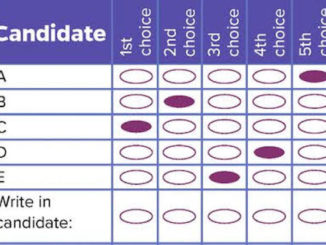
    When New York City voters go to the polls on June 22 to select their party’s nominees in City elections, they will fill out a new kind of ballot that allows them to pick up to five candidates in order of preference in a system known as Ranked Choice Voting.

    Is Ranked Choice voting complicated? Well, yes and no. If you think it’s a new thing which you cannot understand, you will not try to understand it and it will be complicated for you. But, if you think it is something new and you should try to understand, you will find it not so complicated.

    Let us know, in very simple words, what Ranked Choice Voting is.

    In primary and special elections for New York city offices, you can now rank up to five candidates in order of preference instead of choosing just one.

    Ballots are tabulated in what may best be described as a series of instant runoffs. In the first round, if any candidate receives 50% or the vote, he or she is declared the winner, and the election is over.

    If not, the candidate who finished in last place is eliminated, and any ballots that had him or her as the top choice are reallocated to the No. 2 candidate on each ballot. The votes are counted once again. If no candidate has yet reached 50%, the candidate in last place is eliminated, and his or her ballots reallocated, and so on, until someone exceeds 50%.

    I asked my friend Mr. George Abraham, a voter in Queens, to share with our readers what he thinks of the Ranked Choice system.

    This is what he said, “Ranked-choice works by having you rank your top five candidates. If no candidate receives 50% of the vote, then the person with the least number of votes will be eliminated. Those who had listed the eliminated candidate as their first choice will then have their vote go to their second choice. This process will continue until a candidate reaches 50% of the vote.

    The system has been used for years in places like San Francisco, Minneapolis, and Oakland.  Since most voters in the City are Democrats, the ranked-choice vote is almost certain to play a crucial role in the NYC elections. In the past, close contests were decided by run-offs if none of the candidates received at least 40% of the vote.”

    Please keep in mind that you are under no compulsion to indicate all 5 choices. You can still vote for just your 1st-choice candidate. However, ranking other candidates does not harm your 1st choice. If your 1st and only choice is eliminated, your vote will have no influence on the outcome of the election.

    Remember, you cannot rank your preferred candidate more than once (for example as your 1st, 2nd, 3rd, 4th, and 5th choice), then only your first ranking will count. There is no strategic benefit to giving the same candidate multiple rankings.

    Let us have a look at the benefits of Ranked Choice Voting.

    There are several ways that Ranked Choice Voting could benefit voters.

    One, it gives you more say in who gets elected. Even if your top choice candidate does not win, you can still help choose who does.

    Two, it gives you more choices. You can rank up to five candidates, allowing you to support your favorite candidate without worrying about whether they’re likely to win.

    Three, more diverse candidates win elections. Cities that have implemented Ranked Choice Voting have elected more women and more women of color, making their elected officials more representative of their communities.

    However, city voters have expressed concerns, too.

    Mr. George Abraham says, “One of the concerns expressed by many is that when the actual results will be made available. It is believed that there is a tabulation software that will be counting the votes, and the officials are expected to release the unofficial first-round results quickly. However, results may not be known for weeks due to delay in counting the absentee ballots. With the ranked-choice voting, the first-round winner may take little comfort knowing fully well that second choice accumulation of votes for another candidate could spell trouble for his/her real chances”.

    NYC will only use Ranked Choice Voting in primary and special elections for the following city offices:

    • Mayor
    • Public Advocate
    • Comptroller
    • Borough President
    • City Council

    Remember the following key dates.

    Early Voting: Sat, June 12, 2021 – Sun, June 20, 2021

    Absentee ballot request deadline: Tue, June 15, 2021

    Primary Election Day: Tue, June 22, 2021

    Deadline to return absentee ballot: Tue, June 22, 2021

    (Author is chief editor of The Indian Panorama)

  • House passes bipartisan Bill to investigate Capitol insurrection

    House passes bipartisan Bill to investigate Capitol insurrection

    WASHINGTON (TIP): The House voted Wednesday, May 18, to approve legislation to establish an independent commission to investigate the violent insurrection on January 6 at the US Capitol, with 35 Republicans breaking with their party to support the bill, a CNN report says.

    The final vote was 252-175. The GOP defections showcased a significant break with Republican leadership in the chamber and former President Donald Trump, who urged members to vote against the legislation.

    The bill now moves to the Senate where it faces an uncertain fate as GOP resistance is growing.

    Wednesday’s vote, which came as some Republicans have tried to downplay the violence that occurred on January 6 and align themselves with Trump’s version of reality, was still opposed by most rank-and-file Republicans, after House GOP leaders mobilized against the agreement that had been struck by fellow Republican Rep. John Katko of New York.

    The margins are an important indicator because just how many House Republicans are willing to buck their party leadership may offer an early signal for how many GOP senators could back the bill. Supporters of the plan will need at least 10 Republicans in the Senate to join all 50 Democrats in the chamber in order to overcome a 60-vote filibuster and pass the bill.

    Senate Minority Leader Mitch McConnell said Wednesday he is opposed to the bill but wouldn’t tell reporters if he’d actively whip his fellow Republicans against it. Moderate GOP Sen. Susan Collins of Maine said Wednesday changes would have to be made to the bill before she could support it.

  • Trumping majoritarianism in the Hindi heartland

    Trumping majoritarianism in the Hindi heartland

    By Zoya Hasan
    While regional parties will continue to be significant in various States of the Union, the principal challenge of overcoming majoritarianism lies in the Hindi heartland, especially in U.P. Oppositional electoral alliances, notably the formation of a federal front, are important strategies in this battle but it is no less important to challenge the ideological foundations of the majoritarian project through progressive and inclusive politics.

    The landslide victory of the All India Trinamool Congress in the West Bengal Assembly elections and the pushback of the Bharatiya Janata Party (BJP) in West Bengal, Tamil Nadu and Kerala have given rise to a pervasive belief that right-wing politics can be defeated by regional assertions. Undoubtedly, regional and cultural assertion in these States acted as an effective bulwark against the BJP’s expansionary plans in southern and eastern India. The regional-cultural tropes deployed by Mamata Banerjee, for example, worked so well that at one point, Home Minister and BJP leader Amit Shah was even forced to clarify that if the BJP is elected, someone from Bengal would be the Chief Minister. This underlines the effectiveness of regional culture and politics in trumping communal politics. However, this claim needs to be tempered by the realism that it cannot work in the Hindi heartland, which is dominated by caste and communal politics, and has so far not seen any serious ideological and political challenge to politics based on these identities.

    Encompassing nine States whose official language is Hindi, namely Bihar, Chhattisgarh, Haryana, Himachal Pradesh, Jharkhand, Madhya Pradesh, Rajasthan, Uttar Pradesh (U.P.) and Uttarakhand, this region retains a central position in the electoral strategies of the BJP and its larger political imagination. The party’s stunning show in these States propelled it to power in the 2014 and 2019 parliamentary elections. Its continued political dominance in the heartland will neutralize its losses now as well as in future in States where it has been bested by regional players. I will focus here on U.P. to illustrate the limits of the regional assertion.

    Dimensions in the heartland

    The Hindi heartland is clearly different. There are at least four important dimensions of this difference. First is the absence of regional identity in States such as U.P. This is evident from the debate on States reorganization and the reorganization of Uttar Pradesh in the 1950s. The compulsions of nation-oriented identity emerged very clearly from the discussions in the States Reorganization Commission on suggestions for the division of U.P. for administrative convenience. U.P. leaders argued for a large and powerful State in the Gangetic valley as a guarantee of India’s unity.

    In this sense, U.P. was considered the backbone of India and the centerpiece of political identity in modern India. Importantly, it was supposed to provide the chief bulwark against growing regionalization and fragmentation elsewhere. Instilling a sense of regional pride, an essential part of Congress strategy in southern and coastal India, was not followed in U.P. U.P. was seen as the political heartland in contrast to Punjab and Bengal for instance, which were splintered and incorporated into two different nation states. As is well known, the bases of this post-colonial identity varied from its location in the freedom struggle to staking claim as the cultural homeland of Hindi and Hinduism. In both cases, it was centered in the idiom of the nation-state and strong central authority.

    Second, although U.P.’s cultural homogeneity remains a matter of disagreement, the idea of the heartland had great resonance among the political elite who opposed the demand for U.P.’s reorganization. The long-standing traditions of composite cultural identity and shared plural cultures began to yield place to a singular homogenized identity. The Hindi-Urdu divide, which mirrored the communal cleavage of U.P. society, played a crucial role in this process. Urdu was excluded as it was seen to symbolize Muslim cultural identity in independent India, while Hindi was boosted to promote the development of a Hindi-Hindu heritage for this region. The project of homogenization of Indian/U.P. culture as Hindu culture was quickened in later decades. Even though it would be hard to assume a direct link between Hindi dominance and communal politics of subsequent decades, it is nevertheless a fact that all political parties in the State used it as an ingredient of social and cultural differentiation and a means to consolidate political dominance.

    Role of communal politics

    Third, it is clear that communal politics and communal movements have played a key role in U.P.’s modern history which in turn have diluted other identities.

    In some respects, this process gained momentum in the wake of Partition which cast its long shadow upon political institutions and culture in U.P. and to a great extent affected the perspectives of Hindus and Muslims alike. Hindu nationalism was marginalized within the Congress party but many of its ideas were accepted in framing party policies. The State leadership was instrumental in forging a conservative consensus in the State under Chief Minister G.B. Pant who steered the affairs of the state for eight years after Independence.

    The intensification of communal politics took a new turn with the mass mobilization for the construction of a Ram temple at Ayodhya which was deftly used by the Hindu right to establish a major presence in U.P. and to facilitate the political reconstruction of U.P. through the promotion of a collective Hindu identity. The crusade for the appropriation of disputed shrines is central to the communalization of politics and short circuiting the more complex process of political expansion for the BJP.

    Importantly, this has laid the groundwork for building permanent electoral majorities through the deployment of ascriptive symbols in U.P. which, given its huge size, helps it to establish a strong base in the Hindi heartland to offset the appeal of countervailing identities elsewhere in India.

    Caste politics too

    Finally, caste politics which was expected to counter Hindutva expansion has failed to do so; in fact, caste politics has become a building block for the BJP’s expansion. The party has reached out to Dalits, actively mobilizing them and other backward castes to assimilate them into the Hindutva meta-narrative. Instead of erasing caste from electoral politics, the BJP-Rastriya Swayamsevak Sangh has sought to court fragments of castes as a way of undermining broad-based political movements and opposition to it. It has used the wider appeal of Hindu nationalism to co-opt backward castes and Dalits who are keen to align themselves to the larger narrative of Hindu nationalism.

    A reset is needed

    While regional parties will continue to be significant in various States of the Union, the principal challenge of overcoming majoritarianism lies in the Hindi heartland, especially in U.P. Oppositional electoral alliances, notably the formation of a federal front, are important strategies in this battle but it is no less important to challenge the ideological foundations of the majoritarian project through progressive and inclusive politics. This requires a reset of the basic political mindset in U.P. which can only be done by reviving the splendid heritage of the national movement in which this region played a central role and in which Gandhiji and Nehru played a heroic part. Invoking the spirit of the Bhakti movement which was the first major challenge to the religious orthodoxy of Hinduism would also help in resetting the cultural clock. This must, however, combine with much greater concern for the fundamental social and economic issues of the State, and making the struggle between communal and secular forces the central issue through public campaigns that address the problems of religious traditionalism and the cultural underpinning that this provides to the push to make India a Hindu state.

    (Zoya Hasan is Professor Emerita, Jawaharlal Nehru University)

  • Indian American Ashwani K. Jain to run for Maryland governor

    Indian American Ashwani K. Jain to run for Maryland governor

    WASHINGTON (TIP): Ashwani K. Jain, a young Indian American who held multiple roles during the Obama administration, plans to seek the Democratic nomination for Maryland governor next year with an expressly generational appeal for votes.

    The 31-year-old son of Indian immigrants who grew up in Maryland, acknowledged in a campaign video that his youth and inexperience may turn off some voters, marylandmatters.org reported.

    “I understand that some will say that this overly ambitious, eager millennial with a baby face and no elected experience is not qualified or ready for this position,” Jain said. But, he argued, “elective experience is not the only kind of experience that matters.”

    “In a state that’s becoming younger and more diverse than ever before, voices like mine are growing in Maryland and deserve to be heard, because decisions made about us should not be made without us,” Jain asserted,

    In his announcement speech, Jain noted that he would be the first millennial governor in the US and the first governor of color in Maryland.

    Jain said that, if elected, he would seek to make state government policies more equitable, would promote diversity in his cabinet, and would seek to eradicate the influence of money in state government and politics.

    He invoked Obama toward the end of his announcement speech. “Yes, it’s true that we are the underdogs in this election,” Jain said, “but history is shaped by underdogs and those who are told to wait in line ― including a former community organizer who said, ‘Yes, we can!’”

    During the Obama administration Jain worked at the White House and in the Department of Health and Human Services.

    A childhood cancer survivor, who said his illness gave him a higher purpose, Jain also served as director of outreach for the administration’s “cancer moonshot,” which was headed by then-vice president Joe Biden.

    He recalled recovering in a hospital and watching young children die and their parents suffer financial ruin.

    “I turned from survivor to advocate,” he said. “I found my purpose in public service.”

    During an unsuccessful campaign for Montgomery County Council in 2018, Jain often told a story about being in the Make-a-Wish program, which grants children with grave illnesses a fantasy wish, Maryland Matters recalled.

    Jain’s was to meet actor Denzel Washington ― a meeting that took place backstage in 2005 at a Broadway theater, where Washington was starring in a revival of Shakespeare’s “Julius Caesar.”

    Jain has been a volunteer with the Make-a-Wish organization ever since ― and a poster of Washington as Caesar hung behind Jain during his announcement video last Wednesday, along with a printed sheet of computer paper that said, plainly, “Jain for Governor,” taped to a whiteboard.

    Jain did not participate in Montgomery County’s public financing system for political candidates in 2018, and proved to be a skillful fundraiser, Maryland Matters noted.

    He took in about $233,000 for his council race, including $47,000 from his own pocket. President Obama’s Housing and Urban Development secretary, Julian Castro, headlined a fundraiser for Jain during his 2018 campaign.

    Earlier this year, closing out his campaign account and opening one for his gubernatorial bid, Jain forgave the $47,000 debt.

  • Indian American Bhavya Lal Appointed Acting Chief of Staff of NASA

    Indian American Bhavya Lal Appointed Acting Chief of Staff of NASA

    WASHINGTON (TIP): Indian American Bhavya Lal was appointed by NASA as the Acting Chief of Staff of the US space agency on Monday.

    Ms. Lal served as a member of the Biden Presidential Transition Agency Review Team for the agency and oversaw the agency’s transition under the administration of President Joe Biden.

    In a statement, NASA said Ms. Lal brings extensive experience in engineering and space technology, serving as a member of the research staff at the Institute for Defense Analyses Science and Technology Policy Institute (STPI) from 2005 to 2020.

    There, she led analysis of space technology, strategy, and policy for the White House Office of Science and Technology Policy and National Space Council, as well as federal space-oriented organizations, including NASA, the Department of Defense, and the intelligence community.

    Ms. Lal is an active member of the space technology and policy community, having chaired, co-chaired, or served on five high-impact National Academy of Science committees.

    She served two consecutive terms on the National Oceanic and Atmospheric Administration Federal Advisory Committee on Commercial Remote Sensing and was an External Council member of NASA’s Innovative Advanced Concepts Program and the Technology, Innovation and Engineering Advisory Committee of the NASA Advisory Council.

    Before joining STPI, Ms. Lal was president of C-STPS LLC, a science and technology policy research and consulting firm. Prior to that, she was the director of the Center for Science and Technology Policy Studies at Abt Associates, a global policy research consultancy based in Cambridge, Massachusetts.

    She co-founded and is co-chair of the policy track of the American Nuclear Society’s annual conference on Nuclear and Emerging Technologies in Space (NETS) and co-organizes a seminar series on space history and policy with the Smithsonian National Air and Space Museum.

    For her many contributions to the space sector, she was nominated and selected to be a Corresponding Member of the International Academy of Astronautics, the statement said.

    Ms. Lal earned Bachelor of Science and Master of Science degrees in nuclear engineering, as well as a Master of Science degree in technology and policy, from the Massachusetts Institute of Technology, and holds a doctorate in public policy and public administration from George Washington University. She is a member of both the nuclear engineering and public policy honor societies.


  • No chief guest at R-Day, first time in 55 years

    No chief guest at R-Day, first time in 55 years

    New Delhi(TIP): India will not have a chief guest at the Republic Day parade for the first time since 1966 because of the pandemic. But for the first time, a contingent from the Bangladesh Army will march down Rajpath on January 26, said MEA spokesperson Anurag Srivastava at the weekly media briefing here on Thursday, January 14.

    Sources said it was decided not to have a chief guest after the proposal to draft Surinam President Chan Santokhi as a last minute replacement for UK PM Boris Johnson fell through. At the previous last minute pullout during the UPA regime, New Delhi had managed to persuade the King of Bhutan to do the honours. In the initial years, no chief guest was invited in 1952 and 1952, barely two years after the Nehru government had tried to make it a regular practice. The Bangladesh Army’s participation will be the second time foreign soldiers will participate in the march past after a French Army contingent in 2016.              

                    Source:  TNS

  • Biden wins, according to polls sponsored by the mainstream media; Trafalgar poll predicts Trump will win

    Biden wins, according to polls sponsored by the mainstream media; Trafalgar poll predicts Trump will win

    By Ven Parameswaran

    There are only 12 days to the Presidential election on November 3, 2020.  Everyone is interested in knowing who has better chances to win – President Trump or former Vice President Biden.    This discussion and speculation will keep on going till the election.

    All the TV networks including Fox, CBS, ABC, NBC, CNN and the mainstream media including NYT and Washington Post and the polls sponsored by them have been predicting Biden will win by a comfortable margin.  How can one believe them?  They predicted in 2016 that Hillary Clinton would win.But Trump defeated Clinton by 306 electoral votes, though Clinton won the popular vote by 2%.

    Therefore, the decision will be made by the voters in battleground states of Florida, North Carolina, Arizona, Pennsylvania, Ohio, Michigan, and Wisconsin.    In 2016, Trump’s major victory against Clinton was in Pennsylvania, Wisconsin, Ohio, and Michigan.    He won with a narrow margin of 77,000 votes combined from these four states.    According to my calculations Trump has good chances to win New Hampshire, Nevada, and Minnesota this year.

    The upstart Trafalgar does not see 2020 the same way everyone else does.  Trafalgar’s strategist Robert Cahaly was born in Georgia and got involved in politics going door-to-door as a kid.  He started a political consulting firm with some others in the late 1990s.  Around 2008, he says, they realized that the polling they were getting was not very good, so they started doing their own.  He says they got good, accurate results in the races they were working.

    In the 2016 primaries, they started putting out some of their own polls.  “Our polls ended up being the best ones in South Carolina and Georgia, “ Cahaly says.  “So we started studying what it was that made those so different.”

    Then there was the breakthrough in the 2016 general election.  “We ended up having an incredible year,” he says.  “I mean, we got Pennsylvania right.  We got Michigan right.  We had the best poll in five of the battleground states in 2016.  And I actually predicted 306 to 232 on the electoral college.  And we went from doing a little bit of polling on the side to that (being) our primary business in about 24 hours.  And since then, that is what we have been doing.”

    As a general matter, he discounts national polls.  First, because the race for the presidency is won state by state, not on the basis of the national vote.  Second, because all the methodological difficulties involved in getting a balanced, representative sample in a state poll of 1,000 people are magnified in a national survey.  It is easily skewable at that point, and you start making assumptions.

    So how does he see the 2020 race? Fundamentally, as a motivation race, rather than a persuasion race, with perhaps 1.5 per cent, at most, of the electorate UNDECIDED in battleground states.

    The likeliest Trump electoral path to victory involves winning the battlegrounds of North Carolina, Georgia, Florida, Arizona, and either Michigan or Pennsylvania among the former Blue Wall states (assuming he does not lose states such as Iowa or Ohio).

    THIS IS CAHALY’S BREAKDOWN:  He believes Trump will win North Carolina and Florida and discount’s Biden’s chances in Georgia because the Republican-base vote is too big there (the same is true in Texas).

    As for Arizona, “I think Trump has the lead,” Cahaly says.  “I think Republican Senator Martha McSally has some ground to make up.  I see her about 5 points behind Trump, but I think Trump will probably win the state.  And win it by a couple of points or more.  And if he wins it big enough, McSally has a shot.”

    Trump is not there yet in Pennsylvania, according to Cahaly. “Right now, we have got him down in Pennsylvania,” he says, “I think if it were held today, the Undecides would break toward Trump and there would be some hidden vote.

    In Michigan, Trafalgar has Trump ahead.  “I think he will win Michigan, “ Cahaly says, citing fear of the Democratic economic agenda.

    Overall, Cahaly sees another Trump win.  “If it all happened right now,” he maintains, “my best guess would be an Electoral College victory in the high to 270s, low 280s.”

    THERE IT IS.  AMONG POLLSTERS, YOU HEARD IT FROM ROBERT CAHALY FIRST, AND PERHAPS EXCLUSIVELY—A POSITION HE HAS BEEN IN BEFORE.

    I must point out that the second Presidential debate scheduled for 22nd October can have an impact.

    Do not forget Trump has been most unpredictable.  President Obama said Trump won’t run, won’t be nominated and cannot win against Hillary Clinton.   Nobody expected Trump would defeat nine veteran governors and 5 senators in the Primaries.  Trump proved everyone wrong by defeating the most popular Hillary Clinton.  There are more women voters than men voters.

    Trump is generating more enthusiasm than Biden.  The working class of America cannot forget Trump brought the unemployment to 3.4%, a 50-year record.   Four organizations have nominated Trump for Nobel Peace Prize based on foreign policy achievements, especially peace in the Middle East.

    THE GALLUP POLL ASKED THE AMERICANS: Are you better off today than four years ago?  56% said they are better off.  This is the most favorable poll for Trump.The question was coined by President Ronald Reagan during the Presidential debate.

    (Ven Parameswaran, Chairman, Asian American Republican Committee (founded 1988), lives in Scarsdale, NY. He can be reached at vpwaren@gmail.com)


  • U.S. presidential elections: Biden significantly ahead in opinion polls

    U.S. presidential elections: Biden significantly ahead in opinion polls

    Days before the U.S. presidential election, opinion polls show that democratic nominee Joe Biden is significantly ahead of incumbent Donald Trump in the race for the White House. While Biden appeals to a broad variety of people cutting across age, race and gender lines, Trump holds an edge among white, male, older and under-educated voters.

    Poll favorite

    According to data from multiple opinion polls, aggregated by fivethirtyeight.com, a U.S.- based news website, Biden had a 10.7%-point lead over Trump in national polls as of October 17. In March, the gap was narrower (4%-6% points). It widened in June (6%-9.5% points) and increased further in October (8%-10.5% points).

    According to a study by the Pew Research Center, views on Trump are central to voting choices — both among his supporters and Biden’s. In October, 63% of Biden’s supporters said their choice was more a vote “against Trump”. Also, 71% of Trump’s supporters said their choice was more a vote “for Trump”.

    Overall acceptance

    Overall, Biden enjoys significant acceptance across gender, race, age and education lines. However, Trump holds a slight advantage over Biden in certain sections of the population. Charts show the % of voters who would vote for Biden/Trump if the presidential election was to be held today*. Among both men and women, Biden was favored by the majority, though the gap was narrow among men.

    Pew surveyed 11,929 adults, including 10,543 registered voters, during the last week of Sept. and the first week of Oct. 2020.

    (Agencies)


  • Trump’s ‘filthy’ comment on India dismays strategists

    Trump’s ‘filthy’ comment on India dismays strategists

    ‘Look at India, it’s filthy,’ the US President said in the Oct 22 presidential debate

    NEW DELHI / NEW YORK (TIP): After not figuring in the first presidential debate between US President Donald Trump and former Vice President Joe Biden, India did crop up in the second edition but not in the manner proponents of a much closer Indo-US strategic relations would have wished for.

    “Look at China. How filthy it is. Look at Russia. Look at India, it’s filthy. The air is filthy,’’ said Trump in a remark that cut several strategic analysts to the bone. On the other hand, the US has the “lowest number in carbon emissions”, he claimed.

    Several questioned on social media the need for Trump to make an unsavory reference to India when they were expecting Indo-US ties to turn the strategic corner during the forthcoming visit of two top American cabinet ministers to India. They also wondered if Trump had this view of India why did he pay a return stadium-visit to Ahmedabad barely six months after being hosted in a Houston stadium by PM Narendra Modi.

    Biden did not mention India.

    Trump was responding to debate moderator Kristen Welker’s question on how he would simultaneously combat climate change and support job growth.

    The debate was expected to feature India and the wider neighborhood. During the first debate, the two candidates did not speak much on the American foreign policy, especially in the Asia Pacific, which seems to be the focus of the current administration.

    One reason for the cursory references to foreign policy is also because one debate was cancelled after Trump refused to participate in an on-line format.

    Welker had chosen six topics for in-depth discussions. Three of them were domestic issues while the other three – climate change, leadership and national security – had foreign policy ramifications.

    Trump, however, was consistent in his observations in blaming the three countries. In the first debate on September 29, he had said, “China sends up real dirt into the air. Russia does, India does — they all do.’’

    (Source: The Tribune)

  • Indian American Couple’s Campaign for Joe Biden

    Indian American Couple’s Campaign for Joe Biden

    Paraminder Aujla

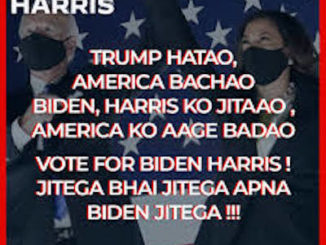
    SACRAMENTO(TIP): A Silicon Valley-based Indian-American couple has released a digital graphic campaign in Hindi, urging their community members to support and vote for Democratic presidential candidate Joe Biden and his running mate Kamala Harris.

    The campaign titled “Trump Hatao America Bachao” and “Biden Harris ko jitao , America ko aage badao“, was launched in 14 Indian languages on Monday, October 12said Biden supporters, Ajay and Vinita Bhutoria.

    The focus of the campaign on the battle ground States where every vote matters and Indian-Americans can play an important role in the election results, Bhutoria said in a statement.

    Battle ground States of Pennsylvania, Wisconsin, Michigan, Minnesota, along with three southern states Florida, Georgia, North Carolina, as well as Arizona collectively have 127 electoral votes.

    “The Indian American Votes will be the margin of victory and make the winning difference in battleground states,” he said.

    In 2016 Trump had a narrow win in Michigan, Wisconsin, Pennsylvania.

    Democratic supporters this year are doing extensive outreach to the Indo Americans /South Asians in 14 languages through thousands of phone banking calls each week.

    “We are determined to turn out the 1.3 million Indo American votes for Biden,” he said.

    Earlier Ajay had released two Bollywood videos to “unite all South Asians and people of Indian origin to support Biden and Harris.

    Chale Chalo Biden ko vote do” (Let’s go, vote for Biden) the music video is now running on TV Asia as advertisement and Ajay also led by bringing Digital Graphics of “America Ka Neta Kaisa Ho Jo Biden Jaisa ho” and “Jaago America Jaago, Biden Harris ko Vote do” earlier in 14 languages.

  • Should we Reject Indian-Americans to our legislative bodies?

    Should we Reject Indian-Americans to our legislative bodies?


    By Mike Ghouse

    Why should we support or pull down the Indian -Americans running for US Congress or Senate?

    The answer is simple, almost all Indian Americans have families back in our motherland, and we must support and elect candidates who subscribe to American values. You and I came to America and have cherished this nation for its values of freedom, equal opportunities, equal justice, equal dignity, liberty, and the pursuit of happiness.  We should wish the same for our fellow Indians back home or any people anywhere.

    We must reject those candidates who do not want the same values as the Indians living in India and certainly pull the hypocrites down if they support the fascist Modi regime in India that is lynching, harassing, raping, and killing fellow Indians.  We cannot let our motherland go down the drain with such individuals.

    Law Makers Ro Khanna, Pramila Jayapal, and Kamala Harris have proved to be patriotic Americans fully subscribing to American Values. However, we have to make a critical decision about new candidates running for the legislatures. The questionable man is Sri Preston Kulkarni, a controversial person running for the US Congress from Congressional District 22 from Houston, Texas.

    He is accused of taking donations from the people who run the RSS organization in India. RSS is a paramilitary organization like the Nazis, ISIS, and KKK, which runs the Indian government and believes that the Christians (30 Million) and Muslims (200 Million) who have lived in India from the 2nd Century and 8th Century respectively do not belong in India. Through his minions, Prime Minister Modi, who has similarities with Hitler has given them three choices– convert to Hinduism, live as 2nd class citizens or disappear.

    The ideology of RSS is dangerous to the social fabric of India and detrimental to India’s economic stability and prosperity. Now, it is creeping into America, and we need to stop it.

    I have texted Mr. Kulkarni thrice to answer simple questions. He turned it over to Jack, his field director; both have promised to respond in vain for almost a month.

    Here are few of the several questions I have asked Kulkarni.

    1. If elected, would you initiate a bill in the house about equal rights, equal pay for women and equal justice for all citizens?

    1. If elected, would you support a bill that would require the Indian Government to treat the Dalits, Muslims, and Christians as equal citizens with equal rights and equal justice for all?

    1. If elected, would you support a bill to restore the full freedoms to the People of Kashmir?

    1. If elected, would you encourage the RSS to renounce its extremist ideology and accept Indian Dalits, Muslims, Sikhs, Jews, and Christians as Indians and have equal rights with all citizens?

    1. Should a conflict arise between India and the United States, and Congress is short of one vote for passing the bill, what would be your position?

    Would Kulkarni make the following statements?

    “I am concerned about the violations of religious freedoms in India, particularly against minorities. Being a minority myself, I will not tolerate minorities to be treated like that in any country.  I am appalled to hear the statements like Muslims are termites, and, I will throw the immigrants into the Bay of Bengal is ascribed to the Home Minister of India Mr. Amit Shah a close confidant of Mr. Modi the Prime Minister.”

     “I support the request of the US Government to the Government of India to issue visas to the commissioners of the USCIRF to investigate the human rights violations and earn a clean certificate and or fix the problems and earn a clean certificate – clean chit as they call it in India.”

     “I do not support the exclusionary policies of the RSS, that advocate Indian Christians and Muslims to disappear from India, live as 2nd class citizens or convert to Hinduism. Indeed, I oppose that policy and urge India to have a place among civilized nations.”

    “I urge the Government of India to withdraw the unnecessary citizenship laws like the CAA** – Citizens Amendment Act. It will stop the protests and restore political stability and social unrest. As Americans, we want a stable India to invest and build a healthy relationship.”

    “America is my home and my motherland, and I pledge to defend her constitution.”

    Lastly, talks are going on quietly about booting the Indians out of America if they boot Christians from India.

    Given the unilateral decisions Trump has taken, disregarding the societal norms, and if the White Supremacist take over the governance, all of the Indians maybe kicked out of the nation.

    If we don’t correct the rogues who run the Government of India, we deserve to be kicked out. Modi was not allowed to come to the United States; it may happen again once Trump is gone. Modi should not bring shame to India.

    I love my India and hate to see the RSS extremists destroying her; as an Individual, I will do my share of the work to save my motherland from the men hell-bent on destroying her. All those who are supporting Modi now will come to regret. One by one, he will push the South Indians, then the Bengalis, Marathas, and finally you. All he wants is power. Modi is a power-hungry man. If the country is destroyed, he will walk away with his jhola (shoulder bag) as if nothing has happened; he does not care about Indians.

    (The author is the founder and president of the Center for Pluralism in Washington, DC and offers pluralistic solutions to the media and policymakers on issues of the day. For more information, visit  www.TheGhouseDiary.com)


  • Hathras a setback for Hindutva’s social project

    Hathras a setback for Hindutva’s social project

    By Saba Naqvi

    There is an undeniable political vacuum in the space for the Opposition in UP, but even an unrivaled political force has to stand on a structure that has strong foundational beams. The Yogi regime is beginning to disgust its own supporters. As long as the Hindutva wave was moving along smoothly, Yogi was even being spoken of as a possible successor to Prime Minister Narendra Modi in the emerging Hindu rashtra. But the Hathras episode has diminished him.

    The Yogi Adityanath regime in Uttar Pradesh has responded hysterically and undemocratically to the criticism and protest generated by the terrible Hathras case. The state police have now filed FIRs against members of Opposition parties and threatened protesters with sedition charges, even as the chief minister has alleged a conspiracy to trigger caste and communal riots. The touchiness over this case comes from the fact that it has the potential to set back the BJP-RSS socio-political project in the nation’s most populous state. The most tangible damage comes from the fact that the Valmiki sub-caste of the Dalit community, to which the victim belonged, has been overwhelmingly voting for the BJP in recent elections in Uttar Pradesh (unlike the numerically larger Chamars/Jatavs who have traditionally been backers of the BSP led by Mayawati).

    The Hindutva project in Uttar Pradesh rode on upending the state parties that became prominent in the Mandal era, by using cadre, narratives and mobilization, to reach out to non-dominant Dalit and backward caste groups. This was achieved by giving them a sense of belonging and telling them that they were included in the Hindutva project. In some instances, Valmikis were the foot soldiers of anti-Muslim mobilization.

    To give an example from the ground in Moradabad in western UP, a seat with a large Muslim population, in the middle of the minority-dominated part of the town is a Valmiki settlement in an area known as Bhude ka Chauraha. In the 2019 Lok Sabha elections and the 2017 Assembly polls, residents of this Valmiki basti were among the most determined BJP voters and foot soldiers on the ground. They were the new voters the BJP has been getting in its consolidation of power in this electorally crucial state, achieved after consistent cadre outreach by the Sangh Parivar.

    But post Hathras, the manner in which the Thakur community (to which the four rape-murder accused belong) has postured with the patronage of BJP leaders as if they are the aggrieved party with the license to protest their arrests, suggests these fragile gains could be lost. Thakurs make up 7.9 per cent of the population, while Dalits account for 21 per cent. So, the question is that as a politician, why is the CM inclined to give a free pass to his own caste although the BJP got the support of both forward and backward sections of society minus Muslims? The answer lies in the fact that despite being an MP from Gorakhpur, the seat of the Gorakhnath temple that he heads, for five consecutive terms, Yogi Adityanath is not really a politician but a religious mascot who likes to talk tough and give the license to shoot to the police in the state.

    Before he got the state as his stage, stormtroopers of the Hindu Yuva Vahini, a so-called youth organization founded by Yogi Adityanath in Gorakhpur in 2002, went about dispensing vigilante justice and intimidating minorities. On its website, under ‘Type of Business’, the Yuva Vahini calls itself ‘far right Hindu nationalist organization.’ As long as just Muslims were at the receiving end, it did not really jar sensibilities in the now deeply communalized state. But now that it has become clear that crime against Dalits is increasing at an alarming rate, it’s an altogether different matter.

    It is common knowledge in Lucknow and the district headquarters that the CM trusts only members of his own caste, as he was groomed and raised in the Thakur-run Gorakhnath monastic order. As the state will have elections in early 2022, it’s possible that Yogi intends to rely solely on the mix of Hindutva and muscle power that Thakurs supply. The community has clout way beyond its numerical strength; in spite of the abolition of the zamindari system, Thakurs are believed to still own half the agricultural land in parts of Uttar Pradesh.

    But the Hathras incident has served the larger social purpose of shining the arc lights on the dark and regressive social impulses that have got a free run during the reign of Yogi Adityanath. Seeing the pushback from the Thakurs, imagine the scale of the bullying that can go unseen. The outrageous scale of injustice at Hathras also raises the larger question about whether the social gains of the Mandal era were superficial at best, dependent solely on a Dalit figure occupying high office? BSP leader and four-time CM Mayawati did leave monuments and parks; her coming to power did make many Dalits believe they need not sit on the floor if a high-caste individual came by; and once upon a time, she famously jailed all the notorious Thakur strongmen of the state.

    But the palpable regression in the years of BJP rule raises the question about whether she left a lasting legacy or just a lot of statues. Has she hollowed out her own movement by selling tickets and making deals with whosoever could keep her person and assets safe? Or is Mayawati just helpless today, reduced to being a Team B of the BJP? During the Hathras episode, for instance, she made more attacks on the Congress than the BJP.

    There is an undeniable vacuum in the space for the Opposition in Uttar Pradesh, but even an unrivalled political force has to stand on a structure that has strong foundational beams. The Yogi regime is beginning to disgust its own supporters and the pillars holding it up are looking rotten. As long as the Hindutva wave was moving along smoothly, Yogi was even being spoken of as a possible successor to PM Narendra Modi in the emerging Hindu rashtra. But the Hathras episode has diminished him.

    Like Yogi, Modi was not an elected but a selected CM. But Modi would remain in control of whatever image or narrative he wished to project, be it the Hindu Hriday Samrat of the 2002 Gujarat riots or the friend of industrialists by 2007, the liberator of Gujarat, the undisputed leader and so on till he cast his eye on Delhi by 2013. Yogi Adityanath in contrast seems to have lost control of any narrative beyond his open desire to erase the names of Muslim historical figures and eras. From aspiring to be the next Hindu Hriday Samrat, he has been caught out to be a mere Thakur strongman in saffron robes. The ghost of that young woman of Hathras who met such a terrible end will haunt him.

    (Saba Naqvi is a senior journalist)

  • 13 men charged in foiled plot to kidnap Michigan Gov. Gretchen Whitmer

    13 men charged in foiled plot to kidnap Michigan Gov. Gretchen Whitmer

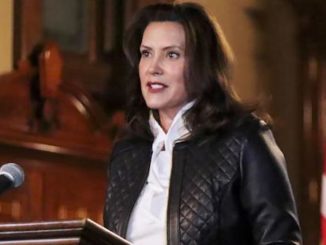
    MICHIGAN (TIP): More than a dozen men were arrested on federal and state charges in connection with an alleged foiled plot to kidnap Michigan’s Democratic governor, Gretchen Whitmer, authorities said Thursday, October 8.

    Six were apprehended and charged with federal crimes, while another seven were picked up on state charges, officials in Michigan said.

    All are members of two militia groups “who were preparing to kidnap and possibly kill me,” Whitmer said in an address from Lansing late Thursday afternoon following the arrests.

    “When I put my hand on the Bible and took the oath of office 22 months ago, I knew this job would be hard,” Whitmer continued. “But I’ll be honest, I never could have imagined anything like this.”

    She thanked federal and state law enforcement for bringing criminal charges that “hopefully will lead to convictions, bringing these sick and depraved men to justice.”

    The arrests grew out of an FBI-led probe which began in March and focused on militia groups’ discussing the “violent overthrow” of certain government and law enforcement officials.

    Each of the federally charged men faces up to life in prison if convicted on all charges, authorities said.

    Those six suspects facing federal charges in the alleged kidnapping plot used encrypted messaging to communicate about the plot, conducted coordinated surveillance on the governor’s vacation home and detonated an improvised explosive device wrapped with shrapnel, officials said.

    Based on court documents, the FBI was well aware of the activities of the six men charged Thursday and there does not seem to have been an imminent threat posed to Whitmer.

    The documents identify the defendants as Adam Fox, Barry Croft, Ty Garbin, Kaleb Franks, Daniel Harris and Brandon Caserta.

    At a meeting in July, allegedly attended and recorded by one of the informants, the men “discussed attacking a Michigan State Police facility, and in a separate conversation after the meeting, Garbin suggested shooting up the Governor’s vacation home,” authorities said.

    Then at a July 27 meeting, Fox and an informant discussed a possible kidnapping of Whitmer, with the defendant allegedly saying: “Snatch and grab, man. Grab the f—ing governor. Just grab the b—-. Because at that point, we do that, dude — it’s over.”

    “Fox said that after kidnapping the governor, the group would remove her to a secure location in Wisconsin for ‘trial’,” according to the criminal complaint.

    The alleged conspirators used code words and encrypted platforms to shield their discussions from authorities, according to U.S. Attorney Andrew Birge for the Western District of Michigan.

    They used terms such as “cake” or “cupcakes” for bombs, a “chemistry set” for components of an improvised explosive device and “baker” for an explosives manufacturer, according to the complaint.

    “Fox and Croft in particular … discussed detonating explosive devices to divert police from the area of the (governor’s vacation) home,” Birge said.

    The federal investigation involved at least one member of a Michigan militia group who was involved in a Second Amendment rally at the Michigan Statehouse in June.

    That member allegedly told the FBI that the group was considering killing police officers and agreed to become an informant.

    But the involvement of that militia in the plot to kidnap the governor appears to be minimal as the group that was charged Thursday allegedly discussed keeping the broader militia out of their actual plan.

    In a YouTube video from May, Caserta claimed in a 30-minute diatribe that “the enemy is government.” He shot the video in front of an anarchist’s flag and a map of Michigan.

    Caserta did not post on YouTube again until three weeks ago. In that video, Caserta does not speak, and simply loads and poses with a long gun off camera while wearing a shirt that says “F— The Government.”

    The seven suspects facing state charges were identified as Paul Bellar, 21, Shawn Fix, 38, Eric Molitor, 36, Michael Null, 38, William Null, 38, Pete Musico, 42, and Joseph Morrison, 42.

    They’ve all been charged with “providing material support for terrorist acts” and “carrying or possessing a firearm during the commission of a felony,” according to state prosecutors.

    The seven are linked to the Wolverine Watchmen militia and sought to “instigate a civil war” and had “engaged in planning and training for an operation to attack the Capitol building of Michigan and to kidnap government officials, including the governor of Michigan,” Michigan Attorney General Dana Nessel said.

    For months, Whitmer has drawn the ire of militia groups and others opposed to her restrictions aimed at curbing the spread of the coronavirus.

    Armed protesters took to the streets of Lansing, the state capital, during the early days of Whitmer’s coronavirus lockdown orders. And President Donald Trump famously tweeted “LIBERATE MICHIGAN!” in April.

    “The Governor of Michigan should give a little, and put out the fire,” Trump tweeted May 1. “These are very good people, but they are angry. They want their lives back again, safely! See them, talk to them, make a deal.”

    (Agencies)

    U.S. Attorney Matthew Schneider, who heads federal prosecutions in the Eastern District of Michigan, acknowledged the fraught political climate in which these arrests were made.

    “All of us in Michigan can disagree about politics,” he said. “But those disagreements should never, ever amount to violence.”

    Whitmer on Thursday said Trump was “complicit” through his rhetoric. She specifically linked the alleged actions of the suspects in her case to Trump’s refusal, at a debate last week, to forcibly denounce white supremacist groups.

    “Just last week the president of the United States stood before the American people and refused to condemn white supremacists and hate groups like these two Michigan militia groups,” she said.

    “Stand back and stand by,’ he told them … hate groups heard the president’s words not as a rebuke but as a rallying cry, as a call to action.”

    Whitmer was elected as the state’s 49th governor in 2018, defeating Republican Bill Schuette by nearly 10 percentage points.

    The governor on Thursday continued to defend her actions during the pandemic.

    Michigan residents are now testing positive at about a 3-percent rate, one of the lowest in the nation, according to a rolling count kept by Johns Hopkins University.

    “It’s not over yet, but here’s what I know: We’re Michiganders. We have grit. We have heart and we are tough as hell,” Whitmer said.

  • October 9 New York & Dallas E – Edition

    [vc_row][vc_column][vc_column_text]

    E-Edition

    [/vc_column_text][/vc_column][/vc_row][vc_row][vc_column width=”2/3″][vc_custom_heading text=”” font_container=”tag:h2|text_align:center” google_fonts=”font_family:Istok%20Web%3Aregular%2Citalic%2C700%2C700italic|font_style:700%20bold%20regular%3A700%3Anormal” link=”url:https%3A%2F%2Fwww.theindianpanorama.news%2Fwp-content%2Fuploads%2F2020%2F10%2FTIP-October-9-Dual-Edition.pdf|||”][vc_single_image image=”101488″ img_size=”full” add_caption=”yes” alignment=”center” onclick=”custom_link” link=”https://www.theindianpanorama.news/wp-content/uploads/2020/10/TIP-October-9-Dual-Edition.pdf”][/vc_column][vc_column width=”1/3″][vc_single_image image=”82828″ img_size=”medium” alignment=”center” onclick=”custom_link” link=”https://www.theindianpanorama.news/advertising-media-kit-portal-indian-panorama/”][vc_single_image image=”82829″ img_size=”medium” alignment=”center” onclick=”custom_link” link=”https://www.theindianpanorama.news/advertising-media-kit-portal-indian-panorama/”][/vc_column][/vc_row][vc_row][vc_column width=”2/3″][vc_custom_heading text=”Lead Stories This Week” font_container=”tag:h2|text_align:center” google_fonts=”font_family:Istok%20Web%3Aregular%2Citalic%2C700%2C700italic|font_style:700%20bold%20regular%3A700%3Anormal” link=”url:https%3A%2F%2Fwww.theindianpanorama.news%2F%20|||”][/vc_column][vc_column width=”1/3″][vc_widget_sidebar sidebar_id=”mh-sidebar”][/vc_column][/vc_row]

  • September 4 New York & Dallas E – Edition

    [vc_row][vc_column][vc_column_text]

    E-Editions

    [/vc_column_text][/vc_column][/vc_row][vc_row][vc_column width=”2/3″][vc_custom_heading text=”” font_container=”tag:h2|text_align:center” google_fonts=”font_family:Istok%20Web%3Aregular%2Citalic%2C700%2C700italic|font_style:700%20bold%20regular%3A700%3Anormal” link=”url:https%3A%2F%2Fwww.theindianpanorama.news%2Fwp-content%2Fuploads%2F2020%2F09%2FTIP-September-4-Dual-Edition.pdf|||”][vc_single_image image=”101036″ img_size=”full” add_caption=”yes” alignment=”center” onclick=”custom_link” link=”https://www.theindianpanorama.news/wp-content/uploads/2020/09/TIP-September-4-Dual-Edition.pdf”][/vc_column][vc_column width=”1/3″][vc_single_image image=”82828″ img_size=”medium” alignment=”center” onclick=”custom_link” link=”https://www.theindianpanorama.news/advertising-media-kit-portal-indian-panorama/”][vc_single_image image=”82829″ img_size=”medium” alignment=”center” onclick=”custom_link” link=”https://www.theindianpanorama.news/advertising-media-kit-portal-indian-panorama/”][/vc_column][/vc_row][vc_row][vc_column width=”2/3″][vc_custom_heading text=”Lead Stories This Week” font_container=”tag:h2|text_align:center” google_fonts=”font_family:Istok%20Web%3Aregular%2Citalic%2C700%2C700italic|font_style:700%20bold%20regular%3A700%3Anormal” link=”url:https%3A%2F%2Fwww.theindianpanorama.news%2F%20|||”][/vc_column][vc_column width=”1/3″][vc_widget_sidebar sidebar_id=”mh-sidebar”][/vc_column][/vc_row]

  • REMEMBERING  JOHN LEWIS: THE FILM  “GOOD TROUBLE”

    REMEMBERING JOHN LEWIS: THE FILM “GOOD TROUBLE”

    By Mabel Pais
    “The word ‘Satyagraha’ in Sanskrit means two things ‘non-violence’ and ‘insistence on the truth’….. And that is what John Lewis was all about.”
    Nancy Pelosi, Speaker – US House of Representatives
    He Always ‘Insisted On The Truth’
    ‘The Conscience of the Congress’
    ‘When He Spoke,  People Listened When He Led,  People Followed’
    ‘One Country, One Destiny’
    ‘Living Example of Courage and Faith and Action’
    Among Big Six leaders of the Civil Rights Movement

    At the funeral of Civil Rights Icon Congressman John Lewis held on July 30 at the Ebenezer Baptist Church in Atlanta, Georgia, Speaker Nancy Pelosi said of John Lewis, “when he spoke, people listened; when he led, people followed.” She also said that ‘Satyagraha’ is what John Lewis was all about.

    He said to Pelosi, “ In my life I have done all I can to demonstrate that the way of peace, the way of love and non-violence is the more excellent way. Answer the calling of your heart and stand up for what you truly believe in.” Pelosi went on to say, “Non-violently he insisted on the truth wherever he went: in Nashville, in Selma, in Washington D.C., at the Lincoln Memorial; and he insisted on the truth in the Congress of the United States.”

    John Lewis, Voting Rights Demonstration
    USA. Selma, Alabama. October 7, 1964. The Student Nonviolent Coordinating Committee (SNCC) organized “Freedom Day”, an attempt to get residents registered to vote. John Lewis being arrested.

    John Lewis died on July 17, 2020.

    Inspired and mentored by Rev. Martin Luther King and his visit to India, in 2009 Congressman John Lewis led a congressional delegation visit to India in order to commemorate the 50th anniversary of Dr. Martin Luther King Jr’s visit to India.

    Inspired by his own visit, Congressman Lewis started the Gandhi-King Exchange Act to seek to apply the philosophies of Mahatma Gandhi and Dr. Martin Luther King, Jr. to conflict resolution efforts and current policy challenges.

    The Congressional committee on July 29 honored the two icons (King and Lewis) of Civil Rights by passing a bill written by the late American Civil Rights leader John Lewis (and co-sponsored by Congressman Ami Bera). The Act would establish an exchange initiative between the United States and India to study the work and legacies of Mahatma Gandhi and Martin Luther King Jr.

    JOHN LEWIS: GOOD TROUBLE, The Film

    “She’s (Dawn Porter, Director) dedicated her career to giving voice to the voiceless, and I like to think of my job as an ally, fighting for her vision.” – Laura Michalchyshyn, Co-Producer

    “Dawn Porter directed this documentary and she brilliantly puts the spotlight squarely on Congressman John Lewis. Good Trouble is his show. – Erica Alexander, Co-Producer

    “RIGHT ALWAYS WINS” – John Lewis

    JOHN LEWIS: GOOD TROUBLE, directed by acclaimed filmmaker Dawn Porter (TRAPPED, GIDEON’S ARMY), chronicles the life and career of the legendary Civil Rights activist and Democratic Representative from Georgia. Using interviews and rare archival footage, JOHN LEWIS: GOOD TROUBLE chronicles John Robert Lewis’ 60-plus years of social activism and legislative action on civil rights, voting rights, gun control, health-care reform and immigration. Using present-day interviews with Lewis, now 80 years old, Porter explores his childhood experiences, his inspiring family and his fateful meeting with Dr. Martin Luther King Jr. in 1957. In addition to her interviews with Lewis and his family, Porter’s film also includes interviews with political leaders, Congressional colleagues, and other people who figure prominently in his life.

    In Porter’s film, John Lewis gets the opportunity to tell us about his life, in his own words. His story. And it’s a good story.

    A Profile in Courage and Principles: Persistent Yet Calm

    ‘It’s going to be okay, because right always wins,’ he told co-producer Erica Alexander “to keep my eyes on the prize and never give up, never give in. Don’t become bitter and hostile.” She learned from John Lewis how to be young, gifted and black in American politics when she campaigned with him and other supporters in Georgia. “Mr. Lewis was the perfect teacher and a patient host. He was also a gentleman, who opened our doors and helped us up the steps. It was heaven. I didn’t know then that that real-world work, and access, would lead to making the congressman’s documentary.” Alexander said.

    John Lewis with peaceful protestors, Edmund Pettus Bridge in Selma, Alabama, on March 7, 1965.

    Early Life

    Now we get to know what it was like for him growing up a black sharecropper in Alabama in a large, loving family. He honed his fiery, oratorical skills, by preaching to the family’s chickens. He tells us how he met Martin Luther King and began his work as a student activist with the Student Nonviolent Coordinating Committee (SNCC), traveling through Jim Crow south as a Freedom Rider. As the young chairman of the SNCC from 1963 to 1966, Lewis was one of the ‘Big Six’ Civil Rights leaders of the era. This all leads to the fateful day on the Edmund Pettus Bridge (Selma, AL), where white policemen stormed their peaceful march and cracked his skull open, nearly killing him. In his appearance on national television that afternoon, bloodied and bruised, Lewis called for President Lyndon Johnson to intervene on behalf of voting rights. Until his last, he still bore scars from that brutal encounter.

    ABOUT REP. JOHN R. LEWIS :

    The Conscience of the Congress

    But John Lewis not only survived all of that, and more, he thrived and became a husband to his beautiful wife and political partner, Lillian Miles, a father to his son John Miles Lewis, and was elected to the Congressman from Georgia who earned the respect of his red and blue state peers, who lovingly call him, “The conscience of the Congress.”

    “To young legislators, he demonstrates that you can live your principles and get things done, while still being true to yourself. To his seasoned colleagues, he’s a consistent and loyal friend. So, my goal was to include the kinds of voices that would speak to each of these different experiences,” Porter said.

    A Timely Topic

    John Lewis: Good Trouble explores a variety of issues that are associated with Lewis but pays particular attention to one that is perhaps most closely associated with the Congressman’s tenure in politics: the Voting Rights Act. “Speaker Nancy Pelosi (D-CA) made the comment that John Lewis can’t be separated from the Voting Rights Act, and she’s absolutely right,” says Porter. “Many of his early activities were centered on gaining access to the vote, so we really wanted to highlight what that battle has been like for both him and the country. And considering how much voter suppression we’ve seen recently, that subject speaks volumes right now.”

    Key Credits

    Dawn Porter: Director

    Laura Michalchyshyn, Dawn Porter, Erika Alexander and Ben Arnon: Producers

    Jessica Congdon: Editor

    Tamar-kali: Music

    Length: 1h 36m

    Release Date: Currently running

    Tickets:  johnlewisgoodtrouble.com

    (Mabel Pais writes on Social Issues, Spirituality, The Arts and Entertainment, and Health & Wellness)


  • All is Well That Ends Well

    All is Well That Ends Well

    By Dr. Yash Goyal

    Congress party gets an Independence Day gift in Rajasthan

    JAIPUR (TIP): Hitting hard at Opposition BJP for its interference in the internal affairs of the Congress party, the Gehlot Government in Rajasthan on Friday, August 14,  won the Confidence Motion by a voice vote in the state Legislative Assembly after over 3 hours of debate.

    The  victory of the Congress  in the  State has  sent a clear message  to the saffron party that its  Mission Lotus in the garb of ‘Congress Mukt Bharat’ would not be applicable in a majority led government anymore,  not in Rajasthan, at least. The ruling members in the House blamed the judiciary and the Governor  for causing hurdles in the democratic  process. Opposition BJP without creating an uproar in the House could not move its ‘no confidence motion’ notice against Gehlot government.

    Proving that he is with the Congress, Pilot interrupted the BJP legislators in the House claiming that he was the ‘strongest warrior’ of the Congress party despite his new sitting arrangement.  ‘I am sitting on border line close to the Opposition members but I will protect my party at all costs. This is not important where one sat but what mattered was what people had in their heart and mind about him”, he warned.

    This was all made possible as a ‘Ram-Bharat Milap’ was witnessed in the Pink City a day ago when a known Jadugar turned Chief Minister Ashok Gehlot and Sachin Pilot, former Deputy CM, came face to face with warmth and anticipating to revive the Congress government’s image and prestige in public once again.

    It seems to give the impression that All Is Well with the Congress Party in Rajasthan. However, only time will tell whether there was a genuine feeling of brotherhood in the hug, or it was another feigned show of amity.

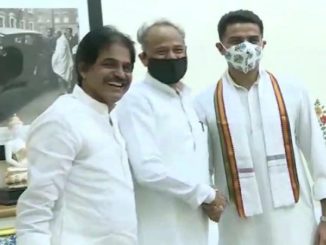
    After a major revolt,  and leading the rebel camp with 18 MLAs for the last  31 days, Pilot was given a warm welcome on his arrival at CMR by AICC’s top functionaries K C Venugopal (now RS MP from Rajasthan), Avinash Pandey, Randeep Surjewala, Ajay Makan and PCC President G S Dotasra.

    Gehlot and Pilot shook  hands enthusiastically, while Gehlot was also seen holding Pilot’s right upper arm as a gesture of unity and political bond. Both were wearing face masks and no emotions were captured, but their glowing eyes gave the impression that both were pleased.

    The brief Ram-Bharat-Milap was followed by Congress Legislature  Party meeting in which Pilot faction also made attendance. Still scared of poaching,  the  Gehlot camp MLAs returned to the hotel, whereas Pilot flock’s MLAs returned  to their residences separately.

    Ending  a month-long  tug of war between the CM and his rebel faction that was piloted  by Sachin with 18 dissidents over ‘political ambitions of youngsters’ in Rajasthan now appears to be settled down, like dust storm in the sandy desert. Rebels have cooled down their feet, and Opposition party (BJP) gave up the hope to be king makers  in case Gehlot government  fell.

    Four days ahead of the Assembly Session slated for August 14, a sudden somersault  by  Pilot, who was sacked on twin posts of Deputy-CM and PCC President, has stunned everyone , especially the ambitious rival BJP that has projected ‘Congress Mukt Bharat’ since 2014 and tried this slogan in Madhya Pradesh, Karnataka, Manipur and Goa to ‘topple’ the governments.

    After  quandary with Gehlot government, keeping only Twitter handle open, and hiding with his flock under alleged  Haryana Government’s hospitality’, Pilot got an appointment very late and met the Congress leaders Rahul Gandhi & Priyanka Gandhi Vadra with his 18 supporting MLAs. This is utterly surprising  that when Pilot first moved to Delhi in early July  to approach and raise his resentment to the party high command, he was not heard because Gehlot had disclosed  alleged audio-clips on ‘horse trading deal struck’  in which the names of a veteran Congress MLA Bhanwarlal Sharma and Union Minister for Jalshakti Gajendra Singh Shekahawat, LS MP from Jodhpur in Modi Government surfaced on police records.

    The deadlock of government’s functioning has been partially paralyzed since July 12 when Pilot had revolted with his camp against CM threatening that the Gehlot government had come in minority. The soup was thicker when  Gehlot had sacked Pilot and two other ministers Ramesh Meena and Vishwendra Singh for their alleged involvement in poaching with huge cash secretly offered by the BJP for toppling the ruling  government having majority of 119 MLAs in a house of 200. Pilot was furious and moved to coup when he was served a notice by SOG under section 124-A of IPC along with CM, and Chief Whip.

    The instability of the state government has revolved around Gehlot vs Pilot over supremacy, Speaker vs Court (High Court and Supreme Court) over notice to rebel MLAs under the  Anti-defection Law (10th schedule of the Constitution) by the Speaker C P Joshi, Gehlot vs Governor over calling early assembly session, and  Gehlot vs BSP’s Mayawati over direct merger of six MLAs with the Congress last year.  After facing the legal challenges under the Article 174 of the Constitution and rejecting Gehlot cabinet’s three-time proposal to convene the assembly session on a short notice,  the Governor Kalraj Mishra  finally issued order to convene the session on August 14,  covering 21 day- notice.

    The BJP appointed Governor’s clash with a  non-BJP Chief Minister in Rajasthan was nothing new.  In Delhi, it was CM Arvind Kejriwal vs Lt Governors, Mamata Banerjee vs Jagdip Dhankar in West Bengal, Uddhav Thackeray  vs Bhagat Singh Koshiyari in Maharashtra, P Vijayan and Arif Mohd Khan in Kerala, V Narayana Swami vs Lt Governor Kiran Bedi in Puducherry, and K Chandrasekhar Rao vs T Sundararajan in Telangana.

    Pilot faction got scared when it calculated that its herd hiding with a meagre  19 rebels  could not cut the ice, and rival party (BJP) which he did not want to join at this juncture would not support him despite alleged ‘poaching’ of some MLAs. Gehlot succeeded in keeping 102 MLA’s in  ‘political quarantine’  under unprecedented security cover, and when time came,  paraded his loyalists before the Governor.

    Later Gehlot’s confidence weakened when BJP and BSP moved to the courts against merger of all six BSP MLAs into the Congress last year. Probably under pressure of raids by Central investigating agencies like IT, ED, CBI against Gehlot’s  one MLA,  friends and relatives, the government bowed down and adopted damage control exercise. The Special Operation Group (SOG) of state Police)  dropped the sedition charges (section 124-A of IPC) in two cases  of horse trading exposed in alleged audio-conversation clip between one BJP Minister and a Congress MLA. The case is now referred to the  slow-paced Anti-Corruption Bureau.

    A hypothesis indicates that the government’s move to go on back foot was a big respite for  Pilot camp.  Though Pilot  was now free from SOG but not having desired support of other party MLAs and deficiency of outside support from rebel party to kick out the ruling government, perhaps they returned to alma mater with their list of grievances.  This time Pilot also lacked active support of Gurjar community on which he won the assembly poll in 2018 from the Tonk constituency. It was the political compulsion to live inside the party and sit in the assembly as a legislator and not to face any ‘disqualification’ clause under Anti-defection Act by flouting any whip of the treasury bench.

    A question remains  unanswered whether a three member AICC Committee comprising Ahmed Patel, Priyanka Gandhi Vadra  and K C Venugopal will redress 19-MLAs’ grievances and  look into demands which include re-allocating cabinet berths to two MLAs . Will Pilot get any parallel post in the cabinet of Gehlot who bluntly  described Pilot as ‘Nikkama, Nakara and Conspired against his own government”. However,  in his face saving move Pilot received a warm welcome to Jaipur where he held a series of individual media interactions. Pilot, son for late Union Minister Rajesh Pilot and former MP Mrs. Rama Pilot, assured that he has not asked for post but there should  be  no vendetta politics. This is a hidden deal when Gehlot says he was unaware under what conditions Pilot group has come back to the party fold.

    Why and how the veteran MLA Sharma, whom the SOG police has failed to search in the audio-conversation case in the country, made a surprise  landing at CM’s  House after Pilot met Gandhi family in Delhi remains a mystery.   Gehlot had openly assailed Sharma’s attempts to destabilize his government and former CM B S Shekhawat’s government and turning coat frequently in the past.

    At a recently held CLP meeting, a number of MLAs and a few Ministers have expressed their displeasure at homecoming of ‘rebels’.  A million-dollar question would chase CM how he is going to appease Independent MLAs who had merged their affiliation with the Congress – 6 BSP turned Congress MLAs, and BTP legislators while fulfilling his promise of ministerial reshuffle in near future after assembly session. Another big puzzle   Congress party will have to address  is how to accommodate   the Pilot camp in the state in remaining term of the government.

    Is this a victory of Ashok Gehlot, 3rd timer Chief Minister in Rajasthan, without a floor test in State Legislative Assembly after a suo moto surrender of Sachin Pilot with his 18-rebellion Congress MLAs  before the Congress High Command for an ‘amicable mediation’ on his flock’s grievances ?  It seems to be a win-win situation more for Pilot and less for Gehlot government as ‘horse trading of lawmakers’ is unpredictable alike Cricket in future too.  Political Pandits feel after some time Pilot may raise his ante against Gehlot rule if more rebels join to saddle him (Gehlot) out of power. Gehlot urged his MLAs to forgive him and move, but would it be so easy for the voters who have noticed fragility of oldest party, the Congress. Caste politics would again emerge as a threat to the Gehlot who is always known as Jadugar of Politics.

    (Dr Goyal is a senior journalist, and has  worked for PTI and The Tribune)

  • Rajasthan slugfest: Need for impartial probe into horse-trading allegations

    Rajasthan slugfest: Need for impartial probe into horse-trading allegations

    What had initially appeared to be an intra-Congress tussle in Rajasthan has turned into a ‘Congress vs BJP’ slanging match after the emergence of audio clips in which Union minister Gajendra Singh Shekhawat is purportedly heard having a conversation with a Congress MLA and a BJP leader about toppling the Ashok Gehlot government. The state’s Special Operations Group has promptly registered a couple of FIRs on a complaint by the Congress. An impartial, time-bound inquiry is needed to verify the authenticity of the recordings and unearth the underlying conspiracy, irrespective of which political party is at fault, even as Shekhawat has denied that the clips have his voice. The development has provided ammunition to the Congress to accuse the ruling BJP at the Centre of horse-trading. The onus is on the NDA government to convince all and sundry that it has no hand in the goings-on in the border state.

    Attempts to subvert democracy and the electoral process have become far too common in recent years. Several states have witnessed post-poll machinations and short-lived governments, with the latest casualty being Madhya Pradesh. The Congress had wrested power from the BJP by winning the 2018 MP Assembly polls, but the latter turned the tables on the ruling party earlier this year with the help of some obliging MLAs. In Goa and Manipur, which produced hung Assemblies in 2017, the BJP formed the government despite having won fewer seats than the Congress. Last year, the long-drawn-out Karnataka ‘nataka’ and the Maharashtra muddle also amounted to a betrayal of the voters’ mandate.

    Whenever a government finds itself on shaky ground, the clamor for strengthening or reviewing the anti-defection law gets louder. Indeed, loopholes in this law enable unscrupulous elected representatives to switch loyalties as whopping sums of money allegedly change hands. With the power struggle in Rajasthan set to get uglier inside as well as outside the courts, the credibility of the parties concerned has come under sharp scrutiny. How the major players acquit themselves will demonstrate their respect, or lack of it, for democracy.

    (Tribune, India)


  • Indian American Sutapa Ghosh Stricklett Named USAID Asia Bureau Assistant Administrator

    Indian American Sutapa Ghosh Stricklett Named USAID Asia Bureau Assistant Administrator

    WASHINGTON (TIP): US President Donald J. Trump has nominated Sutapa Ghosh Stricklett, of Maryland, to be an Assistant Administrator of the United States Agency for International Development (Bureau for Asia).

    Her nomination was sent to Senate July 22.

    Sue Ghosh Stricklett is an attorney in private practice with over twenty-five years of experience in national security law and foreign affairs.  The scope of her practice includes Foreign Corrupt Practices Act compliance, intellectual property licensing and technology transfer, U.S. dual-use and defense trade control licensing, and sanctions law enforcement.  She has served as an Asia policy advisor to three Presidential campaigns and several major Indo-American advocacy organizations.

    Ms. Stricklett hails from Queens, New York, and is a graduate of the State University of New York, Buffalo.  She earned her J.D. from the Columbus School of Law at the Catholic University of America.

    Stricklett has been the general counsel for American Hindu Coalition, which says it is a non-partisan organization that says its aims is to “build a stronger America through Hindu Enlightenment Principles.”

    She is the author of several articles in US media advocating close relations with India and on “Trump’s outreach to Hindu Americans, both before and after his election” with a slew of important appointments in his administration.

  • Indian-American  Puneet Ahluwalia announces PAC for Lt Gov of Virginia race

    Indian-American Puneet Ahluwalia announces PAC for Lt Gov of Virginia race

    WASHINGTON (TIP): An Indian-American Republican businessman will run for the powerful office of Lieutenant Governor of Virginia and has launched a political action committee for it.

    Puneet Ahluwalia, 55, in an e-mail to his supporters on Tuesday, announced: “I have taken the leap by launching the Proud American Political Action Committee to explore my run for Lieutenant Governor of Virginia.”

    A Political Action Committee (PAC) is a tax-exempt organization in the US that raises money privately to influence elections or legislation.

    “I’m forming Proud American PAC because for those Virginians who believe, as I do, that America is the greatest nation in the world, but our political leaders are not living up to the promise of our great state,” said Ahluwalia, who was a member of the Trump Campaign’s Asia Advisory Committee in the 2016 presidential election campaign.

    Delhi-born Ahluwalia migrated to the US in 1990. He serves as a consultant to businesses on client acquisition, marketing, and strategic affairs. His wife is from Pakistan and of Afghan heritage.

    “As a person of color, I sympathize with those who are frustrated and angry about race in this country, but not for the same reasons as the progressive politicians in Richmond,” Ahluwalia said, referring to Left-leaning groups.

    “We need to launch a real discussion among all Virginians about race and the ways we can bridge the gap in opportunities, income, and education,” he said.

    In a press statement, the Proud American PAC said it will work to elect candidates who are aligned with the core principles that everyone is created equal, with personal dignity, and constitutional rights the government should never be allowed to take away.

    “I believe with all my heart that American free market capitalism is the greatest engine of economic prosperity ever devised. But our economy has left too many people behind,” he said.

    “We can and we should do better by making it easier to start and fund small businesses in minority communities, encouraging greater job creation, organizing private internships for every Virginia high school graduate, helping people climb the economic ladder, improving schools, and modernizing our infrastructure,” Ahluwalia said.

    (Source: PTI)

  • India to Play Leading Role in Global Revival: PM Modi

    India to Play Leading Role in Global Revival: PM Modi

    Bidisha Roy

    LONDON (TIP): In his first major speech to a global audience since the Covid-19 pandemic, Prime Minister Narendra Modi, July 9,  assured the world that India will play a leading role in global revival in this crucial time with a spirit of reform and rejuvenation.

    At his much-anticipated inaugural address of India Global Week, biggest international event on India’s globalization, the Prime Minister said that India is ready to do whatever it can to further global good and prosperity.

    “In these times, it is natural to talk about revival. It is equally natural to link global revival and India. There is faith that the story of global revival will have India playing a leading role. I see this closely linked with two factors.   The first is- Indian talent.  World over, you have seen the contribution of India’s talent-force. This includes Indian professionals, doctors, nurses, bankers, lawyers, scientists, professors, our hard-working laborers. Who can forget the Indian tech industry and tech professionals? They have been showing the way for decades.  India is a power-house of talent, that is eager to contribute, ever ready to learn. There is two-way synergy that is greatly beneficial”, he said.

    “The second factor is India’s ability to reform and rejuvenate. Indians are natural reformers!  History has shown   that India has overcome every challenge, be it social or economic. India has done so with a spirit of reform and rejuvenation. The same sprit continues now”, he affirmed.

    India Inc. Group – the UK-headquartered media house behind flagship publications ‘India Global Business’ and the recently-launched diaspora news network ‘iGlobal’ – brought together some of the best strategic minds and experts in their respective fields.

    With +75 sessions, +250 speakers and +5000 participants from 49 countries, India Global Week cements itself as the event where ‘India Meets the World, and the World Meets India.

    Prime Minister Modi tops a stellar list of speakers in packed program across three days between July 9 and 11, including External Affairs Minister Dr S. Jaishankar, Commerce Minister Piyush Goyal, IT & Law Minister Ravi Shankar Prasad and Skills Minister Mahendra Nath Pandey, from India.

    The line-up covers a special address by HRH The Prince of Wales and several UK Cabinet Ministers, including Foreign Secretary Dominic Raab, Home Secretary Priti Patel, Health Secretary Matt Hancock, and International Trade Secretary Lizz Truss – all underlining the centrality of India to a post-Covid, post-Brexit Britain.

    Other international speakers on a diverse range of topics, from geopolitics and business to culture and diaspora, and across four country streams of Australia, Singapore, the UK and the US include Steve Waugh, Former Australian Cricketer; Dr Mukesh Aghi, President and CEO, US-India Strategic Partnership Forum; Chng Kai Fong, Managing Director, Economic Development Board, Singapore; and William Russell, Lord Mayor of the City of London. Other big highlights include Kunal Nayyar, of ‘The Big Bang Theory’ fame, in conversation with Sadhguru, Founder, Isha Foundation; a conversation with Spiritual Leader Sri Sri Ravi Shankar; and an exclusive never-seen performance by Madhu Nataraj and her team.

  • Supreme Court rules  Manhattan prosecutor may see Trump’s  financial records

    Supreme Court rules Manhattan prosecutor may see Trump’s financial records

    WASHINGTON (TIP): In a pair of historic rulings on Thursday, July 9,  the U.S. Supreme Court rejected President Trump’s claim of absolute immunity under the law. The vote was 7 to 2 in cases involving grand jury and congressional subpoenas for Trump’s pre-presidential financial records.

    The Supreme Court ruled that a New York prosecutor is entitled to see President Trump’s private and business financial records, ending an intense legal battle waged by the president to keep them secret.

    The court said Manhattan District Attorney Cyrus R. Vance Jr. had the authority to subpoena the records from Trump’s private accounting firm. Trump had claimed an immunity from criminal investigations while in office.

    Vance is investigating whether the Trump Organization falsified business records to conceal hush payments to two women, including pornographic film actress Stormy Daniels, who claimed they had sex with Trump before he took office. Trump has denied those claims.

    Vance is seeking, Trump’s tax returns, among other records. The president has refused to make them public, unlike previous modern presidents. Because the records are for a grand jury investigation, they would not likely be disclosed before the election.

    However, in a second decision on the House’s request for similar information, the court appeared to question the breadth of congressional authority.

    The Supreme Court ruled that the lower court needs to consider separation of power issues related to the congressional subpoenas, suggesting that Congress did not have unlimited powers to investigate the president. That ruling was also 7-2, with Roberts writing the opinion.

    Trump was apparently enraged by the outcome, tweeting a string of criticism that “this is all a political prosecution,” and “Courts in the past have given ‘broad deference.’ BUT NOT ME!”

    New York District Attorney Cyrus Vance issued a statement calling the decision in the grand jury case “a tremendous victory for our nation’s system of Justice and its founding principle that no one — not even the president — is above the law.”

    Trump’s personal attorney Jay Sekulow took a more optimistic tone than the president in his response to the Supreme Court rulings on the president’s financial information.

    “We are pleased that in the decisions issued today, the Supreme Court has temporarily blocked both Congress and New York prosecutors from obtaining the President’s financial records. We will now proceed to raise additional Constitutional and legal issues in the lower courts,” Sekulow said in a statement.

    (With inputs from agencies)


  • Indian American Vijay Shanker Nominated by Trump as Associate Judge of Columbia Court of Appeals

    Indian American Vijay Shanker Nominated by Trump as Associate Judge of Columbia Court of Appeals

    WASHINGTON (TIP): US President Donald J. Trump June 25 announced his intent to nominateVijay Shanker, of the District of Columbia, to serve as Associate Judge on the District of Columbia Court of Appeals.

    Vijay Shanker serves as Senior Litigation Counsel in the United States Department of Justice, Criminal Division, and as Deputy Chief of the Appellate Section.  Before joining the Department of Justice in 2012, Mr. Shanker was in private practice with the Washington, D.C., offices of Mayer Brown, LLP, and Covington & Burling, LLP.  Upon graduation from law school, Mr. Shanker served as a law clerk to Judge Chester J. Straub on the United States Court of Appeals for the Second Circuit.  Mr. Shanker earned his B.A., cum laude, from Duke University and his J.D. from the University of Virginia School of Law, where he served as a Notes Editor for the Virginia Law Review and was inducted into the Order of the Coif.

    He has briefed and argued almost sixty federal appeals, including four en banc rehearings. Mr. Shanker is currently serving on detail as Senior Litigation Counsel in the Criminal Division’s Fraud Section, where he investigates and prosecutes violations of the Foreign Corrupt Practices Act and related offenses and advises attorneys and leadership on a range of legal issues and litigation matters.

    From October 2012 to February 2014, Mr. Shanker served in the Office of the Assistant Attorney General for the Criminal Division, first as Senior Counsel and then as Acting Deputy Chief of Staff and Counselor to the Assistant Attorney General. Mr. Shanker has been awarded the Attorney General’s John Marshall Award, the Assistant Attorney General’s Award for Exceptional Service, and the Assistant Attorney General’s Award for Distinguished Service.

    Mr. Shanker received his Bachelor of Arts degree in public policy studies, cum laude, from Duke University. He received his law degree from the University of Virginia School of Law, where he was named to the Order of the Coif and served as a Notes Editor on the Virginia Law Review. He was awarded the Roger & Madeleine Traynor Prize for “the graduate who has produced the best written work” and also the Law School Alumni Association Best Note Award. Following law school, Mr. Shanker clerked for the Honorable Chester J. Straub on the United States Court of Appeals for the Second Circuit.

  • Indian American Congressman lashes out at Trump for withdrawing from WHO

    Indian American Congressman lashes out at Trump for withdrawing from WHO

    Parminder Aujla

    SACRAMENTO (TIP): Indian origin Rep. Ami Bera, M.D. (D-CA) Chairman of the House Foreign Affairs Subcommittee on Asia, the Pacific, and Nonproliferation heavily criticized President Trump after he formally withdrew the United States from the World Health Organization (WHO).

    “Communities around the United States are grappling with increasing cases of coronavirus and instead of funding a national testing strategy and ramping up testing and contact tracing, the President has chosen to cut testing and to shift the blame by withdrawing the United States from the WHO. No response has been perfect, including the WHO’s. But the WHO is playing a critical role by coordinating the global response and providing important guidance and information about the virus. It is this information and guidance that has helped countries in Europe and Asia tackle and contain the virus. They bent the curve. Our cases are increasing. If the WHO is to blame: why has the U.S. been left behind while many countries from South Korea to New Zealand to Vietnam to Germany return to normal?” he questioned.

    That answer starts at the White House. Time and time again, even before COVID-19, the President has downplayed the danger of pandemics. They proposed cuts to the CDC and DoD pandemic preparedness programs, which I helped reverse. They disbanded the National Security Council office responsible for preparing for these outbreaks, which I opposed. They tried to cut funds to defeat Ebola during an actual Ebola outbreak, which Congress rolled back. Is it any surprise that when a pandemic came, this President was not prepared? Historically, the United States and the World Health Organization have worked hand in hand. We helped defeat smallpox and nearly eliminated polio. We used to lead the world in combatting infectious disease. Those efforts aligned and supported WHO’s efforts. Not this time.  America lost its best chance to defeat this virus once the President began to minimize the pandemic and shift blame onto others, instead of assuming responsibility and actually leading our country through this crisis. Today’s decision comes as no surprise”, he further added

    Rep. Bera has been a leader in Congress on global health security. He chaired the first congressional hearing on the coronavirus on Feb. 5th, sounded the alarm after the Trump Administration disbanded the global health security office in the National Security Council in 2018, and is a member on the CSIS Commission on Strengthening America’s Health Security, which in November 2019 made a series of recommendations to prevent pandemics.