Tag: Punjab

  • U.S. sets new grim record with over 3,000 COVID deaths in single day

    U.S. sets new grim record with over 3,000 COVID deaths in single day

    The previous single-day record was on May 7 at 2,769 deaths

    WASHINGTON (TIP): The U.S. has set a new grim record of more than 3,000 COVID-19 related deaths in a single day, reflecting a bleak reminder of the pandemic’s devastating toll, even as two coronavirus vaccine candidates appear to be on the verge of clearing the country’s final regulatory hurdles.

    According to The COVID Tracking Project, the U.S. on Wednesday, December 9,  reported as many 3,054 reported deaths — the highest single-day total to date.

    The previous single-day record was on May 7 at 2,769 deaths, it said.

    Overall, there were 1.8 million tests reported on Wednesday, December 9, 210,000 cases, and a record 106,688 COVID-19 patients in U.S. hospitals, it said.

    The 7-day average for COVID-19 deaths are at an all-time high as deaths are rising throughout the country, it said.

    So far more than 15 million Americans have been infected with COVID-19 and 286,249 people have lost their lives, according to Johns Hopkins University.

    “Based on current production schedules, we expect to have enough doses to vaccinate 20 million Americans by the end of this year, 50 million total by the end of January, and at least 100 million total by the end of the first quarter,” Health and Human Services Secretary Alex Azar told reporters at a news conference.

    Within 24 hours of an emergency use authorization (EUA) by the FDA, the vaccine could be shipped out to distribution sites across the United States to make it available to the Americans who need it the most, said Army Gen Gustave Perna, chief operating officer of Operation Warp Speed.

    “Our goal is to make sure that we can ensure the vaccine is delivered in a timely manner, is to be delivered safely, securely, and it’s ready to be utilized to start administering the vaccine as soon as possible,” Mr. Perna said.

    On Tuesday, the FDA released an internal assessment of the Pfizer vaccine’s trial data. The FDA assessment showed that the vaccine was around 95% effective, was efficacious across different groups, including the elderly and people with comorbidities, and did not show any significant safety concerns.

    Mr. Perna said that he had given permission to distribute syringes and needles, alcohol wipes and dilutant, which is required in support of the Pfizer vaccine.

    “We’ll begin that today. The distribution will be completed by Friday, again only to set conditions. And if it sits there for another week or 10 days or whatever, then it does. But planning for success, we wanted to make sure that the states had all that they needed to have,” he said.

  • Biden promises vaccination for100 mn people in his first hundred days in office

    Biden promises vaccination for100 mn people in his first hundred days in office

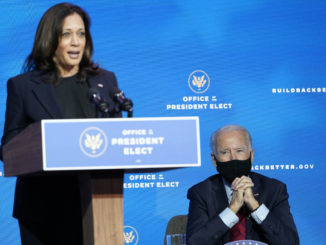
    WASHINGTON (TIP): US President-elect Joe Biden has said that in the first 100 days of his administration, he would mandate everyone to wear a mask, ensure 100 million Covid vaccinations and reopen the majority of schools. He assured Americans that his “crisis-tested” team of experts would deliver better healthcare and revive the economy. The US is in the midst of a deadly pandemic that has infected almost 15 million Americans and killed 2,86,000. Globally, there are 68.2 million Covid cases and the pandemic has claimed more than 1.5 million lives. Announcing his national health team, Biden asked the Trump administration to act now to purchase the doses it has negotiated with Pfizer and Moderna and to work swiftly to scale manufacturing for the US population and the world.

    “This can be fixed. If it does, my team will be able to get at least 100 million vaccinations done in my first 100 days. Third, it should be a national priority to get our kids back into school and keep them in school,” he said on Tuesday. “If Congress provides the funding we need to protect students, educators, and staff, and if states and cities put strong public health measures in place that we all follow, then my team will work to see that the majority of our schools can be opened by the end of my first 100 days,” he added.

    (Source: PTI)

  • Ekal Foundation’s Unprecedented$6.5 Million Magnificent Gala

    Ekal Foundation’s Unprecedented$6.5 Million Magnificent Gala

    Prakash Waghmare

    NEW YORK (TIP): On Saturday, December 5, “Ekal Vidyalaya Foundation (EVF)” hosted a magnificent Star-studded Gala, called ‘Future of India’. This Gala-2020 raised record-setting $6.5 Million in pledges & donations for the special projects. The highlight of this virtual event wasnot only the participation of a galaxy of outstanding personalities, but also, the way they expressed their vote of confidence in‘Ekal’ movement (as “EVF” is popularly known). The celebrities that lent their wholehearted support were iconic cricketer Kapil Dev, Moviestar Vivek Oberoi, Hon. Minister Piyush Goyal, leading entrepreneur Ajay Piramal, Bollywood singer Sanjeevani Bhelande and numerous entrepreneurs. The Gala was chaired by Mohan Wanchu, Chairman  & CEO of EC Info Systems who, like all previous Galas, had ushered the concept in the first place. The main objective of the eveningwas, not only, to raise funds, but also, to acknowledge gratitude to loyal philanthropists who had consistently supported ‘Ekal’ through the years. Earlier in the year, after successfully controlling ‘Covid-19 pandemic in 102,000 rural & tribal villages of India, ‘Ekal’ had raised funds through 10 regional mid-year virtualconcerts for its conventional activitieseven in the current covid-19 pandemic.

    Despite a snowstorm and tornado that created some technical problemsin transmission, the delayed startfor the evening could not dampenthe spirit of generous philanthropists to support their favoriteprojects at Ekal. There was overwhelming support for ‘Integrated Village Development’ (IVD),E-Shiksha, Tailoring Center, Telemedicine, ‘Arogya Initiative’, Ekal-on-wheels’, ‘Gramotthan Research Ctr’ (GRC), Computer Center etc. Among the high net-worth donors, 15 pledged $250,000 or more while Ajay Keshap confirmed donation of cool $1,000,000.

    Mohan Wanchu, welcoming the virtual audienceopened up the evening withan anecdote about a ‘Rikshaw-puller’ and how a ‘Lok-kathakars’ (a cadre of cultural storyteller) from an Ekal village transformed his life for better. Kamlesh Shah, co-chair of Gala started the pledge-drive by contributing $580,000 and appealing donors to raise the bar of Gala-2020 to unprecedented level. Ranjani Saigal, Executive Director of “EVF” gave a brief outline of all Ekal special projects, which was followed by former ZEE-TV CEO & Chairperson of Ekal-Global, Dr Subhash Chandra giving an overview of what Ekal is all about. The person that stole the show was the movie star, philanthropist Vivek Oberoi who also happens to be the Ekal-brand Ambassador. He emphasized that “the donation to Ekal wasn’t a subsidy for the needy, but a divine investment in India’s future”. He further appealed to the youths of India to join ‘inquisitive, creative and passionate organization like Ekal’ to give purpose to their life. Global business tycoon, Ajay Piramal said,” Ekal’s emphasis on dispensing quality education and primary healthcare in rural area is a game changer. No one understands rural-tribal mindset better than Ekal with its widespread presence in villages nor anyone has a committed pool of huge selfless volunteers”. Sajjan Agarwal, not only donated $250,000 for ‘Arogya Sevika’ (Healthcare Assistant) in the villages, but also,appealed other donors to match his willingness to donate additional $250,000. This challenge, in the very next moment, was met by Manubhai Shah. When it comes to healthcare, it is imperative to know that the donation of $250,000 benefits 7,500 people in 150 villages. A new initiative, called ‘GRANE’ (Gramotthan Atma-Nirbharata for Ekal), that is going to change farmer’s life forever, was introduced by Vivek Sharma. It is aimed at bringing E-commerce activities to the villages so as to avail villagers with new profitable economic opportunities. Hon. Minister Piyush Goyal affirmed his own and his family’s long association with Ekal. He lauded Hon PM Modi’s August 15 speech whereby all villages would be interconnected by digital broadband in next 1,000 days. Itis likely to promote widespread digitization of Education & Telemedicine. It is worth noting that Ajay Poddar of ‘Artech Int’L and Himanshu Shah of ‘Shah Capital’ have established “Gramotthan Research Ctr” that would soon circuitously help up to one Million people, at each place with the state-of-the-art information on multiple levels .The evening was interspersed with brief video-clips of Ekal’s outstanding work, its impact on rural lives and its initiatives to empowerrural folks. Kapil Dev was interviewed live for his unique achievements in Cricket. He asserted that, “in life, winning is not everything”. The most endearing memoryto him was the fact that he got to play his game for his beloved country – and not winning the ‘World Cup’ or the captainship of the team etc. He was impressed by Ekal’s infusion of fun-sports in education. Earlier this year in September, Bajrang Bagra, CEO of ‘Ekal Abhiyan’ (umbrella organization of all ‘Ekal’ satellite-divisions) had proposed to keep 102,000 school tallies ‘as is’ and embark on a transformative ‘roadmap’ that would revolutionize rural life in all its aspects. Among the primary goals proposed were to increase parameters of various special project, in next 5 years –forexample : to increase ‘Ekal On Wheels’ vans from current 25 to 85; ‘Integrated Village Clusters’ (30 villages each) from current 12 to 51; ‘Skill Development Ctrs’ from current 33 to 100; ‘Gramotthan Resource Ctrs’ (GRC) from current 16 to 27; ‘Telemedicine’ from current 120 villages to 6,000 villages and ‘Intensive Health Care’ from current 1,200 villages to 6,000 villages. In addition, the most ambitious project that Ekal wants to push hard is that of ‘E-Shiksha’ or digital education. It wants to spread it from current 1,200 villages to 100,000 villages. With the success of Gala-2020, it is quite apparent that Ekal is on the wayto achieve its ambitious goals. For more information to join this organization or to support it, kindly tap into www.ekal.org.

  • A Misnomer Causes Confusion

    A Misnomer Causes Confusion

    • India’s 10- Year Multiple Entry Visa is wrongly termed as Tourist Visa
    • Prem Bhandari recommends entry visa on departure (E-VoD)
    By Prof I.S.Saluja

    My friend Prem Bhandari who is Chairman, Jaipur Foot USA , was at JFK airport in New York on December 2, 2020 where he is a regular visitor to find for himself how NRI’s are being taken care of. Ever Since the government of India launched the Vande Bharat Mission to help stranded Indians to get back to India, Mr. Bhandari has been a regular visitor to extend a helping hand to travelers and Air India. In fact, he led from the front and exhibited rare courage in what he was doing for community at a time when most of us took refuge within the safe four walls of our homes. Undeterred by the raging pandemic, he was out at the airport day after days, helping people.  On December 2, he was, as usual visiting JFK to see if travelers were receiving proper attention of airline offici

    Prem Bhandari at JFK, New York with travelers he helped during Vande Bharat Mission in May 2020

    als when he came across 6 persons who told him they were not allowed to board an Air India flight to India. One of them was a lady with 2 toddlers. Mr. Bhandari, a man well known in India and USA, particularly in New York, as a committed social activist and do-gooder was upset to find the lady in distress for not being able to board the flight.
    Mr. Bhandari who has often raised issues impacting Indian Americans , among others, tried to get at the bottom of the situation. He spoke with the passengers who were denied travel. He spoke with Air India staff present at the JFK airport.
    Mr. Bhandari said the lady was traveling in an emergency to be with her people in India. She was not going for tourism. It was under compelling circumstances that she was going with the two toddlers, aged to India, in extreme weather and under dangerous COVID-19 conditions. Nobody goes to India these days for tourism, anyway. They all travel only driven by a desire to see a family member who may be sick, or to be with family to mourn the loss of a loved one. So it was with the lady.


    A travelers’ advisory well publicized in print, electronic and social media can prove educative for travelers

    The Air India people at JFK told the lady to visit the Consulate in New York to get an emergency visa for the kids. Now, this lady who has come from outside New York will need to hire a cab and go to the Indian Consulate in Midtown Manhattan. Pay for the cab. She may not get the emergency visa then and there. She may have to wait for a day. She will need a hotel room for which she will have to pay. If she is lucky, and if there are no intervening holidays, she gets the visa on the next day. Now the flight. She has to wait until she can be accommodated in the next available flight, subject of course to availability of seats. And when finally, the seats are available, she has to pay an extra amount for the change in her flight schedule. She does it. She settles the hotel bill for all these days of stay.
    The next scene now. The lady with two toddlers in tow reaches Delhi. Now she is to go to a different destination in India. She has missed the flight originally booked. Her tickets are canceled. She has to rebook a flight and pay for it, besides waiting, may be, for a day or two to get seats. She spends again, another few hundred dollars on buying tickets and for stay in a hotel. What a colossal loss of time and money!, one may say. No, friends, it is much more than that. It is a stressful experience which may make one sick. It is only loss of time, money, inconvenience, stress, it is a frightening threat of being exposed to rampaging COVID-19.
    Whose fault is it? Government officials will say the travel advisory is posted on website of each embassy and consulate, and travelers should look into guidelines before undertaking travel. Well, nobody can dispute this claim. All embassy and consulate websites carry the advisory.
    The Indian Panorama asked Mr. Bhandari for his comment, because he was much upset to see the plight of the stranded travelers.
    Mr. Bhandari concluded that the villain of the piece was a wrong term used for 10-Year Multiple Entry Visa. It is a misnomer to call this visa a Tourist Visa.
    One can understand the constraint of the airline, which did not permit boarding to any tourist, because tourist visa has been cancelled in the wake of COVID-19.
    In October this year, the Indian government had decided to restore with immediate effect the validity of all existing visas, except electronic, tourist and medical category visas, almost eight months after their suspension following the coronavirus outbreak and subsequent imposition of a nationwide lockdown.

    Mr. Bhandari explained to The Indian Panorama that almost 80% Indians do not apply for OCI card for children. They feel quite comfortable with the 10-Year Multiple Entry Visa which is wrongly termed as Tourist Visa. The denial to board the flight arose out of the fact that the two kids had “Tourist Visa”. And because, government of India had canceled the Tourist Visa , as stated above, the kids could not be allowed to board the flight.
    Mr. Bhandari had enough reason to sympathize with those denied boarding a flight to India, and at the same time think deep how the situation could be rectified. The first thing he did immediately was to call concerned officials in India government in Delhi. He called the Foreign Secretary Mr. Harsha Vardhan Shringla, Mr. Ajay Bhalla, the Home Secretary, and Civil Aviation Secretary Pradeep Singh Khasola, and apprised them of the suffering of the passengers he had met at the airport. Each one of them appeared to sympathize with the harassed passengers, and assured Mr. Bhandari that a way will be found to remedy the situation. Mr. Bhandari told The Indian Panorama that he was very happy to see the positive attitude of the officials, and that he is grateful to them.
    Mr. Bhandari followed up with an identical letter to each one of them, drawing their attention to the problem, and suggesting immediate solutions.
    In his letter, Mr. Bhandari pointed out that the core of“ the issue is lack of information and deficiency in educating travelers on visa eligibility (visa issued prior to March 12, 2020 are ineligible)”.
    His suggestions to all three Secretaries mentioned above are given below:-
    1. All airlines flying into India under the air-bubble arrangement should proactively verify travelers with foreign passports have eligible visas at time of ticket booking
    2. Key websites in this air-bubble program, namely Air Suvidha, Air India, United Airlines, MoCA, MHA, BOI.gov, MEA, all Consulates, Indianvisa.gov etc. must advertise eligible and ineligible visas
    3. MoCA & AI have been very active in advertising flight schedules in social media. Similarly, it is imperative that the visa eligibility is broadly advertised on the same social platforms.
    As a more considered solution to ease a broad swath of travelers all over the world facing similar situation, I propose the following , Mr. Bhandari wrote:-
    1. Any Indian origin person with either of parents with Indian passport/PIO/OCI card be allowed to travel with their US born minor sons/daughter under the age of 14 with any unexpired visa obtained anytime without applying emergency visa at consulate. As per US federal law, children under 14 cannot be left alone without their legal custodians, which in almost all cases are their parents.
    2. Likewise, all unexpired visas issued in the past should be restored to avoid unnecessary burden as well as expenses of obtaining the emergency visa. It is a fallacy to assume anyone will like to travel to India for tourism during Corona pandemic. This step will alleviate workload on embassy staff, smoothen out travel process for global diaspora and will generate goodwill for the country.
    3. In case it is difficult to carry out above suggested measures, it may be explored to either grant Emergency Visa on Departure (E-VoD) on the line of Visa on arrival OR restore immediate e-Visa process for immediate approval online – travelers can be able to do so digitally from the airport. This small gesture will win heart of the NRI community not only from US but from all over the World.

  • Gurdwara Baba Makhan Shah Lobana Sangat  rallies to support agitating farmers in India

    Gurdwara Baba Makhan Shah Lobana Sangat rallies to support agitating farmers in India

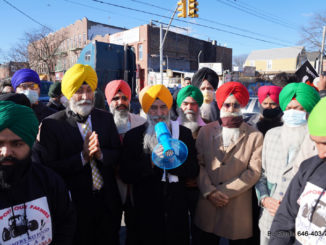
    Picture of rally organized by Gurdwara Baba Makhan Shah Lobana

    RICHMOND HILL, NY (TIP): Hundreds of Sikhs participated in a rally organized by the management of Gurdwara Baba Makhan Shah Lobana, one of the two largest Sikh shrines in New York, December 6. The Sikh community which hails from Punjab in India is deeply upset with the recent farm laws promulgated by government of India which, farmers allege,  go against their interests.

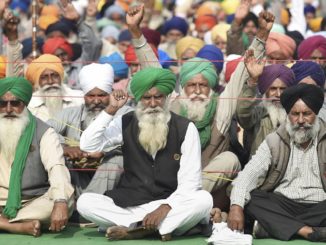
    In India, Punjab farmers have been demanding repeal of these laws since their promulgation in June 2020. When the government of India did not consider their demand, they decided to go to the national capital Delhi to demand justice. They have been on sit in for a fortnight now, joined by farmers from all over India.

    They have made their intentions clear to government of India that they will not be satisfied with anything less than the repeal of the anti-farming and anti-farmer farm laws.

    Punjabis the world over have expressed their solidarity with the agitating farmers I India. In New York and New Jersey, a number of rallies have been held, and more are planned.

  • Government of India continues to play its game to derail farmers movement

    Government of India continues to play its game to derail farmers movement

    By Prof. Indrajit S Saluja

    Continuing with their tactics of delaying acceptance of the demands of farmers to repeal the farm laws enacted in June, 2020, government of India has once again engaged the agitating farmer leaders in an exercise in futlility. It is quite clear that government, as usual, believes the agitators will get tired and will turn against their leaders spearheading the struggle for securing justice for the farming community, and also for the consumers of farm products across the country. It is well known how government of India is well versed in the art of dividing people. One can discern it in their characterization of the struggle as a Sikh or Punjabi struggle which is so untrue. It is struggle of all farmers regardless if their faith. Again, government is trying to project it as a struggle of a people of a region- Punjab. A blatant lie. It is a struggle if farmers of all regions in India. I know the farmers’ leaders leading the struggle are a mature people. But I must remind them that they must not fall to the machinations of the government which is hell bent on failing the people’s movement , the like of which no government has witnessed in more than half a century, since the movement under Jai Prakash Narayan during Indira Gandhi’s emergency days.

    It should remind this government which is so insensitive to the people of the country that no government is strong enough to face the onslaught of  the collective power of a united people. Hope, better sense will prevail with the power drunk government of India before it is too late.

  • Turn to Guru Nanak to end the world’s woes

    By Prof. Indrajit S Saluja

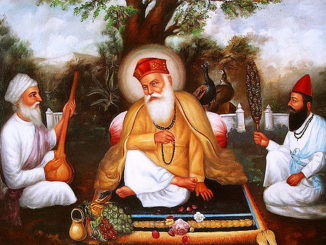
    As the Sikhs across the world get ready to celebrate the 551st birth anniversary of their First Master Guru Nanak Dev Ji, it is pertinent to ask if the Great Master’s message is kept in mind while celebrating the momentous event in Gurdwaras. and elsewhere. The universal message of Guru Nanak has always had relevance. It is more relevant today when the world is getting more and more strife ridden and people are taking to the path of hatred and violence, forgetting the virtues of love and peace. Guru Nanak, more than five hundred years ago, preached a philosophy that could rid the world of much of its ailments and miseries. He preached universal brotherhood. He declared that he recognized human race as one. “Maanas ki jaat sabhe eke pahchanbo”, he said.

    Again, he said, “Na ko bairi, nahe bigana, sagal sang humko ban aayee” which means there are no strangers. I am on terms with all. Peace, harmony, love were the virtues Nanak gave value to. In fact, in recognizing human race as one, he was only taking forward the old Indian idea of “Vasudhaiva Kutumbkam” which means the whole world is a family. In Guru Nanak’s times in India, there were two major religious groups- the Hindus and the Muslims. The latter came to India as invaders and forced many Hindus to convert to Islam. There was natural hatred amongst the Hindus for their Muslim oppressors.

    Guru Nanak raised his voice against the tyranny of the Muslim rulers but never became a part of the hate campaign. He had two constant companions- one a Hindu –  Bala, and the other, a Muslim –  Mardana. He gave out a message of love and oneness of humanity in having the two of them from rival faiths. It is said when Guru Nanak left this world his body was claimed by both the Hindus and the Muslims for the last rites. Kartarpur Sahib in now Pakistan where Guru Nanak Dev breathed his last has a gurdwara and a majar at the same place, and both the Sikhs and the Muslims visit the holy shrine to pay their obeisance to the man who preached oneness of humanity. We need a Guru Nanak today. And we can find him in his teachings. The world can certainly become a better and a more beautiful place to live in if we turned to Guru Nanak for guidance on the art of living in love and peace as brethren.

  • GURU NANAK: POET PHILSOPHER FOR OUR TIMES

    GURU NANAK: POET PHILSOPHER FOR OUR TIMES

    Guru Nanak offers us a strong and enduring infrastructure with fellow beings. We remember him, we imagine him,

    By Dr. Nikky-Guninder Kaur Singh

    and we praise him for breaking barriers; innovatively and gently he guides us to envision the single Reality – timeless, formless, fearless, who cannot and must not be confined to any sect or religion. Men and women of all ages, stages of life, sexual orientations, and religious backgrounds are inspired by his “magical” personality and “magical” words. They are magical for sure, precisely because they are so real, applicable, and empowering. The Guru Nanak Effect surges across multifarious channels and moves us to embrace fellow beings. Seeing our self in the other is what Guru Nanak’s spiritual, philosophical, and musical renditions bring about.

    Guru Nanak’s 974 hymns recorded in the Guru Granth Sahib are an extraordinary philosophical gift for humanity. In his spiritual lyrics our magical shair-dhadhi conjoins verbal language and musical sound. Each simple brief passage is so richly packed that it can be utilized to navigate any aspect of life at any stage. Guru Nanak’s timeless verse infiltrates precise historical moments and emotions to generate new values, new attitudes, new orientations, new social and cosmic relationships.

    Guru Nanak’s philosophy is grounded in his ontological experience of Reality—that of the One infinite reality, Ikk Oan Kar. Whether it is Being, Knowledge, Beauty, Morality, or Liberation, the philosopher Nanak approaches these perennial issues as a poet. The word “method” is a composite of meta (after) and hodos (way) and in Guru Nanak’s method, philosophy and poetry are not at odds with each other. Plato may have found poetry too captivating and therefore banished the poets from his Republic, but the divinely inspired Guru tried to awaken his followers and revitalize their senses, psyche, imagination, and spirit through poetry. Across his oeuvre the Guru’s intimate experience of the infinite One is fused with his keen philosophic pursuit towards an ever-widening Reality. As he interrogates, analyzes, criticizes, and wonders, he perfectly illustrates Wittgenstein’s maxim that philosophy ought really to be written as one “writes a poem.”

    In fact Guru Nanak identifies himself as a  “poet” (shair):  “my breath, my flesh, my very life is Yours, You are my absolute love, and this is what poet (sairu) Nanak says, You are our true provider—sasu masu sabh jio tumhara tu mai khara piara, nanaku sairu ev kahatu hai sache parvadgara” (GGS: 660). He also calls himself a “songster” (dhadhi):  “a  dhadhi of low caste—hau dhadhi ka nic jati (Asa di Var, 9).  These self-references introduce us to a most humble personality; the living breathing corporeal figure is before our eyes, with each pore saturated in the Divine. He is the picture-perfect image of his supreme moral value “sweet humility, Nanak, is the core of virtues and good deeds” (GGS: 470).

    Guru Nanak’s 974 hymns recorded in the Guru Granth Sahib are an extraordinary philosophical gift for humanity. In his spiritual lyrics our magical shair-dhadhi conjoins verbal language and musical sound. Poetry is universal to begin with, and set in musical measures enhances their access to audiences who may not know the language. Cosmic melodies, sounds of nature, musical instruments, and biological rhythms reverberate across Guru Nanak’s mesmerizing repertoire. Completely taken by his awareness and love for the universal Divine the Guru has no control over his words: “jaisi mai ave khasam ki bani taisara kari gianu ve lalo—as comes to me the Husband’s word, that is what I say O’ Lalo!” (GGS: 722).

    Paradoxically, his spontaneous speech ends up being most philosophically meaningful and aesthetically effective. His melodious ensemble is full of vibrant spiritual, emotional, social, and political resonances. Each simple brief passage is so richly packed that it can be utilized to navigate any aspect of life at any stage. Guru Nanak’s timeless verse infiltrates precise historical moments and emotions to generate new values, new attitudes, new orientations, new social and cosmic relationships. The Guru has gifted us an inexhaustible reservoir that diverse cultures can keep feeding on for generations. For instance we can draw upon the following Nanakian metapahysical, ethical, and artistic values:

    1. For our dangerously divided and polarized world, what could be more valuable that Guru Nanak’s philosophical vision of Ikk Oan Kar – One Being Is? The primary number ‘1’ is immediately recognizable to people of all languages and cultures. The transcendent Divine is without any borders — linguistic, spatial, temporal or gender. The singularity and unity of the Divine is reproduced over and over in his hymns. We need to get a real feel for the oneness because without it we cannot implement our social, political, economic, and environmental policies. How do we bring about change in our global world today? Only when we align ourselves with That One will we take constructive steps towards equality, healthcare, education, and ecosystem.

    Moreover Guru Nanak’s philosophy is life affirming. This world is sacred because the divine One is everywhere. Human life is precious “like a diamond” (hire jaisa). Therefore we must ethically live out our diamond like qualities. We exist authentically by attending to ourselves, to our family members, to our communities, and to the world at large. The temporal world is a part of the Infinite One and partakes of its characteristics. The deeper our awareness of the Divine, the more vibrant is our participation in the everyday affairs. We are grounded in our social context. Guru Nanak’s ideal fits in perfectly with our secular lifestyles, for we do not need to give up our families, professions, or hobbies. Our human obligation is to refine our mental, emotional and spiritual faculties so that we construct a better world for all of us, and for our future generations. All of us are equally responsible.

    2) Guru Nanak’s artistic language is full of love. Without “teaching” as such, his beautiful lyrics train us to appreciate and absorb this healthy and wholesome emotion. His words go beyond discords of Sanskrit and Arabic, polytheistic and monotheistic, eastern and western, ancient and modern, classical and vernacular, human and cosmic. When we familiarize ourselves with Allah, Khuda, Nirvana, Banvari, Hari… we sweat out toxic hostilities and begin to feel the different features of our shared humanity. Different images and symbols from respective religious and cultural backgrounds come together harmoniously in his calligraphy of love. How could there be communal bloodshed when we share our universal language?  Since the infinite source is the Beloved — piara — whatever ensues and however it ensues, has to be love. Multi religions and multi cultures and multi languages sonorously play in Guru Nanak’s philosophical poetry.

    3) Guru Nanak charges everyone—equally to make this world a better place for all of us. He rejected the customary four-fold division of Indian society into Brahmins, Kshatriyas, Vaishyas, and Shudras, along with its division of life stages brahmacarin, grahastha, vanaprastha, and sanyasin (varna-ashrama-dharma). Diametrically opposed to the fourfold societal hierarchy and its corresponding privileges, duties, and responsibilities, he postulates the same morality for people of all classes, races, faiths, and ages. The Guru categorically says that there is only one Dharam: “eko dharam” (GG: 1188).   The mutually exclusive scripts that were enforced on people simply on the basis of their biological birth are obliterated. Everyone is equally impelled to perform their ethical duty throughout their entire life. The Kshatriya is not obligated to take up arms for justice, nor the White Man to carry out his burden. Hearing, singing, reciting, and experiencing his verses free us from the conventional codes that smother self-worth and self-realization, and motivate each one of us to actualize our human potential. His philosophical poetics offers a compelling critique of the ancient caste system, untouchability, religious divisions, and basic human degradation. We are inspired to fight against patriarchal “isms” of classism, ethnocentrism, racism, and sexism that continue to fester our modern society.

    4) He offers an exciting bridge between religious studies and natural sciences, which remain divided in our contemporary society. Recurring verses fill us with curiosity about our cosmos and the myriad species: “vismad dharti vismad khani – wonderful earth! Wonderful species!” (GGS: 464) The Guru ushers us into a magical space where we become epistemologically open-minded and discover new tracks. Similarly, “patala patal lakh agasa  — worlds below worlds millions of spheres beyond spheres” (Japji: 22) shifts our attention from a geocentric model of the universe to the ultramodern view of “multiverse” (multi as distinct from universe). It is as though the Guru were offering us a sneak preview of the highly sophisticated technological view from the New James Webb Space Telescope! The knowledge of infinity destroys all kinds of limitations and prejudices, and creates an all-accepting and welcoming attitude. Guru Nanak’s verse is like entering a planetarium: its mystery and thrill leave us wide-eyed. Overall, Guru Nanak’s poetic repertoire verse offers a sumptuous variety of images, symbols, and metaphors that have the potential to help readers realize the countless resources of our common humanity. The literary devices integrate the intellectual faculties with the aesthetic, axiological, and emotional self.  Absorbing them fosters morality. For our shair-dhadhi an aesthetic experience of the ambrosial poetry was the only avenue to real change. It would make the inner circuits and impact external conduct. The aesthetic experience is neither antithetical to the metaphysical doctrine of Oneness, nor antithetical to moral behavior; rather, it is the mechanism for ethical and spiritual growth.

    In the 21st century how easily we connect over Email, Twitter, Skype, WhatsApp, Facebook, Instagram… But do we connect emotionally and spiritually? Guru Nanak offers us a strong and enduring infrastructure with fellow beings. We remember him, we imagine him, and we praise him for breaking barriers; innovatively and gently he guides us to envision the single Reality – timeless, formless, fearless, who cannot and must not be confined to any sect or religion. Men and women of all ages, stages of life, sexual orientations, and religious backgrounds are inspired by his “magical” personality and “magical” words. They are magical for sure, precisely because they are so real, applicable, and empowering. The Guru Nanak Effect surges across multifarious channels and moves us to embrace fellow beings. Seeing our self in the other is what Guru Nanak’s spiritual, philosophical, and musical renditions bring about. The founder Guru’s 551st birth anniversary  is but the beginning of exciting new encounters….

    Gurpurab Mubarak!

    (Author of scores of  books, Professor Nikky-Guninder Kaur Singh is Chair of the Department &  Crawford Family Professor of Religion, Colby College, Waterville, ME. USA.)

  • Guru Nanak Dev Ji, The Prophet of ONENESS of Humanity

    Guru Nanak Dev Ji, The Prophet of ONENESS of Humanity

    Guru Nanak Ji was the pioneer, enunciating the cause of Inter-Religious Peace and Harmony. His Tenets emphasize upon truthful living, humility, liberty, equality, justice, compassion, honest earning, serving the needy selflessly and protecting the weak and the meek. All this, he said would be tantamount to a Divine Life and real, true, actual worship and attainment of God and fulfillment of the purpose of human-birth. Guru Nanak was on a Divine Mission. He was a Spiritual Maestro, a Renaissance-Man, a Crusader for Interreligious Amity, an extraordinary social-reformist much ahead his era and yet he utters the absolute TRUTH that “he is, what he is, ONLY because of the Gracious Mercy of The Almighty and he is nothing without GOD”. In other words, Divine Guru is teaching humanity to embrace humility, by refraining from self aggrandizement.

    By Amarjit Singh Anand

    GURU NANAK, the Enlightened one says there is ONLY ONE OMNISCIENT, who is always there, here and everywhere for all and OMNIPRESENT in all. The Divine Guru says GOD can be realized by humans in different ways and GOD is worshipped and known by innumerable HOLY NAMES, as per the experience of the devotee. GOD existed from time immemorial, before the Prophets were born and before the Scriptures and Religions. GOD is the ETERNAL energy, power, origin and source of every creation.  After the Divine-Merger of the Prophets, GOD granted immortality to the Prophets because they disseminated the REAL TRUTH about the TRUE ONE. Guru Nanak Ji was the pioneer, enunciating the cause of Inter-Religious Peace and Harmony. His Tenets emphasize upon truthful living, humility, liberty, equality, justice, compassion, honest earning, serving the needy selflessly and protecting the weak and the meek. All this, he said would be tantamount to a Divine Life and real, true, actual worship and attainment of God and fulfillment of the purpose of human-birth.  Guru Nanak reformed several tyrannical rulers, vociferously advocated human rights and women’s rights, brought about social revolution, by speaking out against slavish mentality, superstitious beliefs, hollow ritualistic practices, religious bigotry and suppression of the downtrodden social and economic classes.  For over a thousand years, India was invaded by a small bunch of horse-riders, from Mongolia, Persia, Afghanistan, and other regions. Taimur, Ghazni, Ghori, Nadir Shah, Abdali, Durrani, Babar, Sher Shah Suri are only a few of those invaders, who plundered Hindu Temples, looted gold, took women and children as slaves, killed all and sundry who crossed their path.

    And then, in Circa 1469, appeared a man on earth, the likes of whom are seen, once in a millennium. GOD sent GURU NANAK, The Divine Preceptor of ONENESS of humanity and the epitome of humility to HEAL humanity. He was blessed by The Creator, to win the hearts of all, and to bring about massive transformation, wherever he went. The Divine Preceptor traversed various continents, 27000 miles in 25 years of his 70-year sojourn on this planet, fostering Goodwill amongst races, cultures, religions.

    Two of the ten Gurus had to take up arms, to protect the masses from the extreme persecution and tyranny of the ruling elite. The sixth Guru Hargobind Sahib Jee and the tenth Guru Gobind Singh Jee, with their disciples were the Saint Warriors. The fifth Guru Arjan Sahib Jee and the ninth Guru Tegh Bahadur Jee embraced martyrdom, for refusing to follow the diktat of the barbaric regime. Such events forced the sixth and tenth Gurus to raise a martial force, the army named The Khalsa.  Guru Nanak Jee enunciated the Divine Tenets thus : “Human interactions must be replete with *Divine-Love & Godly-Light*, Lifelong-Learning,  Humanitarian-Service, Spirit-of-Sharing,  Peace, Amity, Goodwill, Tolerance, Harmonious Coexistence, Acceptance and Understanding. He traveled far and wide, to have discussions with Saints professing divergent faiths and he collected their spiritual poetry to be included in The Scripture, Guru Granth Sahib Ji, much later, by his fifth embodiment, Guru Arjan Sahib Ji.

    Guru Nanak Sahib Jee says : “I do not know how and what to speak. I utter only that, which YOU, O’ GOD, command me to churn out”. Guru Sahib says GOD is the bestower of ALL BLESSINGS. Guru Nanak claims NO credit, whatsoever and says, “the earth is ONE global family and all creatures and creations come from OUR CREATOR, The Only Omniscient One”.

    To me, the most significant element of the Divine Persona of Guru Nanak Ji is the HUMILITY factor. Guru Sahib says : “O’ GOD, I am a beggar at the gate of Your Palace. I am a minstrel singing at Your Door. Forgive this ignorant one, as I have committed innumerable sins. I am a slanderer, a fraudster, a liar, a schemer, a lustful being. Therefore, my Supreme Master, please pardon this sinister creature, by not taking into account my sins, for if accounting is done, I would not stand even an iota of a chance, to be pardoned. So, I seek Your Mercy”. Due to such inherent humility, the SOUL,  which was named GURU NANAK, was endowed with Divine Wisdom, by GOD.

    Guru Nanak was on a Divine Mission. He was a Spiritual Maestro, a Renaissance-Man, a Crusader for Interreligious Amity, an extraordinary social-reformist much ahead his era and yet he utters the absolute TRUTH that “he is, what he is, ONLY because of the Gracious Mercy of The Almighty and he is nothing without GOD”. In other words, Divine Guru is teaching humanity to embrace humility, by refraining from self aggrandizement

    To say that Guru Nanak was the “Founder of Sikhism” would be a travesty of the larger truth. His reach and depth of thought was expansive as the unfathomable ocean and limitless sky. Similarly, the Divine teachings of Sree Ram Chandra , Sree Krishna,  Moses,  Jesus, Hazrat Mohammed, Gautam Buddha, Tirthankar Mahavir and all Prophets are for the entire humanity and not merely for those who say they are the followers of a particular Prophet. All Prophets were expansive in their Vision & Mission, whereas the disciples have limited them in a House of Worship and have started asserting the supremacy of one Prophet over others. The Prophets invested their life for Unification but the followers started discrimination. The PROPHETS are in absolute PEACE with each other and enjoy Ultimate Communion with GOD. Guru Sahib taught humanity to deal in the True Business of making concerted endeavors towards fostering Peace, Equality, Liberty, Justice, Compassion, by shunning all varieties  of discrimination, domination, bigotry, tyranny, bias and prejudice.

    Guru Nanak says “Do NOT worship me, I am not GOD. If you so desire, then follow my humble advice to lead a Pure, Holy, Pious, Divine Life and this, in itself, shall be tantamount to realizing and attaining GOD, residing within you and in everyone. Do not brag about ANY intellect, talent, knowledge, education, comfort, luxury, power, authority, beauty, courage, ALL of which you have received from GOD, as a GIFT. Always remain humble and learn, as the term ‘SIKH’ denotes ‘a learner for a lifetime’ and share this knowledge with all. Earn honestly, serve selflessly, share compassionately. Remember GOD and shun cruelty and domination. Remember that NOTHING belongs to us, not even LIFE, which we have received on a LEASE-basis. Remember that DEATH could be lurking round the corner, waiting to strike, the very next moment. By cultivating such thought, we would refrain from harming anyone”.

    Imbibing such attributes would be real service to GOD, worshipping GOD, becoming GOD; not actually GOD, but feeling like GOD and feeling GOOD about the journey. The soul MUST return to The Origin, in the pristine, sublime form, just as it was, when it attained this human Body-Temple. By LIVING and LOVING thus, The SOUL (Aatma) would enjoy eternal communion with ‘The Parent-Soul’, GOD (Param-aatma). Living thus, is the Real, True Purpose of life. This is Mukti, Moksha, Nirvaan, Liberation, Salvation, Redemption, Emancipation. This is what can be termed as the Final, Absolute, Ultimate and True Destination, to arrive at which this Soul donned this human body-attire. Humans have the heart, with the emotion of empathy and compassion or hatred and violence, and the brain decides accordingly, asking the hands to take action and implement, execute the plan, either compassionate or evil-minded.

    Sree Guru Nanak Sahib Jee says : “There is One Light of Our Creator pervading in the entire Creation and in all Creatures”. The Divine Guru commands : “I am a mere speck of dust, at the feet of the Holy Saints and True Devotees of GOD. A disciple can rise to be the Guru”. And he, actually, bowed before his successor, while anointing him The Guru, and so did all successive nine Gurus, when their successor was anointed.

    (The author is a recipient of the Ambassador For Peace Award, from the Interreligious International Federation for World Peace N.Y., Affiliated to the United Nations. As the President of ‘Aspirations & Expressions’, he is the Initiator of ‘1GOD1humanity’ Accolades & ‘Guru Nanak Benediction’ Awards, presented to Honorees from ALL Religions, Cultures, Races, for their Endeavors towards a Divine Humanity.

    He can be reached at Amar1Ujagar1Pritam@gmail.com

    www.1GOD1humanity.org/events)

  • Punjab reaches out to US Investors : Organizes Investors’ Roundtable

    Punjab reaches out to US Investors : Organizes Investors’ Roundtable

    WASHINGTON (TIP): Ambassador Taranjit Singh Sandhu delivered a special address at the inaugural session of USA-Punjab Investors’ Roundtable 2020 on 17 November 2020. Chief Minister of Punjab, Capt. Amarinder Singh delivered the Presidential address and highlighted the expanding investment opportunities in Punjab in conversation with President & CEO of Mastercard Dr. Ajay Banga. Senior officials of Government of Punjab, prominent industry representatives, and eminent members of the Indian-American community in the US attended the Roundtable.

    Addressing a virtual USA-Punjab Investors Roundtable 2020 on Tuesday, he said that after months of lockdown due to the COVID-19 pandemic, Punjab’s economy is coming back on track, industry is back on its feet and migrant laborers have started returning. Punjab’s industries have opened up again, Singh said, adding that his government offers industry-friendly and investor-friendly policies. Inviting the investors to enjoy the state’s unique business-friendly culture that promoted entrepreneurship, Singh highlighted the followings:

    1. US is the top export destination for companies from Punjab. In 2019-20, Punjab’s export to the US was to the tune of USD 685 million amounting to approximately 12 percent of the state’s total exports.
    2. Asserting that Punjab is the preferred landing destination for overseas companies, Singh said that there are a number of industrial units which are coming from the US and different parts of the world.
    3. Pepsi and Walmart started their Indian operations in Punjab, he said, adding that more than 30 American firms including Amazon, Walmart, Quark, Cargill, Tyson, Schreiber, Pepsi, Coca Cola currently have operations in the state.

    Responding to Mastercard CEO Ajay Banga’s question, the chief minister acknowledged that he has differences with the Center on the agricultural bills. We are not against corporates but there has to be a regulation to protect the farmers and the long-standing relationship they have with the Arhtiyas (commission agents), he said, asserting that any attempt to do away with this system will not work. Singh said that his government had brought in bills in the Punjab Vidhan Sabha to negate the impact of the central farm laws and had also taken up the issue with Prime Minister Narendra Modi. In his remarks Ambassador Sandhu noted the opportunities that investors could utilize in Punjab, laying emphasis on the strong network of educational, vocational and scientific institutions in Punjab. “Punjab and the US can explore complementarities in many sectors such as agriculture & food processing, education, textile & garment, renewable energy, light engineering, pharma and IT,” he said.

    While urging investors to consider Punjab as a major investment destination, he lauded the strength of Punjab’s economy and its role in India’s economic growth. “For years, Punjab’s industries have proven to be reliable partners, and suppliers, to US giants like Walmart, New Balance, and even food chains, like KFC, Burger King, and McDonalds.” he said. Ambassador Sandhu applauded the Punjabi community in the US for acting as a bridge between India and the US, and reiterated the support of the Embassy in facilitating investments. The USA-Punjab Investors’ Roundtable 2020, held on  17-18 November 2020 was  organized by the Government of Punjab in coordination with Embassy of India, Washington D.C. and US-India Strategic Partnership Forum (USISPF) to showcase Punjab to prospective investors in the US. During the Roundtable, there was  a focus on five areas: Agriculture & Food Processing; Pharma & Medical Devices; Engineering & Manufacturing; IT & Startup; and Education.

  • Special Sikh jatha to Pakistan on Gurpurb: MEA

    Special Sikh jatha to Pakistan on Gurpurb: MEA

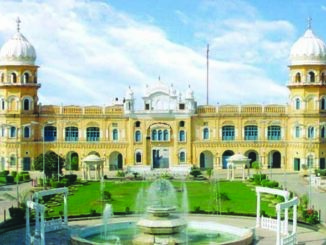
    New Delhi (TIP): India will send a special Sikh jatha to Gurdwara Janam Asthan in Nankana Sahib (Nov 27- Dec 1) on the occasion of the 551st birth anniversary of Guru Nanak Dev, Ministry of External Affairs (MEA) spokesperson Anurag Srivastava announced here on Thursday. However, there is no move yet to reopen the Kartarpur Corridor, he indicated. The visit of a truncated jatha will be as per the 1974 bilateral protocol between India and Pakistan. There is, no confirmation yet from the Pakistan side. Pakistan had in June unilaterally reopened the Kartarpur Corridor to commemorate Maharaja Ranjit Singh`s death anniversary, but India had rejected the offer owing to the pandemic.
    Officials say it has been over a year but Pakistan is yet to construct a bridge over the Budhi Ravi channel.

  • The Sikh Diwali: Bandi Chhor Divas

    The Sikh Diwali: Bandi Chhor Divas

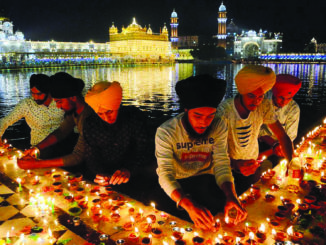
    The day marks the release of Guru Hargobind, along with 52 Hill Princes held in captivity by the Mughal ruler in Gwalior, and his return to Shri Harimandir Sahib in Amritsar.

    When Hindus and others celebrate Diwali, the festival of lights, Sikhs remember the release from prison and return to Amritsar of the sixth Guru, Guru Hargobind, in 1619. The name Bandi Chhor Divas means liberation of prisoners day.
    According to tradition, Guru Hargobind was released from prison in Gwalior and reached Amritsar on Divali. He would only agree to leave prison if 52 Hindu princes who were in prison with him could also go free. The Emperor Jahangir, said that those who clung to the Guru’s coat would be able to go free. This was meant to limit the number of prisoners who could be released. However, Guru Hargobind had a coat made with 52 tassels attached to it so that all of the princes could leave prison with him.
    The story reminds Sikhs of freedom and human rights and this is what they celebrate on Bandi Chhor Divas.
    Bandi Chhor Divas also honors the martyrdom of Bhai Mani Singh who was executed in 1734 because of his refusal to pay religious meeting taxes.
    GURU HARGOBIND’S DETENTION AND RELEASE
    Because of envy and unfounded accusations from the emperor’s court member Chandu Shah, Jahangir ordered the torture and execution of Hargobind’s father Guru Arjan Dev. Hargobind inherited what his father left and tried to bring greatness to his city.
    Guru Hargobind built the Sri Akal Takhat Sahib, “ The Throne of Almighty” and had also managed to strengthen his army. This became a warning signal for Murtaja Khan, Nawab of Lahore, who lied in his report to the emperor saying Hargobind was planning revenge for the death of his father. Upon hearing the report, Emperor Jahangir ordered the arrest of Hargobind through Wazir Khan and Guncha Beg.
    But Wazir Khan was secretly a follower of the guru so instead of arresting him, he asked Hargobind to go visit the emperor. During the first meeting of Guru Hargobind and Emperor Jahangir, Jahangir was captivated by the purity and charm of the young guru.
    The emperor asked the guru which religion was better, Hinduism or Islam. Jahangir was impressed with Hargobind’s answer, which was to recite lines from an Indian mystic and poet named Kabir, whose writing influenced Hinduism. In a hunting expedition, Guru Hargobind saved the life of Jahangir from a lion attack and this eventually started their friendship.
    When Jahangir became very ill while staying at Agra, Chandu Shah who hated Arjan Dev and Hargobind, tricked the emperor by devising a plan to detain the young guru. Shah instructed the astrologers to tell the emperor he would only be healed if a holy man will go and stay at Gwalior Fort and continuously pray for him. Shah also suggested Hargobind was the only man fit for the task. The emperor asked Hargobind and complied with his request. Guru Hargobind discovered that Gwalior Fort wass a prison, but still he complied with the emperor’s request and prayed for Jahangir’s health accompanied by the noble prisoners. It was unclear as to how long the guru was detained but he made significant improvements in the prison because the fort’s governor was also his follower.
    After some time, Guru Hargobind’s followers, headed by Baba Buddha, became concerned about his detainment and asked the now healed emperor for his release. It was Sufi saint Sai Mian Mir who brokered and convinced Emperor Jahangir to eventually release the guru from detention. But Guru Hargobind had one condition, he shall be released together with the Rajput princes in detention. Jahangir who was reluctant at first, but eventually agreed with the condition that only those who can handle his cloak or chola on his way out can be released. Intelligently, Guru Hargobind devised the tailoring of a heavy and long cloak which had 52 tails for each prisoner to hold on to. The guru, together with the 52 princes, was eventually released. Guru Hargobind returned to Amritsar on the day of Diwali, to a grand reception at Shri Harimandir Sahib.

  • Pak court jails spokesperson of Hafiz Saeed-led JuD for 32 years in terror financing cases

    Pak court jails spokesperson of Hafiz Saeed-led JuD for 32 years in terror financing cases

    Lahore (TIP): A Pakistani anti-terrorism court has handed down 32 years of imprisonment to Yahya Mujahid, spokesperson of Mumbai attack mastermind Hafiz Saeed’s Jammat-ud-Dawah (JuD) terror group, in two terror financing cases. The Anti-Terrorism Court (ATC) here on Wednesday also convicted two other JuD leaders, including the brother-in-law of Saeed, in terror financing cases.
    “ATC Judge Ijaz Ahmad Buttar handed down 32 years’ imprisonment to JuD spokesperson Yahya Mujahid in two FIRs. Prof Zafar Iqbal and Prof Hafiz Abdul Rehman Makki (brother-in-law of Saeed) were awarded 16-year and one-year jail terms in two cases,” a court official told PTI.
    He said that the two other JuD leaders – Abdul Salam bin Muhammad and Luqman Shah – were indicted in more terror financing cases. The court directed the prosecution to present its witnesses on November 16. The suspects were presented in the court in high security and media was not allowed to enter the court premises during the case proceedings. Last week, the ATC Lahore convicted JuD’s Hafiz Abdul Rehman Makki, Zafar Iqbal and Muhammad Ashraf in two more cases of terror financing registered by the Counter Terrorism Department (CTD) of Punjab police. Zafar Iqbal and Muhammad Ashraf have been given a collective imprisonment of 16 years each under different sections of the Anti-Terrorism Act. Makki has been sentenced to one-year imprisonment in a case with a fine of Rs 1,70,000. In September last year, the ATC Lahore handed down over 16 years’ imprisonment to Prof Zafar Iqbal and Hafiz Abdus Salam bin Muhammad and one-and-a-half-year sentence to Makki in a terror financing case.
    In February last year, Saeed had been sentenced to jail for 11 years on terror finance charges by an ATC in Lahore.
    The ATC sentenced Saeed and his close aide Zafar Iqbal to five-and-a-half years each in two cases. A total of 11 years’ sentence will run concurrently. Saeed is serving his term in Lahore’s Kot Lakhpat jail. He was arrested in July last year. The CTD of Punjab police had registered 23 FIRs against Saeed and his accomplices on charges of terror financing in different cities of the province.
    Saeed-led JuD is the front organisation for Lashkar-e-Taiba which is responsible for carrying out the 2008 Mumbai attack that killed 166 people, including six Americans.
    The US named Saeed as a Specially Designated Global Terrorist, and the US, since 2012, has offered a USD 10-million reward for information that brings Saeed to justice.
    He was listed as a terrorist under the UN Security Council Resolution 1267 in December 2008. PTI

  • Avenue in Richmond Hill to be named Guru Nanak Way in honor of the First Master of the Sikhs

    NEW YORK (TIP): New York City has decided to name 97 Avenue between Lefferts and 117 Street in Richmond Hill, NY as Guru Nanak Way. The commemoration ceremony will take place on November 30, the day of Guru Nanak Dev Ji’s 551st birth anniversary. Council member Adrienne Adams, Assemblyman David Weprin and other elected officials are expected to join, as also Sikh leaders from all over New York. Council member Adrienne Adams who represents the Richmond Hill  area in New York City Council had initiated the move and was joined by several others in the City Council.Earlier last month, 101 Avenue , from 111 Street to 123 Street was named as Punjab Avenue. The Punjabi community has a strong presence in Richmond Hill where there are two major Sikh places of worship known as Gurdwaras.

  • Bihar has strong message for Opposition

    Bihar has strong message for Opposition

    The results of the Bihar elections have a message for all states headed for polls in the months ahead on taking on the BJP under Modi.

    By Neerja Chowdhury

    Bihar has sent a strong message to the Opposition parties. They will have to combine effectively to have any chance of taking on the Modi-led BJP in states going to the polls. The RJD’s alliance with the Left parties in Bihar— CPI(ML), CPI(M) and CPI— did well, leading to a high strike rate.

    Even though Nitish Kumar has been weakened, the BJP will find it difficult to replace the chief minister with one of its own, having burnt its fingers in Maharashtra, where Uddhav Thackeray, denied the chief ministership, joined hands with the Congress and the NCP. The BJP is expected to tread more carefully in Bihar after the outcome.

    Economic distress of an unprecedented kind, compounded by a health pandemic of the last nine months, the migrant march of lakhs of workers on foot with probably the largest number walking back to their villages in Bihar, incursions made into Indian territory by China in the last few months which could have created a nationalistic upsurge against the government, palpable anger against Chief Minister Nitish Kumar that was evident — if these could not bring about a change of government in Bihar, it only shows that the other factors were more dominant. This when, in this instance, there was a clear alternative in Tejashwi Yadav leading the charge on the Opposition side and getting a popular response.

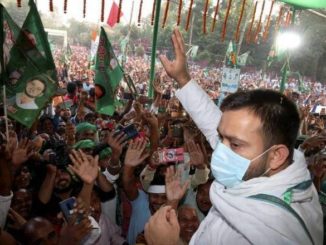
    Clearly, Brand Modi managed to slow down the Tejashwi chariot, though it was a closely run race. And Tejashwi, though not able to form a government in Patna, has established himself as a leader of the Mahagathbandhan at the age of 31. He set the terms of the poll narrative when he flagged ‘joblessness’ as the central theme of Bihar 2020, for the first time giving an economic — and aspirational — spin to caste which has determined poll outcomes in Bihar for three decades and more.

    Given the downturn in the economy, creation of jobs is increasingly going to find resonance, particularly among the young, as also in other states going to polls in the next few months. The first phase of the election was going the Tejashwi way. The turning point came with Narendra Modi’s invocation of ‘jungle raj’ of the Lalu Yadav-Rabri Devi years. This sent those among the most backward castes and women, who were beginning to look at Tejashwi with new eyes — Yeh naya ladka hai— scurrying back to the NDA again. The upper castes are anyway more enamored of the Hindutva, nationalist theme than of any economic hardship, and stayed by the BJP’s side.

    Bihar has reinforced the invincible image of Narendra Modi. He swayed the voters in national elections. This was not always the case in state polls. The BJP did not make it in many states, be it Maharashtra, Jharkhand, Telangana, Andhra Pradesh, Karnataka, Delhi, Rajasthan, Madhya Pradesh and Chhattisgarh. In Bihar, the Prime Minister made a difference to the poll outcome. The Bihar strategy may help the BJP in states which are going to the polls in the coming months — in West Bengal, Assam, Punjab, Kerala and then UP in 2022. It combined Modi’s undimmed popularity and sharp articulation, with Hindutva and nationalism (Ayodhya, Pulwama, Jai Shree Ram) as not so covert a theme, undergirded by a subtle appeal to certain castes. The PM has for some time now emphasized the help given to the poor by his government at the Centre, through the programs he has initiated. So, if money was transferred to the people in Bihar during COVID-19 times, they saw it coming ‘from Narendra Modi’ and ‘not from Nitish Kumar’. In the handling of the pandemic, which exacerbated the problems of the migrants, the Central Government successfully managed to shift the responsibility to the chief ministers. In Bihar, the BJP went one step further. It even managed to distance itself from the Bihar CM, even though it was part of the government headed by him. By going hammer and tongs at only Nitish Kumar, and urging the people to vote for the BJP, Chirag Paswan helped shield the BJP while directing the popular ire towards the CM. The BJP’s seats went up substantially, and those of the JD(U) came down, equally substantially. The BJP as the senior partner in the government will have its obvious advantages, and will increase its clout in the decision-making process.

    Even though Nitish Kumar has been weakened, the BJP will find it difficult to replace the chief minister with one of its own. Having burnt its fingers in Maharashtra, where Uddhav Thackeray, denied the chief ministership, joined hands with the Congress and NCP, the BJP is expected to tread more carefully in Bihar. For Nitish Kumar, with his reputation for doing ‘flip flops’, can always extend outside support to Tejashwi Yadav, if the BJP tries to replace him. Unless the BJP can, at a future date, break the JD(U), the Congress and wean away MLAs also from the RJD to form its ‘own’ government. But that does not seem to be on the cards for the moment.

    Bihar has sent a strong message to the Opposition parties. They will have to combine effectively to have any chance of taking on the Modi-led BJP in states going to the polls. The RJD’s alliance with the Left parties in Bihar— CPI(ML), CPI(M) and CPI— did well, leading to a high strike rate.

    Tejashwi Yadav might have just made it, had he not allowed Mukesh Sahni’s Mallah (Most backward)-based VIP party to leave the Mahagathbandhan over the issue of seat-sharing. This might have been possible had he given less seats to the Congress and accommodated the ‘VIP’ party and enabled Left parties to fight more seats, the ticket distribution based on the ground level strength of the parties today rather than on the position they enjoyed in the past. This Congress’ tally came down from what it was in 2015. While the RJD was able to transfer its votes to the Congress, the Congress could not ensure this for the RJD candidates. As it is, the Congress’ kitty does not have much to transfer.

    The five seats won by Asaddudin Owaisi, who did well in the Muslim-dominated areas of Bihar (Seemanchal) should come as a wake-up call for the Congress. The Muslims, who feel beleaguered and apprehensive, particularly with the way they have been targeted by the BJP, after the NRC, CAA and abrogation of Article 370, have looked to the Congress as the only party which would be able to take on the BJP nationally. For them to turn to Owaisi’s party which was not in a position to form the government in Bihar, being part of the small so-called ‘Third Front’, and not to the Congress, shows their growing sense of alienation from the grand old party. This is not good news for the Congress.

    The crisis — and drift — in the Congress is not likely to go away unless the party settles the question of its leadership, which is hanging out there unaddressed.

    Given the Bihar outcome, will the Opposition parties look afresh at the new challenge being mounted by a BJP determined to increase its footprint all over India, state after state, and go for one-party dominance in the country? Or will it remain business as usual?

    (The author is a senior political commentator)

  • Clash of Civilizations

    Clash of Civilizations

     Islam, more than any other religion, smells apostasy in rejection of its beliefs

    By Julio Ribeiro

    More than any other religion in our universe, Islam smells apostasy and insult in any rejection of its beliefs, however casual the intent of the culprit. In Muslim nations, the apostate would be put to the sword. In non-Muslim countries like France, the violent reactions of true believers would send out messages of dire consequences. The beheadings in Paris and Nice and the stabbings in the latter city were the responses of extremists who really believe that violent revenge would win them grace in heaven!

    The French have always been irreverent about anything to do with religion. Perhaps this almost national attitude to God and God’s attributes was a fallout of the French Revolution. It is not surprising, therefore, that French President Emmanuel Macron made an off-the-cuff statement that conveyed to the Islamic world that the French government would uphold the right of its citizens to dabble in cartoons of the Prophet.

    The issue arose because of the beheading of a Paris schoolteacher who had shown the cartoons drawn in a popular French magazine, Charlie Hebdo, a publication that specializes in political satire, to his pupils in a classroom. Ordinary Muslims take umbrage to the depiction of their Prophet in picture form. Cartoons, of course, are the worst form of picture depictions since the artist intends to draw wry humor which fragile minds cannot stomach. More than any other religion in our universe, Islam smells apostasy and insult in any rejection of its beliefs, however casual the intent of the culprit. In Muslim nations, the apostate would be put to the sword. In non-Muslim countries like France, the violent reactions of true believers would send out messages of dire consequences. The beheadings in Paris and Nice and the stabbings in the latter city were the responses of extremists who really believe that violent revenge would win them grace in heaven!

    What brought me cause for joy and hope was a body of local believers calling themselves ‘Muslims for Secular Democracy’, led by my friend Javed Anand, husband of an even bigger friend, Teesta Setalvad, who in castigating the beheading of the teacher, Samuel Paty, made secular liberals exult. Here, at last, was a group of moderate and sensible Muslims that knows that no religion and no God will condone the brutality of murder and mayhem.

    The very next day, to the consternation of the same secular liberals, thousands of Muslim protesters took to the streets of our cities, condemning France and its President for standing up to the legal rights of its citizens! Cinema houses in France and other countries of Europe have often screened films debunking some core beliefs of Christians regarding Jesus Christ, while hardcore Christians protested peacefully outside. Peaceful protests are par for the course in mature democracies.

    France enforces strict segregation of the Church from the State. In its schools, religious symbols like crucifixes are not displayed. They are, in fact, not permitted. In many Christian lands, the crucifix is prominently displayed above hospital beds — but not in France or the Nordic countries which pride themselves on their secularism.

    In his seminal work, The Clash of Civilizations, political scientist-cum-writer Samuel Huntington had predicted that the North-South divide between democracy and communism would be replaced by the East-West divide between the more populous but economically backward Muslim countries of the East and the established Christian-led economies of the West. The Islamic concept of a caliphate led to the establishment of the ISIS which tried to conquer lands and cities with economies based on oil revenues in Syria and Iraq and actually controlled vast territories in those lands for a decade. It established its capital in the Syrian city of Rakka, then under its control.

    A French journalist named Anna Erelle went undercover to befriend an Algerian-descended ISIS emir or captain of French nationality. Her book Undercover Jihadi Bride gives a fair account of the murders and beheadings ordered by ISIS forces in and around Rakka in the decade before the organization was ousted from the Middle East and its caliph killed by the joint forces of Syria, Russia and the US.

    The depredations linked to the ISIS should caution like-minded Islamic jihadist adventurers from dreaming of the unattainable! But they continue to dream and to feed on promises of rewards in the after-life made to them by semi-literate mullahs. Lacking secular education and skills to compete in a secular environment, they fall back on antiquated religious practices that can only lead them to despair and from despair to crime and from crime to destruction. Candidates to avenge perceived wrongs are never wanting. I have seen this in the Khalistani terrorist scene in Punjab. The emotional chord is one that is easily touched. It leads soldiers of terror to self-destruct sooner or later. The problem with jihadi terrorism is that it transcends boundaries and even geographies. The ISIS and the Al-Qaida attracted recruits from all over the Islamic world. The ‘ummah’, the brotherhood, provided the cannon fodder from among the gullible who were fired by visions of Islamic rule in the world, with the Sharia law dictating how men must pray and dress and eat and how women should be treated.

    In India, extreme elements of the Hindu right were disgusted with the terror strikes by jihadists in a land that had been populated from times immemorial by the Indo-Aryans and the people they had conquered but later assimilated into Aryan society at lower graded levels. These disgruntled elements decided to take matters in their own hands and give a befitting reply to their tormentors. But they went about the riposte in a very amateurish manner, with the result that they were soon discovered and put out of commission. The moral of the story is that the call to arms by extremist elements of any religious persuasion will be answered by disgruntled young men who have smelt insult to their religion and its culture. But those who answer the call will soon repent because those who want to live peaceful and conventional lives outnumber them by wide and convincing margins.

    (The author is a former Indian Police Services Officer)

    (Source: The Tribune, India)

  • CIC allows Centre to withhold list of documents, precious material seized during Operation Bluestar

    CIC allows Centre to withhold list of documents, precious material seized during Operation Bluestar

    New Delhi (TIP): The Central Information Commission (CIC) has allowed the Centre to withhold list of documents and precious material seized by a central agency during the 1984 operation at the Golden Temple in Punjab in which 576 persons, including Army personnel, were killed.

    An RTI applicant, Gurvinder Singh Chadha, had demanded from the Union Home Ministry list of all the material seized during the operation and its present status as well as all records related to the operation and list of all the persons who died during the operation conducted by the Army to flush out militants holed up inside the Golden Temple in Amritsar.

    Without giving the list and the specific details of the seized material, the ministry had said in its RTI response to Chadha that “about 4000 documents/books/files and gold /gold ornaments, silver/silver ornaments, precious stones currency, coins etc. were recovered by a central agency during the Operation Blue Star. The articles and documents were handed over either to SGPC or to the Government of Punjab”. “As per records available with this office, 493 terrorists/civilians and 83 Army officials were killed in Golden Temple area in June, 1984,” the home ministry further said. Dissatisfied with the denial of specific information about the seized material, Chadha filed first appeal within the ministry before a senior official who upheld the denial of information invoking Section 8 1(a) of the RTI Act. The Section allows the government to withhold information, disclosure of which would prejudicially affect the sovereignty and integrity of India, the security, strategic, scientific or economic interests of the State, relation with foreign State or lead to incitement of an offence. During the second appeal before the Central Information Commission, highest adjudication body in RTI matters, Chadha stated that a satisfactory response was not yet provided on points related to records of Operation Blue Star and a list of material seized during it.

    The ministry said a point wise response was provided to Chadha but the details sought pertained to confidential information, the disclosure of which could prejudicially affect the safety and security of the country. Agreeing with the home ministry’s view, Information Commissioner Y K Sinha held Chadha has sought “vague, ambiguous and generic information” which cannot be disclosed in terms of the provisions of the RTI Act, 2005.

    “Hence, no further intervention of the Commission is warranted in the matter,” Sinha said.

    The Shiromani Gurdwara Parbandhak Committee (SGPC) has been demanding the return of the artefacts, allegedly taken away by the Army during Operation Blue Star in 1984.

    Last year in June, SGPC chief secretary Roop Singh had said the holy scriptures, artefacts and historical books, which were part of the Sikh Reference Library, were taken away by the Army during the operation. When asked that a section of media had reported that the Centre had returned the artefacts to the SGPC, Singh had claimed that only a few copies of historical books were returned. He had said still a large quantity of material and handwritten copies of the Guru Granth Sahib were with the Centre.

  • Bank’s manager shot dead by security guard over ‘blasphemy’

    Bank’s manager shot dead by security guard over ‘blasphemy’

    Lahore (TIP): A senior manager of the state-run National Bank of Pakistan was killed by the bank’s security guard over the allegation of “blasphemy” in the country’s Punjab province, the police said on Thursday. Malik Imran Hanif, manager of the multinational commercial bank’s Quaidabad tehsil in Khushab, some 250 km from here, was shot by the bank’s security guard Ahmed Nawaz, retired Army personnel, on Wednesday morning.

    The deceased’s family said that it was a “cold-blooded murder” by the accused over a personal grudge, claiming that the guard took the cover of blasphemy to save himself.

    The manager was shifted to Lahore’s Services Hospital in a critical condition where he succumbed to his injuries on Thursday, the police said, adding that Nawaz has been arrested.

    According to senior police officer Tariq Wilayat, Nawaz claimed that he opened fire at Hanif after he committed blasphemy. “This claim cannot be verified at this stage. Police are probing the matter from all the aspects including the statement of the deceased’s family that Nawaz killed him to settle a personal grudge against him,” the officer said.

    Hanif’s family said Nawaz was fired a few months ago but he was subsequently reinstated. He nursed a grudge against Hanif over his sacking and both had a heated argument recently.

    Muhammad Razzak, another guard of the bank, told the police that after completing his nightshift, he was changing his uniform when he heard the gunshots. “I rushed towards the bank office where I found Hanif in a pool of blood and Nawaz fleeing,” he said.

    In a video posted on social media, Nawaz can be heard saying he killed the bank manager because he had committed blasphemy. Nawaz was seen being greeted by a crowd of supporters who also raised religious slogans and roamed in the city streets. Later, he surrendered himself before the police. Leaders of some religious groups addressed the mob from the rooftop of the police station where he surrendered himself. Police officials were seen standing helplessly. PTI

  • 8 Indian Origin Winners in British Columbia Assembly Polls

    8 Indian Origin Winners in British Columbia Assembly Polls

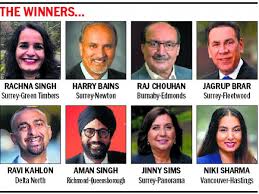
    OTTAWA (TIP): Eight Indo-Canadians, including a Sikh, have won elections in Canada’s British Columbia province as the ruling New Democratic Party (NDP) returned to power with a majority in the snap polls.The NDP led by Jagmeet Singh, the first Indo-Canadian to lead a major federal party in Canada, increased its 41-seat minority into a 55-seat majority in the 87-member assembly, according to preliminary results on Saturday October 24 night, which did not include more than 500,000 mail-in ballots.It is the largest NDP victory in British Columbia history, the Vancouver Sun newspaper reported.”While we wait for that final count to happen, I want to assure people that I’m going to keep the focus right where it belongs, on helping people get through this pandemic and making sure that they have the services that they need,” Premier John Horgan, who had called a snap election during the COVID-19 pandemic, said while addressing a victory rally in Vancouver.

    Aman Singh, a Sikh, defeated Jas Johal of the opposition Liberal Party in Richmond-Queensborough. “Thank you to the amazing residents of Richmond-Queensborough who I was able to connect with during this campaign. It has been a true honor to stand before you & hear about the issues impacting you & your families. I’m grateful to the team of volunteers who helped our team effort,” Mr Singh tweeted.

    Other prominent Indo-Canadian winners are Deputy Speaker Raj Chouhan, Labor Minister Harry Bains, Jagrup Brar and Ravi Kahlon. All are from the ruling party.

    Three Indo-Canadian women – former minister Jinny Sims, Niki Sharma and Rachna Singh – all from the ruling NDP – emerged winners in the polls.

    “I thank you to all the volunteers & everyone who have worked so hard to make my campaign possible. Thank you for your support, phone calls, donations & all the kind messages. I have met so many local residents – listening to many stories & learning about what matters to you,” tweeted Mr Chouhan, who secured victory in the Burnaby-Edmonds constituency.

    Bains, who won from Surrey Newton, also thanked people for his victory in the elections.

    “So incredibly grateful, humbled, and honored – thank you to the amazing constituents of Surrey-Newton for trusting me to be your MLA and to all of my friends & family for their unwavering support – we’ll keep BC moving forward for everyone!” he tweeted.

    Sims, who served as minister of citizens services in Horgan’s government but resigned in October 2019, defeated her fellow Punjabi Dr Gulzar Cheema. Sims, who emigrated to England from Punjab at the age of nine, and her husband moved to Canada in 1975.

    “Congratulations and thank you to all who ran for office and to all who voted. Special shout out to all our volunteers. My heartfelt thanks to my constituents in Surrey Panorama,” she tweeted.

    NDP leaders Kahlon and Brar won from Delta North and Surrey-Fleetwood constituency, respectively.

  • A Proud Moment for the Punjabi Community of New York

    A Proud Moment for the Punjabi Community of New York

    101 Avenue, in part,  is named Punjab Avenue

    RICHMOND HILL, NY (TIP): October 23, 2020 will go down as a red-letter day in the history of the Punjabi community of New York when a part of a busy Avenue was named as Punjab Avenue.

     101 Avenue , from 111 Street to 123 Street has been named as Punjab Avenue.

    The inauguration was done on Friday, October 23 by Councilmember Adrian Adams who had moved the  motion in the NY City Council for renaming of the Avenue, in view of the strong presence of the Punjabi community in the area. It may be mentioned that the two largest Sikh shrines (Gurudwaras are situate between Lefferts Boulevard and 113 Street. Besides, the entire stretch has businesses run by Punjabis.

    Among those present at the inauguration were Assemblyman David Weprin, managing committee members of Gurdwara Sikh Cultural Society and Baba Makhan Shah Lobana Sikh Center, and prominent members of the Punjabi community, including Herman Singh , President of Omni Mortgage, H.S. Toor, and Jay Jasbir Singh. Media was present in strength. A couple of TV channels, which included CBSWLNY , NY 1, and PTC TV, among others, and  Punjabi, Hindi and English language desi newspapers also covered the event.

  • India could yet lead the world on water conservation

    India could yet lead the world on water conservation

    Sandeep Chakravorty
    Photo:-Jay Mandal/On Assignment


    The author is sanguine that the creation of ministry of Jal Shakti by Prime Minister Narendra Modi will address the problem of inadequate access to safe water, removing the “extreme water stress felt by 600 million people in India”.- Editor

    By Sandeep Chakravorty

    The  biggest disruptor in the new government of Prime Minister Narendra Modi for India is by far the creation of a ministry of Jal Shakti. The merger of the ministries of water resources, river development, Ganga rejuvenation, and drinking water and sanitation brings about a much-needed integrated approach for India’s water issues. Water will be the limiting factor to India’s growth. According to a 2018 NITI Aayog report, 600 million Indians face high to extreme water stress and about 200,000 people die every year because of inadequate access to safe water. By 2030, the country’s water demand is projected to be twice the available supply, implying severe water scarcity for millions and an eventual 6% loss in the country’s gross domestic product (GDP). However, if the Jal Shakti ministry, the one ministry on which the future depends, achieves its objectives, all that will change.

    Addressing an election rally before the 2019 Lok Sabha polls, Prime Minister Modi said, “After constructing toilets and giving dignity to women, I will focus my next term on ensuring clean drinking water.” The creation of the Jal Shakti ministry and the adoption of an integrated approach to water issues formed part of the Bharatiya Janata Party’s vision. Gajendra Singh Shekhawat, the minister of Jal Shakti, has hit the ground running, adopting an inclusive approach by spelling out his vision of partnership with states. In his interview with India Today on 8 June, Shekhawat saw India’s water challenge as an opportunity to involve stakeholders. He is keen on the use of India’s traditional water conservation knowledge whose neglect has brought us to the precipice of a water disaster. He also promised “nirmal” or clean Ganga in two years.

    “Nal se Jal” (tap water) for everyone by 2024 is a delayed yet essential goal for India to break into the middle-income league and become a global economic power. It is not difficult to imagine how much economic activity this goal-setting will engender, potentially contributing billions to India’s GDP through the construction/rehabilitation of reservoirs, their linking, the laying of pipes and construction of tanks, among other civil works. Its impact on the nation’s health will also be transcendental, as most diseases in India are water-borne. Nal se Jal is also a natural companion of Swachh Bharat and the National Toilet Mission, which cannot be sustained without water availability in every household. The National Democratic Alliance government has achieved ambitious goals before, be it the 72 million Ujjwala connections, taking electricity to every village and 20 million households, constructing 92 million toilets in less than five years, and the opening of more than 300 million Jan Dhan accounts. Making piped water reach every household is daunting, but the ability to achieve it is there. It is absolutely “Mumkin hai” (possible). If not now, when?

    Only 4% of the available water in India is used for drinking, whereas 80% is used for irrigation with rampant inefficiencies. About 4,000 liters of water is used in Punjab to produce 1 kg of rice, though 300 liters is sufficient. The first charge of India’s water must go to drinking water, followed by crop and then industrial production. Furthermore, placing water on top of the conservation pyramid automatically leads to conservation of soil and forests, and forests make water. The mantra of water conservation is age-old and simple: hold it where it falls, in pits, wells, trenches, reservoirs or ponds. This prevents run-off and soil erosion, recharges aquifers and replenishes sub-soil moisture, critical for plant growth and survival. I speak from my experience in the early 1990s when I spent five years of my youth in rural India espousing soil and water conservation.

    Living in New York, I marvel at the city’s water supply system, which provides the world’s best potable water. Even restaurants serve tap water. The city has a network of conservation watersheds, reservoirs and aqueducts with almost 95% water supplied by gravity, conserving energy. Institutional frameworks exist for every aspect, be it conservation of the watershed, reservoirs, distribution and pricing. Watershed conservation is the central principle for providing drinking water. Even corporate water bottlers such as Poland advertise the watersheds they protect to promote their products. It is not a pipedream to expect such a reality in India.

    Many states have already undertaken path-breaking work. Telangana’s Bhagiratha project is worth emulating across India. Maharashtra’s Jalyukt Shivar Abhiyan has undertaken water conservation work in 16,522 villages. Unfortunately, rainfall has been poor this year, so the impact of the work is not felt. However, this is bound to change in the coming years when real water harvesting kicks in.

    There is also a great synergy between bringing water to all households and the socio-cultural-spiritual movements gaining ground in India around saving the rivers, spearheaded by people such as waterman Rajinder Singh and Jaggi Vasudev. As Vasudev recently said, “Jal Shakti is a landmark step for revitalization and conservation of our rivers and water bodies.” They are opinion makers and have far reaching influence on people. The merger of their objectives with national priorities augurs well for India. On the lines of the International Solar Alliance that India pioneered, we may lead the world on water conservation from Jal Shakti to Bharat Shakti to Vishwa Shakti.

    (The author is an Indian  career diplomat, presently posted as Consul General of India in New York. He can be reached at cg.newyork@mea.gov.in)

    This  article originally appeared in Live Mint and has been  reprinted, with some additions,  with the permission of the author.

  • Meet Narinder Singh Kapany- The Father of ‘Fiber Optics’

    Meet Narinder Singh Kapany- The Father of ‘Fiber Optics’

    NEW YORK (TIP): If we are getting access to ‘high-speed internet connection’, then it’s all because of Narinder Singh Kapany. Had it not been for Narinder’s exuberance, we wouldn’t have been surfing the blazing fast internet. Not only about the internet, Narinder was even able to stamp his authority on laser surgeries and high-speed communications. He is popularly known as the father of ‘Fiber Optics’. Narinder Singh Kapany was the first person in the world who introduced the term ‘Fiber Optics’.

    Hailing from Moga, Punjab, Narinder Singh announced his arrival to the world when he was born in 1927. He successfully graduated from Agra University and then went on to do PhD at Imperial College, London. He carried out an intense research not only in high-speed communications but also medical imaging from OFC networks to endoscopic to laser surgery. This goes to show that if there is no Narinder Singh, then there is no internet, no laser surgery and no high-speed communication.

    Narinder Singh, the Indian-born American physicist hogged the limelight for becoming the first person in the world to depict that light can travel in bent glass fibers. His research paper captioned “A Flexible Fiberscope, using Static Scanning” appeared in the scientific journal Nature in its January 2, 1954 issue and opened the door for instruments such as endoscopes and laser probes.

    Kapany then spiced it up by publishing his first paper in Optica Acta in February 1955 named ‘Transparent Fibers for the Transmission of Optical Images’. Kapany kept on continuing his good work. As an author, he published over 100 scientific papers and four books on optoelectronics. He has lectured to several national and international scientific societies. His famous article on Fiber optics in Scientific American in 1960 coined the new term (Fiber optics). The article adds up as the reference point for the subject even today.

    In November 1999, Fortune magazine had published profiles of 7 people who completely changed the life in the twentieth century. Kapany was one of the unsung heroes. We need to promote this hero who gave us the fastest internet connection which is in demand in the contemporary world. It has been a trend set that without internet, life on Earth would be boring.

  • Sikh Community on Long Island donates generously for Shri Guru Nanak Dev Ji Documentary

    Sikh Community on Long Island donates generously for Shri Guru Nanak Dev Ji Documentary

    JERICHO , NY (TIP) : Dr. Rajwant Singh who  is making a documentary on Shri Guru Nanak Dev Ji to mark the 550th birth anniversary of the founder of Sikhism, the newest and the fifth largest religion of the world, with a following of more than 25 million the world over, was in town to mobilize resources for his project.

    On Sunday, June 2, Dr. Rajwant met with the Sikh community leaders on Long Island and spoke  spoke about the documentary and appealed for financial support for the project. The ever generous and philanthropic community did not disappoint him.

    Dr. Rajwant Singh, Chair, Sikh Council on Religion & Education (SCORE) and the driving force behind National Sikh Campaign speaking about the project of a documentary on Shri Guru Nanak Dev Ji, in Jericho , Sunday, June 2At the fundraising for Dr. Rajwant Singh’s National Sikh Campaign, organized by Gurinderpal Singh Josan, Founder-President of Sikhs in America, Chairman Paramjit Singh Bedi, Vice Chairman Mohinder Singh Taneja, Vice President Brij Mohan Singh Nanda, and with the support of Surinder Singh Chawla, Dr.  Avtar Singh Tinna, Satnam Singh Parhar, Zinda Singh, SBJ Singh  and Virender Singh Sikka, among others, nearly $70,000 was raised, with commitment for more from some. Well known numerologist and astrologer Prem Jyotish pledged to meet the entire cost of post- production promotion of documentary.

    Dr. Rajwant Singh is also a  passionate environmentalist who has brought about a paradigm shift in the attitude of people of PUNJAB in India towards protection of  Environment by involving thousands of volunteers to plant hundreds and thousands of trees.

  • Educationist wins Rs157-cr suit in Oz: Was sued for admitting students by unfair means

    Educationist wins Rs157-cr suit in Oz: Was sued for admitting students by unfair means

    PERTH(TIP): A Punjabi-origin entrepreneur and educationist has won a major legal case in Australia that allows him to run his institution, Unique International College, besides making him eligible to receive a payment of 26 million Australian dollars (Rs 136.32 crore) which was withheld pending the court case.

    He is also eligible to get legal costs of another AUD 4 million (Rs 20.97 crore) from the commonwealth of Australia.

    The entrepreneur, Amarjit Khela, had won the case last week after a long battle in which he braved racism, defamation and several accusations, including that of unfair practices to attract students to his college. Khela has remained in news because of his phenomenal rise to become an educationist and an entrepreneur. He had gone to Australia as a student when he was 19.

    He belongs to Sajawalpur village in Nawanshahr district. Ninder Ghugianvi, media and cultural coordinator, Punjab Kala Bhawan here, in a statement, hailed the court order as the victory of Punjabiyat. “Khela fought for the rights of Punjabis to grow in the foreign land. His book titled “I don’t lie” described his struggle in Australia,” he said.

    He worked in restaurants and did menial jobs and later became the first Punjabi to own a college in Sydney. His college ran into controversy when the Australian Consumer Commission and a watchdog agency accused him of malpractices, including giving free laptops and other gifts to students.

    “My victory is the victory of truth and against racism and certain individuals who were against the rise of Punjabis or Indians in Australia,” he told The Tribune over the phone.

    As per the copy of the court orders, the Full Federal Court found that Unique International College did not engage in a system of unconscionable conduct in enrolling vulnerable students in diploma courses. Khela had lost the case in a lower court last year.

    The case had hogged limelight as the Australian consumer watchdog claimed to recover $140 million paid to the college under the Commonwealth funding scheme.

  • Punjab’s war on drugs

    Punjab’s war on drugs

    Giving a societal push to the Punjab Government’s war on the hydra-headed drug menace, are the villagers — the common people suffering the effects of the consumption blowback. There is hardly any home in the countryside that does not have a family shattered by an addict whose only interest is how to get his next fix, even going to desperate and often deadly extremes. His treatment leaves them penniless, and the children crying and uncared for, and at times, even orphaned. Shattered by the ruin and misery unleashed by drugs over the years, some villages have taken upon themselves the task of eradicating this deadly menace through vigilantism. They are nabbing alleged drug peddlers and handing them over to the police. A political leader has also spearheaded one such campaign.

    However well-meaning this practice may be, it is not without pitfalls. While being vigilant against a potential supplier of drugs, the people need to guard against going over the top. In mob fury lies the inherent danger of individuals tipping over to the side of vigilantism in the heat of the moment and taking law into their hands. The examples of recent lynchings in Maharashtra over rumors of child-lifting as well as some innocent people becoming victims of cow vigilantes are fresh. Rather than even one innocent person being victimized, law enforcement is best left to the government. After all, only the law enforcement agencies are equipped to tackle the drug mafia. Bringing the small fry in the net will not end the menace.

    The Amarinder Singh government has in the past couple of days unveiled a heady mix of strategies that promise to take on the problem of intoxication. Regular dope tests for all 3.25 lakh Punjab Government employees have been made mandatory as cases of drug-tainted officers, especially in the police, are coming to the fore with shocking regularity. Death penalty has been sought for the peddlers of illicit substances as an alarming number of people are becoming addicted to drugs as well as dying from them. Treatment and rehabilitation of addicts with a renewed goal figure high on its mission. Instead of the death penalty, a strict implementation of the existing NDPS laws is sufficient to take the problem head on.

    (Tribune, India)