Tag: Rajasthan

  • Modi’s claim of 400 plus seats entails 100% EVM-VVPAT

    Modi’s claim of 400 plus seats entails 100% EVM-VVPAT

    “Free and fair elections are fundamental to a thriving democracy. One of the foremost indications of that effect is citizenship participation in the democratic process. It is every citizen’s right and duty to vote in the electoral process. Through that participation, they help to build a better democratic system that could effectively serve the public. However, intimidation, corruption, and threats to citizens during or before an election are against the principles of democracy, and the same also holds true for manipulating the voter lists or the voting mechanisms. There ought to be transparency in the public square where those in power are genuinely accountable to the people, and the voters should be fully appraised of what decisions are made, by whom, and why.”

    By George Abraham

    Prime Minister Modi claims that their NDA coalition will win 400 plus seats in the upcoming Parliamentary elections that will take place in India starting April 19 of this year. Is it a panacea or a realistic assessment considering nationwide political dynamics? What is the purpose of making such exaggerated claims if they are not based on accurate data? Their history is replete with fraudulent claims and unscrupulous behavior. Why then should the public believe it now? Anyway, this whole public relations campaign may also be aimed at enthusing the cadres.

    Responding to their claim, Mr. Sam Pitroda, who is also known as the father of the Telecommunication revolution in India, retorted, “BJP can win more than 400 seats in the 2024 elections if issues associated with EVMs are not fixed “. In further expressing his concerns, Mr. Pitroda cited a report by “The Citizens’ Commission on Elections,” chaired by former Supreme Court judge Madan B Lokur and said that the main recommendations of the report were to modify the current design of the VVPAT System to make it truly “voter-verified.”

    It appears that the BJP leaders are engaged in a psychological warfare where people are being conditioned to believe that Modi’s victory is inevitable. It has dual purposes: one is to demoralize the opposition and dispirit their grassroots, and the other is to set up the stage for any illicit operations that would benefit the party before a desensitized electorate. Their strategy is apparently working.

    The public generally assumes that Modi’s third term is inevitable, and to them, it is just a numbers game as far as how big a majority his party could achieve. Is the Indian electorate so naïve as to believe a narrative created by the BJP without supporting facts? However, the BJP is confident that a public that believes in the ‘Gujarat Model’ can be swayed time after time and will fall prey to their deception once again.

    An entirely different picture might emerge if one looks at the electoral map. Their carefully crafted plans may have little impact in South India. With Karnataka going back to the Congress fold, BJP’s expectations of a repeat performance are quite unlikely. The victory in Telangana by the Congress and the BJP’s lack of an alliance with TRS may also spell trouble for the BJP there. In short, the BJP’s plan of building on the 2019 election results is indeed further complicated by the setbacks in these two southern states. With 130 seats distributed among the five states and the union territory in the south, the BJP’s chances of making any substantial gains in South India will remain as elusive as ever before.

    If we look at the poll results in the Northern States, the BJP almost swept them out, creating the current brute majority in the Loka Sabha. They have won all the seats in states like Gujarat, Rajasthan, Haryana, Himachal Pradesh, Uttarakhand, Delhi, and Tripura. In addition, Madhya Pradesh, Bihar, Maharashtra, U.P., Odisha, and Chhattisgarh combined for a whopping 92% of all seats gained by the NDA coalition. It was an incredible win that even the Political pundits have had a hard time explaining since that came at the heel of a disastrous mismanagement of the COVID-19 pandemic that killed more people in India than anywhere else.

    For any sane mind, that history will be hard to replicate. At present, the Modi regime is in the throes of a mushrooming corruption scandal involving Electoral bonds. If the current allegations of pay-to-play are proven, this BJP government may be one of the most corrupt administrations in the history of an Independent India. This is the party that came to power, putting the Manmohan Singh government on the defensive as regards a number of alleged scams. Yet, they have far exceeded in excelling in corrupt ways while covering up their misdeeds from the public’s view. Thanks to the Supreme Court, the public is learning much more about the crimes and the exploitation the country has been subjected to.

    For the BJP leaders, it is imperative that they stay in power not only to perpetuate their ideology and remake India in its medieval ways but also to be in the unenviable position of power where they will never be held accountable for their misdeeds and misgovernance. It is common knowledge that the economy for the man on the main street is not working that well. Rampant inflation, increasing unemployment among the youth, and persistent poverty at the lower end of the strata have all clouded the high GDP numbers India boasts about. The economy is working for the elites and the super-rich, who already own 40% of India’s wealth. It is crony capitalism at its best, joined at the hip by the governing establishment.

    There is a limit to one who can exploit religious sentiment to win votes. The euphoria over the Ram Janmabhoomi Kshetra may be just about dissipated. Patriot games using CAA and NRC may also have found their boundaries. Therefore, despite all the bravado about winning 400 or more seats, the BJP team must be worried, and their internal polls must have indicated the same. Therefore, they dwell on propagating this narrative about the upcoming massive victory, intending to inject inertia into the minds of the opposition while adding fuel to energize their cadre.

    Considering these circumstances, one should be overly concerned about whether the country will have free and fair elections. It doesn’t matter whether the electorate is dissatisfied or opposition parties run a well-rounded campaign if the will of the people is not truly reflected in the outcome. Some countries in the world would conduct pre-determined elections, whereas India stood as a champion of democracy, transferring power when people finally spoke through the ballot boxes. The question being raised by Sam Pitroda and others touches on this susceptible issue.

    Free and fair elections are fundamental to a thriving democracy. One of the foremost indications of that effect is citizenship participation in the democratic process. It is every citizen’s right and duty to vote in the electoral process. Through that participation, they help to build a better democratic system that could effectively serve the public. However, intimidation, corruption, and threats to citizens during or before an election are against the principles of democracy, and the same also holds true for manipulating the voter lists or the voting mechanisms. There ought to be transparency in the public square where those in power are genuinely accountable to the people, and the voters should be fully appraised of what decisions are made, by whom, and why.

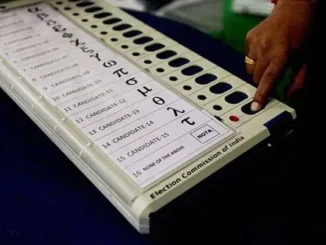
    Therefore, the Supreme Court’s query to the Election Commission on adding VVPAT to every EVM is sensible. Voter Verified Paper Audit Trail is a machine that prints a paper slip of a candidate’s name, serial number, and party’s symbol after a voter has cast their vote. It displays a paper slip for seven seconds for the voters to check if their vote is cast for the chosen candidate. The paper slip then drops down to a locked compartment, and it can be used to audit voting data in the EVMs. Whether the handpicked election commissioners by Modi Sarkar would comply with the public sentiment on this issue will be critical in saving democracy for India and its future generations.

    (The author is a former Chief Technology Officer at the United Nations. He is Vice Chair of Indian Overseas Congress. He can be reached at gta777@gmail.com)

  • Prime Minister Modi unveils Ram Lalla idol at Ayodhya

    Prime Minister Modi unveils Ram Lalla idol at Ayodhya

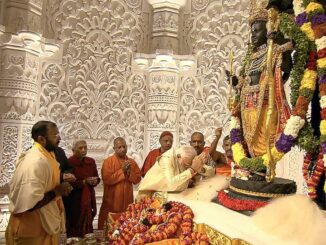
    AYODHYA (TIP): The consecration of the Ram temple in Ayodhya was held today, January 22,  with Prime Minister Narendra Modi attending the rituals. Following the consecration, the shrine will be opened to the public a day later.

    The “ Pran Pratishtha” ceremony began at 12.20 p.m.

    Mangal Dhwani’ from 50 instruments resonated in Ram temple during consecration event

    Fifty traditional musical instruments from across the country were part of a devotional “Mangal Dhwani” that resonated during the consecration ceremony at the newly constructed Ram temple in Ayodhya.

    Orchestrated by Ayodhya’s celebrated poet Yatindra Mishra, the grand musical rendition was supported by the Sangeet Natak Akademi, New Delhi.

    The instruments included pakhawaj, flute and dholak from Uttar Pradesh, veena from Karnataka, algoja from Punjab, sundari from Maharashtra, mardala from Odisha; santoor from Madhya Pradesh, pung from Manipur, nagada and kali from Assam; and tambura from Chhattisgarh. There was also shehnai from Delhi, ravanahatha from Rajasthan, shrikhol and sarod from West Bengal, ghatam from Andhra Pradesh, sitar from Jharkhand, santar from Gujarat, pakhawaj from Bihar, hudka from Uttarakhand and nagaswaram, tavil and mridangam from Tamil Nadu. While about 8,000 people are on the long list of invitees, the select list features 506 A-listers, including prominent politicians, leading industrialists, top film stars, sportspersons, diplomats, judges and high priests. To commemorate the occasion, the Centre gave half a day off to all Government employees including Public Sector Banks. Several States have also followed suit and declared a public holiday.

    The consecration ceremony was held after the first phase of the temple’s construction, made possible by a Supreme Court judgment in 2019 on the Ram Janmabhoomi-Babri Masjid title suit. The Hindu litigants argued that the Babri Mosque was constructed at the site of a temple marking the birthplace of Lord Ram. In 1992, the 16th-century mosque was demolished by “kar sevaks”.

  • JLF to revolve around Tulsidas and the Ramcharit Manas sessions this year

    JLF to revolve around Tulsidas and the Ramcharit Manas sessions this year

    By Dr Yash Goyal

    The Jaipur Literature Festival (JLF) is an annual literary festival that takes place in Pink City every year. Founded in 2006, the 17th JLF is scheduled in Jaipur from February 1-5. The festival is an initiative of Jaipur Virasat Foundation which was founded by Faith Singh, originally as a segment of the Jaipur Heritage International Festival and developed into a free-standing festival of literature with international fame. In 2012, a number of events occurred related to Salman Rushdie and the Satanic Verses controversy. JLF has reached every literary corner of the world. What used to be virtual during the Corona period is now becoming visible in foreign cities. The credit to create literary sensation and others to organise similar events in parts of India certainly goes to Sanjay Roy, William Dalrymple and Namita Gokhale.

    Namita, co-founder and co-director of JLF, is a well-known litterateur. r. She is the author of 23 works of fiction and non-fiction. Her acclaimed debut novel, Paro: Dreams of Passion, was published in 1984. She is the recipient of various prizes and awards, including the prestigious Sahitya Akademi (National Academy of Literature) Award 2021 for her novel Things to Leave Behind. Following are the excerpts of her Online 10 Q-A with Dr Yash Goyal.

    Namita Gokhale, co-founder and co-director of JLF

    Q. The 17th edition of Jaipur Literature Festival 2024 will begin next month. With what intention did you guys start JLF in Jaipur? 

    A. We began with a love for literature, across borders, and a deep belief in Indian writing in all its avatars.

    Q. Since this festival started from Jaipur, how much literary benefit did Rajasthan’s writers get from it? What is the criteria for selecting a writer?

    A. We try to programme a range of writers from Jaipur and different parts of Rajasthan. We include new voices, women writers, and the oral heritage as well as established writers and Sahitya Akademi awardees. Shri Nand Bharadwaj and Shri CP Deval have also guided us over the years.

    Q. This festival also focuses on Rajasthani language and its litterateurs. But Rajasthani language did not get constitutional recognition in 17 years. What do you think of it. 
    A. It is a complex issue. Rajasthani certain deserves constitutional recognition but the many dialects are cited as a factor in this delay in giving the language its due.

    Q. Lok Sabha elections are going to be held soon. There is an atmosphere of Ayodhya and Lord Ram in the entire country. Would JLF want to know the minds of litterateurs on this very religious subject in any of this year’s sessions?

    A. We have a session on Tulsidas and the Ramcharit Manas which should be of interest to our audiences.

    Q. From a commercial point of view, JLF has now become global. Has this created any bridge between Indian and foreign writers?

    A. The global editions have led to deepened ties with diasporic authors of Indian origin and creative exchanges with international writers we interact with. Many valuable initiatives have resulted from this.

    Q. What are the reasons for the popularity of JLF in India and abroad? Now there are many such literary festivals in almost every state, do you guys feel any competition with them?

    A. The Jaipur Literature Festival draws international audiences because the programming is creative, rooted, and provides many different perspectives and points of view. As for competition – we welcome it, for we can all constantly learn from each other.

    Q. How much did JLF’s sponsors increase in these 17 years? Do they also have to compete for admission in JLF?

    A. We have had many wonderful and supportive sponsors, but these things took a hit during the pandemic years.

    Q. You are also a great writer, what kind of writing do you have preferred in your literature? Your novel ‘Things to liv behind’ received the Sahitya Academy Award, what is it all about? 

    A.I have written 23 books by now – including novels, short stories, anthologies, with themes around the Himalaya, and religion, and the interpretation of myth. There is also a play co-authored with Malashri Lal on the life of Michael Madhusudan Dutt.

    ‘Things to Leave Behind’ is a work of historical fiction set in Kumaon in the years 1840 to 1912. I am a Kumaoni and ‘Things to Leave Behind’ is a tribute to the rich heritage of the region.

    Q. Your another novel ‘Never Never Land’, why is this getting popularity?

    A. My new novel ‘Never Never Land’ will be released soon. It is set in the familiar landscape of the Himalayas. Let’s see how readers respond to it.

    Q. JLF’s every session has a record number of young boys’ and girls’ footfall, whether they attend the session or not? Don’t you think JLF emerged as the best fashion and a joint for youngsters at least in Pink City? 

    A. I think it’s wonderful that so many young people attend the festival as a lifestyle choice. Reading is to be enjoyed, it’s a pleasurable activity, and it’s good that they enjoy being there.

    Q. What is the future of JLF in the next 5 years? 

    A. The future can never be foretold – but of this I’m sure, that reading will never go out of fashion. We will go from strength to strength as we continue to creatively interpret the role of the LitFest.
    (Yashpal Goyal is Special Correspondent, TIP, Jaipur)

  • It’s back to the drawing board for the Congress

    It’s back to the drawing board for the Congress

    The Congress needs to go beyond the current focus on the negative aspects of the ruling dispensation or its perceived faultlines

    “The Congress can build on this base, but to take this process forward, it needs to project a clear ideological narrative and articulate its own politics. For a start, it shouldn’t try to outdo the BJP as a ‘more Hindu’ party, particularly when voters have the option to go for the real thing. The ideological counter must reflect a different model of development with an emphasis on rights-based welfare, especially employment guarantees interlaced with social harmony. In sum, the Congress has to reboot its political discourse by foregrounding something substantive, which is best done by advocating a positive agenda that can galvanize the electorate and goes beyond the current focus on the negative aspects of the ruling dispensation or the perceived faultlines within it and the politics it has promoted.”

    By Zoya Hasan

    The Congress’ remarkable victory in Telangana was overshadowed by its devastating defeat in the Hindi heartland in the just-concluded Assembly elections. The Congress has suffered a big blow as it lost all three states — Madhya Pradesh, Rajasthan and Chhattisgarh — it had won in 2018. The Bharatiya Janata Party’s (BJP) comprehensive victory was backed by support across most regions in these states and a strong showing in urban areas. But the Congress, despite its defeat, has managed to retain its vote share — Madhya Pradesh (40.4 per cent), Rajasthan (39.5 per cent) and Chhattisgarh (42.23 per cent). The BJP has gained mostly at the expense of others in the fray. With these triumphs, the BJP has expanded its dominance of a key region ahead of the 2024 General Election. However, the Congress vote share holds considerable significance in the run-up to the Lok Sabha elections.

    The Congress tried to highlight issues such as joblessness and caste discrimination in the hope that it would appeal locally in the state elections and nationally in the General Election. But its two-pronged plank of welfare schemes and social justice was upstaged by the subtext of Hindu nationalism and communal politics. The BJP’s victories highlight the consolidation of Hindu nationalism and the great resonance it enjoys in the heartland states. The use of state machinery, ample financial resources and the party’s organizational framework, buttressed by RSS cadres, have helped it promote itself as a champion of a strong nation, development and welfarism as well as of Hindu interests and the Hindu religion.

    From the outset, the BJP’s campaign pivoted on Prime Minister Narendra Modi, relegating established state leaders to the sidelines. The party decided not to nominate a chief ministerial candidate for any of the states going to the polls. This meant that even popular state leaders of the Congress like Ashok Gehlot and Bhupesh Baghel were not pitted against their local BJP rivals, but against Modi himself. The PM’s huge popularity in north and central India neutralized the public acceptance of these leaders.

    Taking a cue from its experience in Karnataka, where the visibility and prominence of local leaders paid off, the Congress projected state leaders, who were given a free hand. However, the infighting and overweening ambitions of its leaders in Rajasthan and Chhattisgarh put paid to this strategy. Factionalism and divided state leadership, which have been the undoing of the Congress in many states, was on full display throughout its term in office in these two states. Leaders were attacking each other until a few months before the elections, which sent a message to voters that this was a party that couldn’t keep its house in order. A settlement was forged between the warring leaders in both states, but it was a case of too little, too late.

    Apart from factionalism, there was no accord or concord between the state leadership and the high command. The Congress campaign lacked coherence; it appeared disjointed, with powerful state satraps unwilling to countenance any interference on their turf. In contrast, the BJP’s campaign was intensive and focused and the party spoke in one voice. This is not surprising, as the contemporary BJP is a highly centralized party, while the Congress, in a departure from the past, is relatively decentralized.

    To make matters worse, there was no agreement between the Congress and its allies in the state elections. The 28-party INDIA grouping led by the Congress, which came together to fight the BJP, did not feature in the state polls due to inter-party rivalries. Opposition parties should have negotiated state-specific alliances and seat adjustment in a spirit of give-and-take. This is easier said than done. Seat-sharing didn’t happen, which hurt the Congress as well as the INDIA bloc, which the voters saw as a divided house. The fate of the Congress and other parties in this election makes it clear that they can tackle the BJP only when they are united against it.

    A caste-based census was the big battlecry of the Congress to undercut the BJP’s support among the OBCs, but it turned out to be a ‘no-ball’. This call had little traction on the ground, with the issue not paying dividends — the BJP’s share of OBC votes has increased. In any case, it is doubtful that the demand for a caste census is an inspiring or effective counter to Hindu identity politics, which holds much greater appeal for subaltern groups in the current conjuncture. Caste politics and ideas of social justice were not enough without a clear political plank to serve as a counterpoint to the BJP’s politics in these states or effective campaigning, ideological clarity and organizational cohesion to communicate its message.

    There is limited evidence of a correlation between state and national elections. Yet, there’s little doubt that the Congress’ decisive defeat at the hands of the BJP in straight contests has undermined its credibility and is bound to demoralize it at a crucial time when the Lok Sabha elections are just five months away. However, all is not lost as the majority of the voters have opted for non-BJP parties in these critical states.

    The Congress can build on this base, but to take this process forward, it needs to project a clear ideological narrative and articulate its own politics. For a start, it shouldn’t try to outdo the BJP as a ‘more Hindu’ party, particularly when voters have the option to go for the real thing. The ideological counter must reflect a different model of development with an emphasis on rights-based welfare, especially employment guarantees interlaced with social harmony. In sum, the Congress has to reboot its political discourse by foregrounding something substantive, which is best done by advocating a positive agenda that can galvanize the electorate and goes beyond the current focus on the negative aspects of the ruling dispensation or the perceived faultlines within it and the politics it has promoted.
    (The author is Professor Emerita, Centre for Political Studies, JNU)

  • Challenge to Hindutva

    Challenge to Hindutva

    • The clamour for a caste census can redefine political equations and alliances in the run-up to Lok Sabha polls

    It’s premature to conjecture if caste is a robust counter to the BJP’s Hindutva. But the BJP’s strategy of employing religion to heighten a pan-Hindu identity among the non-upper castes might be past its shelf life, at least in the state elections.

    “The belated wisdom of a national party such as the Congress plunging headlong into sectional politics discomfited some of its insiders, who believed that it should focus on the economy’s big picture, inflation and livelihood and leave matters like a caste count to the identity-wedded entities it is aligned with in the regions. Insiders said that would be more in keeping with the ‘character’ of these players, some of whom, incidentally, are products of the post-Mandal period.”

    By Radhika Ramaseshan

    The upcoming Assembly elections in Madhya Pradesh, Chhattisgarh, Rajasthan and Telangana have got inextricably linked with three factors — the Bihar Government’s release of a comprehensive caste survey (CCS), the Congress’ promise to conduct a similar caste count if elected to power in these states and the BJP’s response to frame the discourse in a different idiom, featuring leitmotifs drawn from the Hindutva ideology. As the BJP garnered a little over 40 per cent of the OBC votes in the 2019 elections, largely by projecting Modi both as an OBC mascot and a Hindu icon, the Congress was bereft of any such attribute.

    A little before and immediately after the Bihar CCS demonstrated the potential of resurrecting the issue of the empowerment of Other Backward Classes (OBCs) or backward castes, the Congress strongly advocated for a caste count. Former party president Rahul Gandhi described it as an ‘X-ray’ that would reveal the socioeconomic condition of the OBCs, Dalits and Adivasis and challenged Prime Minister Narendra Modi to lay bare the findings of a socioeconomic caste survey undertaken during then PM Manmohan Singh’s tenure. Rahul claimed that the Congress governments in Rajasthan and Chhattisgarh had initiated a process to carry out a CCS — brave words from the Congress, which belatedly recognized and acknowledged the seriousness of OBC empowerment in shaping the politics of the Hindi heartland. Successive Congress Prime Ministers — from Jawaharlal Nehru to Rajiv Gandhi — did not pursue the recommendations of the Kaka Kalelkar Commission, the first Backward Classes panel, which submitted its report in 1955. It identified 2,399 backward castes in the country, with 837 of them classified as ‘most backward’. The commission also recommended undertaking a caste-wise enumeration of the population during the 1961 census and establishing a connection between the social backwardness of a caste and its low position in the traditional caste hierarchy, among other suggestions.

    The Congress ignored the Mandal Commission’s report mandated to identify the socially and educationally backward castes and adopt ameliorative measures to bring them on a par with the upper and intermediate castes. While the BJP was quick to grasp the political ramifications of the Mandal report and co-opted large OBC sub-groupings under the Hindutva umbrella, the Congress was convinced that its time-tested coalition of the upper castes, Muslims and Dalits/Adivasis would endure an epic churn. As it happened, the amalgam came apart and the party lost its base in the heartland, except in pockets. As the BJP garnered a little over 40 per cent of the OBC votes in the 2019 elections, largely by projecting Modi both as an OBC mascot and a Hindu icon, the Congress was bereft of any such attribute. Now, the party is making a concerted effort to position, front and center, its OBC Chief Ministers Siddaramaiah (Karnataka), Bhupesh Baghel (Chhattisgarh) and Ashok Gehlot (Rajasthan), despite the high command’s express misgivings about Gehlot.

    The belated wisdom of a national party such as the Congress plunging headlong into sectional politics discomfited some of its insiders, who believed that it should focus on the economy’s big picture, inflation and livelihood and leave matters like a caste count to the identity-wedded entities it is aligned with in the regions. Insiders said that would be more in keeping with the ‘character’ of these players, some of whom, incidentally, are products of the post-Mandal period.

    There is more than a grain of truth in this belief if the rejoinder coming from a regional party is an indication. Flagging the caste count issue in Telangana, Rahul contextualized his rationale with the alleged corruption by the Bharat Rashtra Samithi government, Chief Minister K Chandrashekar Rao and his family. A caste survey, Rahul claimed, would bring to light the extent to which the KCR clan had ‘looted’ Telangana. Can caste become a synonym for corruption, considering that the party of Lalu Prasad, whose household is enmeshed in graft charges, is a Congress ally and the Rashtriya Janata Dal draws its sustenance from identity politics? Can the RJD survive without its Muslim-Yadav support?

    The Telangana Government was not in slumber. In 2014, it carried out a household survey of the OBCs which showed that they made up 51 per cent of its 3.6 crore population. With the Dalits and Adivasis, the figure went up to 85 per cent.

    The Chief Minister is from the Velama community, a dominant caste of agriculturists, but in his two stints in office, he made space for OBCs such as the Gouds, Yadavs, Munnuru Kapu and Padmashali as ministers and Rajya Sabha MPs. Having been vociferous about a caste count, the Congress might be hoist by its own petard because its OBC leaders have clamored for three Assembly seats each in Telangana’s 17 Lok Sabha constituencies that add up to 51 OBC candidates in the 119 Assembly segments.

    The Chhattisgarh Government’s OBC survey in 2022 puts their population at 43.5 per cent, while as per the Madhya Pradesh and Rajasthan Backward Classes Commissions, the figures stand at 48 per cent and 42 per cent, respectively. Confronted with the data, the three governments — Chhattisgarh and Rajasthan are Congress-ruled, while MP is BJP-helmed — have made OBCs the centerpiece of their policies and welfare initiatives.

    Madhya Pradesh CM Shivraj Singh Chouhan set up dedicated welfare boards for specific sub-castes, as have Gehlot and Baghel. Rajasthan earmarked 64 per cent reservation in government employment and educational institutions with 16 per cent for the Dalits, 12 per cent for the Adivasis, 26 per cent for the OBCs and most backward castes and 10 per cent for the ‘economically weaker’ sections. In MP, despite the BJP high command’s manifest distrust of Chouhan, he was nominated again from his Budhni seat shortly after the caste census and the accent on OBC empowerment gained currency. Chouhan is from a backward caste. In Chhattisgarh, Baghel legislated an increase in the OBC reservation quota from 14 to 27 per cent and that of the Adivasis (a sizeable population) from 12 to 13 per cent in public employment and educational admissions.

    It’s premature to conjecture if caste is a robust counter to the BJP’s Hindutva. But the BJP’s strategy of employing religion to heighten a pan-Hindu identity among the non-upper castes might be past its shelf life, at least in the state elections.
    (The author is a Senior Journalist)

  • Mount Abu: The hill station of Rajasthan

    Mount Abu: The hill station of Rajasthan

    Situated amidst lush green, forested hills on the highest peak in the Aravali range, Mount Abu is the summer capital for the Indian state of Rajasthan. Its cool and soothing climate makes it an ideal retreat. Explore a number of Jain temples, including the Dilwara Temples, a complex carved of while marble, or visit the nearby Achalgarh fort, which houses many beautiful temples of its own.
    NAKKI LAKE
    Recognized as the first ever manmade lake in India, Nakki Lake is also a preferred place to see in Mount Abu. You can choose to take a boat ride at the lake and watch the sun set past the beautiful hills surrounding this place. Nakki Lake is also popular for being the place where the ashes of Mahatma Gandhi had been immersed. Toad rock, a place for sightseeing in Mount Abu is located close to Nakki Lake.

    GURU SHIKHAR
    Recognized as the highest point on this mountain range, Guru Shikhar is an exquisite place for sightseeing in Mount Abu. Taking about 300 steps up to Guru Shikhar, you reach the temple of Guru Dattatreya, an incarnation of the Divine Trinity (Brahma, Vishnu and Shiva). People flock to this place both for its religious aspects and the panoramic views.
    TOAD ROCK VIEW POINT
    Known for being surrounded by a number of strangely shaped rocks, Nakki Lake offers numerous photo ops to visitors. One of the most popular destinations near Nakki Lake however, has to be the Toad Rock View Point. Located on the main trekking trail near the Lake, the Toad Rock has often been referred to as the mascot of Mount Abu. The massive rock structure is an excellent illustration of igneous rocks found in amazing shapes and is shaped, as the name suggests, like a toad. One of the most frequented places in the hill station; people visit this place out of sheer curiosity. It is pretty easy to climb the rock and the views that it offers of the Nakki Lake and the surrounding greenery are unparalleled. Apart from the novelty of the rock itself, the breathtaking scenery from atop just adds to whole experience, making it well worth your while.
    DILWARA JAIN TEMPLE
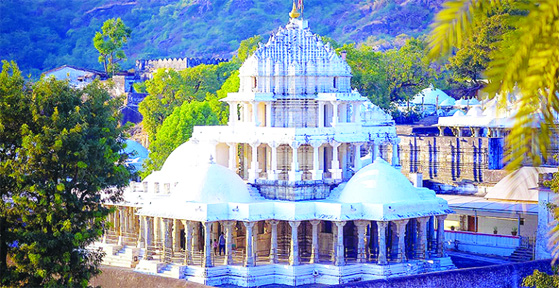
    Established some time in between the 11th and 13th centuries, the Dilwara Jain temples are considered to be among the best specimens of architectural perfection in the country. A complex of five temple structures, the Dilwara Jain temples are located at a distance of about 2.5 kilometres from Mount Abu. Carved out of white marble, these temples features interiors that have intricate designs spreading everywhere from doorways to ceilings. Dilwara Jain temples are a must visit place in Mount Abu.
    MOUNT ABU SANCTUARY
    Covering 288 square kilometres of area, the Mount Abu Wildlife Sanctuary is a part of the subtropical forest in this region. Containing rich flora and fauna, this sanctuary allows you to come close to some rare and exotic species of wild animals, including the Indian fox, pangolin, grey jungle fowl, striped hyena, and also Indian leopard, the apex predator here.
    PEACE PARK
    Nestled in between two famous Aravali peaks, the Guru Shikhar and Achalgarh, the Peace Park in Mount Abu is a part of the Brahma Kumaris’ establishment. With an ambiance that creates the perfect blend of serenity and tranquillity, the park offers a beautiful backdrop for silence and peaceful recreation. At the Peace Park, one can visit the rock garden that houses a wide variety of Cactaceae, the orchard, citrus corner, and view the numerous floral displays that include coleus, shrubs, hibiscus, creepers and climbers, and an exquisitely beautiful rose garden. The park also has a number of areas, like a stone cave and huts, where people can meditate in a tranquil environment. The Brahma Kumaris also provide a guided tour of the park, and you can also watch a short video film that explains interesting meditation concepts. This place of solitude in the lap of nature is something you must experience.
    LAL MANDIR
    Located on Delwara Road, near the Delwara Jain Temple, is this small temple dedicated to Lord Shiva. The temple offers a very peaceful ambiance and is considered as one of the most ancient holy places located in Mount Abu. A small and beautiful temple, the Lal Mandir gets its name from the fact that all the walls of the temple have been painted red. The temple is one of the must visit spots in Mount Abu, popular among the religious tourists as well as others. The temple is also quite well-known for being a Swayambhu ‘ Shiva Temple, so named because the idol placed inside the temple can be seen wearing a ‘jenau’.

  • Rajasthan: The Land of Kings

    Rajasthan: The Land of Kings

    With palaces that still evoke the grandeur of their regal past, in literally every hamlet, and the Thar desert’s never-ending sand dunes that appear like golden-hued paintings, there’s no shortage of places to visit in Rajasthan that provide an ideal backdrop to a romantic escape. The Land of Kings—Rajasthan—is well known for its stunning heritage sites, luxurious hotels, scenic lakes and picture-postcard desert stretches that look straight out of Arabian Nights. Hop on a camel to explore Jaisalmer’s fabled dunes, explore the exquisite Jal Mahal in Jaipur, sail on Mount Abu’s Nakki Lake on a paddleboat or have a candlelit dinner in Udaipur’s City Palace—Rajasthan’s palette of romantic experiences is kaleidoscopic. Here’s your guide to some of the most enchanting destinations in India’s largest state, for an unforgettable outing with your significant other.
    JAISALMER
    A magnificent fort looming over the city, picture-postcard vistas of sand dunes and an array of illuminated sandstone buildings—Jaisalmer is nothing short of a scene straight out of Arabian Nights. It attracts many couples, honeymooners and families with its erstwhile royal splendour. The Jaisalmer Fort (also known as the Golden Fort of Rajasthan) is the most splendid attraction of the city, perched on an elevated patch looking over the city. Surrounded by numerous golden-hued shrines, Gadsisar Lake is ideal for an evening picnic or a short paddleboat ride. The city’s most popular activity is taking a camel ride over the desert sands; best enjoyed at sunrise and sunset, the ride gives an insight into Rajasthan’s rural life and stunning vistas of the horizon. Jaisalmer’s winding alleys are home to vibrant markets from where you can pick up quintessential Rajasthani souvenirs. Rajasthani cuisine, famous for its spicy veg curries, mouth-watering meat dishes and delectable sweets is the icing on the cake.
    JODHPUR
    The second largest city (after Jaipur) in Rajasthan, Jodhpur is an architecture-lover’s feast for sore eyes. The older historic section of the city of Jodhpur is located around the grand Mehrangarh Fort which is bounded by a wall and several gates. Winding streets and unending bazaars run throughout the city that are littered with shops and thronged by visitors throughout the year. Also referred to as the Blue City, Jodhpur is home to the magnificent Umaid Bhawan Palace. A five-hour-drive from the hill-station of Mount Abu, Jodhpur makes for a perfect getaway once the hill station’s charms stop making an impression on you.
    UDAIPUR
    Take a walk to any place in this picturesque city and you will spot historic structures which ooze regal splendour. Home to the most intricately designed palaces, havelis, buzzing streets, and beautiful lakes, the city of Udaipur is also called the ‘Venice of the East’ and ‘City of Lakes’. To accommodate the large influx of travellers each year, the city is well-equipped with a wide variety of hotels and lodging options that suit every pocket, bazaars that are popular for their handicrafts and restaurants that offer lip-smacking Rajasthani dishes. If you’re going by road then the drive takes no more than four hours making it possible to make a hectic day trip. Make sure you include Lake Pichola, Fateh Sagar Lake, City Palace, Jag Mandir and Udaipur Ghat in your Udaipur itinerary.
    JAIPUR
    The majestic courtyard of City Palace, the intricately-carved walls of Hawa Mahal, the striking beauty of Jantar Mantar and the magnificently built mahals of Amber Fort—Jaipur is an evocative showcase of regal Rajasthani architecture. Home to historic structures, world-class hotels and an array of multi-cuisine eateries, the Pink City is a great escape for couples, families and history-buffs. The exquisite water palace located on the Man Sagar Lake—Jal Mahal—is another spectacular example of Rajasthani architecture, seemingly floating in the middle of the lake. When you’ve had your fill of exploring these fascinating monuments, explore Jaipur’s bustling markets that sell everything from spices, jewellery to household bric-a-brac. From gorgeous views of sunset, entertaining folk dance and music, and thoroughly enjoyable elephant and camel rides, the capital of India’s largest state, Rajasthan, will court you like royalty, and make you feel like one too.
    MOUNT ABU
    While you’ve had your fill of the magnificent cities Rajasthan is home to, a romantic escape to the state’s only hill station might not prove as a bad idea. Offering an eclectic mix of experiences, Mount Abu lures you with the serene Nakki Lake, magnificent Dilwara Temples and numerous hilltop points that offer panoramic views. Best visited at dusk, Sunset Point offers a spectacular sight of the colour-changing skyline against the Aravalli Hills. The Achalgarh Fort transports you to the 15th century with its intricately-carved buildings and temples, and offers stunning vistas of the hill station from its highest point. From small eateries that serve delicious street food to fine-dining multi-cuisine restaurants, Mount Abu has something for every kind of foodie. Go on a boat ride, carry your own hamper for a lakeside picnic, or walk up the cobblestone pathways along Nakki Lake, Mount Abu is a picturesque oasis amidst the desert plains of Rajasthan and is a pleasant retreat for couples, honeymooners and families.
    Source: HappyTrips

  • Supreme Court reserves verdict on same-sex marriage

    Supreme Court reserves verdict on same-sex marriage

    After 10 days of marathon arguments, the Supreme Court on Thursday, May 11, reserved its verdict on petitions seeking legal validation of same-sex marriage. A five-judge Constitution Bench headed by Chief Justice DY Chandrachud reserved its judgment after hearing arguments from senior advocates AM Singhvi, Raju Ramachandran, KV Viswanathan, Anand Grover and Saurabh Kirpal on behalf of the petitioners; Attorney General R Venkataramani, Solicitor General Tushar Mehta for the Centre and senior counsel Kapil Sibal for Jamiat-Ulama-i-Hind. The Bench has already made it clear that it would not get into the personal laws of various religious communities and would only examine the Special Marriage Act, 1954, to consider the petitioners’ prayer.
    The Centre, some of the states, certain Hindu, Muslim and Christian organisations have opposed the petitions. The governments of Assam, Andhra Pradesh and Rajasthan have the petitions, citing public opinion and adverse implications on the social and family system. On behalf of the Government of Madhya Pradesh, senior counsel Rakesh Dwivedi has opposed the petitions seeking recognition for same sex marriage.
    The Bench is expected to deliver the verdict after the summer vacation.

  • Rajasthan Royals beat Chennai Super Kings by 32 runs

    Rajasthan Royals beat Chennai Super Kings by 32 runs

    Jaipur (TIP)– Promising Yashasvi Jaiswal once again displayed his talent as he conjured up a brilliant half-century before Rajasthan Royals’ spinners choked Chennai Super Kings to register a comfortable 32-run win in their IPL clash and move to the top of the standings. Jaiswal (77 off 43 balls) continued his rich form with his third fifty of the tournament before Devdutt Padikkal (24 not out) and Dhruv Jurel (34 off 15) provided the final flourish to register 202/5 — their highest total — at the Sawai Mansingh Stadium.
    Spinners Adam Zampa (3/22) and Ravichandran Ashwin (2/35) then shared five wickets between them to restrict Chennai to 170/6 despite Ruturaj Gaikwad (47) and Shivam Dube’s (52) best efforts.
    With the win, Rajasthan moved to the top of the table, while Chennai drop down to third.
    In contrast to Rajasthan, Chennai’s openers found the going tough before Gaikwad, who was dropped on four, broke the shackles and hit Jason Holder (0/49) for a four over mid-on before cracking a six over deep backward square leg in the fourth over. Rajasthan’s skipper Sanju Samson intensified the pressure by bowling spin from both ends and the move paid dividends.
    Devon Conway (8) continued to struggle and with the required run-rate increasing he was forced to hit a Zampa delivery flat to Sandeep Sharma at mid-off.
    Unperturbed by the wicket, Gaikwad kept stealing boundaries every over to keep the scoreboard ticking before Zampa struck once again to get rid him.
    Chennai were 72/2 at the halfway mark. Ashwin (2/35) then snared the wickets of Ajinkya Rahane (15) and impact player Ambati Rayudu (0) to further dent Chennai’s chances.
    Brief scores: Rajasthan Royals: 202/5 in 20 overs (Jaiswal 77; Deshpande 2/42); Chennai Super Kings: 170/6 in 20 overs (Dube 52, Gaikwad 47; Zampa 3/22). Source: PTI

  • India finds 5.9 million tonnes lithium deposits in Jammu and Kashmir

    The Union Government on Thursday, February 9,  said that 5.9 million tonnes of lithium reserves have been found for the first time in the country in Jammu and Kashmir. Lithium is a non-ferrous metal and is one of the key components in EV batteries. “Geological Survey of India for the first time established Lithium inferred resources (G3) of 5.9 million tonnes in the Salal-Haimana area of the Reasi district of Jammu and Kashmir,” the Ministry of Mines said on Thursday. It further that 51 mineral blocks including Lithium and Gold were handed over to respective state governments.

    “Out of these 51 mineral blocks, 5 blocks pertain to gold and other blocks pertain to commodities like potash, molybdenum, base metals etc. spread across 11 states of Jammu and Kashmir (UT), Andhra Pradesh, Chhattisgarh, Gujarat, Jharkhand, Karnataka, Madhya Pradesh, Odisha, Rajasthan, Tamil Nadu, and Telangana,” the ministry added. The blocks were prepared based on the work carried out by GSI from field seasons 2018-19 to till date. Apart from these, 17 reports of Coal and Lignite with a total resource of 7897 million tonnes were also handed over to the Ministry of Coal.                 Source: ANI

  • Mount Abu: Rajasthan’s only hill station

    Mount Abu: Rajasthan’s only hill station

    Surrounded by verdant forests and perched at an altitude of 4000 feet, Rajasthan’s only hill station is an oasis of respite from the scorching heat. The charming hill town is an eclectic mix of experiences that you do not expect in a state which is mostly known for its arid desertscapes. Watered by the serene Nakki Lake and close to the famous Dilwara temples and centuries-old forts, the hill station has enough to keep visitors busy for two to three days. Mount Abu’s beautiful landscape, quaint heritage hotels, bustling street markets, restaurants and cafes make it one of the most popular getaways in western India.

    SUNSET POINT

    One of the most well-known spots in Mount Abu, Sunset Point is located to the south-west of Nakki Lake. Best visited at dusk, this picturesque point commands magnificent views of the Aravali ranges. Thronged by travellers throughout the year, it is surrounded by numerous food stalls and souvenir shops. To get to Sunset Point, grab your camera and walk up the cobblestone pathways along the Nakki Lake for about a km. Those who do not wish to take a walk can also opt for pony rides.

    DILWARA TEMPLES

    The five marble temples of Dilwara are a sacred pilgrimage place for the Jain community, and rank among India’s finest temple architecture. Located in the northern part of the hill-station, these Jain temples are about two-and-a-half-kms away from the bustling town of Mount Abu. They comprise of five temples—Vimal Vasahi, Luna Vasahi, Pithalhar, Parshvanath, Mahavir Swami—each of which is dedicated to a revered Jain guru. Built in 11th and 13th centuries, the temples boast of opulent entrances, minutely-carved ceilings, doorways, pillars and panels and intricately-designed domes. Mahavir Jayanti, the most important festival of Jains, is celebrated with full vigour here and many Jain pilgrims visit the temples during the festival each year.

    NAKKI LAKE

    Believed to be have been dug out by a god using his nails, the sacred Nakki Lake is one of the landmarks of the hill town of Mount Abu. About half a mile long, the lake is deeper towards the dam on the west. Carry your picnic hamper, a book and camera and spend a peaceful afternoon on the banks of the lake. Boat riding is another activity that interests visitors here. A pleasant stroll around the lake will lead you to Toad Rock, a boulder that looks just like a toad about to hop into the lake. The 14th-century Raghunath Temple stands near the lake’s southern shore.

    ACHALGARH FORT

    Bordered by massive walls that enclose a few beautiful temples inside, the Achalgarh Fort offers interesting glimpses of Mewar architecture. Built in the year 1452 by the famous Rajput ruler of Mewar, Rana Kumbha, the fort is situated 11 kms to the north of Mount Abu. Various viewpoints from the fort offer scenic lookouts onto the hill town, the Aravali ranges and the picturesque sunset views.

    ADHAR DEVI TEMPLE

    Situated atop a cliff in a cave, a visit to the Adhar Devi Temple, also known as Arbuda Devi Temple requires you to climb 365 steep steps, but the strenuous journey is worth the effort. Offering a bird-eye-view of the hill-station from the top, the temple is constructed out of a large rock, and visitors have to stoop and crawl to enter the inner shrine. Located 3 km away from Mount Abu, the temple is dedicated to Goddess Durga and is considered as one of the prominent religious spots in the hill town. The temple is visited by hordes of Hindu pilgrims during Navratri, a nine-day Hindu festival that is celebrated with full gusto.

    Adhar Devi Temple is quite old and legend has it that ‘Adhar’ of the Goddess fell here. It is also believed that goddess’s image hangs in the mid air. Besides, the temple has a number of gorgeous statues that you can admire and looking at those arts will make you praise the artists from the bygone era. And the view of mountains and forests you get to see after climbing those hundreds of stairs will make you forget all the tiredness and fatigue. It is recommended you wear proper and comfortable clothes and footwear because the climb uphill is really tiring.

  • Trumping majoritarianism in the Hindi heartland

    Trumping majoritarianism in the Hindi heartland

    By Zoya Hasan
    While regional parties will continue to be significant in various States of the Union, the principal challenge of overcoming majoritarianism lies in the Hindi heartland, especially in U.P. Oppositional electoral alliances, notably the formation of a federal front, are important strategies in this battle but it is no less important to challenge the ideological foundations of the majoritarian project through progressive and inclusive politics.

    The landslide victory of the All India Trinamool Congress in the West Bengal Assembly elections and the pushback of the Bharatiya Janata Party (BJP) in West Bengal, Tamil Nadu and Kerala have given rise to a pervasive belief that right-wing politics can be defeated by regional assertions. Undoubtedly, regional and cultural assertion in these States acted as an effective bulwark against the BJP’s expansionary plans in southern and eastern India. The regional-cultural tropes deployed by Mamata Banerjee, for example, worked so well that at one point, Home Minister and BJP leader Amit Shah was even forced to clarify that if the BJP is elected, someone from Bengal would be the Chief Minister. This underlines the effectiveness of regional culture and politics in trumping communal politics. However, this claim needs to be tempered by the realism that it cannot work in the Hindi heartland, which is dominated by caste and communal politics, and has so far not seen any serious ideological and political challenge to politics based on these identities.

    Encompassing nine States whose official language is Hindi, namely Bihar, Chhattisgarh, Haryana, Himachal Pradesh, Jharkhand, Madhya Pradesh, Rajasthan, Uttar Pradesh (U.P.) and Uttarakhand, this region retains a central position in the electoral strategies of the BJP and its larger political imagination. The party’s stunning show in these States propelled it to power in the 2014 and 2019 parliamentary elections. Its continued political dominance in the heartland will neutralize its losses now as well as in future in States where it has been bested by regional players. I will focus here on U.P. to illustrate the limits of the regional assertion.

    Dimensions in the heartland

    The Hindi heartland is clearly different. There are at least four important dimensions of this difference. First is the absence of regional identity in States such as U.P. This is evident from the debate on States reorganization and the reorganization of Uttar Pradesh in the 1950s. The compulsions of nation-oriented identity emerged very clearly from the discussions in the States Reorganization Commission on suggestions for the division of U.P. for administrative convenience. U.P. leaders argued for a large and powerful State in the Gangetic valley as a guarantee of India’s unity.

    In this sense, U.P. was considered the backbone of India and the centerpiece of political identity in modern India. Importantly, it was supposed to provide the chief bulwark against growing regionalization and fragmentation elsewhere. Instilling a sense of regional pride, an essential part of Congress strategy in southern and coastal India, was not followed in U.P. U.P. was seen as the political heartland in contrast to Punjab and Bengal for instance, which were splintered and incorporated into two different nation states. As is well known, the bases of this post-colonial identity varied from its location in the freedom struggle to staking claim as the cultural homeland of Hindi and Hinduism. In both cases, it was centered in the idiom of the nation-state and strong central authority.

    Second, although U.P.’s cultural homogeneity remains a matter of disagreement, the idea of the heartland had great resonance among the political elite who opposed the demand for U.P.’s reorganization. The long-standing traditions of composite cultural identity and shared plural cultures began to yield place to a singular homogenized identity. The Hindi-Urdu divide, which mirrored the communal cleavage of U.P. society, played a crucial role in this process. Urdu was excluded as it was seen to symbolize Muslim cultural identity in independent India, while Hindi was boosted to promote the development of a Hindi-Hindu heritage for this region. The project of homogenization of Indian/U.P. culture as Hindu culture was quickened in later decades. Even though it would be hard to assume a direct link between Hindi dominance and communal politics of subsequent decades, it is nevertheless a fact that all political parties in the State used it as an ingredient of social and cultural differentiation and a means to consolidate political dominance.

    Role of communal politics

    Third, it is clear that communal politics and communal movements have played a key role in U.P.’s modern history which in turn have diluted other identities.

    In some respects, this process gained momentum in the wake of Partition which cast its long shadow upon political institutions and culture in U.P. and to a great extent affected the perspectives of Hindus and Muslims alike. Hindu nationalism was marginalized within the Congress party but many of its ideas were accepted in framing party policies. The State leadership was instrumental in forging a conservative consensus in the State under Chief Minister G.B. Pant who steered the affairs of the state for eight years after Independence.

    The intensification of communal politics took a new turn with the mass mobilization for the construction of a Ram temple at Ayodhya which was deftly used by the Hindu right to establish a major presence in U.P. and to facilitate the political reconstruction of U.P. through the promotion of a collective Hindu identity. The crusade for the appropriation of disputed shrines is central to the communalization of politics and short circuiting the more complex process of political expansion for the BJP.

    Importantly, this has laid the groundwork for building permanent electoral majorities through the deployment of ascriptive symbols in U.P. which, given its huge size, helps it to establish a strong base in the Hindi heartland to offset the appeal of countervailing identities elsewhere in India.

    Caste politics too

    Finally, caste politics which was expected to counter Hindutva expansion has failed to do so; in fact, caste politics has become a building block for the BJP’s expansion. The party has reached out to Dalits, actively mobilizing them and other backward castes to assimilate them into the Hindutva meta-narrative. Instead of erasing caste from electoral politics, the BJP-Rastriya Swayamsevak Sangh has sought to court fragments of castes as a way of undermining broad-based political movements and opposition to it. It has used the wider appeal of Hindu nationalism to co-opt backward castes and Dalits who are keen to align themselves to the larger narrative of Hindu nationalism.

    A reset is needed

    While regional parties will continue to be significant in various States of the Union, the principal challenge of overcoming majoritarianism lies in the Hindi heartland, especially in U.P. Oppositional electoral alliances, notably the formation of a federal front, are important strategies in this battle but it is no less important to challenge the ideological foundations of the majoritarian project through progressive and inclusive politics. This requires a reset of the basic political mindset in U.P. which can only be done by reviving the splendid heritage of the national movement in which this region played a central role and in which Gandhiji and Nehru played a heroic part. Invoking the spirit of the Bhakti movement which was the first major challenge to the religious orthodoxy of Hinduism would also help in resetting the cultural clock. This must, however, combine with much greater concern for the fundamental social and economic issues of the State, and making the struggle between communal and secular forces the central issue through public campaigns that address the problems of religious traditionalism and the cultural underpinning that this provides to the push to make India a Hindu state.

    (Zoya Hasan is Professor Emerita, Jawaharlal Nehru University)

  • Indian-origin US based Sehgal Foundation shipping oxygen concentrators to 7 Indian states

    Indian-origin US based Sehgal Foundation shipping oxygen concentrators to 7 Indian states

    DES MOINES (TIP): The Des Moines, Iowa, -based Sehgal Foundation said it was shipping out 200 oxygen concentrators to seven Indian states on May 6, 2021. The shipment of the medical equipment was made possible through donations from its individual supporters across the United States, the foundation said in a press release.

    “Working in close coordination with local partners and government officials, the Sehgal Foundation team on the ground in India is ensuring that the equipment is directly reaching those who need it the most in public hospitals in villages across 7 states,” the release said. It added, “In the coming week, more oxygen cylinders, ventilators, personal protective equipment, rapid diagnostic tests, and therapeutics will be sent.”

    Sehgal Foundation teams are working with district administrators and local partners in Andhra Pradesh, Bihar, Haryana, Maharashtra, Rajasthan, Telangana, and Uttar Pradesh, the release said. “To respond quickly during this catastrophic surge in Covid-19 cases in India, Sehgal Foundation has taken immediate action to reach the people in the greatest need,” the release said.

    S.M. Sehgal Foundation, a Gurgaon, India, -based sister organization of the Sehgal Foundation operates in more than 1,000 villages, across 10 states, serving more than 2.5 million people. Areas it focuses on include food and water security, and good rural governance. Since a devastating second wave of Covid-19 surged in India, dozens of US-based organizations have sent medical equipment to India. Last week, the American Association of Physicians of Indian Origin (AAPI), which represents the 80,000-strong Indian American physician community in the US, airlifted the first batch of 1,000 of oxygen concentrators.

    On May 3, pharmaceutical giant Pfizer announced it will donate more than $70 million worth of medicines to India.

    Indiaspora, a nonprofit, raised $1 million raised through its private donor network of members.

  • Centre sounds alert as bird flu cases spread to 6 states

    Centre sounds alert as bird flu cases spread to 6 states

    New Delhi (TIP): As a Bhopal-based laboratory confirmed that 437,000 poultry birds in Haryana died because of bird flu, the Centre on Friday, January 8, asked the six states where deaths because of the disease have been confirmed to increase their vigil and act to curb the outbreak. The Centre has confirmed bird flu in Kerala, Rajasthan, Madhya Pradesh, Himachal Pradesh, Gujarat and Haryana, the government said in a statement.
    “So far, the disease has been confirmed from six states. It is learnt that culling operations have been completed in both the affected districts of Kerala. The disinfection process is underway,” the statement read.
    Following the confirmation of bird flu, Haryana is set to start the biggest culling of birds in any state. Officials said 166,000 birds would be killed in the next few days. Culling of birds is to take place within 1 km of Kheri and Ghanauli villages from where samples tested positive for bird flu, they said. Two of the three samples sent by the Haryana animal husbandry department from poultry farms in Panchkula’s Barwala belt to the National Institute of High Security Animal Diseases (NIHSAD) laboratory in Bhopal tested positive for avian influenza on Friday. “As per the report received, it has been confirmed that birds of two poultry farms were infected with avian influenza (H5N8). Though this bird flu strain is less pathogenic, the state government has issued a notification for the affected poultry farms of Panchkula as a precautionary measure,” Haryana’s animal husbandry and dairying minister JP Dalal said on Friday. Tests done on three batches of samples sent to a Jalandhar lab from Barwala were inconclusive, following which the samples were sent to the Bhopal lab. More than 437,000 poultry birds have died in Panchkula’s Barwala and Raipur Rani areas, considered to be Asia’s second largest poultry belt, over the past 26 days. On Friday, the central team visited the community health centre in both areas. Arrangements have been made at the community health centre in Raipur Rani, and isolation wards set up, while Tamiflu tablets have been procured to check human-to-human transmission of the influenza, said Dr Saroj Aggarwal, deputy civil surgeon, Panchkula. “We are ready to deal with any situation.” (Source: HT)

    Budget session will be as long as earlier: Speaker
    Indicating that the upcoming Budget session of Parliament will have a Question Hour, Lok Sabha Speaker Om Birla on Friday, Jan 8, said questions of Opposition parties will be answered and issues raised by them discussed when the House meets for the next session.Speaking to reporters in Dehradun, Birla said the upcoming Budget session will be of the same duration as it had been in the past and there will be discussions on all issues. The Lok Sabha Speaker was in Dehradun to address an event part of an outreach programme for Panchayati Raj Institutions — ‘Panchayati Raj System: Strengthening the Decentralised Democracy’. The event was aimed at introducing panchayat members to the functioning of Parliament and to provide them with an exposure to democratic principles and ethos.
    India-UK flights resume
    Weeks after flights between the United Kingdom and India were suspended following the detection of a more infectious strain of the novel coronavirus, air services between the two countries resumed Friday. The first flight carrying 256 passengers from London landed in New Delhi on Jan 8 morning, reported news agency ANI. The government had suspended flights on December 23. As flights resume in a calibrated manner, for the next two weeks, till January 23, only 15 flights will operate between the two countries. The incoming flights will land only in Delhi, Mumbai, Bengaluru, Chennai and Hyderabad. The government has put out the standard operating procedure for travellers entering India. According to the guidelines, all passengers will have to undergo mandatory self-paid RT-PCR tests on arrival.
    India, Japan sign pact for 50-bn yen loan
    India and Japan on Friday signed an agreement for a loan of up to 50 billion yen (about Rs 3,550 crore) to back New Delhi’s economic support programmes for the poor and vulnerable affected by the Covid-19 crisis. CS Mohapatra, additional secretary in the department of economic affairs and Japanese ambassador Satoshi Suzuki signed the agreement in New Delhi for the loans with an interest rate of 0.65% per annum and a repayment period of 15 years, including a five-year grace period. Japan had earlier provided budget support of 50 billion yen and grant assistance worth one billion yen (about Rs 71 crore) to support the Indian government’s efforts to counter the Covid-19 crisis.

  • All is Well That Ends Well

    All is Well That Ends Well

    By Dr. Yash Goyal

    Congress party gets an Independence Day gift in Rajasthan

    JAIPUR (TIP): Hitting hard at Opposition BJP for its interference in the internal affairs of the Congress party, the Gehlot Government in Rajasthan on Friday, August 14,  won the Confidence Motion by a voice vote in the state Legislative Assembly after over 3 hours of debate.

    The  victory of the Congress  in the  State has  sent a clear message  to the saffron party that its  Mission Lotus in the garb of ‘Congress Mukt Bharat’ would not be applicable in a majority led government anymore,  not in Rajasthan, at least. The ruling members in the House blamed the judiciary and the Governor  for causing hurdles in the democratic  process. Opposition BJP without creating an uproar in the House could not move its ‘no confidence motion’ notice against Gehlot government.

    Proving that he is with the Congress, Pilot interrupted the BJP legislators in the House claiming that he was the ‘strongest warrior’ of the Congress party despite his new sitting arrangement.  ‘I am sitting on border line close to the Opposition members but I will protect my party at all costs. This is not important where one sat but what mattered was what people had in their heart and mind about him”, he warned.

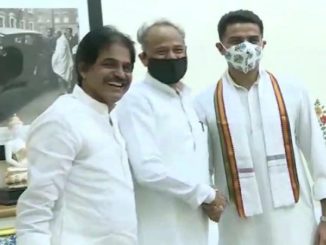
    This was all made possible as a ‘Ram-Bharat Milap’ was witnessed in the Pink City a day ago when a known Jadugar turned Chief Minister Ashok Gehlot and Sachin Pilot, former Deputy CM, came face to face with warmth and anticipating to revive the Congress government’s image and prestige in public once again.

    It seems to give the impression that All Is Well with the Congress Party in Rajasthan. However, only time will tell whether there was a genuine feeling of brotherhood in the hug, or it was another feigned show of amity.

    After a major revolt,  and leading the rebel camp with 18 MLAs for the last  31 days, Pilot was given a warm welcome on his arrival at CMR by AICC’s top functionaries K C Venugopal (now RS MP from Rajasthan), Avinash Pandey, Randeep Surjewala, Ajay Makan and PCC President G S Dotasra.

    Gehlot and Pilot shook  hands enthusiastically, while Gehlot was also seen holding Pilot’s right upper arm as a gesture of unity and political bond. Both were wearing face masks and no emotions were captured, but their glowing eyes gave the impression that both were pleased.

    The brief Ram-Bharat-Milap was followed by Congress Legislature  Party meeting in which Pilot faction also made attendance. Still scared of poaching,  the  Gehlot camp MLAs returned to the hotel, whereas Pilot flock’s MLAs returned  to their residences separately.

    Ending  a month-long  tug of war between the CM and his rebel faction that was piloted  by Sachin with 18 dissidents over ‘political ambitions of youngsters’ in Rajasthan now appears to be settled down, like dust storm in the sandy desert. Rebels have cooled down their feet, and Opposition party (BJP) gave up the hope to be king makers  in case Gehlot government  fell.

    Four days ahead of the Assembly Session slated for August 14, a sudden somersault  by  Pilot, who was sacked on twin posts of Deputy-CM and PCC President, has stunned everyone , especially the ambitious rival BJP that has projected ‘Congress Mukt Bharat’ since 2014 and tried this slogan in Madhya Pradesh, Karnataka, Manipur and Goa to ‘topple’ the governments.

    After  quandary with Gehlot government, keeping only Twitter handle open, and hiding with his flock under alleged  Haryana Government’s hospitality’, Pilot got an appointment very late and met the Congress leaders Rahul Gandhi & Priyanka Gandhi Vadra with his 18 supporting MLAs. This is utterly surprising  that when Pilot first moved to Delhi in early July  to approach and raise his resentment to the party high command, he was not heard because Gehlot had disclosed  alleged audio-clips on ‘horse trading deal struck’  in which the names of a veteran Congress MLA Bhanwarlal Sharma and Union Minister for Jalshakti Gajendra Singh Shekahawat, LS MP from Jodhpur in Modi Government surfaced on police records.

    The deadlock of government’s functioning has been partially paralyzed since July 12 when Pilot had revolted with his camp against CM threatening that the Gehlot government had come in minority. The soup was thicker when  Gehlot had sacked Pilot and two other ministers Ramesh Meena and Vishwendra Singh for their alleged involvement in poaching with huge cash secretly offered by the BJP for toppling the ruling  government having majority of 119 MLAs in a house of 200. Pilot was furious and moved to coup when he was served a notice by SOG under section 124-A of IPC along with CM, and Chief Whip.

    The instability of the state government has revolved around Gehlot vs Pilot over supremacy, Speaker vs Court (High Court and Supreme Court) over notice to rebel MLAs under the  Anti-defection Law (10th schedule of the Constitution) by the Speaker C P Joshi, Gehlot vs Governor over calling early assembly session, and  Gehlot vs BSP’s Mayawati over direct merger of six MLAs with the Congress last year.  After facing the legal challenges under the Article 174 of the Constitution and rejecting Gehlot cabinet’s three-time proposal to convene the assembly session on a short notice,  the Governor Kalraj Mishra  finally issued order to convene the session on August 14,  covering 21 day- notice.

    The BJP appointed Governor’s clash with a  non-BJP Chief Minister in Rajasthan was nothing new.  In Delhi, it was CM Arvind Kejriwal vs Lt Governors, Mamata Banerjee vs Jagdip Dhankar in West Bengal, Uddhav Thackeray  vs Bhagat Singh Koshiyari in Maharashtra, P Vijayan and Arif Mohd Khan in Kerala, V Narayana Swami vs Lt Governor Kiran Bedi in Puducherry, and K Chandrasekhar Rao vs T Sundararajan in Telangana.

    Pilot faction got scared when it calculated that its herd hiding with a meagre  19 rebels  could not cut the ice, and rival party (BJP) which he did not want to join at this juncture would not support him despite alleged ‘poaching’ of some MLAs. Gehlot succeeded in keeping 102 MLA’s in  ‘political quarantine’  under unprecedented security cover, and when time came,  paraded his loyalists before the Governor.

    Later Gehlot’s confidence weakened when BJP and BSP moved to the courts against merger of all six BSP MLAs into the Congress last year. Probably under pressure of raids by Central investigating agencies like IT, ED, CBI against Gehlot’s  one MLA,  friends and relatives, the government bowed down and adopted damage control exercise. The Special Operation Group (SOG) of state Police)  dropped the sedition charges (section 124-A of IPC) in two cases  of horse trading exposed in alleged audio-conversation clip between one BJP Minister and a Congress MLA. The case is now referred to the  slow-paced Anti-Corruption Bureau.

    A hypothesis indicates that the government’s move to go on back foot was a big respite for  Pilot camp.  Though Pilot  was now free from SOG but not having desired support of other party MLAs and deficiency of outside support from rebel party to kick out the ruling government, perhaps they returned to alma mater with their list of grievances.  This time Pilot also lacked active support of Gurjar community on which he won the assembly poll in 2018 from the Tonk constituency. It was the political compulsion to live inside the party and sit in the assembly as a legislator and not to face any ‘disqualification’ clause under Anti-defection Act by flouting any whip of the treasury bench.

    A question remains  unanswered whether a three member AICC Committee comprising Ahmed Patel, Priyanka Gandhi Vadra  and K C Venugopal will redress 19-MLAs’ grievances and  look into demands which include re-allocating cabinet berths to two MLAs . Will Pilot get any parallel post in the cabinet of Gehlot who bluntly  described Pilot as ‘Nikkama, Nakara and Conspired against his own government”. However,  in his face saving move Pilot received a warm welcome to Jaipur where he held a series of individual media interactions. Pilot, son for late Union Minister Rajesh Pilot and former MP Mrs. Rama Pilot, assured that he has not asked for post but there should  be  no vendetta politics. This is a hidden deal when Gehlot says he was unaware under what conditions Pilot group has come back to the party fold.

    Why and how the veteran MLA Sharma, whom the SOG police has failed to search in the audio-conversation case in the country, made a surprise  landing at CM’s  House after Pilot met Gandhi family in Delhi remains a mystery.   Gehlot had openly assailed Sharma’s attempts to destabilize his government and former CM B S Shekhawat’s government and turning coat frequently in the past.

    At a recently held CLP meeting, a number of MLAs and a few Ministers have expressed their displeasure at homecoming of ‘rebels’.  A million-dollar question would chase CM how he is going to appease Independent MLAs who had merged their affiliation with the Congress – 6 BSP turned Congress MLAs, and BTP legislators while fulfilling his promise of ministerial reshuffle in near future after assembly session. Another big puzzle   Congress party will have to address  is how to accommodate   the Pilot camp in the state in remaining term of the government.

    Is this a victory of Ashok Gehlot, 3rd timer Chief Minister in Rajasthan, without a floor test in State Legislative Assembly after a suo moto surrender of Sachin Pilot with his 18-rebellion Congress MLAs  before the Congress High Command for an ‘amicable mediation’ on his flock’s grievances ?  It seems to be a win-win situation more for Pilot and less for Gehlot government as ‘horse trading of lawmakers’ is unpredictable alike Cricket in future too.  Political Pandits feel after some time Pilot may raise his ante against Gehlot rule if more rebels join to saddle him (Gehlot) out of power. Gehlot urged his MLAs to forgive him and move, but would it be so easy for the voters who have noticed fragility of oldest party, the Congress. Caste politics would again emerge as a threat to the Gehlot who is always known as Jadugar of Politics.

    (Dr Goyal is a senior journalist, and has  worked for PTI and The Tribune)

  • Rajasthan slugfest: Need for impartial probe into horse-trading allegations

    Rajasthan slugfest: Need for impartial probe into horse-trading allegations

    What had initially appeared to be an intra-Congress tussle in Rajasthan has turned into a ‘Congress vs BJP’ slanging match after the emergence of audio clips in which Union minister Gajendra Singh Shekhawat is purportedly heard having a conversation with a Congress MLA and a BJP leader about toppling the Ashok Gehlot government. The state’s Special Operations Group has promptly registered a couple of FIRs on a complaint by the Congress. An impartial, time-bound inquiry is needed to verify the authenticity of the recordings and unearth the underlying conspiracy, irrespective of which political party is at fault, even as Shekhawat has denied that the clips have his voice. The development has provided ammunition to the Congress to accuse the ruling BJP at the Centre of horse-trading. The onus is on the NDA government to convince all and sundry that it has no hand in the goings-on in the border state.

    Attempts to subvert democracy and the electoral process have become far too common in recent years. Several states have witnessed post-poll machinations and short-lived governments, with the latest casualty being Madhya Pradesh. The Congress had wrested power from the BJP by winning the 2018 MP Assembly polls, but the latter turned the tables on the ruling party earlier this year with the help of some obliging MLAs. In Goa and Manipur, which produced hung Assemblies in 2017, the BJP formed the government despite having won fewer seats than the Congress. Last year, the long-drawn-out Karnataka ‘nataka’ and the Maharashtra muddle also amounted to a betrayal of the voters’ mandate.

    Whenever a government finds itself on shaky ground, the clamor for strengthening or reviewing the anti-defection law gets louder. Indeed, loopholes in this law enable unscrupulous elected representatives to switch loyalties as whopping sums of money allegedly change hands. With the power struggle in Rajasthan set to get uglier inside as well as outside the courts, the credibility of the parties concerned has come under sharp scrutiny. How the major players acquit themselves will demonstrate their respect, or lack of it, for democracy.

    (Tribune, India)


  • Sandy Desert Barmer

    Sandy Desert Barmer

    By Yash Goyal

    Barmer in Rajasthan is a part of the Great Indian Thar Desert surrounded by Jaisalmer in the North, and neighbouring Pakistan on the West side. Barmer’s small railway station Munabao is famous forThar Express Link Trainthat used to run up to Zero Point of Khokhrapar in Pakistan. Unfortunately, due to an escalated tension between India and Pakistan after abrogation of article 370 and 35-A in Jammu and Kashmir, the international weekly train was suspended on August 16 by Indian Railways. Barmer’s Uttarlai is also very important IAF airbase on the International border along with entire BSF jawans deployed on high alerts in the hottest summer of up to 50 degree C and minus 2 degree Celsius in cold wave conditions.

    In 2016 the Ministry of Panchayati Raj Institutionhas christened Barmer as one of the country’s 250 most backward districts (out of a total 640) and it was one of the 12 other districts getting the central funds from Backward Regions Grants Fund Programme(BRGF). Once in 2006, extreme rainfall of over 550 mm and flash flood in August month had caused to scores of casualties and a ten of villages inundated for months in Kawas area of Barmer.

    CAIRN is expected to generate US $ 100 billion of revenues for India

    Folk music and dance specially of Bhopas (priest singers) is a speciality of the desert terrain. Muslim Dholis (drummers), Langas and Manganiars are the some of these communities engaged in traditional music and songs. The district covering 28,387 square kilometres area after Jaisalmer and Bikaner district is also popular for its carved wooden furniture and hand block printing industry.

     Oil is Well

    Way back in previous century in 80s and 90s, the Geological Survey of India(GSI) and other Oil and Gas companies have predicted not only ancient flowing Sarswati River underneath the sand dunes but also indicated deposit of huge oil reserves in Sandy Thar Desertof Western Rajasthan. The story started in 1995 when Royal Dutch Shell had signed a pact with the GOI to explore oil block in Barmer. In 1998, CAIRN Energy, which owned 10 percent in the lease, acquired 27 percent of the project. In 2002, CAIRN has acquired 100 percent control.

    The story of oil discovery was full of upheaval task as CAIRN Energy had faced failures in its initial attempts but got the success with the Mangladiscovery in 2004 after drilling its 16thwell. It was the breakthrough discovery in India in 30 years. In 2009, former Congress Prime Minister Dr Manmohan Singh has turned on the valve for symbolic start of production on August 29.

    CAIRN is expected to generate US $ 100 billion of revenues for India

    In 2010, World’s largest continuously heated and insulated pipeline covering 670 km made operational. In following years, Vedanat Groupacquired 58.5 percent stake in CAIRN Indiafor US $ 8.67 billion for faster production polymer injection at enhanced oil recovery (EOR) well starts on July 10 giving a major boost to the ongoing project. Sales commenced to IOCL Viramgamin January 2012; commercial production starts using Train on April 8, 2012. Gas sale had begun through AGI in April 2013 and the production crossed 200 million barrels on June 5, 2014.

    Recently celebrating its one decade of crude oil production in Rajasthan, CAIRN India at Barmer is now contributing 30 percent of the total crude oil production of the country at 1.70 lakh barrels of oil per day (bopd), and it has planned to raise it to 3 lakh BOPD by 2021 fiscal year.

    “As of now CAIRN has generated US$ 20 billion revenue to the GOI which included USD 5 billion as royalty to the government of Rajasthan from the crude oil production”, its CEO Ajay Dixit said on this occasion.

    Being India’s key strategic assets, CAIRN is expected to generate US $ 100 billion of revenues for India, he claims.

    “The region has been transformed with Barmer now second highest GDP in the state of Rajasthan behind capital Jaipur, and CAIRN has invested USD 9 billion in Barmer Basin”, Dixit underlined.

    CAIRN is expected to generate US $ 100 billion of revenues for India

    Cairn Energy invested more than US$6 billion, drilled more than 600 wells and made more than 40 discoveries.  Crude oil discovery opened the multiple opportunities for the local entrepreneurs. There are so many ‘Rags to Riches’ stories in Barmer today where the local entrepreneurs started with thousand rupees, later developed their own business house earning billions and providing jobs to local youths.

    Recently, the Director General of Hydrocarbons (DGH) as per the Open Acreage Licensing Policy (OALP) has allocated eight new blocks to the company. These blocks are situation in Barmer, Jaisalmer, Jalore and Bikaner districts. Seismic survey and exploratory drilling will start soon in these blocks to discover more oil reserves in Rajasthan. According to the Department of Geology at Jai Narayan University, the sedimentary deposits of Rajasthan have immense hydrocarbon potential. The story has just begun with the Barmer-Sanchore basin and more will be explored in near future.

    Barmer district which used reel under drought (not famine), scarcity of water and electricity is giving prosperity and economic strength not only the state of Rajasthan but also the Centre in revenue collection. Though the backwardness in remote villages due to poor education facilities and roads does exist. However, through CSR activities CAIRN has brought cheers by educating the girls and providing the infrastructure facilities to the villagers in their area.

    As a result, Barmer’s per capita income has risen by 650 percent in 10 years since CAIRN India started crude oil production, Chief Minister Ashok Gehlot told the audience at the celebration of the company’s achievement at Barmer on August 20. The state government has provided a medical college and announced to increase beds in Barmer district hospital from 300 to 500, Gehlot maintained. He also inaugurated an Ujjawal, a news scheme of Cairn Oil and Gas.

    Refinery: Boom for investment

    Upcoming Refinery and Petrochemical Complex at Pachpadra in Barmer district with a planned capacity of 9 MMPTA refining capacity and 2 MMTPA of Petrochemical Complex will made this district a destination for investment and creation of newer jobs for locals in the western Rajasthan. The refinery whose stone laying ceremony was laid by UPA Chairperson Sonia Gandhi in 2013 and later construction inauguration was started by Prime Minister Narendra Modi 2018 will be readied by 2022-23, if all goes well.


  • Congress will not name CM candidate before Rajasthan polls

    Congress will not name CM candidate before Rajasthan polls

    NEW DELHI (TIP): The Congress will not declare its chief ministerial face ahead of the Rajasthan Assembly polls, party general secretary in-charge for the state Avinash Pande said on Thursday, stressing that it has been the party’s “tradition”.

    He said the party’s Rajasthan leaders will put on a united performance to ensure victory “as they did” during the recently-held bypolls in Ajmer and Alwar parliamentary seats and Mandalgarh assembly segment in the state.

    “It has been the Congress tradition that it never declares a CM face, barring exceptional cases, ahead of assembly polls.

    The high command decides the chief minister after discussing it with elected MLAs. This tradition will be followed in Rajasthan too,” Pande said.

    Earlier in the day, Congress president Rahul Gandhi held a meeting with Rajasthan Congress leaders, including former Chief Minister Ashok Gehlot, state unit chief Sachin Pilot and others on the party’s activities for the next six months.

    Pande maintained that the leadership issue in connection with the state assembly polls, scheduled to be held later this year, did not figure during the meeting.

    “We sought the final approval for the party programme for next six months (from Gandhi). All the leaders in unison assured that the programme will be implemented jointly.

    Rahul ji wished them good luck,” he added.

    Pande also said that the leaders have decided that the state unit’s ‘Mera Booth, Mera Gaurav’ programme will be implemented in all the assembly segments of the state, which goes to polls later this year.

    “Hamara hoga ek hi agenda, Congress ka jhanda (Our only agenda is to see Congress flag flies high),” Pande added.

    Asked about the meeting with Gandhi, Pilot said it was decided that the party will undertake a mass outreach programme in all the 200 assembly segments of the state. “We have now a lot of weight on our shoulders (following the success in bypolls). Expectations are very high from the Congress and we must not rest and immediately start a mass outreach programme the youth, farmers, middle class, rural areas in 200 constituencies. The meeting discussed the details of the same,” Pilot added.

    Source: PTI

  • 55-YR-OLD MAN THRASHED TO DEATH BY R’STHAN CIVIC STAFF

    55-YR-OLD MAN THRASHED TO DEATH BY R’STHAN CIVIC STAFF

    JAIPUR (TIP): A 55-year-old man was today allegedly thrashed to death by civic body employees in Pratapargh district when he reportedly stopped them from taking photographs of women defecating in the open.

    Zafar Khan, a social worker, was assaulted by five MC employees, his brother Noor Mohammad told the media. “The employees, shaming those defecating in the open, scared away some tribal women by taking their photographs. When my brother intervened, they attacked him. As soon as we learnt about the incident, we rushed to the hospital.We were told he was brought dead,” he said.

    The police have lodged a case of murder against the five employees and the Commissioner of the Pratapgarh municipality who, according to an eyewitness, was on the spot when Zafar Khan was thrashed. Family members of the deceased and locals staged a protest outside the mortuary, demanding that the “killers” be arrested. They blocked the national highway for several hours. Members of the CPI-ML (Liberation), with whom Zafar was associated, said he had paid with his life for opposing “bullying”.