
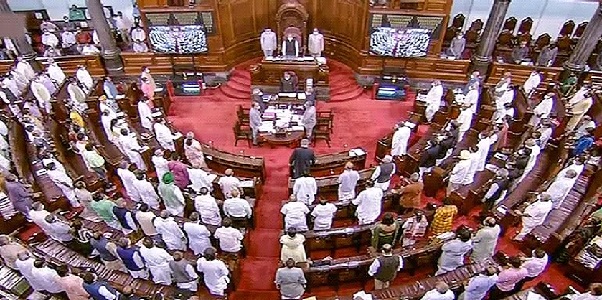

New Delhi (TIP): The Bharatiya Janata Party (BJP) and the Congress on Thursday announced their candidates for the upcoming Rajya Sabha elections scheduled for June 18, triggering intense political activity across several states and setting the stage for crucial contests that could reshape the balance of power in the Upper House of Parliament.
The biennial Rajya Sabha elections will be held for 24 seats across 10 states, along with a by-election in Odisha. The polls assume considerable political significance as both the ruling BJP-led National Democratic Alliance (NDA) and the opposition INDIA bloc seek to consolidate their strength in the Upper House amid preparations for key legislative battles and future electoral contests.
The BJP released a list of candidates from Gujarat, Madhya Pradesh, Rajasthan, Manipur and Arunachal Pradesh, while the Congress announced nominees from Karnataka, Tamil Nadu and other states where it enjoys the support of regional allies.
Among the BJP’s prominent nominees is party national general secretary Tarun Chugh, who has been fielded from Madhya Pradesh. The party also nominated former Rajasthan BJP president Satish Poonia and Gurjar leader Alka Gurjar from Rajasthan, signalling an attempt to balance caste equations and strengthen outreach among influential social groups ahead of future assembly and local body elections in the state.
Political observers noted that the selection of Alka Gurjar reflects the BJP’s continued efforts to consolidate support among the Gurjar community, which remains politically significant in Rajasthan and neighbouring states. Satish Poonia’s candidature, meanwhile, is being viewed as recognition of his organisational role within the party despite the BJP’s leadership changes in Rajasthan over the past few years.
From Gujarat, the BJP nominated Rajubhai Shukla, Mukeshbhai Rathwa, Mansingh Parmar and Jitendra Meghjibhai Kanzariya, reflecting the party’s focus on social representation and regional balance in one of its strongest political bastions. Rajneesh Agrawal was named from Madhya Pradesh, while A Sharda Devi from Manipur and Tai Tagak from Arunachal Pradesh were selected to represent the party from the Northeast.
In Odisha, the BJP nominated Debashish Samantaray for the Rajya Sabha by-election. Samantaray had recently joined the BJP after resigning from the Biju Janata Dal (BJD) and vacating his Upper House seat, making his candidature politically significant amid shifting alliances in the state.
The BJP’s candidate list also sparked political speculation due to the absence of Union ministers Ravneet Singh Bittu and George Kurian, both of whose Rajya Sabha terms are nearing completion. Their omission has fuelled discussion in political circles about a possible reshuffle or restructuring within the Union Council of Ministers.
The Congress, meanwhile, announced seven candidates, with party president Mallikarjun Kharge emerging as the most high-profile nominee. Kharge was fielded from Karnataka alongside senior party spokesperson Pawan Khera, while policy expert and strategist Praveen Chakravarty was nominated from Tamil Nadu with the backing of the ruling DMK alliance.
Congress leaders described the candidate selection as a combination of organisational experience, communication strength and policy expertise. Pawan Khera’s nomination, in particular, is being seen as recognition of his aggressive role as one of the party’s principal national spokespersons.
Kharge’s candidature from Karnataka also carries symbolic importance as the Congress seeks to maintain political momentum in the southern state, where it currently heads the government and views itself as electorally competitive against the BJP.

Be the first to comment