Month: May 2020

  • Mango Phirni

    Mango Phirni

    Phirni is a traditional Indian Dessert made with rice and milk. The first memory of this dish is associated with my grandmother who used to prepare it for all her grandchildren and served it in individual clay platters topped with lots of sliced almonds and pistachios. This simple yet delicious dish has undergone many versions.  Today’s recipe is about its combination of phirni with Mango ‘ the king of fruits’ which despite being great in taste is packed with nutrients as well. Mango is a great source of Vitamin A & C with lots of fiber. I am sharing with you the recipe of Mango Phirni which requires few ingredients available at our home. This recipe is cooked faster and hence a great option when you need dessert quickly.


    We need:

    1 Liter full cream Milk

    50 gm Rice soaked in water

    40 gm Sugar or according to taste Green Cardamoms

    1 cup Mango puree fresh or canned

    20 Almonds sliced.

    Here we go:                                                                                                                            By Tript Arora 

     Soak 50 gm of rice in water for half an hour. Drain water. Grind rice coarsely in a mixer.

    Boil milk in a heavy bottomed pan. Add whole green cardamom so that we can take it out later.   Let it boil for 5 min on low flame stirring in between.

    Add ground rice to milk and let it simmer on low flame till the rice are done and milk is thickened. Keep on stirring in between to avoid lumps. Meanwhile keep on scratching the milk which has struck to the sides of the pan and mix it in the phirni. This enhances the taste.

    Milk needs constant attention as it sticks to the bottom and get burned.

    Add half of the sliced almonds and keep rest for garnishing.

    When the rice is cooked completely and blended well with milk switch off the flame. If phirni looks very thick you can add hot milk to adjust its consistency.

    Let it cool completely. Add Mango puree to it.  It should be on the room temperature when you add Mango puree.

    Pour it in a bowl and garnish it with sliced almonds. Refrigerate it for 2 hours.

    Enjoy the cool Mango Phirni and beat the summer heat.

    (The author is an entrepreneur by profession. Cooking for her family is the fuel for her soul. Her mantra is cooking simple, yet delicious recipes, which fit comfortably in today’s hectic life. Her life revolves around her husband, a daughter and a fur baby. She loves spending time with them and enjoys watching comedy movies in free time. She can be reached at triptasfoodtunnel@gmail.com)

    For more recipes by Tript Arora, visit www.triptasfoodtunnel.com


  • 2 Indian-origin men jailed for ‘largest’ bust with 20 million pounds of drugs in UK

    2 Indian-origin men jailed for ‘largest’ bust with 20 million pounds of drugs in UK

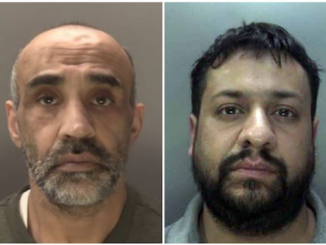
    LONDON (TIP): Two Indian-origin men have been sentenced to a total of 34 years in what Scotland Yard described as one of its biggest drugs busts in the UK, worth more than 20 million pounds.

    Shakti Gupta, 34, from Birmingham and Baldev Singh Sahota, 54, from Oldbury in West Midlands was jailed for 18 years and 16 years respectively following a haul of 172 kg of cocaine, one of the largest land seizures of Class A or illegal drugs in the country.

    “This operation has resulted in one of the largest land seizures of cocaine within the UK, ever,” said Detective Superintendent Neil Ballard, from the Metropolitan Police Specialist Crime Command.

    “It is an extremely significant amount of Class A drugs that indicates the scale of this organized drug supply, which the Met has successfully dismantled,” he said.

    On December 11 last year, a team of the Met’s Specialist Crime officers, supported by West Midlands Police, carried out a stop of a vehicle on the A45 highway, which was being driven by Sahota.

    On inspection of the van, officers discovered a large quantity of Class A drugs (cocaine) had been mixed among pallets of frozen food. The total weight of the cocaine discovered was 168 kg.

    A further search was carried out at an address in Olds Trading Estate Park in Hockley, Birmingham, the same day.

    A further 4 kg of Class A drugs (cocaine and MDMA) and 1 kg of the cutting agent were discovered inside the address. Gupta was arrested following the second raid and both men were taken into custody within the West Midlands Police jurisdiction.

    They were charged with conspiracy to supply Class A drugs, namely cocaine and appeared at Birmingham Crown Court in January this year, where they pleaded guilty to the offence.

    The duo was sentenced at the same court earlier this month.

    “This sentencing result is due to the hard work and commitment from those involved in dismantling drugs networks that are intrinsically linked to the violence that we have seen playing out on our streets throughout the country,” said Ballard.

    “This result should serve as a stark warning to anyone involved in the supply of drugs in London and the rest of the UK that we will do everything we legitimately can to bring you to justice,” he said.

    “The Met will continue to work with, and assist, our colleagues in other forces around the country, who are all dedicated to removing the drugs from our streets and reducing the serious violence associated with drugs supply, to protect the public,” he added.

    The Met Police released the details of the case this week as part of an appeal for information on anyone suspected of similar criminal activity.

    (Source: PTI)


  • Keys to a Successful Business Reopening

    Keys to a Successful Business Reopening

    A successful business reopening must include a carefully thought out plan that complies with relevant federal, state and local guidelines, prioritizes health and safety, and communicates a clear and consistent message to employees, customers and the community. Before employees return to the workplace, business owners should have already updated relevant employment policies, assessed their physical environment and implemented precautionary measures to prepare for the “new normal.” Preparation and communication are the keys to a successful business reopening, especially since some employees and their family members may be sick, may have childcare or other family care issues due to school closures, etc. and/or may be more vulnerable to contracting COVID-19 due to an underlying health issue. Considering a staggered return with fewer employees and providing employees with flexible work arrangements, such as teleworking are just some considerations for employers as they safely navigate a return to the workplace.

    1.Employment Policies and Handbooks. Before returning to work, employers should review their Employment Policies and Handbook and make modifications that are in keeping with new regulations and practicalities. Among the policies that may need to be revised are sick leave and family leave. Implementing or continuing flexible work policies such as teleworking should also be considered. New regulations reflecting the likelihood of the impact of COVID-19 on families will necessitate changes in a business’s policies. The CDC has issued recommended Guidelines for Employers on how they should identify sick employees and encourage them to remain at home and maintain proper health and hygiene in the workplace to reduce the transmission of the virus.

    2.Scheduling Employees in the Office. Employers will need to determine who is available to work. The workforce is likely to have challenges. Some employees may be ill or have family members for whom they are caring. Others have children or other family members for whose care they are responsible. There are also employees, who for underlying health factors, may be at a significantly higher risk for COVID-19 than others or may face other challenges such as commuting on public transportation. Workplace accommodations such as continued teleworking and staggered shifts may be solutions to meeting employee and regulatory requirements.

    3.Screening. Some employers are considering pre-screening in the form of questionnaires and temperature taking before employees and visitors are allowed to enter the workplace. These interventions come with privacy issues and strict protocols to protect employees. Employers will need to ensure compliance with regulatory guidelines from the CDC, OSHA and the EEOC when implementing screening measures. If employers are considering testing, they will also need to ensure reliability and compliance with FDA regulations.

    4.Maintaining a Healthy Work Environment. In addition to flexible work arrangements, employers will also need to assess the physical layout of the workplace to ensure that social distancing can be achieved. Employers will need to consider removing certain furniture, closing or limiting access to meeting rooms and cafeterias, creating one-way hallways and installing barriers such as plexiglass protectors. Employers will also need to consider whether facemasks or other PPE will be required, develop clear policies and protocols to ensure that proper hygiene and cleanliness is maintained and perform enhanced sanitization as needed. If some employees refuse to wear PPE, maintain social distancing or take part in the businesses’ other protective measures, they are subject to the same outcomes as if they were derelict in their duties and responsibilities as spelled out in the Employee Handbook.


    5.Bringing Back Employees. For some employees who have been furloughed or laid-off, unemployment benefits have been significant. For them, bringing them back to work on less than a full-time basis may be detrimental, which should be considered when deciding the first phase of the return to work.

    (Source: Warshaw Burstein, LLP)

  • NRIA DONATES $2,500 TO CORONAVIRUS TESTING SITE IN EDISON, NJ

    NRIA DONATES $2,500 TO CORONAVIRUS TESTING SITE IN EDISON, NJ

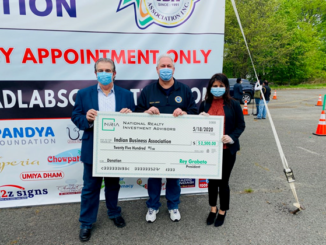
    EDISON, NJ (TIP)   NRIA of Secaucus, NJ, a leading luxury multi-family real estate developer, private equity investment manager, and EB-5 Visa specialist has donated $2,500 to the Indian Business Association of New Jersey (IBA) to help fund the organization’s new coronavirus testing site in Edison, NJ.  NRIA’s Glenn A. LaMattina, SVP of Operations (below left), and Tanvi Prenita Chandra, SVP of South Asian Marketing and Business Development (right) presented the check to Thomas Lankey, Mayor of Edison, NJ (center) at the grand opening earlier this week.

    Located at 103 Cinder Road in Edison, NJ, the IBA-sponsored testing site will be conducting free coronavirus, saliva tests by appointment on Mondays and Thursdays, 9:00 AM to 2:00 PM.  Those interested in being tested may register online at https://IBA.adlabscovidtest.com.  Once registered an Agile Urgent Care staff member will be in touch to discuss symptoms.

    The testing site is just one of several IBA-funded coronavirus emergency response projects to help counter the impact of the virus.  Other programs include distributing non-perishable food items to hospital employees, supplying Personal Protective Equipment to frontline workers, and translating pertinent coronavirus updates so New Jersey’s Indian community can stay apprised of new developments in their native language.

    “NRIA is committed to supporting the local South Asian community and we are delighted to make this donation,” said Glenn A. LaMattina.  Last month, NRIA also donated $2,500 to the SKN Foundation for the purchase of PPE for local medical staff.

  • Govt plans for third phase of ‘Vande Bharat mission’ as 300,000 Indians want to return

    Govt plans for third phase of ‘Vande Bharat mission’ as 300,000 Indians want to return

    A total of 3,08,200 persons have registered with Indian missions abroad for repatriation on compelling grounds

    NEW DELHI / NEW YORK (TIP): The government is planning for phase three of the ‘Vande Bharat Mission’ as over three hundred thousand stranded Indians have registered themselves with Indian missions abroad for evacuation on compelling grounds.

    The first phase was a modest 64 flights and a couple of sorties by naval ships that brought back over 16,000 Indians. The ongoing second phase that will last till June 16, plans to bring back another one lakh Indians.

    So far in phase two, over 45,000 Indians have returned, including about 8,000 migrant workers, 7,656 students and over 5,000 professionals. About 5,000 have returned through land border immigration checkpoints from Nepal and Bangladesh.

    “A total of 3,08,200 persons have registered with our missions abroad for repatriation to India on compelling grounds,” said government sources. Unless international flights do not resume, the third phase will mean a logistical exercise that will dwarf phase two.

    In the current phase, 429 Air India flights from 60 countries will land in India. Besides, the Indian Navy will make four sorties to bring back returnees from Iran, Sri Lanka and the Maldives.

    The government is also assisting in the return of stranded Indians from remote locations in Latin America and the Caribbean, Africa and parts of Europe. This is being done by taking advantage of foreign carriers flying to India primarily for the evacuation of their nationals.

    Recently, about 300 stranded Indians from Peru, Mexico, Belize, Guatemala, Honduras, Portugal and Netherlands were brought in. We will be exploring more such options, said government sources.

    Private airlines have now been included and chartered flights have also begun to operate.

    “The numbers are expected to go up in the coming days with the permission for chartered flights and more efficient use of quarantine capacity,” said the sources.

    The Indian Panorama spoke with some of those returning to India about the air fare, the quarantine on arrival in India, and some other issues. Most passengers complained of excessive fares. On condition of anonymity, a lady said: “I feel cheated by the government of India. I am already passing through a difficult financial situation, having to stay back in the US and spending to support myself and two kids, and then I am asked to pay a much higher price for air tickets than the normal rates I know of. Again, government of India wants all those going from here to India to pay for their stay in the hotels government has approved for quarantine. And the payment for 14 is to be paid upfront. Government of India is not supporting us financially in any way. We are paying for everything.”

    Mr. R.P. Sharma (name changed) said the only favor government of India has done is they have arranged the flights and permitted us to be back. He said going by the pronouncements of government of India, it appeared the government was doing a great favor to those stranded abroad. He added, however, he was happy to be getting back.

    Mr. Shingara Singh (name changed) from New York said he has been trying to get a ticket but was told by Air India that he will be informed when his turn comes. Asked when he should expect his turn, the officer expressed his ignorance.

  • Supreme Court Orders States to provide free food, shelter and travel to migrant workers

    Supreme Court Orders States to provide free food, shelter and travel to migrant workers

    NEW DELHI (TIP): The Supreme Court on Thursday, May 28, ordered states to provide free food and shelter to thousands of migrant workers stranded in various parts of the country due to COVID-19 lockdown.

    A three-judge Bench headed by Justice Ashok Bhushan also ordered that no fare either by train or bus shall be charged for migrant workers and railway fare will have to be shared by states.

    “All Migrant workers who are stranded at various places shall be provided food by the concerned state and UT at places which shall be publicized and notified to them for the period they are waiting for their turn to board a train or a bus, said the Bench — which also included Justice SK Kaul and Justice MR Shah.

    It said originating state shall provide meal and water at the station and during the journey, railways to provide meal and water to migrant workers.

    It emphasized the need for coordinated efforts to deal with the crisis. “There are different mechanisms for different states. How do you ensure that nobody asks the migrant to pay or troubles him? What we are saying is that the migrants should be least concerned with the means of payment,” it said.

    “The state shall oversee the registration of migrant workers and states to ensure that after registration, they are made to board the train or bus at an early date,” the Bench said.

    “We further direct that those migrant workers found walking on the roads, immediately be taken to shelters and provided food and all facilities should be provided to them,” it said, adding, “As and when the state governments put in a request for trains, railways has to provide them.”

    “All necessary details regarding number of migrants, plan for transportation mechanism of registration and other details should be brought on record in the reply,” the Bench said.

    After hearing Solicitor General Tushar Mehta, senior counsel Kapil Sibal, Colin Gonsalves, Indira Jaising, PS Narsimha and other advocates representing various states, the Bench went on to issue the directions saying, “At present we are looking at the miseries of the migrant workers, we are of the view that some interim directions need to be issued.”

    “We believe that the center and state governments require to be given some time to bring the steps taken by them on record, it said directing them to file detailed replies by June 5 –the next date of hearing.

    During the hearing, the Solicitor General faced a volley of questions from the Bench on food, shelter, transportation and as to who would foot the bill.

    Terming it an “unprecedented crisis”, Mehta said around 91 lakh migrant workers had been transported to their native states since special trains started on May 1.

    However, Sibal, Jaising and Gonsalves contradicted him saying the way migrant workers were being sent back to their native states it would take several months to complete the process.

    At the very outset, Mehta said, “We are immensely grateful to the Supreme Court for taking cognizance of the issue. Due to this, states and Centre have an August forum now to discuss the migrant crisis issue. Some unfortunate things have happened, and it is being flashed again and again.

    “We are not disputing the fact that Centre has not taken steps. But whoever needs help is not getting that help. States are not doing their bit,” the Bench said.

    Mehta assured the Bench that the government will not stop its efforts until every willing migrant laborer is sent to his village. He, however, said many of the migrants didn’t want to go back as lockdown has been relaxed and activities have resumed.

    The Solicitor General said a large number of steps were taken by the government and the Supreme Court was fully satisfied about it earlier. “We have something called prophets of doom who only spread negativity. All these people writing on social media, giving interviews cannot even acknowledge what is being done,” he said.

    Mehta said people are working tirelessly. From the safai karamcharis to the PM… State governments and ministers are working overnight. None of these people acknowledge that. Human race is facing a difficult challenge.”

    On intervention applications, Mehta said, “Don’t let anyone use this platform to become a political platform.”

    He also drew the court’s attention to a letter written by some senior advocates to the CJI on the issue. “See the letter which is doing the rounds.”

    “People who have been part of the institution, if they believe they can run down the institution it is unfortunate. We have to go by our conscience,” said Justice Kaul.

  • Trump cracks whip on social media companies with executive order

    Trump cracks whip on social media companies with executive order

    Social activists condemned the order as unconstitutional

    For both sides, freedom is in peril

    WASHINGTON (TIP): President Donald Trump on Thursday, May 28, signed an executive order cracking down on “censorship” by social media sites, a move widely seen by critics as retaliation against Twitter’s decision to slap fact-checking labels on the president’s tweets, says a CNBC report .

    The executive order targets companies granted liability protection through Section 230 of the Communications Decency Act. Under the statute, large social media companies cannot be sued for much of the content posted by others using their sites.

    Without congressional action, however, there are limits to what Trump can do with the executive order. The president said Thursday that he would indeed pursue legislation in addition to the order.

    Attorney General William Barr, who also attended the signing, said the Justice Department would seek to sue social media companies, saying the statute “has been stretched way beyond its original intention.”

    The order would push the Federal Communications Commission to set new rules on some websites’ protections under Section 230. It would also encourage the Federal Trade Commission to take action against companies that engage in “deceptive” acts of communication, and it would form a working group of state attorneys general to review relevant state laws.

    Barr earlier this year signaled the department’s intention to look “critically” at the law, originally designed to allow growing technology companies protection. But critics of the law have argued it allowed social media firms to turn a blind eye to unlawful content. It is unclear, though, on what grounds the Justice Department might sue.

    While Barr said that the president’s order does not repeal Section 230, Trump added shortly after: “One of the things we may do … is remove or totally change [Section] 230.”

    The executive order came two days after Twitter, for the first time, added warning links to two of Trump’s tweets, inviting readers to “get the facts.” The tweets made a series of claims about state-led mail-in voting services, an issue Trump has railed against in recent weeks.

    The labels, when clicked, led Twitter users to a page describing Trump’s claims as “unsubstantiated.”

    Source: Twitter

    “Trump falsely claimed that mail-in ballots would lead to ‘a Rigged Election.’ However, fact-checkers say there is no evidence that mail-in ballots are linked to voter fraud,” Twitter’s fact-checking page said, citing reporting from CNN, The Washington Post and other news outlets.

    Trump said Thursday that social media companies selectively choosing who to fact-check is tantamount to “political activism, and it’s inappropriate.”

    Twitter on Thursday night called Trump’s executive order “a reactionary and politicized approach to a landmark law, saying attempts to erode it “threaten the future of online speech.”

    Facebook issued the following statement Thursday evening:

    “Facebook is a platform for diverse views. We believe in protecting freedom of expression on our services, while protecting our community from harmful content including content designed to stop voters from exercising their right to vote. Those rules apply to everybody. Repealing or limiting section 230 will have the opposite effect. It will restrict more speech online, not less. By exposing companies to potential liability for everything that billions of people around the world say, this would penalize companies that choose to allow controversial speech and encourage platforms to censor anything that might offend anyone.”

    Google also released a statement which said the company had “clear content policies and we enforce them without regard to political viewpoint.”

    “Our platforms have empowered a wide range of people and organizations from across the political spectrum, giving them a voice and new ways to reach their audiences,” the statement said. “Undermining Section 230 in this way would hurt America’s economy and its global leadership on internet freedom.”

    On Wednesday night, Trump lashed out — on Twitter — accusing the social media giant of “interfering” in the 2020 presidential election and trying to “CENSOR” him.

    “If that happens, we no longer have our freedom. I will never let it happen!” Trump tweeted Wednesday night.

    The president had earlier tweeted that “Republicans feel that Social Media Platforms totally silence conservatives’ voices. We will strongly regulate, or close them down, before we can ever allow this to happen.”

    While Section 230 has critics on both sides of the aisle, including apparent Democratic nominee Joe Biden, who has said he believes Section 230 should be “revoked,” the executive order was swiftly panned by House Speaker Nancy Pelosi.

    “The proliferation of disinformation is extremely dangerous, particularly as our nation faces the deadliest pandemic in history,” Pelosi said in a statement.

    “Clearly and sadly, the President’s Executive Order is a desperate distraction from his failure to provide a national testing strategy to defeat COVID-19.”

    Social activists condemned the order as unconstitutional.

    “Much as he might wish otherwise, Donald Trump is not the president of Twitter,” said American Civil Liberties Union senior legislative counsel Kate Ruane after a draft of the executive order was made public earlier Thursday. “This order, if issued, would be a blatant and unconstitutional threat to punish social media companies that displease the president.”

    Still, the order had some supporters, including the Internet Accountability Project, a conservative opponent to Big Tech that is funded, in part, by Oracle.

    “The social media platforms, regardless of whether or not they are bound by the First Amendment, should be held accountable to their end-users,” said Rachel Bovard, senior adviser for Internet Accountability Project.

    “There are many lawmakers looking to recalibrate the law in order to foster the accountability and transparency that achieves that goal. President Trump’s Executive Order seeks those same ends.”

    Sen. Josh Hawley, R-Mo, who has introduced legislation tackling section 230, took to Twitter to remind his followers of own battle with Big Tech, though did not address the President’s order directly.

    “Gotta remember that key to #BigTech dominance/monopoly is advertising, and how they have manipulated [section 230] to create behavioral advertising machine,” he wrote.

    Trump’s opponents have long pressured Twitter to take action against his frequent, and frequently criticized, use of the platform. Of the 18,000-plus false or misleading claims Trump has made as president, more than 3,300 were made in tweets, according to The Washington Post.

    Those calls for action reached a fever pitch this week, as Trump continued making baseless suggestions that MSNBC anchor Joe Scarborough might have been involved in the death in 2001 of his former staffer when he served in Congress.

    The staffer’s widower asked Twitter CEO Jack Dorsey to remove Trump’s tweets on the matter. “I’m asking you to intervene in this instance because the President of the United States has taken something that does not belong to him — the memory of my dead wife — and perverted it for perceived political gain,” the widower wrote in a letter to Dorsey.

    Twitter refused to delete Trump’s tweets about Scarborough. But Dorsey on Wednesday defended his company’s fact-checking labels, saying Twitter will “continue to point out incorrect or disputed information about elections globally.”

    (With inputs from CNBC and agencies)

  • Protests break out in Minneapolis and elsewhere in the U.S. over George Floyd’s death in Police Custody

    Protests break out in Minneapolis and elsewhere in the U.S. over George Floyd’s death in Police Custody

    Mayor Frey calls for criminal charges to be brought against the officer who kept his knee on Floyd

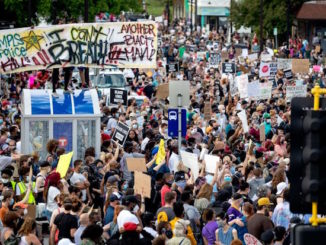
    MINNEAPOLIS, MN (TIP): Violent protests broke out in Minneapolis on May 27, 2020, two days after George Floyd, 46 years old black person died in police custody. A number of businesses and homes around Precinct 3 were damaged as the area has become the site of an ongoing protest after the police killing of George Floyd on May 25. Four Minneapolis police officers have been fired after a video   (https://youtu.be/ZWzkgKPZWcw) taken by a bystander was posted on social media showing Floyd’s neck being pinned to the ground by an officer as he repeatedly said, “I can’t breathe”. Floyd was later pronounced dead while in police custody after being transported to Hennepin County Medical Center.

    And the city’s mayor said he’s requesting state assistance and allowing Police Chief Arradondo to use resources from other jurisdictions.

    “We must confront our shortcomings with humility as well as hope. We must restore the peace so that we can do this hard work together,” Mayor Jacob Frey said.

    Fury has been rising in Minneapolis over Monday, May 25 death of Floyd, a black man who died after pleading for help as a police officer pinned him — unarmed and handcuffed — to the ground.

    Protesters and police face each other during a rally for George Floyd in Minneapolis, May 27

    On Wednesday, May 27 night, Minneapolis’ second day of protests transitioned to rioting and looting south of downtown, with people smashing their way into stores and setting businesses and other buildings ablaze.

    One of Floyd’s brothers cried Thursday, May 28 morning as he said his family wants protests to be peaceful, but stressed people are struggling with seeing another black man die following a police encounter, this one over the passing of an allegedly counterfeit $20 bill at a store.

    “I want everybody to be peaceful right now, but people are torn and hurt, because they’re tired of seeing black men die,” George Floyd’s brother, Philonise Floyd, said on CNN’s “New Day.”

    “These officers (involved in George’s arrest) need to be arrested right now … and held accountable about everything because these people want justice right now,” he said.

    A man was fatally shot overnight near the protests, police said early Thursday. One person was arrested, and police said they’re investigating the nature of the incident.

    As the protests developed, demonstrators threw water bottles and firecrackers at officers and a police precinct building.

    An unspecified number of police officers and other people suffered minor injuries in the protests, Arradondo said, without elaborating.

    Demonstrations were held elsewhere in the country Wednesday night. In Los Angeles, hundreds of protesters marched. At one point, some attacked a California Highway Patrol car.

    In Memphis, Tennessee, police in riot gear responded to a protest and at least two people were arrested, according to news reports on TV channels.

    Meanwhile, Governor Tim Walz signed an executive order Thursday, May 28 to activate the Minnesota National Guard, a move that came at the request of local leaders after “peaceful protests evolved into a dangerous situation for protesters and first responders,” according to a release.

    In a news conference Wednesday, Mayor Frey also called for criminal charges to be brought against the officer who kept his knee on Floyd. That officer was identified by his attorney Tom Kelly as Derek Chauvin. Kelly has not released a statement on Chauvin’s behalf.

    Chauvin had 18 complaints filed with the police department’s internal affairs division, according to MPD.

    It’s unclear what the complaints, which were all closed, were for and no details were provided by police.

    Only two of the 18 complaints against Chauvin were “closed with discipline,” according to a public summary from police. The “discipline issued” column listed a letter of reprimand for each of the two complaints.

    Devastating fire breaks out at Lake St. and 26th Ave. S. as angry protesters set property on fire

    George Floyd’s family says four officers involved in his death should be charged with murder

    In an interview aired Thursday, Frey told CBS News that he believed Floyd’s death constituted murder.

    “I am not a prosecutor but let me be clear: The arresting officer killed someone,” Frew told CBS. “He (Floyd) would be alive today if he were white.”

    The other three officers were identified by police as Thomas Lane, Tou Thao and J Alexander Kueng.

    Thomas Plunkett, representing Kueng, said, “At this time, out of respect for Mr. Floyd, we are declining all invitations to discuss these painful events.”

    Earl Gray is representing another of the officers involved but has declined to say who his client is.

    Police said they arrested Floyd Monday after responding to the forgery call and finding him inside a car.

    Police said he “physically resisted” after he got out of the vehicle.

    CNN reports that a surveillance video obtained from a nearby restaurant shows some of the officers’ initial contact with him and doesn’t appear to show obvious resistance from a handcuffed Floyd. Eventually Floyd is escorted away from view.

    Donald Williams, a witness, told CNN he was about to walk into a store when he noticed commotion. He said he saw Floyd “panting for his life, begging for his forgiveness.”

    Williams’ description of events matches a video captured by one bystander in which Floyd can be heard calling for help, saying, “I can’t breathe,” and that his body was hurting.

    Williams said he tried to approach an officer and ask what was happening. Officers said Floyd was “resisting arrest.”

    “I said, ‘Officer, he’s not resisting arrest, you have your knee on him and you have handcuffs on him, he’s detained at this moment,’” he said. One officer responded by saying “this is what drugs do to you,” according to Williams.

    Floyd was declared dead at a nearby hospital a short time later. A medics team that responded to the incident worked on an “unresponsive, pulseless male,” according to a Minneapolis Fire Department narrative released by police.

    (With inputs from CNN, CBS and agencies)

  • Daring the Dragon

    Daring the Dragon

    India must tone down rhetoric, build its capabilities silently

    Chinese President Xi Jinping’s call to the People’s Liberation Army on Tuesday to think about worst-case scenarios and to scale up battle preparedness has come at an inopportune moment during a face-off between China and India in Ladakh. Coming as it does from the highest Chinese authority, the message is a riddle, as is often the case with Chinese military-diplomatic signals. It appears more as provocative muscle flexing rather than a subtle attempt to make its neighbor strike a balance between its priorities, possibilities and vulnerabilities. The Chinese are clearly anxious about a new Cold War in the post-pandemic world and their foreign minister Wang Yi stated it in no uncertain terms, warning the US. In this context, any overture by India towards the US for a quasi-military alliance through the Quad will surely tilt the balance against China, militarily and economically.

    But instead of offering India reasons to remain equipoised, the Chinese are merely offending India by focusing on its vulnerabilities. Every small border skirmish gets magnified and overstated in Indian media, particularly in the toxic electronic media with its hyperventilating, super-nationalist anchors. So, even if China is attempting to thwart India’s border infrastructure construction in a benign stand-off, or it has grand plans to throttle India’s new economic aspirations, it has done it the wrong way. A public opinion is getting created, which will force the government to strike a strong, muscular pose.

    India, unfortunately, has not learnt from its own past follies or the history of its neighbor. The Chinese grew keeping their head low, turning the rhetoric down, avoiding bravado and working hard to get cats from all over to catch their mice, to quote Deng Xiaoping. So, instead of poking a creeping dragon with announcements that could be read as a statement of intent against Chinese imports, India ought to focus on building its economy. The government has so far done well to create capabilities on the LAC and to stand firm against Chinese incursions. India survived the last Cold War, despite being on the losing side; it should thrive during the next one with elastic diplomacy.

    (Tribune, India)

  • Keeping Peace Alive: A Tribute to UN Peacekeepers

    Keeping Peace Alive: A Tribute to UN Peacekeepers

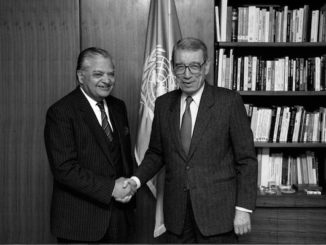
    General Rikhye (left)with UNSG Boutros Ghali in1995. General Rikhye was the first Military Adviser of the UN Secretary General (1960-67) and was instrumental in establishing the International Peace Institute in New York


                                                            By Ambassador Asoke Kumar Mukerji

    The human cost of UN peacekeeping has been high. Deployed under the Blue Flag of the United Nations, UN peacekeepers have operated under volatile conditions. However, in recent years, these peacekeepers have themselves become victims of violence, making the supreme sacrifice to safeguard their mandate, and the principles of the UN Charter.

    A total of 110,000 UN peacekeepers are currently deployed across the world in 13 missions, funded by a peacekeeping budget of $6.5 billion.

    India is justifiably proud of her contributions to UN peacekeeping. She has sent the largest number of troops for UN peacekeeping from among the 193 member-states of the United Nations, with more than 200,000 troops deployed in 49 out of the 71 peacekeeping operations mandated so far by the UNSC.

    29 May 2020 is being commemorated as the International Day of UN Peacekeepers. It was on this day in 1948 that the United Nations Security Council (UNSC) attempted to innovate a mechanism to keep the peace by deploying a small number of UN military observers to monitor the Armistice Agreement between Israel and its Arab neighbors.

    Since then, UN peacekeeping has been used extensively by the UNSC over the past seven decades to provide stability in conflict situations for implementing peace agreements between member-states of the United Nations, and to stabilize conflict situations within the UN’s member-states.

    The human cost of UN peacekeeping has been high. Deployed under the Blue Flag of the United Nations, UN peacekeepers have operated under volatile conditions. However, in recent years, these peacekeepers have themselves become victims of violence, making the supreme sacrifice to safeguard their mandate, and the principles of the UN Charter.

    India is justifiably proud of her contributions to UN peacekeeping. She has sent the largest number of troops for UN peacekeeping from among the 193 member-states of the United Nations, with more than 200,000 troops deployed in 49 out of the 71 peacekeeping operations mandated so far by the UNSC.

    On the International Day of UN Peacekeepers, we remember with respect the supreme sacrifice made by 3925 troops from UN member-states.

    India has suffered the largest number of casualties in UN peacekeeping among the troop-contributing member-states, with 170 fatalities in 25 peacekeeping missions. Of these, as many as 39 Indian UN peacekeepers were killed during their deployment in the Congo as part of ONUC in 1960-64.

    At its 70th anniversary in 2015, the UN convened a Leaders’ Summit on Peacekeeping to take stock of the contribution made by UN peacekeeping to maintaining international peace and security. Addressing the gathering of world leaders, India’s Prime Minister Shri Narendra Modi conveyed India’s commitment to participate proactively in implementing the peacekeeping mandates given by the UNSC. He also referred to the UN General Assembly’s unanimous decision to build a Commemorative Wall in honor of the fallen UN peacekeepers from all countries and said “it would be most fitting if the proposed memorial wall to the fallen peacekeepers is created quickly”.

    A total of 110,000 UN peacekeepers are currently deployed across the world in 13 missions, funded by a peacekeeping budget of $6.5 billion. As many as 54,000 troops serve in just four peacekeeping missions in Africa – MONUSCO in the Democratic Republic of Congo (annual budget $1.01 billion), UNMISS in South Sudan (annual budget $1.18 billion), MINUSMA in Mali (annual budget $1.13 billion) and MINUSCA in the Central African Republic (annual budget $ 1.2 billion).

    India is a major contributor to two of these four operations, with 1864 troops as part of the 16,215 military personnel deployed on the ground in MONUSCO in the Democratic Republic of Congo and 2343 troops on the ground as part of the 13,795 contingent troops in UNMISS in South Sudan.

    The increasing challenges being faced by UN peacekeeping are compounded by the growing resistance of some major powers represented as permanent members in the UNSC to contribute financial resources to sustain UN peacekeeping operations. In April 2019, the UN Secretary General Antonio Guterres had reported that over $250 million were owed to troop contributing countries, among which India was owed $38 million, the highest for any member-state.

    As the United Nations prepares to mark its 75th anniversary later this year, it is time to look to the future of UN peacekeeping. Two issues are relevant in this context.

    First, it is time to augment the effectiveness of UN peacekeeping by enhancing the role played by UN women peacekeepers. 2020 marks the 20th anniversary of the landmark UNSC resolution on “women, peace and security”. India was the first UN member-state to deploy an all-women’s peacekeeping unit in Liberia in 2007. The impact of UN women peacekeepers from India in performing their mandate, as well as acting as force multipliers to sustain the resilience of national governance structures during a period of volatile conflict, has been acknowledged by President Ellen Johnson Sirleaf of Liberia, who was the first elected female head of state in Africa. Building on this experience, India has deployed her women UN peacekeepers as part of UNMISS in South Sudan, where the challenges posed by violent conflict (and their impact on women in particular) are greater.

    Major Suman Gawani of the Indian Army has been given the UN Military Gender Advocate Award for 2020

    It is a fitting tribute to India’s women UN peacekeepers that the UN Military Gender Advocate Award for 2020 has been given to Major Suman Gawani of the Indian Army. The UN highlighted that Major Gawani mentored over 230 UN Military Observers on conflict-related sexual violence and ensured the presence of women military observers in each of UNMISS’ team sites. She also trained South Sudanese government forces.

    The second issue is the long overdue reform of the decision-making process of the UNSC, which decides on the mandates to deploy UN peacekeepers. This reform, mandated by world leaders 15 years ago at the 60th anniversary Summit of the United Nations, must be completed urgently if the UN is to be seen as an effective multilateral institution for maintaining international peace and security. The unprecedented challenges facing the UN today due to the Covid-19 pandemic prioritize the need to break the current deadlock in inter-governmental negotiations in the UN General Assembly. Polarization among the permanent members of the UNSC  and their resistance to UNSC reform cannot be allowed to paralyze or compromise the effectiveness of the Security Council, especially when millions of lives of people caught in conflicts where UN peacekeeping missions are deployed are at stake.

    (The author is a former Indian diplomat and writer. He was Permanent Representative of India to the United Nations from April 2013 to December 2015. He can be reached at 1955pram@gmail.com)


  • Future of U.S.  Economy

    Future of U.S. Economy

    By Ven Parameswaran

    The stock market is a leading indicator of American economy. After President Trump was elected in 2016, the Dow Jone’s Average has jumped from 18,000 to almost 30,000. Because of Coronavirus and subsequent locked-in, the market plunged back to 18,000 by March 23, 2020. From March 23, 2020 to May 27, 2020, the Dow Jone’s has recovered 7540 points in a matter of two short months. This kind of rapid recovery has been unprecedented in the history of the stock market.   This is highly remarkable and a very significant factor to gauge future economy. The NASDAQ dominated by trillion-dollar technology companies (Microsoft, Apple, Amazon, Google) have performed even better than the Dow Jone’s. The Nasdaq is now only 5% from its all-time high reached in February before the Coronavirus.

    Never before, the stock market has performed breaking all past records. President Trump and his policies have been credited by the investors and all Americans who have their pension funds invested in the market (401-K). Once the market performs, nobody can challenge because all Americans believe in higher wages and prosperity. Americans are wondering how the market could go up so big and so rapidly when the economy has been shut and the unemployment has exceeded historical record of over 20%. How can the market go up when the business of travel, restaurants, retail sales, manufacturing, and others have been stopped because of locked-ins?

    The Federal Reserve cut the interest rate to zero per cent. The Federal Reserve is an independent agency. But President Trump pressured its Chairman Powell to lower the interest rate to zero. Now he has asked him to lower it further into negative interest rate so that it will grow the economy.   The Federal Reserve has flooded the financial markets, commercial and investment banks, asset management firms, and large hedge funds with approximately 7 trillion dollars. What the Fed has done is unprecedented. Powell, the Fed Chairman has assured the captains of the industry that the Fed will employ all tools available in its hand to help the economy grow.   With generous tax cuts and heavy deregulations by President Trump, potential for corporate profits have expanded.   In addition, President Trump’s recommendation to the Congress to approve $3 trillion in fiscal support to all Americans, small businesses, and other businesses in distress have helped enormously in recovery of the economy.   Generous unemployment compensation of $1200 per week has created unbelievable security and is perking the economy.

    Americans received $1200 each and the government postponed filing of tax returns to July from April 15. Proof of climbing retail sales is the result of President Trump’s fiscal support. President Trump and the Congress are working on issuing second installment of $2000 each to drum up the economy.

    The combined support from the Fed Reserve and the Congress is equal to 50% of America’s annual GDP of 20 trillion dollars.   I would speculate that a substantial amount from this has gone into investing in stocks. Can we not ask how can the stocks skyrocket like this when the economy has been shut down and more than 40 million are unemployed?   When the real economy is not generating any income based on productivity, how can the stock go up?     President Trump has said that the economy he created is a solid and sound economy. Therefore, when the locked in is over, the economy will rebound and the stock market will go up like a rocket. Proof of the pudding lies in the eating of it. It appears now that President Trump’s prophesies are coming true.

    Has the Fed Chairman Powell succeeded in playing magic? Or, is this artificial? Who knows? Let me analyze the comments of some vehement Democrats, economists, and industry captains.

    JPMorgan Chairman, Jamie Dimon, a staunch Democrat and a candidate for the Secretary of the Treasury in Biden administration stated that the government has been pretty responsive, big companies have the means, hope we keep the small companies alive.” “growing stocks” from the Fed Reserve had helped small business. He said the U.S. economy could see a rapid recovery in the 3rd quarter.   He said: “you can already see the positive effects of the current opening, at least for the economy.”   The same Jamie Dimon has been highly critical of President Trump just for political purposes. But when his own company and stocks of major banks and financial firms go up, he cannot but tell the truth.

    Michael Darda, MKM Partners Chief Market Strategist and Chief Economist said: “The market has been making a V-pattern upward and there has been a tremendous amount of skepticism around that but we are just starting now to see some evidence in the data turning some better than expected Housing numbers. As reopening gets underway, virtually all states now we are starting to see activity bounce off of very low levels.”

    On Wednesday, May 27, the Mortgage Bankers Association reported a sixth straight weekly rise in mortgage applications. Data released Tuesday showed NEW HOME SALES in April topped estimates. Sales of new U.S. SINGLE FAMILY HOMES increased by 623,000 in April, beating estimates of 490,000.

    Wharton School of Business Professor Jeremy Siegel told that new stock market highs this year is a ‘REAL POSSIBILITY’.   Absent a second wave of Coronavirus later in the Fall, it is “even a likelihood that we will reach “fresh record highs.”     This kind of over optimism from conservative and liberal economists is unprecedented.

    “One of the unfortunate things about the lockdown is we have actually improved the prospects of the very companies in the stock markets.” Siegel added.     “In fact, given no serious second wave, which could mean just effective therapeutics without even a universal vaccine, my feeling is it is even a likelihood that we will reach fresh record highs.” Siegel said.

    (The author is a former President & CEO, First Asian Securities Corporation, NYC. His successful trading strategies on the day of 1987 stock market crash was highlighted by the WSJ. He lives in Scarsdale, N.Y. He can be reached at vpwaren@gmail.com)

  • Keeping Peace Alive: A Tribute to UN Peacekeepers

    Keeping Peace Alive: A Tribute to UN Peacekeepers

    By Ambassador Asoke Kumar Mukerji

    The human cost of UN peacekeeping has been high. Deployed under the Blue Flag of the United Nations, UN peacekeepers have operated under volatile conditions. However, in recent years, these peacekeepers have themselves become victims of violence, making the supreme sacrifice to safeguard their mandate, and the principles of the UN Charter.

    A total of 110,000 UN peacekeepers are currently deployed across the world in 13 missions, funded by a peacekeeping budget of $6.5 billion.

    India is justifiably proud of her contributions to UN peacekeeping. She has sent the largest number of troops for UN peacekeeping from among the 193 member-states of the United Nations, with more than 200,000 troops deployed in 49 out of the 71 peacekeeping operations mandated so far by the UNSC.

    On the International Day of UN Peacekeepers, we remember with respect the supreme sacrifice made by 3925 troops from UN member-states.

    29 May 2020 is being commemorated as the International Day of UN Peacekeepers. It was on this day in 1948 that the United Nations Security Council (UNSC) attempted to innovate a mechanism to keep the peace by deploying a small number of UN military observers to monitor the Armistice Agreement between Israel and its Arab neighbors.

    Since then, UN peacekeeping has been used extensively by the UNSC over the past seven decades to provide stability in conflict situations for implementing peace agreements between member-states of the United Nations, and to stabilize conflict situations within the UN’s member-states.

    The human cost of UN peacekeeping has been high. Deployed under the Blue Flag of the United Nations, UN peacekeepers have operated under volatile conditions. However, in recent years, these peacekeepers have themselves become victims of violence, making the supreme sacrifice to safeguard their mandate, and the principles of the UN Charter.

    India is justifiably proud of her contributions to UN peacekeeping. She has sent the largest number of troops for UN peacekeeping from among the 193 member-states of the United Nations, with more than 200,000 troops deployed in 49 out of the 71 peacekeeping operations mandated so far by the UNSC.

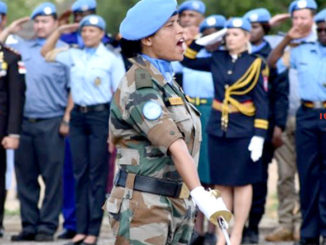
    Indian women peacekeepers in Liberia from 2007 when they first landed there.

    On the International Day of UN Peacekeepers, we remember with respect the supreme sacrifice made by 3925 troops from UN member-states.

    India has suffered the largest number of casualties in UN peacekeeping among the troop-contributing member-states, with 170 fatalities in 25 peacekeeping missions. Of these, as many as 39 Indian UN peacekeepers were killed during their deployment in the Congo as part of ONUC in 1960-64.

    At its 70th anniversary in 2015, the UN convened a Leaders’ Summit on Peacekeeping to take stock of the contribution made by UN peacekeeping to maintaining international peace and security. Addressing the gathering of world leaders, India’s Prime Minister Shri Narendra Modi conveyed India’s commitment to participate proactively in implementing the peacekeeping mandates given by the UNSC. He also referred to the UN General Assembly’s unanimous decision to build a Commemorative Wall in honor of the fallen UN peacekeepers from all countries and said “it would be most fitting if the proposed memorial wall to the fallen peacekeepers is created quickly”.

    A total of 110,000 UN peacekeepers are currently deployed across the world in 13 missions, funded by a peacekeeping budget of $6.5 billion. As many as 54,000 troops serve in just four peacekeeping missions in Africa – MONUSCO in the Democratic Republic of Congo (annual budget $1.01 billion), UNMISS in South Sudan (annual budget $1.18 billion), MINUSMA in Mali (annual budget $1.13 billion) and MINUSCA in the Central African Republic (annual budget $ 1.2 billion).

    India is a major contributor to two of these four operations, with 1864 troops as part of the 16,215 military personnel deployed on the ground in MONUSCO in the Democratic Republic of Congo and 2343 troops on the ground as part of the 13,795 contingent troops in UNMISS in South Sudan.


    The increasing challenges being faced by UN peacekeeping are compounded by the growing resistance of some major powers represented as permanent members in the UNSC to contribute financial resources to sustain UN peacekeeping operations. In April 2019, the UN Secretary General Antonio Guterres had reported that over $250 million were owed to troop contributing countries, among which India was owed $38 million, the highest for any member-state.

    As the United Nations prepares to mark its 75th anniversary later this year, it is time to look to the future of UN peacekeeping. Two issues are relevant in this context.

    First, it is time to augment the effectiveness of UN peacekeeping by enhancing the role played by UN women peacekeepers. 2020 marks the 20th anniversary of the landmark UNSC resolution on “women, peace and security”. India was the first UN member-state to deploy an all-women’s peacekeeping unit in Liberia in 2007. The impact of UN women peacekeepers from India in performing their mandate, as well as acting as force multipliers to sustain the resilience of national governance structures during a period of volatile conflict, has been acknowledged by President Ellen Johnson Sirleaf of Liberia, who was the first elected female head of state in Africa. Building on this experience, India has deployed her women UN peacekeepers as part of UNMISS in South Sudan, where the challenges posed by violent conflict (and their impact on women in particular) are greater.

    Major Suman Gawani of the Indian Army has been given the UN Military Gender Advocate Award for 2020

    It is a fitting tribute to India’s women UN peacekeepers that the UN Military Gender Advocate Award for 2020 has been given to Major Suman Gawani of the Indian Army. The UN highlighted that Major Gawani mentored over 230 UN Military Observers on conflict-related sexual violence and ensured the presence of women military observers in each of UNMISS’ team sites. She also trained South Sudanese government forces.

    The second issue is the long overdue reform of the decision-making process of the UNSC, which decides on the mandates to deploy UN peacekeepers. This reform, mandated by world leaders 15 years ago at the 60th anniversary Summit of the United Nations, must be completed urgently if the UN is to be seen as an effective multilateral institution for maintaining international peace and security. The unprecedented challenges facing the UN today due to the Covid-19 pandemic prioritize the need to break the current deadlock in inter-governmental negotiations in the UN General Assembly. Polarization among the permanent members of the UNSC and their resistance to UNSC reform cannot be allowed to paralyze or compromise the effectiveness of the Security Council, especially when millions of lives of people caught in conflicts where UN peacekeeping missions are deployed are at stake.

    (The author is a former Indian diplomat and writer. He was Permanent Representative of India to the United Nations from April 2013 to December 2015. He can be reached at 1955pram@gmail.com)


  • A Webinar on Augmenting US-India Healthcare Relations under Covid Challenge

    A Webinar on Augmenting US-India Healthcare Relations under Covid Challenge

    NEW YORK (TIP): Global Indian Trade and Cultural Council, USA in collaboration with Consulate General of India, NY has started a Webinar series. The first webinar is scheduled for June 1st, 2020 on Augmenting US India Healthcare Relations under Covid Challenge. This will have professionals from Covid 19 vaccine manufacturing companies,  IT company Birlasoft who specialize in  healthcare software, distinguished Professors from Harvard, Johns Hopkins and Panjab University, Pharmaceutical Scientist from NIPER, India, Ex Director Organization of Pharmaceutical Produces of India, Banker and Media professional, according to Mr. H.S. Panaser, Chair, Global Indian Trade and Culture, USA.

    Speaking to The Indian Panorama on the need for  series of webinars to deal with the subject of  cooperation between the U.S. and India in the pharmaceutical sector, Mr. Panaser said: “The dependencies and inter-dependencies of globalization especially between US India,  have been in headlines during the COVID-19 pandemic—and nowhere more so than in the Healthcare segment. More so, in pharmaceutical industry. We don’t yet know how the medicine and vaccine challenge will end. Whether it be avipiravir, remdesivir or something else. It is unclear which drug, if any, will work. It  may be an Indian company Bharat Biotech or American company or an Oxford lab that is hailed as a hero for a treatment or prevention, the task is not just about discovering a treatment or vaccine that works, but making it available to as many people as possible in as short a time as possible. Successful accomplishment of that task—especially in the global south is difficult to envisage without Indian involvement. COVID-19 ignores borders and the solutions to address it will need to overcome them too.

    “Therefore, there was a need for a school of thought to bring on a platform from the field of Academia, Industry and Government, Mr. Panaser said.

    Mr.  Panaser spoke at length about the Indian pharmaceutical scene and the healthcare sector. “The Indian healthcare sector is expected to reach Rs 19,56,920 crore (US$ 280 billion) by 2020. Rising income level, greater health awareness, increased precedence of lifestyle diseases and improved access to insurance would be the key contributors to growth.  Indian Pharmaceuticals is a sunrise industry with a competitive advantage for India globally. we should leverage India’s position by unleashing entrepreneur spirit the bullish outlook for health care segment is now taking India in a forward momentum. The market size of India in Pharmaceuticals alone is estimated to be $100 billion and medical devices is $25 billion by 2025. Now with amendment in FDI policy where one can invest up to 100% specially if it is medical devices segment where India is importing 80% of medical devices”, Mr. Panaser said.

    “This webinar will discuss the US India Healthcare Relations to kickstart Exchange program of Student, research fellows in Universities, research institutes, Medical Colleges in the field of Pharmaceuticals, Medicine, Healthcare AI, MT by IT companies and Medical Devices.

    ‘Such webinars will set a movement to spearhead collaborative mindset and a platform for FDI, mergers and joint ventures under Prime Minister Modi’s $13 billion for three pharmaceutical parks in India and up to 100% FDI in Medical devices. Covid 19 has been an Eye opener – the present Government has done more in last   few weeks than what was done in years.

    “Indian government has to make new policies for top Universities with research and institutes like National Institute of Pharmaceutical Education and Research with top scientist to allow them collaboration with public private partnership and to have India’s best leadership.

    The following is the list of people who along with Ambassador Sandeep Chakravorty are on the panel.

    1.Mr. T. Srinivas, CFO, Bharat Biotech, Hyderabad, India

    2.Mr. Sai Prasad, President QC, Bharat Biotech, India

    3.Mr. Roop Singh, Chief Business Officer, Birlasoft, USA

    4.Prof. Charles N Pozner, MD, Emergency Medicine, Harvard University, USA

    5.Prof. Subroto Chatterjee, John Hopkins University of Medicine, USA.

    6.Prof.(Dr) T.R. Bhardawaj , Vice Chancellor, Baddi University (Pharmaceuticals),India

    7.Prof, (Dr) Pradeep Gupta, Burroghs Wellcome Professor of Pharmaceuticals, USciences, Philadelphia, PA, USA

    8.Prof.(Dr) Saranjit Singh, Pharmaceutical Scientist, National Institute and Pharmaceutical Education and Research, Mohali, Punjab, India

    9.Prof. (Dr) Kanwaljit Chopra, Chairperson, University Institute of Pharmaceutical Sciences, Panjab University, Chandigarh, India

    10.Mr. Vivek Padgaonkar, Director- Project & Policy, OPPI (Organization of Pharmaceutical Producers of India)

    11.Mr. Yash Dani, VP, Fulton Bank, NJ, USA

    12.Prof. Indrajit Saluja, Editor, The Indian Panorama, NY, USA, Media

    Moderator: H S Panaser, Chair, Global Indian Trade and Culture, USA

  • Indian American Nayan Parikh named a member of de Blasio’s real estate reopening council

    Indian American Nayan Parikh named a member of de Blasio’s real estate reopening council

    NEW YORK (TIP): Indian American Nayan Parikh , owner of Ashnu International, Inc. an award winning, premier/MWBE Construction and Management provider to host of Federal, State and City Agencies, Corporations and other industries, is one of the 30 New Yorkers named on Mayor de Blasio’s real estate reopening council. The panel will guide the industry’s economic reboot.

    Nayan Parikh has, over the past fifteen years, continued hard to establish his name within the corridors of Government Agencies and has continued to build his reputation to his expertise in bringing excellent performance to the projects undertaken by his company. He has been the champion in leading many professional and community organizations and continues to give back to the society in many different ways. He has brought new ideas to fruition, both for profit and non-profit organizations. After graduation from college, Nayan began his career as a Civil Engineer in India, before migrating to the USA. In his new homeland, he began his career as an estimator in a small construction company, before quickly finding his own strength to become the founder and Managing Director of Ashnu International, Inc.

    Parikh’s vision, entrepreneurial aptitude, civil engineering background and broad range of expertise have made AIC a name to be envied within the construction industry. His company has credit to many well-known projects including Sandy Repair work at Coney Island, Rockaway Beach, multiple schools renovation for New York City School Construction Authority and Signal Modification at 71st Continental Ave with the Metropolitan Transportation Authority.

    Serving the community comes naturally to Parikh. From his first days of being a new immigrant to this country till now, he has been involved and giving his time, knowledge and wisdom to non-profit organizations, both within the community and professional. Although he is a part of many organizations and affiliations, he takes pride in each and every one and maintains an active leadership role in these organizations. Currently he is the president of the NAMC NY Tri-State Chapter, during his term he would like to bring more project procurement to his local chapter members. From humble beginnings and a minority himself, he understands the struggle to make to make the right connections or get that big break. Parikh isn’t afraid to reach out to make the necessary connection, which is one of his many strengths. Because of this, his network of associations varies in different influencers, who hold his opinion in high regards and has created a foray into creating an outreach program for his chapter members.


  • Indian American Rutgers Student Tanvi Banota Named 2020 Goldwater Scholar

    Indian American Rutgers Student Tanvi Banota Named 2020 Goldwater Scholar

    NEW BRUNSWICK, NJ (TIP): Tanvi Banota, a rising junior majoring in cell biology and neuroscience at Rutgers University-New Brunswick, has been named a recipient of the prestigious Goldwater Scholarship for her academic excellence.

    Considered the premier undergraduate award of its type in the fields of mathematics, natural sciences and engineering, the Goldwater Scholarship, which honors the late Sen. Barry Goldwater, is designed to encourage outstanding students to pursue careers in these fields. The scholarship awards up to $7,500 to help cover costs associated with tuition, mandatory fees, books, and room and board.

    Banota was chosen from a pool of more than 5,000 distinguished students submitted by 461 academic institutions for the 2020-21 academic year.

    Banota has worked in the lab of Debra Laskin in the Department of Pharmacology and Toxicology since she was in high school (thanks to Liberty Science Center’s Partners in Science program). There, her research focuses on the mechanisms of inflammation as a response to pulmonary injuries. She has worked in the lab and done research around this topic since 2017 and credits the continuity of that research and the many hours of experience she’s gained in the lab as part of what earned her a Goldwater Scholarship.


  • Indian American Senate Candidate Announces Campaign to Label Drugs with Country of Origin

    Indian American Senate Candidate Announces Campaign to Label Drugs with Country of Origin

    TRENTON, NJ (TIP): Republican Senate candidate Rik Mehta, a pharmacist and former FDA consumer safety officer from New Jersey, announced a plan to force drug manufacturers to label their products’ country of origin. Mehta is seeking to replace failed presidential candidate Cory Booker as Senator from New Jersey.

    “Americans have a right to know where their medicine comes from especially when nearly all other products are labeled with the country it was made in,” Mehta, a pharmacist, said. “I can look at products on my body, like my shirt and shoes and know exactly where it was made, but the same doesn’t hold true for things that go in our body, like our prescription drugs. That makes no sense.”

    Under current Food and Drug Administration regulations, the last place a given drug was manufactured is considered its place of origin.

    “These bizarre and conflicting laws and regulations that govern how to label products with their country of origin has allowed companies to profit from foreign drug manufacturing while hiding their supply chain from the American people for too long,” said Mehta. “American doctors and pharmacists should be able to inform patients on not only what ingredients are in their drugs, but where those ingredients were made.”

    In the public sector, Rik worked at the United States Food and Drug Administration as a Consumer Safety Officer to advance policies to expedite and increase access to quality, affordable drugs and health care. He also enforced against pharmaceutical companies taking millions of illegal prescription opioids off the market.

  • Indian American IBM Scientist Rajiv Joshi Wins Inventor of the Year Award

    Indian American IBM Scientist Rajiv Joshi Wins Inventor of the Year Award

    NEW YORK (TIP): Indian-American scientist Rajiv Joshi has bagged the prestigious Inventor of the Year award in recognition of his pioneering work in advancing the electronic industry and improving artificial intelligence capabilities. Dr Joshi has more than 250 patented inventions in the US and works at the IBM Thomson Watson Research Center in New York.

    He was presented with the prestigious annual award by the New York Intellectual Property Law Association earlier this month during a virtual awards ceremony.

    Dr. Joshi received his B.Tech from I.I.T (Bombay, India) and his MS from M.I.T, is a prolific inventor with more than 250 US and more than 350 international patents. He is an IEEE Fellow and received the Industrial Pioneer Award from the IEEE Circuits and Systems Society in 2013. He is a key technical lead at IBM’s T. J. Watson Research Center, focusing on the development of integrated circuits and memory chips.

    Holding the IBM title of Master Inventor since 1997, Joshi has more than 200 publications including conferences and journals, and he has received scores of other accolades and awards including receiving the IBM’s Corporate Patent Portfolio Award on three separate occasions. Among several honors, Joshi was inducted into the New Jersey Inventor Hall of Fame in 2014, received IEEE CAS Society’s Industrial Pioneer Award, and the IEEE Daniel E. Noble Award for Emerging Technologies in 2018.

    Joshi’s successful tenure at IBM Research has been highlighted by breakthrough inventions that are prevalent to our everyday lives such as servers, medical devices, handheld devices, and wearable technology. His inventions include fundamental interconnect process technology that helped in the achievement of Moore’s scaling, which aides with computational performance and for memory bandwidth issues, which are much needed for AI.

  • Indian American Princeton Student Wins Walter E. Hope Class of 1901 Medal

    Indian American Princeton Student Wins Walter E. Hope Class of 1901 Medal

    PRINCETON, NJ (TIP): Princeton senior Preeti Iyer has been honored for her service to the Class of 2020 and to the University. Iyer received the Walter E. Hope Class of 1901 Medal, which recognizes the senior who, in the judgment of the student’s classmates, has done the most for Princeton.

    Iyer, of Alpharetta, Georgia, is a computer science concentrator and a member of Forbes College. She has been involved in a wide range of activities across the University, ranging from advocacy to athletics and the arts.

    She led the Princeton Menstrual Products Task Force for three years, successfully launching a University program to provide free menstrual products in Princeton restrooms, and has assisted over a dozen other universities in launching similar initiatives. She is also the founder and director of “Period Palooza: A Menstrual Equity and Innovation Conference,” and previously served as a U-Councilor on the Undergraduate Student Government.

    Iyer co-founded Representable.org along with four other Princeton students. The crowdsourced redistricting tool helps combat gerrymandering and improves redistricting efforts across the county.

    A member of the campus arts community, she performed with DiSiac Dance Company and Princeton Bhangra. During her first two years, she also competed as a member of Princeton Women’s Rugby Team.

    In addition, Iyer has held data science internships at Facebook, Tesla, and the Associate of American Medical Colleges.

  • Indian Army officer Major Suman Gawani Wins UN Military Gender Award

    Indian Army officer Major Suman Gawani Wins UN Military Gender Award

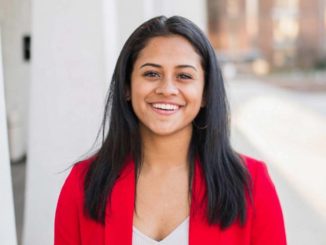
    NEW YORK (TIP): For the first time, the UN Military Gender Advocate award has been awarded to two UN peacekeepers: Major Suman Gawani, of the Indian Army and Commander Carla Monteiro de Castro Araujo, a Brazilian Naval officer.

    The award, created in 2016, recognizes the dedication and effort of individual military peacekeepers in promoting the UN principles on Women, Peace and Security in peace operations. Women peacekeepers are nominated by the heads and force commanders of peace operations.

    Major Gawani – the first Indian peacekeeper to win the award – is a Military Observer, formerly deployed to the UN Mission in South Sudan (UNMISS), where she mentored over 230 UN Military Observers on conflict-related sexual violence, and ensured the presence of women military observers in each of the Mission’s team sites. She also trained South Sudanese government forces, and helped them to launch their action plan on conflict-related sexual violence.

    Expressing happiness at seeing her work recognized, Major Gawani noted that, “whatever our function, position or rank, it is our duty as peacekeepers to integrate an all-genders perspective into our daily work and own it, in our interactions with colleagues as well as with communities”.

    Commending the two women peacekeepers, UN chief António Guterres described them as powerful role models: “Through their work, they have brought new perspectives and have helped to build trust and confidence among the communities we serve”, he said. “Through their commitment and innovative approaches, they embrace a standard of excellence that is an inspiration to all blue helmets everywhere. As we confront today’s challenges, their work has never been more important or relevant.”


  • Indian American Led Team Develops Low-Cost Ventilator

    Indian American Led Team Develops Low-Cost Ventilator

    ATLANTA, GA (TIP): An Indian American led team has developed a low-cost, portable ventilator meant to help doctors around the world treat COVID-19 patients. Devesh Ranjan, a professor and associate chair in the prestigious Georgia Tech’s George W Woodruff School of Mechanical Engineering and his research team at the Georgia Institute of Technology has created a prototype for a low-cost, portable emergency ventilator that uses electronic sensors and computer control to manage key clinical parameters such as respiration rate, tidal volume (the amount of air moved into and out of the lungs during each cycle), inspiration and expiration ratio, and pressure on the lungs.

    The Open-AirVentGT was designed to address acute respiratory distress syndrome (ARDS), a common complication for COVID-19 patients which causes their lungs to stiffen, requiring their breathing to be assisted by ventilators. Unlike many other emergency ventilators, the new Georgia Tech device endeavors to make breathing more natural by allowing patients to trigger their own breaths instead of relying on a respiration rate pre-set in the device.

    The ventilator works by pneumatically compressing a BVM (Bag Valve Mask) assembly of the kind used in hospitals and carried in ambulances as resuscitation devices. The ventilator is envisioned for use outside the United States in countries that do not have significant medical infrastructure in place, and is designed to be produced for around $300.

    A projected shortage of ventilators prompted by the COVID-19 pandemic has led to development of makeshift ventilators, many of them based on differing mechanical strategies to compress BVM devices. Ranjan and his research team evaluated what others had done and sought input on clinician needs from critical care specialists at two Atlanta hospitals during the design of the Open-AirVentGT.


  • Indian American Professor Brinda Sarathy Receives ACLS Fellowship

    Indian American Professor Brinda Sarathy Receives ACLS Fellowship

    CLAREMONT, CA  (TIP): Pitzer College Professor of Environmental Analysis and the Director of the Robert Redford Conservancy for Southern California Sustainability at Pitzer College Brinda Sarathy has received The American Council of Learned Societies (ACLS) fellowship for her project on Laid to Waste: The Stringfellow Acid Pits and Making of Place in Southern California.

     This project examines the history of the first Superfund site in California, the Stringfellow Acid Pits, to better understand how places are produced in the context of invisible flows: of toxics, of groundwater, and less told stories of social mobilization. Drawing on archival material and interviews with community activists and government officials, this research explores how hazardous wastes are understood, rationalized, and managed by scientific experts to justify dumping; why policy makers overlooked groundwater contamination in spite of prevailing scientific knowledge; and how to make sense of the often heterogeneous and contradictory nature of local resistance to, and mobilization against, contamination by industrial waste. Significantly, this work considers how institutions of expertise often exclude the experiences of those most exposed to harm and, despite deep and persistent uncertainties, authority figures have been called on to minimize concerns about hazardous substances, thus facilitating industrial, military, and economic expansion.

    The ACLS Fellowship Program awards fellowships to individual scholars working in the humanities and related social sciences.

  • May 29 New York & Dallas E – Edition

    [vc_row][vc_column][vc_column_text]

    E-Edition

    [/vc_column_text][/vc_column][/vc_row][vc_row][vc_column width=”2/3″][vc_custom_heading text=”” font_container=”tag:h2|text_align:center” google_fonts=”font_family:Istok%20Web%3Aregular%2Citalic%2C700%2C700italic|font_style:700%20bold%20regular%3A700%3Anormal” link=”url:https%3A%2F%2Fwww.theindianpanorama.news%2Fwp-content%2Fuploads%2F2020%2F05%2FTIP-May-29-Dual-Edition.pdf|||”][vc_single_image image=”99495″ img_size=”full” add_caption=”yes” alignment=”center” onclick=”custom_link” link=”https://www.theindianpanorama.news/wp-content/uploads/2020/05/TIP-May-29-Dual-Edition.pdf”][/vc_column][vc_column width=”1/3″][vc_single_image image=”82828″ img_size=”medium” alignment=”center” onclick=”custom_link” link=”https://www.theindianpanorama.news/advertising-media-kit-portal-indian-panorama/”][vc_single_image image=”82829″ img_size=”medium” alignment=”center” onclick=”custom_link” link=”https://www.theindianpanorama.news/advertising-media-kit-portal-indian-panorama/”][/vc_column][/vc_row][vc_row][vc_column width=”2/3″][vc_custom_heading text=”Lead Stories This week” font_container=”tag:h2|text_align:center” google_fonts=”font_family:Istok%20Web%3Aregular%2Citalic%2C700%2C700italic|font_style:700%20bold%20regular%3A700%3Anormal” link=”url:https%3A%2F%2Fwww.theindianpanorama.news%2F%20|||”][/vc_column][vc_column width=”1/3″][vc_widget_sidebar sidebar_id=”mh-sidebar”][/vc_column][/vc_row]

  • For America to judge the murderers

    For America to judge the murderers

    Another sad day in America’s history. The murder of a black person by a white police officer in Minneapolis, May 26, is another addition to a chain of such crimes by the police who are supposed to protect lives, not snuff them out.

    The video (https://youtu.be/ZWzkgKPZWcw) shot by a bystander and in wide circulation on social media platforms clearly tells us who the murderer is. It is inhuman and barbaric of the police officer to kill the man. It is not an isolated case. The brutal murder of a black person by a white police officer reminds one of the murder on July 17, 2014, of a black Eric Garner in New York, who, too, was choked to death almost in the way  as the black George Floyd (46) in this video. The repeated pleadings  of Floyd to police officer to get off his neck and his cries that he was not able to breathe which continued until he could speak no more, reminds one of the similar cries of Garner who kept repeating he could not breathe until he fell silent.

    Over the years we have seen a propensity among white police officers to murder black persons. And, it happens all across America. Americans need to analyze why it happens. It is time to ensure we have in the police, people who harbor no racial or ethnic prejudices. People with prejudices are sure to harm the multicultural mosaic of America.  Let politicians of all hues understand if they do not arrest the trend now, future generations will pay a heavy price for their indifference. Let there be no politics that divides the great nation that America is, and of which we all are so proud.

    Founding fathers of America must be turning in their graves each time a racial killing born out of prejudice of a white guy against a black person takes place. This is not the America we want our children to inherit.

    Stop it here. Stop it now.

    The least that needs to be done is to charge the white officer with his left hand in his pocket relishing the slow death he was forcing on a pinned down Floyd, with manslaughter. No witnesses are required. The video alone is sufficient credible witness. Other colleagues of the murderer police officer are guilty of complicity. They need to be charged as conspirers in the murder of Floyd.

    And remember, justice dispensers, justice delayed is justice denied. And, again, no presidential pardon for a murderer -police officer, please.

  • Future of U.S.  Economy

    Future of U.S. Economy

    By Ven Parmeswaran

    “America’s 20 trillion economy will rebound from third quarter and shock the world in the fourth quarter. The stock market will make a new high this year. Jamie Dimon, chairman of JP Morgan, a staunch Democrat, says U.S. economy will witness “quite rapid recovery” from Coronavirus pandemic”, says the author.


    The stock market is a leading indicator of American economy.  After President Trump was elected in 2016, the Dow Jone’s Average has jumped from 18,000 to almost 30,000.  Because of Coronavirus and subsequent locked-in, the market plunged back to 18,000 by March 23, 2020.  From March 23, 2020 to May 27, 2020, the Dow Jone’s has recovered 7540 points in a matter of two short months.  This kind of rapid recovery has been unprecedented in the history of the stock market.   This is highly remarkable and a very significant factor to gauge future economy.  The NASDAQ dominated by trillion-dollar technology companies (Microsoft, Apple, Amazon, Google) have performed even better than the Dow Jone’s.  The Nasdaq is now only 5% from its all-time high reached in February before the Coronavirus.

    Never before, the stock market has performed breaking all past records.  President Trump and his policies have been credited by the investors and all Americans who have their pension funds invested in the market (401-K).  Once the market performs, nobody can challenge because all Americans believe in higher wages and prosperity.  Americans are wondering how the market could go up so big and so rapidly when the economy has been shut and the unemployment has exceeded historical record of over 20%. How can the market go up when the business of travel, restaurants, retail sales, manufacturing, and others have been stopped because of locked-ins?

    The Federal Reserve cut the interest rate to zero per cent.  The Federal Reserve is an independent agency.  But President Trump pressured its Chairman Powell to lower the interest rate to zero.  Now he has asked him to lower it further into negative interest rate so that it will grow the economy.    The Federal Reserve has flooded the financial markets, commercial and investment banks, asset management firms, and large hedge funds with approximately 7 trillion dollars.  What the Fed has done is unprecedented.  Powell, the Fed Chairman has assured the captains of the industry that the Fed will employ all tools available in its hand to help the economy grow.   With generous tax cuts and heavy deregulations by President Trump, potential for corporate profits have expanded.   In addition, President Trump’s recommendation to the Congress to approve $3 trillion in fiscal support to all Americans, small businesses, and other businesses in distress have helped enormously in recovery of the economy.   Generous unemployment compensation of $1200 per week has created unbelievable security and is perking the economy.

    Americans received $1200 each and the government postponed filing of tax returns to July from April 15.  Proof of climbing retail sales is the result of President Trump’s fiscal support.  President Trump and the Congress are working on issuing second installment of $2000 each to drum up the economy.

    The combined support from the Fed Reserve and the Congress is equal to 50% of America’s annual GDP of 20 trillion dollars.   I would speculate that a substantial amount from this has gone into investing in stocks.  Can we not ask how can the stocks skyrocket like this when the economy has been shut down and more than 40 million are unemployed?    When the real economy is not generating any income based on productivity, how can the stock go up?     President Trump has said that the economy he created is a solid and sound economy.  Therefore, when the locked in is over, the economy will rebound and the stock market will go up like a rocket.  Proof of the pudding lies in the eating of it.  It appears now that President Trump’s prophesies are coming true.

    Has the Fed Chairman Powell succeeded in playing magic?  Or, is this artificial? Who knows?  Let me analyze the comments of some vehement Democrats, economists, and industry captains.

    JPMorgan Chairman, Jamie Dimon, a staunch Democrat and a candidate for the Secretary of the Treasury in Biden administration stated that the government has been pretty responsive, big companies have the means, hope we keep the small companies alive.”  “growing stocks” from the Fed Reserve had helped small business.  He said the U.S. economy could see a rapid recovery in the 3rd quarter.    He said: “you can already see the positive effects of the current opening, at least for the economy.”    The same Jamie Dimon has been highly critical of President Trump just for political purposes.  But when his own company and stocks of major banks and financial firms go up, he cannot but tell the truth.

    Michael Darda, MKM Partners Chief Market Strategist and Chief Economist said: “The market has been making a V-pattern upward and there has been a tremendous amount of skepticism around that but we are just starting now to see some evidence in the data turning some better than expected Housing numbers.  As reopening gets underway, virtually all states now we are starting to see activity bounce off of very low levels.”

    On Wednesday, May 27, the Mortgage Bankers Association reported a sixth straight weekly rise in mortgage applications.  Data released Tuesday showed NEW HOME SALES in April topped estimates.  Sales of new U.S. SINGLE FAMILY HOMES increased by 623,000 in April, beating estimates of 490,000.

    Wharton School of Business Professor Jeremy Siegel told that new stock market highs this year is a ‘REAL POSSIBILITY’.   Absent a second wave of Coronavirus later in the Fall, it is “even a likelihood that we will reach “fresh record highs.”     This kind of over optimism from conservative and liberal economists is unprecedented.

    “One of the unfortunate things about the lockdown is we have actually improved the prospects of the very companies in the stock markets.” Siegel added.     “In fact, given no serious second wave, which could mean just effective therapeutics without even a universal vaccine, my feeling is it is even a likelihood that we will reach fresh record highs.” Siegel said.

    (The author is a former President & CEO, First Asian Securities Corporation, NYC.  His successful trading strategies on the day of 1987 stock market crash was highlighted by the WSJ.  He lives in Scarsdale, N.Y. He can be reached at vpwaren@gmail.com)

  • Reforming the UN system after Covid-19

    Reforming the UN system after Covid-19

    By Ambassador Asoke Mukerji

    The current global crisis demands global leadership. This is a major opportunity for India, together with a coalition of member-states whose national aspirations in a post-Covid19 world depend on effective international cooperation, to rise to the challenge.

    When the United Nations (UN) was conceptualized during the Second World War to “save succeeding generations from the scourge of war”, its two major objectives were to secure and to sustain international peace and security. Among the six principal organs of the UN, the UN Security Council (UNSC) was mandated by all signatory states of the UN Charter with the “primary responsibility” for securing international peace and security. The Economic and Social Council (ECOSOC) of the UN General Assembly (UNGA) was entrusted with sustaining international cooperation to achieve socio-economic progress, including upholding human rights and fundamental freedoms for all. As the UN commemorates the 75th anniversary of its establishment in September 2020, it is apparent that the implementation of this holistic vision of the UN Charter has been fragmented. That is the basis for calls for reform of the UN.

    On the positive side, the ECOSOC and the UN General Assembly have succeeded in responding to the single biggest change in international relations since the end of the Second World War. Decolonization enabled hundreds of millions of people in former colonies to be integrated into the UN system based on freedom and equality. Their aspirations have become the focus of the work of the UN and its specialized agencies.

    In the past four decades, these two organs of the UN have succeeded in creating a vibrant framework for upholding human rights. They have converged the twin objectives of climate change and accelerated development into Agenda 2030, with its 17 Sustainable Development Goals. Adopted unanimously by world leaders in September 2015, Agenda 2030 is the first multi-stakeholder universally agreed global framework for socio-economic progress. The adoption of Agenda 2030 signaled an awakened hope in ordinary people for better health, education, infrastructure, employment, and equality of opportunity.

    A crucial sentence in the Preamble of Agenda 2030 encapsulates the inter-linked nature of the global challenges of the 21st century. World leaders unanimously agreed that “there can be no sustainable development without peace and no peace without sustainable development”. This can only be ensured if there is a supportive global environment of peace and security, which requires an effective UNSC.

    However, the UNSC’s ineffectiveness in responding to challenges to international peace and security has become a major factor behind the fragmentation of international cooperation. Such challenges include the increased recourse to unilateral policies by its five permanent members (China, France, the Russian Federation, the United Kingdom and the United States of America, known as the P5), the increasing number of intra-state conflicts within UN member-states, the unfettered activities of designated terrorist entities and individuals, and the lack of a coherent political direction by the UNSC to support the UN’s response to global challenges, including the current Covid-19 pandemic. More than 70 million people across the five continents are currently impacted by the breakdown of international peace and security. This is the largest such number since the Second World War ended. The responsibility for this disaster lies squarely with the UNSC.

    The main reason for the UNSC’s ineffectiveness is the ‘veto’ provision of the P5 applied to decision-making by the Council. Although used in public as a measure of last resort during voting on a UNSC resolution, the P5 have consistently leveraged their ‘veto’ power to pursue their increasingly narrow self-interest. Most recently, China used this power during its Presidency of the UNSC in March 2020 to prevent any discussion on the impact of Covid-19 on international peace, security, and sustainable development. The United States used this power to prevent the adoption of a UNSC resolution supporting an all-of-UN response to Covid-19 on 8 May 2020.

    Fifteen years ago, at the 60th anniversary of the UN in 2005, world leaders had unanimously agreed that a malfunctioning UNSC needed to undergo early reform. They mandated such reform to make the UNSC “more broadly representative, efficient and transparent and thus to further enhance its effectiveness and the legitimacy and implementation of its decisions.” In 2007, the UNGA unanimously agreed to establish an inter-governmental negotiating platform to implement this mandate. In 2008 the UNGA unanimously agreed on five specific areas for reform of the UNSC including the question of the veto. In 2015, the UNGA unanimously agreed to use written proposals by over 120 member-states on these five areas to negotiate a resolution to amend the UN Charter.

    Since then, the momentum in the negotiations has been stymied by the P5, led by China. At the core of the status quo position of the P5 is their shared interest in keeping intact the provision of Article 27.3 of the UN Charter that confers on each of them the power to ‘veto’ substantive decisions of the UNSC. Historically, the ‘veto’ provision was agreed upon between the United States, United Kingdom and USSR at Yalta in February 1945. Despite calls to discuss this provision during the San Francisco Conference held between April-June 1945, the permanent members resisted any attempt to reopen the Yalta agreement on the veto.

    Participating countries at the San Francisco Conference eventually acquiesced with the P5’s veto provision in the expectation that this would ensure a supportive framework of peace and security for their reconstruction and development after the war. Their view was facilitated by the understanding, contained in Article 109 of the UN Charter, that the provisions of the treaty would be reviewed ten years after the Charter was ratified (i.e. by 1955) by a General Conference of the UN.

    Despite this provision, such a General Conference has never been convened. The last major opportunity for the UN to do so was following its 60th anniversary Summit in 2005. In the Summit declaration, world leaders had unanimously agreed to amend provisions of the UN Charter to delete references to “enemy state” (Germany, Japan and Italy), the Trusteeship Council (which had “no remaining functions”) and UNSC reforms.

    Since 2005, the UN has undertaken significant activities which need to be integrated into the provisions of its Charter. These include the establishment of the UN Human Rights Council (2006), the creation of UN Women for gender equality and the empowerment of women (2010), the agreement on Agenda 2030 on Sustainable Development (2015), a coordinated approach to countering terrorism through a Global Counter-Terrorism Strategy (2006) and Office of Counter-Terrorism (2017), and the ongoing impact of digital technologies on peace, security and development. Only a General Conference can enable a review of the provisions of the 1945 UN Charter to bring these initiatives into the context of making the UN “fit for purpose” in the 21st century.

    During the last decade, any initiative to implement Article 109 of the UN Charter and convene a General Conference has been deflected by pointing to the ongoing inter-governmental negotiations on UNSC reforms, which were expected to result in amending provisions of the UN Charter. Today, the hard reality is that these inter-governmental negotiations on UNSC reform are deadlocked with no end in sight.

    World leaders meeting at the UN’s 75th anniversary Summit on 21 September 2020 therefore must address this paradoxical situation, which holds the key to any reform of the UN. To do so, they must agree to convene the General Conference provided for in Article 109 of the UN Charter. Any proposal to hold such a Conference can be put on the agenda of the UNGA “if so decided by a majority vote of the members of the General Assembly and by a vote of any seven members of the Security Council.”

    The current global crisis demands global leadership. This is a major opportunity for India, together with a coalition of member-states whose national aspirations in a post-Covid19 world depend on effective international cooperation, to rise to the challenge.

    (Ambassador Asoke Mukerji served in the Indian Foreign Service for more than 37 years, retiring as India’s Ambassador and Permanent Representative to the United Nations in New York in December 2015)