Tag: Arvind Kejriwal

  • Sisodia’s arrest

    • Transparent & fair probe a must to refute vendetta charge

    The arrest of Delhi’s Deputy Chief Minister Manish Sisodia by the CBI in connection with alleged irregularities in the formulation and implementation of the now-scrapped excise policy is a major setback for the ruling Aam Aadmi Party (AAP), which showcased corruption-free governance among its main planks to record thumping poll victories in Delhi and Punjab in recent years. The development has worsened the conflict between the state government and the BJP-ruled Centre, with the former accusing the latter of misusing Central agencies for political vendetta.

    The contentious Delhi Excise Policy was scrapped in July last year after the Lieutenant Governor recommended a CBI inquiry into the allegations. Officials are accused of receiving kickbacks from liquor traders to grant licenses, extending undue favors to the licensees, waiving/reducing license fee and renewing L-1 license without due approval. It is apparent that the policy was withdrawn due to some anomalies in its execution; AAP needs to do the answering about what had gone wrong. Meanwhile, the onus is on the CBI to come up with irrefutable evidence to establish that Sisodia was directly or indirectly involved in any wrongdoing and whether the money trail leads to him. If any inconsistency or lacuna is detected in the case against the Deputy CM, it will lend credence to AAP’s allegation that he is being victimized.

    At stake here is the credibility of the CBI as well as of the AAP government, particularly Sisodia, who has been entrusted with 18 of the 33 state departments by CM Arvind Kejriwal. Central probe agencies have repeatedly been accused of targeting ministers in Opposition-ruled states and turning a blind eye to irregularities in states where the BJP is in power. The CBI needs to allay apprehensions over its ‘pick-and-choose’ approach by bringing details of the excise policy case into the public domain and looking into the L-G’s role as well. A transparent and fair probe is a must to serve the interests of truth and justice; otherwise, the growing perception of vindictiveness will undermine the Centre’s credentials and offer a lifeline to AAP and the beleaguered Opposition a year ahead of the Lok Sabha polls.

    (Tribune, India)

  • Opposition unity remains a bridge too far

    Opposition unity remains a bridge too far

    Sisodia’s arrest has profound national implications for the direction the Opposition will eventually pursue. After tarring the TMC and AAP with the corruption taint, it is inconceivable that the Congress could include the Opposition in its anti-corruption blitzkrieg. That’s expecting too much. The core of its 2024 blueprint has only one strategy, and that is to position Rahul as Modi’s sole adversary.

    “Refusing to reconcile with the reality that its pre-eminence as the Grand Old Party might be dated by now, Congress president Mallikarjun Kharge qualified his imploration to the Opposition with the caveat that the exercise would follow the UPA template with the Congress heading the coalition because it was the only party that had never done business with the BJP. It’s a fact few would dispute, but should the Congress grandstand at every opportunity on its ‘unsullied’ ideological ‘credentials’? Can parties such as the SP be labelled as BJP’s accomplices even as the subject of whether their campaigns against Hindutva were sufficiently robust should be debated? Has the Congress scored over other non-BJP entities on this marker? If the Congress’s pro-secular, pro-minority credentials were impeccable, why did Thiruvananthapuram MP Shashi Tharoor intervene at the AICC plenary to emphasize that his party could have been ‘more vocal’ on the release of Bilkis Bano’s rapists in Gujarat, the attacks on churches, lynchings in the name of cow vigilantism and the bulldozing of Muslim homes.”

    By Radhika Ramaseshan

    The ruling BJP could be sanguine in the belief that the country’s attention has been deflected from the Hindenburg-Adani row by the arrest of Delhi minister and Aam Aadmi Party’s backbone Manish Sisodia.

    The development has profound national implications for the direction the Opposition will eventually pursue. The early indications augur well for the BJP because the arrest has reopened the fault lines running through the Congress and the regional parties, some of which it is counting on as its allies in the prelude to the 2024 General Election.

    Delhi offers only seven parliamentary states. It is a quasi-state that is partially governed by the Centre, which has increasingly shrunk the space for the exercise of powers by the Arvind Kejriwal government after the BJP lost the 2015 and 2020 Assembly polls to the AAP.

    Delhi is significant for the BJP because the seeds of the downfall of the Congress-helmed United Progressive Alliance (UPA) government were sown in the national capital in a long-drawn-out protest against the UPA’s ‘corruption’ and ‘misrule’; Kejriwal was then closely associated with the anti-corruption movement piloted by Anna Hazare. The India Against Corruption stir became a launch pad for Kejriwal’s political career, which was carefully camouflaged by his ‘activism’ with a moral underpinning. The Congress was the principal casualty of the protests and the BJP the eventual gainer.

    The arrest of Sisodia, a founding member of the AAP, provoked strong reactions from regional forces, but invited the Congress’s endorsement. KT Rama Rao, working president of the Bharat Rashtra Samithi (BRS), accused the BJP of “resorting to stealth politics by inciting Central agencies against Opposition parties in states where it can’t come to power (on its own).” For the BJP, BRS-ruled Telangana is analogous to Delhi. The party’s exertions have not fructified into tangible political gains. At best, the BJP can hope to unseat the Congress as the main Opposition party in Telangana, unless the ground situation dramatically changes. Samajwadi Party (SP) chief Akhilesh Yadav lauded Sisodia’s record in making quality education accessible to Delhi’s underprivileged children and remarked, “The BJP proved that it is not only against education, but also against the future of Delhi’s children.”

    The approval by the Congress’s Delhi unit stood out all the more against the backdrop of the party’s call for forging ‘Opposition unity’ before the next Lok Sabha battle at its just-concluded plenary in Raipur. Refusing to reconcile with the reality that its pre-eminence as the Grand Old Party might be dated by now, Congress president Mallikarjun Kharge qualified his imploration to the Opposition with the caveat that the exercise would follow the UPA template with the Congress heading the coalition because it was the only party that had never done business with the BJP. It’s a fact few would dispute, but should the Congress grandstand at every opportunity on its ‘unsullied’ ideological ‘credentials’? Can parties such as the SP be labelled as BJP’s accomplices even as the subject of whether their campaigns against Hindutva were sufficiently robust should be debated? Has the Congress scored over other non-BJP entities on this marker? If the Congress’s pro-secular, pro-minority credentials were impeccable, why did Thiruvananthapuram MP Shashi Tharoor intervene at the AICC plenary to emphasize that his party could have been ‘more vocal’ on the release of Bilkis Bano’s rapists in Gujarat, the attacks on churches, lynchings in the name of cow vigilantism and the bulldozing of Muslim homes? “If we don’t speak out in such cases, we are only surrendering our core responsibility of standing up for India’s diversity and pluralism, which should be central to the Congress’s core message,” Tharoor had stated.

    More evidence followed to demonstrate that the Congress was unwilling to cede the leadership position to a leader from a prospective ally. Addressing a meeting in Shillong, Rahul Gandhi aggressively engaged with the Trinamool Congress (which fought the Meghalaya elections solo) and listed the violence in West Bengal, the Saradha scam and the alleged profligacy exhibited by the TMC in the Goa elections as proof of its ‘tradition’ and its propensity to ‘help’ the BJP and defeat the Congress. Meghalaya’s last Congress Chief Minister Mukul Sangma had crossed over to the TMC with a dozen legislators. At the same time, at a rally in Nagaland, Kharge made it amply clear that the Congress would lead the Opposition alliance that will come to power at the Centre in 2024. “The Congress will lead. We are talking with other parties. Because otherwise, democracy and the Constitution will go,” claimed the Congress president.

    Secularism apart, it is apparent that the Congress has acquired a sense of proprietorship over the public articulation and projection of corruption, exemplified in the Centre’s alleged patronage to Adani and its silence on the questions raised by Rahul in Parliament. In his speech at the Raipur session, Rahul compared the Adani conglomerate with the East India Company and said, “History is being repeated.” “The Independence struggle was against the East India Company. That was also a company, the company that took away India’s wealth, infrastructure, ports….” he stressed.

    After tarring the TMC and AAP with the corruption taint, it is inconceivable that the Congress could include the Opposition in its anti-corruption blitzkrieg. That’s expecting too much. The core of its 2024 blueprint has only one strategy, and that is to position Rahul as Narendra Modi’s sole adversary.

    (The author is a senior journalist)


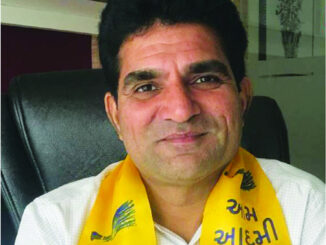
  • Meet ex-journalist Isudan Gadhvi, the Aam Aadmi Party’s chief ministerial candidate for Gujarat assembly elections

    Meet ex-journalist Isudan Gadhvi, the Aam Aadmi Party’s chief ministerial candidate for Gujarat assembly elections

    Delhi Chief Minister and Aam Aadmi Party (AAP) chief Arvind Kejriwal announced Isudan Gadhvi, 40, as Gujarat’s Chief Ministerial candidate for the AAP on Friday, November 4, at a public gathering in Ahmedabad, Gujarat. “Last week we invited public opinion, and 16,48,500 responses were received and 73 per cent of them named Isudanbhai Gadhvi”, Kejriwal said.

    Last week, Kejriwal urged people to contact the party through SMS, WhatsApp, voice mail and e-mail to give their views about who should be the CM candidate from the party in the state for the elections, due to be held in two phases – on December 1 and 5.

    After the announcement, Gadhvi embraced party colleagues Manoj Sorathiya and Yuvrajsinh Jadeja and got down the stage to seek the blessings of his mother. In a tweet, he thanked Kejriwal and the people of Gujarat.

    Who is Isudhan Gadhvi?

    Born to a farmer in Pipaliya village of Dwarka district in Gujarat on January 10, 1982, Isudan Gadhvi belongs to the community of other backward classes.

    He graduated from Gujarat Vidyapeeth, Ahmedabad in 2005 where he pursued a Master’s degree in Journalism and Mass Communication and then worked as a journalist. He began working with Doordarshan and started as a field journalist in Porbandar with ETV Gujarati from 2007 to 2011. Gadhvi’s reporting helped bring focus on a 150-crore illegal deforestation scam in the Dang and Kaprada districts of the state, and the Gujarat government subsequently took action in the case. His reporting on farmers’ issues helped earn him a substantial following in rural areas.

    In 2015, Gadhvi joined the Gujarati TV channel VTV as a prime-time show anchor. In his show called Mahamanthan, Gadhvi discussed national and state issues with panellists in the studio, as well as with the public via ‘phone-ins’ and organised debates. At VTV, he went on to become the youngest channel head in the regional media. He quit as the channel’s editor last year to join the AAP. The former journalist joined the Aam Aadmi Party on June 14, 2021, in presence of Arvind Kejriwal. He was among the first influential figures to join the party in Gujarat as AAP made a debut in BJP’s stronghold for 27 years.

    Gadhvi began his foray into politics when he joined AAP last year. He was made the AAP’s national joint general secretary after his inclusion in the party.

  • Delhi Deputy Chief Minister Manish Sisodia is booked  in excise policy scam

    Delhi Deputy Chief Minister Manish Sisodia is booked in excise policy scam

    NEW DELHI (TIP): The CBI today conducted raids at the official residences of Delhi Deputy Chief Minister Manish Sisodia and IAS officer Arava Gopi Krishna, besides 29 other locations in seven states and union territories, after registering an FIR to probe alleged irregularities in formulating and executing the city government’s excise policy, which was brought in November last year. The agency has named 15 persons, including Sisodia, in its FIR, lodged on August 17. Besides Sisodia, other public servants who have been named in the FIR as accused include then Excise Commissioner Arava Gopi Krishna, then Deputy Excise Commissioner Anand Kumar Tiwari and Assistant Excise Commissioner Pankaj Bhatnagar, besides nine businessmen and two companies. In a statement, the CBI said, “Searches are being conducted at 31 locations, including Delhi, Gurugram, Chandigarh, Mumbai, Hyderabad, Lucknow and Bengaluru, which have led to the recovery of incriminating documents, articles and digital records.”

    Last month, Delhi Lieutenant Governor VK Saxena had recommended a CBI probe into the Arvind Kejriwal-led AAP government’s Excise Policy (2021-22) over alleged violations of rules and procedural lapses.

    Officials in the CBI said the deputy Chief minister and other accused in the case would soon be summoned for questioning and those who failed to cooperate in the investigation might be arrested.

    In his first reaction to the raids, Sisodia took to Twitter and wrote saying that he welcomed the CBI and asserted that the truth would come out. He said these people were troubled because of the excellent work done by the Delhi Government in the health and education sectors.

    “That is why ministers of both departments are targeted to stop us from the good work in the health and education sectors,” he said referring to the arrest of Health Minister Satyendra  Jain under criminal provisions of the Prevention of Money Laundering Act (PMLA).

    Delhi Chief Minister Arvind Kejriwal said the CBI raid at his junior colleague’s house was the result of his good performance, which is being appreciated globally. “The day Delhi’s education model was appreciated and Manish Sisodia’s photo appeared on the front page of the New York Times, the Centre sent the CBI at the residence of Manish. The CBI is welcome. Will extend full cooperation. Earlier also there were raids and a probe. Nothing came out. Nothing will come out now also,” Arvind Kejriwal said.

    AAP Rajya Sabha member Raghav Chadha said, “Earlier it was “Modi vs who”, today it is “Modi vs Kejriwal”, Kejriwal is an alternative to Prime Minister Modi.” Delhi Congress leader Alka Lamba said Manish Sisodia should face the action by the probe agency instead of “running away” to the cool climes of Himachal Pradesh. She also claimed that the “corrupt face” of the self-acclaimed “truly honest” minister of AAP today stood exposed.

    Allegations against  Sisodia and  14 others are:

    • Irregularities in formulation of excise policy, 2021-22
    • Liquor trader paid Rs 1 cr to firm managed by Sisodia’s associate
    • Sisodia and public servants took decisions without approval
    • Intention was to extend undue favors to licensees post tender
    • Sisodia aides Amit Arora, Dinesh Arora, Arjun Pandey involved
    • Collected money from licensees, also gave it to public servants
    • Excise Dept gave a waiver of Rs 144 cr to licensees on Covid excuse
  • Faceoff between cops of 3 states over 1 arrest

    Faceoff between cops of 3 states over 1 arrest

    Bagga held by Punjab Police in Delhi,  Brought back from Haryana by Delhi Police

    CHANDIGARH / NEW YORK (TIP): In a dramatic turn of events that brought the police of three states face to face, BJP leader Tajinder Pal Singh Bagga was arrested by the Punjab Police from his Delhi residence around 8.30 am today, stopped by the Haryana Police in Kurukshetra while being taken to Punjab and brought to the national capital by the Delhi cops a few hours later, reports TNS.

    The incident triggered a political slugfest with the BJP accusing the Punjab Police of abducting its leader allegedly at the behest of AAP convener and Delhi CM Arvind Kejriwal, against whom Bagga (36) has been quite vocal in criticism. Rejecting the charge, the AAP claimed the Delhi BJP spokesperson was arrested for allegedly stoking communal tension in Punjab.

    Based on a complaint by Bagga’s father Preetpal Singh, the Delhi Police registered a case of kidnapping against the Punjab Police personnel. Sources in the Delhi Police claimed that their Mohali (Punjab) counterparts “violated” the mandatory norm of informing local cops before arresting Bagga from his residence in Janakpuri.

    In a statement, the Mohali police claimed that Bagga was arrested in a case related to making allegedly provocative, false and communal statements in an interview given to the media and through posts on Twitter on March 1. They said five notices were served on the accused on April 9, 11, 15, 22 and 28, but “he deliberately did not join the investigation”. They said a case under Sections 153-A, 505, 505(2) and 506 of the IPC was registered against him on the complaint of Mohali AAP leader Sunny Ahluwalia.

    Bagga had demanded an apology from Kejriwal for his speech in the Delhi Assembly regarding film ‘The Kashmir Files’, which a few BJP leaders had demanded be made tax-free. Kejriwal had contended that the filmmakers should upload the film on YouTube for all to watch free of cost. The Punjab Government, on its part, moved the Punjab and Haryana High Court against the “detention” of its police team in Kurukshetra.

    The Delhi Police registered the case under IPC Sections 452 (house trespass, assault or wrongful restraint), 392 (robbery), 342 (wrongful confinement), 365 (kidnapping), 295 (injuring or defiling place of worship with intent to insult the religion of any class) and 34 (common intension). In his complaint, Bagga’s father said, “I was present at my home along with my son when, around 8.30 am, someone knocked on the door repeatedly. When I opened, a few persons entered my home and manhandled me. Some of them had weapons.

    “They started asking me where is Tajinder Singh Bagga? When I asked them what they wanted from Tajinder, they slapped me. Later, my son came there and they started beating him up and didn’t even allow him to put on his turban while they were arresting him. When I tried to intervene, they pushed me,” it said.

    The Punjab Police team that had arrested Bagga was on way to Mohali when it was stopped on the NH-44 near Khanpur Kolian village in Kurukshetra around 11.30 am. As a large number of BJYM workers soon reached the spot demanding Bagga’s release, the BJP leader and the Punjab Police team were taken to the Thanesar Sadar police station. Delhi Police officials reached the police station around 2.10 pm and Bagga, based on a search warrant issued by a Delhi court, was taken back to the national capital. The Delhi Police had shared the warrant with the Haryana Police when the latter stopped their Punjab counterparts.

    Sources said the Haryana Police had information that Bagga had been “forcibly” picked up from his residence and they needed to verify and crosscheck the allegations. Mohali DSP (City-1) Sukhnaaz Singh said, “A police team was sent from Mohali to Delhi last night. A team arrested them today morning and simultaneously, another team reached the police station concerned in Delhi to inform local cops. The entire process has been video-recorded. Although Bagga resisted arrest, no force was used against him or his father.”

  • Opposition, Agitation, Rebellion and Change

    Opposition, Agitation, Rebellion and Change

    AAP would have to, and must remember the People’s temperament pertaining to ‘Opposition, Agitation, Rebellion and Change’.

    By Gurmit Singh Palahi
    English translation by Amarjit Singh Anand

    There has come about an upheaval in the echelons of power, in the strategically significant border-State of Punjab, which has been relegated to a dilapidated condition. In this context, it is noteworthy that many a stalwart veteran political bigwigs have been reduced to a shambles, having tasted crushing defeat in the recent elections. Amongst those who tasted bitter fruit are Prakash Singh Badal (five-time CM) Sukhbir Singh Badal (Supremo o Akali Dal) ‘Raja’ Amarinder Singh (former CM) Charanjit Singh Channi (CM for a couple of months) Navjot Singh Sidhu (State-Congress Chief) and Jasvir Singh Garhi (BSP State-President) while Ashwani Sharma (BJP State-boss) has emerged victorious. Aam Aadmi Party (AAP) has been given a resounding mandate by the populace. Leaders have lost the contest and Punjab has won the battle. Has Punjab actually won, in reality?

                Polling results for 117 seats in Punjab Assembly were declared on March 10. The State has 2.14 crore voters. In 2017, 70% voters had exercised their right to political franchise. This year, 71.95% people voted. Punjab was, apparently, dejected this time, as compared to 2017. A staggering number of 1,10,308 voters opted to accept ‘notes’, in exchange for votes.

                AAP won a thumping 92 seats, BSP got 1, BJP 2, 1 Independent candidate won, Congress 18 and SAD was saddened at having bagged just 3 seats. Others including Leftist-parties, Kisaan Morcha and sundry outfits failed miserably while not evening opening their accounts. Could it be presumed that the overwhelming success of one party is a victory for AAP and the demolition of all other parties is a vote of disappointment against Congress and SAD ? There was noticeable widespread public protestation, anger and a rebellious wave to effect massive change, by bringing about the downfall of ‘the establishment’.  All of these sentiments assumed the form of a volcanic eruption, which outpoured rivers of lava. Delhi CM Arvind Kejriwal and his Dy. CM Manish Sisodia visit Hanuman Mandir and then tell their party-cadre that “this is the biggest Inquilaab” (revolution). Is it, truly, a “revolution”?

                  The percentage of votes was as follows : AAP 42, SAD 18.38, BJP 1.77, CPI 0.05, CPM 0.06, CPML 0.03, Congress 22.98, NOTA votes (none of the above) totaled 0.71, RSP 0.01. The maximum % of 42.01 was claimed by AAP which had received only 23.7% in 2017. Congress got 22.98 as against 38.5 in 2017. SAD recorded a fall from 25.2 to 18.38. BJP registered 1.77 compared to 1.5 last time. Out of 69 seats in Malwa-belt, AAP captured 66. In this region, there was a strong presence of Kisaan protestors and a huge dejection against the previous governance by various parties or alliances. The farming community became a catalyst for Punjab’s empowerment and for giving power to AAP. Whether ‘Dera-following’ or caste-politicking or religious machinations, nothing at all could succeed obstruct the wave of massive awareness amongst the people. AAP reaped a rich harvest, on account of strong public resentment against the traditional parties, everywhere including the latter’s bastions. AAP’s slogan of “One Chance” resonated extremely well with the masses and their hearts were touched. Then, there were additional enticements like the National Coordinator’s poll-promises, which included Rupees 1000/-, 300 free units and 24-hour uninterrupted supply of electricity. It was an emotionally charged election.

    After the victory-laps are over, AAP shall have no ordinary, common promises to keep but would have a very special agenda to adhere to, in order to retain the faith and trust of voters who installed AAP at the pinnacle of power. AAP would not benefit from breaching this faith and betraying such trust especially when the Party has promised revolutionary measures for the good of Punjab. Special emphasis would have to be given to the extinction of the era of traditional fashion or trend of lineage-nepotism, as promised by AAP. The general message is that the public wants change in various spheres and desire public-welfare schemes to be implemented. People want to visualize government as public servants and not as monarchs or dictators.

                The political texture had been entangled since long, whereby one privileged and affluent and powerful segment was ruling the roost. ‘Once upon a time’ there used to be governance which was respected by the nomenclature of ‘Divine Kingship’, which was rejected by the people. Then came the era of Principalities, which also vanished. Finally, the era of democratic rule by majority votes came into effect but which was hijacked and misused by aristocrats, affluent ones and the ‘high and the mighty’. The devastatingly excruciating results of such selfish machinations, by vested interests, are verily visible. In 4 States of India, where polls were conducted, continuity and status-quo was maintained in Goa, Manipur, Uttarakhand and Uttar Pradesh. The winds of change were experienced in Punjab, where people were exasperated on account of rising rate of unemployment, rampant menace of drugs-influx, unresolved cases of repeated incidents of desecration of Guru Granth Sahib Ji, prevalent massive corruption, mal-administration and mafia-rule.

                   People in Punjab are becoming poorer. Farmers are giving up the non-profitable occupation of agriculture and are opting for labor-oriented vocations or they are migrating to other States. The farmers are pained to see their children flying abroad, in search of earning a livelihood. They are unable to envision the fulfillment of their aspirations, in Punjab, whose total annihilation they are pained to see. They are awaiting the manifestation of a miracle-of-sorts, to uplift Punjab out of the doldrums. Their foremost hopes rest on the politicians. For this sole reason, the people used their voting-prowess to ignite the ‘vacuum-cleaner’, instead of merely wielding the ‘broom’. This gave a clean-sweep to AAP, thereby awarding Kejriwal-Mann-combine an unimaginable mandate. Similar power had been given, earlier, to SAD-BJP-alliance, which miserably failed to deliver, despite having 93 seats, that’s 1 more than the seats gained by AAP, on its own. SAD-BJP bigwigs lost their reputation and image. People’s Power of Peaceful Protest was well demonstrated in the electoral arena and the betrayers were uprooted.

    The public rewarded those who were part of the successful year-long strenuous Kisaan-Morcha, on the borders of Delhi, which had forced the Central government to revoke the ‘Three Black-Laws’. Those who appeared to be corrupt and double gamers were rejected outright, by the people. Punjabis have always adored those who lead from the front, those who fight for the people’s rights, those fearless ones who are valiant to face the onslaught of the might of oppressors. Martyr Bhagat Singh and Martyr Kartar Singh Sarabha have always been their role-models. Whenever the Punjabis see someone brave as the Martyrs, they decide to follow and support such leaders. So, AAP is everywhere, and all others have been wiped out, without a trace. However, it remains to be seen whether this trust is respected and if such faith fructifies. Only time shall tell if the victorious leaders, most of whom have been selected from amongst traditional outfits, prove to be loyal to Common-Cause of Public-Good.

               Amongst the people of Punjab, there’s a general air of mistrust in the politicians. Unemployment is eating at their roots. There is intense frustration, irritation and bitterness in their mind, against mal-administration and there is immense resentment against those governing the State. The farmers are increasingly concerned about the fact that agriculture and agro-businesses are running into losses and their landholdings are receding, on account of the rampant influence of corporate-culture, which controls all political parties. Generally, the image of political leaders has been linked with nepotism, corruption, bribery, police-reports, violence, litigation et al. The politicians get votes by giving wind to communalism, fanning sentiments pertaining to religious bias. Would such intentions and policies of politicians change in Punjab?  The people have given their verdict by bringing forward candidates with a clean image, who are expected to work on an agenda of growth, development, progress, to uplift the masses. People have favored the Delhi-model and would like to see it replicated in Punjab.

    Aam Aadmi Partyhas members drawn from various spheres and there are many who give precedence to power, over and above working for public-good. They speak their own language and have their own opinions. Although the people of Punjab are not in any kind of a hurry, but they are, certainly, emotional and have the capability of analyzing those whom they have selected and elected. People shall judge the new government on the parameters of concrete policies, programs, performance, deliverance of results and they would not be content with living on mere minor concessions. The Central government is constantly maneuvering to destabilize the structure of ‘State-autonomous sphere of functioning’. What would be the stance of AAP, on this point? What would be the policy of AAP, on the issue of Punjab’s river-waters? What would be the approach and attitude of AAP, towards mitigating the sufferings of the unemployed youth, thereby ameliorating their condition? What would be the views and measures of AAP, regarding the farming community?

                  For AAP and for CM Bhagwant Mann, the major thrust areas are : presenting a budget whereby public-welfare schemes are offered; decision-making, implementation and functioning, free from the shackles of Central domination; providing an honest and transparent governance; taking effective action on sentimental-issues; giving priority to growth and development projects; working towards having a clean Punjab. These would be some of the major and primary tasks and challenges, for CM and his cabinet and for his party-cadre. Punjab is under severely exorbitant fiscal debts. Would there be effective control exercised over the mafia, ruling the land and construction sector? Would the CM be able to break free from the ‘High-Command-culture’, and work independently, as per the localized needs and requirements? Would the CM bid adieu to the party or be chucked out, just as Sukhpal Khaira, Kanwar Sandhu or Dharamveer met their fate?

              AAP claims that it shall uplift Punjab economy from the throes of financial debt and red tape. Would the CM face a challenge while dealing with leaders drawn from ‘traditional-culture’ parties?

             AAP would have to bravely face the greatest challenge of tackling major emotional issues, including farming, migration and booking the culprits who are guilty of desecration of Guru Granth Sahib Ji, with sheer grit and determination. No doubt, AAP has been victorious in Punjab. Arvind Kejriwal and Bhagwant Mann have risen in stature, nationally. Kejriwal has harbored ambitions of entering Punjab politics and his aspirations have seen fruition. Punjab is a challenge for him, now. Then, the question also arises whether the Delhi-model, especially on health and education, could possibly be replicated successfully, in Punjab. The culture, heritage and lifestyle conditions in Punjab are at variance with Delhi. Punjabis differ in their thought-process, from the folks in Delhi. People in Punjab have, now, started confabulating amongst themselves and have started questioning the politicians, openly and increasingly.  The success of Kisaan-Morcha has effectively impacted the awareness-levels of the common folks in Punjab. People have rejected the ‘Supremo-culture’ of high-handedness, practiced by politicians. People of Punjab are no longer ignorant, indifferent and unaware; they do not refrain from expressing dissent and disagreement, in crystal-clear terms.AAP would have to, and  must remember the People’s temperament pertaining to ‘Opposition, Agitation, Rebellion and Change’.

    (The author is an India based  retired Principal and a well-known columnist. He is President of Punjabi Columnists Patrakar Manch. He can be reached at gurmitpalahi@yahoo.com)

    (New York based Amarjit Anand is a writer, thinker and an Ambassador for Peace. He can be reached at amar1ujagar1pritam@gmail.com)

  • “My Personal Number”: Bhagwant Mann Announces Anti-Corruption Helpline

    “My Personal Number”: Bhagwant Mann Announces Anti-Corruption Helpline

    Punjab’s new Chief Minister, Aam Aadmi Party’s Bhagwant Mann, announced the launch of an anti-corruption helpline on March 17. Mann, who took oath on March 16, promising that he would not “waste a day”, said the helpline number will be launched on March 23, the death anniversary of freedom fighter Bhagat Singh.. “The anti-corruption helpline number will be my personal number… If anybody asks for bribe, send audio and video on that number,” he said.

    “I am not threatening any govt employee as 99 per cent of govt employees are honest but 1 percent of such employees are corrupt which has rotted the system. Only AAP can clean this corrupt system,” he added in the tweet.

    The number will be exclusively for people to upload videos of corrupt officials demanding bribe for their day to day work or indulging in other malpractices. Such officials, he later said, will be given exemplary punishment.

    Eradication of corruption from Punjab was one of the key promises of AAP, which traces its birth to the anti-corruption movement of freedom fighter and Gandhian Anna Hazare. On February 5, party chief and Delhi Chief Minister Arvind Kejriwal had promised to “end corruption in government jobs if AAP government is formed”.

    In his first meeting with police and administration officials today, Mr Mann stressed on the need for a corruption-free government.

    “Corrupt officers have no place in my government and if any such complaint comes to my notice, then don’t expect any sort of sympathy for such officers,” he told the officials who had assembled at the Chief Minister’s Office.

    In a first, the Chief Minister also announced reward for both civil and police officers. The “Best Performance Award” will be given quarterly for making a difference in the lives of common man at the grassroots level, besides ensuring free and fair justice.

  • Bhagwant Mann sworn in as 18th Chief Minister of Punjab

    Bhagwant Mann sworn in as 18th Chief Minister of Punjab

    Punjab Governor Banwarilal Purohit (right) administering the oath of office and secrecy to Bhagwant Mann at Khatkar Kalan. Khatkar Kalan (TIP): Punjab Governor Banwarilal Purohit administered the oath of office and secrecy to Bhagwant Mann in the swearing-in ceremony  at Khatkar Kalan, the ancestral village of legendary freedom fighter Bhagat Singh in Punjab’s Shaheed Bhagat Singh (SBS) Nagar district. The venue was  brimming with ‘basanti’ turbans and dupattas,

    Mann, the 18th CM of Punjab,  took oath in Punjabi. Besides newly-elected AAP MLAs, Delhi Chief Minister & Aam Aadmi Party national convener Arvind Kejriwal, deputy chief minister Manish Sisodia, and other leaders wearing yellow turbans took part in the ceremony.

    The AAP romped home winning 92 seats in the 117-member Punjab Assembly, decimating the Congress and the SAD-BSP combine.

    Besides the newly-elected AAP MLAs, Delhi Chief Minister Arvind Kejriwal, deputy chief minister Manish Sisodia, Delhi minister Satyendar Jain, and other leaders were also present in bright yellow turbans.

    The 48-year-old Mann, who took the oath in Punjabi, also delivered a brief address after the ceremony.

    In his first speech after becoming the chief minister, Mann assured the people of the state that his party’s government in Punjab will work to address issues like unemployment, corruption and farmers’ plight.

    Starting his speech after the Governor left, the new Chief Minister said: “Bhagat Singh had a dream of taking this freedom to every household. AAP is fighting that battle. You have supported us. I will require many lifetimes to pay off the debt of this love that you have showered over me,” he said from the stage.

    Kejriwal, Delhi deputy CM Manish Sisodia and other party leaders, who were seated on a separate stage on Mann’s left, were seen applauding as the new CM took oath and later spoke. The newly-elected 91 AAP MLAs were also seated on another stage to Mann’s right. Mann and Governor were on the podium in the middle. AAP’s Punjab affairs in-charge Jarnail Singh and co-incharge Raghav Chadha also attended the event. Dressed in a white kurta-pyjama, blue blazer and a ‘basanti’ turban, Mann sounded a note of caution as he asked AAP supporters to exercise restraint.

    “I am not going to speak against anyone today. I want to tell you too that we do not have to be arrogant. We do not have to go to anyone’s house and challenge him. We do not have to say that we are the winners. Those who did not vote for us, we are their Chief Minister also. We are their government too. It is democracy. Everybody has the right. I should not get this news that these people are arrogant,” said Mann.

    He reiterated that the new government will start working without losing any time.

    “We will work. We have to start working from today. We have already wasted 70 years. We have no time to waste anymore,” he said.

    Later, in the evening, Mann assumed charge of the office at the Punjab Civil Secretariat.

    During his speech after taking oath, Mann also touched upon the issue of youth of Punjab migrating to other countries for better opportunities and said that this trend has to be reveresed. He assured the people of the state that his party’s government in Punjab will work to address issues like unemployment, corruption and farmers’ plight.

    “I want to share a couplet by Bhagat Singh – ‘Ishq karna sab ka paidayashi haq hai, kyo na iss baar vatan ki sar-zameen ko mehboob bana liya jaye (Loving is everyone’s birthright. Why not choose the nation as our beloved this time)’. We will change the state like Delhi. People will come from abroad to take selfies at our schools. You people created history. Punjab’s name was written in golden words on March 10. It will be written in the school books that February 20, 2022, was the day when people started voting without fear or greed of inducements,” he said.

    Saying that he paid obeisance to the martyrs and sought courage and wisdom to carry out his task as CM, Mann said: “I am not even the dust of their feet. But when public supports you, then you can expect anything from a person.”

    He also thanked Kejriwal for changing country’s politics by creating a political party out of an “aandoolan”.

    He ended his speech, saying: “Haqumat who karate hain jinka dilon par raj hota hai, yun kehne ko toh murge ke sarr pe phi taj hota hai (Real rulers are those who rule over people’s hearts, otherwise even a rooster has a ‘crown’ over its head)’.”

    A number of singers and artists, including Gurdas Mann, Karamjit Anmol, singer-turned-politician and Congress MP Mohammad Sadique, and Amar Noorie, were present at the event.

    There was heavy police presence at the the venue to manage lakhs who started descending at Khatkar Kalan to attend the event from morning itself. The event scheduled to start at 12.30 pm, began at 1.25 pm.

    Mann had invited the people of the state to attend his swearing-in ceremony, saying the three crore people of Punjab will also take oath with him.

    Elaborate arrangements were made for the ceremony which was attended by AAP supporters from various parts of the state. Almost all were seen wearing yellow – in form of dupattas or turbans. While many arrived in buses, few also cycled to the venue.

    The atmosphere was surcharged with enthusiasm as the people raised slogans of ‘Inquilab Zindabad’ (long live revolution) and ‘Bole So Nihaal’.

    In a tweet, the PM said: “Congratulations to Shri @BhagwantMann Ji on taking oath as Punjab CM. Will work together for the growth of Punjab and welfare of the state’s people.”

    Union Defence Minister Rajnath Singh too tweeted his best wishes to Mann for his tenure ahead.

    Tamil Nadu CM M K Stalin and his Odisha counterpart Naveen Patnaik, Samajwadi Party president Akhilesh Yadav were also among those who congratulated the new Punjab CM.      Source: The Indian Express and Agencies

  • Challenges before Bhagwant Mann and his Government

    Challenges before Bhagwant Mann and his Government

    By Prabhjot Singh

    “Expectations of people of Punjab who voted out the two earlier ruling parties – Congress and Shiromani Akali Dal –  are high as they expect that instead of subsidies, the delivery systems in education and health care should be reliable and affordable. Similarly, civic issues, which the people have been fighting since Independence, need to be tackled in a more professional and competent manner. Corruption in public offices is another irritant that people want the new Government to handle with a firm hand.”

    After a landslide triumph in the just concluded Punjab Assembly elections, the Aam Aadmi Party (AAP) has set upon itself the onerous task of reviving not only the tottering economy but also in establishing the Rule of Law in this border State. After an impressive oath ceremony, attended by hundreds of thousands of the party workers and well-wishers at the historic Khatkar Kalan, the birthplace of Shaheed-e-Azam Bhagat Singh, the Chief Minister, Bhagwant Singh Mann, is faced among other things , a difficult challenge of not only naming members of his Council of Ministers but also in deciding who seven will sit in the Upper House of Parliament, Rajya Sabha, as representatives of AAP. These are ticklish issues as some loyalists workers and leaders tend to feel offended if their loyalty and sincerity to the party is not recognized. While some of the second time MLAs, including Harpal Cheema, Aman Arora and Baljinder Kaur look certain choices for inclusion in the Council of Ministers, there may be pressures on the Chief Minister from other quarters and groups also. There will be similar pressures for nomination to Rajya Sabha.

    Though these party level decisions will be taken in consultation with the national convener Arvind Kejriwal, Bhagwant Mann will have to put his head down to go about the task of restructuring the State Administration while following the legislative requirements in a time bound manner. He has to tone up the civil administration by making it  responsive to public needs.

    Convening of the session of the newly constituted Punjab Vidhan Sabha with a Pro-Tam Speaker administering oath of secrecy to all members, election of Speaker will follow. A date has also to be fixed for passing a vote on account as the new ruling party may need time to finalize its budget for the current financial year. The new excise policy that must become effective from April 1, too, needs to be drafted and approved by the Council of Ministers. While Vote on account must be done before March 31, the new Budget may take a couple of months and a special session of Vidhan Sabha. In between, the AAP government must take policy decisions on several issues of public interest, including implementation of promised 300 units of free power in the power tariff from April 1.

    The AAP national convener Arvind Kejriwal had been talking about replicating the Delhi model in Punjab with certain promises, including free 300 electricity units to all. Punjab has almost 1 crore electricity consumers, including 73 lakh domestic consumers, 14 lakh agriculture consumers, 11.50 lakh commercial consumers and 1.5 lakh industrial consumers. The State spends Rs 10,000 crores as electricity subsidy of which a major chunk – Rs 7180 crores – goes to the farm sector alone.

    The AAP government will also become cynosure of all eyes as it takes on the battle to fight mafias. The first step of the battle will get initiated with the announcement of the new Excise policy. How the State reins in those controlling the liquor trade, both in retail and wholesale, besides tightening control over the running of distilleries and breweries – major sources of evasion of excise duty – will be watched with bated interest. Simultaneously, it will face an uphill task of controlling  deeply entrenched sand and gravel mafia not only to bring down these essential building raw materials but also to check the massive drain of State resources. Illicit mining has also been posing a serious threat to the ecology and environment of the State.

    Expectations of people of Punjab who voted out the two earlier ruling parties – Congress and Shiromani Akali Dal –  are high as they expect that instead of subsidies, the delivery systems in education and health care should be reliable and affordable. Similarly, civic issues, which the people have been fighting since Independence, need to be tackled in a more professional and competent manner. Corruption in public offices is another irritant that people want the new Government to handle with a firm hand.

    Equally challenging will be handling the problem of unemployment and drain of youth to developed nations. Not only the able-bodied young men and women, especially those belonging to the 18-15 age group are heading for green pastures overseas, they are also adding to the debt of their aging and helpless parents and guardians by taking huge sums of money with them. The faith of the people in governance needs to be restored. It can be done only when the new Government with an unprecedented mandate starts delivering by keeping its pre-election promises. Fortunately, the coffers of the State are neither empty nor do they have any pending bills needing clearance. All the State needs is an honest government with a vision. Will Bhagwant Mann and his team deliver? Time will tell.

    (The author  is a veteran journalist with over three decades of experience covering a wide spectrum of subjects and stories. He has covered  Punjab and Sikh affairs for more than three decades besides covering seven Olympics and several major sporting events and hosting TV shows. For more in-depth analysis please visit probingeye.com  or follow him on Twitter.com/probingeye)

    For Jatin

    Categories: Breaking News, Front page,  Politics, India, Punjab,

    Tags:Facebook, WhatsApp, Twitter  LinkedIn,  snap chat, Bhagwant Mann, Kejriwal, Punjab, India, NRIs

  • Kejriwal as contender

    Kejriwal as contender

    Punjab’s tidal wave of anti-incumbency is against the entire privileged political class

    By Rajesh Ramachandran

    “The most shocking aspect of these results is how the mighty bit the dust, a lesson taught by angry voters to the feudal, tainted and rent-seeking leadership of Punjab. Among the banyan trees of political privilege that fell are four-time former CM and Punjab’s political patriarch Parkash Singh Badal, the “Maharaja” of Patiala, former CM Capt Amarinder Singh, ex-CM Rajinder Kaur Bhattal, sitting CM Charanjit Singh Channi, celebrity Punjab Congress president Navjot Singh Sidhu, Shiromani Akali Dal president and former deputy CM Sukhbir Badal, his controversial brother-in-law fighting drug cases, Bikram Singh Majithia, and his cousin and Congress’ finance minister Manpreet Badal. Most importantly, these weighty “lords” have been knocked out of the ring with a huge thud by first-timers — mobile phone repairmen, volunteers and other nobodies.”

    It is always heartening to talk of hope. The angry, resilient, yet ebullient people of Punjab believe that things can and will change; this, in short, explains the political deluge that has drowned a sitting Chief Minister, three former Chief Ministers, the heads of two parties and the state’s most controversial politician. This tsunami of change has to be credited entirely to Delhi Chief Minister Arvind Kejriwal’s meticulous planning, patience and people-connect. Bhagwant Mann was declared the CM candidate only a few weeks ahead of the polls — till then, there was just Kejriwal representing the Delhi model of governance, seeking a vote for change. The first sign of this campaign’s effectiveness was Union Territory of Chandigarh’s local body polls in December, which resulted in the AAP emerging as the single largest party, dislodging the BJP. Kejriwal offers a national alternative as voters can break away from identity silos to get their lives improved.

    The most shocking aspect of these results is how the mighty bit the dust, a lesson taught by angry voters to the feudal, tainted and rent-seeking leadership of Punjab. Among the banyan trees of political privilege that fell are four-time former CM and Punjab’s political patriarch Parkash Singh Badal, the “Maharaja” of Patiala, former CM Capt Amarinder Singh, ex-CM Rajinder Kaur Bhattal, sitting CM Charanjit Singh Channi, celebrity Punjab Congress president Navjot Singh Sidhu, Shiromani Akali Dal president and former deputy CM Sukhbir Badal, his controversial brother-in-law fighting drug cases, Bikram Singh Majithia, and his cousin and Congress’ finance minister Manpreet Badal. Most importantly, these weighty “lords” have been knocked out of the ring with a huge thud by first-timers — mobile phone repairmen, volunteers and other nobodies.

    But mere free-floating anger would not have consolidated in favor of one party to cause this landslide of an election result. And this anger was not confined or focused against just the incumbent government. It was a sort of a tidal wave of anti-incumbency against the entire privileged political class. The rushing river of anger that was dammed in 2017 appears to have burst forth in 2022 to submerge the political landscape. Another factor that worked in favor of the AAP was that it became the sole beneficiary of the collective angst against the new farm laws. So, while Bharatiya Kisan Union leader Balbir Singh Rajewal lost his credibility and the polls, the anti-establishment vote that coalesced as a result of farm unions’ mobilization went into the AAP’s kitty.

    The results prove that rural Sikh farmers voted for the AAP in huge numbers, a fact further established by the decimation of the Akalis. From 15, the party’s strength has been reduced to three. Similar is the BJP’s drubbing. Despite all its dirty tricks — including Kumar Vishwas’ last-minute stab in the back — the Hindus of Punjab voted overwhelmingly for the AAP, helping the party sweep the urban seats. So, if in 2017 it was a backlash of the Hindus over unfounded fears of a Khalistani connection that defeated the AAP and made the Congress victorious on 77 seats, Kejriwal worked hard early in the campaign to allay those old apprehensions by launching the Tiranga Yatra to burnish his nationalist credentials. And it worked: the committed Hindu voter turned against the Congress and the BJP to emphatically support the AAP. Or rather, Hindus rose above sectarian interests and minority insecurities and voted along with other communities for hope and change.

    That leaves the famed Dalit voters of Punjab — 32 per cent of the population. The replacement of a lazy Maharaja with an enthusiastic Dalit as CM was thought to be a masterstroke by the Congress leadership. But angry Dalit voters treated the high command’s trump card as if it was the joker in the pack. And like Sikhs and Hindus, Dalits voted against the political establishment, proving yet again that anger overrides identity in Indian politics — for there was an attempt to split the Dalit votes in favor of the BJP and the Akalis through the discredited Dera Sacha Sauda. Neither Channi’s candidature nor Ram Rahim’s furlough seemed to have made any difference to the determined Dalit voter seeking revenge against corrupt tokens taken out of the cupboard at the last minute. The Enforcement Department raid seizing crores in cash from Channi’s nephew robbed him of all his “poor Dalit” sheen and Sidhu’s daily barbs against the government left Congress with nothing worth defending.

    If these elections have thrown up Kejriwal as a national contender for the top post, offering a credible alternative beyond Delhi, it is because voters are breaking away from their identity silos and coalescing to get their lives improved. The same logic applies to Yogi Adityanath’s victory, however unseemly his saffron robes may appear to the liberals. The Muslim-Yadav formula, with some non-Yadav OBCs thrown in, did read like a winning combination, but popular sentiment had forgiven Yogi and the BJP for the Delta deaths, floating graves on the Ganga, the farm laws and even the Lakhimpur Kheri killings. The law-and-order situation, free ration, direct benefit transfers and various targeted schemes improving the people’s lot seem to have caught the voter’s imagination. Yet, the Samajwadi Party’s performance only shows that there is simmering anger against the incumbent, which has not yet reached the boiling point. Its leader Akhilesh Yadav may also have to get out of the caste costume to look at the new realities of a changing India, in which the political capital of identity politics may just not be enough to win elections.

    The Congress’s failure as an alternative to the BJP is writ large over the results in Uttarakhand, Goa and Manipur. The party is steadily sliding into inconsequence, with its leadership refusing to re-engineer itself. In this context of a crisis of Opposition leadership steps in Kejriwal, with the amalgamation of two contemporaneously disparate political slogans of ‘Bharat Mata Ki Jai’ and ‘Inquilab Zindabad’. The 2024 contest just got hotter with Kejriwal’s promise of ‘inquilab’.

  • BJP retains power in 4 States; AAP Tsunami decimates stalwarts in Punjab

    BJP retains power in 4 States; AAP Tsunami decimates stalwarts in Punjab

    Uttarakhand votes for BJP, but CM Dhami loses; BJP to form govt in Goa with Independents, MGP; Adityanath back with higher vote share but  fewer seats; AAP wins 92 of 117 seats in Punjab, In Manipur, BJP wins 32 seats in 60-member House

    NEW DELHI / NEW YORK (TIP): The BJP retained power in all the four States that it was governing  while the Congress lost Punjab to the Aam Aadmi Party (AAP). The AAP said it has emerged as the “natural, national” alternative to the BJP, even as the Congress declined to a new low of just 18 seats in Punjab, 2 in UP, 18 in Uttarakhand, 12 in Goa , and 5 in Manipur.

    The BJP held on to power in Uttar Pradesh, where it won two-thirds of the seats (274), compared to three-fourths in 2017. The Samajwadi Party succeeded in improving upon its 2017 performance by bagging 124 seats. The BJP’s vote share though increased in U.P., Goa and Manipur. The party conclusively won Uttarakhand, and won enough seats to retain power in Manipur and Goa — three States where its main rival was the Congress. “This is a seal of approval by the people for the BJP’s pro-poor, proactive governance,” Prime Minister Narendra Modi said at the party headquarters on Thursday, March 10  evening. “We will learn from this,” Congress leader Rahul Gandhi posted on Twitter. In U.P., the Samajwadi Party doubled its 2017 tally but fell far short of a majority, in the second consecutive Assembly election defeat under the leadership of Akhilesh Yadav, who did not comment on the results. His call for a coalition of Ambedkarites and Samajwadis — a euphemism for Dalits and Other Backward Classes — had takers as the increase in SP’s vote share shows, but nowhere enough to dislodge the BJP. Bolstered by Hindutva, welfarism, and expansive accommodation of OBCs and Dalits, the BJP stayed ahead of the SP across all regions of the State.

    Swami Prasad Maurya, an OBC leader who switched from the BJP to the SP on the eve of the elections lost his own seat; in west U.P., the SP’s alliance with the Rashtriya Lok Dal dented the BJP but only marginally. “This is a victory of nationalism and good governance,” Chief Minister Yogi Adityanath told an ecstatic crowd at the party office in Lucknow, concluding his speech with calls of “Jai Shriram”.

    In Punjab, the AAP harnessed the resentment against the Congress and the Akali Dal that have been alternating in power, to build a decisive momentum that won it 92 of the 117 seats in the State. The Congress won 18 and the BJP two, which is as many as what the Congress won in U.P.

    AAP with 92 seats has created history as never before has a  single party in Punjab   won as many seats. The highest number of 93 seats was once won by the coalition of SAD and BJP.

    “This is a revolution,” AAP founder and Delhi Chief Minister Arvind Kejriwal said. “First this revolution happened in Delhi, then in Punjab and it will now happen all over country,” he said.

    Party leader Raghav Chadha said Mr. Kejriwal would become the Prime Minister of the country one day. The AAP will have two Chief Ministers now- one in Delhi and another in Punjab which is as many as what the Congress has.

    The Congress’s last minute efforts to rescue its fortunes in Punjab, which elected one-fifths of its Lok Sabha members, through a leadershipchange that brought Charanjit Singh Channi at the helm did not bear fruit. The party’s halfhearted attempt to profit from his Dalit identity appears to have alienated dominant social groups such as Jatt Sikhs. Mr. Channi lost both seats that he contested.

    The father-son duo that helms the SAD — Sukhbir Singh Badal and Prakash Singh Badal — both former CMs, lost their seats, even as the party finished with just four seats in its second consecutive rout. Mr. Modi said the voters have punished dynastic parties, referring to the setbacks to the SP, RLD, SAD and the Congress, all controlled by particular families for generations.

    (With inputs from agencies)

  • Will Punjab Model be the Key Issue in Assembly Elections 2022?

    Will Punjab Model be the Key Issue in Assembly Elections 2022?

    Kejriwal is promising justice in sacrilege cases, jobs to youths and corruption-free governance.
    Sukhbir Singh Badal has not yet come up with any model
    By Prabhjot Singh

    In the last 55 years, politics in Punjab has mainly revolved around politics of doles and appeasements that in turn wreaked havoc with the economy of the State bringing it down from the top spot in the country to the also ran category.

    “After witnessing two partitions since 1947, the State is without its own capital, besides it has lost control over the prestigious hydel projects like Bhakra and Beas, its rivers waters are being diverted in utter violation of the conventional Riparian laws and several other prestigious institutions the State either acquired as a part of partition settlement or built on its own after 1947 like Panjab University, Postgraduate Institute of Medical Education and Research, Punjab Engineering College, etc., etc. are managed by the Union government or the Centre.”

    For those, who are worried about the deteriorating fiscal health and social fabric of this border agrarian State, yes, “Punjab Model” should be a guiding factor for its electors in determining their future ruling political parties or leaders.

    But then what is the “Punjab Model”?

    Both the Punjab Pradesh Congress Committee chief Navjot Singh Sidhu and the Aam Aadmi supremo Arvind Kejriwal are going around with their “Punjab Model” in soliciting support of the worried voters as the State is on the verge of both political and financial bankruptcy.

    Their models may not be in line or consonance with what Punjab needs today. They are mostly talking about models broadly to appease some sections of voters without dealing with the issues that have scripted tormenting history of the State since the 1947 partition in general and the reorganization in 1966 in particular.In the last 55 years, politics in Punjab has mainly revolved around politics of doles and appeasements that in turn wreaked havoc with the economy of the State bringing it down from the top spot in the country to the also ran category.

    After witnessing two partitions since 1947, the State is without its own capital, besides it has lost control over the prestigious hydel projects like Bhakra and Beas, its rivers waters are being diverted in utter violation of the conventional Riparian laws and several other prestigious institutions the State either acquired as a part of partition settlement or built on its own after 1947 like Panjab University, Postgraduate Institute of Medical Education and Research, Punjab Engineering College, etc., etc. are managed by the Union government or the Centre.

    In addition, there are other issues, like inclusion of Punjabi speaking areas, that prompted the State to demand “autonomy” through the Sri Anandpur Sahib resolution. Many elections have come and gone but these core issues or demands never made it to the top of the agenda or election manifesto of any political party. The coming elections are no different.

    When and who is going to fight for these long-standing demands of Punjab?

    Looking through the history of the State after Independence in general and reorganization in 1966 in particular, grabbing power has been the only agenda of the political parties or their leadership.

    None other than Darshan Singh Pheruman of Akali Dal (Pheruman) made a sacrifice to press for acceptance of these demands. His sacrifice, however, went waste for lack of support from the mainstream parties.Unfortunately, these issues still do not figure in any of the “Punjab Models” being projected by Congress or AAP leaders. Should voters presume that these issues stay consigned to the history books and would not be raised or fought for.

    Let us talk about the Kejriwal or AAP’s “Punjab Model” of governing the state after polls. Like Sidhu’s model, it is primarily about the current issues facing the State. He is promising justice in sacrilege cases, jobs to youths and corruption-free governance. With his model, he asserts, will help hard working people of the State to bring his party to power to break the friendly “partnership” between the Badals and the Congress. He maintains that his Punjab model will have a 10-point agenda that will include free power to people up to 300 units per billing cycle and controlling the drug menace. The AAP, while trying to lure women voters, also wants regular financial support for them saying each woman above the age of 18 would be given Rs 1000 each every month.

    On the other hand, Navjot Sidhu had been going around and promising Punjab with his 13-point Punjab model. His mainstay is restructuring the economy of the State by pulling it out of debt trap. His concept of a healthy fiscal model is to use internal resources in not only generating new revenue channels but also solving the problem of unemployment. For Sidhu, liquor, sand and bajri (gravel) could serve as wonder commodities in filling the empty coffers of the State. He has been promising to set up state-owned liquor besides sand and bajri corporations for mobilizing revenue enough to make the State cut its annual borrowing and be on its way to great financial recovery. Sidhu feels convinced that from liquor alone, Punjab could generate about Rs 25,000 crore of revenue. His model also includes setting up a regulatory commission to control the cable sector.

    Other major contestants, including the Shiromani Akali Dal-Bahujan Samaj Party alliance, Bharatiya Janata Party-Punjab Lok Congress-Sanyukta Shiromani Akali Dal alliance, and the Samyukat Samaj Morcha have so far refrained from making public their “Punjab Models”.

    Even if all the contestants – political parties or alliances – make public their models, what legal sanctity these pronouncements will have in the post-election scenario remains a million-rupee question.

    (The author, a former editor of The Tribune, is a senior journalist. He can be reached at prabhjot416@gmail.com)

  • Centre, states in war of words over O2 deaths

    Centre, states in war of words over O2 deaths

    New Delhi (TIP): The ruling Bharatiya Janata Party (BJP) and several Opposition parties were locked in a war of words over how many people in India died due to lack of oxygen supplies while battling Covid-19, a day after the Union government told Parliament that no state reported such fatalities.

    The submission to Parliament brought back focus on a crisis that in part defined the devastation of the second wave, but with little accountability being fixed since. A database of media reports from the time has identified at least 619 deaths that likely occurred because of lack of oxygen, while many more may have taken place outside of inundated hospitals. Still, with most states unwilling, even on Wednesday, to accept that there were deaths on account of oxygen supplies, the Union government’s submission, while insensitive, could well be technically correct.

    The BJP accused the states of playing politics, and pointed to submissions by some of them to reaffirm that the central government was merely reporting data that states sent to it.

    “The Centre says that health is a state subject. It says that it just collects the data, it doesn’t generate it. None of them said that a death occurred in their state and Union territory due to shortage of oxygen, there is no data for that. Did the Centre generate this data? No,” said Sambit Patra, BJP spokesperson.

    Patra in particular pointed to the Congress, the Shiv Sena and the Aam Aadmi Party to accuse the rivals of “playing politics”.

    “Rahul Gandhi is part of a coalition in Maharashtra and Sanjay Raut said he is shocked. The Maharashtra high court was given an affidavit by the state government where it stated that no death took place due to oxygen shortage,” he said. “On April 23 and 24, Arvind Kejriwal said 21 people died in Jaipur Golden Hospital due to oxygen shortage. He did a press conference and politicised it. This matter went to the high court. The Delhi government formed a committee and a report was submitted — it said patients got oxygen and no there was no mention of a shortage,” he said.

    Patra’s comments appeared to be targeted at a tweet by Gandhi on Tuesday afternoon, in which the Congress leader said: “The shortage wasn’t only of oxygen; it was also of empathy and facts. The shortage was there then, and it’s there now.”

    On Wednesday, July 21, Shiv Sena MP Sanjay Raut, whose party shares power with the NCP and Congress in Maharashtra, said people whose relatives died due to oxygen shortage should “take the Union government to court”.

    Delhi health minister Satyendar Jain, too, attacked the Centre, saying it was “completely false” to say no one died for want of oxygen. “If no deaths occurred due to oxygen shortage, why did hospitals move high court one after another every day? Hospitals had been saying that oxygen shortage led to deaths. The media, too, flagged this issue daily,” Jain told reporters.

    The AAP leader said the Delhi government set up a committee to collect data on such deaths and give ?5 lakh compensation to the families of the deceased, “but the Centre got the panel disbanded through the lieutenant governor”.

    A day earlier, his cabinet colleague and deputy chief minister Manish Sisodia accused the Centre of a cover-up following its submission in Parliament. Neither Jain nor Sisodia put a number to deaths in Delhi on account of lack of oxygen.

    As the controversy raged, officials in eight states – Goa, Maharashtra, Tamil Nadu, Madhya Pradesh, Odisha, Bihar, West Bengal and Uttar Pradesh – told HT that there were no deaths due to oxygen shortage in their hospitals.

    Experts said the controversy was “unnecessary and unfortunate”. “The answers to parliamentary questions are compiled by respective ministries depending on inputs from various states and institutions, which means none of the states actually accepted that there were deaths due to oxygen shortage. The minister, however, could have just said that this is the official record and unofficially, there have been reports of deaths but there was no data,” said Dr MC Misra, former director of All India Institute of Medical Sciences.

                    Source: HT

  • After Tikait’s emotional appeal, farmers swell at Delhi borders

    After Tikait’s emotional appeal, farmers swell at Delhi borders

    New Delhi/Meerut (TIP): Thousands of farmers poured into Ghazipur on the eastern fringes of Delhi on Friday, January 29,  after an emotional appeal for support by farm leader Rakesh Tikait, indicating that the government crackdown on the two-month-old agitation following violence on Republic Day may have partially backfired.

    Farmers from 10 districts in western UP, a stronghold of the influential Jat community, congregated at a massive gathering in Muzaffarnagar, where they announced the social boycott of anyone not backing the movement. In Haryana, khaps, or clan-based bodies, vowed to send at least one person from each family to bolster the ongoing stir against three agriculture laws passed in September.

    Throughout the night, cultivators took tractors, trucks and motorbikes to reach the Delhi border, where numbers swelled and morale mounted with the arrival of a new contingent of protesters determined to defend the honour of Bharatiya Kisan Union (BKU) leader Tikait. While just about a thousand farmers had gathered at Ghazipur on Thursday, the number swelled around 10,000 on Friday.

    “If the police use force on us for not leaving, it is not a problem. But if some political organisations attempt to trouble us, that is unacceptable…Now, I will not surrender (to the police), we’ll continue to protest here,” Tikait told the gathering. It was a dramatic reversal from Thursday afternoon, when dwindling numbers, bitter public fallout of violence by farmers at the Republic Day tractor rally, and increasing police presence, left the protesters demoralised.

    The Ghaziabad administration served Tikait, son of legendary farm leader Mahendra Singh Tikait, with an ultimatum to vacate the site or face penal consequences, part of a wider crackdown on the agitation since January 26. Farmers also said that the authorities cut off their water and power supply to the site.

    But instead of caving in, Tikait broke down in front of television cameras and vowed to not leave the site until the government repealed the laws. “If the farm laws are not repealed, Rakesh Tikait will commit suicide,” he had said, biting back tears. These visuals were beamed on television channels and went viral on social media, triggering calls for mobilisation from temples, mosques and panchayats across western UP throughout the night. Tikait’s resolve to not drink water unless it was brought from his village in particular touched a chord with the people, who carried water in bottles and pouches from their homes in the heartland to the Capital’s edge.

    Prabhjeet Singh, a farmer from Muzaffarnagar who returned to Ghazipur a day after he left for his home, said, “We couldn’t leave him (Tikait) to battle it alone when he needed us the most”

    By morning, the agitation seemed to have regained some of the momentum it lost when on Republic Day, farmer groups broke through barricades, clashed violently with police, ran riot on the Capital’s streets, and stormed the Red Fort, hoisting the Nishan Sahib, the flag of the Sikhs, on its ramparts.

    The violence and vandalisation were widely condemned and sparked statements of remorse and anguish from farm groups across north India, even as unions leading the stir blamed fringe elements, a government “conspiracy”, and Punjabi actor Deep Sidhu for stoking passions.

    The improvement in morale was visible in the principal protest site at the Singhu border despite violence by a mob of around 200 people earlier in the day. The Samyukt Kisan Morcha, the umbrella body leading the stir, said farmers will hold a one-day hunger strike to mark Mahatma Gandhi’s death anniversary on January 30.

    “Today, we just saw farmers arriving in Ghazipur. In a couple of days, more protesters will arrive at Tikri, Singhu, and Shahjahanpur border from Haryana, Punjab, Uttar Pradesh, and Rajasthan,” said Darshan Pal, president of Krantikari Kisan Union Punjab. Ghazipur is the smallest of the three protest sites — after Singhu and Tikri on the Capital’s northwestern and western borders respectively — where farmers have camped since November.

    But on Friday, it was the focal point of the agitation as politicians, journalists, ordinary people made a beeline to meet Tikait, and union leaders scrambled to put up more tents, and set up community kitchens for the incoming crowds. Delhi’s deputy chief minister Manish Sisodia met Tikait and extended unconditional support on behalf of chief minister Arvind Kejriwal. “It is in such tough times that one aandolankari (protesters) come to help other aandolankari (protesters),” Tikait responded. Other politicians to visit were Rashtriya Lok Dal leader Jayant Chaudhary, UP Congress chief Ajay Kumar Lallu, and Congress leader Deepinder Singh Hooda. Opposition politicians across the country also extended their support.   Source: HT

  • Kejriwal apologises to Majithia over drugs charge; AAP’s Punjab leaders term it ‘meek surrender’

    Kejriwal apologises to Majithia over drugs charge; AAP’s Punjab leaders term it ‘meek surrender’

    NEW DELHI (TIP): Delhi Chief Minister Arvind Kejriwal on March 15 apologized to former Punjab minister Bikram Singh Majithia for making “unfounded” allegations against him over his involvement in the illegal drug trade.

    Majithia, a senior Shiromani Akali Dal leader, had filed a criminal defamation case against Kejriwal and two other AAP leaders for allegedly “tarnishing” his reputation by levelling “false, baseless and malicious charges”.

    Following the apology, Majithia has decided to withdraw the court case against him.

    However, the “meek surrender” drew flak from AAP Punjab unit leaders who termed Kejriwal’s step a “letdown”.

    AAP leaders in New Delhi, however, said the move was to shed court cases, in which the party convenor finds himself mired, and hinted that a similar course could be adopted in the defamation case filed by Finance Minister Arun Jaitley.

    Kejriwal apology “In the recent past, I made certain statements and allegations against you regarding your alleged involvement in drug trade. These statements became a political issue. Now I have learnt that allegations are unfounded,” Kejriwal said in a letter addressed to Majithia.

    “I hereby withdraw all my statements and allegations made against you and apologies for the same,” the Aam Aadmi Party (AAP) chief said.

    The damage caused to your esteem, the hurt caused to you, your family, friends, well-wishers, followers and the loss caused to you is regretted, he said.

    Former Punjab minister Majithia claimed he was grateful that truth had won and Kejriwal had realized his mistake. Since the AAP leader had “tendered his apology”, he did not want to pursue the defamation case filed against him, Majithia said.

    Accusing Majithia of playing with the youth of Punjab by “unleashing narcoterrorism in the state,” Kejriwal had once declared that he would “drag” the then Punjab cabinet minister “by his collar” to jail for his alleged role in a multi-million rupee drug racket.

    Majithia, who was once probed by the ED in connection with the alleged Rs 6,000 crore money laundering drugs racket case, had often been at the receiving end of Kejriwal’s ire during the AAP convenor’s rallies in Punjab in the run-up to the Assembly election last year.

    Drug abuse was a major issue in the high-octane Punjab Assembly elections last year and Kejriwal, who was leading the AAP charge, accused Majithia, then a minister in the state government, of being involved in narcotics trade.

    Majithia had denied the charges against him.

    In May 2016, he filed a criminal defamation case against Kejriwal, Sanjay Singh and Ashish Khaitan. Majithia said Kejriwal, Singh and Khaitan have “made it a habit” to target their political opponents by resorting to statements “filled with lies with the sole motive of hoodwinking the people”.

    “I will not let anyone besmirch my and family’s honour. Anyone doing so will have to face the consequences. I am determined to make them face trial and be punished for their misdeeds,” the minister had said.

    Majithia ‘accepts’ Kejriwal’s apology Talking to reporters, Majithia said he had accepted the apology.

    “I thank Kejriwal for showing greatness in seeking apology for his remarks made against me. I have told my lawyers that from our side, this case ends as Kejriwal has sought apology. I have asked my counsels to withdraw the defamation case. Person makes mistake and with the grace of God, if I have the ability to forgive and I will forgive,” the SAD leader said.

    Majithia had filed a defamation case against Kejriwal and Ashish Khetan in May 2015.

    “I had said from the beginning that either he will say sorry or he will go to jail. Sending someone to jail is not my intention,” he asserted.

    It is indeed a historical moment that a sitting chief minister has submitted a written apology in court withdrawing all statements he made against me,”said Majithia.

    The SAD leader said although it was

    “very torturous journey” for him as he battled the allegations. “The AAP, however, did not benefit as their candidate lost his security forfeited in my constitutency,” he said.

    Majithia said the entire controversy

     had taken a toll on his mother because she could not understand this kind of politics.

    “My wife also went through a difficult phase, I thank the almighty that this chapter has ended and truth has prevailed,” he said, adding, “If my two little kids were asked in school that your father does such things, you can imagine what could have been my position. What answer I could have given to them.” AAP

    leader Ashish Khetan had apologized as well, he added.

  • ‘Outsiders’ Sanjay, Durgesh finally exit Punjab AAP

    ‘Outsiders’ Sanjay, Durgesh finally exit Punjab AAP

    CHANDIGARH (TIP): It’s been more than six weeks since the Aam Aadmi Party’s disappointing loss in the Punjab assembly elections, but finally a humiliation in the Delhi civic polls became the trigger for Sanjay Singh and Durgesh Pathak to resign as the party’s bosses for the state on April 27 (Thursday).

    The signs were there immediately after the party lost face in the elections to the municipal corporation of Delhi (MCD) on Wednesday. Punjab AAP legislative party leader HS Phoolka, chief whip Sukhpal Singh Khaira and star campaigner MP Bhagwant Mann had upped the ante and again blamed the central leadership, or “the outsiders”, for the party’s Punjab loss.

    Uttar Pradesh natives Sanjay (Sultanpur) and Durgesh (Gorakhpur) had effectively taken over the Punjab unit in early 2015 — as in-charge and co-incharge — almost 18 months before the state polls. The idea was to reap dividends in Punjab — the state that had given the party all its four MPs in the 2014 Lok Sabha polls — particularly after the party’s historic mandate in the Delhi assembly polls in the February of that year.

    By then, Sucha Singh Chhotepur, who had been picked by party national convener and Delhi chief minister Arvind Kejriwal, had built a structure for the party as the state unit convener. The Sanjay-Durgesh team brought along a 52-member team of observers from Delhi that spread out as an umbrella body over that structure.

    Inside story a mystery

    A dormant fight for dominance blew up when Chhotepur was removed in August 2016 over a “sting operation”, allegedly showing him taking bribe for a ticket. The “sting” was never made public, and thus the real reasons behind Chhotepur’s removal remain a mystery. After Chhotepur floated his own party —significant in the politics of perception— the Congress and Shiromani Akali Dal raised the decibel level on labelling AAP as a party of outsiders.

    Some local faces were given posts, but the duo continued to enjoy primary roles— Durgesh as final authority on tickets and funds to candidates, and Sanjay as the overseeing troubleshooter. Their dominance was even disliked by a number of candidates, but they said little or nothing, hoping for a bigger role in an AAP government.

    Another section in the party kept raking up allegations of Sanjay-Durgesh taking money for tickets, but the party overlooked it all, not realising that opposition parties were cashing in.

    All their doing?

    But can the two be blamed for all the mistakes? A section of AAP leaders in Punjab is asking this question too.

    For instance, the party faced serious flak from within for not announcing a chief ministerial candidate. But who could have been projected when prominent local leaders were competing with each other in being on the right side of the duo?

    On seeing all others getting miffed with one given prominence, the party went into the polls on the back of Brand Kejriwal, but the bubble burst on March 11, the result day, when the party managed to win just 20 seats, plus two of coalition partner Lok Insaaf Party, as against its own claims of 100 out of 117. The Congress won a decisive victory with 77, though the AAP managed to become the prime opposition ahead of the SAD-BJP combined tally of 18.

    Insiders and observers both have also pointed out Kejriwal’s flirtations with Sikh radicals, and theories of his own ambitions to become Punjab CM, as reasons behind the loss; and not just mismanagement by the duo.

    Even party leaders in Punjab are not satisfied by the duo’s ouster alone. Khaira and NRI wing convener Jagtar Sanghera want more heads to role, and Khaira in particular has called for a “free hand” to state leaders. A roadmap for introspection and action is still not clear, and party leaders and volunteers remain confused. The resignations by Sanjay and Durgesh are the culmination of resentment within the AAP, but not the final solution to its troubles in Punjab.

    ‘Victory has many fathers, defeat has none’

    While Durgesh did not dwell, Sanjay again denied that he took money in exchange of poll tickets. “There’s no proof,” he told HT over phone. On being blamed for the Punjab fiasco, he commented, “Victory has many fathers; defeat has none.” Advocating introspection now, Sanjay said he had worked “very hard” to build the party “but the results turned out to be a reversal”. Source: HT

  • SUPREME COURT NOTICE TO CENTRE, EC ON EVM ROW

    SUPREME COURT NOTICE TO CENTRE, EC ON EVM ROW

    NEW DELHI (TIP): Amid raging controversy over authenticity of electronic voting machines (EVMs), the Supreme Court on April 13 issued notices to the Centre and the Election Commission on petitions alleging that EVMs can be easily hacked to favour a particular candidate or a political party. The petitions demanded paper trail on all EVMs.

    A Bench headed by Justice J Chelameswar asked the NDA government and the EC to respond to the petition filed by the Bahujan Samaj Party and Samajwadi Party MLA Ataur Rehman by May 8, the next date of hearing.

    After tasting poll defeat, BSP chief Mayawati and AAP convener and Delhi Chief Minister Arvind Kejriwal had alleged that EVMs were tampered with. The BSP alleged that large-scale tampering of EVMs helped the BJP to win the UP Assembly polls. The Congress and Trinamool Congress told the court that they, too, wanted to be heard in the matter.

    “The views of technicians working in this field are important and not of what political parties say,” the Bench told senior counsel P Chidambaram who appeared for both the BSP and Rehman. The Bench said EVMs were a remedy to several ills that plagued the voting system before it was introduced. Chidambaram pointed out that a 2013 verdict of the SC made it mandatory for the EC to install VVPAT. Despite the EC writing to the government 10 times since June last, including the Chief Election Commissioner’s letter to the Prime Minister, the government didn’t release funds for paper trail machines. “They need Rs 3,000 crore for having this system,” he told the Bench.

    He, however, chose to withdraw the BSP’s prayer for deferring forthcoming elections until paper trail machines were made available after the Bench said it would not like to get drawn into political controversies.

    On behalf of the Congress, senior counsel Kapil Sibal said EVMs were not used in any democracy, except a couple of countries in latin America. “But, this system was introduced when your party was in power,” the Bench commented. Noting that it would not decide the issue on the basis of which country was using or not using it, the Bench said: “We would purely go on the basis of law and technical data.”

  • Recover Rs 97 cr from AAP for ads: LG tells CS

    Recover Rs 97 cr from AAP for ads: LG tells CS

    NEW DELHI (TIP): In a setback to the Kejriwal dispensation, Lt Governor Anil Baijal has directed that Rs 97 crore be recoverd from AAP that was allegedly “splurged” by the city government on advertisements in violation of the Supreme Court guidelines.

    Baijal also ordered an inquiry into the spendings on advertisements projecting Chief Minister Arvind Kejriwal and his party and asked the chief secretary to fix responsibility.

    The AAP will have to reimburse the money within a month. The move comes months after a Centre-appointed three-member committee indicted the AAP government for “misusing” exchequer money on advertisements.

  • New York Indian Film Festival Announces Dates & Films

    New York Indian Film Festival Announces Dates & Films

    NEW YORK CITY (TIP): America’s premier film festival representing the Indian subcontinent, New York Indian Film Festival (NYIFF), kicks off its 17th anniversary season on Sunday, April 30th, with Alankrita Shrivastava’s women’s empowerment film LIPSTICK UNDER MY BURKHA at the Smithsonian’s National Museum of the American Indian in the Financial District. The film premiered at the Tokyo and Mumbai Film Festivals, where it won the Spirit of Asia Prize and the Oxfam Award for Best Film on Gender Equality. In January, India’s Central Board of Film Certification refused to certify the film because it claimed the story was too “lady-oriented,” so the film is currently banned in India. The red carpet reception for the New York premiere of the film will be followed by a gala benefit dinner, open to the general public.

    The festival’s centerpiece film is the New York premiere of Khushboo Ranka and Vinay Shukla’s critically-acclaimed documentary about India’s Aam Aadmi Party activist Arvind Kejriwal called AN INSIGNIFICANT MAN. After its world premiere at the Toronto International Film Festival in September of 2016, the film has traveled to multiple festivals around the world, including London, Busan and Mumbai, and makes a stop at NYIFF in May.

    The festival will close its programming on Sunday, May 7th, with the North American premiere of Milind Dhaimade’s YOU ARE MY SUNDAY, an uplifting, and slice-of-life comedy about five close friends who struggle to find a place to play soccer in Mumbai every Sunday. The closing night screening will take place at Mason Hall on the Baruch College campus (17 Lexington Avenue at 23rd Street), and it will also be preceded by a red carpet reception for media interviews and followed by the NYIFF 2017 Award Ceremony and gala closing night party.

    NYIFF’S SIDEBAR PROGRAMMING: Sibling Filmmakers: DeepaMehta & Dilip Mehta present their respective New York Premieres of ANATOMY OFVIOLENCE and MOSTLY SUNNY on Saturday, May 6th. Both films’ world premieres took place at the Toronto International Film Festival in September 2016.

    OM PURI TRIBUTE: A DEATH IN THE GUNJ, directed by Konkona Sen Sharma, pays tribute to the late Om Puri, one of India’s most versatile character actors who starred in more than 147 films during his illustrious career; he was awarded the Padma Shri, the fourth highest civilian award of India in 1990. NYIFF Screening on Monday, May 1st.

    PRIYANKA PRODUCES: VENTILATOR and SARVAAN, produced by actor Priyanka Chopra- NYIFF Screenings on Thursday, May 4th.

    MOBILE BOLLYWOOD: One Minute Cell Phone Films (NYU Tisch Cinema Studies students)

    SHOOT A SHORT FILM: Workshop by National Award-Winning Filmmaker Umesh Kulkarni – May 5th & 6th Industry Panels (May 4th).

  • EVMs tamper-proof, says EC

    EVMs tamper-proof, says EC

    NEW DELHI (TIP): With losing parties alleging rigging of results in the recently concluded Assembly elections by tampering with electronic voting machines (EVMs), the Election Commission of India (ECI) on Thursday reiterated these were tamper-proof, as ever, and the integrity of poll process was preserved.

    “ECI unequivocally reiterate that given the effective technical and administrative safeguards, EVMs are not tamperable and integrity of the electoral process is preserved,” the EC said in a statement.

    Strongly rejecting the charges levelled by BSP leader Mayawati and AAP convener Arvind Kejriwal, the EC said, “At this stage, baseless, speculative and wild allegations are being made which deserves to be rejected.”

    The commission said it did not receive specific complaints or concrete material from political parties and candidates about alleged tampering with EVMs during the elections and went on to add: “BSP’s representation on EVM tampering was without any specific allegation and it had already rejected the claim of the party”.

    “Such concerns about alleged tamperability of ECI-EVM have been raised earlier also since their introduction, including before the high court and the Supreme Court,” it said.

    Since 2000, EVMs had been used in 107 elections to state legislative assemblies and three Lok Sabha elections held in 2004, 2009 and 2014, the EC said. But in 2009, in a case before the Delhi High Court, all earlier allegations about EVM tamperability were raised. The court then satisfied itself with a detailed reply of the EC as to why EVM cannot be rigged.

    It was then decided that the EC would put in efforts to develop Voter Verifiable Paper Audit Trail (VVPAT) and thus the court disposed of the case in 2012. Sources in the EC, however, said, the panel would need Rs 3,174 crore for introducing VVPATs for the General Elections in 2019, as about 15.5 lakh machines would need to be enabled. The manufacturers BEL and ECIL would require 30 months to deliver needed VVPATs.

  • Congress a Non-Entity, AAP making BJP very Nervous in Gujarat

    Congress a Non-Entity, AAP making BJP very Nervous in Gujarat

    There is a famous Modi Model which has been ideated, projected and sold by Narendra Modi, which was lapped up by a large number of people and was the reason for his ascension to Prime Minister. This Modi Model was camouflaged into a robust model of development and Zero Tolerance for corruption. Decisive and strong leadership is an integral part of that model. But this model has another side, which, like Anurag Kashyap’s film, is dark and edgy; in that part, there are no democratic bones in its body. There is no place for disagreement and dissent. And that is the part that is coming to the fore now.

    The first sign of nervousness in the opposition camp and the first sign of victory are complimentary to each other and happen simultaneously. The BJP has ruled Gujarat long enough to get delusional about its own immortality in the state. Modi won the state for the BJP for three consecutive terms and before him, the BJP won twice despite being faction-ridden. But since Modi moved to center and Anandiben Patel took over the reins of the government, there are clear indications of BJP losing ground and she is nowhere close to what Modi was.

    Ideally, the Congress should have been the perfect replacement. By now, they should have successfully challenged the BJP and left it feeling insecure. Unfortunately, the Congress in last 20 years or so has been reduced to a non-entity. It has ceased to even be a political party. This has created a vacuum in the political space. It is this vacuum which AAP is filling up very fast. It is emerging as a real alternative. They are taking up small and big issues on behalf of the common citizens of Gujarat and fighting it out in the streets for them.

    It is this fighting spirit which has made the BJP nervous. Therefore, in this context, when traders of Surat district invited Arvind Kejriwal for a meeting and interaction, and he readily accepted, Anandiben Patel had sleepless nights and finally the Vice chancellor of the university that was selected as the venue announced that the permission for the venue of the meeting was being revoked. Anandiben Patel did not stop there. She threatened the traders’ association and they were reprimanded for daring to call Kejriwal to Gujarat. They were told that their business would be ruined if they went ahead with the function. The President of the Association was also asked to give in writing that he had been misled by the AAP. Poor man had no option but to capitulate.

    The Vice Chancellor said that the venue could not be given for political activities. The gentleman has forgotten that the same venue was used by the BJP and Congress in the past many times. He also said that university had no idea that Kejriwal was coming for the meeting.

    It is rather clear that the BJP is nervous with the exponential growth of AAP.

    AAP also wanted to hold a protest in Bhavnagar in February about the corruption charges against Anar Patel, the Chief Minister’s daughter, but permission was not granted. Yet again AAP volunteers were detained. In Saurashtra, our planned Padyatra in April to save Gauchar or land for grazing by cows was not allowed. Senior leader of the AAP Gujarat unit Kanubhai Kalsariya was arrested and then got bail.

    So now there is a pattern. Under the Indian constitution, every citizen and group has every democratic right to protest against the government. As long as such protest is peaceful and doesn’t resort to violence or doesn’t threaten the sovereignty of the country, the government of the day has no reason to stop a protest from taking place.

    Unfortunately, during the Modi regime, the state has turned into a police state. All voices of dissent are muzzled. Disagreement is strongly disliked by the BJP government. There is a long list of government officers who had to pay a heavy price for the disagreement with then Chief Minister Modi. Many landed in jail. The non-governmental organizations that exposed misdeeds of Modi government are being hounded even now. Several cases are lodged against them and their finances have been choked by the government. This is dictatorship in democratic attire.

    Unlike her predecessor, Anandiben is not a charismatic leader; she does not have a similar grip over the administration and the party. She is perceived as a weak Chief Minister who is struggling with intra-party factionalism. AAP’s rise has made her very nervous in a state which in the last 20 years has not seen a robust opposition. But like AAP in Delhi, which is fighting the relentless onslaughts of the Modi government, AAP’s Gujarat unit will withstand BJP’s intimidating tactics and dirty tricks.

    AAP is not like the Congress that it will buckle under the BJP’s pressure. Anandiben might be smiling with the cancellation of Kejriwal’s meeting in Surat but AAP will come back strong soon with a massive mobilization and Kejriwal leading the rally. That will be the crushing blow to her corrupt regime. It is just a matter of time.

  • JNU ROW | PROTEST OVER AFZAL GURU HANGING, SEDITION ROW AND WHO SAID WHAT

    JNU ROW | PROTEST OVER AFZAL GURU HANGING, SEDITION ROW AND WHO SAID WHAT

    NEW DELHI (TIP): The protests in Jawaharlal Nehru University (JNU) began on Wednesday, Feb 10, when Left-oriented students’ group planned to organise a cultural program and a protest march to protest against the ‘Judicial Killing of Afzal Guru’ and also to dislplay solidarity with Kashmiri migrants who are struggling at varsity’s Sabarmati Dhaba.

    The Akhil Bhartiya Vidyarthi Parishad (ABVP) staged a protest outside the office of the vice chancellor to protest over the event against the hanging of 2001 Parliament attack convict Afzal Guru.

    Feb 11

    • JNU set up a proctorial committee on to inquire into an event organised by some former members of Democratic Students’ Union (DSU) that led to violent clashes on the campus.
    • Maheish Giri, the BJP Lok Sabha member from East Delhi, on Thursday, Feb 11 lodges an FIR against ‘anti-national’ students of Jawaharlal Nehru University who opposed the death penalty to parliament attack convict Afzal Guru.

    Feb 12

    • Talking tough, Home Minister Rajnath Singh on Friday, Feb 12, warns of
      “strongest possible” action against those involved in raising anti-India slogans at an event in JNU campus here, saying such activities will not be tolerated.
    • Former Delhi University lecturer SAR Geelani is booked for sedition in connection with an event at Press Club of India, in which a group shouted slogans hailing Parliament attack convict Afzal Guru.
    • The president of Jawaharlal Nehru University’s students union (JNUSU) is arrested by Delhi police, in a case of sedition and criminal conspiracy.
    • Left parties question the arrest of JNUSU president Kanhaiya Kumar and asks Delhi Police to not act in “connivance” with ABVP to target “entire Left” even as they likened the ongoing developments in the varsity campus to “situations during Emergency”.
    • Union minister Kiren Rijiju says the government will not allow anyone to spread anti-national sentiment in the country.
    • 8 students get debarred from academic activities by JNU pending a disciplinary enquiry into an event at varsity against hanging of Parliament attack convict Afzal Guru.
    • Congress Vice President Rahul Gandhi says Modi government “bullying” an institution like JNU was “completely condemnable”, but at the same time asserted that anti-India sentiment is “unquestionably unacceptable”.

    Feb 13

    • Delhi police issued an alert across the country in the wake of a tweet allegedly posted by 26/11 mastermind Hafiz Saeed. Tweet said, “We request our Pakistani Brothers to trend
      #SupportJNU for our pro-Pakistani JNUites brothers.”
    • A group of ex-army officials threaten to return their degrees as mark of protest. Communist Party of India-Marxist General Secretary Sitaram Yechury meets Union Home Minister Rajnath Singh regarding the JNU campus incidents and demands the release of a student leader arrested over sedition charges.
    • Home Minister Rajnath Singh asserts that no innocent will be harassed but the guilty “will not be spared” as Left leaders met him questioning the police action against students including arrest of JNUSU leader.
    • Delhi police have detains seven students in connection with the JNU campus row.
    • Union Minister Kiren Rijiju says the premier academic institute cannot be allowed to be a hub of anti-national activities.
    • Delhi Chief Minister Arvind Kejriwal orders a magisterial inquiry into the JNU incident and accuses Prime Minister Narendra Modi of using police to “terrorise everyone” even as he asserted that anti-national activities should not be tolerated under any circumstances and those guilty must be identified and punished.
    • Congress vice president Rahul Gandhi says the government is trying to crush students’ voice in the country by ordering police action in university campuses.
    • Hitting out at Rahul Gandhi and other opposition leaders who criticised the arrest of a JNU student leader, BJP alleges that they were speaking in the voice of terror outfit LeT which was an insult to the martyrs and would boost the morale of anti-national forces.
    • Senior Congress leader Anand Sharma alleges that he was attacked physically by ABVP activists in JNU campus when he was returning with Rahul Gandhi after attending a protest meeting held by students there.

    Feb 14

    • “Please do not call my son a terrorist,” says JNUSU President Kanhaiya’s mother as she breaks down while watching the news flashes on TV at a neighbour’s house in Bihar’s Begusarai district.
    • Rajnath Singh appeals to political parties to unite in opposing incidents where anti-national slogans are raised.
    • Delhi police says enough evidence for sedition charges.

    Feb 15

    • JNU students go on strike till Kanhaiya Kumar is released. Shiv Sena says all politicians who support the students’ agitation should be stripped off their ‘elected status’ and those raising slogans against India put behind bars.
    • The Delhi Police again filled the role of a “silent spectator” as attackers defied the Supreme Court’s order for restricted entry to the trial court complex, bashed up Kanhiya Kumar en route to his court hearing and hurled the choicest abuse, gravel and a jagged end of a flowerpot piece at a six-member team of senior advocates, including Kapil Sibal, hand-picked by the Supreme Court to verify and report back on the ground situation in the court complex.

    Feb 16

    • Delhi police have formally arrested ex-Delhi university teacher S A R Geelani in connection with the JNU campus row case. Delhi police launches a hunt for several students who are on the run.
    • A First Information Report (FIR) registered over some lawyers thrashing journalists at Patiala House court. JNU teachers join students in boycotting classes in protest against arrest of its student union leader in a sedition case and say they would take classes on
      “nationalism” in the varsity lawns.
    • Congress condemns the attack on teachers and journalists in Patiala House court premises, calling it an “act of facism”. Delhi High Court rejects petition seeking NIA probe into JNU incident.
    • Delhi journalists stage a protest march against the violence that took place in Patiala House Courts on Monday, where some of them as well as students were beaten up.

    Feb 17

    • Lawyers turn lawless again. Mobs of lawyers heckled journalists and kicked and punched Kanhaiya Kumar when he was brought to court to face sedition charges on Wednesday, prompting the Supreme Court to ask officials to ensure the JNU student leader’s safety.

    Feb 18

    • A snowballing political row over the JNU crisis reached the President’s doorstep on Thursday as Congress vice-president Rahul Gandhi and Delhi chief minister Arvind Kejriwal attacked the Centre and sought Pranab Mukherjee’s intervention to resolve the issue.

    Feb 19

    • No relief for Kanhaiya Kumar, SC transfers bail plea to Delhi HC.
  • Rescued Siachen Soldier Lance Naik Hanumanthappa Koppad Dies of Multiple Organ Failure

    Rescued Siachen Soldier Lance Naik Hanumanthappa Koppad Dies of Multiple Organ Failure

    NEW DELHI – Lance Naik Hanumanthappa Koppad died here Feb. 11, three days after he was found miraculously alive under 35 feet of ice for six long days in the treacherous Siachen glacier.

    President Pranab Mukherjee and Prime Minister Narendra Modi condoled his death as Koppad’s body was flown to Hubbali in Karnataka in an IAF An-32 plane, accompanied by his grieving family. From there, the body will be taken to his village Betadur in Dharwad for the last rites Feb. 12.

    Mukherjee called the 33-year-old a “hero who demonstrated exemplary will power and courage in the face of adversity.”

    Koppad died at 11.45 a.m. at Delhi’s Army Hospital Research and Referral, where he was admitted Feb. 9, following multi-organ failure, disappointing millions in the country who had prayed for his recovery.

    Koppad was found from under 35 feet of hardened ice at an avalanche-hit army post in the Siachen glacier in Jammu and Kashmir, six days after an enormous snow wall came crashing down with a massive roar on the post he and nine other soldiers were occupying.

    The bodies of the other nine have been found. Siachen, in Jammu and Kashmir, is the world’s highest battlefield where more Indian and Pakistan soldiers succumb to the extreme climate rather than fighting. An India-Pakistan truce has been in place on the glacier since 2003.

    Mukherjee added: “The nation shall always remember Hanumanthappa for his bravery and indomitable spirit.”

    Modi tweeted: “He leaves us sad and devastated. RIP Lance Naik Hanumanthappa. The soldier in you remains immortal. Proud that martyrs like you served India.”

    Defence Minister Manohar Parrikar added: “The nation salutes him.”

    Indian Army chief General Dalbir Singh said: “The soldier in him will continue to inspire generations.”

    Besides the Army Chief and Parrikar, Congress Vice President Rahul Gandhi and Delhi Chief Minister Arvind Kejriwal laid wreaths on the body at Delhi Cantonment. Koppad’s wife Mahadevi and two-year-old daughter Netra were present.

    When Koppad was found alive late on Feb. 8 in Siachen, he was conscious but disoriented. The next morning, he was flown to Delhi where his health took a turn for the worse Feb. 10.

    On Feb. 11, doctors said in the morning that he was “extremely critical,” with worsening multi-organ dysfunction.

    He had suffered from pneumonia and multi-organ dysfunction, and the blood clotting disorder showed no sign of reversal.

    The soldier was serving in the high altitude Siachen glacier from August 2015 and was chosen for deployment on one of the highest posts, where temperatures fall below minus 40 degrees Celsius with wind speeds of 100 km per hour.

    Koppad has earlier served in difficult and challenging areas for 10 of the 13 years of his military service, the army said.

    His postings had earlier taken him to Jammu and Kashmir (2003-06 and 2008-10) and the northeast.

    Siachen glacier is one of the five largest glaciers in the Karakoram range, situated at an average altitude of 17,700 feet above sea level and is contested by India and Pakistan.

  • Tug of War on Garbage Tarnishing Clean Delhi Image Worldwide: Jolly

    Tug of War on Garbage Tarnishing Clean Delhi Image Worldwide: Jolly

    NEW DELHI (TIP): Continued tug-war on garbage politics in the capital has tarnished the “Clean Delhi City” image worldwide, stated Senior BJP leader Vijay Jolly at New Delhi February 2, 2016.

    Foreign tourists especially Non Resident Indians (NRI’s) are baffled, surprised and shocked over the recent course of “Govt. & Civic” tussle in Delhi. Cancelation of travel to Delhi by foreign & domestic travelers is causing a tremendous loss to tourism revenue, deplored BJP leader Mr. Jolly.

    Due to piling garbage all over Delhi, foreign tourist arrivals are on the decline, said Jolly. The last quarter of year 2015 registered a growth of 6.1% in FTA in India. Delhi port recorded the highest FTA of 30.08% followed by Mumbai 17.21%, Chennai 8.91%, Bengaluru 6.5%, Kolkata 4.02% etc. The maximum number of foreign tourist arrivals last year were from 15 countries namely Bangladesh 18.81%, USA 10.99%, UK 7.96%, Malaysia 4.72% Sri Lanka 4.69%, China 3.37%, Pakistan 1.61% etc. But early January & February, the FTAs from these countries have considerably reduced, stated the Delhi BJP leader.

    Tussle over financial jugglery, safai karamcharies strike, followed by doctors & teachers strike, non-payment of civic salaries, scattered garbage, over flowing dustbins, stoppage of mid-day meals to children, failure of PWD to clean up Delhi & absence of CM Kejriwal from Delhi are spreading fears of epidemic in Delhi soon, stated BJP leader Mr. Jolly. Conciliation and not confrontation alone can save Delhi. Early bail-out and payment of 2 months pending salaries of civic staff by Arvind Kejriwal govt. is the only -solution stated Mr. Jolly.

  • DDCA probe panel chief alleges pressure, wants to meet Rajnath Singh seeking transfer to Centre

    DDCA probe panel chief alleges pressure, wants to meet Rajnath Singh seeking transfer to Centre

    Chetan Sanghi, a senior IAS officer serving in the Delhi government, who had claimed that he was under “pressure” for naming a “certain VIP” in the DDCA probe panel report, has sought an appointment of Home Minister Rajnath Singh.

    Sanghi has sought the appointment of the home minister but no decision has been taken yet to oblige him, sources said.

    The home ministry is the cadre controlling authority of the Union Territory cadre IAS officers and home minister is guardian of all of them. But no one will be allowed to break service rules and regulations, sources said.

    Sanghi, the Delhi government-appointed DDCA probe panel chief had recently written to Union home secretary Rajiv Mehrishi that he was under “pressure” from various “stakeholders” for naming some individuals, including a “certain VIP”, in his report on the affairs of the cricket body.

    Sanghi has requested for deputation at Centre, but his demand is unlikely to be addressed, sources said because the Centre wants the officer to first devote himself in his present assignment in the AAP government within the rules and regulations.

    Accepting the requests of Sanghi will only encourage “politicking” by bureaucrats and further confrontation with the Arvind Kejriwal-led Delhi government, sources said.

    Leader of opposition in the Delhi Assembly Vijender Gupta had recently alleged that lawyer Rahul Mehra, a member of the probe panel, had put pressure on Sanghi to name Union Finance Minister Arun Jaitley, who has been accused by AAP of allowing “wrongdoings” to happen under his watch as DDCA chief from 1999-2013. Mehra had denied the charges.

    Sanghi had submitted the report to the AAP government in November last year.

    Based on recommendations of the Sanghi panel, the AAP government had last month set up an inquiry commission to investigate the alleged irregularities in DDCA, including the period from 1999-2013 when Jaitley headed it.

    “There was considerable emphasis on naming who were at fault and in particular a certain VIP. There was a lot of pressure from various stakeholders since the subject was very controversial,” Sanghi wrote to the home secretary.

    Since the “formal mandate was not to do so”, a very tightrope walk was taken and the short time frame of three days also did not particularly help matters, he added.

    Sanghi, who headed the three-member probe committee, said there was a “lot of pressure from various stakeholders” since the subject was very controversial and there were a lot of yesteryear cricket luminaries who were very vocal about the alleged mismanagement in DDCA.

    In his letter, Sanghi has also requested for closing cases initiated against him by the Anti-Corruption Branch.