
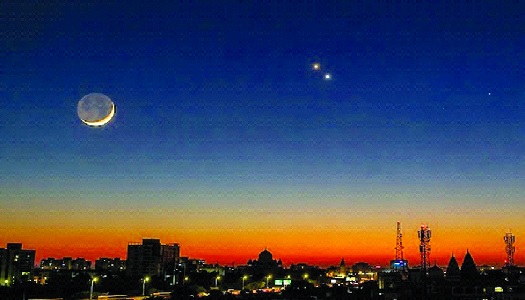

Skywatchers are in for a spectacular celestial treat this month as Venus and Jupiter, the two brightest planets visible from Earth, move into a rare and dazzling conjunction.
The planetary pairing, being described as a cosmic kiss, will see Venus and Jupiter appear just 1.6 degrees apart in the evening sky shortly after sunset.
Astronomers say this will be one of the most impressive sunset conjunctions in years, offering stargazers an easy-to-spot planetary display without the need for telescopes.
A conjunction occurs when two planets appear close together in the sky from Earth’s perspective.
Although Venus and Jupiter will seem almost side by side, they will remain separated by hundreds of millions of kilometres in space.
The effect is created because the planets orbit the Sun along a similar path known as the ecliptic, causing them to occasionally gather in the same region of the sky when viewed from Earth.
Observers should look toward the western horizon shortly after sunset to catch the event. Venus will be the brightest object in the scene and should be easy to identify, while Jupiter will shine nearby with a slightly softer glow.
The conjunction is being hailed as one of the standout astronomical events of June, with many astronomy enthusiasts comparing its visual appeal to some of the most memorable planetary alignments of recent decades.
The celestial pairing of Jupiter and Venus will peak on June 8 and 9.
The show will not end with Venus and Jupiter. From June 11 to June 15, Mercury will join the pair, creating a rare mini parade of planets low in the western sky.
However, Mercury will be much closer to the horizon and may be difficult to spot without an unobstructed western view. The alignment comes during a busy month for skywatchers. Alongside the conjunction, the Moon will make several close passes to bright planets, while the arrival of the Northern Hemisphere summer will bring longer evenings and more opportunities for observing deep-sky objects.
Astronomers recommend finding a location away from city lights and ensuring a clear view of the western horizon for the best experience. Binoculars can enhance the view, but the conjunction will be visible to the naked eye. For those willing to look up after sunset, June 8 and 9 promise a rare chance to witness the Solar System’s two brightest planets appearing to embrace in one of the year’s most beautiful sky shows.


Be the first to comment