

From the snowy streets of 1970s Queens to iconic NYC billboards, an actor, model and storyteller redefines South Asian visibility and dignity.
Current Position: New York-based Actor, Model, and Storyteller
Known For: First mature Sikh model to walk at New York Fashion Week
Major Recognition: Dialogue writer for the international film “Love in Vietnam”
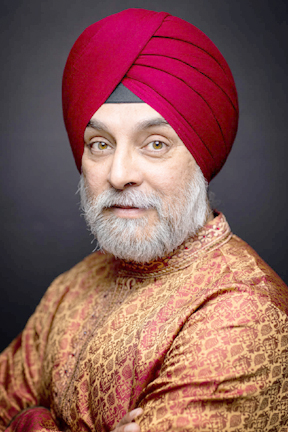
For many South Asian immigrants and first-generation Americans navigating New York in the late 20th century, the experience of belonging was rarely a straight path. It was an intricate dance between two worlds—the deeply rooted traditions of the home and the loud, fast-paced reality of the streets outside.
For Harbinder Singh, a New York-based actor, model, and creative storyteller, that journey did not begin under the flashing lights of a runway or on a bustling movie set. It began on a cold winter day in Queens in 1972.
Then just three years old, Singh was walking down the street with his father when a group of older kids threw a snowball. With a dull thud, it struck his father, knocking his turban to the ground. In the freezing air, the young boy waited for an explosion of anger, or at least a shout. It never came.
Instead, his father calmly reached down, picked up the sacred fabric, retied it with practiced composure, took his young son’s hand, and kept walking.
“In that silence,” Singh reflects, looking back over five decades later, “he taught me something many of us come to understand over time—the strength of dignity.”
That single, quiet moment became the blueprint for Singh’s life. It taught him how to carry an identity that the world did not always know how to read, eventually transforming a silhouette that once made him a target into a powerful symbol of representation on billboards across Manhattan.
Acutely Seen, but Rarely Understood
Growing up as a Sikh child in 1970s Queens meant carrying a highly visible identity in a pre-multicultural America. The turban, the beard, and his very name formed an immediate question mark in the minds of onlookers before Singh could ever speak a word. While his experiences weren’t always extreme, they were marked by a constant, quiet friction: the feeling of being acutely seen, but rarely understood.
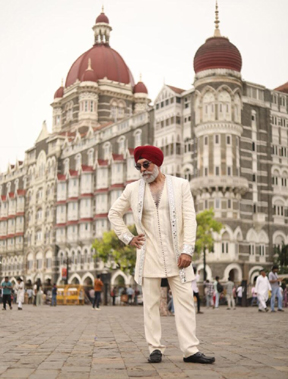
Like so many first-generation South Asians of his era, Singh lived in the “in-between.” The American media landscape of his youth offered no mirrors; there were no characters on television who looked like him, no heroes who wore a turban.
“For a long time, I wondered what I needed to change to be accepted,” Singh says. It is a question that resonates with generations of immigrants who have felt the subtle pressure to shrink their identity to fit into American rooms.
But as the years passed, Singh stopped asking for permission. Instead of editing himself for the comfort of others, he leaned entirely into the truth of who he was. The turban, which had once been a catalyst for childhood teasing and neighborhood misunderstanding, became his anchor. It evolved into a symbol of discipline, presence, and an unbreakable link to his roots.
Redefining the Runway
Decades after that fateful winter day in Queens, Singh found himself in a room that could not have been further from the snowy streets of his childhood: backstage at New York Fashion Week.
As he prepared to step out into the blinding lights of the runway, a profound realization washed over him. The very markers of his Sikh identity—the turban, the uncut beard, the silver-streaked maturity—had not changed. What had changed was the world’s readiness to see them, and his own relationship to them.
Stepping onto the runway as one of the fashion world’s first mature Sikh models, Singh shattered decades-old industry stereotypes. Soon, his striking visage wasn’t just confined to the runways; it was blown up on massive billboards across New York City’s most iconic locations, including Madison Square Garden.
For Singh, seeing his image looming large over the city he called home was not a victory of personal vanity. It was a full-circle tribute to the quiet dignity his father had displayed in Queens decades earlier. The silhouette that had once been misunderstood was now celebrated as art, culture, and high fashion.
From Visibility to Voice
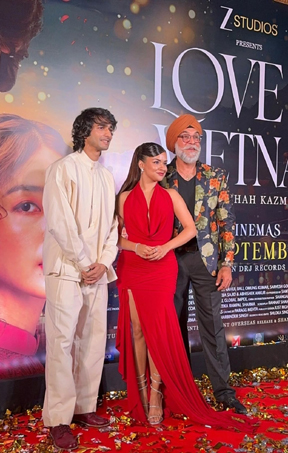
However, achieving visual representation was only the first step. For a storyteller, a hunger to be seen naturally matures into a hunger to be heard.
Singh recently expanded his creative footprint into global cinema, contributing as a dialogue writer for the major Bollywood film Love in Vietnam. Standing on the red carpet in Mumbai for the film’s star-studded launch, the weight of the moment was not lost on him. He had moved from the periphery of American culture to writing words that would be spoken on a global cinematic stage.
To bridge these worlds permanently, Singh has founded Kahani Road Productions. Through the banner, he develops narrative projects specifically designed to challenge lazy cultural stereotypes, dismantle biases, and celebrate the authentic depth of South Asian and Sikh heritage.
The Power of Being Enough
Today, Singh’s narrative is not a cliché story of “overcoming” an identity to achieve success in the West. Rather, it is a masterclass in stepping fully into it. What once felt like a painful cultural distance during his Queens upbringing has developed into creative depth; what once felt like a misunderstanding has sharpened into a unique perspective.
For the South Asian diaspora watching a new generation navigate questions of belonging in a complex cultural landscape, Singh’s journey offers a timeless piece of wisdom.
“Being different is not something to correct,” he emphasizes. “It is something to understand, to carry with pride, and to own fully.”
By ceasing the endless search for external validation, Harbinder Singh proved that the boy from Queens holding his father’s hand didn’t need to change to fit the world. The world just needed to catch up to him.
For more, HYPERLINK “http://www.harbindersinghofficial.com/”www.harbindersinghofficial.com; www.linktree.com/sikhicon


Be the first to comment