
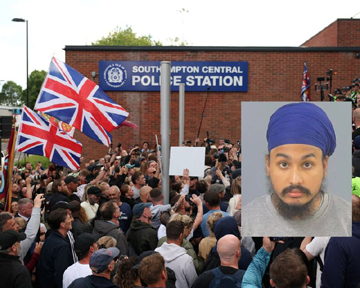

Police officers got distracted by allegations of racism while failing to recognize who had actually been attacked
Britain likes to think of itself as a practical country. This is, after all, the nation that gave the world parliamentary democracy, the civil service and a reputation—sometimes deserved, sometimes not—for administrative common sense.
Yet many Britons now wonder whether that common sense is being overwhelmed by something else: an increasing preoccupation with identity, offence and the fear of causing controversy. Questions involving race, religion, immigration and minority communities now shape public debate in ways that would have seemed unfamiliar a generation ago.
The question has been thrown into sharp relief by the tragic case of Henry Nowak, an 18-year-old student who died after being stabbed in Southampton. The circumstances of the case would soon draw police, media and public opinion into a fraught debate involving race, religion and identity.
For Indian readers, several aspects of the case are immediately recognizable. The attacker, Vickrum Digwa, was a Sikh. There were allegations of racist abuse. There were claims involving a turban. Questions of identity, religion and discrimination quickly became entangled with the facts of a violent crime.
Yet what has shocked Britain is not simply the killing itself. It is what happened afterwards.
Bodycam footage released after the trial appears to show a dying young man repeatedly insisting that he had been stabbed. One exchange has become emblematic of the entire controversy.
“I’ve been stabbed,” Nowak told arresting officers.
“I don’t think you have, mate,” the police replied.
The first statement was true.
The second was disastrously wrong.
At another point, Nowak can be heard saying: “I can’t breathe.”
The footage has generated outrage because many viewers reached a troubling conclusion. They believe police officers became distracted by allegations of racism while failing to recognize who had actually been attacked.
Whether that judgement is entirely fair will be debated for years. But the public reaction reveals something important.
Many Britons no longer trust their institutions to exercise ordinary judgement when questions of identity are involved.
For many critics, these anxieties first surfaced during debates over Islamist extremism, integration, community relations and accusations of Islamophobia. Similar controversies emerged during the grooming-gang scandals that later engulfed several English towns, including Rotherham, Rochdale and Telford.
Over many years, hundreds of vulnerable white girls were sexually exploited by organized groups of mostly Pakistani men. Subsequent inquiries found serious failures by police, local authorities and social services.
Critics argued that some officials were reluctant to confront aspects of the abuse for fear of inflaming community tensions or attracting accusations of racism or Islamophobia. Others dispute that interpretation and point to a range of institutional failures. The scandals left a lasting impression on public opinion and became a touchstone in wider debates about identity, community relations and official judgement.
The issue extends beyond race or religion. It reflects a broader anxiety that public authorities have become increasingly responsive to allegations of offence while appearing less effective in dealing with actual harm.
Yet a series of incidents has helped create precisely that perception.
Consider the case of Maxie Allen and Rosalind Levine in Hertfordshire.The couple became involved in a dispute with their daughter’s primary school. They exchanged emails and participated in WhatsApp discussions concerning school management and the appointment of a head teacher.
Six police officers arrived at their home. Levine was arrested in front of one of the couple’s children, who was three years old. No prosecution followed. Hertfordshire Police later admitted the arrests were unlawful and paid compensation. Even the county’s Police and Crime Commissioner acknowledged that the dispute “shouldn’t have become a police matter”.
Many Britons see a pattern.
A parent complains about a school. Police arrive. A social media argument escalates. Police become involved. An allegation of offence is made. Officials intervene.
Each case has its own facts. Each deserves to be considered individually. But together they have created a wider impression that the boundaries of policing are expanding into areas that previous generations would have regarded as matters for families, schools, employers or civil society. The controversy surrounding Graham Linehan, co-creator of the popular television comedy Father Ted, has reinforced that perception.
Linehan was arrested at Heathrow Airport in connection with social media posts concerning transgender issues. The image of five police officers demanding DNA details from a comedy writer because of online comments immediately provoked questions about priorities.
The case quickly became another national argument about free speech, policing priorities and the limits of acceptable opinion. The details differ dramatically—a murder investigation, a school dispute and social media posts—but together they point to the same underlying concern.
The public sees a contradiction. Police say they cannot investigate every burglary, theft or act of anti-social behavior because resources are stretched.
Yet they somehow find the manpower to record non-crime hate incidents, visit citizens over controversial tweets and intervene in disputes that previous generations would have settled without police involvement.
The complaint is not that British police are too active. It is that they often appear active in the wrong places. That perception may not always be fair. Police officers face difficult decisions. Genuine racism exists. Genuine discrimination exists. Genuine threats exist online.
No serious person believes such matters should simply be ignored.
The challenge lies elsewhere.
How does a society combat prejudice without becoming paralyzed by accusations of prejudice?
How does it protect vulnerable groups while retaining confidence in its own judgement?
How does it distinguish between hurt feelings and actual harm?
India, too, wrestles with issues of identity, religion, community and speech. Yet many Indians are struck by the spectacle of Britain appearing increasingly uncertain about how to balance competing claims of victimhood.
That is why the Henry Nowak case has resonated so deeply.
The public argument is not really about Sikhism. Nor is it ultimately about Islam, immigration, race or any other single identity question. Rather, it reflects a growing concern that identity itself is becoming the lens through which institutions interpret events before they have established the facts.
It is not even primarily about racism. It is about judgement.
A society can survive disagreement. It can survive controversy. It can survive offensive speech.
What it struggles to survive is the loss of confidence that its institutions can distinguish between a victim and an offender, between an argument and a crime, between a complaint and a genuine threat.
The first duty of a police officer is not to endorse a narrative. It is to establish the facts.
Many Britons watching the Nowak footage fear that this simple principle is becoming harder to uphold. If that fear continues to spread, the damage will extend far beyond a single tragic case. It will reach the very foundation on which public trust depends.
(Shyam Bhatia is London based senior journalist. His X handle is @ShyamBh83243946)


Be the first to comment