
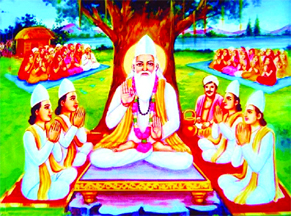

Sant Kabir Das occupies a unique and revered place in the spiritual history of India. A mystic poet, social reformer and saint of the Bhakti movement, Kabir transcended religious boundaries and preached the message of universal brotherhood, devotion and inner realization. Every year, Sant Guru Kabir Das Jayanti is celebrated with great devotion on the full moon day (Purnima) of the Hindu month of Jyeshtha, commemorating the birth anniversary of one of India’s greatest spiritual luminaries.
Kabir Das Jayanti will be celebrated on Monday, June 29, this year.
Kabir’s teachings, expressed through simple yet profound couplets known as dohas, continue to inspire millions across the world. His message of love, compassion, equality and direct communion with the Divine remains as relevant today as it was over five centuries ago.
The Life of Sant Kabir Das
The exact details of Kabir’s birth remain shrouded in legend and spiritual lore. According to popular tradition, Kabir was born in the fifteenth century, around 1398 CE, in or near Varanasi, one of India’s holiest cities. It is widely believed that he was raised by a humble Muslim weaver couple, Niru and Nima, who belonged to the Julaha community.
Kabir spent much of his life as a weaver, earning his livelihood through honest labour. Despite his modest social background, he emerged as one of the most influential saints of medieval India.
Many traditions hold that Kabir became a disciple of the renowned Bhakti saint Ramananda. Legend narrates that Kabir, eager to receive spiritual initiation from Ramananda, lay on the steps leading to the Ganges where the saint used to bathe. When Ramananda accidentally stepped on him in the darkness and uttered “Ram, Ram,” Kabir accepted these sacred words as his mantra and considered Ramananda his guru.
Throughout his life, Kabir travelled extensively, spreading his spiritual message among people from all walks of life. He challenged social inequalities, religious orthodoxy and empty rituals, advocating instead a direct, personal experience of God.
It is believed that Kabir attained Mahasamadhi at Maghar. According to tradition, after his passing, Hindus and Muslims disputed over his last rites. When the cloth covering his body was removed, only flowers were found, symbolizing the saint’s transcendence of religious divisions. Both communities then performed their respective rites, underscoring Kabir’s lifelong message of unity.
Kabir’s Spiritual Philosophy
At the heart of Kabir’s philosophy lies the belief in the oneness of God. He rejected sectarian divisions and emphasized that the Divine is beyond names, forms and religious labels.
For Kabir, God was neither exclusively Hindu nor Muslim. He proclaimed that the same Supreme Reality is worshipped under different names.
One of his famous sayings declares:
“Kankar pathar jor ke, masjid layi chunaye,
Ta chad mulla bang de, kya bahra hua Khudaye?”
Through such verses, Kabir questioned external religious practices and urged seekers to discover God within their own hearts.
The Concept of Nirguna Bhakti
Kabir is regarded as a leading exponent of Nirguna Bhakti-devotion to a formless, attributeless God. Unlike traditions centred on idol worship, Kabir emphasized inward spirituality and direct mystical experience.
He taught that God resides within every living being and can be realized through sincere devotion, self-purification and constant remembrance of the Divine Name.
His celebrated verse states:
“Moko kahan dhoonde re bande, main to tere paas mein.”
(“Where do you seek Me, O seeker? I am close to you.”)
This simple yet profound teaching reminds humanity that spiritual realization lies within, not merely in external places of worship.
Kabir’s Teachings
1. Unity of Humanity
Kabir strongly opposed caste discrimination and social hierarchy. He believed that all human beings are equal in the eyes of God.
He famously said:
“Jaat na pucho sadhu ki, pooch lijiye gyaan.”
(“Ask not the caste of a saint; ask about his wisdom.”)
Kabir envisioned a society free from prejudice, discrimination and social divisions.
2. Rejection of Empty Rituals
Kabir criticized blind adherence to rituals, ceremonies and dogma. He observed that true spirituality cannot be attained through outward practices alone.
He urged people to cultivate purity of heart, compassion and self-realization rather than merely performing religious formalities.
3. Importance of the Guru
Kabir accorded immense importance to the spiritual guru, considering the Guru as the guide who illuminates the path to Divine realization.
His famous doha states:
“Guru Govind dou khade, kake lagu paay,
Balihari Guru aapne, Govind diyo bataye.”
(“When both Guru and God stand before me, whose feet should I touch first? I bow to the Guru, who showed me the path to God.”)
4. Honest Living and Simplicity
Kabir advocated a life of simplicity, humility and honest labour. As a weaver himself, he demonstrated that spiritual growth does not require renunciation of worldly duties.
He taught that one can realize God while fulfilling responsibilities with sincerity and detachment.
5. Love as the Supreme Path
Love formed the essence of Kabir’s spiritual message. He believed that Divine love transcends all barriers and leads the soul to liberation.
According to Kabir, the path of love demands surrender of ego, selfishness and pride.
Relevance of Kabir’s Teachings Today
In a world increasingly marked by divisions, intolerance and materialism, Kabir’s message remains profoundly relevant. His teachings encourage humanity to rise above religious and social barriers, embrace compassion and seek inner transformation.
Kabir reminds us that true religion is not found in external symbols but in kindness, truthfulness and selfless love. His timeless wisdom continues to inspire spiritual seekers, scholars and ordinary people alike.
As devotees celebrate Sant Guru Kabir Das Jayanti, they not only honour the birth of a saint but also reaffirm the eternal values of harmony, equality and universal love that Kabir championed throughout his life. His voice, resonating through centuries, continues to guide humanity towards a more compassionate and spiritually awakened world.


Be the first to comment